Gemstone Inclusions Bibliography

Gemstone Inclusions Bibliography

Explore books, articles and historical sources on inclusions in gemstones in Four Treasures, the Lotus Gemology reference database. This bibliography brings together matching records from the collection, with publication details, abstracts and cover images where available.

Gemstone Inclusion References

The list below matches the terms inclusion or inclusions in the database's searchable fields. Some references discuss inclusions as part of a broader subject.
381–400 of 1,247 matching references

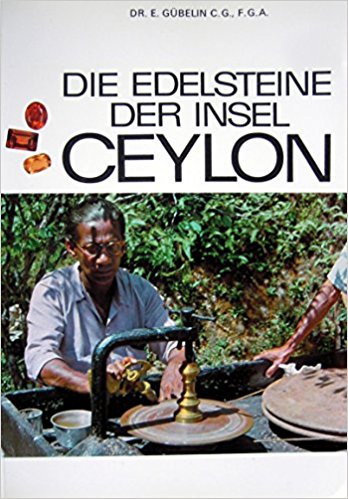
Die Edelsteine der Insel Ceylon

The gemstones of the island of Ceylon
Book
Gübelin, E.J. (1968) Die Edelsteine der Insel Ceylon. [The gemstones of the island of Ceylon] Lucerne, privately published, 152 pp.
Record No. 2094  |  Sinkankas/Born No.: 2575  |  Language: in German  |  RWHL*
Sinkankas: Aside from Iyer & Thiagarajan’s Indian Precious Stones (1961), which see, almost all information on the gemstones and gem industry of Ceylon had appeared in short articles scattered throughout a large variety of journals, both technical and nontechnical. Thus the present authoritative work clearly supersedes all previously published information and is based on the author’s numerous visits to the island. It is filled with splendid photographs, both scenic and pertaining to the industry. The text gives a sketch of the island’s geology as well as details of the alluvial deposits that furnish practically all of the gem material. Historical notes support the thesis that these gem deposits supplied gemstones to much of Asia, Egypt, and Europe from time immemorial. The section treating mining is exceptionally detailed and beautifully illustrated, discussing all the factors that must be taken into consideration before the commencement of mining operations and the traditional rules by which such activity is governed. Equally thorough are descriptions of the unique lapidary work and of the progress of the rough stone from mine to finished gem and ultimate sale. Descriptions of individual gemstones cover qualities, relative rarity, specific sources, properties, and diagnostic inclusions. Properties and absorption-spectra data are summarized in tabular form in the last part of the work. There is also a less detailed section on organic gem materials which furnishes an up-to-date account of the pearl fishery and contains remarks on coral and tortoiseshell. This work apparently was published at the author’s expense, although it is understood that copies were also made available through Rühle-Diebener Verlag, Stuttgart, at DM 38. Reviews: Der Aufschluss, 21(12), 1970, p. 384 (price given as DM 25.74); Journal of Gemmology, 11(6), 1969, p. 220 (price given as 70s); National Geographic, 64(1), 1969, pp. 74–75.

Gem corundum pegmatites in N.E. Tanganyika
Journal Article
Solesbury, F.W. (1967) Gem corundum pegmatites in N.E. Tanganyika. Economic Geology, Vol. 62, pp. 983–991.
Record No. 1623  |  Sinkankas/Born No.: NIS/NIB  |  RWHL*
New additional data on petrography and mineralogy of jadeite and associated rocks from the Polar Urals and Prebalkhash region are given. Some questions of the jadeite rock genesis in hyperbasites are also considered. In the Pay-Yer massif, Polar Urals, the jadeite rocks are associated with a gabbro–pyroxenite complex, garnet-bearing gabbro–amphibolite, metamorphic schists, and glaucophane rocks. Jadeitite and albitite form a chain of lens-shaped bodies in hyperbasites and represent metasomatic metagabbro rocks, altered under conditions of high pressure and high soda potential. Secondary processes of diaphthoresis are strongly revealed. In the Kantegir hyperbasite massif, northern Prebalkhash region, jadeitites form drop-like bodies together with numerous inclusions of unaltered granitoids and other metasomatic rocks. Jadeitite and hornblende are the earliest (high-temperature) metasomatic rocks. Chemical, optical, and X-ray data of jadeitite and accessory and other minerals of jadeite rocks are given. The authors conclude that jadeite rocks of the Polar Urals formed at a temperature close to 700 °C and at a general pressure not less than 14,000 bars; the Prebalkhash jadeite, at a temperature close to 600 °C and pressure not less than 12,000 bars. High pressure is caused by stress produced in deep fault zones. The Na₂O potential and partial pressure of H₂O are of great importance, a question discussed in the light of the most recent data. The prevailing type of formation process (mechanism) of jadeite rocks in hyperbasites is bimetasomatosis, which is not always accompanied by desilication. Composition and genesis of original rocks is not of decisive significance. Appropriate model and genetic features of the mentioned deposits are considered in this paper.

Gemmology on a shoestring

Journal Article
Anderson, B.W. (1966) Gemmology on a shoestring. Journal of Gemmology, Vol. 10, No. 3, July, pp. 69–83.
Record No. 4143  |  ISBN/ISSN: 221252  |  Sinkankas/Born No.: NIS/NIB  |  RWHL*
Anderson examines how trained gemmologists can identify many gemstones through informed observation with a good pocket lens and a small selection of inexpensive accessories, while recognizing that difficult problems require comprehensive laboratory testing. His purpose is to develop the interpretation of visible evidence rather than provide mechanical recipes or encourage excessive confidence in limited equipment. An eight- or ten-power lens, suitable illumination, clean specimens, and careful handling form the foundation of the approach. Initial impressions of colour, lustre, transparency, dispersion, weight, and thermal sensation are followed by systematic examination of facet edges, surface markings, cleavage, inclusions, and colour distribution. Anderson emphasizes the diagnostic value of double refraction, observable as doubled facet junctions, and explains why specimens must be examined in several directions before its presence or absence can be assessed. Surface polish and wear provide indirect evidence of hardness, although neither should be interpreted alone. Characteristic internal features include horsetail inclusions in demantoid, silk in ruby, tiger-stripe inclusions in amethyst, copper crystals in aventurine glass, and bubbles or junction planes in imitation and composite stones. Curved colour bands in synthetic sapphire and angular zoning in natural sapphire illustrate the importance of growth structures. Simple supplementary equipment substantially extends these observations. The Chelsea filter can help distinguish certain similarly coloured materials, but its response depends on selective transmission and fluorescence and must be interpreted with knowledge of exceptions, including natural emeralds that remain green and synthetic emeralds that appear strongly red. Inexpensive polarizing film permits the construction of polariscopes and dichroscopes, enabling examination of double refraction, strain patterns, interference figures, and pleochroism. Anderson also describes immersion liquids as versatile aids for revealing internal structures, comparing densities, and estimating refractive indices. Immersion reduces distracting surface reflections and refraction, exposing colour zoning, flaws, and synthetic overgrowths. Heavy-liquid tests distinguish materials with similar appearances but different densities, while the visibility of immersed facet boundaries and the character of projected light and dark rims indicate refractive-index relationships between stones and liquids. Contact photography can record these effects and sometimes reveal curved growth structures that are difficult to observe directly. Examples include distinguishing diamond from lower-index substitutes, separating quartz from topaz or chrysoberyl, and examining natural, synthetic, and overgrown emeralds. Anderson concludes by recommending a reference collection, including inexpensive imitations, synthetics, and damaged specimens, together with reliable reference books. The central argument is that scientific training makes simple observations more informative, but economy in equipment must remain subordinate to accurate identification and an understanding of the limits of each test.

The origin of negative crystals in gemstones
Journal Article
Eppler, W.F. (1966) The origin of negative crystals in gemstones. Journal of Gemmology, Vol. 10, No. 2, April, pp. 49–56.
Record No. 3751  |  ISBN/ISSN: 221252  |  Sinkankas/Born No.: NIS/NIB  |  RWHL*
Eppler examines the formation of negative crystals in gemstones, distinguishing cavities produced during fracture healing from those originating during growth of the host crystal. Building on Roedder’s explanation of secondary fluid inclusions, he describes how dissolution and redeposition along fracture surfaces can progressively isolate small volumes of fluid, which subsequently acquire rounded or crystallographically controlled outlines. An experiment on fractured synthetic ruby illustrates this transformation. The specimen was first boiled in water to replace air within the fissure as completely as possible, although irregularities in the fracture walls retained films and channels of air. Heating for seven days at 1950°C substantially reorganized the inclusion pattern, producing a pronounced network of channels separated by transparent patches that Eppler interpreted as residual water films. Continued heating for two months at 1800°C reduced and subdivided the channels as the fracture progressively healed. Their isolated portions developed crystal faces and preferred orientations governed by the ruby lattice, with their longest dimensions aligned along the c-axis. Successive photomicrographs document the transition from irregular connected cavities to discrete negative crystals. Natural blue spinel from Ceylon provides a comparative example: a healed fracture contains numerous dark, approximately rectangular inclusions that could be mistaken for minute magnetite crystals. Higher magnification reveals cavities partly occupied by opaque material and partly by transparent, doubly refractive crystals. Eppler interprets these contents as substances excluded from the material redeposited during healing. He contrasts such secondary inclusions with primary negative crystals attributed to defects or disturbances at advancing growth surfaces. Examples in Burmese ruby and Madagascan beryl show irregular outlines or fine striations interpreted as records of incremental growth. As a practical distinction, he characterizes secondary negative crystals as generally small, numerous, and arranged along a former fracture plane, whereas primary examples tend to occur singly and are commonly larger. Hawaiian peridot introduces a further complication: inclusions that appear to be rounded gas bubbles in transmitted light reveal crystal faces under reflected illumination and are therefore identified as negative crystals. Their origin is considered primary, although the mechanism remains uncertain. Eppler speculates that a temperature increase during growth might have caused partial evaporation of the host material, while also drawing an analogy with faceted gas cavities in synthetic spinel. He reports finding no similarly shaped glassy droplets in the specimens examined. The study emphasizes the value of inclusion distribution, cavity morphology, crystallographic orientation, magnification, and illumination in distinguishing formation histories and avoiding confusion between negative crystals, solid inclusions, and apparently spherical bubbles.

Studies on inclusions in some Indian gemstones
Journal Article
Phukan, S. (1966) Studies on inclusions in some Indian gemstones. Journal of Gemmology, Vol. 10, No. 1, January, pp. 1–7.
Record No. 1422  |  ISBN/ISSN: 221252  |  Sinkankas/Born No.: NIS/NIB  |  RWHL*
Different types of inclusions in sapphires from Kashmir and aquamarines from Chitral, Monghyr and Coimbatore have been described. The Kashmir sapphires are often zoned, cornflower blue in colour with a milky or a hazy appearance. Inclusions in Indian sapphires in general, are similar to those from Ceylon, particularly in respect of rutile needles, liquid feathers and colour zoning; they even contain zircon haloes, considered typical of Ceylon sapphires. However, they differ from Ceylon stones in containing euhedral crystals of zircon without haloes, which are said to occur in Burma stones. These are reported for the first time in Kashmir sapphires. Liquid feathers and brown liquid films seem to characterize Indian sapphires. Colourless-tube like inclusions in Chitral and Monghyr aquamarines resemble those from Rhodesia. The brown colour of the tubes in Coimbatore aquamarines is due to iron stains and not due to brown liquid as reported from other localities. The two-phase inclusions, of liquid and gas, and the liquid feathers running at right angles to each other, appear peculiar to Chitral and Monghyr aquamarines only.

Jade and jade carvings in the Ch'ing dynasty
Journal Article
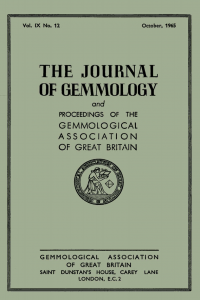
Hansford, S.H. (1965) Jade and jade carvings in the Ch'ing dynasty. Transactions of the Oriental Ceramic Society, Vol. 35 • 1963–64, pp. 29–40.
Record No. 6599  |  Sinkankas/Born No.: NIS/NIB  |  RWHL*
Hansford explains the expansion of jade carving during the Ch’ing dynasty through the interaction of imperial patronage, growing private wealth, military conquest, and increased access to raw material, emphasizing the exceptional conditions of the eighteenth century. He traces China’s traditional nephrite supply to the Khotan and Yarkand region and shows how political instability and difficult transport had restricted its availability. The Ch’ien-lung conquest of Eastern Turkestan brought the jade-producing districts under military administration, secured communications, and enabled organized collection and tribute deliveries. Drawing on Chinese geographical accounts, Hansford describes supervised recovery of river boulders, extraction from mountain deposits, seasonal collecting camps, and the selection and preparation of material for shipment to Peking. Large requisitions for musical stones, writing tablets, and seals illustrate both the scale of imperial demand and the importance of sound, sufficiently large blocks. Boulder nephrite was preferred to quarried material because the latter could reveal damaging fractures during carving. These improved supplies help explain the unprecedented size and quality of eighteenth-century works, while nineteenth-century rebellions disrupted the trade and encouraged alternative sources. Hansford separately examines Burmese fei cui, rejecting as unsubstantiated the story of its introduction to China in the thirteenth century and arguing for recognition only in the second quarter of the eighteenth century. He contrasts its commercially organized, speculative trade with the tribute arrangements governing Yarkand nephrite, following extraction from valley deposits and later mines through Mogaung and onward by river and sea to Chinese markets. The beginnings of Siberian nephrite imports remain less certain. Hansford tentatively places significant trade after the mid-nineteenth century, using travellers’ accounts and the disruption of Central Asian supplies as evidence, while questioning whether black inclusions reliably establish Siberian origin. Specimens examined at his request contained chromite rather than the graphite commonly supposed. The article also considers the wider range of stones employed by Ch’ing carvers, including locally available and imported materials. Technical advances are judged less fundamental than the increased scale of production: ancient carvers had already mastered openwork, undercutting, and linked elements, but heavy Ch’ing pieces required counterbalanced suspension at the workbench. Corundum remained the principal abrasive during the dynasty. Hansford corrects an interpretation of palace workshop records, distinguishing filigree jewellery incorporating gems from a dedicated jade-carving workshop, and notes the scarcity of securely dated late Ming carvings for comparison. Harry Garner’s supplementary exhibition note broadens the discussion to carving across mineral, animal, and vegetable materials, emphasizing shared design principles, adaptation to natural colour and structure, archaistic vessel forms, and the artistic merit of works outside jade.

Apatite crystals in a Ceylon spinel

Journal Article
Zwaan, P.C. (1965) Apatite crystals in a Ceylon spinel. Journal of Gemmology, Vol. 9, No. 12, p. 434.
Record No. 4140  |  ISBN/ISSN: 221252  |  Sinkankas/Born No.: NIS/NIB  |  RWHL*
Zwaan investigates prismatic crystal inclusions in a violet-blue spinel collected from a gem pit at Pelmadulla in the Ratnapura district of Ceylon during the winter of 1958–1959, establishing their identity as chlorine-bearing hydroxylapatite through optical examination and X-ray diffraction. After cutting, the host became a 3.20-carat oval faceted stone with a refractive index of 1.717, specific gravity of 3.599, isotropic optical behaviour, and an absorption spectrum characteristic of natural blue spinel. An initial suggestion that the inclusions were zircon was rejected because their refractive index was lower than that of the host. Subsequent consideration narrowed the possibilities to beryl or apatite. The inclusions exhibit six-sided prismatic forms terminated by pyramid faces, parallel extinction, a negative optic sign, and distinct dichroism in yellow and blue, with stronger absorption in the extraordinary ray. Measurements relating crystal thickness to interference colour indicate birefringence below 0.005; apparently high interference colours in some crystals reflect their thickness rather than strong double refraction. These observations favour apatite but do not provide a definitive identification. An X-ray rotation photograph closely resembles that of a reference apatite crystal from St. Gotthard, Switzerland. Further confirmation comes from powder diffraction using a minute sample scraped from an inclusion exposed at the polished surface. A rubber-sphere preparation method permits grinding and mounting without appreciable loss of the limited material, while the stone loses only 0.0002 grams. The resulting diffraction pattern agrees closely with hydroxylapatite. More detailed comparison of selected reflections with those of a chemically intermediate apatite from Matale indicates that the inclusions are chlorine-bearing hydroxylapatite. Zwaan relates this association to crystalline limestones in Ceylon containing both apatite and spinel, citing observations at Matale and near Hakgala, where forsterite also occurs. The inclusion surfaces appear partly dissolved, and dendritic markings support an interpretation of partial solution before enclosure by the growing spinel. Some apatite crystals themselves contain elongated two-phase inclusions and distinct negative crystals. The study demonstrates the limitations of identifying inclusions from appearance alone and shows how optical evidence, small-sample diffraction, and geological associations can combine to resolve an initially uncertain mineral identification.

The ruby mines in Mogok in Burma

Journal Article
Gübelin, E.J. (1965) The ruby mines in Mogok in Burma. Journal of Gemmology, Vol. 9, No. 12, October, pp. 411–425.
Record No. 2086  |  ISBN/ISSN: 221252  |  Sinkankas/Born No.: 2573  |  RWHL*
Describes the Mogok gem-mining district of Burma, focusing on the occurrence and recovery of ruby and sapphire. Introduces the region’s setting and documents the mining activities associated with its celebrated corundum deposits.

Properties and growth of flux ruby

Journal Article
Linares, R.C. (1965) Properties and growth of flux ruby. Journal of the Physics and Chemistry of Solids, Vol. 26, No. 12, pp. 1817–1820.
Record No. 1191  |  Sinkankas/Born No.: NIS/NIB  |  RWHL*
The growth of ruby from molten fluxes has been studied with emphasis on the resulting spectral and optical properties. Growth was accomplished by the usual process of self nucleation as well as by deliberate seeding. The formation of a plate and rhombohedral form of ruby was studied and found to depend on local thermal conditions. The spectral properties of the grown rubies have been correlated with the incorporation of fluorine and noble metal ions into the ruby. Dislocation measurements show large dislocation free areas in slowly grown rubies. The types of inclusions have been studied and are found to be primarily flux and in special cases precipitated noble metal.

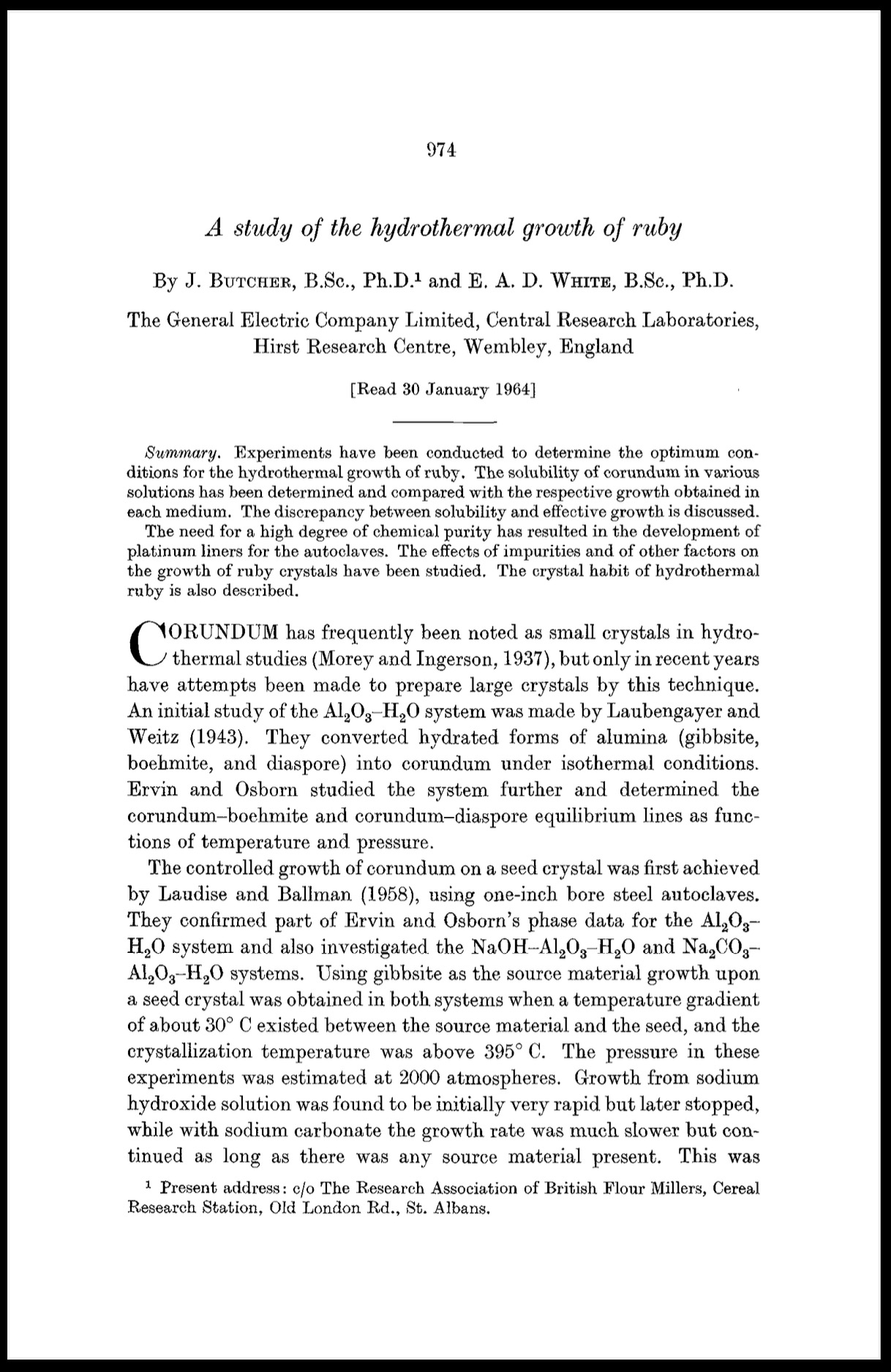
A study of the hydrothermal growth of ruby
Journal Article
Butcher, J. and White, E.A.D. (1964) A study of the hydrothermal growth of ruby. Mineralogical Magazine, Vol. 33, No. 226, pp. 96–98.
Record No. 4730  |  Sinkankas/Born No.: NIS/NIB  |  RWHL*
Butcher and White investigate the conditions governing hydrothermal growth of ruby, examining the relationships among corundum solubility, solvent composition, chromium incorporation, contamination, seed orientation, growth rate, and crystal quality. Preliminary experiments establish that corundum dissolves in several alkaline solutions, but appreciable solubility does not necessarily produce growth on seed crystals. Under the conditions investigated, effective growth occurs principally in potassium, rubidium, and caesium carbonate solutions, with limited growth subsequently obtained in sodium carbonate when platinum-lined equipment is used. The authors attribute the discrepancy between dissolution and crystallization to differences in solution chemistry and the temperature dependence of solubility, proposing that some solvents form dissolved compounds from which corundum does not readily recrystallize. Experiments employ stainless-steel autoclaves with a temperature gradient between the nutrient and seed regions. Severe iron contamination from unlined vessels produces green, inclusion-rich crystals and obscures evidence of chromium incorporation, leading to the development of platinum liners and seals. Lining also improves the growth rate of undoped corundum, suggesting that iron inhibits crystallization. Among the chromium sources tested, potassium dichromate provides reproducible doping, although increasing its concentration markedly suppresses growth. The authors suggest adsorption of chromate ions on corundum surfaces as a possible explanation. Solvent concentration emerges as the most important adjustable growth factor: insufficient carbonate gives slow deposition, whereas excessive concentrations promote spontaneous nucleation and poor-quality material. Rubidium carbonate generally yields better crystals than potassium carbonate for comparable amounts of growth. The best results within the apparatus limits are obtained with an autoclave base temperature of 650°C, a top temperature of approximately 475°C, an estimated pressure of 750 atmospheres, and a charge containing 4.5 grams of rubidium carbonate, 1 gram of potassium dichromate, and 30 cubic centimetres of water. This produces deep pink ruby containing approximately 0.1 per cent chromium. Growth strongly favours directions parallel to the basal plane, with comparatively little extension along the crystallographic c-axis. Rapid deposition commonly forms parallel stacks of crystallites rather than homogeneous single crystals; slower growth and the eventual development of bounding prism faces improve quality. Seed quality also appears influential, with some satisfactory growth obtained on crystals prepared by the flux method. Experiments using a spherical seed establish the characteristic hydrothermal crystal habit. Compared with flame-fusion ruby, the resulting crystals show a more uniform chromium distribution, but even the best specimens retain numerous small inclusions, presumed to contain water. The study demonstrates the feasibility of controlled hydrothermal ruby growth while identifying contamination, growth kinetics, and apparatus limitations as obstacles to producing consistently high-quality single crystals.

Mineralogy for Amateurs

Book
Sinkankas, J. (1964) Mineralogy for Amateurs. New York, Van Nostrand Reinhold, 585 pp.
Record No. 1604  |  Sinkankas/Born No.: NIS/NIB  |  RWHL*
A comprehensive and extensively illustrated introduction to mineralogy intended for amateur mineral collectors, students, and others interested in the earth sciences. John Sinkankas combines fundamental scientific principles with practical methods of mineral identification, emphasizing the relationships between atomic structure, crystal growth, physical properties, geological occurrence, and the external appearance of minerals. The opening chapters trace the historical development of mineralogy and explain atomic bonding, crystal chemistry, mineral classification, solid solution, polymorphism, and the structural organization of silicates. Detailed discussions of crystal growth examine crystallization from melts, solutions, and vapors; variations in crystal habit; twinning; growth imperfections; inclusions; pseudomorphism; and the formation of mineral aggregates. Crystallography is introduced through explanations of crystal systems, symmetry, axial ratios, Miller indices, and crystal forms, supported by numerous original diagrams. Subsequent chapters cover diagnostic physical properties, including hardness, cleavage, fracture, specific gravity, optical behavior, fluorescence, refractive index, double refraction, pleochroism, and other characteristics useful in identification. The geological section examines mineral formation and associations in igneous, sedimentary, and metamorphic environments. The descriptive mineralogy portion systematically treats approximately 280 mineral species, arranged by chemical class, with particular attention to readily recognizable characteristics, physical properties, and mineral associations. Gemologically important minerals include diamond, corundum, beryl, spinel, garnet, tourmaline, topaz, zircon, quartz, jadeite, and nephrite. Practical identification procedures, comparative tables, recommendations for assembling mineral collections, and selected references supplement the text. Illustrated with photographs and hundreds of drawings and diagrams prepared by the author, the volume emphasizes observation, inexpensive testing methods, and the importance of understanding mineral structures and formation processes rather than relying solely upon memorized descriptions.

Polysynthetic twinning in synthetic corundum
Journal Article
Eppler, W.F. (1964) Polysynthetic twinning in synthetic corundum. Gems & Gemology, Vol. 11, No. 6, Summer, pp. 169–175.
Record No. 717  |  ISBN/ISSN: 0016626X  |  Sinkankas/Born No.: NIS/NIB  |  RWHL*
Polysynthetic twinning in synthetic corundum is examined through microscopic observations demonstrating that straight twin lamellae cannot be regarded as exclusive evidence of natural origin. Such twinning consists of repeated thin lamellae in twin orientation to the host crystal and commonly produces straight striations in natural ruby and sapphire. Under crossed polarizers, the lamellae appear bright when the surrounding crystal is in extinction. The article distinguishes two forms occurring occasionally in synthetic material. The first, known as Sandmeier–Plato striation, produces a lozenge-shaped pattern through the intersection of two sets of straight lamellae at angles of 60° and 120°. Visible under crossed polarizers when viewed along the c-axis, these lamellae are described as parallel to the prism zone and approximately 70 micrometres thick. The second form corresponds to the polysynthetic twinning familiar in natural corundum and is documented in two synthetic specimens. A 5.05-carat blue sapphire of irregular Ceylon cut contains curved growth lines and spherical gas bubbles establishing its synthetic character, together with several parallel twin lamellae at two locations. Approximately 90 micrometres thick, these lamellae lack the intersecting arrangement of Sandmeier–Plato striation and resemble those of natural stones. Comparable structures occur in a small brown synthetic corundum boule, where parallel lamellae extend inward from the rim, tapering into wedges. Their orientation is parallel to a face of the primitive rhombohedron, and their thickness is approximately 15 micrometres. Despite their thinness, they can be detected with a magnifying glass. Under strongly inclined illumination and a reflecting orientation, some exhibit an unusual forked appearance, with their lateral portions extending farther inward than their centres. Photomicrographs illustrate the natural and synthetic structures, their responses to polarized light, and the associated diagnostic inclusions. Earlier observations are reviewed to show that twinning in synthetic sapphire had already been reported, although its occurrence remained insufficiently recognized. A slow growth rate is suggested as a possible cause, but this proposal does not explain why the two differently oriented forms develop. The findings establish an exception to a formerly useful identification rule: straight polysynthetic twin lamellae may occur in synthetic corundum, so their interpretation requires examination of orientation, optical behaviour, growth structures, and inclusions.

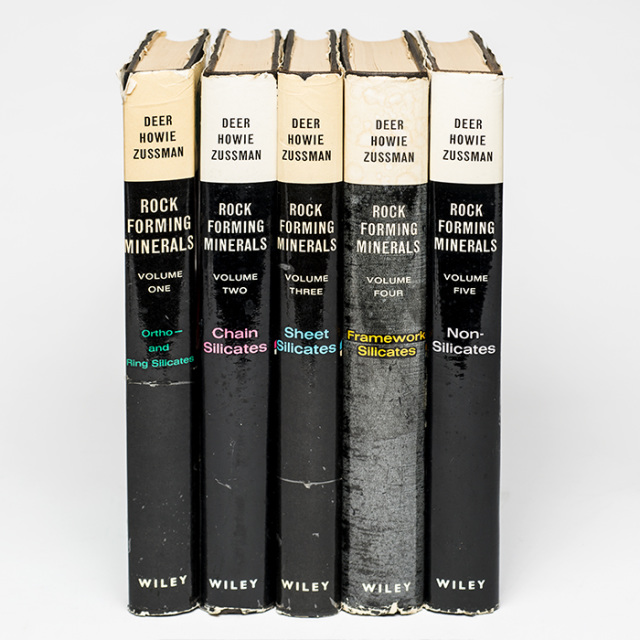
Rock-forming Minerals

Book
Deer, W.A., Howie, R.A. and Zussman, J. (1963–) Rock-forming Minerals. London, Longmans, 5 Vols., Vol. 1, Ortho- and Ring Silicates; Vol. 2, Chain Silicates; Vol. 2B, Double-Chain Silicates; Vol. 3, Sheet Silicates; Vol. 4, Framework Silicates; Vol. 5, Non-Silicates
Record No. 5119  |  Sinkankas/Born No.: NIS/NIB  |  RWHL*
A monumental multivolume reference work on the mineralogy, crystallography, chemistry, physical properties, optical characteristics, occurrence, and geological significance of the principal rock-forming minerals. Written by W. A. Deer, R. A. Howie, and J. Zussman, the series systematically examines mineral groups according to their crystal structures and chemical compositions, providing detailed descriptions of individual species, compositional variations, solid-solution relationships, phase equilibria, and geological associations. Volume 1 covers orthosilicates and ring silicates, including olivine, garnet, zircon, topaz, beryl, and tourmaline. Volume 2 treats chain silicates, particularly the pyroxenes, including enstatite, diopside, jadeite, aegirine, and related minerals. Volume 2B addresses double-chain silicates, principally the amphiboles, including tremolite, actinolite, hornblende, and other members of this structurally complex group. Volume 3 examines sheet silicates, including micas, chlorites, serpentine minerals, talc, and clay minerals. Volume 4 covers framework silicates, particularly feldspars, feldspathoids, and silica minerals, while Volume 5 discusses non-silicate minerals, including oxides, hydroxides, carbonates, sulfates, phosphates, and other groups. Each mineral description incorporates crystallographic data, chemical analyses, optical properties, X-ray diffraction information, structural relationships, stability fields, and geological occurrences, supported by extensive references to the scientific literature. Of particular gemological importance are the treatments of jadeite, omphacite, and related pyroxenes; nephrite-forming amphiboles; garnet, beryl, tourmaline, zircon, topaz, and other gem minerals; and the mineralogical distinctions between closely related species and compositional varieties. The discussions of crystal chemistry and solid solutions are especially valuable for understanding variations in gemstone composition, color, physical properties, and geological origin. The work also provides an essential foundation for interpreting mineral inclusions in gemstones and understanding the geological environments in which gem deposits form. Widely regarded as one of the most authoritative mineralogical reference series of the twentieth century, Rock-forming Minerals remains an indispensable resource for mineralogists, petrologists, geologists, and gemologists.

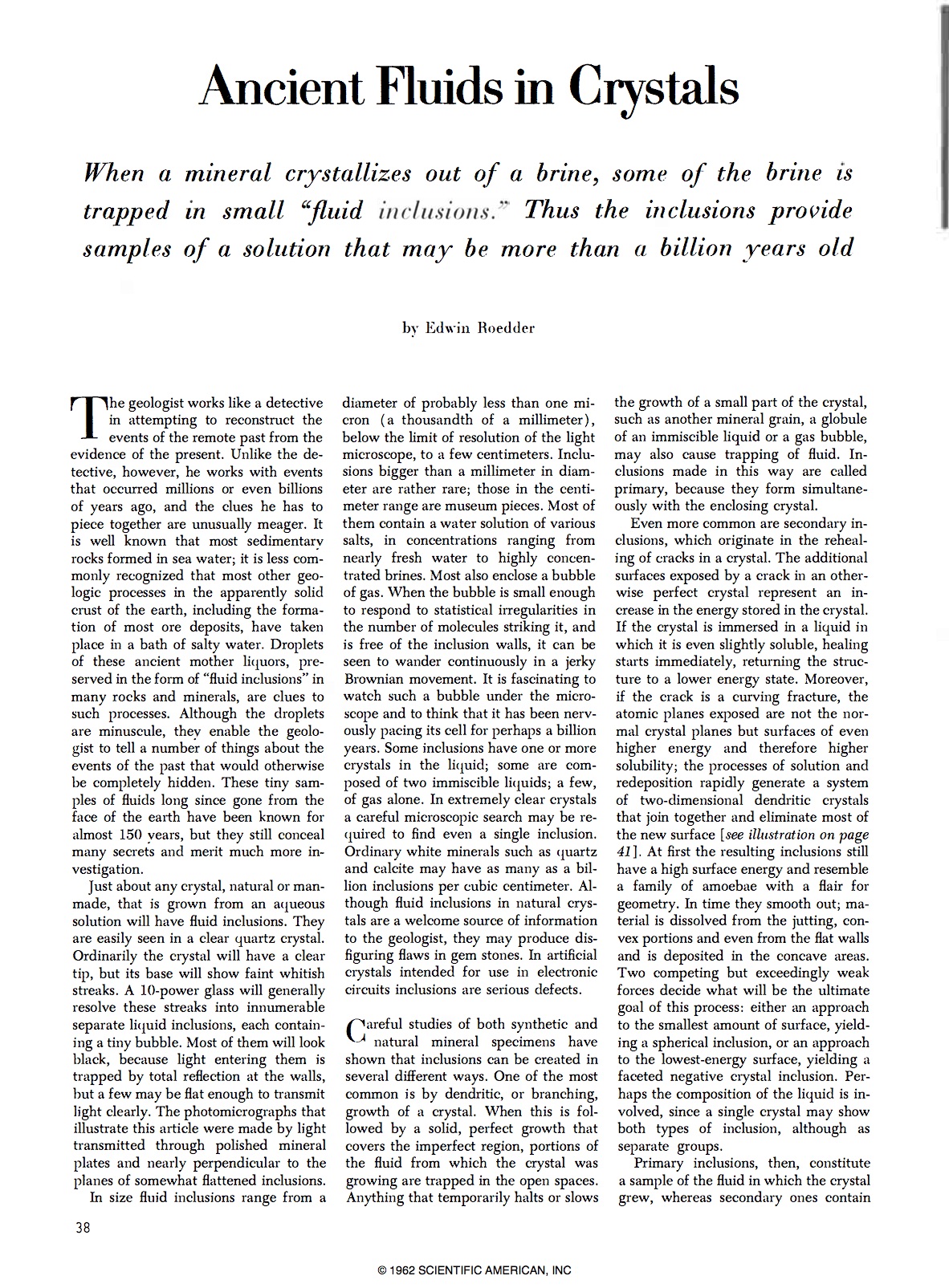
Ancient fluids in crystals

Journal Article
Roedder, E. (1962) Ancient fluids in crystals. Scientific American, Vol. 207, pp. 38–47.
Record No. 1489  |  Sinkankas/Born No.: 5510; NIB  |  RWHL*
The geologist works like a detective in attempting to reconstruct the events of the remote past from the evidence of the present. Unlike the de­ tective, however, he works with events that occurred millions or even billions of years ago, and the clues he has to piece together are unusually meager. It is well known that most sedimentary rocks formed in sea water; it is less com­ monly recognized that most other geo­ logic processes in the apparently solid crust of the earth, including the forma­ tion of most ore deposits, have taken place in a bath of salty water. Droplets of these ancient mother liquors, pre­ served in the form of fluid inclusions" in many rocks and minerals, are clues to such processes. Although the droplets are minuscule, they enable the geolo­ gist to tell a number of things about the events of the past that would otherwise be completely hidden. These tiny sam­ ples of uids long since gone from the face of the earth have been known for almost 150 years, but they still conceal many secrets and merit much more in­ vestigation. Just about any crystal, natural or man­ made, that is grown from an aqueous solution will have uid inclusions. They are easily seen in a clear quartz crystal. Ordinarily the crystal will have a clear tip, but its base will show faint whitish streaks. A 10-power glass will generally resolve these streaks into innumerable separate liquid inclusions, each contain­ ing a tiny bubble. Most of them will look black, because light entering them is trapped by total re ection at the walls, hut a few may be at enough to transmit light clearly. The photomicrographs that illustrate this article were made by light transmitted through polished mineral plates and nearly perpendicular to the planes of somewhat attened inclusions. In size uid inclusions range from a diameter of probably less than one mi­ cron (a thousandth of a millimeter), below the limit of resolution of the light microscope, to a few centimeters. Inclu­ sions bigger than a millimeter in diam­ eter are rather rare; those in the centi­ meter range are museum pieces. Most of them contain a water solution of various salts, in concentrations ranging from nearly fresh water to highly concen­ h'ated brines. Most also enclose a bubble of gas. When the bubble is small enough to respond to statistical irregularities in the number of molecules striking it, and is free of the inclusion walls, it can be seen to wander continuously in a jerky Brownian movement. It is fascinating to watch such a bubble under the micro­ scope and to think that it has been nerv­ ously pacing its cell for perhaps a billion years. Some inclusions have one or more crystals in the liquid; some are com­ posed of two immiscible liquids; a few, of gas alone. In extremely clear crystals a careful microscopic search may be re­ quired to nd even a single inclusion. Ordinary white minerals such as quartz and calcite may have as many as a bil­ lion inclusions per cubic centimeter. Al­ though uid inclusions in natural crys­ tals are a welcome source of information to the geologist, they may produce dis­ guring aws in gem stones. In arti cial crystals intended for use in electronic circuits inclusions are serious defects."

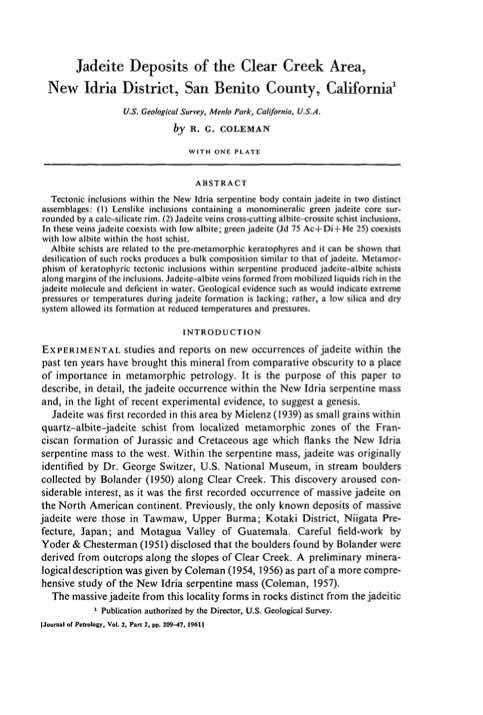
Jadeite deposits of the Clear Creek Area, New Idria District, San Benito County, California
Journal Article
Coleman, R.G. (1961) Jadeite deposits of the Clear Creek Area, New Idria District, San Benito County, California. Journal of Petrology, Vol. 2, No. 2, pp. 209–247.
Record No. 4472  |  Sinkankas/Born No.: 1410  |  RWHL*
Tectonic inclusions within the New Idria serpentine body contain jadeite in two distinct assemblages: lenslike inclusions with a monomineralic green jadeite core encased by a calc-silicate rim, and jadeite veins cross-cutting albite-crossite schist inclusions. In these veins, jadeite coexists with low albite; green jadeite (Jd 75 Ac+Di+He 25) also coexists with low albite in the host schist. The albite schists are related to pre-metamorphic keratophyres, and desilication of such rocks results in a bulk composition similar to jadeite. Metamorphism of keratophyric tectonic inclusions within the serpentine produced jadeite-albite schists along the inclusion margins, while jadeite-albite veins formed from mobilized, jadeite-rich, water-deficient fluids. Geological indicators of extreme pressure or temperature during jadeite formation are absent, suggesting instead that its formation occurred under reduced temperature and pressure in a low-silica, dry system.

The Chivor emerald mine

Journal Article
Johnson, P.W. (1961) The Chivor emerald mine. Journal of Gemmology, Vol. 8, No. 4, October, pp. 1–27.
Record No. 4273  |  ISBN/ISSN: 221252  |  Sinkankas/Born No.: 3244  |  RWHL*
Johnson presents a detailed account of Colombia’s Chivor emerald mine, combining field observations, historical records, mineralogical examination, and production statistics to describe its development and operation. Situated in steep, heavily vegetated terrain in the Eastern Cordillera, Chivor is portrayed as an isolated enterprise whose accessibility, rainfall, water supply, and security requirements strongly influence mining. The historical narrative traces indigenous exploitation, Spanish occupation and coercive labour practices, abandonment in the seventeenth century, and Francisco Restrepo’s rediscovery of the workings in 1896, followed by changing ownership and management. Contemporary operations are described through the organization of contractors, division of emerald-sale proceeds, working conditions, administration, and policing. Mining combines terracing, tunnelling, and bulldozing, with open workings favoured because the irregular distribution of productive veins and pockets makes underground exploration liable to miss valuable deposits. An eighteen-kilometre canal supplies reservoirs whose sudden discharge washes loosened overburden and debris down the slopes. Emeralds encountered during excavation are carefully removed by hand under supervision. The geological account places the deposits in folded and faulted Cretaceous shale and argillite, with emerald-bearing fissures associated principally with albite and pyrite. Johnson distinguishes these occurrences from pegmatitic beryl deposits and from the calcite-associated mineralization commonly used to characterize Colombian emeralds generally. Iron-stained bands provide local stratigraphic markers, with much historical production concentrated below the lowest band. His proposed genetic model invokes mineral-bearing fluids or vapours moving through fractures during or after deformation, with vein intersections and localized cavities favouring crystallization. The emeralds include hexagonal and dihexagonal prisms, colour-zoned crystals, and uncommon pointed, tapered, hollow, or flattened forms. Measured refractive indices range from 1.565 to 1.579, while specific gravities for eleven specimens range from 2.646 to 2.730. The article distinguishes gem-quality material from opaque morralla, discussing their appearance, commercial uses, and differences observed by X-ray diffraction. Inclusion descriptions encompass pyrite, quartz, albite, goethite, and characteristic three-phase cavities containing a solid identified as halite, liquid, and gas. Grading practices emphasize colour, transparency, freedom from fractures, and size, with numerical colour grades supplemented by letter designations for clarity. A separate account records Justo Daza’s discovery of the 632-carat Patricia emerald in 1920 and the subsequent destruction of another promising pocket during blasting. Johnson also challenges the belief that newly recovered emeralds fracture merely through exposure to air. Production and operating-cost tables document the mine’s uncertain economics: prolonged unproductive periods, substantial excavation requirements, incomplete records, and occasional exceptional finds. The resulting study links Chivor’s gemmological characteristics directly with its geological setting and the practical difficulties of recovering emeralds from highly irregular mineralization.

The origin of healing fissures in gemstones

Journal Article
Eppler, W.F. (1959) The origin of healing fissures in gemstones. Journal of Gemmology, Vol. 7, No. 2, April,
Record No. 3750  |  ISBN/ISSN: 221252  |  Sinkankas/Born No.: NIS/NIB  |  RWHL*
HEALING fissures as inclusions in gemstones are well known Hand have often been described. In spite of this, the question of their origin has not yet been answered. A most valuable hint can be found in papers published by American authors about liquid inclusions in some minerals of the pegmatite series. Here, the aim of numerous investigations was to find out whether or not the liquid inclusions could be used as a geologic thermometer." In this sense researches have been made to prove whether those particular inclusions could supply the desired information about the temperature at which the minerals of the pegmatites, and consequently the pegmatites of certain localities itself, have been formed."

Chinese Art

Book
Willetts, W. (1958) Chinese Art. New York, Penguin, 2 Vols., 802 pp.
Record No. 28810  |  Sinkankas/Born No.: 7214  |  RWHL*
Sinkankas: An esteemed near-encyclopedic work covering all of Chinese art and much larger in content than its physical size suggests due to the use of small type. In addition to the usual discussions of history, stylistic features, artistic merits, cultural significances, etc., the work is remarkable for its inclusion of much technical information on all the arts, with discussions of the nature, provenance, and preparation of the materials employed in the manufacture of the various specimens. The first chapter is general and discusses the geography of China and early civilizations, followed by chapters on jades, and others on bronzes, lacquer and silks, sculpture, ceramics, painting and calligraphy, and architecture. The chapter on jade, p. 53–107, is excellent and frequently cited in later works on jade. The development of jade carving is traced from the Neolithic period into the present, and covers the nature and sources of jades, their lapidary treatment, employment of symbolism, special types of carvings and their meanings, ritual jades, and purely decorative pieces of carved jade.

Notes on asterism in spinel and chatoyancy in chrysoberyl, quartz, tourmaline, zircon and scapolite
Journal Article
Eppler, W.F. (1958) Notes on asterism in spinel and chatoyancy in chrysoberyl, quartz, tourmaline, zircon and scapolite. Journal of Gemmology, Vol. 6, No. 6, April, pp. 251–263.
Record No. 4210  |  ISBN/ISSN: 221252  |  Sinkankas/Born No.: NIS/NIB  |  RWHL*
W.F. Eppler investigates the nature and origin of inclusions producing asterism in spinel and chatoyancy in several other gemstones, using microscopic observations to question explanations based solely on hollow channels or a single inclusion species. In Ceylon spinel, oriented rutile needles parallel to octahedral edges are attributed to exsolution, while other birefringent fibres have refractive indices below that of spinel and remain unidentified. Larger sphene crystals arranged on former octahedral growth planes show evidence of partial dissolution by the enclosing host, supporting their interpretation as primary inclusions. Their sparse distribution prevents asterism in the specimens examined, distinguishing them from the minute exsolved sphene needles reported to produce stars elsewhere. Burmese spinels contain unidentified dark, hexagonally shaped crystals surrounded by minute brownish particles tentatively identified as rutile. Eppler suggests that strain around the larger inclusions may promote localized, crystallographically controlled exsolution. Synthetic spinel provides experimental examples: heat treatment separates alumina-rich phases into oriented flakes, but their shape and limited refractive contrast produce weak stars of little commercial interest. Suitably arranged elongated gas inclusions can also generate a four-rayed star. In a sharply chatoyant chrysoberyl from Ceylon, the reflecting inclusions prove to be short, birefringent needles with a refractive index exceeding that of the host. Their mineral identity is unresolved, and an origin through exsolution remains tentative. A rose-coloured tourmaline similarly demonstrates the limitations of reflected-light appearances: inclusions resembling hollow channels are revealed in transmitted light as brown crystalline fibres, interpreted as having developed alongside the tourmaline. Quartz cat’s-eye and tiger’s-eye are described in terms of aligned amphibole-asbestos fibres, while earlier observations of cat’s-eye zircon indicate minute crystals parallel to the principal axis without establishing their composition. Madagascar scapolite contains several potentially cooperating causes of chatoyancy, including hollow channels, liquid-filled channels, birefringent needles, and oriented blades. Eppler regards the blades as products of exsolution and discusses their possible relationship to the marialite–meionite solid-solution series. Photomicrographs document these contrasting inclusion types and their spatial relationships. The study shows that comparable star and cat’s-eye effects can result from different internal structures, and that identifying the reflecting material and interpreting its developmental history require attention to optical properties, morphology, distribution, and host-crystal orientation.

A contribution to the genealogy of inclusions

Journal Article
Gübelin, E.J. (1957) A contribution to the genealogy of inclusions. Journal of Gemmology, Vol. 6, No. 1, January, pp. 1–47.
Record No. 2049  |  ISBN/ISSN: 221252  |  Sinkankas/Born No.: 2565  |  RWHL*
E.J. Gübelin proposes a genetic classification of gemstone inclusions intended to complement their established use in identification by explaining how they originate and what they reveal about their hosts’ histories. The scheme distinguishes primary inclusions associated with crystal growth from secondary inclusions produced during later processes. Primary inclusions are subdivided into autogenetic features derived from the mother liquor or irregularities of growth, and xenogenetic inclusions formed by the enclosure of foreign substances. Autogenetic features include trapped growth media, negative crystals, phantoms, and structures resulting from skeletal or interrupted growth; some are more appropriately described as inhomogeneities than as true inclusions. Xenogenetic inclusions comprise foreign solids, liquids, or gases incorporated as the host develops. Their distribution commonly records former crystal faces and growth zones. Secondary inclusions are divided principally into residual liquids in healed fissures and solid phases formed by exsolution. Gübelin gives particular attention to fracture healing, drawing on experiments in soluble crystals in which solutions enter artificial cracks, crystallization bridges the walls, and residual droplets become isolated. Subsequent changes in cavity shape are interpreted as adjustments towards lower surface energy. Diagnostic features of healed fissures include intersecting or curved inclusion planes, relationships that cut across growth structures, extremely flattened cavities, and systematic changes in droplet size within wedge-shaped cracks. Examples from diamond, corundum, beryl, quartz, topaz, and fluorite demonstrate how inclusion morphology and spatial relationships can distinguish growth features from later damage and repair. The discussion also shows how healed cores enclosed by undisturbed overgrowths can establish a sequence of fracture, healing, and renewed growth. A second major section explains exsolution through temperature-dependent solid solution, atomic substitution, and declining miscibility during cooling. Components originally dispersed within a homogeneous crystal may separate into crystallographically oriented needles, plates, or other microscopic phases. Gübelin applies this interpretation to rutile in corundum, intergrowths in feldspars, and various inclusions in spinel, cordierite, peridot, and other gemstones, relating their development to turbidity, asterism, aventurescence, iridescence, and colour. He also recognizes that similar-looking inclusions may arise through different mechanisms, complicating interpretation from appearance alone. Numerous photomicrographs illustrate the proposed relationships. The classification is presented as a framework requiring further confirmation, with the broader aim of turning inclusion study into a means of reconstructing gemstone formation and subsequent geological change.

Exploring the Literature of Gemstone Inclusions

The literature of gemstone inclusions covers identification, origin determination, treatments, synthesis, mineral inclusions, fluid inclusions and other internal features of natural and synthetic gems.

For a curated selection of important sources, read Inclusions in Gemstones — Hyperion Literature Sources.

About Four Treasures

Four Treasures is Lotus Gemology's freely accessible gemological reference database. Use the full database to search by author, title or keyword and explore literature on gemology, mineralogy, jewelry and related fields. Where available, hyperlinks on titles may lead directly to the full publication.

Search the Complete Four Treasures Database