Gemstone Inclusions Bibliography

Gemstone Inclusions Bibliography

Explore books, articles and historical sources on inclusions in gemstones in Four Treasures, the Lotus Gemology reference database. This bibliography brings together matching records from the collection, with publication details, abstracts and cover images where available.

Gemstone Inclusion References

The list below matches the terms inclusion or inclusions in the database's searchable fields. Some references discuss inclusions as part of a broader subject.
581–600 of 1,197 matching references

Micro-World: Violetish blue spinel in yellow sapphire
Journal Article
Renfro, N. and Koivula, J.I. (2015) Micro-World: Violetish blue spinel in yellow sapphire. Gems & Gemology, Vol. 51, No. 4, Winter, p. 444.
Record No. 5589  |  ISBN/ISSN: 0016626X  |  Sinkankas/Born No.: NIS/NIB  |  RWHL

G&G Microworld: Glassy melt inclusions in sapphires from Montana
Journal Article
Palke, A.C., Renfro, N. and Berg, R.B. (2015) G&G Microworld: Glassy melt inclusions in sapphires from Montana. Gems & Gemology, Vol. 51, No. 3, Fall, pp. 329–330.
Record No. 5575  |  ISBN/ISSN: 0016626X  |  Sinkankas/Born No.: NIS/NIB  |  RWHL
Two-phase inclusions are common in many sapphires. Physical and chemical analysis of the gas and liquid phases present in these inclusions can shed light on the formation conditions of alluvial sapphires, even in the absence of evidence of source rock lithology. We report here some initial observations of a different type of two-phase inclusion, seen in alluvial sapphires from the Rock Creek and Missouri River deposits in the state of Montana. At first glance, these inclusions appeared to be ordinary gas-liquid inclusions (left image); however, polishing through the inclusions demonstrated that the “liquid” component was actually a glassy solid. The identification of the solid as a glass rested with the phase’s optically isotropic nature and the lack of an identifiable Raman spectroscopic signal attributable to any crystalline phase. Glassy melt inclusions in Montana sapphires were previously documented by John Koivula (R.W. Hughes, Ruby & Sapphire, RWH Publishing, Boulder, Colorado, 2007, pp. 468–469). Electron microprobe analysis (EPMA) of glass inclusions from several samples showed them to be dacitic to trachydacitic in composition. In this sense the inclusions are ordinary two-phase inclusions in which the original liquid phase was a silicic magma that quenched to form a silicate glass. The gas phase is presumed to have originally been dissolved in the silicate magma. Later exsolution produced a separate gas phase as volatile solubility in the magma decreased due to falling pressure and/or temperature. Volatile exsolution likely also led to the discoid fractures commonly seen around melt inclusions, which are filled with silicate liquid and/or the volatiles themselves (again, see left image). The center image captures a snapshot of the process of volatile exsolution and the “bursting” of the two-phase inclusions, in which multiple gas bubbles seem to have precipitated instantaneously as the inclusion exploded out into the surrounding corundum. Due to the high relief of the silicate glass, these discoid fractures often have a “flux”-like appearance. In some cases, the fractures seem to have partially healed, leaving hexagonal geometric patterns as evidence of the crystallographic orientation of the sapphire host (right image). Further work is being carried out to characterize these inclusions and to decipher the story they have to tell about the genesis of alluvial Montana sapphires.

G&G Microworld: Modified Rheinberg illumination
Journal Article
Renfro, N. and Sanchez, D.J. (2015) G&G Microworld: Modified Rheinberg illumination. Gems & Gemology, Vol. 51, No. 3, Fall, pp. 328–329.
Record No. 5574  |  ISBN/ISSN: 0016626X  |  Sinkankas/Born No.: NIS/NIB  |  RWHL

Actualités gemmologiques: Un rubis vraisemblablement huilé
Gemological news: A likely oil-treated ruby
Journal Article
Fritsch, E. and Droux, A. (2015) Actualités gemmologiques: Un rubis vraisemblablement huilé. [Gemological news: A likely oil-treated ruby] Revue de Gemmologie A.F.G., Mars, No. 191, pp. 4–6.
Record No. 5545  |  Sinkankas/Born No.: NIS/NIB  |  Language: in French  |  RWHL
Reports the examination of a 12.12 ct natural ruby whose inclusions and chemical composition were consistent with Myanmar origin, with no evidence of heat treatment. Microscopy revealed material within surface-reaching fractures, including flattened bubbles, whitish residues and patterns resembling dried oil in treated emeralds. Droplets formed at fracture openings under the warmth of fibre-optic illumination, while DiamondView imaging highlighted the filling’s luminescence. Infrared absorption confirmed an organic substance, with bands supporting identification as oil. The authors concluded that the ruby showed moderate transparency enhancement by fracture filling, probably with oil, documenting an unusual treatment in a large Myanmar ruby.

Gem News International: Unusual combination of inclusions in synthetic star sapphire
Journal Article
Verma, P. (2015) Gem News International: Unusual combination of inclusions in synthetic star sapphire. Gems & Gemology, Vol. 51, No. 2, Summer, pp. 208–209.
Record No. 4344  |  ISBN/ISSN: 0016626X  |  Sinkankas/Born No.: NIS/NIB  |  RWHL
Describes a Verneuil synthetic star sapphire.

The geographic origin of emeralds

Journal Article
Schwarz, D. (2015) The geographic origin of emeralds. InColor, December, pp. 98–105.
Record No. 4207  |  Sinkankas/Born No.: NIS/NIB  |  RWHL

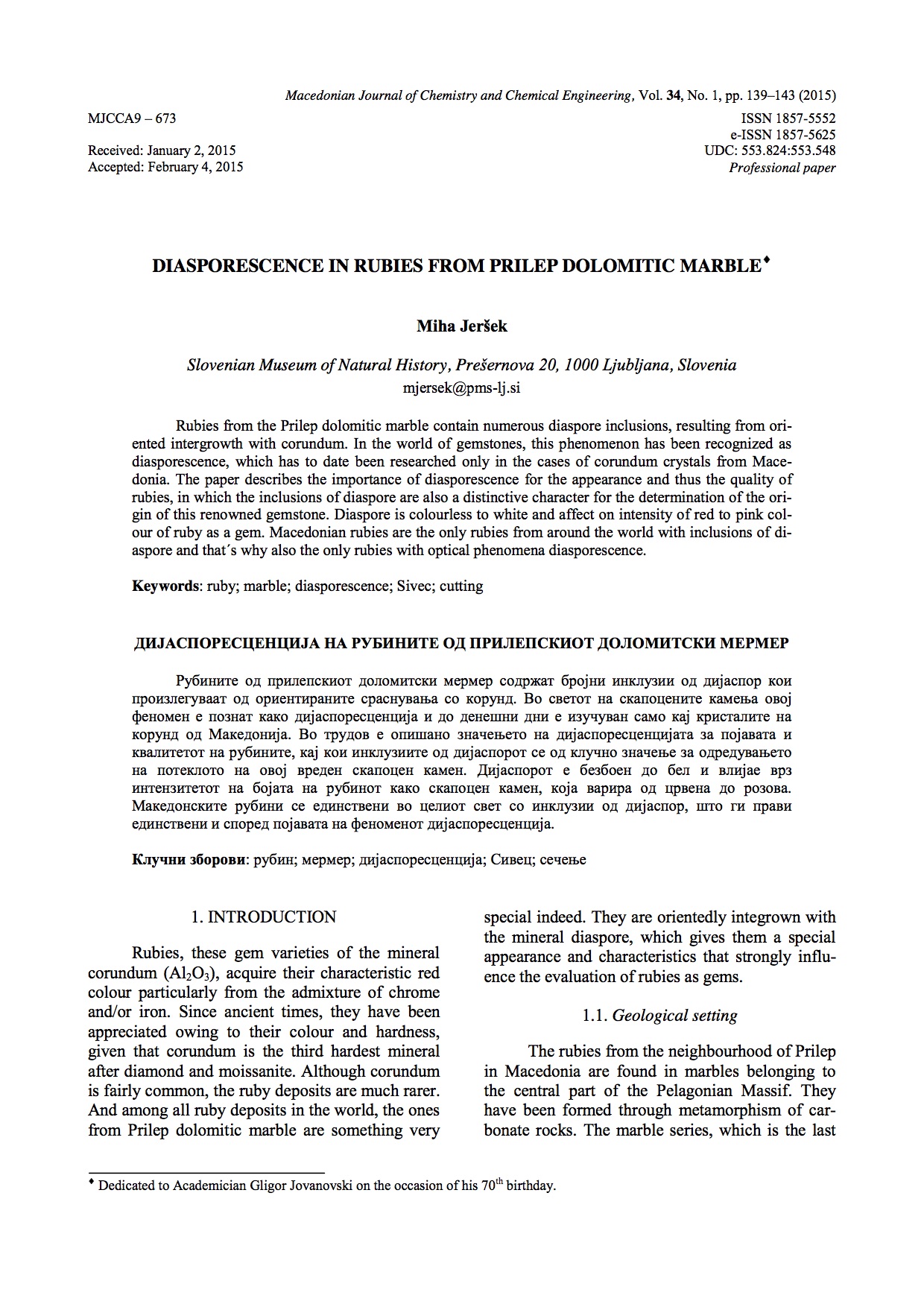
Diasporescence in rubies from Prilep dolomitic marble
Journal Article
Jeršek, M. (2015) Diasporescence in rubies from Prilep dolomitic marble. Macedonian Journal of Chemistry and Chemical Engineering, Vol. 34, No. 1, pp. 139–143.
Record No. 3321  |  Sinkankas/Born No.: NIS/NIB  |  RWHL
Rubies from the Prilep dolomitic marble contain numerous diaspore inclusions, resulting from ori-ented intergrowth with corundum. In the world of gemstones, this phenomenon has been recognized as diasporescence, which has to date been researched only in the cases of corundum crystals from Mace-donia. The paper describes the importance of diasporescence for the appearance and thus the quality of rubies, in which the inclusions of diaspore are also a distinctive character for the determination of the ori-gin of this renowned gemstone. Diaspore is colourless to white and affect on intensity of red to pink col-our of ruby as a gem. Macedonian rubies are the only rubies from around the world with inclusions of di-aspore and that ́s why also the only rubies with optical phenomena diasporescence.

Age determination of zircon inclusions in faceted sapphires
Journal Article
Link, K. (2015) Age determination of zircon inclusions in faceted sapphires. Journal of Gemmology, Vol. 34, No. 8, October, pp. 692–700.
Record No. 3233  |  ISBN/ISSN: 221252  |  Sinkankas/Born No.: NIS/NIB  |  RWHL
The age determination of zircon inclusions in faceted sapphires by LA-ICP-MS may provide a valuable tool to support geographical origin determination. In this initial study, U–Pb dating of a zircon inclusion in a pink sapphire from Madagascar yielded an age of 650 million years (Ma), suggesting a syngenetic origin (i.e., formed at the same time as the host sapphire) of the zircon. In a greenish blue sapphire from Madagascar, an included zircon yielded a U–Pb age of 1,750 Ma, pre-dating the host sapphire, and therefore indicating the zircon is an inherited inclusion (i.e., it originated from rocks that existed before the host sapphire crystallized). These results are supported by indications provided from conventional methods of geographical origin determination. This article also discusses the potential influence on U–Pb age dating of post-formation metamorphic events, laboratory heat treatment, and the possibility of complex zoning in the zircon inclusions.

Metamorphic diamonds in a garnet megacryst from the Edough Massif (northeastern Algeria). Recognition and geodynamic consequences
Journal Article
Caby, R., Bruguier, O., Fernandez, L., Hammor, D., Bosch, D., Mechati, M., Laouar, R., Ouabadi, A., Abdallah, N. and Douchet, C. (2014) Metamorphic diamonds in a garnet megacryst from the Edough Massif (northeastern Algeria). Recognition and geodynamic consequences. Tectonophysics, Vol. 637, pp. 341–353.
Record No. 27478  |  ISBN/ISSN: 401951  |  DOI: https://doi.org/10.1016/j.tecto.2014.10.017  |  Sinkankas/Born No.: NIS/NIB  |  RWHL
We report for the first time the discovery of diamond inclusions (5–30μm in size), identified by Raman spectroscopy and the characteristic sharp band at 1332cm−1 for crystalline diamond, in a garnet megacryst (≥5cm) from the Edough Massif (NE Algeria). The garnet is adjacent to actinolite and ultramafic boudins and slices of marbles that are inserted within a major mylonite–ultramylonite band. This tectonic contact sharply delineates the Kef Lakhal oceanic unit from the granite-gneiss core below. The host garnet is almandine-dominant and is rich in exsolution of acicular rutile needles. Major and trace elements show a gradual but significant zonation from core to rim, and a sharp increase in grossular component in the rim. Trace element analyses of prismatic rutile inclusions up to 300μm in size indicate that the host metamorphic rock was a mafic protolith of MORB affinity. The Zr-in-rutile thermometry indicates a temperature range of 724–778°C that we relate to rutile growth, either during prograde metamorphism or under peak UHP metamorphic conditions of ≥3.6GPa that were reached during subduction of the UHP-rock precursors. We suggest that the mafic protolith originates from the subducted retreating Calabrian branch of the Tethyan slab, that broke or tore, and which fragments were dragged upward and thrust onto the North African margin along with the Kef Lakhal unit, shortly followed by formation of the Edough dome and opening of the Algerian basin.

The Piteiras emerald mine, Minas Gerais, Brazil: Fluid-inclusion and gemmological perspectives
Journal Article
Lynch, E.P., Costanzo, A., Feely, M., Blamey, N.J.F., Pironon, J. and Lavin, P. (2014) The Piteiras emerald mine, Minas Gerais, Brazil: Fluid-inclusion and gemmological perspectives. Mineralogical Magazine, Vol. 78, No. 7, pp. 1571–1587.
Record No. 27205  |  ISBN/ISSN: 0026461X  |  DOI: https://doi.org/10.1180/minmag.2014.078.7.04  |  Sinkankas/Born No.: NIS/NIB  |  RWHL
New fluid inclusion analyses—using a range of techniques including quadrupole mass spectrometry coupled with gemmological investigations—were conducted on rough and gem-quality faceted emeralds from the Piteiras Mine, Minas Gerais, Brazil. These data complement those of Rondeau et al. (2003), who also studied emeralds from this locality. The emeralds typically occur as euhedral to anhedral crystals disseminated in biotite-phlogopite schist and range from 0.5 to 50 mm in length. Mineralization is closely associated with alkaline metasomatized pegmatite bodies, quartz boudins and veins, and talc-chlorite bands. Four types of fluid inclusions have been identified, including aqueous brine and aqueous carbonic inclusions containing one or two liquid phases, gas bubbles, and/or solid crystals such as carbonates. Primary fluid inclusions in the emeralds record salinities of approximately 4–24 equivalent wt.% NaCl and minimum trapping temperatures ranging from ~350 to 480 °C. Combined microthermometry, Raman spectroscopy, and crush-leach gas analyses reveal that the mineralizing fluid was an aqueous carbonic brine enriched in reduced volatile species such as CH₄, N₂, H₂S, and alkanes. In terms of optical properties (RI ε = 1.573–1.580; RI ω = 1.580–1.588; birefringence = 0.006–0.008) and specific gravity (2.65–2.78), the Piteiras emeralds fall within the expected range for metasomatic, schist-hosted emeralds.

Beryllium-Diffused Corundum in the Japanese Market, and Assessing the Natural vs. Diffused Origin of Beryllium in Sapphire
Journal Article
Emori, K., Kitawaki, H. and Okano, M. (2014) Beryllium-Diffused Corundum in the Japanese Market, and Assessing the Natural vs. Diffused Origin of Beryllium in Sapphire. Journal of Gemmology, Vol. 34, No. 2, pp. 130–137.
Record No. 16877  |  ISBN/ISSN: 221252  |  Sinkankas/Born No.: NIS/NIB  |  RWHL
More than a decade has passed since Be-diffused corundum was first recognized by gemologists, and such material is still present in the gem market. This study summarizes data from about 22,000 pieces of corundum submitted for identification to the Central Gem Laboratory in Japan in 2012. LA-ICP-MS analysis revealed an average of 10 ppm beryllium in Be-treated samples, regardless of corundum colour or the specific spot analysed on a stone. Traces of naturally occurring Be also were detected in corundum that was identified in the laboratory as being heat treated without Be-diffusiontreatment. Such stones were identified by their colour distribution and by wide variations in Be measured in different spots, which was positively correlated with other trace elements (i.e. Nb and Ta in blue sapphires, and Zr and Hf in yellow to yellowish orange sapphires). These elements were typically associated with clouds of minute inclusions, but they also were present in the blue sapphires in areas where no inclusions were visible with the gemmological microscope. While the LA-ICP-MS technique is useful for identifying Be-diffused corundum, the simple presence of Be is not always proof of this treatment.

Composition and genesis of green nephrites from the Karakax river in Hetian, Xinjiang
新疆和田喀拉喀什河青玉的组成及成因
Journal Article
Wen, Z., Maituohuti, A. and Lu, F. (2014) Composition and genesis of green nephrites from the Karakax river in Hetian, Xinjiang. [新疆和田喀拉喀什河青玉的组成及成因] Acta Petrologica et Mineralogica [岩石矿物学杂志], Vol. 33, Febuary, pp. 19–27.
Record No. 7289  |  Sinkankas/Born No.: NIS/NIB  |  Language: in Chinese with English abstract  |  RWHL
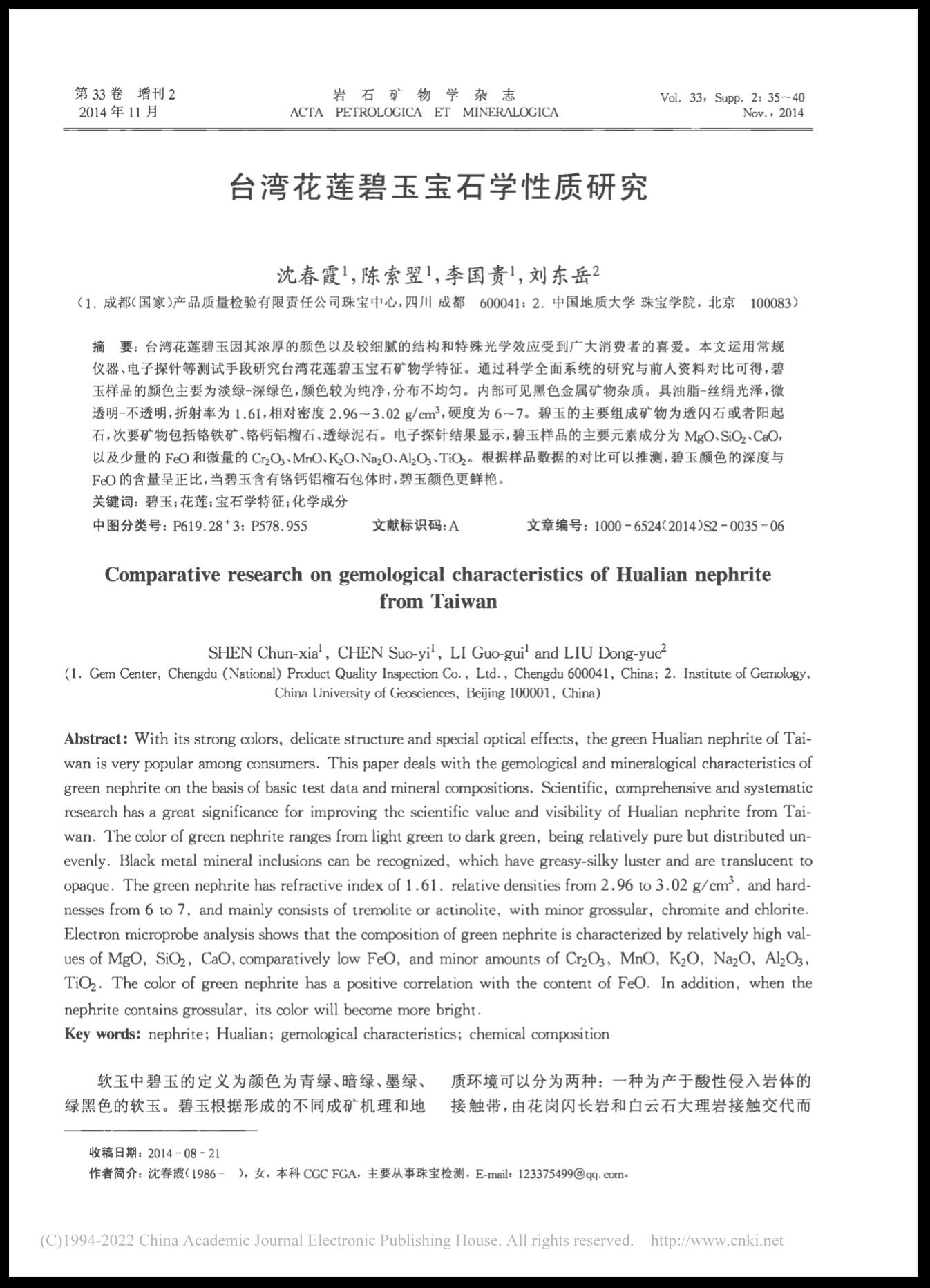
The Yurungkax river and Karakax River ( White Jade and Black Jade) are two main placer nephrite sites located in Hetian, Xinjiang. They are well known historically for their valuable white, green and black nephrite, respectively, with a long history of use in the world. In this study, electron microprobe ( EPMA) analysis was used to study green nephrite samples. The result shows that low Cr and Ni ( Cr2 O3 = 0. 00 to 0. 06% and NiO = 0. 00 to 0. 09%, respectively) are constant in these samples, consistent with the content of the marble type nephrite but different from the content of serpentinite related nephrite ( Cr2 O3 = 0. 07% to 0. 43% and NiO = 0. 08% to 0. 36% ). The accessory minerals in green nephrite include zircon, rutile, titanite and apatite which indicate the magmatic origin. According to petrographic study, several processes have been found in green nephrite: Di→Dol, Tr→Di, Tr→Tr, Chl→Tr. The homogenization temperatures for the inclusions in tremolite in green nephrite range from 200 to 400°C. Test data of the stable isotopes of the ore forming fluid acquired at different temperatures show that the H and O isotopic values of green nephrite from the secondary deposit fall in the value range of existing marble type nephrite, but are remarkably different from values of other serpentine type nephrite deposits, as evidenced by a comparison with other types of nephrite deposits in the world. The results obtained by the authors show that green nephrite from secondary deposits was formed by contact metasomatism between magmatic rocks and marble, and that the ore forming fluid was derived from magmatic hydrothermal fluid and precipitation.

Comparative research on the gemological characteristics of Hualien nephrite from Taiwan
台湾花莲碧玉 宝石学性质研究
Journal Article
Shen, C., Chen, S., Li, G. and Liu, D. (2014) Comparative research on the gemological characteristics of Hualien nephrite from Taiwan. [台湾花莲碧玉 宝石学性质研究] Acta Petrologica et Mineralogica [岩石矿物学杂志], Vol. 33, November, pp. 35–40.
Record No. 7012  |  Sinkankas/Born No.: NIS/NIB  |  Language: in Chinese with English abstract  |  RWHL
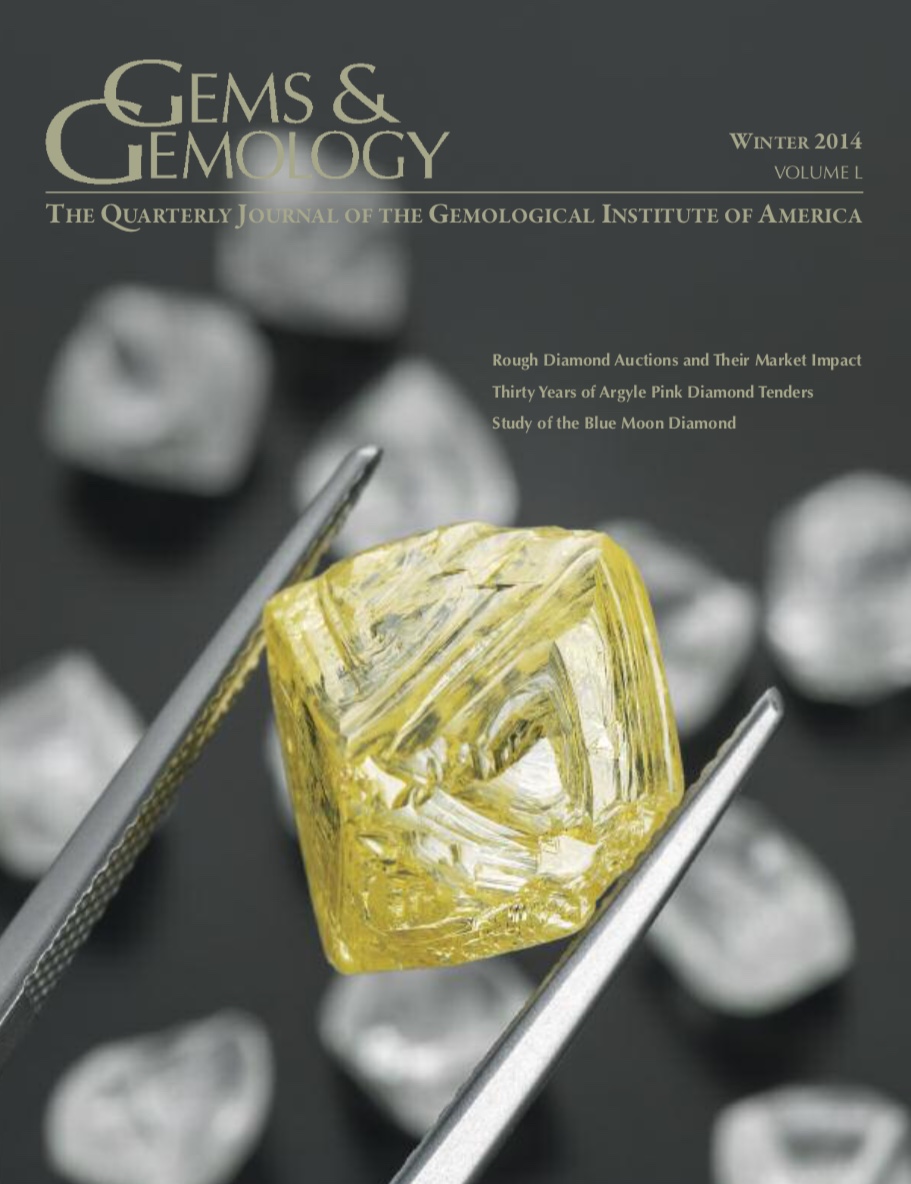
With its strong colors, delicate structure and special optical effects, the green Hualian nephrite of Taiwan is very popular among consumers. This paper deals with the geological and mineralogical characteristics of green nephrite on the basis of basic test data and mineral compositions. Scientific, comprehensive and systematic research has a great significance for improving the scientific value and visibility of Hualian nephrite from Taiwan. The color of green nephrite ranges from light green to dark green, being relatively pure but distributed unevenly. Black metal mineral inclusions can be recognized, which have greasy-silky luster and are translucent to opaque. The green nephrite has refractive index of 1.61, relative densities from 2.96 to 3.02 g/cm³, and hardnesses from 6 to 7, and mainly consists of tremolite or actinolite, with minor grossular, chromite and chlorite. Electron microprobe analysis shows that the composition of green nephrite is characterized by relatively high values of MgO, SiO₂, CaO, comparatively low Fe, and minor amounts of Cr₂O₃, MnO, K₂O, Na₂O, Al₂O₃, TiO₂. The color of green nephrite has a positive correlation with the content of FeO. In addition, when the nephrite contains grossular, its color will become more bright.

Lab Notes: Spinel inclusion in spinel
Journal Article
Cooper, A. and Sun, Z. (2014) Lab Notes: Spinel inclusion in spinel. Gems & Gemology, Vol. 50, No. 4, Winter,
Record No. 5986  |  ISBN/ISSN: 0016626X  |  Sinkankas/Born No.: NIS/NIB  |  RWHL

Mineral inclusions in sapphire from the basalt-related deposit in Bo Phloi, Kanchanaburi, western Thailand: indication of their genesis
Journal Article
Khamloet, P., Pisutha-Arnond, V. and Sutthirat, C. (2014) Mineral inclusions in sapphire from the basalt-related deposit in Bo Phloi, Kanchanaburi, western Thailand: indication of their genesis. Russian Geology and Geophysics, Vol. 55, No. 9,, 2014/09/01/ pp. 1087–1102.
Record No. 5853  |  ISBN/ISSN: 10687971  |  DOI: https://doi.org/10.1016/j.rgg.2014.08.004  |  Sinkankas/Born No.: NIS/NIB  |  RWHL
The Bo Phloi gem field in Kanchanaburi Province, Western Thailand, is closely associated with Cenozoic basalts. Blue and yellow sapphire, black spinel, and minor zircon have been mined for over three decades. The mineral inclusions observed in sapphire samples are alkali feldspar, nepheline, hercynitic spinel, zircon, manganiferous ilmenite, silica-rich enstatite, almandine–pyrope garnet, monazite, calcite, sapphirine, biotite–phlogopite mica, and staurolite. Based on their geochemical affinity, these mineral inclusions can be categorized into two main groups: felsic alkaline and contact-metamorphic, which appear to have originated from different processes. These inclusions provide new evidence for proposing a bimodal genetic model. Felsic alkaline origin is evidenced by the occurrence of a felsic alkaline inclusion suite and the REE geochemistry of sapphire-associated zircon, which indicates that most of the sapphires crystallized from a high-alkali felsic melt (probably, in the lower crust). Contact-metamorphic origin is evidenced by the presence of a contact-metamorphic inclusion suite, suggesting that some of these sapphires might also have originated from metasomatized crustal rocks and a contaminated melt along the contact zone of a basaltic intrusion (probably, in the upper mantle or lower crust).

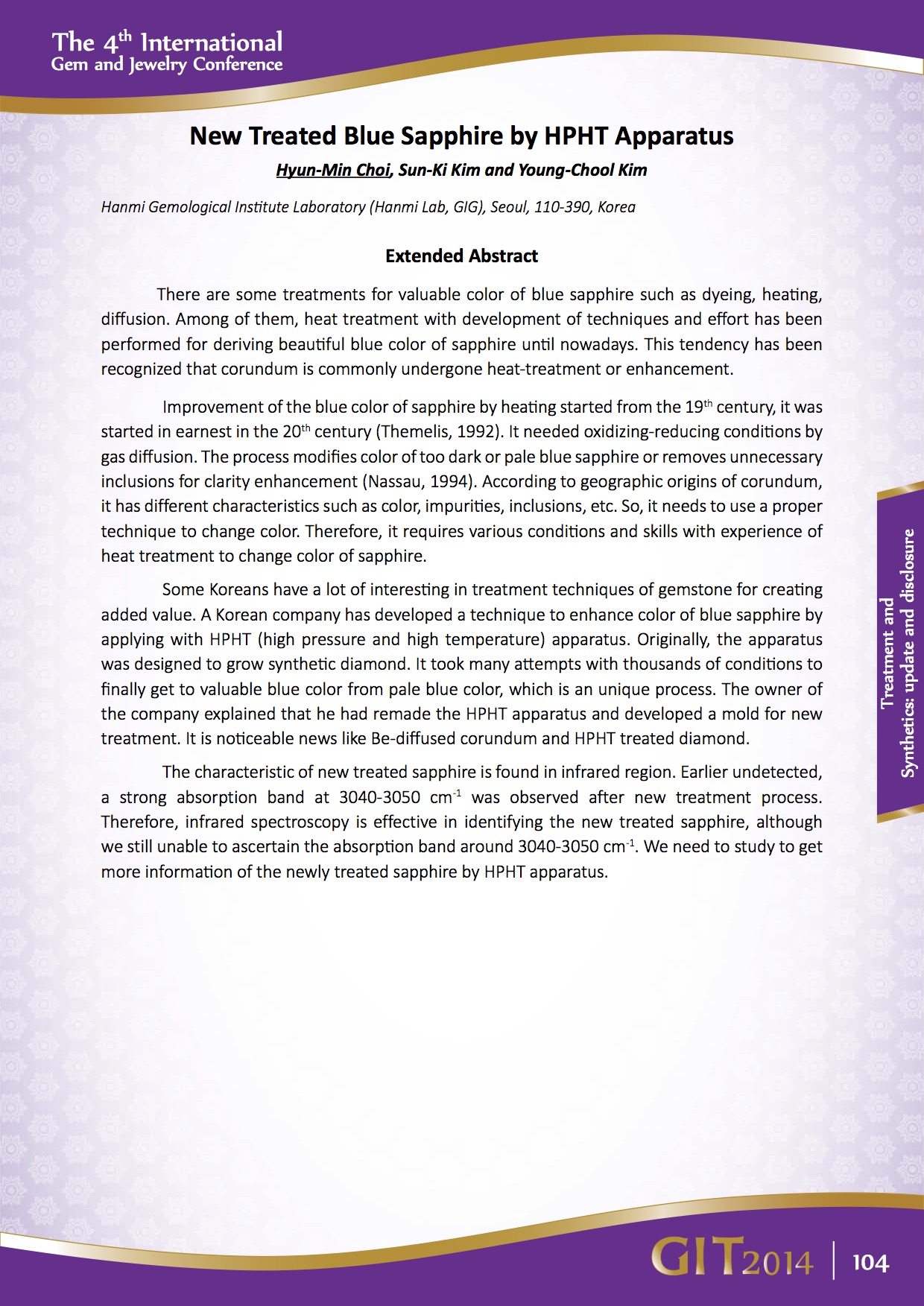
New treated blue sapphire by HPHT apparatus
Conference Paper
Choi, H.-M., Kim, S.-K. and Kim, Y.-C. (2014) New treated blue sapphire by HPHT apparatus. GIT 2014 Conference Proceedings, Chiang Mai, Thailand: Gem and Jewelry Institute of Thailand, pp. 104–105.
Record No. 5622  |  Sinkankas/Born No.: NIS/NIB  |  RWHL
There are some treatments for valuable color of blue sapphire such as dyeing, hea ng, di usion. Among of them, heat treatment with development of techniques and e ort has been performed for deriving beau ful blue color of sapphire un l nowadays. This tendency has been recognized that corundum is commonly undergone heat-treatment or enhancement. Improvement of the blue color of sapphire by hea ng started from the 19th century, it was started in earnest in the 20th century (Themelis, 1992). It needed oxidizing-reducing condi ons by gas di usion. The process modi es color of too dark or pale blue sapphire or removes unnecessary inclusions for clarity enhancement (Nassau, 1994). According to geographic origins of corundum, it has different characteristics such as color, impuri es, inclusions, etc. So, it needs to use a proper technique to change color. Therefore, it requires various condi ons and skills with experience of heat treatment to change color of sapphire. Some Koreans have a lot of interes ng in treatment techniques of gemstone for crea ng added value. A Korean company has developed a technique to enhance color of blue sapphire by applying with HPHT (high pressure and high temperature) apparatus. Originally, the apparatus was designed to grow synthe c diamond. It took many a empts with thousands of condi ons to nally get to valuable blue color from pale blue color, which is an unique process. The owner of the company explained that he had remade the HPHT apparatus and developed a mold for new treatment. It is no ceable news like Be-diffused corundum and HPHT treated diamond. The characteristic of new treated sapphire is found in infrared region. Earlier undetected, a strong absorption band at 3040-3050 cm-1 was observed after new treatment process. Therefore, infrared spectroscopy is effective in identifying the new treated sapphire, although we still unable to ascertain the absorp on band around 3040-3050 cm-1. We need to study to get more informa on of the newly treated sapphire by HPHT apparatus.

Classification chimique des corindons par analyse factorielle discriminante application à la typologie des gisements de rubis et saphirs
Chemical classification of corundums by discriminant factor analysis: Application to the typology of ruby and sapphire deposits
Journal Article
Giuliani, G., Caumon, G., Rakotosamizanany, S., Ohenstetter, D. and Rakotondrazafy, M. (2014) Classification chimique des corindons par analyse factorielle discriminante application à la typologie des gisements de rubis et saphirs. [Chemical classification of corundums by discriminant factor analysis: Application to the typology of ruby and sapphire deposits] Revue de Gemmologie A.F.G., No. 188, June, pp. 14–22.
Record No. 5544  |  Sinkankas/Born No.: NIS/NIB  |  Language: in French  |  RWHL
Develops a statistical classification of ruby and sapphire deposit types using discriminant analysis of electron-microprobe measurements of Fe, Cr, V, Ti, Mg and Ga. The dataset comprises 918 corundum analyses, including reference samples from known primary deposits and specimens used to test predictions. Applied to basalt-associated placers in Madagascar, the method identifies probable source environments broadly consistent with independent geological, inclusion and isotopic evidence. Classification is less reliable for plumasite–skarn sapphires because of limited sampling and chemical heterogeneity. Rubies from Kenya’s Rockland mine illustrate a further limitation: despite forming in plumasite, their compositions overlap those of marble-hosted rubies, requiring oxygen-isotope evidence for differentiation. The authors recommend expanding the reference data and refining both deposit categories and statistical methods.

Wonders Within Gemstones II

Book
Goutiere, A., de (2014) Wonders Within Gemstones II., Friesen Press, 72 pp.
Record No. 3236  |  Sinkankas/Born No.: NIS/NIB  |  RWHL

Residual pressure distribution and visualization of mineral inclusions in corundum: Application of photoluminescence spectroscopy in relation to sapphires from New England, New South Wales, Australia""
Journal Article
Abduriyim, A. (2014) Residual pressure distribution and visualization of mineral inclusions in corundum: Application of photoluminescence spectroscopy in relation to sapphires from New England, New South Wales, Australia"". Australian Gemmologist, Vol. 25, No. 6–7, pp. 245–254.
Record No. 3232  |  Sinkankas/Born No.: NIS/NIB  |  RWHL

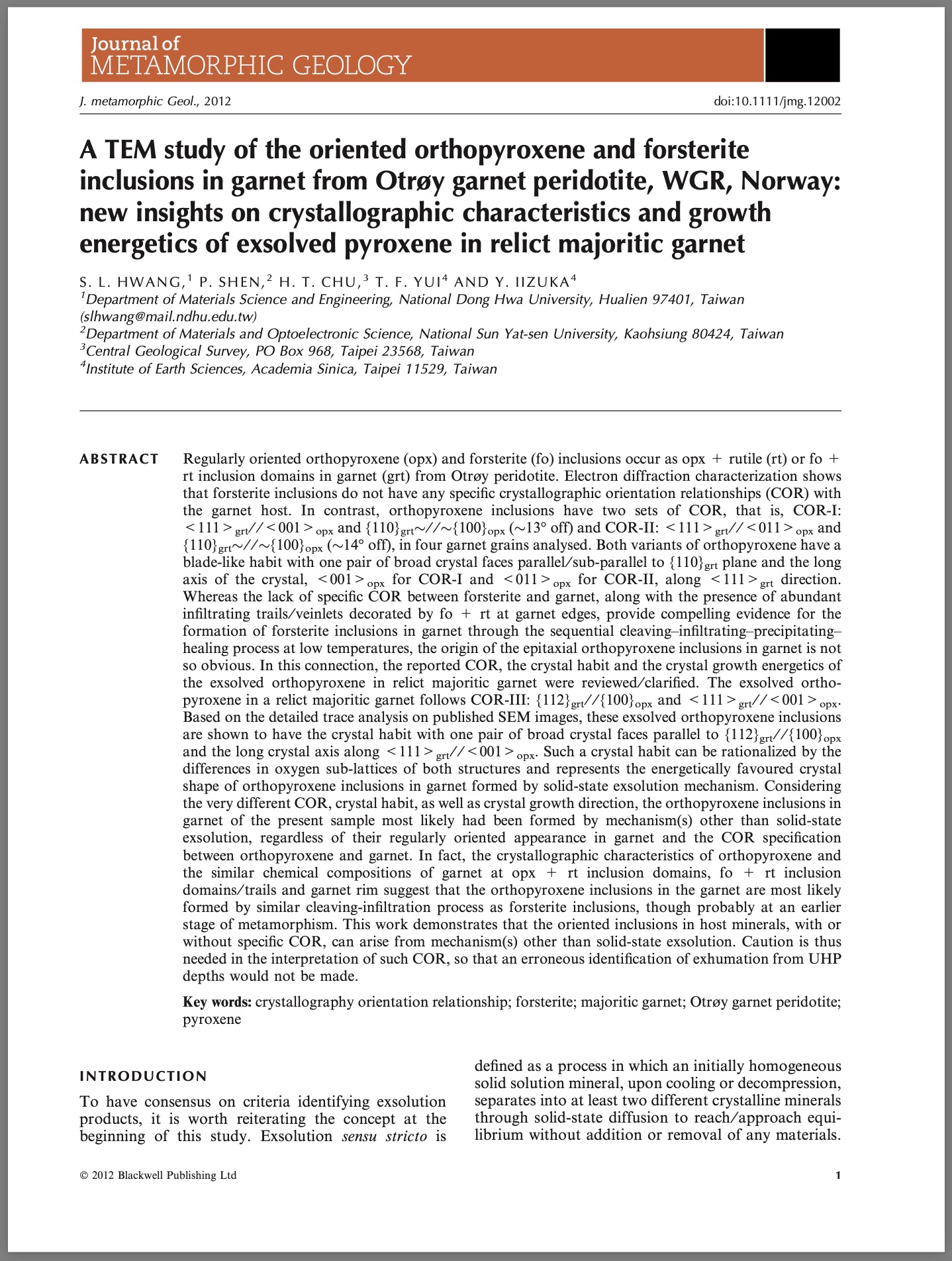
A TEM study of the oriented orthopyroxene and forsterite inclusions in garnet from Otrøy garnet peridotite, WGR, Norway: new insights on crystallographic characteristics and growth energetics of exsolved pyroxene in relict majoritic garnet

Journal Article
Hwang, S.L., Shen, P., Chu, H.T., Yui, T.F. and Iizuka, Y. (2013) A TEM study of the oriented orthopyroxene and forsterite inclusions in garnet from Otrøy garnet peridotite, WGR, Norway: new insights on crystallographic characteristics and growth energetics of exsolved pyroxene in relict majoritic garnet. Journal of Metamorphic Geology, Vol. 31, No. 2, pp. 113–130.
Record No. 28242  |  ISBN/ISSN: 0263-4929  |  DOI: https://doi.org/10.1111/jmg.12002  |  Sinkankas/Born No.: NIS/NIB  |  RWHL
Regularly oriented orthopyroxene (opx) and forsterite (fo) inclusions occur as opx + rutile (rt) or fo + rt inclusion domains in garnet (grt) from Otrøy peridotite. Electron diffraction characterization shows that forsterite inclusions do not have any specific crystallographic orientation relationships (COR) with the garnet host. In contrast, orthopyroxene inclusions have two sets of COR, that is, COR-I: <111>grt//<001>opx and {110}grt∼//∼{100}opx (∼13° off) and COR-II: <111>grt//<011>opx and {110}grt∼//∼{100}opx (∼14° off), in four garnet grains analysed. Both variants of orthopyroxene have a blade-like habit with one pair of broad crystal faces parallel/sub-parallel to {110}grt plane and the long axis of the crystal, <001>opx for COR-I and <011>opx for COR-II, along <111>grt direction. Whereas the lack of specific COR between forsterite and garnet, along with the presence of abundant infiltrating trails/veinlets decorated by fo + rt at garnet edges, provide compelling evidence for the formation of forsterite inclusions in garnet through the sequential cleaving–infiltrating–precipitating–healing process at low temperatures, the origin of the epitaxial orthopyroxene inclusions in garnet is not so obvious. In this connection, the reported COR, the crystal habit and the crystal growth energetics of the exsolved orthopyroxene in relict majoritic garnet were reviewed/clarified. The exsolved orthopyroxene in a relict majoritic garnet follows COR-III: {112}grt//{100}opx and <111>grt//<001>opx. Based on the detailed trace analysis on published SEM images, these exsolved orthopyroxene inclusions are shown to have the crystal habit with one pair of broad crystal faces parallel to {112}grt//{100}opx and the long crystal axis along <111>grt//<001>opx. Such a crystal habit can be rationalized by the differences in oxygen sub-lattices of both structures and represents the energetically favoured crystal shape of orthopyroxene inclusions in garnet formed by solid-state exsolution mechanism. Considering the very different COR, crystal habit, as well as crystal growth direction, the orthopyroxene inclusions in garnet of the present sample most likely had been formed by mechanism(s) other than solid-state exsolution, regardless of their regularly oriented appearance in garnet and the COR specification between orthopyroxene and garnet. In fact, the crystallographic characteristics of orthopyroxene and the similar chemical compositions of garnet at opx + rt inclusion domains, fo + rt inclusion domains/trails and garnet rim suggest that the orthopyroxene inclusions in the garnet are most likely formed by similar cleaving–infiltration process as forsterite inclusions, though probably at an earlier stage of metamorphism. This work demonstrates that the oriented inclusions in host minerals, with or without specific COR, can arise from mechanism(s) other than solid-state exsolution. Caution is thus needed in the interpretation of such COR, so that an erroneous identification of exhumation from UHP depths would not be made.

Exploring the Literature of Gemstone Inclusions

The literature of gemstone inclusions covers identification, origin determination, treatments, synthesis, mineral inclusions, fluid inclusions and other internal features of natural and synthetic gems.

For a curated selection of important sources, read Inclusions in Gemstones — Hyperion Literature Sources.

About Four Treasures

Four Treasures is Lotus Gemology's freely accessible gemological reference database. Use the full database to search by author, title or keyword and explore literature on gemology, mineralogy, jewelry and related fields. Where available, hyperlinks on titles may lead directly to the full publication.

Search the Complete Four Treasures Database