Gemstone Inclusions Bibliography

Gemstone Inclusions Bibliography

Explore books, articles and historical sources on inclusions in gemstones in Four Treasures, the Lotus Gemology reference database. This bibliography brings together matching records from the collection, with publication details, abstracts and cover images where available.

Gemstone Inclusion References

The list below matches the terms inclusion or inclusions in the database's searchable fields. Some references discuss inclusions as part of a broader subject.
1,041–1,060 of 1,197 matching references

The chemical compounds of some liquid inclusions
Journal Article
Gübelin, E.J. (1943) The chemical compounds of some liquid inclusions. Gems & Gemology, Vol. 4, No. 6, Summer, pp. 82–86; No. 7, Fall, pp. 98–100.
Record No. 2021  |  ISBN/ISSN: 0016626X  |  Sinkankas/Born No.: NIS/NIB  |  RWHL

Chinese Snuff-Bottles in Parti-Coloured Hardstones
Journal Article
Hildburgh, W.L. (1942) Chinese Snuff-Bottles in Parti-Coloured Hardstones. The Burlington Magazine for Connoisseurs, Vol. 81, No. 475, pp. 247–251.
Record No. 3406  |  ISBN/ISSN: 9510788  |  Sinkankas/Born No.: NIS/NIB  |  RWHL
W.L. Hildburgh examines Chinese snuff-bottles carved from parti-coloured hardstones, emphasizing the lapidary’s ability to transform natural layers, stains, inclusions, and irregularities into coherent decorative designs. Extending an earlier discussion of Chinese hardstone carving, he argues that these small utilitarian objects often display exceptional artistic invention alongside technical mastery. He explains that the exterior is completed before hollowing begins, allowing the craftsman to investigate colour distribution, exploit useful features, and remove defects before undertaking the lengthy excavation of the interior. Reports from carvers using treadle-driven tools suggest that shaping and ornamenting a fine bottle could require ten to fifteen days, with another ten to thirty days devoted to hollowing and internal polishing. Thin walls enhance translucency, reduce weight, and demonstrate skill, while the precision achieved inside opaque or awkwardly shaped vessels reflects sophisticated control of tools and material. Hildburgh distinguishes several approaches to coloured decoration. Contrasting layers may be carved in rounded cameo relief against a relatively uniform body, as in agate bottles bearing horses, birds, bamboo, or a cricket among vegetables. Rock crystal with adhering white quartz matrix provides another combination, with the matrix shaped into trees, animals, and figures; one smoky-quartz example retains the crystal’s natural hexagonal form beneath carved decoration on all six faces. More complex stones permit the coordination of several coloured strata, variations in translucency, and differentiated polish within a single composition. Hildburgh also notes that separately carved reliefs may be cemented over flaws so skilfully that the repair is difficult to detect. Where colour occurs only in a thin surface concentration, the carver must preserve its irregular level and avoid rounding edges that would expose the underlying body colour. The article’s most sustained analysis concerns agates containing dispersed dark markings. Here the craftsman selectively lowers and shapes the surface to reveal coloured areas at different depths, adjusting their contours and opacity to create silhouettes, figures, foliage, birds, and landscape effects. Some natural formations remain untouched, while others are integrated with carefully worked details. Hildburgh contrasts this responsive manipulation with European uses of patterned stones, crediting Chinese carvers with an unusually sensitive appreciation of each specimen’s individual possibilities. Throughout, he stresses that photographs inadequately convey many effects dependent on subtle colour, translucency, depth, or decoration extending around the vessel. The study presents successful snuff-bottle carving as an accommodation between the demands of handling, the geological character of the stone, and the craftsman’s imaginative interpretation.

Local peculiarities of sapphires

Journal Article
Gübelin, E.J. (1942–43) Local peculiarities of sapphires. Gems & Gemology, Vol. 4, No. 3, Fall, pp. 34–39; No. 4, Winter, pp. 50–54; No. 5, Spring, pp. 66–69.
Record No. 877  |  ISBN/ISSN: 0016626X  |  Sinkankas/Born No.: NIS/NIB  |  RWHL

Genuine type inclusions in new European synthetics
Journal Article
Gübelin, E.J. (1942) Genuine type inclusions in new European synthetics. Gems & Gemology, Vol. 4, No. 2, Summer, pp. 18–21.
Record No. 876  |  ISBN/ISSN: 0016626X  |  Sinkankas/Born No.: NIS/NIB  |  RWHL

The synthetic emerald

Journal Article
Gübelin, E.J. (1941) The synthetic emerald. Gems & Gemology, Vol. 3, No. 10, Summer, pp. 146–150.
Record No. 2020  |  ISBN/ISSN: 0016626X  |  Sinkankas/Born No.: NIS/NIB  |  RWHL

Differentiation between Russian and Colombian emerald
Journal Article
Gübelin, E.J. (1940) Differentiation between Russian and Colombian emerald. Gems & Gemology, Vol. 3, No. 6, Summer, pp. 89–92.
Record No. 2018  |  ISBN/ISSN: 0016626X  |  Sinkankas/Born No.: NIS/NIB  |  RWHL

Characteristics of Ceylon rubies

Journal Article
Gübelin, E.J. (1940) Characteristics of Ceylon rubies. Gems & Gemology, Vol. 3, No. 8, Winter, pp. 121–124.
Record No. 2017  |  ISBN/ISSN: 0016626X  |  Sinkankas/Born No.: NIS/NIB  |  RWHL

Asterism in garnet, spinel, quartz, and sapphire
Journal Article
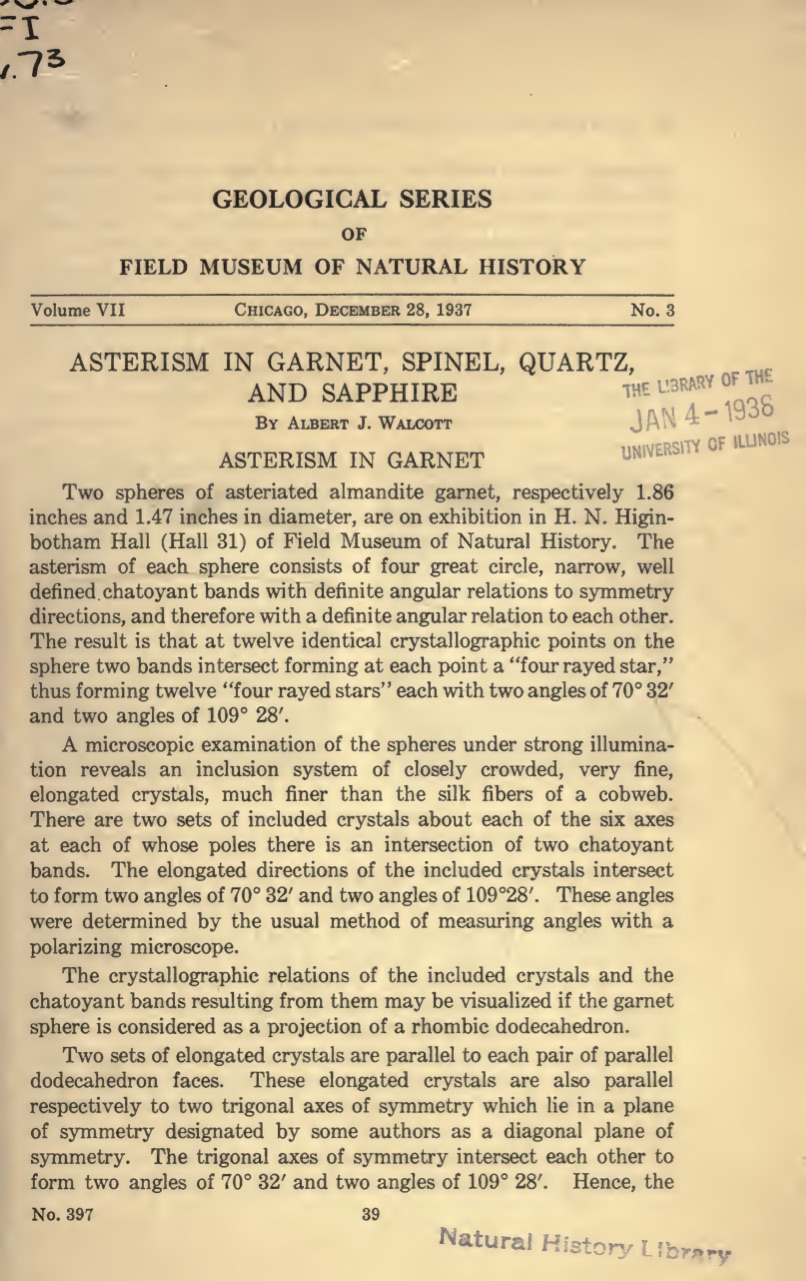
Walcott, A.J. (1937) Asterism in garnet, spinel, quartz, and sapphire. Geological Series of the Field Museum of Natural History, Vol. 7, No. 3, December, pp. 39–57.
Record No. 1803  |  Sinkankas/Born No.: NIS/NIB  |  RWHL
Walcott investigates asterism in garnet, spinel, quartz and sapphire through microscopic observations, measurements of angular relationships, and geometrical reconstructions of luminous bands on spheres and crystal models. His principal aim is to relate star patterns to crystallographic symmetry and to identify the internal structures responsible for their formation. Two almandine garnet spheres in the Field Museum display four great-circle chatoyant bands intersecting to produce twelve four-rayed stars, each with alternating angles of 70°32′ and 109°28′. These bands are associated with fine elongated inclusions oriented parallel to the crystal’s threefold symmetry axes. A garnet cabochon possesses an additional inclusion system parallel to the fourfold axes, producing a combination of four- and six-rayed stars. A dark-red spinel cabochon contains inclusions aligned with the twofold symmetry axes; projected onto a complete sphere, its six bands would generate eight six-rayed stars with 60° angles and six four-rayed stars with 90° angles. These observations directly challenge the assumption that cubic minerals can exhibit only four-rayed stars with right angles. Walcott develops a classification of possible inclusion arrangements parallel to the three classes of symmetry axes in the hexoctahedral crystal class, considering both complete and incomplete sets and their combinations. He calculates a minimum of 179 possible arrangements, while distinguishing the few represented by available specimens from hypothetical configurations. The most elaborate configuration considered would produce thirteen great-circle bands and combinations of six- and eight-rayed stars. Turning to colourless quartz, rose quartz and sapphire, he describes three intersecting bands forming six-rayed stars at the poles of the crystallographic c-axis. Restricted illumination reveals fine internal striae that he interprets as surface growth striations incorporated into the crystal during oscillatory development of different crystal forms. In sapphire, he further suggests that some striae lengthened through minute cracks associated with metamorphism. He attributes the greater abundance of star sapphires than star rubies to differences in prevailing crystal habits and their propensity to develop striations. Variations in the fineness, continuity and arrangement of these structures are used to explain sharply defined, broad or feathery star bands, while zoning, twinning and other inclusions may diminish their brightness. A predominantly single directional system can produce a sapphire cat’s-eye when appropriately cut. Throughout the study, Walcott interprets asterism chiefly as a diffraction phenomenon, supported by transmitted-light stars in quartz and spectral colours observed in sapphire bands. The paper combines documented observations with geometrical predictions and proposed explanations for the origin of the structures producing the optical effects.

Unusual inclusions in synthetic ruby

Journal Article
Anonymous (1937) Unusual inclusions in synthetic ruby. Gems & Gemology, Vol. 2, No. 5, Spring, pp. 91–92.
Record No. 277  |  ISBN/ISSN: 0016626X  |  Sinkankas/Born No.: NIS/NIB  |  RWHL

Bergkristall, Glas und Glasflüsse nach dem Steinbuch von el-Bērūnī
Rock crystal, glass, and glass fluxes according to Al-Biruni's Book of Stones
Journal Article
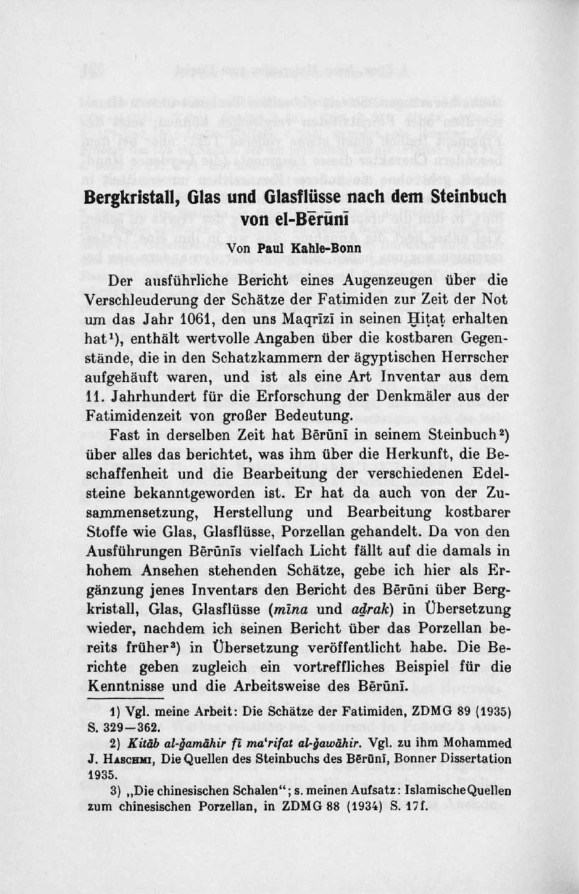
Kahle-Bonn, P. (1936) Bergkristall, Glas und Glasflüsse nach dem Steinbuch von el-Bērūnī. [Rock crystal, glass, and glass fluxes according to Al-Biruni's Book of Stones] Zeitschrift der Deutschen Morgenländischen Gesellschaft, Vol. 90, pp. 322–356.
Record No. 8124  |  Sinkankas/Born No.: NIS/NIB  |  Language: in German  |  RWHL
Kahle presents and translates sections of al-Bīrūnī’s eleventh-century Kitāb al-jamāhir fī maʿrifat al-jawāhir dealing with rock crystal, glass, enamel/glass fluxes (mīnā), and ruby glass (adrak), using two manuscripts and emphasizing the value of al-Bīrūnī’s account for understanding the materials and techniques represented among the Fatimid treasures. Rock crystal is described as a transparent, colorless stone prized for vessels, hardness, clarity, and resemblance to water and air; al-Bīrūnī discusses its sources, working, value, inclusions, and supposed formation, including contemporary observations and historical anecdotes concerning valuable crystal vessels. Glass is described as produced by melting quartz or sand with alkali, prolonged firing increasing its clarity and hardness; properly made colorless glass could approach rock crystal in transparency, though its greater abundance and softness reduced its value. Particularly important is al-Bīrūnī’s treatment of mīnā, explicitly described as a type of glass, softer and heavier according to its lead content. He records recipes employing finely powdered quartz or rock crystal with red lead or tin oxide, together with natron or borax-type fluxes, and gives coloring materials: lead compounds for yellow, copper compounds for green, burned brass for red, iron residues for black, manganese for wine-purple, lead white for white, burned gold for ruby color, and lapis lazuli and carnelian for violet. Kahle notes that these descriptions strongly support the interpretation of mīnā in Fatimid inventories primarily as enamel or vitreous flux. The final section discusses adrak, an ancient Alexandrian red or garnet-colored glass reportedly comparable in appearance and value to ruby and whose manufacture was said already to have been lost by the ninth century; al-Bīrūnī preserves several recipes or traditions for attempting its production, along with observations on other artificial colored materials, mosaics, and objects recovered from ancient Egyptian and Yemeni burials.

New facts about Siam rubies

Journal Article
Halford-Watkins, J.F. (1934) New facts about Siam rubies. The Gemmologist, Vol. 4, No. 41, December, pp. 147–149.
Record No. 915  |  Sinkankas/Born No.: NIS/NIB  |  RWHL

Lapis-lazuli et rubis balais des cipolins afghans
Lapis lazuli and balas rubies from Afghan marbles
Journal Article
Barthoux, J. (1933) Lapis-lazuli et rubis balais des cipolins afghans. [Lapis lazuli and balas rubies from Afghan marbles] Comptes Rendus de l’Académie des Sciences de France, Vol. 196, 10-Apr, pp. 1131–1134.
Record No. 436  |  Sinkankas/Born No.: NIS/NIB  |  Language: in French  |  RWHL
Describes lapis lazuli, spinel, and ruby occurrences in the crystalline limestones and marbles associated with Afghanistan’s extensive metamorphic formations. The Badakhshan lapis lazuli deposit lies in the upper Kokcha valley, about ten kilometres downstream from Robat, where mineralization locally replaces the enclosing marble. Barthoux records three commercial colour varieties and describes extraction by heating selected portions of the rock with fires, followed by ventilation and removal of the loosened blocks. Lazurite crystals reaching 15 mm occur in the surrounding white marble, accompanied by phlogopite, humite, forsterite, and pyrite; crystallographic details are provided for several minerals. Historical balas rubies from Gharan, near Siz on the right bank of the Oxus, are described as large, slightly cloudy, violet-pink spinel octahedra, distinguished from almandine obtained across the river. At Jagdalak, between Kabul and Jalalabad, steeply inclined marbles contain abundant spinels of various colours together with pink corundum. The paper describes the crystal forms of the corundum and associated minerals, including humite, chondrodite, phlogopite, fuchsite, rutile, titanite, hematite, pyrite, and diopside. Emerald-green pargasite occurs as isolated crystals or aggregates with phlogopite, and a chemical analysis is reported for comparison with edenite.

The composition of the earth’s crust

Journal Article
Clarke, F.W. and Washington, H.S. (1924) The composition of the earth’s crust. USGS Professional Paper, No. 127, 117 pp..
Record No. 4736  |  Sinkankas/Born No.: NIS/NIB  |  RWHL
Clarke and Washington estimate the chemical composition of the earth’s accessible outer crust through a compilation of 5,159 selected analyses of igneous rocks, supplemented by data on sedimentary rocks, ocean water, and the atmosphere. Regional and continental averages are compared, with explicit consideration of uneven geographical coverage, analytical quality, minor constituents, and alternative weighting methods. Calculations adopt an assumed crustal thickness of ten miles and distinguish the composition of solid rocks from that of the combined lithosphere, hydrosphere, and atmosphere. Oxygen and silicon dominate the resulting estimates, while a small group of common elements accounts for nearly all crustal material. The average igneous composition is interpreted as broadly granodioritic, although provisional inclusion of ocean-floor areas produces a more mafic estimate. Further sections examine analytical methods, meteorite composition, elemental abundance, mineral associations, and relationships to the periodic classification. The authors distinguish predominantly rock-forming, or petrogenic, elements from ore-forming, or metallogenic, elements, relating their occurrence to characteristic mineral groups and natural processes of concentration. The study provides a quantitative framework for geochemical comparison while acknowledging substantial uncertainties arising from incomplete sampling and assumptions about the crust’s structure and extent.

Le rubis

The ruby
Journal Article
Escard, J.-G. (1913) Le rubis. [The ruby] Cosmos, Vol. 62, No. 1481,, 12 Juin pp. 655–660.
Record No. 2547  |  Sinkankas/Born No.: NIS/NIB  |  Language: in French  |  RWHL
Escard provides a concise survey of the ruby, describing its varieties, physical properties, geographical sources, mining, cutting, valuation, and methods of distinguishing natural stones from imitations and artificial products. [655] He identifies ruby as red corundum and discusses differences in color among rubies from Burma, Siam, and Ceylon, noting that terminology such as “Oriental ruby” and “Siam ruby” was often applied inconsistently in commerce. [656] Particular attention is given to microscopic examination: natural rubies may contain crystalline inclusions and other internal features, while differences in color and dichroism can help separate stones from different sources; illustrations show characteristic inclusions and a Ceylonese lapidary at work. [657] Escard discusses the distinctive internal structure of Burmese and Siamese rubies, differences observed with the dichroscope, and variations in specific gravity, accompanied by photomicrographs and a map of the ruby-bearing district of Burma. [658] Fluorescence and phosphorescence are described as useful diagnostic properties, Burmese rubies showing particularly strong fluorescence; the principal ruby deposits are said to occur in Burma and Ceylon, where ruby-bearing gravels are washed and sorted, with an account of mining and recovery methods in the Mogok district and illustrations of the Burmese mines. [659] The article gives production and value figures for Burmese ruby mining, mentions occurrences in Ceylon, Siam, Afghanistan, and elsewhere, discusses the considerable variation in value according to color, quality, and size, and briefly describes cutting practices, including the preference for the oval form. [660] Escard concludes with remarks on celebrated rubies, including stones associated with European collections, and emphasizes the commercial importance of distinguishing natural rubies from artificial stones, illustrating a certificate of authenticity for a natural Burmese ruby.

The Morgan Collection of precious stones
Journal Article
Kunz, G.F. (1913) The Morgan Collection of precious stones. American Museum Journal, Vol. 13, No. 4, April, pp. 159–168.
Record No. 1150  |  Sinkankas/Born No.: NIS/NIB  |  RWHL
Traces the formation of J. Pierpont Morgan’s gem collection at the American Museum of Natural History, beginning with material assembled by Kunz through Tiffany & Co. for the Paris Exposition of 1889 and expanded through a second collection exhibited in 1900. Describes outstanding rough crystals, cut gemstones, pearls and carved objects, recording their localities, weights, colors and historical associations. Highlights include large sapphires and aquamarines, Madagascar morganite, California tourmalines and kunzite, American freshwater pearls, jade vessels, Babylonian cylinder seals and Persian engraved gems. Explains that the collection was intended to illustrate both gemstone diversity and the history of lapidary craftsmanship across cultures. Notes mineral inclusions, phantom growth structures and exceptionally thin polished jade sections, alongside Morgan’s subsequent acquisition of the Bement mineral and meteorite collections. Photographs illustrate selected specimens and objects.

The production and identification of artificial precious stones
Journal Article
Heaton, N. (1911) The production and identification of artificial precious stones. Journal of the Royal Society of Arts, Vol. 59, No. 3049, April 28, pp. 574–597.
Record No. 7203  |  Sinkankas/Born No.: NIS/NIB  |  RWHL
Heaton reviews the contemporary production of artificial precious stones and the methods available for distinguishing them from their natural counterparts. Particular attention is given to synthetic ruby and sapphire, including the processes developed by Frémy and Verneuil, the materials and apparatus employed, and the physical and optical properties of the resulting products. The paper discusses the identification of artificial stones by microscopic examination, inclusions, internal structure, and other diagnostic characteristics, and considers imitation and reconstructed stones alongside true synthetic products. Published at a time when flame-fusion corundum was becoming commercially important, it provides a useful contemporary account of the problems that synthetic gemstones posed for jewelers and gemologists.

Sur la nature des oxydes qui colorent le saphir oriental
On the nature of the oxides that color the oriental sapphire
Journal Article
Verneuil, A. (1910) Sur la nature des oxydes qui colorent le saphir oriental. [On the nature of the oxides that color the oriental sapphire] Comptes rendus hebdomadaires des séances de l'Académie des sciences, Vol. 151, No. 23, 5 December, pp. 1063–1066.
Record No. 1770  |  Sinkankas/Born No.: NIS/NIB  |  Language: in French  |  RWHL
Verneuil investigates the causes of the blue coloration of sapphire, prompted by his successful reproduction of “oriental sapphire” by fusing alumina with titanic acid and iron oxide. Earlier analyses had generally attributed sapphire’s color to iron oxide and had not detected titanium in clear, inclusion-free material. Verneuil therefore analyzed carefully selected natural blue sapphires from Australia, Burma, and Montana, finding iron oxide together with small but consistent quantities of titanium: Australian sapphire contained 0.92% iron oxide and 0.031% titanic acid; Burmese sapphire 0.72% and 0.04%; and Montana sapphire 0.56% and 0.058%, respectively. Chromium oxide was absent, while silica occurred only in traces and phosphoric acid was absent from the Australian and Montana stones. From the close similarity of these results in sapphires from widely separated localities, and from the fact that his synthetic sapphire reproduced the natural blue using the same elements, Verneuil concludes that the color results from the combined presence of iron oxide and a titanium oxide. He leaves unresolved whether the principal coloring agent is blue titanium oxide, present in extremely small quantity, or a compound of titanium and ferrous iron, noting that further synthetic experiments might resolve the question.

Le Rubis • Communication faite aux Chambres Syndicales des Marchands de Diamants et Lapidaires, Joailliers et Bijoutiers, réunies le 21 juin 1904
The Ruby • Communication made to the Syndical Chambers of Diamond Merchants and Gem Cutters, Jewelers, and Goldsmiths, gathered on June 21, 1904
Book
Chaumet, J. (1904) Le Rubis • Communication faite aux Chambres Syndicales des Marchands de Diamants et Lapidaires, Joailliers et Bijoutiers, réunies le 21 juin 1904. [The Ruby • Communication made to the Syndical Chambers of Diamond Merchants and Gem Cutters, Jewelers, and Goldsmiths, gathered on June 21, 1904] Paris, Imprimerie Petit, 15 pp.
Record No. 6377  |  Sinkankas/Born No.: NIS/NIB  |  Language: in French  |  RWHL
Small booklet describing how to separate natural rubies from the newly developed synthetic rubies.

Der ägyptische Smaragd nebst einer vergleichenden mineralogischen Untersuchung der Smaragde von Alexandrien, vom Gebel Sabara und vom Ural
The Egyptian emerald together with a comparative mineralogical study of the emeralds of Alexandria, the Gebel Sabara and the Urals
Journal Article
Schneider, O. and Arzruni, A. (1892) Der ägyptische Smaragd nebst einer vergleichenden mineralogischen Untersuchung der Smaragde von Alexandrien, vom Gebel Sabara und vom Ural. [The Egyptian emerald together with a comparative mineralogical study of the emeralds of Alexandria, the Gebel Sabara and the Urals] Zeitschrift für Ethnologie, Vol. 24, pp. 41–100.
Record No. 8132  |  Sinkankas/Born No.: 5850; NIB  |  Language: in German  |  RWHL
Sinkankas: The discovery of the Alexandrian hoard of gemstones and other materials, including glasses, enamels, partly-worked, and finished gemstones during 1867–9, inspired the present study of Egyptian emeralds in a monograph of great historical and archaeological value, not to mention the numerous gleanings of pertinent information from ancient writers who mentioned Egyptian emerald. As a result of the discovery of the hoard, a controversy arose concerning the origin of the emeralds—were they from Egypt or were they from the Urals? Andreas Arzruni, the eminent European mineralogist, was called in to examine the specimens and compare them to emeralds from Gebel Sabara in Egypt and from the Urals. From his examinations, especially of inclusions, he concluded that the Alexandrian stones were from Gebel Sabara. In the course of his study, Schneider examined works by K.R. Lepsius (1810–1884), a German Egyptologist, Leo Africanus, Diodorus Siculus, Ptolemy Philadelphus, Solinus Polyhistor, Aelian, Lucian, Strabo, Olympiodorus, and other ancient writers, and took much from a treatise on gemstones by Masudi (Abu-al-Hasan Ali al-Masudi, d. 956 AD) and Achmed Teifaschi (13th c. Cairo gem dealer), not to mention much later accounts of travelers, explorers, and visitors to the Gebel Sabara emerald mines. Among the latter may be mentioned Frederic Cailliaud (1787–1869), whose account is referenced elsewhere in the present bibliography, and who rediscovered the emerald mines in 1816. [919] The present account by Schneider is of great importance but is rarely mentioned in the ordinary gemological bibliographies; it deserves translation into English and other languages. USGS Kunz Coll, GS 34-1005.

Precious stones

Book Section
Kunz, G.F. (1888) Precious stones. In: Mineral Resources of the United States | Calendar Year 1887, Washington: Govt. Printing Office, pp. 555–579.
Record No. 17009  |  Sinkankas/Born No.: 3603; NIB  |  RWHL
Kunz reviews the precious-stone industry and trade in 1887, beginning with American gem mining and estimated U.S. production, then describing recent discoveries and developments involving diamond, zircon, beryl, phenacite, garnet, tourmaline, hiddenite, rock crystal, chrysoprase, agate, pectolite, feldspars, rhodonite, turquoise, cyanite, labradorite, and ornamental stones. Kunz-1888-Precious stones.pdf A substantial section treats foreign sources, particularly the rapidly expanding South African diamond mines, their mining and sorting methods, production, values, consolidation, and effects on the international diamond trade; Kunz also discusses Brazilian, Indian, and Australian diamond production and the growth of diamond imports, cutting, and consumption in the United States. Of particular gemological interest are detailed accounts of the Kashmir sapphire deposit, discovered in 1882 in the Zanskar Range, and the Mogok ruby mines of Burma, including British attempts to lease the mines, contemporary mining practices, royalties, and trade. Kunz also surveys changing fashions in gems, including cat’s-eye, alexandrite, moonstone, opal, and amber, and notes the rapidly growing American interest in carved jade and other hardstone objects. He discusses Alaskan jade, Central American jadeite artifacts, Burmese jadeite, and Māori jade objects, while recording contemporary theories concerning the provenance of American jadeite. The report concludes with accounts of important gem collections and their dispersal or acquisition, including the Hope collection, the French Crown jewels, C.W. King’s engraved gems, the Sommerville collection, W. Hayes Ward’s ancient cylinders, and Isaac Lea’s collection of gems studied for microscopic inclusions.

Exploring the Literature of Gemstone Inclusions

The literature of gemstone inclusions covers identification, origin determination, treatments, synthesis, mineral inclusions, fluid inclusions and other internal features of natural and synthetic gems.

For a curated selection of important sources, read Inclusions in Gemstones — Hyperion Literature Sources.

About Four Treasures

Four Treasures is Lotus Gemology's freely accessible gemological reference database. Use the full database to search by author, title or keyword and explore literature on gemology, mineralogy, jewelry and related fields. Where available, hyperlinks on titles may lead directly to the full publication.

Search the Complete Four Treasures Database