Gemstone Inclusions Bibliography

Gemstone Inclusions Bibliography

Explore books, articles and historical sources on inclusions in gemstones in Four Treasures, the Lotus Gemology reference database. This bibliography brings together matching records from the collection, with publication details, abstracts and cover images where available.

Gemstone Inclusion References

The list below matches the terms inclusion or inclusions in the database's searchable fields. Some references discuss inclusions as part of a broader subject.
1,021–1,040 of 1,197 matching references

Application of phase contrast microscopy in gemmology
Journal Article
Gübelin, E.J. (1957) Application of phase contrast microscopy in gemmology. Journal of Gemmology, Vol. 6, No. 4, October, pp. 151–165.
Record No. 2051  |  ISBN/ISSN: 221252  |  Sinkankas/Born No.: NIS/NIB  |  RWHL
Gübelin introduces phase contrast microscopy as a means of improving the visibility of inclusions and structural irregularities within gemstones, explaining its optical principles and the modifications required for gemmological use. The method increases brightness differences between transparent features and their surroundings, allowing details that are indistinct under conventional illumination to become more readily observable. He first considers the limitations of bright-field and dark-field examination. Closing the condenser diaphragm can increase contrast in bright-field illumination, but reduces resolving power, darkens the image, and introduces diffraction effects that may complicate interpretation. Dark-field illumination makes inclusions conspicuous against a dark background, yet may emphasize their boundaries while obscuring subtler internal details. To explain the alternative offered by phase contrast, Gübelin outlines Abbe’s account of microscopic image formation through diffraction and interference, stressing that magnification alone cannot reveal progressively finer structures. He distinguishes amplitude objects, whose visibility depends principally on differences in light absorption, from phase objects, whose transparent structures chiefly alter the phase of transmitted light. Although most actual specimens combine both effects, this distinction explains why transparent inclusions can remain difficult to see even when they differ optically from the surrounding gemstone. Following Zernike’s principle, a phase plate positioned in the objective’s back focal plane shifts the direct light relative to the diffracted light by approximately one-quarter wavelength. Their subsequent interference converts otherwise imperceptible phase differences into visible intensity differences, producing stronger contrast. Gübelin then addresses the practical difficulty of applying conventional phase contrast equipment to gemstones: objectives designed for high magnification and thin preparations cannot readily examine inclusions situated deep within a substantial stone. He describes equipment developed by Zeiss-Winkel, with the assistance of H. Piller, to meet this requirement. Its components include an adjustable collecting lens, three special achromatic objectives incorporating annular phase plates and providing long working distances, and alternative condensers fitted with appropriate phase annuli. The objectives also permit bright-field and dark-field observation, facilitating direct comparison of the same feature under different illumination conditions. In the supplied opening portion of the article, the emphasis is therefore on the physical basis and instrumental adaptation of the technique, presenting phase contrast as a complementary tool for detailed examination and research into gemstone interiors.

The phase-contrast method

Journal Article
Gübelin, E.J. (1957) The phase-contrast method. Gems & Gemology, Vol. 9, No. 3, Fall, pp. 67–79.
Record No. 2050  |  ISBN/ISSN: 0016626X  |  Sinkankas/Born No.: NIS/NIB  |  RWHL

Structure & inclusions of synthetic star-stones
Journal Article
Breebaart, A.J. (1957) Structure & inclusions of synthetic star-stones. Journal of Gemmology, Vol. 6, No. 2, April, pp. 72–74.
Record No. 489  |  ISBN/ISSN: 221252  |  Sinkankas/Born No.: NIS/NIB  |  RWHL
Breebaart compares the microscopic structures and inclusions of American and German synthetic star rubies and sapphires, identifying differences that may help distinguish their manufacturing origins. He first considers stones produced by the Linde Air Company, describing their manufacture by the Verneuil process with titanium oxide added to the starting materials, followed by annealing to produce the oriented needles responsible for asterism. These stones retain features associated with conventional flame-fusion synthetic corundum, but their appearance and distribution differ in several respects. The rutile needles are very fine, short, and densely packed, although occasional coarser crystals, tentatively identified as rutile, also occur. Small spherical gas bubbles commonly form clouds of pinpoint inclusions, generally less densely concentrated than those observed in ordinary synthetic corundum. Curved growth striae provide another characteristic feature, particularly in synthetic star ruby, where their comparatively wide separation makes them more conspicuous than the fine striations of conventional synthetic ruby. Turning to German products then entering the market in increasing quantities, Breebaart notes that their production method is unknown to him, but infers procedural differences from their contrasting internal features. Their oriented rutile needles are longer and coarser than those in the American material. In German star sapphires, pinpoint bubbles occur throughout the stones and appear to radiate from the centre toward the girdle. German star rubies contain bubbles ranging from minute points to elongated, tadpole-like forms, arranged in a circular pattern. Both varieties display widely separated needles, probably rutile, near the girdle, intersecting at angles consistent with corundum’s crystallographic symmetry. Changes of microscopic focus reveal that different inclusions occupy separate layers: rutile needles may be brought into focus before deeper bubble concentrations become visible. The author also describes a transparent circular region surrounded by bubbles and extending approximately halfway through the stone to the needle-bearing zone. Rather than the curved striae characteristic of the American material, the German specimens show complete circular growth bands arranged concentrically. Breebaart proposes a round dark spot surrounded by such bands as an indication of German manufacture. Four photomicrographs illustrate bubble distributions, growth structures, and needle inclusions, with additional straight features tentatively interpreted as a twinning plane or internal fractures. The paper presents these observations as practical microscopic distinctions between the synthetic star-corundum products examined, while retaining uncertainty concerning the German manufacturing process and the identity of some internal features.

Echt oder synthetisch?

Genuine or Synthetic?
Book
Chudoba, K. and Gübelin, E. (1956) Echt oder synthetisch? [Genuine or Synthetic?] Stuttgart, Rühle-Diebener-Verlag, 156 pp.
Record No. 4735  |  Sinkankas/Born No.: 1349; NIB  |  Language: in German  |  RWHL
Chudoba and Gübelin provide a practical guide to distinguishing natural gemstones from synthetic counterparts, combining a short history of artificial gem production with detailed discussion of the principal manufacturing methods and their diagnostic consequences. The Verneuil flame-fusion process, flux growth, and hydrothermal synthesis are described, together with the characteristic structures and inclusions they produce. Particular attention is given to synthetic ruby and sapphire, spinel, emerald, and other important gem materials, with comparisons between natural and laboratory-grown stones based on growth zoning, curved striae, gas bubbles, mineral inclusions, refractive properties, fluorescence, and other microscopic and physical features. The authors emphasize examination with the gemological microscope as one of the most powerful means of separation, supported by numerous photomicrographs illustrating inclusions and growth phenomena in both natural and synthetic gems. Conceived as a concise working manual for gemologists and jewelers, the book brought together the principal identification criteria then available at a time when synthetic gemstones were becoming increasingly sophisticated and commercially important.

Inclusions in synthetic spinels

Journal Article
Gübelin, E.J. (1956) Inclusions in synthetic spinels. The Gemmologist, Vol. 25, No. 302, September, pp. 153–157; No. 303, October, pp. 173–176,
Record No. 2047  |  Sinkankas/Born No.: NIS/NIB  |  RWHL

Emerald from Habachtal

Journal Article
Gübelin, E.J. (1956) Emerald from Habachtal. Journal of Gemmology, Vol. 5, No. 7, July, pp. 342–361.
Record No. 2046  |  ISBN/ISSN: 221252  |  Sinkankas/Born No.: 2564  |  RWHL
Gübelin investigates whether emeralds from Habachtal, Austria, possess characteristics that distinguish them from emeralds of other origins, combining a review of mining history and geology with measurements and detailed microscopic examination. He recounts the deposit’s reported exploitation from antiquity onward and the repeated difficulties encountered by later mining ventures. Its position at approximately 2,100 metres in the Hohe Tauern, hazardous access, prolonged winters, modest production, and short mining licences are presented as obstacles to sustained commercial development. The emerald-bearing zone lies near the contact between central gneiss and surrounding schists. Gübelin interprets its formation through contact metamorphism and the interaction of granitic residual solutions with neighbouring rocks, assigning the beryllium supply to granite and the chromium responsible for green colour to serpentinite. Biotite schist is the principal host, accompanied by tremolite, actinolite, chlorite, and talc-rich rocks; he draws parallels with emerald deposits in the Urals, India, and the Transvaal. Most local beryl is pale or greyish green, while only a small proportion displays fine emerald colour, and abundant inclusions commonly diminish transparency and value. Crystals generally show simple prismatic forms, sometimes flattened according to their orientation within the schist. Measurements on eleven specimens establish average refractive indices of approximately 1.591 and 1.584, birefringence near 0.007, and an average specific gravity of 2.74. Dichroism is generally weak, combining yellowish green and bluish green, and the absorption spectrum is typical of emerald. Chelsea-filter reactions range from pink to red; ultraviolet fluorescence is usually suppressed, attributed to iron, although some specimens fluoresce red and the response under a Stokes fluoroscope is more conspicuous. The principal diagnostic evidence comes from inclusions and internal fractures. Gübelin describes frequent basal cracks, intersecting fracture systems, healed fissures, and liquid-filled cavities or negative crystals, commonly containing two phases and forming dense featherlike patterns. Biotite is the most abundant mineral inclusion, occurring as isolated plates, clustered books, or material extending inward from the matrix, sometimes altered or strongly resorbed. Other identified inclusions include tremolite, tourmaline, apatite, epidote, sphene, and rutile. Emeralds associated with tremolite-bearing rocks are generally clearer and less fractured than those from biotite schist, though often more bluish, and contain green needles, rods, or blades that may cross the entire crystal, terminate internally, form bundles, or bend. Gübelin regards the appearance of these tremolite inclusions as especially characteristic of Habachtal and valuable for recognizing cut stones, while acknowledging resemblance to amphibole inclusions in Ural emeralds. Photomicrographs document the inclusion assemblages, supporting the article’s central connection between geological environment, internal features, and the assessment of geographic origin.

Jadeite from Manzanal, Guatemala

Journal Article
Foshag, W.F. and Leslie, R. (1955) Jadeite from Manzanal, Guatemala. American Antiquity, Vol. 21, No. 1, pp. 81–83.
Record No. 5702  |  ISBN/ISSN: 27316  |  DOI: https://dx.doi.org/10.2307/276111  |  Sinkankas/Born No.: NIS/NIB  |  RWHL
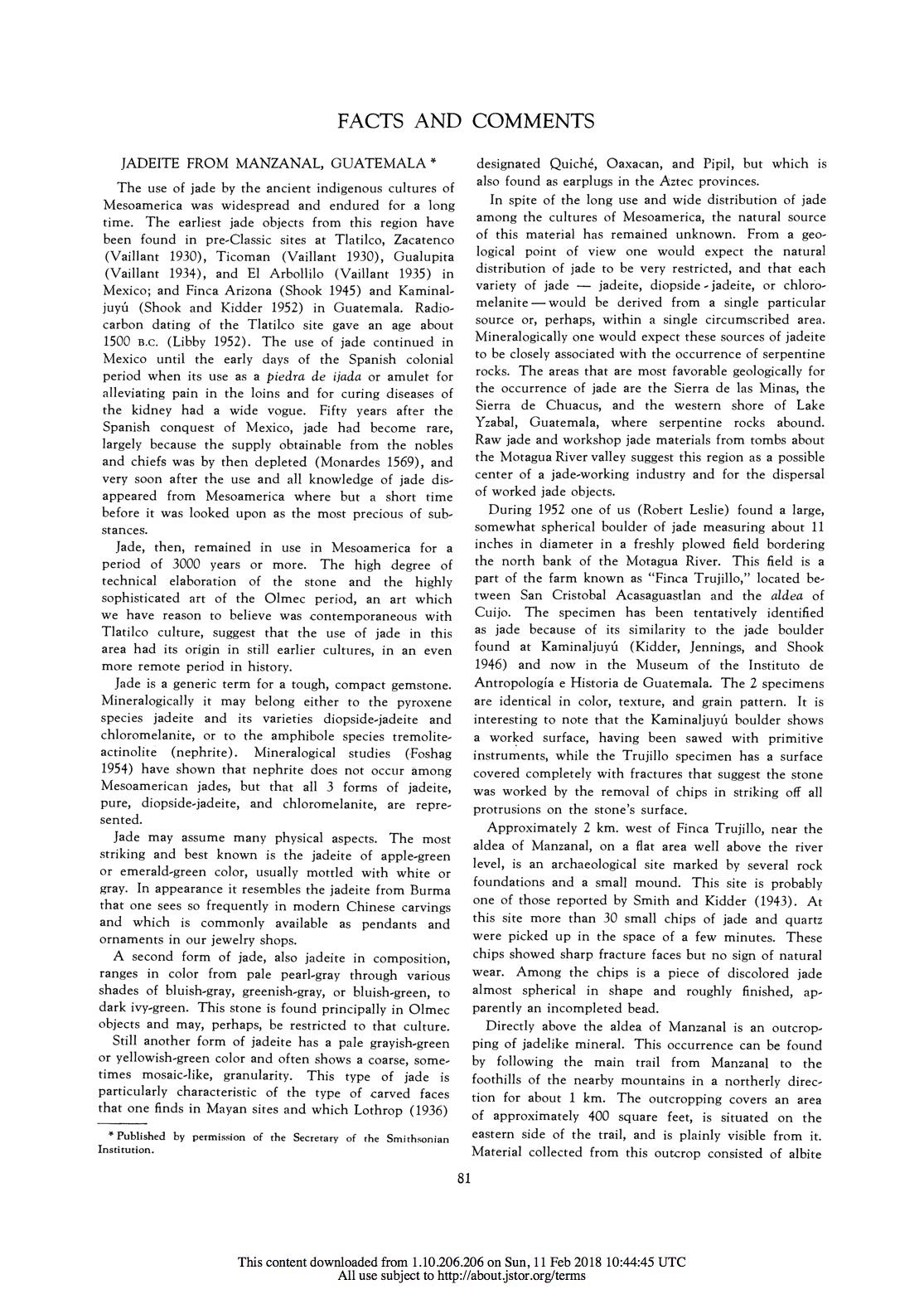
W.F. Foshag and R. Leslie report the identification of a natural jadeite occurrence near Manzanal in Guatemala’s Motagua River valley, providing evidence for a local source of material used by ancient Mesoamerican cultures. They place the discovery within a tradition of jade use extending over at least three millennia, from pre-Classic communities through the early Spanish colonial period, and distinguish jadeite and its associated varieties from nephrite, which their mineralogical studies had not identified among Mesoamerican jades. Geological associations with serpentine and archaeological discoveries of raw and partly worked jade had already suggested the Motagua region as a promising source area. In 1952, Leslie found an approximately eleven-inch boulder at Finca Trujillo whose colour, texture, and grain pattern resembled a worked jade boulder from Kaminaljuyú. Nearby archaeological remains yielded numerous angular chips of jade and quartz and an apparently unfinished bead, suggesting local stoneworking. Approximately one kilometre north of Manzanal, an outcrop covering about 400 square feet supplied albite containing amphibole or jadeite inclusions, together with a substantial specimen of jadeite. The jadeite is pale green, granular, and composed principally of interlocking prismatic crystals, with occasional radiating arrangements and a mosaic pattern visible on polished surfaces. Its appearance closely resembles material used for carved Maya faces, particularly examples associated with Guatemala’s Quiché region. Petrographic measurements gave minimum and maximum refractive indices of 1.654 and 1.669, respectively, consistent with jadeite. Chemical analysis of material purified by heavy-liquid separation further confirmed the identification. Comparisons with jadeite from Kaminaljuyú, a Mexican archaeological specimen, and Burma demonstrate broad mineralogical similarity, although the authors lacked an analysis of the particular pale-green archaeological material most closely resembling the Manzanal stone. Abundant angular fragments around the occurrence suggest that it may have supplied prehistoric makers of figurines, ear ornaments, and beads, but the authors explicitly reserve confirmation of ancient exploitation for archaeological investigation. The principal result is the establishment of jadeite within Mesoamerica itself, which they regard as removing the remaining need to explain American jade through importation from Asia.

Asterism in corundum

Journal Article
Tait, A.S. (1955) Asterism in corundum. Journal of Gemmology, Vol. 5, No. 2, April, pp. 65–72.
Record No. 1674  |  ISBN/ISSN: 221252  |  Sinkankas/Born No.: NIS/NIB  |  RWHL
A.S. Tait investigates the cause of asterism in corundum, testing competing explanations involving twinning lamellae, microscopic cavities, and regularly arranged solid inclusions. The study draws on extensive rough and cut material from Montana, North Carolina, Ceylon, Siam, Burma, and Queensland, with basal thin sections permitting examination of inclusion arrangements in transmitted and reflected light without the distortion introduced by curved gemstone surfaces. Microscopic observations show that star-producing material contains rodlike or needlelike inclusions arranged in the basal plane, parallel to the hexagonal prism faces and intersecting in three directions at 60°. When these inclusions are sufficiently abundant and evenly distributed, a cabochon cut with its axis parallel to the crystal’s optic axis displays a six-rayed star. Stars formed in water droplets placed on thin sections provide a direct demonstration linking the optical effect to the included material. Tait also identifies a second set of basal inclusions oriented perpendicular to the first-order prism faces. Although generally too sparse to produce visible rays, these offer an explanation for twelve-rayed stars when sufficiently concentrated alongside the principal set. Determining the inclusions’ mineral identity proves more difficult. At magnifications up to 900×, they appear reddish brown in transmitted light and show apparently square cross-sections, suggesting rutile, but their fineness prevents reliable refractive-index measurement. Microchemical analysis and X-ray powder examination fail because the quantity of included material is too small. Spectrographic analysis therefore compares carefully prepared samples ranging from apparently inclusion-free corundum to heavily included star-producing material. The latter contains titanium at approximately 0.001% and iron at approximately 0.009%, with traces of chromium; the apparently inclusion-free material shows aluminium with traces of chromium and iron. Combining the titanium detection with the observed colour and crystal habit, Tait identifies the needles as rutile, excluding other titanium dioxide minerals on morphological grounds. The article concludes that symmetrically oriented rutile needles account for the asterism of the material examined. Photomicrographs further relate optical appearance to inclusion distribution: predominantly one-directional concentrations produce a cat’s-eye effect, localized arrangements restrict where a star can be obtained, and uniformly distributed needles permit star formation across suitably oriented portions of the crystal.

Historical Development of Inclusion Thermometry
Book
Smith, F.G. (1953) Historical Development of Inclusion Thermometry. Toronto, Univ. of Toronto Press, 149 pp.
Record No. 1614  |  Sinkankas/Born No.: NIS/NIB  |  RWHL

Die Steine und Fassungen von Ring und Anhaenger der hl. Hemma aus dem Dome zu Gurk in Kaernten; 1. Teil, Die Steine
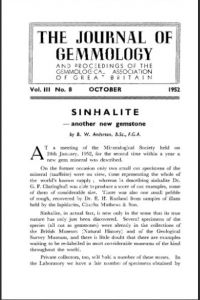
The Stones and Settings of the Ring and Pendant of Saint Hemma from the Cathedral of Gurk in Carinthia; Part 1, The Stones
Journal Article
Meixner and Heinz (1952) Die Steine und Fassungen von Ring und Anhaenger der hl. Hemma aus dem Dome zu Gurk in Kaernten; 1. Teil, Die Steine. [The Stones and Settings of the Ring and Pendant of Saint Hemma from the Cathedral of Gurk in Carinthia; Part 1, The Stones] Carinthia II, Jg. 142 (Car. II, Jg. 62, H. 1), pp. 81–84.
Record No. 4914  |  Sinkankas/Born No.: NIS/NIB  |  Language: in German  |  RWHL
A laboratory examination of an unpolished gemstone from one of the St. Hemma jewels (11th century) of the Gurk cathedral, Carinthia, Austria, showed it to be corundum with rutile inclusions, not yellow quartz (false topaz) as labeled. The source of the stone was probably a Far Eastern locality.

Unusual two and three phase inclusions in Ceylon sapphire
Journal Article
Hoagland, L.P. (1952) Unusual two and three phase inclusions in Ceylon sapphire. Journal of Gemmology, Vol. 3, No. 8, Oct., pp. 330–336.
Record No. 995  |  ISBN/ISSN: 221252  |  Sinkankas/Born No.: NIS/NIB  |  RWHL
At a meeting of the Mineralogical Society held on 24ᵗʰ January, 1952, for the second time within a year a new gem mineral was described. On the former occasion only two small cut specimens of the mineral (taaffeite) were on view, these representing the whole of the world’s known supply; whereas in describing sinhalite Dr. G. F. Claringbull was able to produce a score of cut examples, some of them of considerable size. There was also one small pebble of rough, recovered by Dr. E. H. Rutland from samples of illam held by the lapidaries, Charles Mathews & Son.

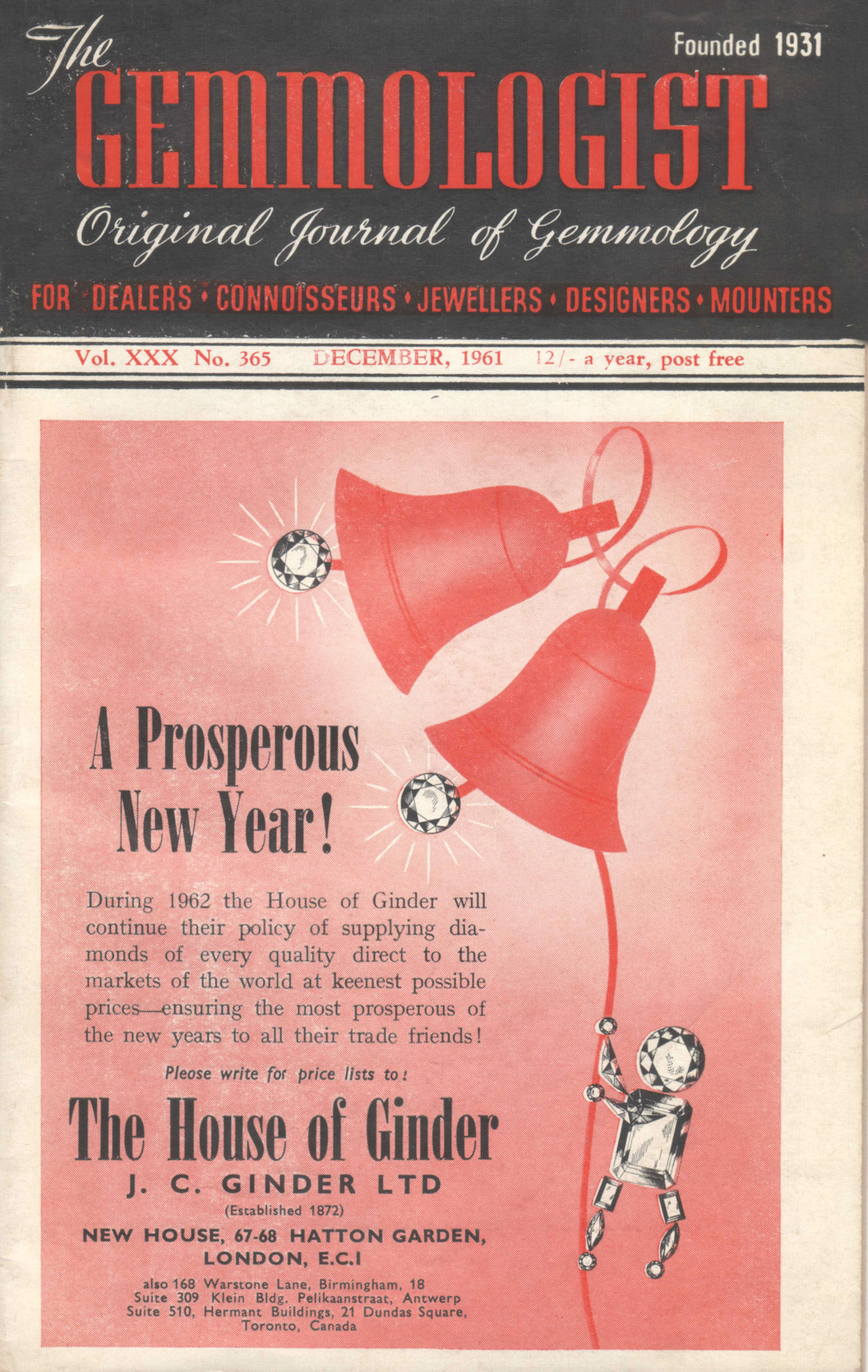
Jadeite of San Benito County, California
Journal Article
Yoder, H.S. and Chesterman, C.W. (1951) Jadeite of San Benito County, California. California Division of Mines, Special Report 10–C, 8 pp..
Record No. 5093  |  Sinkankas/Born No.: NIS/NIB  |  RWHL
Preliminary field investigations conducted in summer 1950 describe jadeite deposits in the Clear Creek area of San Benito County, California, identified as the first occurrences of jadeite in place recognised in the western hemisphere. Eight bodies were located within an oval serpentine mass approximately four by twelve miles across, bordered by Franciscan sandstone and the Upper Cretaceous Panoche formation. Six bodies are lens shaped, completely enclosed by strongly sheared and brecciated serpentine, and no larger than approximately 50 by 200 feet in outcrop. A seventh forms a vein along the contact between serpentine and an enclosed schist block, while an eighth is inferred from float and jadeite-bearing schist near another contact. The lenses commonly exhibit alternating light- and dark-green bands and contain irregular inclusions of natrolite, pectolite, albite, black talcose material and shaly rock. Preliminary examination indicates that much of their jadeite contains a substantial diopside component. Contact assemblages include grossularite, lawsonite, pumpellyite and green amphibole, with locally developed natrolite. The veinlike body can be traced for approximately fifty feet and is generally six to eight inches wide, narrowing locally to two inches. Dark-green margins grade towards a coarser white centre, whose material is exceptionally rich in the jadeite component according to preliminary X-ray work. Branches and smaller veinlets enter the adjacent schist, and analcite commonly lines or fills later fractures and small faults. Complex cross-cutting relationships, apparent brecciation and enclosed patches of contrasting jadeite suggest multiple stages of growth and deformation, although their sequence remains uncertain. The proposed origin involves deformation of serpentine and brittle schist, creation of fractured and open zones, and entry of mineralising fluids, probably residual from the process that produced the serpentine. These fluids are inferred to have deposited an initially more diopsidic pyroxene followed by nearly pure jadeite, with analcite introduced during or after final consolidation. The authors tentatively interpret the vein occurrence, together with contemporary laboratory findings, as evidence that jadeite could form without exceptionally high pressure and at temperatures below approximately 500°C. The studied deposits were considered unlikely to yield high-quality gem material but promising as sources of attractive specimens for collecting and polishing. Additional discoveries were anticipated throughout California’s serpentine belt, with jadeite’s toughness and density offering useful prospecting clues despite its superficial resemblance to serpentine. Verified occurrences elsewhere in California are also briefly listed.

Inclusions in diamond

Journal Article
Gübelin, E.J. (1951) Inclusions in diamond. The Gemmologist, Vol. 20, No. 245, December, pp. 241–243.
Record No. 2039  |  Sinkankas/Born No.: NIS/NIB  |  RWHL

Some additional data on Indian emeralds

Journal Article
Gübelin, E.J. (1951) Some additional data on Indian emeralds. Gems & Gemology, Vol. 7, No. 1, Spring, pp. 13–22, map.
Record No. 2038  |  ISBN/ISSN: 0016626X  |  Sinkankas/Born No.: NIS/NIB  |  RWHL
Gübelin supplements earlier descriptions of Indian emeralds with a detailed examination of four faceted specimens, emphasizing the value of microscopic inclusions for distinguishing their origin. He outlines the discovery and development of emerald deposits in the Aravalli Mountains between Ajmer and Udaipur, particularly near Kaliguman and Bhilwara, where wartime prospecting for beryl and mica revealed emerald-bearing rocks. The emeralds occur in biotite schists associated with hornblende, talcose, and chloritic schists and probable pegmatitic intrusions. Gübelin compares this geological setting with deposits in the Urals, South Africa, and especially Austria’s Habach Valley. His four specimens, weighing 0.70–2.42 carats, display colours comparable to fine Colombian emeralds, although their lustre and visible inclusions vary. Because all were cut stones, he could not examine their original crystal forms directly, but inferred a conventional hexagonal prismatic habit from enclosed negative crystals. Refractive indices range from 1.580 to 1.598, with birefringence of 0.0075–0.009, and specific gravities range from 2.739 to 2.781. These comparatively high values resemble those of emeralds from the Urals and Transvaal but do not independently establish geographic origin. The stones show distinct to strong blue-green and yellow-green dichroism. Lighter specimens exhibit the usual emerald absorption spectrum, whereas darker examples show stronger absorption in the red region. All four remain green through the colour filters tested and are inert under ultraviolet radiation; the two lighter stones exhibit faint dull-red luminescence under X-rays. Gübelin concludes that these physical and optical properties must be supplemented by inclusion evidence. The most characteristic features are liquid-filled negative crystals containing movable gas bubbles, aligned parallel to the emerald’s optic axis. At lower magnification they appear rectangular, square, or comma-shaped; stronger magnification and darkfield illumination reveal their crystalline forms and show that the comma-like outlines arise from groups in which one elongated cavity projects beyond shorter companions. These two-phase inclusions are contrasted with the characteristic three-phase inclusions of Colombian emeralds. A second prominent inclusion type consists of biotite tablets and flakes oriented parallel to the basal plane, often with negative crystals arranged perpendicular to them. Minute actinolite rods and calcite crystals may also occur. The biotite association reinforces the comparison with emeralds from the Urals and Habach Valley, while the combined arrangement and morphology of the inclusions provide the principal distinguishing features described. Through numerous photomicrographs, the article presents an early framework for recognizing Indian emeralds by relating their internal features to their geological environment and measurable gemmological properties.

Gemological Digests: Repeated twinning lines seen in synthetic corundum
Journal Article
Anonymous (1951) Gemological Digests: Repeated twinning lines seen in synthetic corundum. Gems & Gemology, Vol. 7, No. 1, Spring, p. 25.
Record No. 292  |  ISBN/ISSN: 0016626X  |  Sinkankas/Born No.: NIS/NIB  |  RWHL

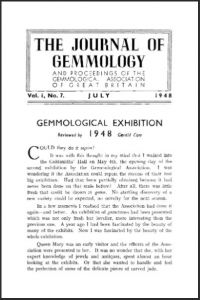
Die diagnostische Bedeutung der Einschlüsse in Edelsteinen
The diagnostic significance of the inclusions in gemstones
Journal Article
Gübelin, E.J. (1948) Die diagnostische Bedeutung der Einschlüsse in Edelsteinen. [The diagnostic significance of the inclusions in gemstones] Schweizerische Mineralogische und Petrographische Mitteilungen, Vol. 28, No. 1, pp. 146–156.
Record No. 2033  |  Sinkankas/Born No.: NIS/NIB  |  Language: in German  |  RWHL
Gübelin reviews the diagnostic value of gemstone inclusions and their significance for understanding mineral formation. Improved dark-field binocular microscopy permits examination of inclusions throughout a faceted stone, revealing characteristic differences in their composition, form, orientation, and distribution. Inclusions are classified both by their timing relative to host-crystal growth and as solid, liquid, or gaseous components. Examples from diamond, corundum, beryl, garnet, tourmaline, spinel, moonstone, and fluorite illustrate their use in gemstone identification and, in some cases, determining geographical origin. Particular attention is given to locality-specific inclusion assemblages in rubies and sapphires, three-phase inclusions in emeralds, and characteristic mineral inclusions in garnets. The paper emphasizes that diagnostic value frequently resides in the overall inclusion pattern and its relationship to crystal structure, rather than in an isolated inclusion. Five plates illustrate representative features. Gübelin advocates closer collaboration between gemmology and mineralogy to advance both practical identification and interpretation of crystal growth.

The diagnostic importance of inclusions in gemstones
Journal Article
Gübelin, E.J. (1948) The diagnostic importance of inclusions in gemstones. Journal of Gemmology, Vol. 1, No. 7, July, pp. 1–23.
Record No. 878  |  ISBN/ISSN: 221252  |  Sinkankas/Born No.: NIS/NIB  |  RWHL
COULD they do it again? It was with this thought in m y mind that I walked into It was with this thought in my mind that I walked into the Goldsmiths' Hall on May 4th ,the opening day of the the Goldsmiths' Hall on May 4th, the opening day of the second exhibition by the Gemmological Association. I was second exhibition by the Gemmological Association. I was wondering if the Association could repeat t h e success of their first wondering if the Association could repeat the success of their first big exhibition. Had that been partially obtained because it had big exhibition. Had that been partially obtained because it had never been done on that scale before? After alll,, there wass little fresh that could be shown in gems. No startling discovery of a new variety could be expected, no novelty for the next season. In a few moments I realised that the Association had done it again and better. An exhibition of gemstones had been presented which was not only fresh butt lovelier, more interesting than the previous one. A year ago I had been fascinated by the beauty off many of the exhibits. Now I was fascinated by the beauty of thee whole exhibition. Queen Mary was an early visitor and the officers of the Association were presented to her. It was no wonder that she, with her expert knowledge of jewels and antiques, spent almost an hour looking at the exhibits. Or that she wanted to handle and feel the perfection of some of the delicate pieces of carved jade.

Spectrochemical and spectrophotometric analyses of rubies and sapphires
Journal Article
Alexander, A.E. (1948) Spectrochemical and spectrophotometric analyses of rubies and sapphires. Journal of Gemmology, Vol. 1, No. 8, October, pp. 4–8.
Record No. 223  |  ISBN/ISSN: 221252  |  Sinkankas/Born No.: NIS/NIB  |  RWHL
Spectrochemical and spectrophotometric investigations of natural and synthetic rubies and sapphires were undertaken to compare their compositions and optical properties and explore possible methods of distinguishing them. For spectrochemical analysis, ruby samples were ground in a boron carbide mortar under acetone to minimise contamination and examined using the Harvey method of semiquantitative analysis. Results for two natural and two synthetic rubies, comprising a light and a dark specimen of each, were expressed as oxide percentages. Alumina constituted 96.5–98.8% of the samples, while chromium oxide ranged from 0.945 to 2.58%, with higher concentrations in the darker specimen of each pair. Silica and minor quantities of copper, cadmium, magnesium, molybdenum and iron were reported in all four specimens. Vanadium was detected in both natural rubies but in neither synthetic ruby. Numerous additional elements, including titanium, were sought but not detected in these four samples. Separate analyses examined the clear core, combined core and outer layers, and outer layers alone of a Linde synthetic star ruby to investigate the material producing asterism. Titanium increased from 0.064% in the core to 0.162% in the outer layers containing dense interlocking crystals. This enrichment supported the suggested identification of the star-producing inclusions as titania, consistent with their microscopic resemblance to rutile needles in natural rubies. Magnesium was also more abundant in the outer layers, whereas chromium concentrations were relatively similar throughout the analysed sections. Spectrophotometric measurements were made with a Hardy recording spectrophotometer on highly polished plates of natural and synthetic ruby and sapphire measuring approximately 2 mm square and 1 mm thick. Visible spectral reflection curves showed broadly similar patterns for natural and synthetic examples of each gem variety, in keeping with their closely comparable chemical and physical properties. Ruby curves exhibited a broad blue-region maximum, a yellow-region minimum and a pronounced rise towards red wavelengths; sapphire curves showed a broad blue-region maximum followed by lower reflection at longer wavelengths. The curves were submitted to Eastman Kodak for investigation of a special filter that might permit rapid differentiation of natural and synthetic corundum. Research remained incomplete, and no wholly satisfactory filter had been obtained.

Inclusions as a means of identification
Journal Article
Gübelin, E.J. (1945–46) Inclusions as a means of identification. Gems & Gemology, Vol. 5, 1945: No. 2, Summer, pp. 226–231 (garnet); No. 3, Fall, pp. 242–247 (garnet); No. 4, Winter, pp. 270–274 (garnet),
Record No. 2029  |  ISBN/ISSN: 0016626X  |  Sinkankas/Born No.: NIS/NIB  |  RWHL

Gemstone inclusions

Journal Article
Gübelin, E.J. (1944–46) Gemstone inclusions. Gems & Gemology, Vol. 4–5, Vol. 4, No. 10, Summer, pp. 142–149 (sapphire); No. 11, Fall, pp. 158–163 (ruby); No. 12, Winter, pp. 174–179 (emerald); Vol. 5, No. 1, Spring, pp. 205–210 (diamond); No. 5, Spring, p. 294; No. 6, Summer, pp. 318–323 (various gems).
Record No. 2027  |  ISBN/ISSN: 0016626X  |  Sinkankas/Born No.: NIS/NIB  |  RWHL

Exploring the Literature of Gemstone Inclusions

The literature of gemstone inclusions covers identification, origin determination, treatments, synthesis, mineral inclusions, fluid inclusions and other internal features of natural and synthetic gems.

For a curated selection of important sources, read Inclusions in Gemstones — Hyperion Literature Sources.

About Four Treasures

Four Treasures is Lotus Gemology's freely accessible gemological reference database. Use the full database to search by author, title or keyword and explore literature on gemology, mineralogy, jewelry and related fields. Where available, hyperlinks on titles may lead directly to the full publication.

Search the Complete Four Treasures Database