Jade Bibliography

Jade Bibliography

Explore books, articles and historical sources on jade in Four Treasures, the Lotus Gemology reference database. This bibliography brings together matching records from the collection, with publication details, abstracts and cover images where available.

Jade References

The list below matches the terms jade, jadeite, nephrite or Fei Cui in the database's searchable fields. Some references discuss these materials as part of a broader subject.
2,961–2,980 of 3,819 matching references

Jade

Journal Article
Anonymous (1888) Jade. The Decorator and Furnisher, Vol. 12, No. 1, pp. 16–17.
Record No. 3416  |  ISBN/ISSN: 21506256  |  Sinkankas/Born No.: NIS/NIB  |  RWHL
The anonymous article surveys jade as both a mineral substance and a highly valued material for decorative art, emphasizing its exceptional toughness, durability, and suitability for laborious carving and polishing. It discusses the principal varieties recognized as jade, their colors and physical characteristics, and the particular esteem in which the material was held in China, where skilled craftsmen fashioned it into vessels, ornaments, personal objects, and elaborate carvings. Attention is also given to the difficulty and slow nature of working jade, which contributed substantially to the value of finished pieces, and to the appreciation of variations in color and translucency by collectors. The article provides a useful late nineteenth-century popular account of jade and of the growing Western interest in Chinese jade carvings as objects of decorative art.

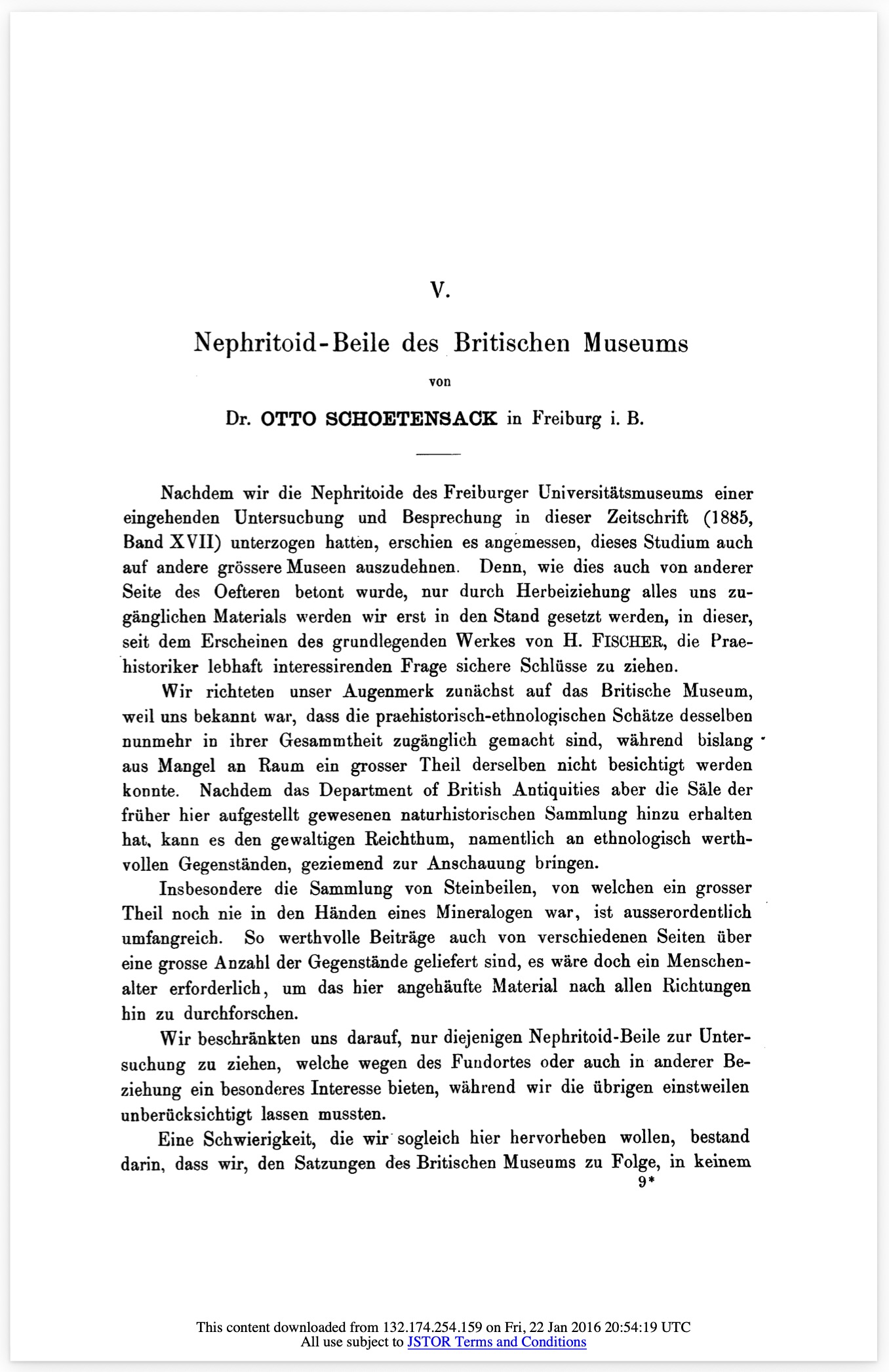
Nephritoid-Beile des Britischen Museums
Nephrite-like axes of the British Museum
Journal Article
Schoetensack, O. (1887) Nephritoid-Beile des Britischen Museums. [Nephrite-like axes of the British Museum] Zeitschrift für Ethnologie, Vol. 19, pp. 119–148.
Record No. 28802  |  ISBN/ISSN: 442666  |  Sinkankas/Born No.: 5854 (not seen)/NIB  |  Language: in German  |  RWHL
After we had subjected the nephritoids of the Freiburg University Museum to a detailed examination and discussion in this journal (1885, Vol. XVII), it appeared appropriate to extend this study to other major museums as well. For, as has often been emphasized by others, only through the inclusion of all accessible material shall we finally be placed in a position to draw secure conclusions regarding this question, which since the appearance of the fundamental work of Heinrich Fischer has so vividly interested prehistorians. We directed our attention first to the British Museum because it was known to us that its prehistoric-ethnological treasures had now been made accessible in their entirety, whereas previously, owing to lack of space, a large part of them could not be inspected. Since the Department of British Antiquities has now acquired the halls formerly occupied by the natural history collections, it has been able to display appropriately its enormous wealth, particularly of ethnologically valuable objects. Especially the collection of stone axes, a large part of which had never yet passed through the hands of a mineralogist, is extraordinarily extensive. Valuable contributions concerning a great number of these objects have indeed already been made from various quarters, yet it would require a lifetime to investigate in every respect the mass of material accumulated here.

Ueber einen neuen Fund von anstehendem Nephrit bei Reichenstein in Schlesien
About a new find of upcoming nephrite near Reichenstein in Silesia
Journal Article
Traube, H. (1887) Ueber einen neuen Fund von anstehendem Nephrit bei Reichenstein in Schlesien. [About a new find of upcoming nephrite near Reichenstein in Silesia] Neues Jahrbuch für Mineralogie, Geologie und Paläontologie, Vol. 2, pp. 275–278.
Record No. 7598  |  Sinkankas/Born No.: NIS/NIB  |  Language: in German  |  RWHL
Traube reports the discovery of a new occurrence of in situ nephrite near Reichenstein in Silesia (now Złoty Stok, Poland), providing further evidence that nephrite occurs naturally in Europe rather than solely as transported archaeological material. The discovery followed his earlier identification of in situ nephrite at Jordansmühl in Lower Silesia and was significant to the contemporary “nephrite question,” the debate over whether European prehistoric nephrite objects necessarily represented material imported from distant Asian sources. Traube describes the Reichenstein occurrence in its geological setting and establishes it as another natural Silesian source of nephrite, strengthening the case for indigenous European deposits capable of supplying at least some prehistoric nephrite artifacts.

On jade and jadeite

Journal Article
Kunz, G.F. (1887) On jade and jadeite. Transactions of the New York Academy of Sciences, Vol. 6, pp. 139–141.
Record No. 6909  |  Sinkankas/Born No.: NIS/NIB  |  RWHL
Kunz discusses jade and jadeite, their mineralogical distinctions, geographical occurrence, and use for ornamental and archaeological objects. He considers the confusion historically surrounding the term “jade,” distinguishing nephrite from jadeite and noting differences in their composition and physical properties. Attention is given to the occurrence and use of these materials in China and other regions and to the problem of determining the sources of jade objects found far from known deposits. The paper reflects the growing late nineteenth-century application of mineralogical analysis to ethnological and archaeological questions concerning jade artifacts and their distribution.

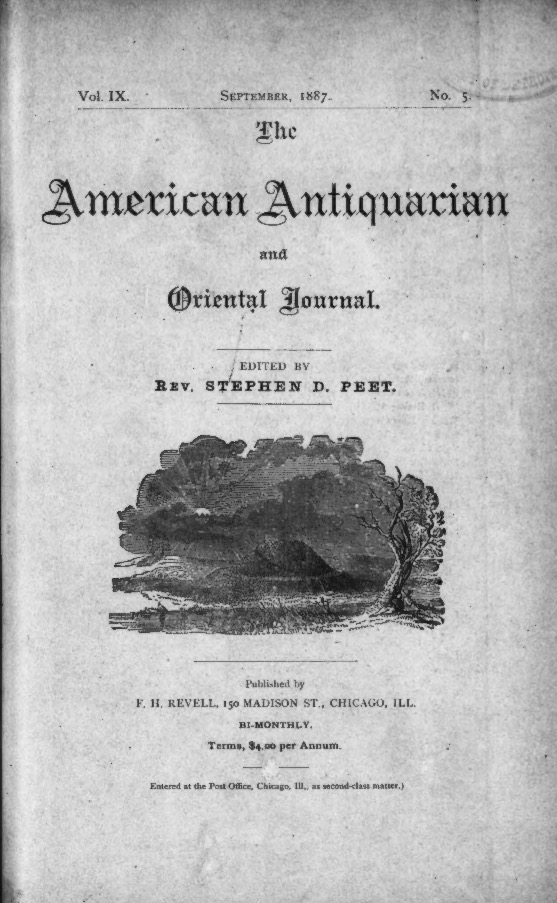
The green stone axe: Is it a “chalchihuatl?”
Journal Article
Peet, S.D. (1887) The green stone axe: Is it a “chalchihuatl?”. American Antiquarian and Oriental Journal, Vol. 9, No. 5, September, pp. 317–319.
Record No. 6908  |  Sinkankas/Born No.: NIS/NIB  |  RWHL
Discusses a gigantic jadeite votive adze from Oaxaca brought to a meeting by G.F. Kunz.

Note on the occurrence of jade in British Columbia and its employment by the natives
Journal Article
Dawson, G.M. (1887) Note on the occurrence of jade in British Columbia and its employment by the natives. Canadian Record of Science, Vol. 2, No. 6 April, pp. 364–378.
Record No. 6851  |  Sinkankas/Born No.: 1600  |  RWHL
Includes an English translation of Über Nephrit und ähnliches Material aus Alaska. With quotations and extracts from a paper by Prof. A. B. Meyer on nephrite and analogous minerals from Alaska. Canadian Record of Science 2(6), April 1887, pp. 364–379, with figures; also issued separately. The source of the nephrite was apparently boulders and pebbles found in the gravels of the Fraser River. These, together with similar materials, including pectolite, are described, along with remarks on methods of sectioning using abrasives. Dawson believed that nephrite would eventually be found in situ in British Columbia within highly altered basic rocks. Most of the article is devoted to Meyer’s paper, from which extracts are reproduced concerning nephrite artefacts collected from Indigenous peoples during various explorations in the sub-Arctic region. Meyer noted that one explorer obtained a piece of rough nephrite from a Native informant who claimed it came from northwestern Alaska, possibly from the now well-known Kobuk River source.

Medieval Researches from Eastern Asiatic Sources
Book
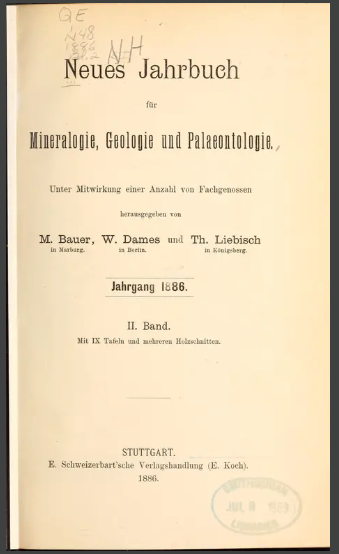
Bretschneider, E. (1887) Medieval Researches from Eastern Asiatic Sources. London, Kegan Paul, Trench, Trübner and Co., 2 Vols., 334, 352 pp.
Record No. 2717  |  Sinkankas/Born No.: NIS/NIB  |  RWHL
Mediæval Researches from Eastern Asiatic Sources is a famous two-volume work by the physician and sinologist E. Bretschneider. First published in London in 1888, it collects translated fragments and notes from Chinese and Asian texts. The book explores the history and geography of Central and Western Asia from the 13th through the 17th century. Bretschneider brings together historical and geographical studies derived principally from Chinese and other East Asian sources, using them to reconstruct medieval knowledge of Central and Western Asia and relations between China and regions farther west. The work examines Chinese accounts of peoples, countries, routes, embassies, conquests, and commerce, particularly during the Mongol period, and compares Chinese records with Persian, Arabic, and European sources. Detailed discussions cover Central Asia, Turkestan, Persia, Afghanistan, India, and adjoining regions, including geographical names, travel routes, commodities, and mineral products. For gemological research the work is valuable for its translations and interpretations of Chinese references to precious stones, spinel, lapis lazuli, turquoise and jade, particularly materials associated with Khotan and other Central Asian regions, and for documenting the historical routes by which these materials reached China.

Obituary: Leopold Heinrich Fischer

Journal Article
Rosenbusch, H. (1886) Obituary: Leopold Heinrich Fischer. Neues Jahrbuch für Mineralogie, Geologie und Palaeontologie, Vol. 2, pp. 1–7.
Record No. 29412  |  Sinkankas/Born No.: NIS/NIB  |  Language: in German  |  RWHL
Rosenbusch commemorates Leopold Heinrich Fischer (1817–1886), reviewing his life, academic career, and scientific work. Particular attention is given to Fischer’s mineralogical and petrographic investigations and to his extensive studies of prehistoric stone implements, especially objects described as nephrite, jadeite, and related materials. The obituary discusses Fischer’s efforts to apply mineralogical methods to archaeological questions, including the identification and geographical distribution of jade implements, and assesses his contributions to mineralogy, petrography, and prehistoric archaeology.

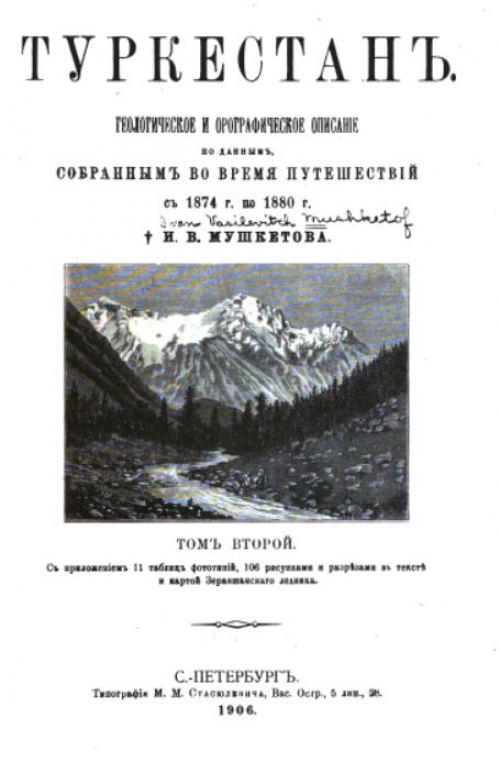
Turkestan. Geological and Orographical Description According to Data Collected During the Journeys from 1874 to 1880. Vol. 1.
Туркестан. Геологическое и орографическое описание по данным собранным во время путешествий с 1874 и 1880. Том 1
Book
Mushketov, I.V. (1886) Turkestan. Geological and Orographical Description According to Data Collected During the Journeys from 1874 to 1880. Vol. 1. [Туркестан. Геологическое и орографическое описание по данным собранным во время путешествий с 1874 и 1880. Том 1], 2 Vols., 748, 348 pp.
Record No. 28793  |  Sinkankas/Born No.: 4673  |  Language: in Russian  |  RWHL
Mushketov presents a comprehensive geological and orographical description of Russian Turkestan based largely on his extensive field journeys between 1874 and 1880. Volume 1 reviews the history of exploration of Turkestan and treats the Turanian or Aral basin, combining observations on physical geography, relief, stratigraphy, tectonics, hydrology, and the geological development of Central Asia. The work incorporates results from the Tian Shan, Pamir, and Amu Darya regions and was regarded at publication as an important synthesis of the rapidly developing geological knowledge of Central Asia. The 1886 first volume actually comprises XXVI + 742 pages; the second geological volume, including the Pamir-Alai and mineral deposits, was published posthumously in 1906 and contains XVI + 348 pages. Sinkankas: The collected works of Mushketov include essentially the same material noted in the previous entry in Ch. 10, p. 365–99, with the same col. litho. pl. of nephrite thin-sects, tissued, 2 tinted view pls. (Tamerlane’s tomb), and omitting the previous map of jade occurrences but substituting therefor a large, full-col. fold map (53 x 38.5 cm) of the geology of the Turkestan Basin showing thereon routes taken by various explorers, including the author.

Begleitworte zu der Karte über die geographische Verbreitungder Beile aus Nephrite, Jadeit und Chloromelanit in Europa. Mit Karte von E. v Tröltsch
Accompanying notes to the map on the geographical distribution of axes made of nephrite, jadeite, and chloromelanite in Europe. With a map by E. von Tröltsch
Journal Article
Fischer, H. (1886) Begleitworte zu der Karte über die geographische Verbreitungder Beile aus Nephrite, Jadeit und Chloromelanit in Europa. Mit Karte von E. v Tröltsch. [Accompanying notes to the map on the geographical distribution of axes made of nephrite, jadeite, and chloromelanite in Europe. With a map by E. von Tröltsch] Archiv für Anthropologie, Vol. 16, pp. 563–590, map.
Record No. 16669  |  Sinkankas/Born No.: 2132  |  Language: in German  |  RWHL
From the compilations of discovery sites of axes made from the three minerals mentioned above¹, which I published with Mr. A. Damour in Paris in the article Notice sur la distribution géographique des haches et autres objets préhistoriques en jade néphrite et en jadéite in the Revue archéologique de France, Paris, July 1878 (23 pages), and later in a German version in the Correspondence Sheet of the German Anthropological Society, 1879, No. 3, March, pp. 17–23 (see also my Overview of Nephrite, Jadeite, and Chloromelanite Axes Found in Museums, in the Correspondence Sheet, 1880, No. 3), I have recently received, through written correspondence from Mr. Damour, a significant number of additional French discovery sites. For some of these, however, only the department could be specified, not the exact locality; this, of course, does not detract in the slightest from the importance of the findings themselves.²

Note sur le professeur Dr Fischer

Note on Professor Dr. Fischer
Journal Article
Damour, A. (1886) Note sur le professeur Dr Fischer. [Note on Professor Dr. Fischer] Bulletin de la Société Française de minéralogie, No. 2, pp. 25–29.
Record No. 6821  |  Sinkankas/Born No.: NIS/NIB  |  Language: in French  |  RWHL
Obituary of the famous German jadeologist, Heinrich Fischer.

Ueber Nephrit und Jadeït. Ein Stück südamerikanischer Vorgeschichte
On Nephrite and Jadeite. A piece of South American prehistory
Journal Article
Netto, L. and Müller, F. (1886) Ueber Nephrit und Jadeït. Ein Stück südamerikanischer Vorgeschichte. [On Nephrite and Jadeite. A piece of South American prehistory] Zeitschrift für Ethnologie, Vol. 18, pp. 85–95.
Record No. 6794  |  Sinkankas/Born No.: NIS/NIB  |  Language: In German  |  RWHL
Netto and Müller discuss nephrite and jadeite in the context of South American archaeology, examining worked stone objects and the problem of identifying their mineralogical materials and geographical sources. They consider the occurrence and distribution of nephrite- and jadeite-like artifacts in South America and their implications for prehistoric trade, cultural contacts, and the movement of valued stone materials. The paper combines mineralogical identification with archaeological and ethnological evidence in an attempt to clarify the role and provenance of jade materials in South American prehistory.

A Record of Buddhistic Kingdoms

Book
Fa-hsien (1886) A Record of Buddhistic Kingdoms. Oxford, Clarendon Press, (Ceylon, pp. 101–107)
Record No. 2754  |  Sinkankas/Born No.: NIS/NIB  |  RWHL
Annotated English translation of the Chinese Buddhist pilgrim Fa-hsien’s account of his travels in India and Ceylon during AD 399–414. The Ceylon passages describe pearls and precious stones from neighbouring islands, including a pearl-producing island guarded by the king, who claimed three-tenths of the yield. They also record precious materials used in Buddhist monuments, a Buddha image described by Legge as jade and holding a priceless pearl, and gems accumulated in monastic treasuries. Combining travel observations with religious traditions and local legends, the narrative provides early evidence of the commercial and devotional importance of gems in Ceylon. Legge’s renderings of the precious materials should not be treated as secure modern mineral identifications.

Analysis of a specimen of jade from Mogaung, found in the Palace at Mandalay
Journal Article
White, J.T.O. (1886) Analysis of a specimen of jade from Mogaung, found in the Palace at Mandalay. The Chemical News and Journal of Physical Science, Vol. 54, p. 20.
Record No. 2014  |  Sinkankas/Born No.: NIS/NIB  |  RWHL
Early chemical analysis of fei cui looted by the British at Mandalay Palace.

Nephrit von Jordansmühl in Schlesien. Magnetismus des Tigerauges. Topas von Ouro preto
Nephrite from Jordansmühl in Silesia. Magnetism of tiger’s-eye. Topaz from Ouro Preto
Journal Article
Kenngott, A. (1885) Nephrit von Jordansmühl in Schlesien. Magnetismus des Tigerauges. Topas von Ouro preto. [Nephrite from Jordansmühl in Silesia. Magnetism of tiger’s-eye. Topaz from Ouro Preto] Neues Jahrbuch für Mineralogie, Geologie und Paläontologie, II. Band, pp. 239–240.
Record No. 7599  |  Sinkankas/Born No.: NIS/NIB  |  Language: in German  |  RWHL
Three short mineralogical communications concerning nephrite from Jordansmühl in Silesia, the magnetic behavior of tiger’s-eye, and topaz from Ouro Preto, Brazil.

Ueber den Nephrit von Jordansmühl in Schlesien
About the nephrite of Jordansmühl in Silesia
Journal Article
Traube, H. (1885) Ueber den Nephrit von Jordansmühl in Schlesien. [About the nephrite of Jordansmühl in Silesia] Neues Jahrbuch für Mineralogie, Geologie und Paläontologie, Supplementary Vol. 3, No. 2, pp. 412–427.
Record No. 7595  |  Sinkankas/Born No.: NIS/NIB  |  Language: in German  |  RWHL
Traube describes the discovery and mineralogical investigation of nephrite occurring in situ at Jordansmühl in Silesia (now Jordanów Śląski, Poland), an important European occurrence because it demonstrated a natural local source for a material previously known largely from prehistoric implements and distant Asian deposits. The nephrite occurs in close association with serpentine, with the adjoining rocks showing alteration involving epidote and zoisite. Traube examines the physical, microscopic, and geological characteristics of the material and argues that the occurrence is a genuine natural nephrite deposit rather than transported material. The discovery was significant to the contemporary “nephrite question”—the debate over whether European prehistoric nephrite objects were made from indigenous stone or imported from Asia. Traube notes, however, that the Jordansmühl occurrence had only recently been exposed by deep quarrying and therefore could not itself have supplied the prehistoric nephrite implements found in Europe.

Über Nephrit und ähnliches Material aus Alaska
About nephrite and similar materials from Alaska
Journal Article
Meyer, A.B. (1885) Über Nephrit und ähnliches Material aus Alaska. [About nephrite and similar materials from Alaska] Jahresbericht (xxi) des Vereins für Erdkunde zu Dresden, Vol. 21, pp. 3–21.
Record No. 6917  |  Sinkankas/Born No.: 4430; NIB  |  Language: in German  |  RWHL
Sinkankas: Worked and raw nephrites from Alaska, obtained by various explorers and visitors from the natives, appear to confirm Meyer’s view that the material is obtained locally and was not imported via the suggested Siberia–Alaska route from Asia. One of the explorers reported that natives told him of deposits of nephrite at some unspecified place in the extreme northwest portion of Alaska (probably the Kobuk River deposits). Substantial parts of this paper were translated and quoted by G. M. Dawson in his “Note on the occurrence of jade in British Columbia, etc.” Canadian Science, 1887, which see.

Our Burmese Wars and Relations with Burma
Book
Laurie, W.F.B. (1885) Our Burmese Wars and Relations with Burma. London, W.H. Allen, 487 pp.
Record No. 2818  |  Sinkankas/Born No.: NIS/NIB  |  RWHL
Laurie provides a historical account of British military and political relations with Burma, concentrating on the First Burmese War of 1824–1826 and the Second Burmese War of 1852–1853, while extending the narrative through subsequent events to 1879 and the early reign of King Theebaw. Drawing on official dispatches, military narratives, and contemporary accounts, he describes campaigns, battles, diplomacy, annexations, and the development of British administration in Arakan, Tenasserim, and Pegu. The later sections broaden the work beyond military history to include information on population, revenue, commerce, communications, and the trade routes linking Mandalay, Bhamo, Yunnan, and China, as well as an assessment of the economic and strategic value of Upper Burma. Although not principally a gemological work, it provides useful historical and commercial background for understanding Burma immediately before the British annexation of Upper Burma and the subsequent opening of the country’s important ruby and jade-producing regions to intensified European investigation and trade.

Handbook of Engraved Gems

Book
King, C.W. (1885) Handbook of Engraved Gems. London, George Bell and Sons, 286 pp.
Record No. 2803  |  Sinkankas/Born No.: 3404  |  RWHL
Sinkankas: As in the first edition, the history chapter (pp. 1–133) is the lengthiest. It is followed by sections on famous rings and signets, cabinets of gems, descriptions of plates, and the catalog of artists. There are many changes and additions: the poem of Christodorus is omitted; the plates are entirely new, although in most cases the same gems are illustrated, now classified as Assyrian, Parthian, Sassanian, Indo-Sassanian, Sassanian-Christian, Egyptian, Gnostic, Christian, Phoenician, Etruscan, Greek, etc., with plates illustrating the Apotheosis of Augustus cameo and several other very large cameos, as well as Roman, Medieval, and Renaissance gems. Among the plates are a cameo of jade from Mexico and the “Emerald Vernicle,” or representation of Christ. Another issue differed in omitting the folding frontispiece and substituting the plate formerly tipped in to face p. [1]; the text description, however, was not altered, and the plate itself still bears the note stating that it is to face that page. As usual, both versions appear most commonly in poor condition.

Notes on Ancient Stone Implements, &c., of Japan

Book
Kanda, T. (1884) Notes on Ancient Stone Implements, &c., of Japan. Tokyo, Kokubunsha, 129 pp.
Record No. 16469  |  Sinkankas/Born No.: NIS/NIB  |  RWHL
Kanda describes ancient stone implements and related archaeological objects from Japan, discussing their forms, materials, manufacture, geographical distribution, and probable uses. The work includes axes, arrowheads, ornaments, and other artifacts and compares specimens from different Japanese localities. Particular attention is given to the identification of the stones from which the objects were made, including jade and related materials, making the work relevant to the early study of Japanese jade artifacts. It provides an important nineteenth-century record of Japanese prehistoric stone objects at a formative period in the development of archaeology in Japan.

Exploring the Literature of Jade

Jade literature spans gemology, mineralogy, archaeology, art history, mining, carving and connoisseurship, and includes works on both jadeite and nephrite from around the world.

For an introduction to collecting books on this subject, read Hidden Treasure — Collecting the Literature of Jade.

About Four Treasures

Four Treasures is Lotus Gemology's freely accessible gemological reference database. Use the full database to search by author, title or keyword and explore literature on gemology, mineralogy, jewelry and related fields. Where available, hyperlinks on titles may lead directly to the full publication.

Search the Complete Four Treasures Database