Jade Bibliography

Jade Bibliography

Explore books, articles and historical sources on jade in Four Treasures, the Lotus Gemology reference database. This bibliography brings together matching records from the collection, with publication details, abstracts and cover images where available.

Jade References

The list below matches the terms jade, jadeite, nephrite or Fei Cui in the database's searchable fields. Some references discuss these materials as part of a broader subject.
2,981–3,000 of 3,819 matching references

On the source of the jadeite implements of the Alaskan Inuits
Journal Article
Nelson, E.W. (1884) On the source of the jadeite implements of the Alaskan Inuits. Proceedings of the United States National Museum, 1883, Vol. 6, pp. 426–427.
Record No. 4340  |  Sinkankas/Born No.: NIS/NIB  |  RWHL
Nelson discusses the source of the jadeite implements used by the Inuit of Alaska, drawing upon information obtained during his travels and collections in the region. He considers the geographical origin of the raw material and the routes by which it may have reached the communities that fashioned it into implements. The brief paper contributes to the nineteenth-century debate over whether Alaskan jade objects were made from locally available material or obtained through trade and is an early ethnographic account of the procurement and distribution of jade used by Alaskan Inuit.

Nephrit aus dem Sannflusse, Untersteiermark
Nephrite from the Sannflusse, Lower Styria (Slovenia)
Journal Article
Berwerth, F.M. (1883) Nephrit aus dem Sannflusse, Untersteiermark. [Nephrite from the Sannflusse, Lower Styria (Slovenia)] Mitteilungen der Anthropologischen Gesellschaft in Wien, Vol. 13, pp. 213–215.
Record No. 16965  |  Sinkankas/Born No.: NIS/NIB  |  Language: in German  |  RWHL
Berwerth reports the occurrence of nephrite from the Sann River (present-day Savinja River) in Lower Styria, now Slovenia. He describes the material and its mineralogical characteristics and discusses its identification as nephrite in relation to similar material known from other European localities. The occurrence was of particular interest because contemporary debate centered on whether nephrite objects found at European prehistoric sites had been manufactured from indigenous material or from jade imported over long distances. The paper thus provides evidence relevant to the nineteenth-century discussion of European nephrite sources and the provenance of prehistoric jade implements.

Brockhaus' conversations-lexikon. Allgemeine deutsche real-encyklopädie
Brockhaus' conversation dictionary. General German real encyclopedia
Book
Brockhaus, F.A. (1883) Brockhaus' conversations-lexikon. Allgemeine deutsche real-encyklopädie. [Brockhaus' conversation dictionary. General German real encyclopedia] Leipzig, F.A. Brockhaus, 948 pp.
Record No. 8080  |  Sinkankas/Born No.: NIS/NIB  |  Language: in German  |  RWHL
Brockhaus’ Conversations-Lexikon is a general German-language encyclopedia covering geography, history, biography, science, technology, literature, art, politics, and other fields of contemporary knowledge. Its mineralogical entries include descriptions of minerals and gemstones, their physical properties, composition, occurrence, uses, and terminology, reflecting late nineteenth-century scientific understanding. Entries relating to precious stones and ornamental materials provide a useful contemporary reference for German gemological and mineralogical nomenclature and for prevailing knowledge of their sources and characteristics.

Ein neue Fundort von Nephrit in Asien
A new location of nephrite in Asia
Journal Article
Meyer, A.B. (1883) Ein neue Fundort von Nephrit in Asien. [A new location of nephrite in Asia] Sitzungsberichte Abhandlungen der naturwissenschaftlichen Gesellschaft Isis in Dresden, Vol. 9, pp. 75–76, plate and map.
Record No. 7204  |  Sinkankas/Born No.: NIS, NIB  |  Language: in German  |  RWHL
Meyer reports a newly recognized occurrence of nephrite in Asia, describing the locality and the material obtained there. He discusses the identification of the stone as nephrite and its geographical and geological occurrence, accompanied by a plate and map showing the material and its source. The discovery is considered in relation to the broader question of the geographical distribution of nephrite and the possible sources of Asian jade objects. The brief paper contributes to the nineteenth-century debate over nephrite provenance and the extent to which worked jade could be connected with known natural deposits.

Über jadeit

About jadeite
Journal Article
Krenner, J.A. (1883) Über jadeit. [About jadeite] Neues Jahrbuch für Mineralogie, Geologie und Paläontologie, Vol. 2, pp. 173–174.
Record No. 7105  |  Sinkankas/Born No.: NIS/NIB  |  Language: in German  |  RWHL
Krenner discusses jadeite, with particular attention to its mineralogical identification and crystallographic characters. He comments on the properties by which jadeite may be distinguished from related minerals and considers observations on specimens then available for study. The brief note contributes to the late nineteenth-century investigation of jadeite as a distinct mineral species and to contemporary efforts to distinguish it from nephrite and other materials historically included under the general name jade.

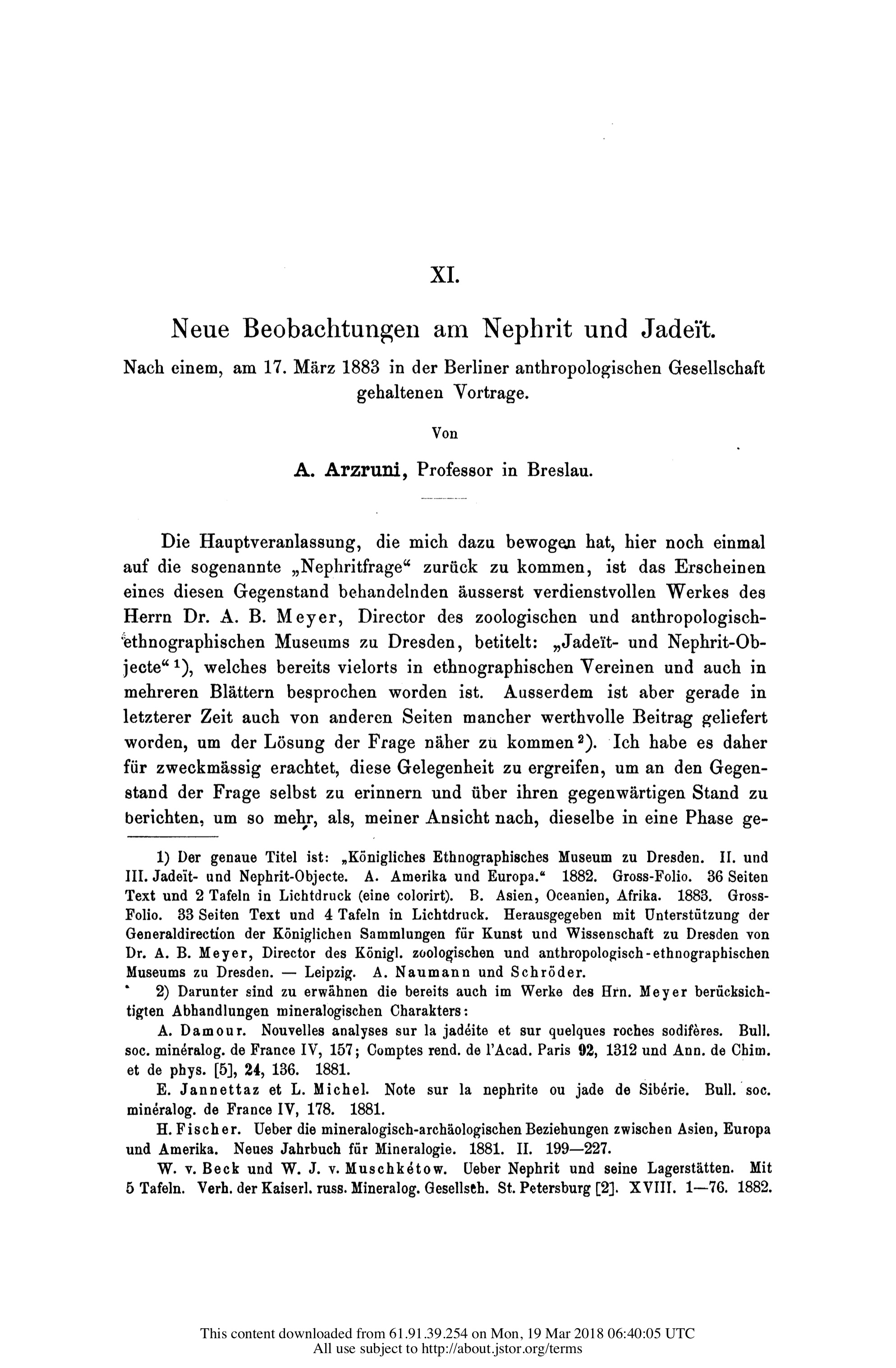
Neue Beobachtungen Am Nephrit Und Jadeït. Nach Einem, Am 17. März 1883 in Der Berliner Anthropologischen Gesellschaft Gehaltenen Vortrage
New Observations On Nephrite And Jadeït. After One, On The 17th Lectures held in the Berlin Anthropological Society in March 1883
Journal Article
Arzruni, A. (1883) Neue Beobachtungen Am Nephrit Und Jadeït. Nach Einem, Am 17. März 1883 in Der Berliner Anthropologischen Gesellschaft Gehaltenen Vortrage. [New Observations On Nephrite And Jadeït. After One, On The 17th Lectures held in the Berlin Anthropological Society in March 1883] Zeitschrift für Ethnologie, Vol. 15, pp. 163–190.
Record No. 5684  |  ISBN/ISSN: 442666  |  Sinkankas/Born No.: 224; NIB  |  Language: in German  |  RWHL
Sinkankas: This work examines the arguments surrounding the “jade question,” namely whether jade artefacts found in many parts of the world can be traced to a common source. Arzruni points out that existing petrographic techniques make it possible to examine the fine structure of both nephrite and jadeite and thereby establish similarities and differences among specimens. He collected samples from numerous widely separated localities, examined them, and determined that although some specimens from certain areas appeared to have been derived from a common deposit, no evidence was found for a single deposit common to all sources. The study provides descriptions of the specimens, information on the institutions from which they were obtained, and the results of the investigations. Arzruni concludes that the “common source” theory is untenable.

Über Jadeite aus Ostasien

On jadeite from East Asia
Journal Article
Fischer, H. (1883) Über Jadeite aus Ostasien. [On jadeite from East Asia] Neues Jahrbuch für Mineralogie, Geologie und Paläontologie, Vol. 2, p. 92.
Record No. 5074  |  Sinkankas/Born No.: NIS/NIB  |  Language: in German  |  RWHL
Fischer reports briefly on jadeite from East Asia, discussing specimens identified as jadeite and their significance for the study of Asian jade. He considers the mineralogical identification of the material in relation to nephrite and to the growing recognition that objects traditionally grouped together as jade could consist of distinct minerals. The note contributes to Fischer’s broader investigations of jadeite and nephrite and to the nineteenth-century debate concerning the composition, geographical distribution, and sources of East Asian jade materials.

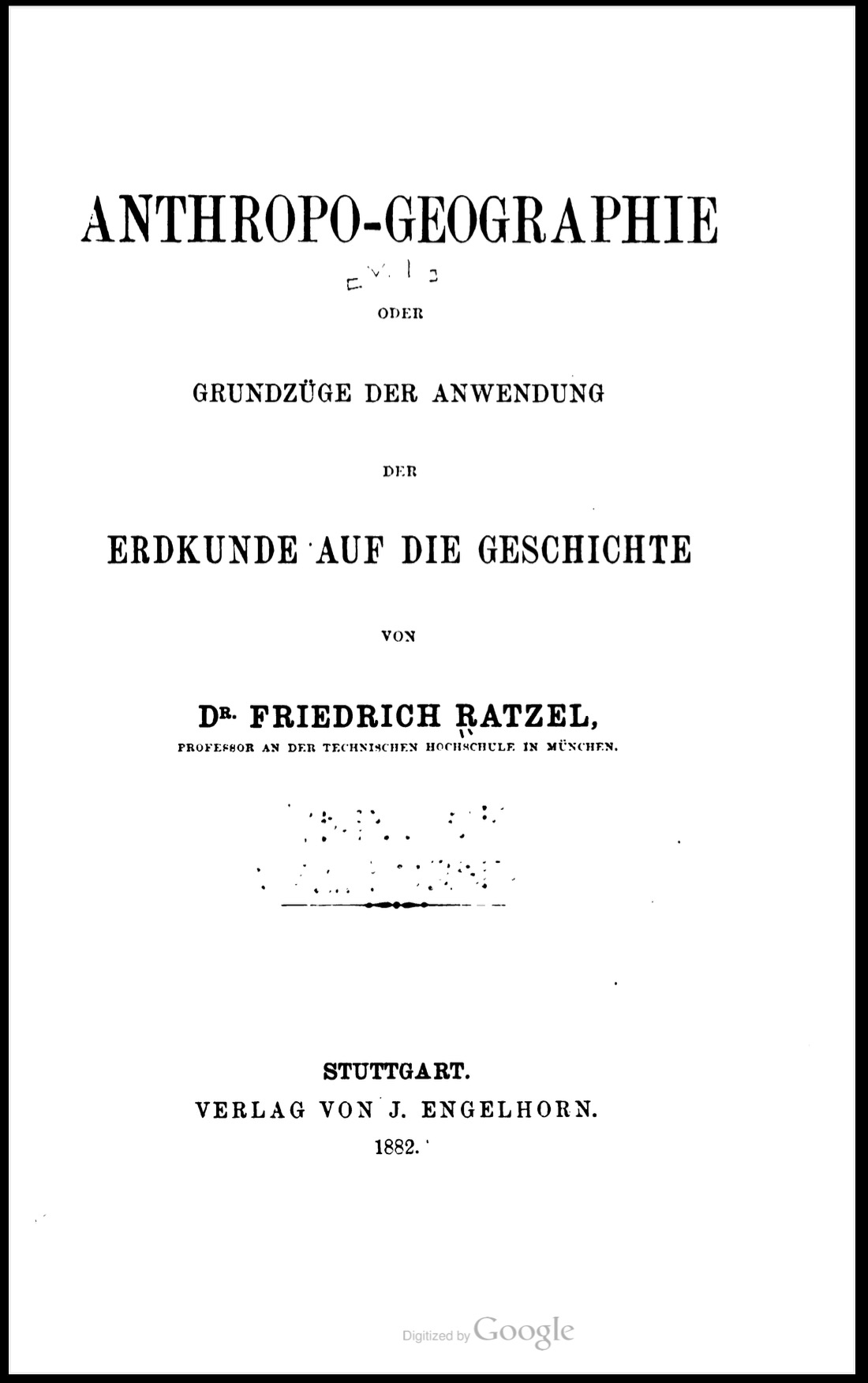
Bibliothek Geographischer Handbücher

Library of Geographical Handbooks
Book
Ratzel, F. (1882) Bibliothek Geographischer Handbücher. [Library of Geographical Handbooks] Stuttgart, J. Engelhorn, 506 pp.
Record No. 6842  |  Sinkankas/Born No.: NIS/NIB  |  Language: in German  |  RWHL
Ratzel’s geographical handbook presents a broad survey of the physical and human geography of the world, treating the relationships between peoples and their natural environments. It discusses geographical distribution, settlement, migration, economic activities, natural resources, and the influence of terrain and climate upon human societies. Mineral resources and their geographical occurrence are considered within this wider treatment of the economic products of different regions. The work reflects Ratzel’s developing approach to anthropogeography and provides a useful nineteenth-century synthesis of geographical knowledge and contemporary ideas concerning the relationship between human populations and the physical world.

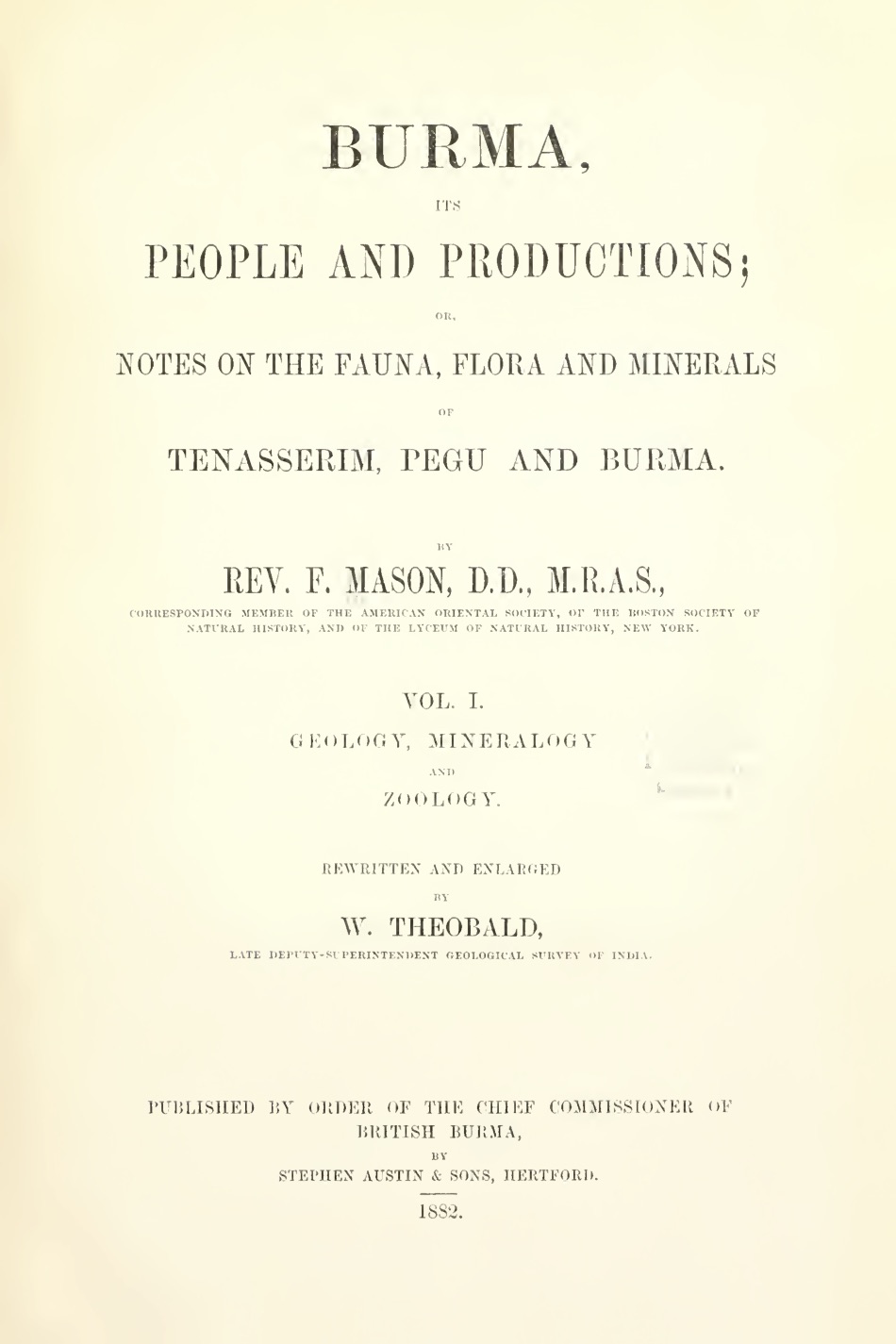
Burma, its People and Productions; or Notes on the Fauna, Flora, and Minerals of Tenasserim, Pegu, and Burma
Book
Mason, F. and Theobald, W. (1882) Burma, its People and Productions; or Notes on the Fauna, Flora, and Minerals of Tenasserim, Pegu, and Burma. Hetford, 2 Vols.
Record No. 5240  |  Sinkankas/Born No.: NIS/NIB  |  RWHL
Mason and Theobald present an extensive natural history of Burma, with accounts of the peoples, fauna, flora, and mineral resources of Tenasserim, Pegu, and other parts of the country. Of particular gemological interest are the sections dealing with Burmese minerals and precious stones, including ruby, sapphire, spinel, jade, amber, and other materials, with notes on their occurrence, localities, mining, trade, and indigenous names and uses. The work brings together observations accumulated during the nineteenth century and provides valuable contemporary evidence on Burma’s mineral resources and gem-producing regions. Its descriptions of precious stones and their sources make it an important early reference for the history of Burmese gemology and mining.

Les Arts Meconnus: Les Nouveaux Musees du Trocadero
The Little-Known Arts: The New Museums of the Trocadéro
Book
Émile-Soldi (1881) Les Arts Meconnus: Les Nouveaux Musees du Trocadero. [The Little-Known Arts: The New Museums of the Trocadéro] Paris, Ernest Leroux, 531 pp.
Record No. 28849  |  Sinkankas/Born No.: 1892; NIB  |  Language: in French  |  RWHL
Sinkankas: Essentially a guide to the industrial arts exhibits in the Trocadéro Museum, Paris, lavishly illustrated with wood engravings and ornamental chapter title pages. The preface describes the museum and its history, while the introduction gives a general history of the development of the industrial arts throughout the ages. The first chapter, pp. 21–65, concerns cameos and intaglios, as well as engraved work upon larger objects such as cups, and is well illustrated. At its end appear three tables summarizing notable features of art in various cultures as exemplified by engraved gems, the materials used in them, and providing a catalog, by period and culture, of a series of gems collected, donated, or exhibited in the Trocadéro by the author. Numerous references to lapidary work appear throughout the text, the chapter on American art, for example, containing remarks on the jade carvings of the Pre-Columbian Indians, pp. 349–60. Other chapters treat the arts of the Middle Ages, Persian arts, and also the arts of the Khmer, American, and Egyptian civilizations.

Über Nephrit und Jadeit

About Nephrite and Jadeite
Journal Article
Fischer, H. (1881) Über Nephrit und Jadeit. [About Nephrite and Jadeite] Neues Jahrbuch für Mineralogie, Geologie und Paläontologie, Year 1881, Vol. 1, pp. 99–100; 196–203.
Record No. 16979  |  Sinkankas/Born No.: NIS/NIB  |  Language: in German  |  RWHL
Features a comment on nephrite and jadeite from Fritz Berwerth and a response by Heinrich Fischer.

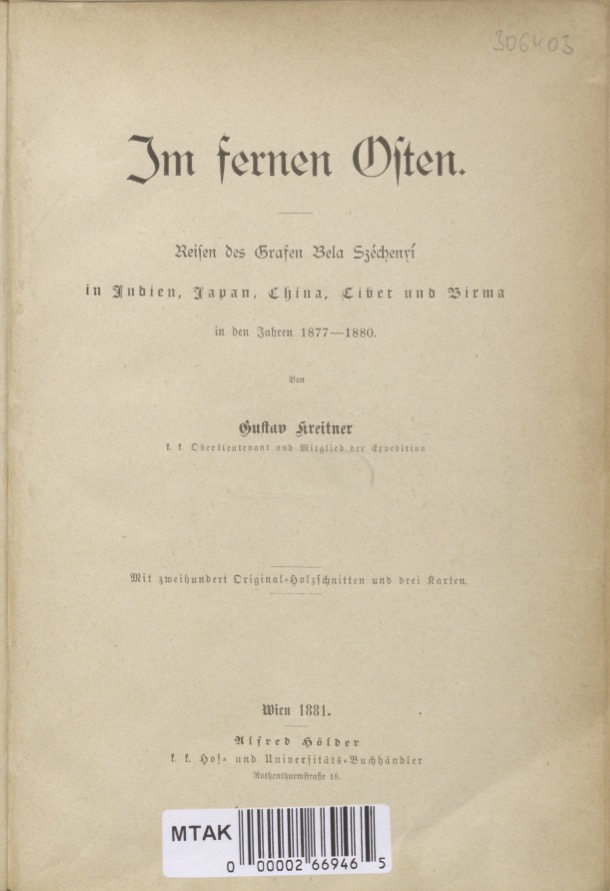
Im fernen Osten: Reisen des Grafen Béla Széchenyi in Indien, Japan, China, Tibet und Birma in den Jahren 1877–1880
In the Far East: Travels of Count Béla Széchenyi in India, Japan, China, Tibet, and Burma from 1877 to 1880.
Book
Kreitner, G. (1881) Im fernen Osten: Reisen des Grafen Béla Széchenyi in Indien, Japan, China, Tibet und Birma in den Jahren 1877–1880. [In the Far East: Travels of Count Béla Széchenyi in India, Japan, China, Tibet, and Burma from 1877 to 1880.] Wien, Hölder (1013 pp., maps, plates).
Record No. 16926  |  Sinkankas/Born No.: NIS/NIB  |  Language: in German  |  RWHL
Kreitner recounts Count Béla Széchenyi’s expedition through India, Japan, China, Tibet, and Burma from 1877 to 1880, providing extensive observations on the geography, peoples, natural history, commerce, and resources of the regions traversed. The work records geological and mineralogical observations made during the journey and includes information on local mineral products and precious materials encountered or traded in East and Southeast Asia. Maps and plates supplement this substantial contemporary account of exploration across Asia. They visit Bhamo and buy jade.

Ueber die mineralogisch Bestimmung archäologischer Steinobjekte
On the mineralogical identification of archaeological stone objects
Journal Article
Fischer, H. (1881) Ueber die mineralogisch Bestimmung archäologischer Steinobjekte. [On the mineralogical identification of archaeological stone objects] Neues Jahrbuch für Mineralogie, Geologie und Paläontologie, Year 1881, Vol. 1, pp. 58–59.
Record No. 16668  |  Sinkankas/Born No.: 2131; NIB  |  Language: in German  |  RWHL
Sinkankas: The discussion highlights the desirability of positively identifying stone objects and outlines the methods used for identification, including color, diaphaneity, luster, hardness, and specific gravity, which are sometimes sufficient for accurate identification. It also notes the predominance of color in stones, suggesting that primitive green-colored peoples particularly favored this hue. Additional comments are made on the usefulness of other properties for identification, such as cleavage planes, streak, acid reactions, and optical properties.

Ueber die mineralogisch-archäologischen Beziehungen zwischen Asien, Europa und Amerika
On the mineralogical-archaeological connections between Asia, Europe, and America
Journal Article
Fischer, H. (1881) Ueber die mineralogisch-archäologischen Beziehungen zwischen Asien, Europa und Amerika. [On the mineralogical-archaeological connections between Asia, Europe, and America] Neues Jahrbuch für Mineralogie, Geologie und Paläontologie, Year 1881, Vol. 2, pp. 199–227.
Record No. 16667  |  Sinkankas/Born No.: 2130; NIB  |  Language: in German  |  RWHL
Sinkankas: Studying the accounts of several scientific travelers in Asia led Fischer to conclude that all Asian jadeites come from a single source: Mung-Kong in Burma. Several specimens were investigated, and their properties were determined. Some Alpine jadeites were also examined. However, most of the discussion is devoted to the question of whether American jadeites originated from Asia.

On jade implements found in Switzerland
Journal Article
Westropp, H.M. (1881) On jade implements found in Switzerland. Journal of the Anthropological Institute of Great Britain and Ireland, Vol. 10, pp. 359–363.
Record No. 7601  |  Sinkankas/Born No.: NIS/NIB  |  RWHL
Westropp discusses implements of jade found in the Swiss lake-dwellings and considers the problem of their origin. He reviews the occurrence of jade objects in prehistoric Europe and the question of whether the material was obtained from European sources or introduced from distant regions through trade. The paper contributes to the nineteenth-century debate over the provenance of European prehistoric jade implements.

Contribution à l’Étude des Néphrites

Contribution to the Study of Nephritis
Book
Brault, A. (1881) Contribution à l’Étude des Néphrites. [Contribution to the Study of Nephritis] Paris, 46 pp.
Record No. 7139  |  Sinkankas/Born No.: NIS/NIB  |  Language: in French  |  RWHL
Albert Brault was a French physician, and Contribution à l’étude des néphrites was his 1881 inaugural medical thesis concerning kidney disease.

Nouvelles analyses sur la jadeite et sur quelques roches sodifères
New analyses on jadeite and on some sodiferous rocks
Journal Article
Damour, A. (1881) Nouvelles analyses sur la jadeite et sur quelques roches sodifères. [New analyses on jadeite and on some sodiferous rocks] Comptes Rendus Hebdomadaires des Séances de l’Académie des Sciences, Vol. 92, pp. 1312–1318.
Record No. 6719  |  Sinkankas/Born No.: NIS/NIB  |  Language: in French  |  RWHL
Reports new chemical analyses of jadeite and several sodium-bearing rocks, extending Damour’s earlier work on the mineralogical nature of jade. He compares their chemical compositions and discusses the relationships between jadeite and other sodic silicate materials, further defining jadeite as a distinct mineral species. The paper is particularly important because Damour recognizes that objects described as jadeite may be composed of aggregates rather than single crystals, helping to clarify the distinction between the mineral jadeite and jadeite-bearing rocks.

Sur la néphrite ou jade de Sibérie

On nephrite or jade from Siberia
Journal Article
Jannettaz, E. and Michel, L. (1881) Sur la néphrite ou jade de Sibérie. [On nephrite or jade from Siberia] Bulletin de Minéralogie, Vol. 4, No. 6, pp. 178–182.
Record No. 6706  |  Sinkankas/Born No.: NIS/NIB  |  Language: in French  |  RWHL
Jannettaz and Michel examine nephrite specimens from Siberia, including material discovered by Jean-Pierre Alibert in the bed of the Onot River in the Eastern Sayan region. They describe the nephrite’s physical, microscopic, optical, and chemical characteristics, including its fibrous structure, and compare it with nephrite from other sources. The occurrence provides evidence for a natural Siberian source of nephrite at a time when the provenance of nephrite used for prehistoric and ethnographic objects was the subject of considerable debate.

Nouvelles analyses sur la jadeite et sur quelques roches sodifères
New analyses on jadeite and on some sodiferous rocks
Journal Article
Damour, A. (1881) Nouvelles analyses sur la jadeite et sur quelques roches sodifères. [New analyses on jadeite and on some sodiferous rocks] Bulletin de la Société Minéralogique de France, Vol. 4, pp. 157–164.
Record No. 6480  |  Sinkankas/Born No.: 1569; NIB  |  Language: in French  |  RWHL
Reports new chemical analyses of jadeite and several sodium-bearing rocks, extending Damour’s earlier work on the mineralogical nature of jade. He compares their chemical compositions and discusses the relationships between jadeite and other sodic silicate materials, further defining jadeite as a distinct mineral species. The paper is particularly important because Damour recognizes that objects described as jadeite may be composed of aggregates rather than single crystals, helping to clarify the distinction between the mineral jadeite and jadeite-bearing rocks.

Über die Verbreitung von Stein-Idolen und Amuletten bei den verschiedenen Völkern der Erde

On the distribution of stone idols and amulets among the various peoples of the Earth
Journal Article
Fischer, H. (1880) Über die Verbreitung von Stein-Idolen und Amuletten bei den verschiedenen Völkern der Erde. [On the distribution of stone idols and amulets among the various peoples of the Earth] Correspondenz-Blatt der deutschen Gesellschaft für Anthropologie, Ethnologie und Urgeschichte, Vol. 11, No. 7, pp. 60–62.
Record No. 16671  |  Sinkankas/Born No.: NIS/NIB  |  Language: in German  |  RWHL
A short comparative study by Heinrich Fischer on the widespread use of stone idols and amulets among peoples in different parts of the world. Forming part of his Mineralogisch-archäologische Beobachtungen, the paper approaches such objects from both ethnographic and mineralogical perspectives, emphasizing the value of identifying the stone from which an artifact was made when considering its origin, cultural significance and possible movement between regions. Fischer places stone images and amulets within his broader program of applying mineralogical methods to archaeological and ethnographic collections. The paper is useful for the history of archaeometry and for understanding nineteenth-century attempts to relate the choice and distribution of particular stone materials to human cultural practices.

Exploring the Literature of Jade

Jade literature spans gemology, mineralogy, archaeology, art history, mining, carving and connoisseurship, and includes works on both jadeite and nephrite from around the world.

For an introduction to collecting books on this subject, read Hidden Treasure — Collecting the Literature of Jade.

About Four Treasures

Four Treasures is Lotus Gemology's freely accessible gemological reference database. Use the full database to search by author, title or keyword and explore literature on gemology, mineralogy, jewelry and related fields. Where available, hyperlinks on titles may lead directly to the full publication.

Search the Complete Four Treasures Database