Jade Bibliography

Jade Bibliography

Explore books, articles and historical sources on jade in Four Treasures, the Lotus Gemology reference database. This bibliography brings together matching records from the collection, with publication details, abstracts and cover images where available.

Jade References

The list below matches the terms jade, jadeite, nephrite or Fei Cui in the database's searchable fields. Some references discuss these materials as part of a broader subject.
3,161–3,180 of 3,817 matching references

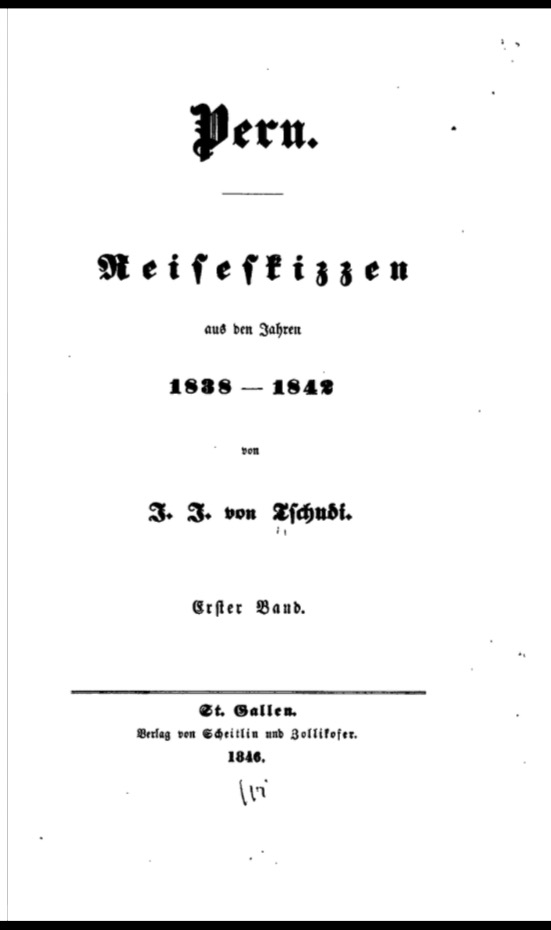
Peru: Reiseskizzen aus den Jahren 1838–1842
Peru: Travel Sketches from the Years 1838–1842
Book
Tschudi, J.J., von (1846) Peru: Reiseskizzen aus den Jahren 1838–1842. [Peru: Travel Sketches from the Years 1838–1842] St. Gallen, Scheitlin und Zollikofer, 2 Vols., 347, 402 pp.
Record No. 7074  |  Sinkankas/Born No.: NIS/NIB  |  Language: in German  |  RWHL
An account of Tschudi’s travels and residence in Peru between 1838 and 1842, combining observations on the country’s geography, natural history, peoples, customs, economy, and political conditions. Drawing on extensive travel from the Pacific coast into the Andes, Tschudi describes Lima, the coastal deserts, mountain communities, Indigenous peoples, agriculture, mining, and the flora and fauna of different ecological zones. The work provides a detailed mid-nineteenth-century European account of Peru and includes observations on its mineral wealth and mining industry.

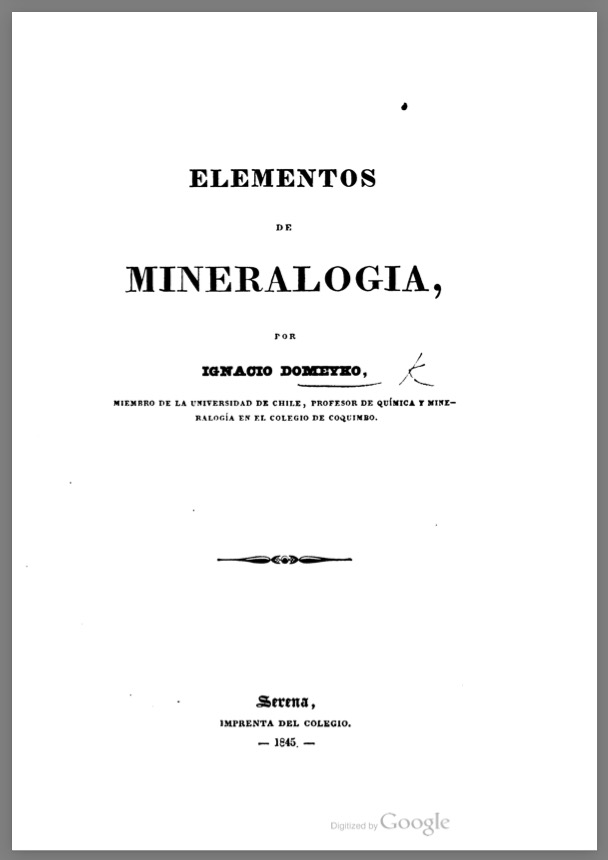
Elementos de mineralogia

Elements of Mineralogy
Book
Domeyko, I. (1845) Elementos de mineralogia. [Elements of Mineralogy] Serena, Chile, Imprenta del colegio, 158 pp
Record No. 16709  |  Sinkankas/Born No.: NIS/NIB  |  Language: in Spanish  |  RWHL
A concise Spanish-language textbook of mineralogy prepared by Ignacio Domeyko during his early work in Chile. The book presents the principal mineral species, their physical and chemical properties, classification, identification, and occurrence, and was intended as an instructional manual for students of mining and mineralogy. It is significant as one of the earliest systematic mineralogical texts produced in Chile and reflects Domeyko’s role in introducing modern European mineralogical methods into South American mining education.

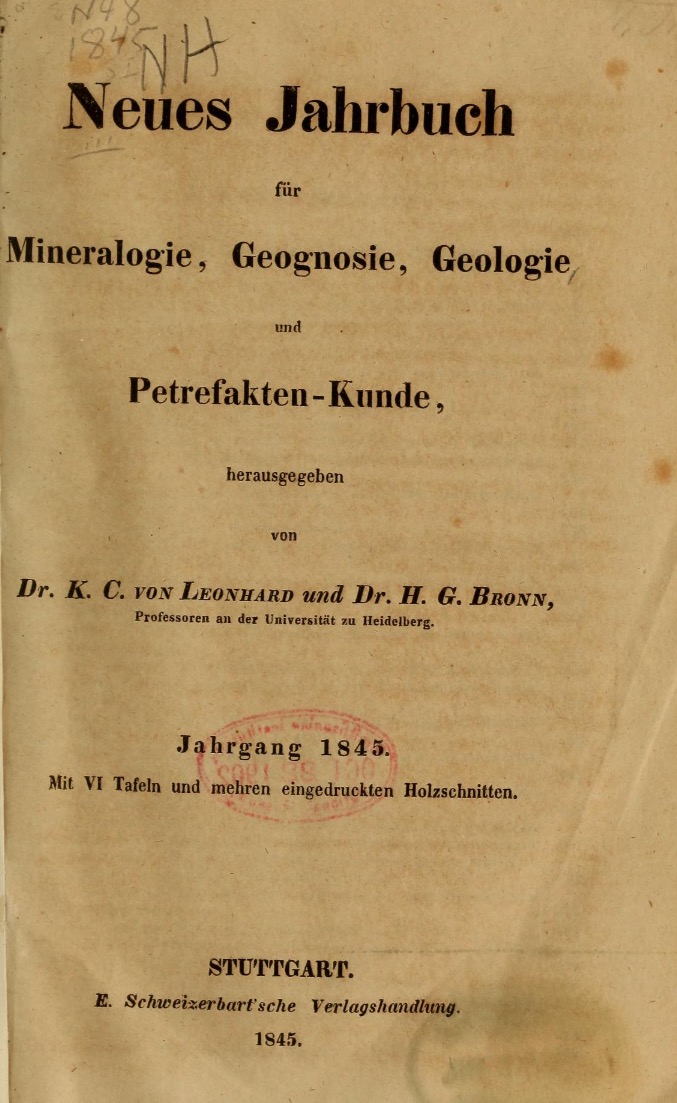
Analyse verarbeiteter Nephrite (Annal. d. Chem. u. Pharm. XLVI, 338)
Analysis of processed nephrites
Journal Article
Schaffhäutl, C. (1845) Analyse verarbeiteter Nephrite (Annal. d. Chem. u. Pharm. XLVI, 338). [Analysis of processed nephrites] Neues Jahrbuch fuer Mineralogie, Geognosie, Geologie und Petrefaktenkunde, p. 102.
Record No. 16473  |  Sinkankas/Born No.: NIS/NIB  |  Language: in German  |  RWHL
Reports Schaffhäutl’s chemical analysis of worked nephrite objects, based on material previously discussed in the Annalen der Chemie und Pharmacie. The notice concerns the composition of fashioned nephrite and its comparison with related mineral substances, contributing to contemporary efforts to determine the true mineralogical nature of jade. It is of particular historical interest as an early chemical investigation of archaeological or manufactured nephrite rather than merely geological specimens. One of the first chemical analyses of nephrite.

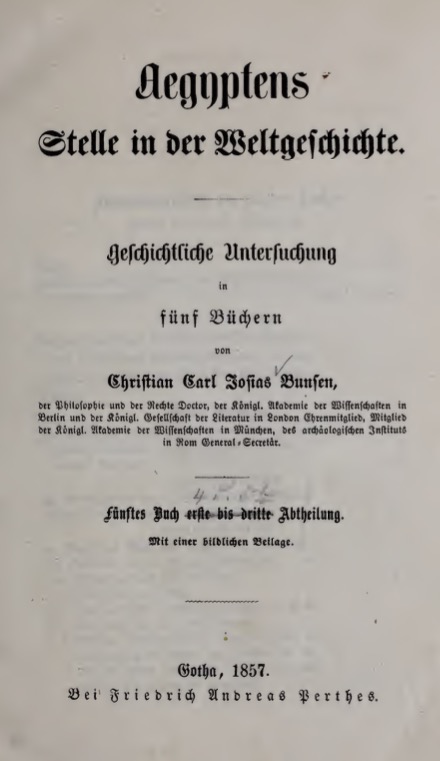
Aegyptens stelle in der weltgeschichte
Egypt's Place in World History
Book
Bunsen, C.K.J., Freiherr von (1845) Aegyptens stelle in der weltgeschichte. [Egypt's Place in World History] Hamburg, F. Perthes, 5 Vols. (see Vol. 5, pp. 413–415).
Record No. 8112  |  Sinkankas/Born No.: NIS/NIB  |  Language: in German  |  RWHL
A monumental study of ancient Egypt intended to establish its place within the broader development of world civilization. Bunsen examines Egyptian chronology, dynasties, religion, language, writing, literature, monuments, and material culture, drawing extensively on classical authors, Egyptian inscriptions, and the rapidly developing field of Egyptology. Published in five volumes, the work attempts to reconstruct Egyptian history from the earliest periods and to relate it to the histories and chronologies of neighboring civilizations, particularly those of the ancient Near East and Mediterranean.

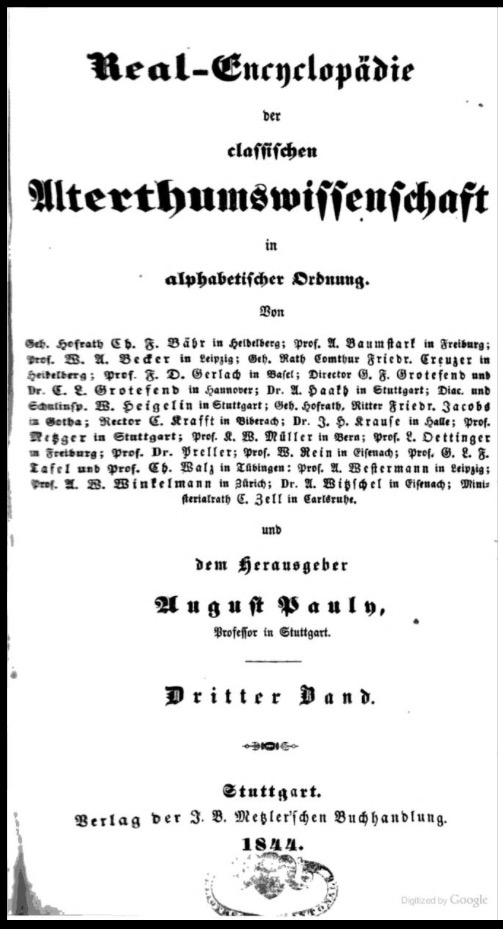
Real-Encyclopädie der Classischen Alterthumswissenschaft in alphabetischer Ordnung
Real Encyclopedia of Classical Antiquity in Alphabetical Order
Book
Pauly, A.F., von (1844) Real-Encyclopädie der Classischen Alterthumswissenschaft in alphabetischer Ordnung. [Real Encyclopedia of Classical Antiquity in Alphabetical Order] Stuttgart, J.B. Metzler, 1572 pp. (see p. 1463).
Record No. 8113  |  Sinkankas/Born No.: NIS/NIB  |  Language: in German  |  RWHL
A major nineteenth-century encyclopedia of classical antiquity, arranged alphabetically and covering the history, geography, religion, mythology, literature, institutions, material culture, and daily life of the ancient Greek and Roman worlds. Edited by August Friedrich Pauly, it brought together detailed scholarly articles based on ancient literary sources and contemporary classical research. Of gemological interest are entries relating to precious stones, minerals, jewelry, engraved gems, mining, and the terminology and uses of such materials in antiquity.

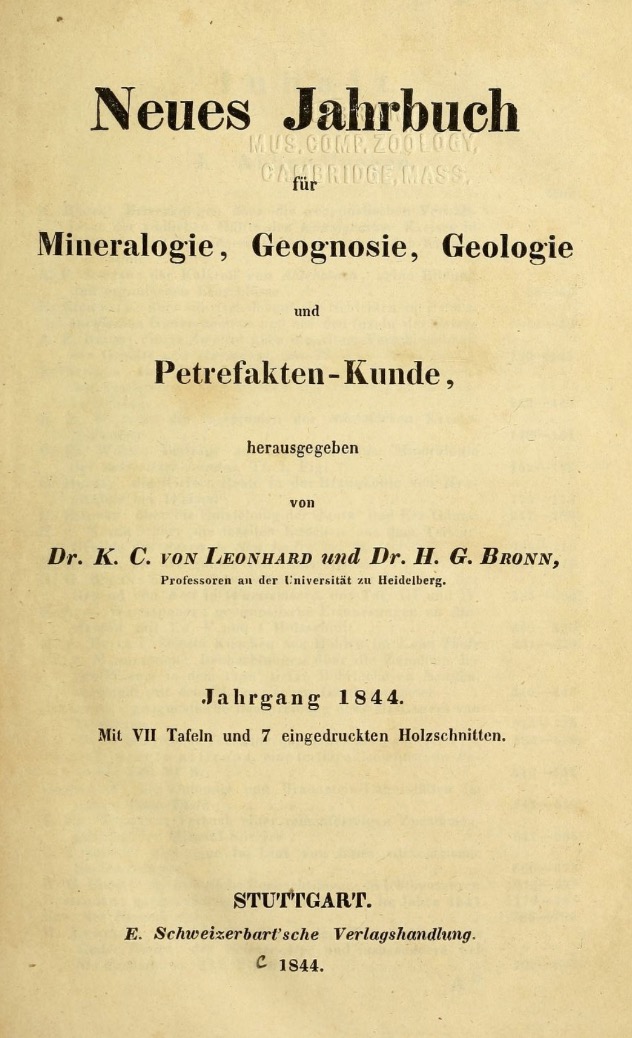
Analyse des Nephrits aus der Türkei: Repertorium des chemischen Teils der Mineralkunde
Analysis of the nephrite from Turkey: Report of the chemical part of mineral science
Journal Article
Rammelsberg, C.F. (1844) Analyse des Nephrits aus der Türkei: Repertorium des chemischen Teils der Mineralkunde. [Analysis of the nephrite from Turkey: Report of the chemical part of mineral science] Neues Jahrbuch für Mineralogie, Geognosie, Geologie und Petrefaktenkunde, 1st Issue, p. 208.
Record No. 8085  |  Sinkankas/Born No.: NIS/NIB  |  Language: in German  |  RWHL
Reports Rammelsberg’s chemical analysis of nephrite from Turkey, presented in his review of the chemical aspects of mineralogy. The analysis concerns the composition of the material then identified as nephrite and its relationship to other mineral species with similar physical properties. The brief notice is of particular gemological interest as an early chemical investigation of nephrite from a locality outside the better-known Asian sources and as part of nineteenth-century efforts to establish the mineralogical identity and composition of jade materials.

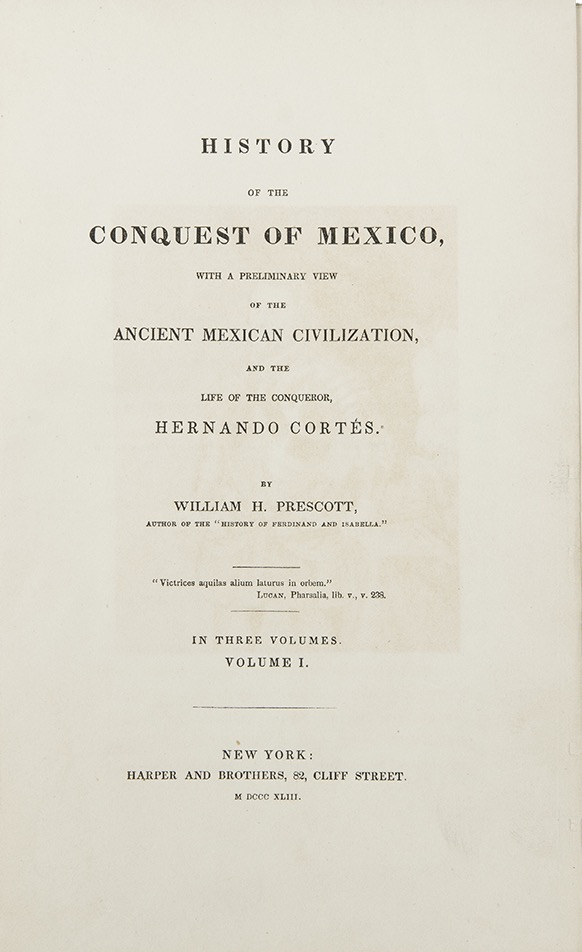
History of the Conquest of México

Book
Prescott, W.H. (1843) History of the Conquest of México. New York, Harper and Brothers, 3 Vols., 488, 480, 524 pp.
Record No. 16713  |  Sinkankas/Born No.: NIS/NIB  |  RWHL
A cornerstone work for any collection on American literature or the historiography of Mexico. It is a magnificent epic," said William H. Prescott after the publication of History of the Conquest of Mexico in 1843. Since then, his sweeping account of Cortés's subjugation of the Aztec people has endured as a landmark work of scholarship and dramatic storytelling. This pioneering study presents a compelling view of the clash of civilizations that reverberates in Latin America to this day. "Regarded simply from the standpoint of literary criticism, the Conquest of Mexico is Prescott's masterpiece," judged his biographer Harry Thurston Peck. "More than that, it is one of the most brilliant examples which the English language possesses of literary art applied to historical narration… Here, as nowhere else, has Prescott succeeded in delineating character. All the chief actors of his great historic drama not only live and breathe, but they are as distinctly differentiated as they must have been in life. Cortés and his lieutenants are persons whom we actually come to know in the pages of Prescott… Over against these brilliant figures stands the melancholy form of Montezuma, around whom, even from the first, one feels gathering the darkness of his coming fate. He reminds one of some hero of Greek tragedy, doomed to destruction and intensely conscious of it, yet striving in vain against the decree of an inexorable destiny… [Prescott] transmuted the acquisitions of laborious research into an enduring monument of pure literature.""

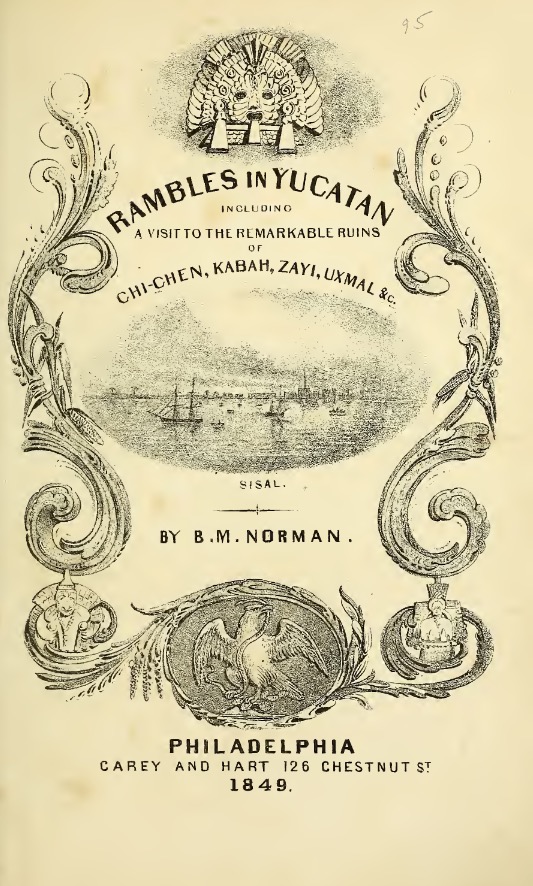
Rambles in Yucatan, or, Notes of travel through the peninsula, including a visit to the remarkable ruins of Chi-Chen, Kabah, Zayi, and Uxmal
Book
Norman, B.M. (1843) Rambles in Yucatan, or, Notes of travel through the peninsula, including a visit to the remarkable ruins of Chi-Chen, Kabah, Zayi, and Uxmal. New York, J. & H.G. Langley, 304 pp.
Record No. 16712  |  Sinkankas/Born No.: NIS/NIB  |  RWHL
Published in the mid-19th century, this book provides a vivid and engaging account of travel in the Yucatan Peninsula. The author, whose name is not given, provides detailed descriptions of the region's geography, flora, and fauna, as well as insightful commentary on the customs and traditions of the Mayan people. The highlight of the book is the author's visit to the ruins of Chi-Chen, Kabah, Zayi, and Uxmal, which are described in loving detail.

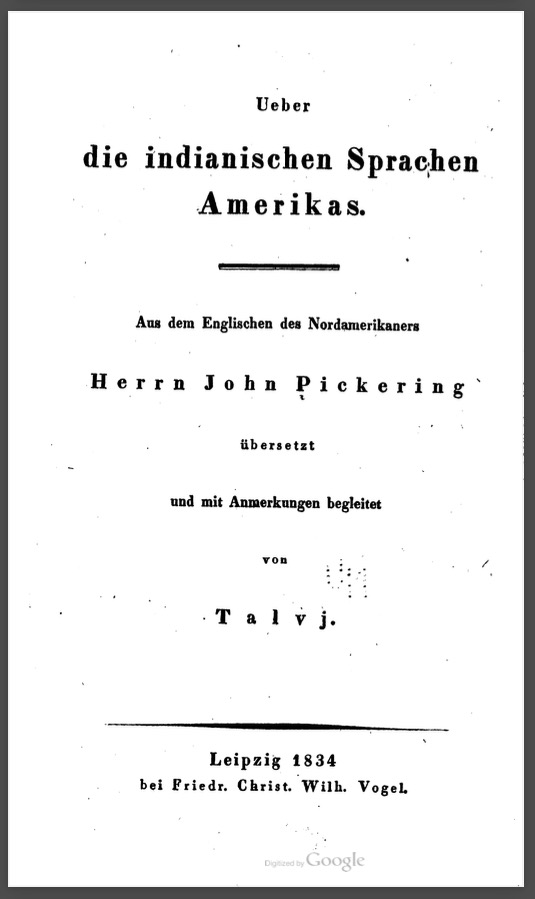
Ueber die indianischen Sprachen Amerikas
On the Indian Languages of America
Book
Pickering, J. (1843) Ueber die indianischen Sprachen Amerikas. [On the Indian Languages of America] Leipzig, Friedr. Christ. Wilm. Vogel, 79 pp.
Record No. 16564  |  Sinkankas/Born No.: NIS/NIB  |  Language: in German  |  RWHL
A German translation of John Pickering’s study of the Indigenous languages of the Americas, examining their classification, geographical distribution, relationships, and distinctive linguistic features. Pickering considers the diversity of Native American languages and the evidence they provide for relationships among the peoples of North and South America, drawing upon vocabularies and earlier linguistic and ethnographic sources. The work forms part of the early nineteenth-century development of comparative American linguistics and ethnology.

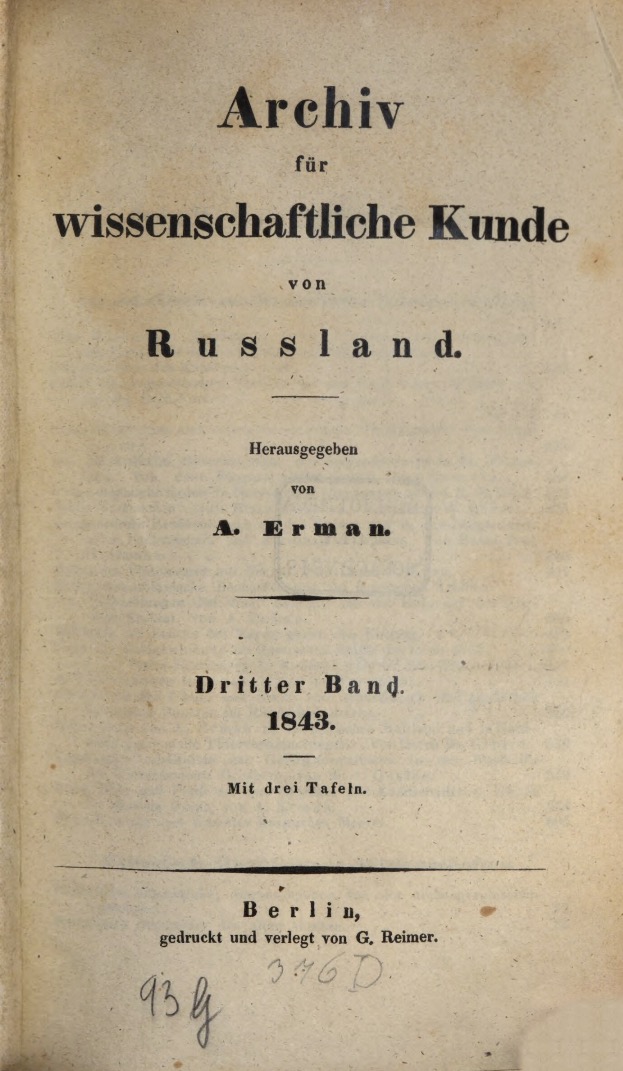
Ueber die geognostischen Verhältnisse von Nord- Asien in Beziehung auf das Gold-Vorkommen in diesem Erdtheile. II. Die trans-uralischen Gebirge
About the geognostic conditions of North Asia in relation to the gold deposit in this part of the earth. II. The transural mountains
Journal Article
Erman, A. (1843) Ueber die geognostischen Verhältnisse von Nord- Asien in Beziehung auf das Gold-Vorkommen in diesem Erdtheile. II. Die trans-uralischen Gebirge. [About the geognostic conditions of North Asia in relation to the gold deposit in this part of the earth. II. The transural mountains] Archiv für wissenschaftliche Kunde von Russland, Vol. 3, pp. 121–177, map (see pp. 154–155).
Record No. 8149  |  Sinkankas/Born No.: NIS/NIB  |  Language: in German  |  RWHL
Examines the geological structure of the Trans-Ural region of northern Asia in relation to its extensive gold deposits. Erman discusses the mountain systems, rock formations, alluvial deposits, and geological circumstances associated with the occurrence of gold, drawing on observations made during his travels across Siberia. Of particular gemological interest are pp. 154–155, where he discusses gemstones occurring in association with the gold-bearing deposits, including their localities and geological setting.

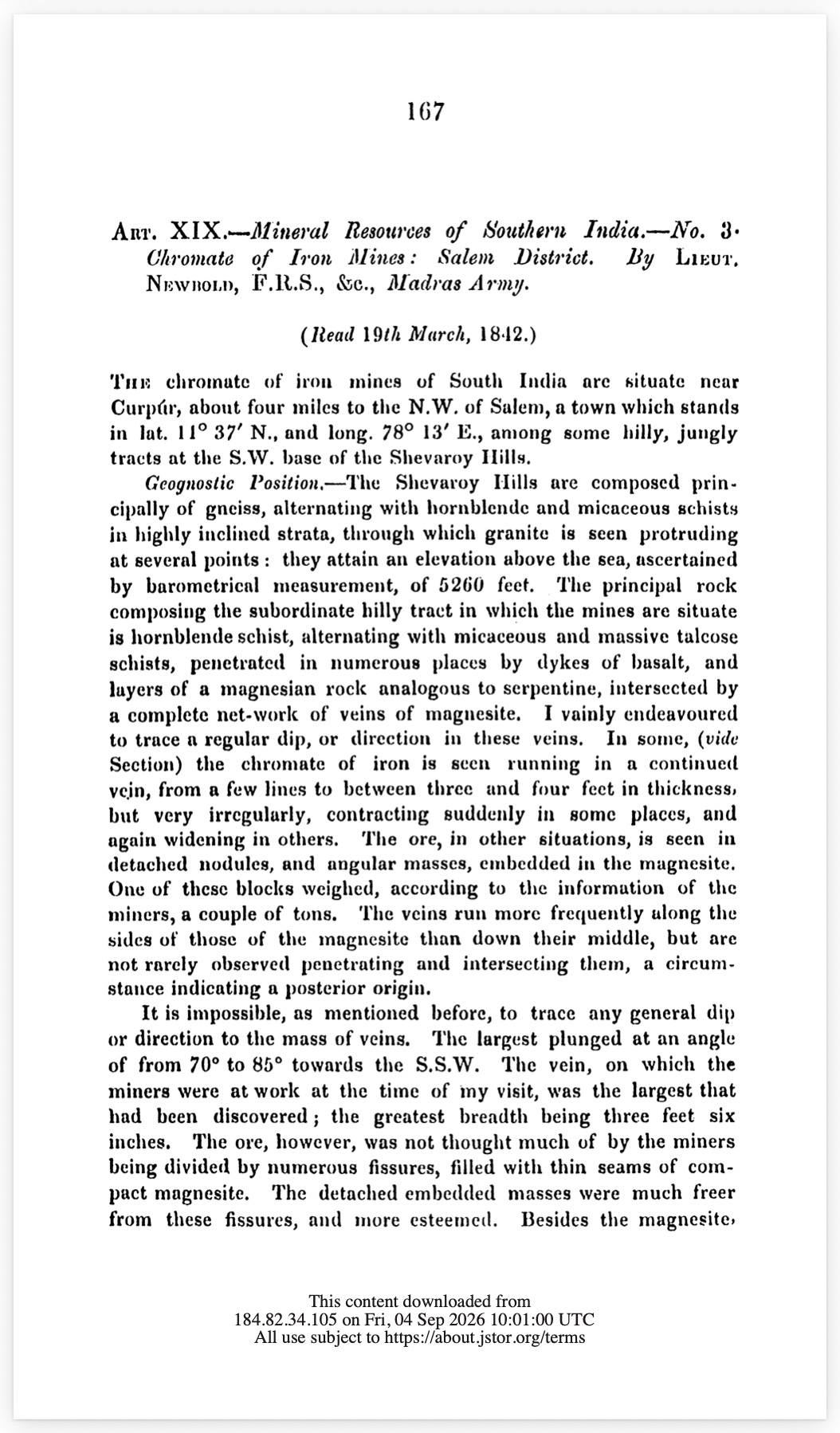
Mineral resources of Southern India. No. 3. Chromate of iron mines: Salem District
Journal Article
Newbold, T.J. (1842) Mineral resources of Southern India. No. 3. Chromate of iron mines: Salem District. Journal of the Royal Asiatic Society, Vol. 7, Vol. 167–171.
Record No. 29491  |  Sinkankas/Born No.: NIS/NIB  |  RWHL
Surveys the mineral resources of southern India, describing the occurrence, geological setting, working, and economic importance of a wide range of ores and minerals.

Reisen in Guiana und am Orinoko während der Jahre 1835–1839
Travel in Guiana and the Orinoco during the years 1835–1839
Book
Schomburgk, R.H. (1841) Reisen in Guiana und am Orinoko während der Jahre 1835–1839. [Travel in Guiana and the Orinoco during the years 1835–1839] Leipzig, Wigand, 510 pp.
Record No. 16714  |  Sinkankas/Born No.: NIS/NIB  |  Language: in German  |  RWHL
An account of Robert Hermann Schomburgk’s explorations of British Guiana and the Orinoco region between 1835 and 1839, describing the geography, rivers, mountains, natural history, Indigenous peoples, customs, settlements, and resources encountered during his journeys. The work records extensive travel through the interior of the Guianas and neighboring Venezuela, with observations on geology, minerals, plants, animals, and regional trade, and constitutes an important early nineteenth-century description of the largely unexplored interior of northeastern South America.

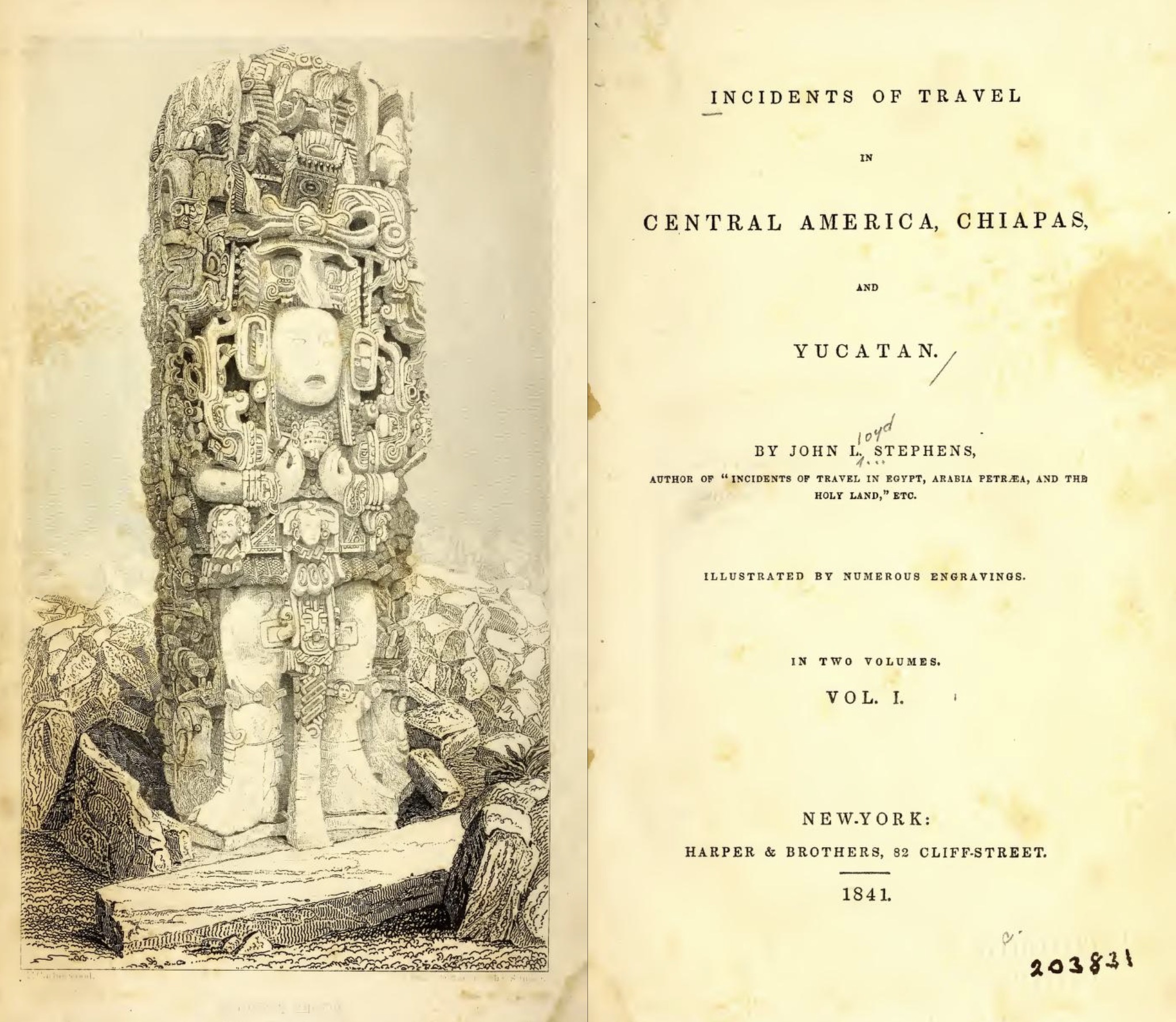
Incidents of Travel in Central America, Chiapas, and Yucatan
Book
Stephens, J.L. (1841) Incidents of Travel in Central America, Chiapas, and Yucatan. New York, Harper & Brothers, 2 Vols., 424, 474 pp.
Record No. 6878  |  Sinkankas/Born No.: NIS/NIB  |  RWHL
A two-volume account of Stephens’s travels through Central America, Chiapas, and Yucatán, with illustrations by Frederick Catherwood. The work describes the geography, peoples, politics, customs, and antiquities encountered during the journey and is particularly important for its detailed accounts of Maya archaeological sites, including Copán, Quiriguá, Palenque, and Uxmal. Stephens records monumental architecture, sculpture, inscriptions, and artifacts, while Catherwood’s illustrations provided some of the earliest accurate published representations of Maya remains. The work played a major role in bringing the ancient Maya civilization to international attention.

Voyage pittoresque et archéologique dans la province d’Yucatan (Amérique Centrale), pendant les années 1834 et 1836
Picturesque and archaeological journey through the province of Yucatan (Central America), during the years 1834 and 1836
Book
Waldeck, F., de (1838) Voyage pittoresque et archéologique dans la province d’Yucatan (Amérique Centrale), pendant les années 1834 et 1836. [Picturesque and archaeological journey through the province of Yucatan (Central America), during the years 1834 and 1836] Paris, Bellizard Dufour, 110 pp., map, many plates
Record No. 16716  |  Sinkankas/Born No.: NIS/NIB  |  Language: in French  |  RWHL
An illustrated archaeological and travel account by Frédéric de Waldeck based on his journeys in Yucatán in 1834 and 1836. The work describes Maya ruins, landscapes and inhabitants and is especially important for its large engraved and lithographed plates, most of which depict the architecture and sculpture of Uxmal, including the Pyramid of the Magician and the Nunnery Quadrangle; it also includes a map of Yucatán. The volume was among the earliest substantial illustrated publications devoted to Maya antiquities and helped stimulate European and American interest in the ancient civilizations of Mesoamerica. Waldeck’s reconstructions and interpretations are sometimes imaginative and inaccurate, so the illustrations must be used critically, but they remain important documents in the early history of Maya archaeology. The 1838 edition contains x + 110 pp. and 22 plates.

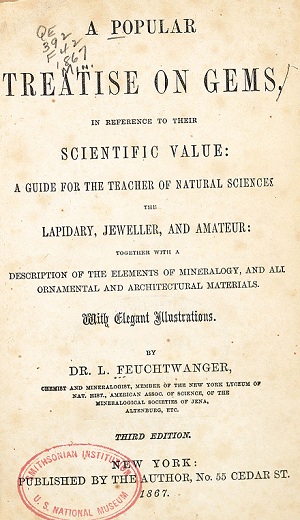
A Treatise on Gems

Book
Feuchtwanger, L. (1838) A Treatise on Gems. New York, A. Hanford, 178 pp.
Record No. 2757  |  Sinkankas/Born No.: 2081–2085  |  RWHL
Sinkankas: The first monograph on gemstones published in the United States and an excellent one at that. In the testimonial letter, James Renwick (1792–1863), LLD, professor of chemistry & physics in Columbia College, noted that “in reference to the native minerals and rocks of the United States, that I conceive your treatise to be most likely to be eminently useful.” In his Gems and Precious Stones of North America, the eventual successor to Feuchtwanger, published in 1890, G.F. Kunz notes that “Dr. Lewis Feuchtwanger, of New York, was, in 1838, an authority on precious stones, and his book was one of the first to be written on the subject in the United States. During his long residence in this country, he made an interesting and valuable collection of minerals, fossils, and gems, many of the latter being fine specimens, but it has not been sold, and is in the possession of his daughters. Moving has greatly damaged this collection, which originally included nearly 900 specimens; it was placed on sale in 1874, and for a time was deposited in the American Museum of Natural History in New York” (p. 322). In regard to the priority of Feuchtwanger’s book, I have not found any published earlier and unlike Kunz, conclude that it is the first. The text begins with general gemology: properties, chemistry, geology, geographical distribution, enhancement of color, gem setting, cleaning of gems, imitations, commerce, and gems used in optical applications. The second part considers individual gemstones and ornamental materials beginning with the diamond and working through the major and minor species into such rarities as natrolite, apatite, pyrite, and numerous ornamental stones. Feuchtwanger took special care to record as much information as he could find on native gemstones and the localities that furnished them, and while some localities were previously recorded by Samuel Robinson in his Catalogue of American Minerals, 1825, these were treated very briefly and without amplifying details such as characterizes Feuchtwanger’s treatment. Another “first” of the present work is the extended description of pearls, artificial pearls, and corals, but nothing was said about the freshwater pearls of the United States which apparently were largely unknown at the time. As alluded to in Renwick’s letter, Feuchtwanger’s writing sometimes borders on the quaint, but all of it is easily followed and forms much pleasant as well as informative reading. Very rare.

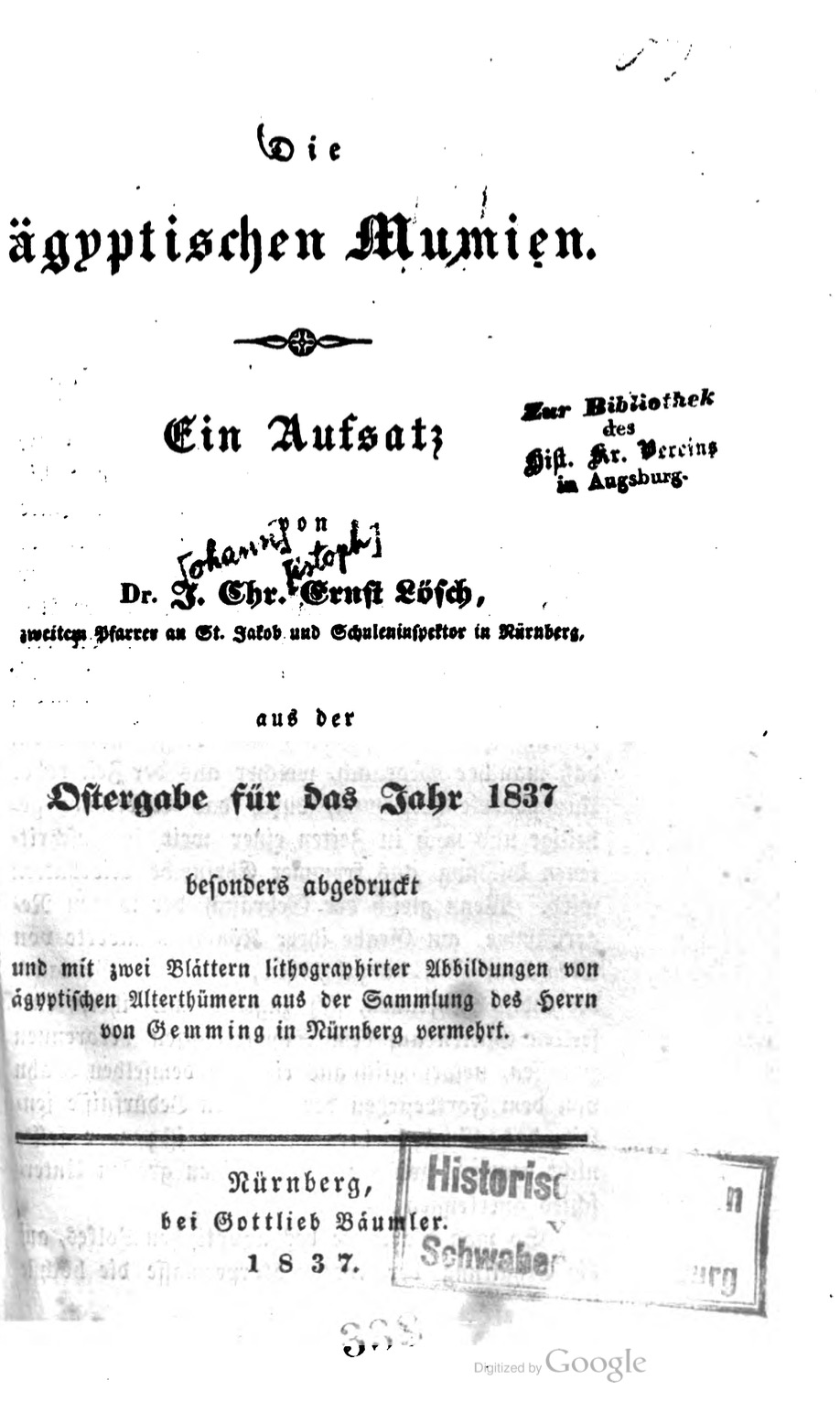
Die ägyptischen Mumien: e. Aufsatz

The Egyptian mummies: e. Essay
Book
Lösch, J.C.E. (1837) Die ägyptischen Mumien: e. Aufsatz. [The Egyptian mummies: e. Essay] Nürnberg, Gottlieb Bäumler, 21 pp.
Record No. 8079  |  Sinkankas/Born No.: NIS/NIB  |  Language: in German  |  RWHL
A short essay on Egyptian mummies, discussing the ancient Egyptian practice of embalming and the preservation of the dead. Lösch examines mummification in the context of Egyptian funerary customs and considers the methods and substances employed in preparing bodies for burial. The work belongs to the early nineteenth-century European literature on Egyptian antiquities and mummification, a subject then attracting increasing antiquarian and scientific attention.

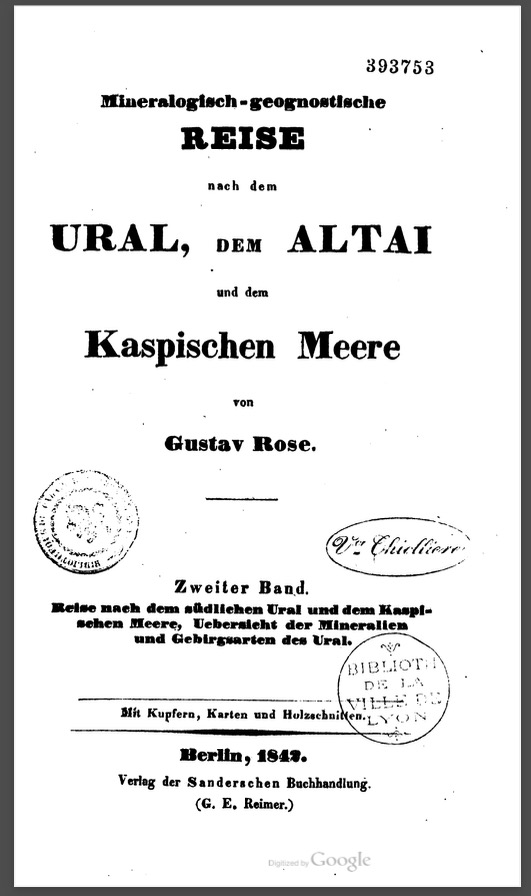
Mineralogisch geognostische Reise nach dem Ural, dem Altai und dem Kaspischen Meere
Mineralological Geognostic Journey to the Urals, the Altai and the Caspian Seas
Book
Rose, G. (1837–1842) Mineralogisch geognostische Reise nach dem Ural, dem Altai und dem Kaspischen Meere. [Mineralological Geognostic Journey to the Urals, the Altai and the Caspian Seas] Berlin, Sander, 2 Vols., 641, 606 pp.
Record No. 7474  |  Sinkankas/Born No.: NIS/NIB  |  Language: in German  |  RWHL
Schuh: Rare. In 1829, Rose along with C.G. Ehrenberg [see note below] was choosen to accompany Humboldt on a scientific journey commissioned by the Russian Czar to the Urals, the Altai, and the Caspian Sea. This venture took him from Europe to as far as the China frontier. The Mineralogisch-geognostische Reise chronicles the journey and includes many observations on geology, mineralogy, and mineral resources of the regions traversed. Since its publication, it has been widely quoted as an authoritative source about these matters. Volume one concerns the northern Urals and the Altai, while volume two describes the excursions through the southern Urals and the Caspian sea, reviewing in particular the minerals and geology of the Ural mountains.

Abstract of a route travelled by Capt. S.F. Hannay, from the capital of Ava to the amber mines of the Hukong Valley on the south-east frontier of Assam
Journal Article
Hannay, S.F. and Pemberton, R.B. (1837) Abstract of a route travelled by Capt. S.F. Hannay, from the capital of Ava to the amber mines of the Hukong Valley on the south-east frontier of Assam. Journal of the Asiatic Society of Bengal, Vol. 6, No. 64, April, pp. 245–278 (see p. 265, 274), map.
Record No. 4680  |  Sinkankas/Born No.: NIS/NIB  |  RWHL
An abstract by Robert Boileau Pemberton of Captain S.F. Hannay’s 1835–1836 journey from Ava through northern Burma to the Hukong Valley and its amber mines. The paper records routes, geography, peoples, trade and natural resources and is particularly important for the early history of Burma’s jade and amber deposits. At Mogaung, Hannay obtained specimens of the green stone called kyouktsein by the Burmese and yueesh by the Chinese, which he believed to be nephrite; the material described was the jadeite-bearing stone later recognized as Burmese jade. He also records Chinese trade in the material, its use for rings, bracelets and cups, and the approximate location of the mines northwest of Mogaung. Farther north, Hannay visited the Hukong amber workings and described the pits, mining methods, quality of the amber and its trade. The paper is therefore an important early European source for both the Burmese jade tract and the Hukong amber mines. One of the earliest Western accounts of travels through Kachin State, with details on the jade and amber mines.

Neue specifische Gewichte von Mineralien *) und anderen Körpern
New Specific Gravities of Minerals and Other Bodies
Journal Article
Breithaupt, A. (1835) Neue specifische Gewichte von Mineralien *) und anderen Körpern. [New Specific Gravities of Minerals and Other Bodies] Journal für Praktische Chemie, Vol. 4, pp. 272–278.
Record No. 16571  |  Sinkankas/Born No.: NIS/NIB  |  Language: in German  |  RWHL
Reports new determinations of the specific gravities of numerous minerals and other substances, including several for which such measurements had not previously been available. Breithaupt gives density values for a wide range of mineral species and varieties, among them opal, garnet, rutile, amphibole (nephrite), pyroxene, barite, carbonates, sulphides and arsenides, emphasizing specific gravity as an important diagnostic physical property in mineral identification and classification. The paper is also historically significant for introducing the name “chloritoid,” which Breithaupt applied to a mineral previously described by Fiedler.

L’Univers pittoresque. Histoire et description de tous les peuples, de leurs religions, moeurs, coutumes, industries, etc.

The Picturesque Universe. History and description of all peoples, their religions, customs, industries, etc.
Book
Denis, F. (1835–1863) L’Univers pittoresque. Histoire et description de tous les peuples, de leurs religions, moeurs, coutumes, industries, etc. [The Picturesque Universe. History and description of all peoples, their religions, customs, industries, etc.] Paris, 67 Vols. (see Brésil, p. 13–15).
Record No. 7978  |  Sinkankas/Born No.: NIS/NIB  |  Language: in French  |  RWHL
A vast illustrated French series devoted to the history, geography, peoples and cultures of the world. Published by Firmin Didot from the mid-nineteenth century, L’Univers pittoresque was divided geographically into sections on Europe, Asia, Africa, the Americas and Oceania and comprised dozens of separately authored volumes. The series combines historical narrative with descriptions of geography, religion, customs, dress, industries, monuments, natural resources and material culture, accompanied by thousands of engraved illustrations. For gemological research, individual volumes are useful for references to regional minerals, precious stones, jewelry, mining and decorative arts, although the content and authority vary according to the individual author. Contemporary bibliographies commonly describe the complete series as 67 volumes, though some sets and catalogues count the parts differently.

Exploring the Literature of Jade

Jade literature spans gemology, mineralogy, archaeology, art history, mining, carving and connoisseurship, and includes works on both jadeite and nephrite from around the world.

For an introduction to collecting books on this subject, read Hidden Treasure — Collecting the Literature of Jade.

About Four Treasures

Four Treasures is Lotus Gemology's freely accessible gemological reference database. Use the full database to search by author, title or keyword and explore literature on gemology, mineralogy, jewelry and related fields. Where available, hyperlinks on titles may lead directly to the full publication.

Search the Complete Four Treasures Database