Jade Bibliography

Jade Bibliography

Explore books, articles and historical sources on jade in Four Treasures, the Lotus Gemology reference database. This bibliography brings together matching records from the collection, with publication details, abstracts and cover images where available.

Jade References

The list below matches the terms jade, jadeite, nephrite or Fei Cui in the database's searchable fields. Some references discuss these materials as part of a broader subject.
3,261–3,280 of 3,802 matching references

Historia Naturalis Lapidum Pretiosorum Omnium
Natural History of All Precious Stones
Book
Baumer, J.W.C. (1771) Historia Naturalis Lapidum Pretiosorum Omnium. [Natural History of All Precious Stones] Frankfurt, Apvd Ioan. Georg. Fleischer, 159 pp. (lapis nephriticus: p. 123).
Record No. 8063  |  Sinkankas/Born No.: 483  |  Language: in Latin  |  RWHL
Schuh: Very scarce. Baumer discusses the uses of gemstones and other mineral substances in medicine, while making it clear that many of the precious variety can not be useful because they will not dissolve in the stomach. However, as a physician he knew that some `earths' neutralize acid, or are soluable in water, and therefore of potential therepeutic use. He deplores the myths and superstions assigned to many of the stones, especially for there curative powers. The text is divided into two parts. The first is a classification of gemstones, into precious, semi-precious, spurious, etc., with discussions of physical properties, origins, and differences between species. The second section describes other mineral substances, such as ochre and the earths that were used in medices of he late eigheenth century. Baumer makes note of curious lore and ancient beliefs attached to the same, together with details on the preparation and administration, and ills cured.

Geschichte und chymische Untersuchung des Nieren (Gries) Steines, (Lapis Nephriticus.)
History and chemical examination of the kidney (gravel) stone, (Lapis Nephriticus)
Journal Article
Lehmann, J.G. and Krůníz, D.J.G. (1768) Geschichte und chymische Untersuchung des Nieren (Gries) Steines, (Lapis Nephriticus.). [History and chemical examination of the kidney (gravel) stone, (Lapis Nephriticus)] Neues Hamburgisches Magazin, Vol. 23, pp. 403–442.
Record No. 7102  |  Sinkankas/Born No.: NIS/NIB  |  Language: in German  |  RWHL
An eighteenth-century study of lapis nephriticus (nephrite or “kidney stone”), so named for its traditional association with the treatment of kidney and urinary ailments. Lehmann and Krünitz examine the history, reported properties, and chemical characteristics of the material, placing traditional medicinal beliefs alongside contemporary mineralogical and chemical investigation. The paper is of particular importance to the early scientific history of nephrite, documenting the transition from its treatment as a medicinal lapidary substance to its investigation as a distinct mineral material.

Dactyliothec, das ist, Sammlung geschnittener Steine der Alten: aus denen vornehmsten Museis in Europa, zum Nutzen der schonen Kúnste und Kúnstler
Dactyliothec, that is, Collection of Engraved Gems of the Ancients: from the Most Distinguished Museums in Europe, for the Benefit of the Fine Arts and Artists
Book
Lippert, P.D. (1767) Dactyliothec, das ist, Sammlung geschnittener Steine der Alten: aus denen vornehmsten Museis in Europa, zum Nutzen der schonen Kúnste und Kúnstler. [Dactyliothec, that is, Collection of Engraved Gems of the Ancients: from the Most Distinguished Museums in Europe, for the Benefit of the Fine Arts and Artists] Leipzig, Bernigeroth, 3 Vols., 344, 308, 184 pp.
Record No. 10932  |  Sinkankas/Born No.: 3991–3995; NIB  |  Language: in German  |  RWHL
Sinkankas: While the preface discusses engraved gems in general, it is perhaps more noteworthy because of its descriptions of the machinery and tools used by the gem engraver, and remarks on the preparation of the crushed diamond powder used for cutting, with one of the text woodcuts showing the mortar and pestle used for crushing, while the other cut shows a typical engraving point. There are also comments and a plate on antique vessels and urns of elaborate classical designs. The catalogs list the gems, their materials, provenances, present location, and literary references. Roth, op. cit., p. viii ff., notes that the Latin translation of Heyne found little acceptance and caused Lippert to prepare the present German text, with Thierbach and Scheller taking the classical references and translating them. The work is now an abstract from all previous 3,000 impressions and is divided into mythological and historical subjects, the first part offering 1005 mythological impressions and the second, 1095 historical gems. The Supplement, described below, offered another 575 mythological and 474 historical pieces. An extended commentary was provided by C. A. Klotz in Acta litteraria, 4, pt. II, Altenberg, 1767, pp. 194–206. Copious remarks by Furtwängler, op. cit., 3, 415; Vinet 1623; Goodland, 372.

Catalogue systematique et raisonne des Curiosites de la nature et de l’art, qui composent le cabinet de M. Davila
Systematic and Reasoned Catalogue of the Curiosites of Nature and Art, which make up Mr. Davila's cabinet
Book
Dávila, P.F. (1767) Catalogue systematique et raisonne des Curiosites de la nature et de l’art, qui composent le cabinet de M. Davila. [Systematic and Reasoned Catalogue of the Curiosites of Nature and Art, which make up Mr. Davila's cabinet] Paris, Briasson, 3 Vols., 571, 656, 487 pp.
Record No. 7959  |  Sinkankas/Born No.: 1594  |  Language: in French  |  RWHL
From Schuh: Very scarce. Pedro Francisco Dávila, possessor of the largest collection of natural history specimens in Paris, and wishing to establish an institution in Spain to preserve it, approached King Carlos III of Spain. But political difficulties and a approaching war with England distracted the king, who declined the purchase. Because of debts incurred building the collection, creditors forced Dávila to put the accumulation up for auction in Paris. For this purpose, a detailed collection catalog was required. Dávila had already written many descriptions, but it was his introduction through Balthasar Sage to the young Romé de l'Isle that created this remarkable record of the collection. Romé de l'Isle took the existing material, added considerably to the mineralogical descriptions, and put the catalog into publishable form. In this task he was assisted by Abbé Duguat who helped with the mineralogical descriptions and Abbé Gua de Malves [1712-1786] who described the shells. Through their efforts, two volumes describing natural history specimens were produced, one of which was entirely devoted to minerals. In addition, a third volume written by Romé de l'Isle probably with assistance from Pierre Remy, describes the fossils, artwork and books. The Dávila catalog (as it has become known) describes 8,096 mineral specimens that encompass a large range of localities, including a suite of specimens from Potosí in Spanish America. In addition, the catalog lists 5,253 shells, 600 preserved animals, 101 plants, 3,915 fossils, 154 bezoars and calculi, and 402 books. Over 12,000 prints and engravings, 1,741 original artworks, 441 maps, as well as various scientific instruments and precious stones are also described. Thus Dávila's collection was certainly one of the largest ever formed, and a major auction event of the 18th century. The published catalog provides a detailed insight into his collection, his special tastes and preferences. The major value of the collection lay in its superb mineral specimens, many of which were finely crystallized examples. Romé de l'Isle fully described the many fine mineralogical specimens, which included examples of native silver from Norway, cassiterite from the Dutch East Indies, crocoite from Siberia, pyrite from Columbia, and calcite from Saxony, etc. Dávila had been a collector for over 20 years when his accumulation was auctioned. In that time, he or his agents had acquired specimens at other auctions, including those that liquidated the collections of Albertus Seba in 1752, the Abbé Joly de Fleury in 1755, Claude Geoffroy in 1753 and others. Dávila's catalog received wide distribution in Paris, London, Amsterdam, Rotterdam and Basle. This helped push the total realized by Dávila to over 800,000 Spanish reales, more than enough to pay of his creditors, and to finance a second collection, which he immediately began to build. Within two or three years he had again amassed a sizable collection, specializing in minerals, and selected with more knowledge and experience than his first collection had been. Once again he dreamed of establishing the cabinet in Madrid. In October 1771 this became reality when King Carlos III agreed to take over his collections, with Dávila serving as director for life. This enormous collection eventually passed into the National Museum of Natural Sciences in Madrid, where Dávila's specimens are still preserved today.

Practisches Mineralsystem, entworfen von D. Rudolf Augustin Vogel
Practical Mineral System, designed by D. Rudolf Augustin Vogel
Book
Vogel, R.A. (1762) Practisches Mineralsystem, entworfen von D. Rudolf Augustin Vogel. [Practical Mineral System, designed by D. Rudolf Augustin Vogel] Leipzig, Bernard Christoph Breitkopf und Sohn, 518 pp. (lapis nephriticus see p. 102).
Record No. 10844  |  Sinkankas/Born No.: NIS/NIB  |  Language: in German  |  RWHL
A systematic mineralogical handbook by the German physician and chemist Rudolf Augustin Vogel, intended to provide a practical classification and description of minerals. The work organizes mineral substances according to their observable and chemical characteristics and discusses their identification, properties and uses within the framework of mid-eighteenth-century mineralogy. Precious stones are treated as part of the mineral kingdom, making the book useful for tracing contemporary classification and terminology of gemstones before the development of modern mineralogical systems.

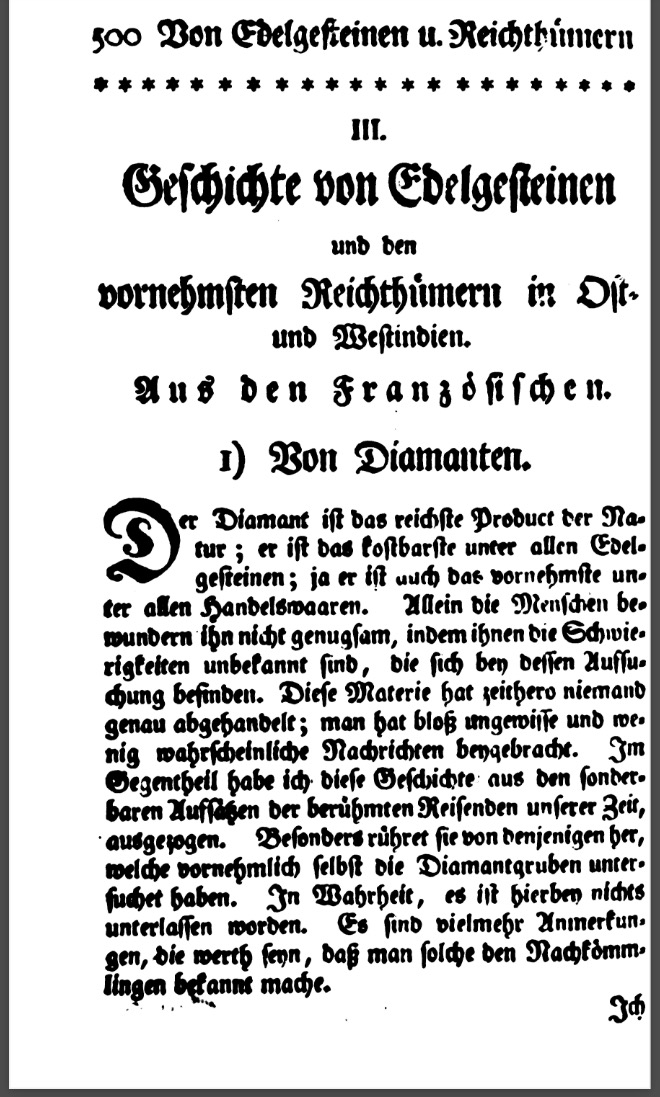
Geschichte von Edelgesteinen und den vornehmsten Reichthümern in Ost- und Westindien
History of Precious Stones and the Most Noble Riches in East and West India
Journal Article
Anonymous (1757) Geschichte von Edelgesteinen und den vornehmsten Reichthümern in Ost- und Westindien. [History of Precious Stones and the Most Noble Riches in East and West India] Hamburgisches Magazin, Vol. 18, pp. 500–543.
Record No. 8081  |  Sinkankas/Born No.: NIS/NIB  |  Language: in German  |  RWHL
Believed to be a German translation of Samuel Chappuzeau’s Histoire des Joyaux et des principales richesses de l’Orient et de l’Occident from 1671. An eighteenth-century German article on precious stones and other valuable natural products associated with the East and West Indies. Published anonymously in the *Hamburgisches Magazin* in 1757, it discusses gemstones within the broader context of the natural riches and commodities of overseas regions. The work is of interest to the history of gemology as an example of the way information about precious stones, their sources and their economic importance was disseminated to German readers through mid-eighteenth-century periodical literature.

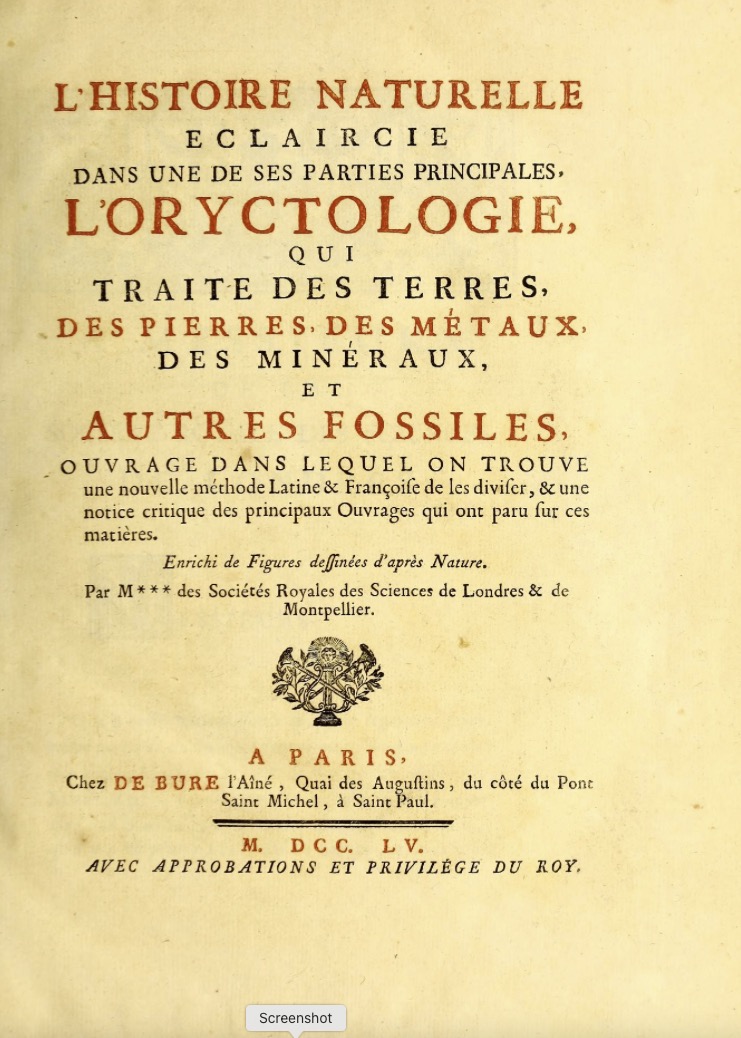
L’histoire naturelle éclaircie dans une de ses parties principales, l’oryctologie : qui traite des terres, des pierres, des métaux, des minéraux, et autres fossiles : ouvrage dans lequel on trouve un nouvelle méthode latine & françoise de les diviser, & une notice critique des principaux ouvrages qui ont paru sur ces matières
The Natural History Elucidated in One of Its Principal Parts, Oryctology: Which Deals with Earths, Stones, Metals, Minerals, and Other Fossils: A Work in Which a New Latin and French Method of Classifying Them Is Presented, Along with a Critical Review of the Principal Works Published on These Subjects
Book
Dezallier d’Argenville, A.J., Chedel, P.Q. and Collin de Vermont, H. (1755) L’histoire naturelle éclaircie dans une de ses parties principales, l’oryctologie : qui traite des terres, des pierres, des métaux, des minéraux, et autres fossiles : ouvrage dans lequel on trouve un nouvelle méthode latine & françoise de les diviser, & une notice critique des principaux ouvrages qui ont paru sur ces matières. [The Natural History Elucidated in One of Its Principal Parts, Oryctology: Which Deals with Earths, Stones, Metals, Minerals, and Other Fossils: A Work in Which a New Latin and French Method of Classifying Them Is Presented, Along with a Critical Review of the Principal Works Published on These Subjects] Paris, Chez De Bure l’aîné (560 pp.).
Record No. 16708  |  Sinkankas/Born No.: NIS/NIB  |  Language: in French  |  RWHL
Dezallier d’Argenville’s L’histoire naturelle éclaircie… l’oryctologie (1755) is an important mid-eighteenth-century treatise on what would later develop into mineralogy and geology. The work systematically describes and classifies earths, stones, metals, minerals, and other substances then grouped under the broad category of “fossils,” presenting parallel Latin and French terminology and discussing the principal earlier literature on the subject. Of particular gemological interest are its descriptions and classification of precious and ornamental stones, including diamonds, rubies, sapphires, emeralds, topazes, garnets, opals, agates, jaspers, rock crystal, and other lapidary materials, with attention to their physical appearance, varieties, localities, and contemporary nomenclature. The volume is also notable for its engraved plates, drawn by Hyacinthe Collin de Vermont and engraved by Pierre Quentin Chedel, illustrating minerals, crystals, fossils, and related natural-history specimens. It provides a valuable picture of European mineralogical and gemological knowledge immediately before the major advances in chemical mineralogy and crystallography of the later eighteenth century.

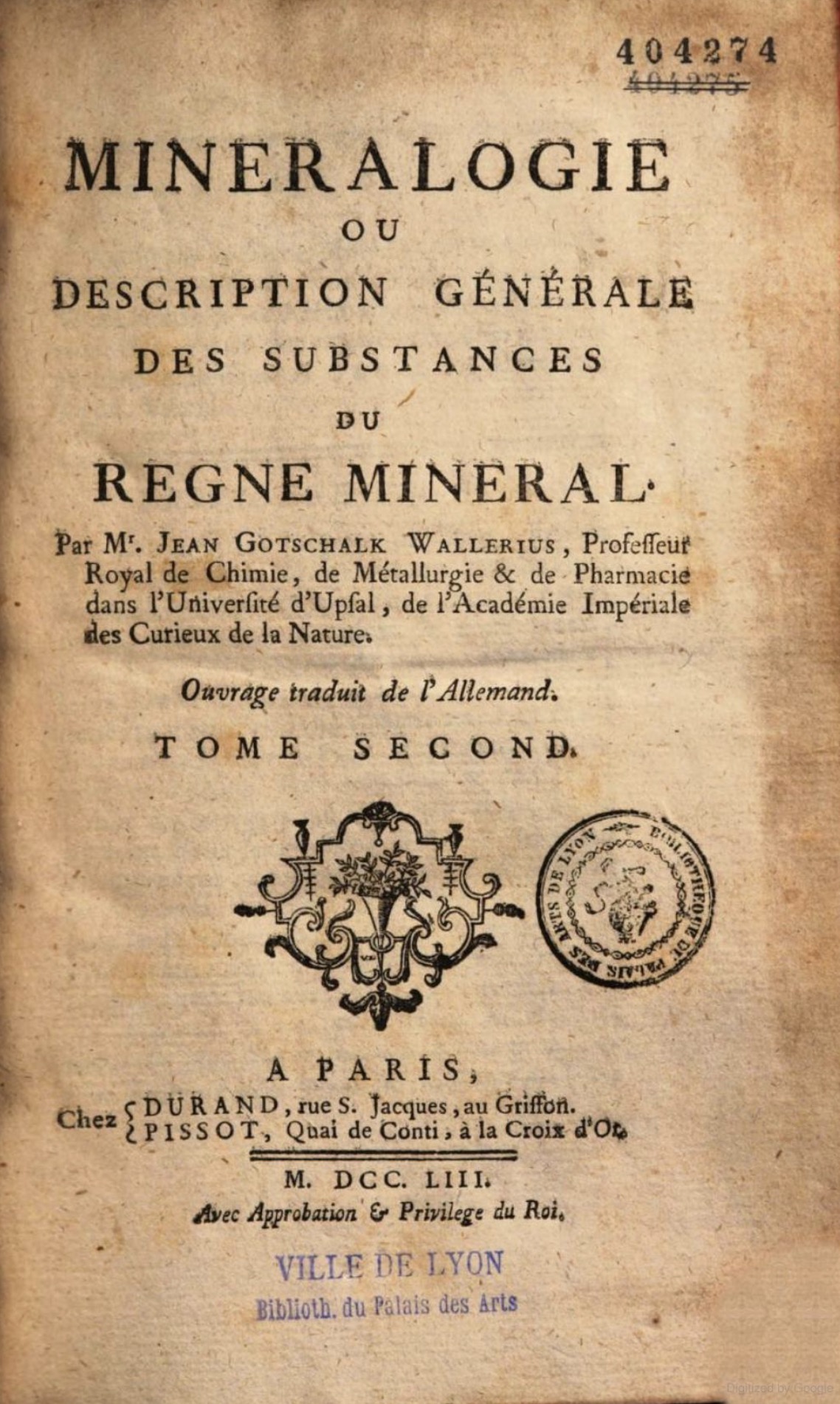
Minéralogie, ou description générale des substances du règne
Mineralogy, or General Description of the Substances of the Mineral Kingdom
Book
Wallerius, J.G. (1753) Minéralogie, ou description générale des substances du règne. [Mineralogy, or General Description of the Substances of the Mineral Kingdom] Paris, Durand / Pissot, 2 Vols., 591, 256 pp.
Record No. 29560  |  Sinkankas/Born No.: NIS / NIB  |  Language: in French  |  RWHL
This French translation of Wallerius’s influential Mineralogia presents an early systematic classification of the mineral kingdom, dividing it into earths, stones, minerals, and concretions, followed by preparations made from mineral substances. Minerals are distinguished through their composition, form, colour, transparency, hardness, specific gravity, geological occurrence, and behaviour under heat or chemical treatment. The extensive treatment of stones includes nephrite, rock crystal, agate, chalcedony, onyx, opal, jasper, lapis lazuli, and numerous ornamental materials. Precious stones are discussed separately, including diamond, ruby, sapphire, topaz, emerald, chrysolite, amethyst, garnet, hyacinth, and aquamarine. Wallerius describes their varieties, crystal forms, relative hardness, colours, host rocks, geographical sources, and response to fire, while also addressing false or coloured crystals, methods of artificial staining, and means of distinguishing genuine stones. Although many identifications and mineral relationships are now obsolete, the work represents an important transition from traditional lapidary nomenclature toward the systematic classification of minerals by observable physical and chemical properties.

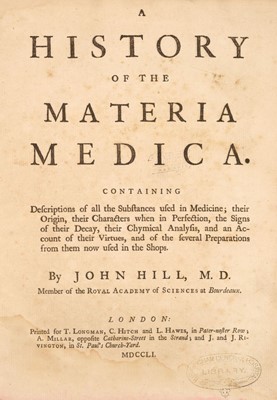
A History of the Materia Medica

Book
Hill, J. (1751) A History of the Materia Medica. London, T. Longman, C. Hitch, & L. Hawes, 895 pp. (jade see pp. 270–272).
Record No. 16449  |  Sinkankas/Born No.: NIS/NIB  |  RWHL
A systematic account of medicinal substances by the English botanist and apothecary John Hill, covering materials derived from the vegetable, animal and mineral kingdoms. Hill describes individual substances, their sources, physical characteristics, preparation and supposed medicinal properties and uses. Of gemological interest is the section on mineral substances, which includes precious stones and other minerals employed medicinally, reflecting the persistence in eighteenth-century European pharmacology of therapeutic uses traditionally attributed to gems. The work is useful for tracing the transition from older lapidary and pharmacological traditions toward increasingly empirical descriptions of natural substances.

Encyclopédie, ou dictionnaire raisonné des sciences, des arts et des métiers
Encyclopedia, or reasoned dictionary of sciences, arts and crafts
Edited Book
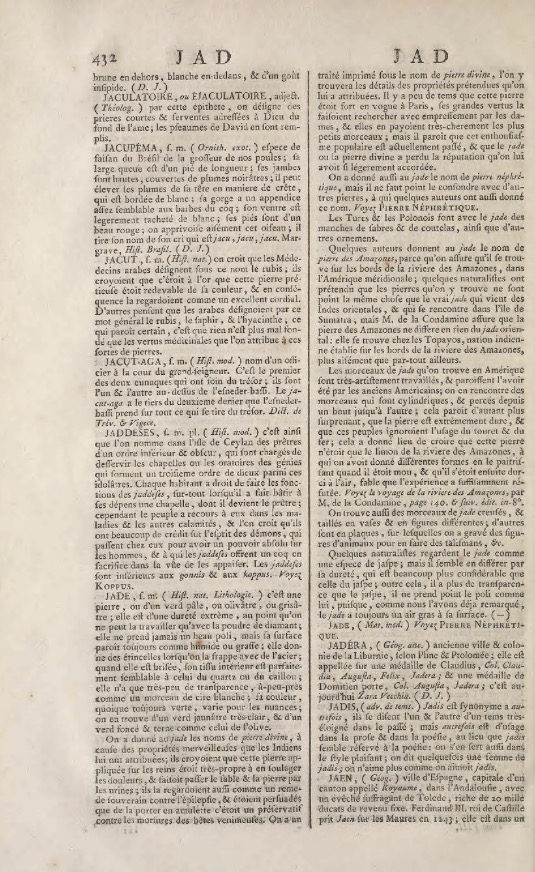
Diderot, D., editor (1751–1780) Encyclopédie, ou dictionnaire raisonné des sciences, des arts et des métiers. [Encyclopedia, or reasoned dictionary of sciences, arts and crafts]. Paris, Neuchâtel, 35 Vols., see Vol. 8, p. 432.
Record No. 8166  |  Sinkankas/Born No.: NIS/NIB  |  Language: in French  |  RWHL
A monumental French reference work edited principally by Denis Diderot and, for much of its early development, Jean le Rond d’Alembert. The Encyclopédie sought to assemble and critically organize contemporary knowledge of the sciences, arts, crafts and trades, combining theoretical articles with detailed descriptions and illustrations of practical processes. Of particular gemological interest are articles concerning precious stones, minerals, metals, jewelry, lapidary work and related terminology, while the plate volumes illustrate tools and techniques employed by jewelers, goldsmiths and other craftsmen. The work is an important source for understanding eighteenth-century European knowledge of gemstones and minerals and, especially, contemporary methods of cutting, polishing, setting and working precious materials.

Sammlung neuer und merkwürdiger Reisen zu Wasser und zu Lande, aus verschiedenen Sprachen übersetzt und mit vielen Kupfertafeln und Landkarten versehen
Collection of New and Remarkable Travels by Sea and Land, Translated from Various Languages and Enriched with Many Copper Engravings and Maps
Book
Anonymous (1750–1754) Sammlung neuer und merkwürdiger Reisen zu Wasser und zu Lande, aus verschiedenen Sprachen übersetzt und mit vielen Kupfertafeln und Landkarten versehen. [Collection of New and Remarkable Travels by Sea and Land, Translated from Various Languages and Enriched with Many Copper Engravings and Maps] Göttingen, Vandenhoeck, 11 Vols., Vol. 2 includes the travels to Guyana, Peru, and southern America by Barrère, Bouguet, and de la Condamine
Record No. 16706  |  Sinkankas/Born No.: NIS/NIB  |  Language: in German  |  RWHL
A multi-volume German collection of accounts of notable voyages and travels by sea and land, translated from various European languages and illustrated with numerous engraved plates and maps. Published at Göttingen between 1750 and 1754, the series brought German readers accounts of exploration and travel in different parts of the world, combining geographical description with observations on peoples, customs, natural history, commerce and regional products. The volumes belong to the eighteenth-century tradition of compilations that disseminated European geographical and natural-historical knowledge through translated travel literature.

Allgemeines Gelehrten-Lexicon

General Lexicon of Scholars
Book
Jöcher, C.G. (1750–51) Allgemeines Gelehrten-Lexicon. [General Lexicon of Scholars] Leipzig, Johann Friedrich Gleditschens Buchhandlung, 4 Vols.
Record No. 16482  |  Sinkankas/Born No.: NIS/NIB  |  Language: in German  |  RWHL
A major eighteenth-century German biographical and bibliographical reference work compiled by Christian Gottlieb Jöcher. The Allgemeines Gelehrten-Lexicon provides alphabetically arranged accounts of scholars and writers, giving biographical information together with lists or notices of their published works. Published at Leipzig in four volumes between 1750 and 1751, it covers authors from antiquity through Jöcher’s own time and became an important reference source for European intellectual and publishing history. For research into the history of gemology and mineralogy, it is particularly useful for identifying early authors, variant names, biographical details and bibliographical information concerning works cited in older scientific and lapidary literature.

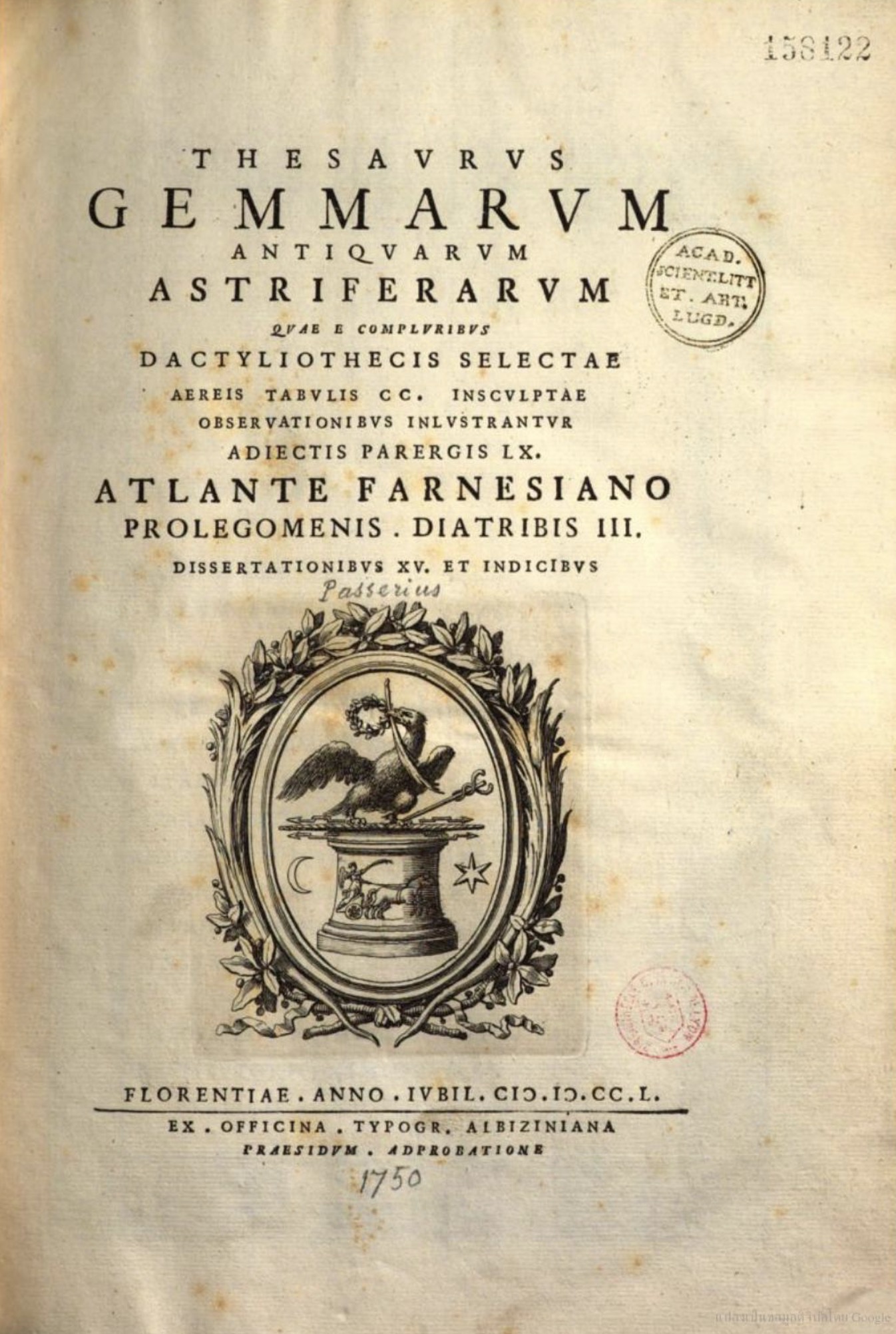
Thesaurus Gemmarum Antiquarum Astriferarum, quae e Compluribus Dactyliothécis Selectae... Observationibus Inlustrantur
Thesaurus of Ancient Star-Bearing Gems, Selected from Several Dactyliothecae… Illustrated with Observations
Book
Gori, A.F. and Passeri, G.B. (1750) Thesaurus Gemmarum Antiquarum Astriferarum, quae e Compluribus Dactyliothécis Selectae... Observationibus Inlustrantur. [Thesaurus of Ancient Star-Bearing Gems, Selected from Several Dactyliothecae… Illustrated with Observations] Florence, Albiziniana, 3 Vols.
Record No. 16348  |  Sinkankas/Born No.: 2466; NIB  |  Language: in Latin  |  RWHL
Sinkankas: A large and elaborate work written and illustrated about the theme of the significance of the stars and other celestial bodies as depicted upon engraved gems, but with excursions into related subjects, most notably a lengthy dissertation on the symbolism shown in the Farnese Museum statue of Atlas. This book is generally cataloged under Gori, although it is apparent that the major writing was by Passeri, with Gori acting mainly in the capacity of editor. The first volume contains a preface by Gori and 200 plates, one of which is double-numbered and hence raises the plate count to 209, but with only 199 distinct engravings on as many leaves. Remarks on the quality of plates below. The second volume contains Passeri’s descriptions and comments on the gems and an essay on Basilidian gems and another on a gem depicting Mercury by Gori. The last volume begins with a detailed study of the Farnese Atlas and is supplied with two fine plates of the same, each from a different viewpoint, and four other plates depicting the constellations carved on the celestial sphere supported by Atlas. Next are fifteen dissertations by Passeri on selected gems from among those depicted in the first volume, some plates of which are reproduced as illustrations for the essays. The most extended commentary on this work is by G. A. Aldini, Inst. Glitt., 1785, in which two entire chapters are devoted to discussion of its contents and merits, pp. 227–74. C. W. King’s comments are curt: “many plates of astrological and Gnostic gems, the designs much magnified, and coarsely engraved” (Antique Gems and Rings, vol. 1, p. 464). Furtwängler, Die antiken Gemmen, vol. 3, p. 414, summarizes the chief contents and notes that the engravings are “simple outlines without pretension” and the small gems representative of the Roman imperial period. He calls the illustrations “unreliable.” See also Vinet 1619, not in Goodland although some illustrations appear to qualify.

Verzeichniss derjenigen Schriftsteller, die von Edelsteinen gehandelt haben
List of those writers who have written about gemstones
Book Section
Beyer, A. (1750–1765) Verzeichniss derjenigen Schriftsteller, die von Edelsteinen gehandelt haben. [List of those writers who have written about gemstones] In: Neue Versuche nützlicher Sammlungen zu der Natur- und Kunstgeschichte, sonderlich von Ober-Sachsen, Vol. 18 , pp. 471–494.
Record No. 10937  |  Sinkankas/Born No.: NIS/NIB  |  Language: in German  |  RWHL
An early bibliography of writings on gemstones, published as a contribution to Christian Gottlob Grundig’s Neue Versuche nützlicher Sammlungen zu der Natur- und Kunstgeschichte, sonderlich von Ober-Sachsen. Beyer surveys authors who had written about precious stones, providing a useful guide to the gemological and lapidary literature known in the eighteenth century. The work is of particular historical value as an early attempt to gather references on gemstones into a dedicated bibliographical compilation, and as a record of the sources available to German scholars before mineralogy and gemology developed into more formally organized scientific disciplines.

Gemmae Antiquae, Dactyliotheca | Le gemme antiche di Anton-Maria Zanetti di Girolamo
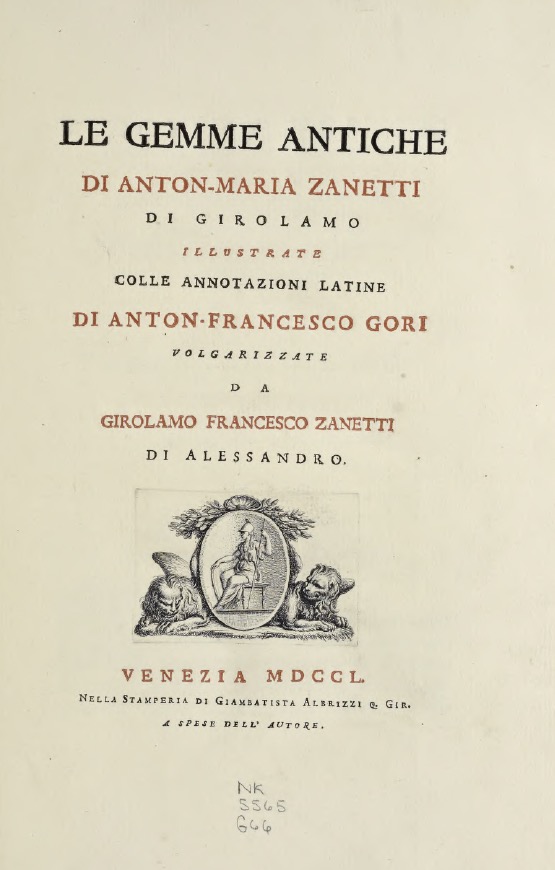
Ancient Gems, Dactyliotheca | The Ancient Gems of Anton-Maria Zanetti, son of Girolamo
Edited Book
Gori, A.F., editor (1750) Gemmae Antiquae, Dactyliotheca | Le gemme antiche di Anton-Maria Zanetti di Girolamo. [Ancient Gems, Dactyliotheca | The Ancient Gems of Anton-Maria Zanetti, son of Girolamo]. Venice, Giambatista Albrizzi, 148 pp..
Record No. 8143  |  Sinkankas/Born No.: NIS/NIB  |  Language: in Latin  |  RWHL
A lavishly illustrated catalogue of the celebrated collection of engraved gems formed by the Venetian connoisseur and collector Anton Maria Zanetti. The volume presents 80 full-page engraved plates depicting ancient and modern intaglios and cameos in Zanetti’s collection, based on drawings by Zanetti himself. Antonio Francesco Gori supplied the scholarly descriptions and commentary in Latin, with an Italian translation by Girolamo Francesco Zanetti; the Latin and Italian texts are presented in parallel. The entries discuss the subjects represented on the gems, their iconography, inscriptions, artists and antiquarian significance, making the work an important eighteenth-century contribution to glyptic studies and the documentation of European collections of engraved gems. Published in Venice by Giambattista Albrizzi in 1750, the work is also known from its half-title as the Dactyliotheca Zanettiana.

Le Gemme Antiche di Anton-Maria Zanetti di Girolamo
The Ancient Gems of Anton-Maria Zanetti by Girolamo
Book
Zanettii, A.M. (1750) Le Gemme Antiche di Anton-Maria Zanetti di Girolamo. [The Ancient Gems of Anton-Maria Zanetti by Girolamo], 146 pp.
Record No. 7553  |  Sinkankas/Born No.: NIS/NIB  |  Language: in Latin  |  RWHL
A lavishly illustrated catalogue of the collection of engraved gems formed by the Venetian artist, printmaker and collector Anton Maria Zanetti (1680–1767). Published in Venice in 1750, the work presents ancient and modern intaglios and cameos from Zanetti’s collection, with engraved illustrations based on drawings by Zanetti himself. Antonio Francesco Gori contributed the scholarly Latin descriptions and antiquarian commentary, while Girolamo Francesco Zanetti provided the Italian text. The entries discuss the subjects represented on the gems, including figures from classical mythology and history, inscriptions and questions of attribution. An important eighteenth-century work on glyptics, it also provides valuable documentation of a major Venetian collection of engraved gems.

History of Stones. Theophrastus's History of stones. With an English version, and critical and philosophical notes, including the modern history of the gems, &c, described by that author, and of many other of the native fossils. By John Hill. To which are added, two letters: one to Dr. James Parsons, F.R.S., on the colours of the sapphire and turquoise. And the other, to Martin Folkes ... upon the effects of different menstruums on copper ...
Book
Theophrastus (1746) History of Stones. Theophrastus's History of stones. With an English version, and critical and philosophical notes, including the modern history of the gems, &c, described by that author, and of many other of the native fossils. By John Hill. To which are added, two letters: one to Dr. James Parsons, F.R.S., on the colours of the sapphire and turquoise. And the other, to Martin Folkes ... upon the effects of different menstruums on copper ... London, C. Davis, xxiii, 211 pp.
Record No. 7398  |  Sinkankas/Born No.: NIS/NIB  |  RWHL
The references to Theophrastus and the quotations from him, so frequent in the works of later writers on fossils, might lead one to believe that his treatise was universally known and perfectly understood. However, upon closer examination, it becomes apparent that, while he is often cited, he is rarely understood—and indeed, rarely read. Those who freely invoke his name have generally taken little effort to engage with his works, relying instead on secondhand references, many of which originate from Pliny. As for Pliny, anyone familiar with the works of earlier writers knows that, although he deserves credit for the vast repository of knowledge he compiled, his accuracy in quotations leaves much to be desired. It is therefore not surprising that the genuine work of Theophrastus on fossils has been so neglected. Anyone attempting to read even the best editions available today will encounter numerous obstacles: missing words, incomplete phrases, and sentences rendered unintelligible due to preserved errors or poorly executed editorial corrections. Such deficiencies make the treatise challenging to read without extraordinary effort, subject expertise, and frequent consultation of other ancient authors. This treatise, though filled with excellent material, has remained nearly unintelligible for these reasons. Theophrastus was known for his brevity, and where even some of those few words are missing, understanding his meaning becomes no easy task. To address this, I have painstakingly consulted other ancient authors to reconstruct what Theophrastus most likely intended, based on how they addressed the same topics. In these efforts, Pliny—when reliable—has been particularly helpful, as many of his passages are literal translations of Theophrastus, offering insight into how the original text was read before later errors rendered it unclear. In this work, I have employed two main methods to restore and understand the text: comparing Theophrastus’s descriptions with the actual substances he discusses, and cross-referencing his words with those of other ancient authors, particularly Pliny, to reconstruct missing or corrupted passages. With these methods and resources, I have undertaken to produce a new edition of the Greek text. While I have filled in the gaps and corrected errors to make the text clear, readable, and coherent, I have also documented every alteration in the notes—indicating where defects occurred and what changes I made. As for the English translation, my goal has been to make the work accessible to British readers. I have not limited myself to a strict, word-for-word translation; instead, I have aimed to convey both the words and the meaning of Theophrastus. In many instances, I have expanded a single word into a full sentence, adding brief recaps of previously mentioned ideas to maintain the logical flow of the text and ensure clarity. For this edition, I have also included a Greek index of all Theophrastus’s words, for which I am indebted to Mr. Newberry, an account of a newly discovered acid derived from a stone first identified in Sweden, and suggestions for new methods of categorizing fossils—a much-needed improvement in the field of natural history.

Edelgesteine

Gemstones
Book Section
Trichter, V. (1742) Edelgesteine. [Gemstones] In: Curiöses Reit- Jagd- Fecht- Tantz- oder Ritter-Rxercitien-Lexicon, Leiipzig, pp. 575–576.
Record No. 8139  |  Sinkankas/Born No.: NIS/NIB  |  Language: in German  |  RWHL
Precious stones: These are those which are made valuable not only due to their rarity and beauty but also because nature has adorned them with a special light and radiance, making them, in a sense, noble—so that they sparkle like the finest stars and have always maintained a higher status than gold or silver. There are two types of precious stones: transparent and opaque. The transparent ones include amethyst, beryl, carbuncle, chrysolite, diamond, hyacinth, ruby, sapphire, and emerald. Among the opaque ones, though some are semi-transparent, are agate, carnelian, chalcedony, jasper, the so-called cat’s eye, lapis lazuli, nephrite, and gallstone, malachite and schreckstein, onyx, opal, turquoise, etc. These precious stones, especially the transparent ones, originate from water or moisture impregnated with mountain salt, which allows them to grow and develop into crystals. It is impossible for something to be transparent that has not first been in liquid form. Dense substances such as silver and lead, when dissolved in separating water or other acidic liquids, can easily grow into transparent crystals. Similarly, one often finds completely clear water droplets inside the most beautifully grown crystals, and in the hardest stones in India, the finest gemstones. Moreover, that there is some mountain salt mixed in is evident from the geometric shape of the precious stones, which are clearly recognizable as having the same structure as salt and saltpeter, as the mined crystals and diamonds, which differ only in hardness, grow entirely angular, often even with veins and such deposits, so that one can clearly see how the salty components have been layered on top of each other. Their charming colors come from a delicate metallic sulfur, similar to metals found in mines: for example, carbuncle, ruby, garnet, and amethyst from a gold-sulfur; sapphire from the tincture of silver; emerald and chrysolite from the greenish-sulfuric nature of copper; topaz and hyacinth from the sulfurous substance of iron, etc. However, this sulfur in precious stones is very volatile, so much so that the colors resulting from it can easily disappear and evaporate in the fire. But since these gemstones, when broken, are often irregular, or unclean and blotchy, even the most beautiful and purest stones do not shine as brightly as when they are cut, whereby the multiple facets reflect and play the light that falls on the foil or diamond ink all the more toward the eye. Therefore, those skilled in this art are called gem cutters, and they practice a free craft; however, they have been regulated by a noble order in Nuremberg for more than 100 years.

Histoire naturelle civile et geographique de l’Orenoque et de principales Rivieres qui s’y jettent
Civil and geographical natural history of the Orenoque and the main rivers that flow into it
Book
Gumilla, J. (1741) Histoire naturelle civile et geographique de l’Orenoque et de principales Rivieres qui s’y jettent. [Civil and geographical natural history of the Orenoque and the main rivers that flow into it] Avignon, F. Girard, 3 Vols., 388, 334, 332 pp.
Record No. 7960  |  Sinkankas/Born No.: NIS/NIB  |  Language: in French  |  RWHL
Gumilla, J. (1741) Histoire naturelle civile et geographique de l’Orenoque et de principales Rivieres qui s’y jettent. [Civil and geographical natural history of the Orenoque and the main rivers that flow into it] Avignon, F. Girard, 3 Vols., 388, 334, 332 pp. A French edition of the Jesuit missionary José Gumilla’s important account of the Orinoco region of northern South America, describing its geography, rivers, Indigenous peoples, customs, natural history, plants, animals, and mineral resources. Based substantially on Gumilla’s years of missionary activity and travel in the region, the work provides an early European description of the interior of the Orinoco basin and its natural products, including information relevant to the history of precious stones and mineral resources in colonial South America.

Essai sur l'histoire naturelle de la France Equinoxiale: Ou de'nombrement des plantes, des animaux & des minéraux, qui se trouvent dans l'isle de Cayenne, les isles de Remire, sur les côtes de la mer, & dans le continent de la Guyane

Essay on the Natural History of Equatorial France: Or, Enumeration of the Plants, Animals, and Minerals Found in the Isle of Cayenne, the Isles of Remire, on the Coasts of the Sea, and in the Continent of Guyana
Book
Barrère, P. (1741) Essai sur l'histoire naturelle de la France Equinoxiale: Ou de'nombrement des plantes, des animaux & des minéraux, qui se trouvent dans l'isle de Cayenne, les isles de Remire, sur les côtes de la mer, & dans le continent de la Guyane. [Essay on the Natural History of Equatorial France: Or, Enumeration of the Plants, Animals, and Minerals Found in the Isle of Cayenne, the Isles of Remire, on the Coasts of the Sea, and in the Continent of Guyana] Paris, Piget, xxiv + 215 pp.
Record No. 6902  |  Sinkankas/Born No.: NIS/NIB  |  Language: in French  |  RWHL
Barrère presents an early inventory of the plants, animals and minerals of Cayenne, the Rémire islands and mainland Guiana, recording Latin, French and Indigenous names alongside observations on their uses in medicine and the arts. The work brings together botanical and zoological descriptions with a much shorter account of mineral substances, including iron-bearing material, green jasper and clay. Its principal value lies in documenting the region’s natural productions and the terminology applied to them before the adoption of Linnaean nomenclature. For gemological research, the mineral notices require interpretation within eighteenth-century usage; the identification of a material as green jasper does not by itself establish that it was jade.

Exploring the Literature of Jade

Jade literature spans gemology, mineralogy, archaeology, art history, mining, carving and connoisseurship, and includes works on both jadeite and nephrite from around the world.

For an introduction to collecting books on this subject, read Hidden Treasure — Collecting the Literature of Jade.

About Four Treasures

Four Treasures is Lotus Gemology's freely accessible gemological reference database. Use the full database to search by author, title or keyword and explore literature on gemology, mineralogy, jewelry and related fields. Where available, hyperlinks on titles may lead directly to the full publication.

Search the Complete Four Treasures Database