Jade Bibliography

Jade Bibliography

Explore books, articles and historical sources on jade in Four Treasures, the Lotus Gemology reference database. This bibliography brings together matching records from the collection, with publication details, abstracts and cover images where available.

Jade References

The list below matches the terms jade, jadeite, nephrite or Fei Cui in the database's searchable fields. Some references discuss these materials as part of a broader subject.
3,281–3,300 of 3,802 matching references

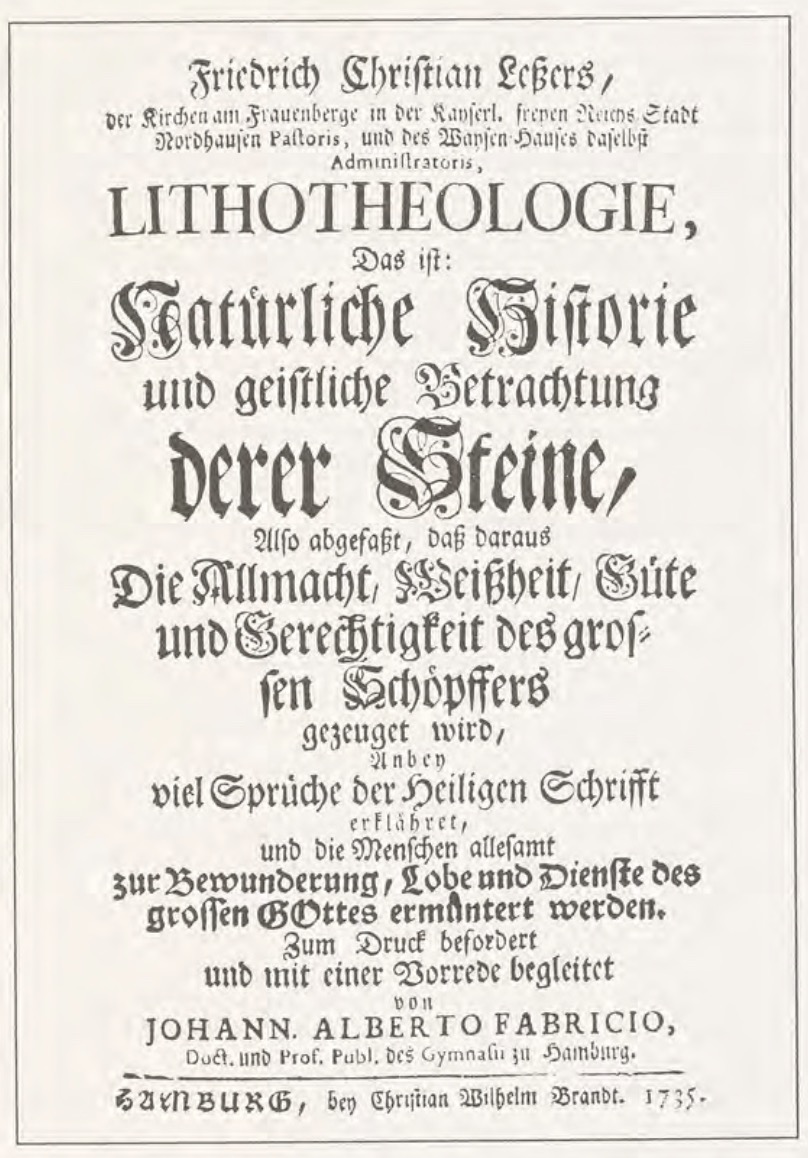
Lithotheologie, Das ist: Natürliche Historie und geistliche Betrachtung derer Steine, also abgefasst, dass daraus die Allmacht, Weisheit, Güte und Gerechtigkeit des grossen Schöpffers gezeuget wird, anbey viel Sprüche der Heiligen Schrifft erklähret und die Menschen allesamt zur Bewunderung, Lobe und Dienste des grossen Gottes ermuntert werden.
Lithotheologic, that is: Natural history and spiritual contemplation of stones, composed in such a way that from them the omnipotence, wisdom, goodness, and justice of the great Creator are demonstrated; together with explanations of many passages of Holy Scripture, and an exhortation to all mankind to admiration, praise, and service of the great God
Book
Lesser, F.C. (1735) Lithotheologie, Das ist: Natürliche Historie und geistliche Betrachtung derer Steine, also abgefasst, dass daraus die Allmacht, Weisheit, Güte und Gerechtigkeit des grossen Schöpffers gezeuget wird, anbey viel Sprüche der Heiligen Schrifft erklähret und die Menschen allesamt zur Bewunderung, Lobe und Dienste des grossen Gottes ermuntert werden. [Lithotheologic, that is: Natural history and spiritual contemplation of stones, composed in such a way that from them the omnipotence, wisdom, goodness, and justice of the great Creator are demonstrated; together with explanations of many passages of Holy Scripture, and an exhortation to all mankind to admiration, praise, and service of the great God] Hamburg, Christian Wilhelm, 1300 pp.
Record No. 28779  |  Sinkankas/Born No.: 3904  |  Language: in German  |  RWHL
Sinkankas: Utterly fascinating work in great detail and complexity, attempting to demonstrate the hand of God in every manifestation of the mineral kingdom. Lesser assembled an astounding fund of information culled from hundreds of ancient and modern sources and covering nearly every aspect of geology, mineralogy, paleontology, and gemology. So successful was he, and apparently so careful in his choices and interpretations, that the present work was very commonly quoted by later writers in earth sciences and mineralogy. It is divided into nine books, each with several parts and chapters. Book one explains fundamental interrelationships existing among the lithosphere, atmosphere, hydrosphere, and biosphere. Book two concerns the origin and formation of rocks and minerals. Book three treats occurrences or deposits of mineral materials, including gemstones. Book four discusses the properties of minerals and stones. Book five addresses “precious” and “non-precious” stones, with pp. 343–66 treating precious stones, though restricted to a limited number of the better-known species and varieties, the stones themselves being apportioned among transparent, translucent, and opaque kinds, i.e., diamond, ruby, garnet, hyacinth, sapphire, amethyst, emerald, topaz, opal, and chrysolite as transparent stones, and translucent stones such as carnelian, sard, and other varieties of chalcedony; opaque stones include turquoise, malachite, jasper, lapis lazuli, and jade. This book also contains descriptions of some famous diamonds and other large and valuable gems, as well as data on the precious stones mentioned in the Bible. Also among the stones in this book are those that display remarkable inclusions, fanciful portraits or scenes, fossils, and crystals, and other curious, if not marvelous, mineral materials. Book six treats architectural and monumental stones, and also includes brief discussions of engraved gems, seals, and ringstones, with pp. 832–46 describing and speculating on the true identities of the gemstones in the vestments and breastplate of the High Priest, suitably illustrated with diagrams showing their positions and identities. Book seven concerns the misuse of stones, ostentatious display of gemstones, superstitious belief in their powers, the use of birthstones and planetary stones, and other topics of this nature. Book eight treats artificial stones of all kinds, including gemstones. Book nine concerns “works of wonder” in stone, e.g., Lot’s wife turned into a pillar of salt!

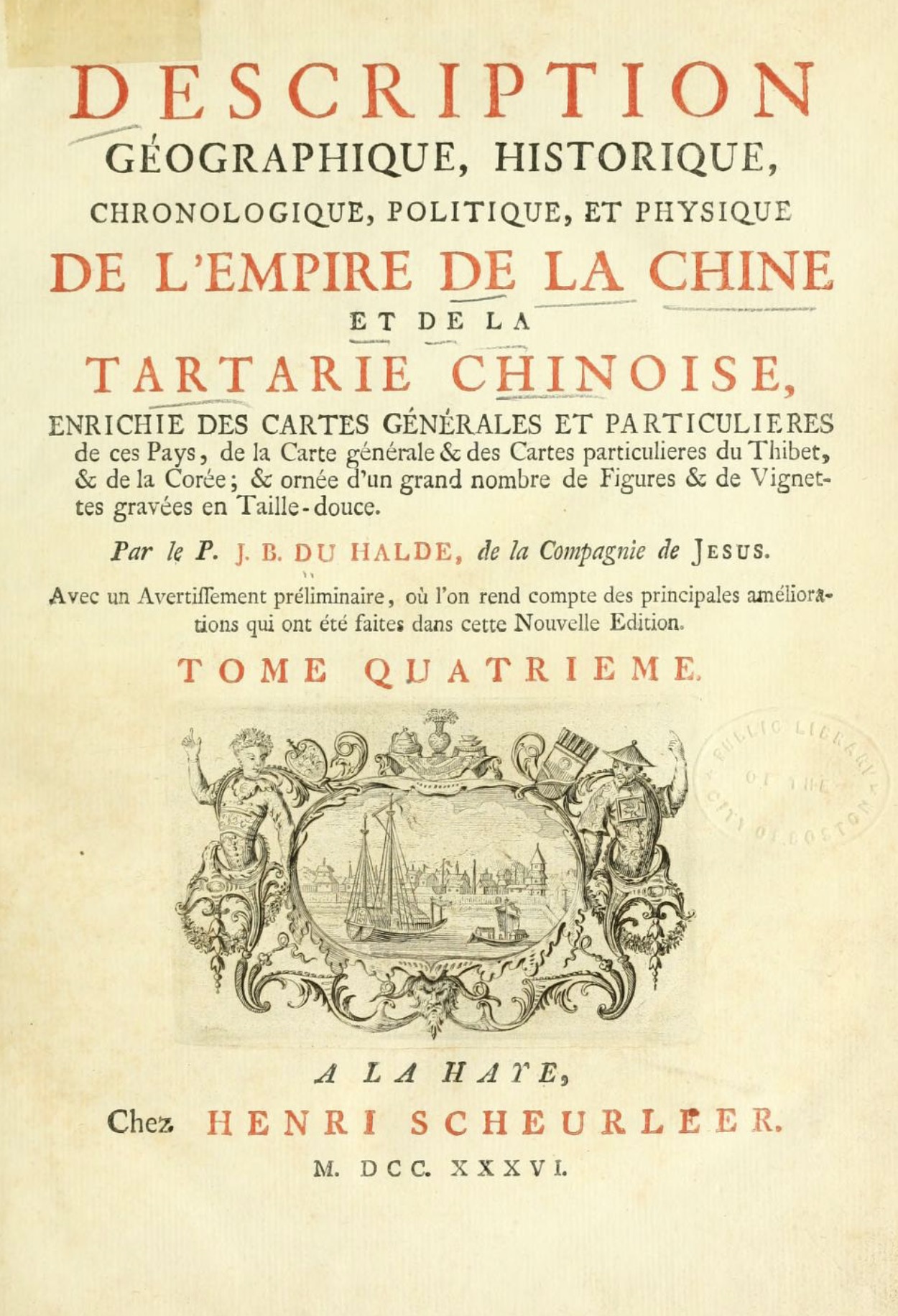
Description géographique, historique, chronologique, politique, et physique de l’empire de la Chine et de la Tartarie Chinoise
Geographical, historical, chronological, political, and physical description of the empire of China and Chinese Tartary
Book
Halde, J.-B., du (1735) Description géographique, historique, chronologique, politique, et physique de l’empire de la Chine et de la Tartarie Chinoise. [Geographical, historical, chronological, political, and physical description of the empire of China and Chinese Tartary] Paris, P.G. Le Mercier, 4 Vols., 592, 725, 564, 520 pp. (see Vol. 1, p. 38).
Record No. 16720  |  Sinkankas/Born No.: NIS/NIB  |  Language: in French  |  RWHL
The first edition of Du Halde's encyclopaedic account of China" (Lust) — and one of the earliest European sources on Chinese ceramics. Du Halde, who became a Jesuit priest in 1708, was entrusted by his superiors to edit the published and manuscript accounts of Jesuit travellers in China. The present work records the narratives of twenty-seven of these missionaries (listed in volume I, pp. li-li). Also notable is the Relation succinte du voyage du capitaine Beering dans la Sibérie (volume IV, pp.452-458), which is the first published account of Vitus Bering's 1728 voyage through the eponymous straits, whose importance he failed to recognize after sighting no land. The accompanying double-page map titled Carte des pays traversees par le Capne. Beering depuis la ville de Tobolsk jusqu' Kamtschatka (bound between pp.452 and 453) is based on Bering's manuscript map, which was given to the King of Poland and in turn passed to Du Halde to be reproduced here. Bering's map is "The first printed map of part of present Alaska" (S.I. Schwarz and R.E. Ehrenberg, The Mapping of America)."

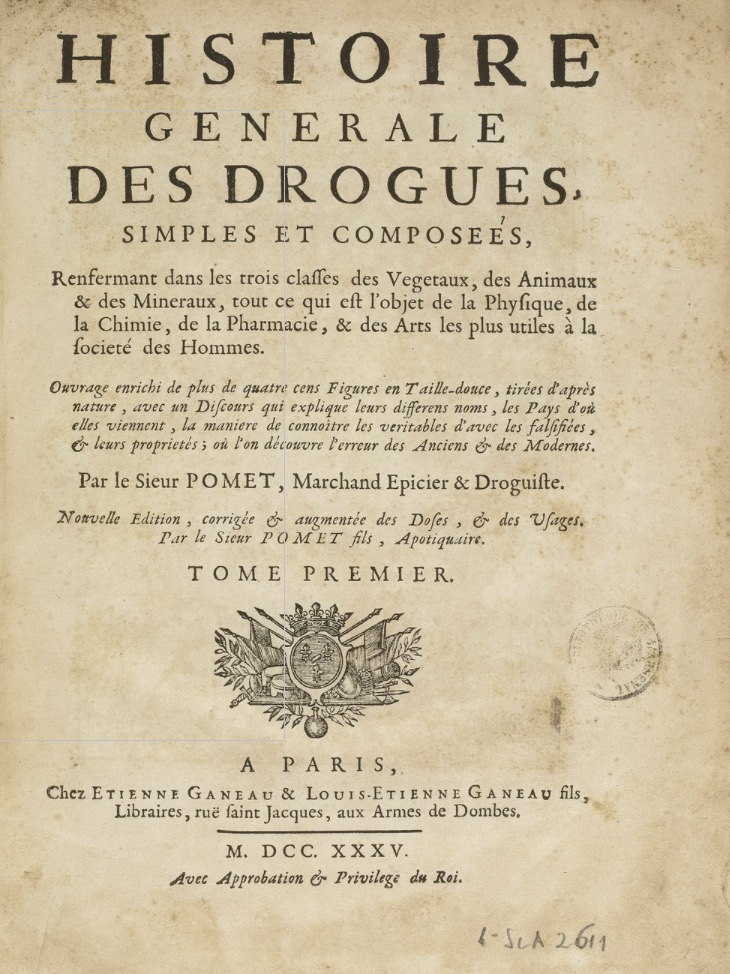
Histoire générale des Drogues simples et composées
General history of simple and compound drugs
Book
Pomet, P. (1735) Histoire générale des Drogues simples et composées. [General history of simple and compound drugs] Paris, Etienne Ganeau & Louis-Etienne Ganeau, Vol. 2, pp. 386–387 of the 1735 edition; Vol. 1, p. 429–436 of the 1876 edition; folio p. 103, Vol. 3
Record No. 7112  |  Sinkankas/Born No.: NIS/NIB  |  Language: in French  |  RWHL
Contains information on many minerals, including jade, as follows: Of Jasper: Jasper is a stone with many varieties and colors, somewhat similar in nature to agate, except that it is not as hard. It is brought to us from the East and West Indies, Persia, Syria, and other places. However, as it has limited use in medicine, I will only mention that one should use only the beautiful green variety, marked with red spots inside resembling blood stains, which has earned it the name “blood jasper.” One should reject the counterfeit type, which is nothing but vitrification. The authentic choice is true Oriental jasper of the aforementioned color. It is valued for stopping bleeding, treating epilepsy, and is considered among the cordials. Green jasper is prepared in the same way as hyacinths and other precious stones. In folio, page 103, Part III. Of Jade: Jade is a greenish stone with grayish undertones, extremely hard and rare. It is little used in medicine but highly valued for crafting various objects that are greatly esteemed due to the difficulty of working with it. The Turks and Poles frequently use jade to make knife handles, saber hilts, cutlasses, and other items, which they adorn with gold filigree. Of the Nephritic Stone: The nephritic stone is a gray-colored stone, tinged with a slight blue hue, so that it is typically bluish-gray, dense, and greasy to the touch, like the talc of Venice. This stone is highly valued by certain individuals for the treatment of kidney stones; this is why it is so rare and sought after, due to its healing property when hung on the thigh. Those afflicted by kidney or bladder stones, which form in the kidneys, have given it the name “nephritic stone,” derived from the word nefros, meaning “kidney.” The costliness and rarity of this stone have led some to substitute it with a type of green marble called malachite. For this reason, they carve it in the shape of a bird’s head, as the Ancients believed that the true nephritic stone resembled bird heads or parrot beaks. The true nephritic stone comes from New Spain. In folio, page 103, Part III.

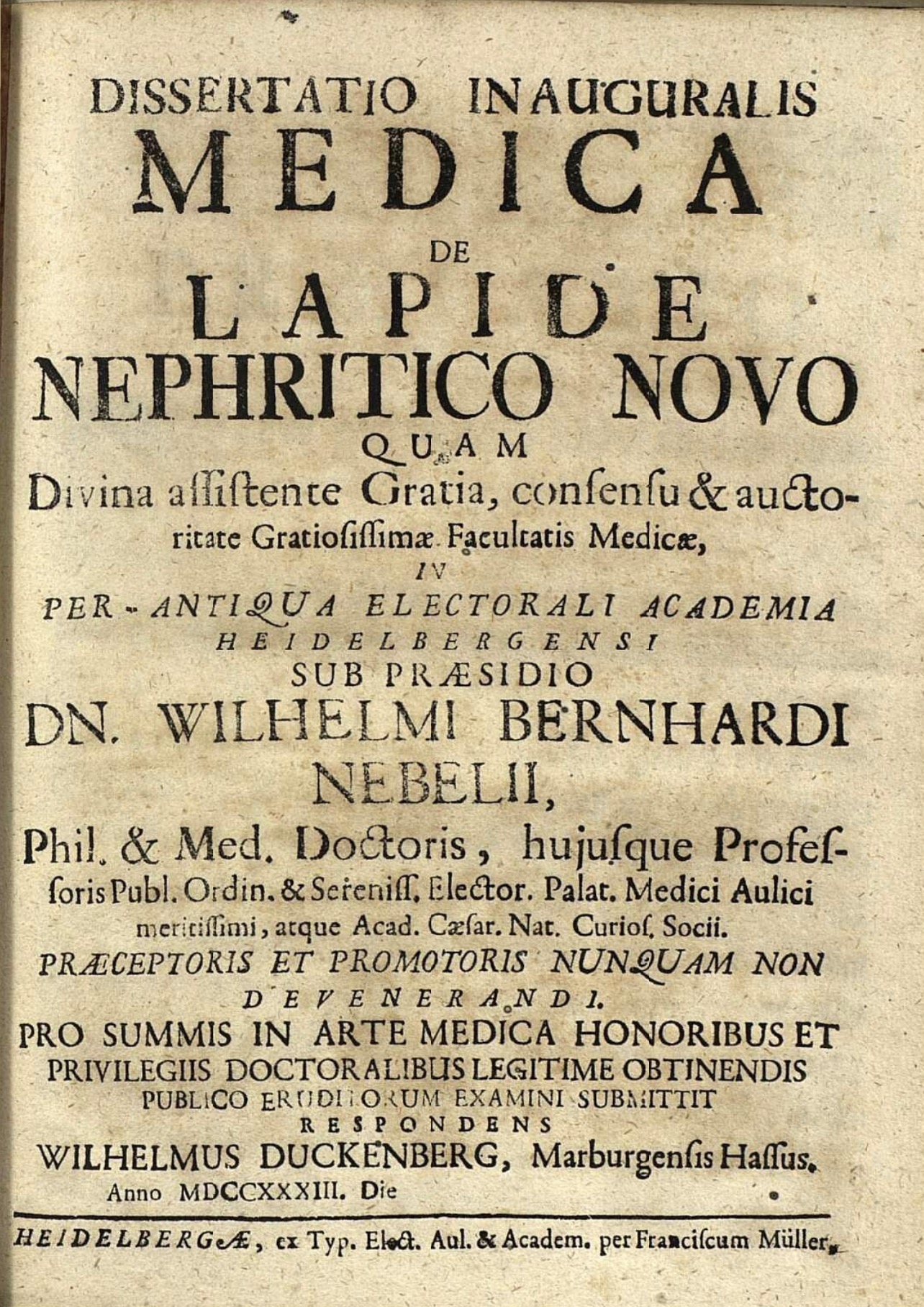
Dissertatio Inauguralis Medica de Lapide Nephretico Novo
Dissertation on the New Nephritic Stone
Book
Nebel, W.B. (1733) Dissertatio Inauguralis Medica de Lapide Nephretico Novo. [Dissertation on the New Nephritic Stone] Heidelbergae, Resp. Wilh. Duckenberg, 33 pp.
Record No. 29446  |  Sinkankas/Born No.: 4726 (not seen); NIB  |  Language: in Latin  |  RWHL
Wilhelm Bernhard Nebel’s Dissertatio inauguralis medica de lapide nephretico novo is an eighteenth-century medical dissertation devoted to a “new nephritic stone” and its reputed therapeutic action in disorders of the kidneys and urinary tract. The work examines the substance within the contemporary medical tradition of lapides nephritici, stones believed to prevent or alleviate renal complaints, and considers its nature and medicinal use. It is of particular interest to the history of gemology and medicine because it documents the continuing European investigation of so-called kidney stones at a time when the term nephritic stone could encompass materials distinct from the mineral later defined as nephrite. The dissertation thus provides evidence for the medical terminology and concepts from which the modern name nephrite ultimately developed.

Histoire de l'Isle espagnole ou de S. Domingue : ecrite particulierement sur des memoires manuscrits du P. Jean-Baptiste le Pers, jesuite, missionnaire à Saint Domingue, & sur les pieces originales, qui se conservent au Dépôt de la marine
History of the Spanish Isle or S. Domingue: written in particular on handwritten memoirs of P. Jean-Baptiste le Pers, Jesuit, missionary in Santo Domingo, & on the original pieces, which are kept at the Navy Depot
Book
Charlevoix, P.-F.-X., de (1730–1731) Histoire de l'Isle espagnole ou de S. Domingue : ecrite particulierement sur des memoires manuscrits du P. Jean-Baptiste le Pers, jesuite, missionnaire à Saint Domingue, & sur les pieces originales, qui se conservent au Dépôt de la marine. [History of the Spanish Isle or S. Domingue: written in particular on handwritten memoirs of P. Jean-Baptiste le Pers, Jesuit, missionary in Santo Domingo, & on the original pieces, which are kept at the Navy Depot] Paris, Hippolyte-Louis Guerin, 2 Vols., 482, 506 pp.
Record No. 7117  |  Sinkankas/Born No.: NIS/NIB  |  Language: in French  |  RWHL
Charlevoix traces the history of Hispaniola from its Indigenous inhabitants and Columbus’s voyages through Spanish colonization and the establishment of French Saint-Domingue. Drawing particularly on Jean-Baptiste Le Pers’s manuscript memoirs and documents preserved in the French naval archives, he combines historical narrative with descriptions of the island’s geography, settlements and inhabitants. The work covers conquest, colonial government, missionary activity, buccaneering and conflicts among European powers in the Caribbean. Maps and plans illustrate the island and associated places. Its accounts of Indigenous society and material culture include representations of religious objects known as zemis. The two volumes preserve an extensive early eighteenth-century compilation of information about Hispaniola, shaped by the author’s Jesuit perspective and the documentary sources available to him.

De Beschryving van Japan

The Description of Japan
Book
Kaempfer, E. (1729) De Beschryving van Japan. [The Description of Japan] Amsterdam, Arent van Huyssteen, 2 Vols., 500 pp.
Record No. 29448  |  Sinkankas/Born No.: NIS/NIB  |  Language: in Dutch  |  RWHL
Engelbert Kaempfer’s De Beschryving van Japan is the Dutch edition of his influential account of Japan, based on observations made while serving as physician to the Dutch East India Company at Dejima, Nagasaki, from 1690 to 1692. The work describes Japan’s geography, government, religion, customs, cities, natural history, agriculture, manufactures, commerce, and relations with foreign nations, and includes accounts of Kaempfer’s journeys to the shogunal court at Edo. Richly illustrated with maps, plans, plants, objects, and other subjects, it provided eighteenth-century Europeans with one of their most detailed sources of information about Japan during the period of restricted foreign contact. Its observations on natural products, manufactures, trade, and material culture also make it an important source for the history of European knowledge of Japanese resources and commodities.

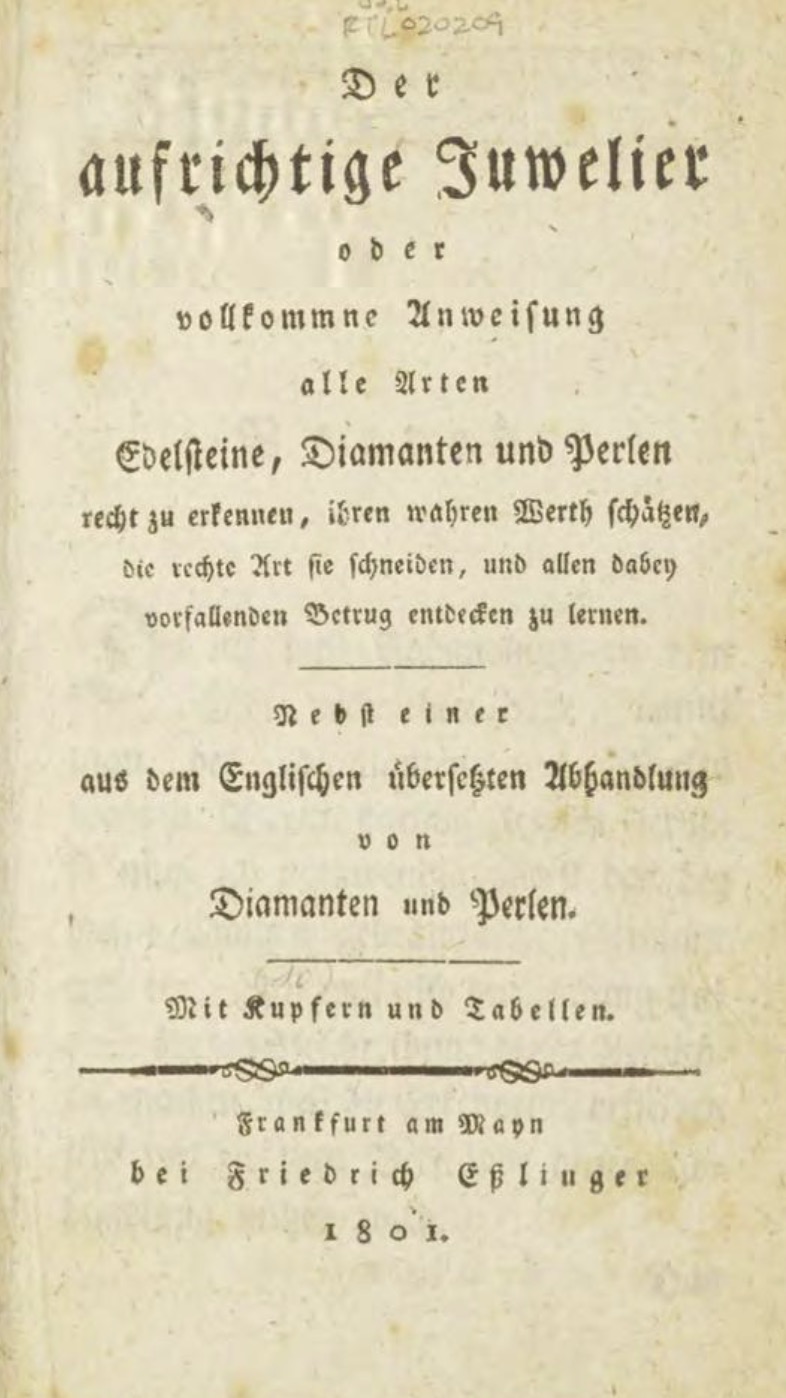
Der auffrichtige Jubelier

The Honest Jeweler
Book
Anonymous (1729) Der auffrichtige Jubelier. [The Honest Jeweler] Frankfurt a. M., F. Esslinger, 116 pp.
Record No. 29444  |  Sinkankas/Born No.: NIS/NIB  |  Language: in German  |  RWHL
Der auffrichtige Jubelier is an anonymous early eighteenth-century German handbook for jewelers dealing with precious stones, pearls, and the practical knowledge required in the jewelry trade. It discusses the principal varieties of gems, their characteristics, qualities, defects, and values, together with methods used to distinguish genuine stones from imitations and altered materials. The work also addresses aspects of buying, selling, and evaluating jewels, reflecting the practical concerns of contemporary merchants and craftsmen rather than purely mineralogical classification. It is of particular interest to the history of gemology because it documents the empirical methods, terminology, valuation practices, and commercial knowledge employed by German-speaking jewelers in the early eighteenth century.

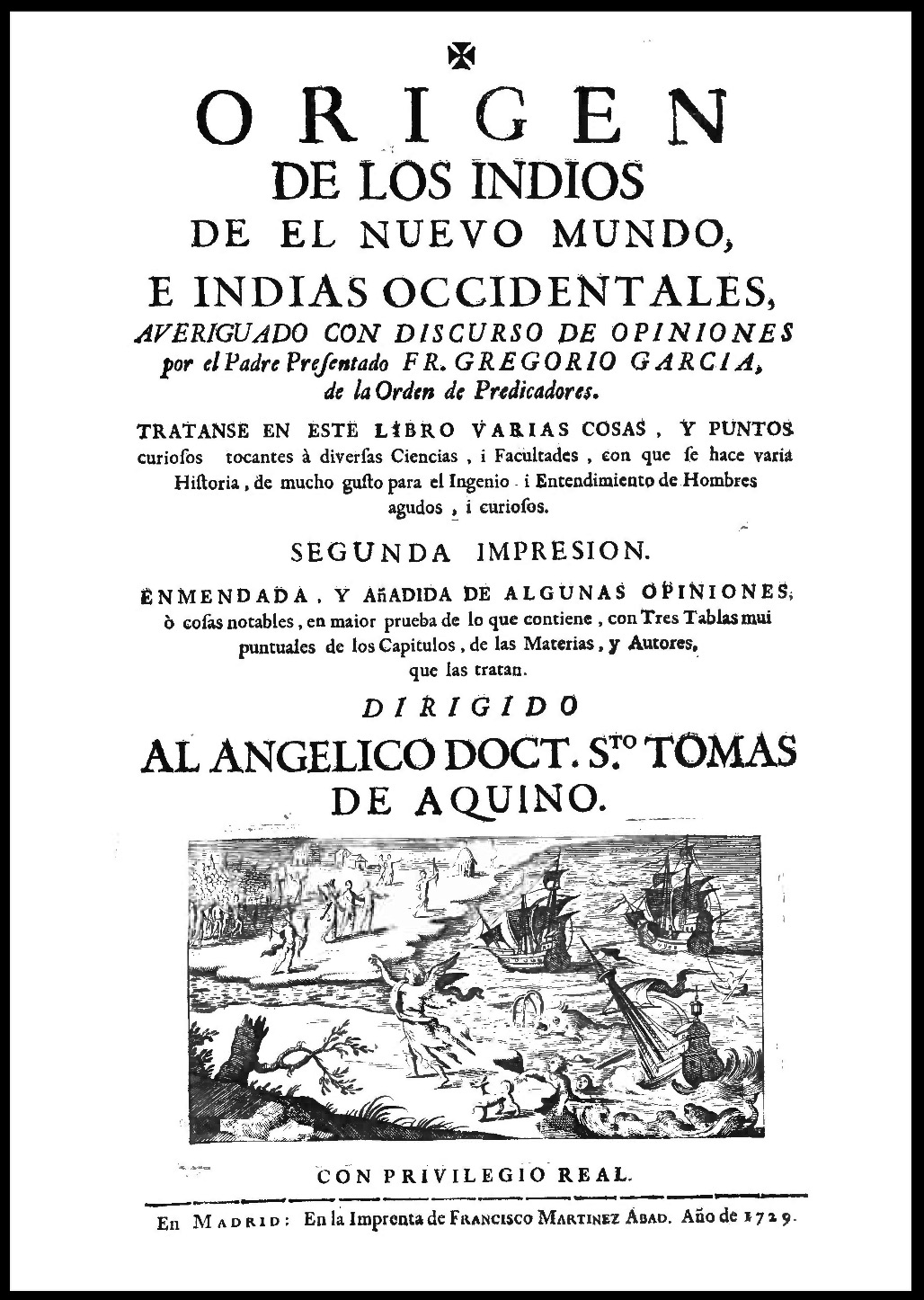
Origen de los indios de el Nuevo Mundo, e Indias Occidentales
Origin of the New World Indians, and the West Indies
Book
Garcia, G. (1729) Origen de los indios de el Nuevo Mundo, e Indias Occidentales. [Origin of the New World Indians, and the West Indies] Madrid, Imprenta de Francisco Martines Abad, 336 pp.
Record No. 7522  |  Sinkankas/Born No.: NIS/NIB  |  Language: in Spanish  |  RWHL
Gregorio García’s Origen de los indios de el Nuevo Mundo, e Indias Occidentales examines contemporary theories concerning the origins of the Indigenous peoples of the Americas. Drawing on biblical, classical, historical, linguistic, and ethnographic sources, García considers possible migrations from Europe, Africa, Asia, and the ancient Near East and compares the customs, religions, languages, physical characteristics, and material cultures of American peoples with those of the Old World. The work incorporates information from earlier Spanish chroniclers and missionaries concerning Mexico, Peru, and other regions of the Americas. Of particular interest to gemologists are references to gold, silver, precious and ornamental stones, jewelry, and Indigenous uses of valuable natural materials, which García employs in his broader comparisons between American and Old World cultures. The book provides evidence for early modern European interpretations of pre-Columbian material culture, although its theories of Indigenous origins reflect the historical and biblical assumptions of its period.

Historia general de los hechos de los castellanos en las islas i tierra firme del mar oceano / escrita por Antonio de Herrera ...; En quatro decadas desde el año de 1492 hasta el de 1531
General history of the events of the Castilians on the islands and the mainland of the ocean sea / written by Antonio de Herrera ... ; In four decades from the year 1492 to the year of 1531
Book
Herrera y Tordesillas, A., de (1726) Historia general de los hechos de los castellanos en las islas i tierra firme del mar oceano / escrita por Antonio de Herrera ...; En quatro decadas desde el año de 1492 hasta el de 1531. [General history of the events of the Castilians on the islands and the mainland of the ocean sea / written by Antonio de Herrera ... ; In four decades from the year 1492 to the year of 1531] Madrid, Castellano, 8 Vols., 486 pp.
Record No. 7115  |  Sinkankas/Born No.: NIS/NIB  |  Language: in Spanish  |  RWHL
Antonio de Herrera y Tordesillas’s Historia general de los hechos de los castellanos en las islas i tierra firme del mar océano is an extensive official history of Spanish exploration and conquest in the Americas, covering events from 1492 to 1531. Drawing upon royal archives, reports, letters, and earlier chronicles, Herrera recounts the voyages of discovery, conquests of Mexico and other regions, encounters with Indigenous peoples, establishment of Spanish settlements, and the geography, customs, resources, and commerce of the New World. Of particular interest to gemologists are numerous references to gold, silver, pearls, emeralds, turquoise, greenstones, and other precious and ornamental materials encountered, traded, presented as tribute, or seized during the conquests. The work provides important evidence for European perceptions of Indigenous valuables and for the sources, uses, and circulation of precious materials in the Americas during the early colonial period, although Herrera wrote several decades after many of the events he describes.

Histoire de Timur-Bec, connu sous le nom du grand Tamerlan, empereur des Mogols & Tartares
History of Timur-Bec, known as the great Tamerlane, emperor of the Mughals & Tartars
Book
Yazdī, S.a.-D.ʻ. (1722) Histoire de Timur-Bec, connu sous le nom du grand Tamerlan, empereur des Mogols & Tartares. [History of Timur-Bec, known as the great Tamerlane, emperor of the Mughals & Tartars] Paris, Robert-Marc d'Espilly, 449 pp.
Record No. 14023  |  Sinkankas/Born No.: NIS/NIB  |  Language: in French  |  RWHL
Sharaf al-Dīn ʿAlī Yazdī’s Histoire de Timur-Bec is a French translation of the Ẓafarnāma, the celebrated 15th-century Persian history of Timur (Tamerlane). Based on earlier chronicles and official records, the work recounts Timur’s ancestry, rise to power, military campaigns, conquests, administration, court, and relations with the peoples and rulers of Central Asia, Persia, India, and the Middle East. The narrative contains descriptions of tribute, booty, royal gifts, treasuries, and luxury goods accumulated and exchanged during Timur’s campaigns. Of particular interest to gemologists are references to precious stones, pearls, jewelry, gold, and jeweled objects, providing historical evidence for the possession, display, and movement of gems among the courts and commercial centers of Central and Western Asia and India during the late 14th and early 15th centuries.

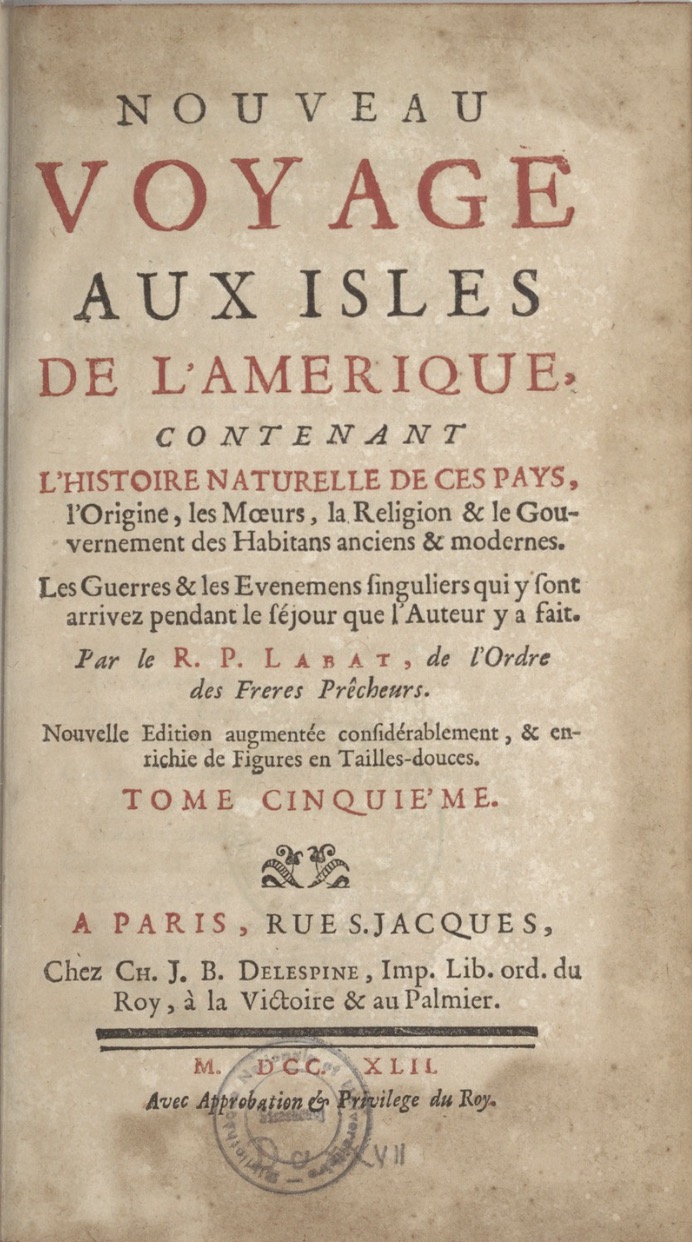
Nouveau Voyage aux isles Françoises de l'Amérique
New Voyage to the French Isles of America
Book
Labat, J.-B. (1722) Nouveau Voyage aux isles Françoises de l'Amérique. [New Voyage to the French Isles of America] Paris, 6 Vols.
Record No. 7109  |  Sinkankas/Born No.: NIS/NIB  |  Language: in French  |  RWHL
Jean-Baptiste Labat’s Nouveau Voyage aux isles Françoises de l’Amérique is an extensive account of the French Caribbean based largely on the Dominican missionary’s residence and travels in the region from 1694 to 1706. Across six volumes, Labat describes the geography, natural history, peoples, agriculture, commerce, industries, fortifications, warfare, slavery, Indigenous communities, and colonial societies of Martinique, Guadeloupe, and neighboring islands. His detailed observations include plants, animals, minerals, manufacturing processes, commodities, and trading practices, combining firsthand experience with information gathered from other inhabitants and travelers. Of particular interest to gemologists are references to precious and ornamental stones, pearls, metals, and other mineral substances encountered or traded in the Caribbean, as well as Indigenous use of stone materials. The work is an important early 18th-century source for the natural resources and material culture of the Caribbean and for European perceptions of its mineral wealth.

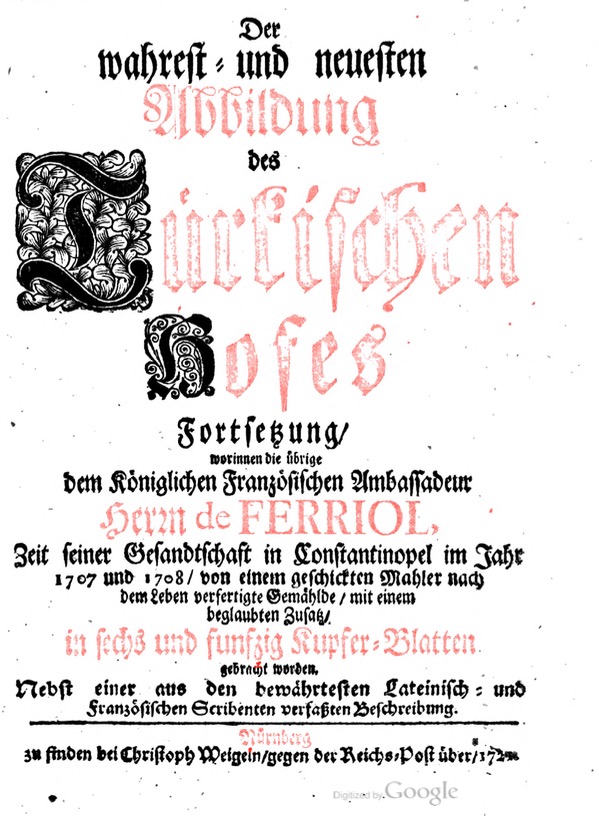
Der wahrest= und neuesten Abbildung des Türkischen Hofes Fortsetzung/ worinnen die übrige dem Königlichen Französischen Ambassadeur Herrn de Ferriol, etc.
The most true= and latest illustration of the Turkish Court continuation/ where the rest of the Royal French Ambassador Mr. de Ferriol, etc.
Book
Ferriel, H., de (1721) Der wahrest= und neuesten Abbildung des Türkischen Hofes Fortsetzung/ worinnen die übrige dem Königlichen Französischen Ambassadeur Herrn de Ferriol, etc. [The most true= and latest illustration of the Turkish Court continuation/ where the rest of the Royal French Ambassador Mr. de Ferriol, etc.] Nürnberg, Weigel, 102 pp. (1789 ed., 136 pp.).
Record No. 7986  |  Sinkankas/Born No.: NIS/NIB  |  Language: in German  |  RWHL
Charles de Ferriol’s Der wahrhafftesten und neuesten Abbildung des Türkischen Hofes Fortsetzung is a German edition associated with the celebrated series of illustrations of Ottoman dress and court society commissioned by the French ambassador Charles de Ferriol and based on paintings by Jean-Baptiste Vanmour. The work depicts members of the Ottoman court and administration, religious figures, military personnel, ethnic and occupational groups, and women in characteristic costumes, accompanied by explanatory descriptions of their roles and customs. Of particular interest to historians of gems and jewelry are the detailed representations of jeweled turbans, aigrettes, belts, weapons, necklaces, earrings, and other personal ornaments worn by members of Ottoman society. The volume provides valuable visual evidence for the forms, placement, and social significance of jewelry and precious materials at the Ottoman court in the early 18th century.

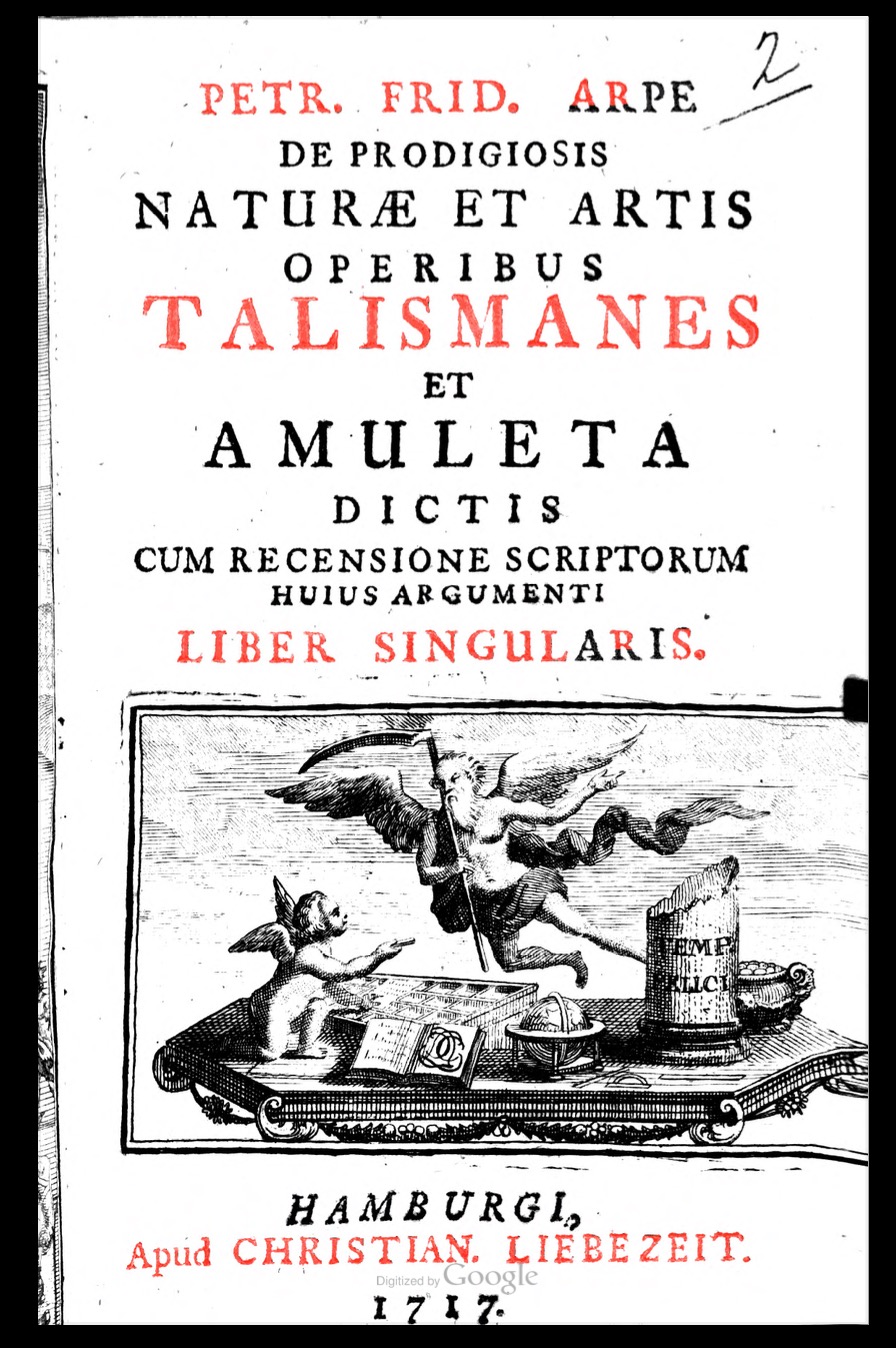
De prodigiosis naturae et artis operibus, talismanes et amuleta dictis cum recensione scriptorum hujus argumenti liber singularis
On the Wondrous Works of Nature and Art, a Singular Book on Talismans and Amulets with a Review of Writers on this Subject
Book
Arpe, P.F. (1717) De prodigiosis naturae et artis operibus, talismanes et amuleta dictis cum recensione scriptorum hujus argumenti liber singularis. [On the Wondrous Works of Nature and Art, a Singular Book on Talismans and Amulets with a Review of Writers on this Subject] Hamburg, Christian Liebezeit, 200 pp.
Record No. 6876  |  Sinkankas/Born No.: NIS/NIB  |  Language: in Latin  |  RWHL
Peter Friedrich Arpe’s De prodigiosis naturae et artis operibus is an early 18th-century scholarly examination of talismans, amulets, and objects believed to possess extraordinary natural or artificial powers. Drawing upon classical, medieval, Arabic, and early modern authorities, Arpe surveys writings on magical and protective objects and critically considers the claims made for their effects. Precious and engraved stones occupy an important place in these traditions, particularly gems bearing figures, symbols, astrological signs, or inscriptions and believed to confer protection, healing, good fortune, or other powers upon their owners. The work is of particular interest to historians of gemology for its treatment of magical gems and engraved talismans and for its extensive review of earlier lapidary and occult literature, documenting the persistence and scholarly reassessment of such beliefs in early 18th-century Europe.

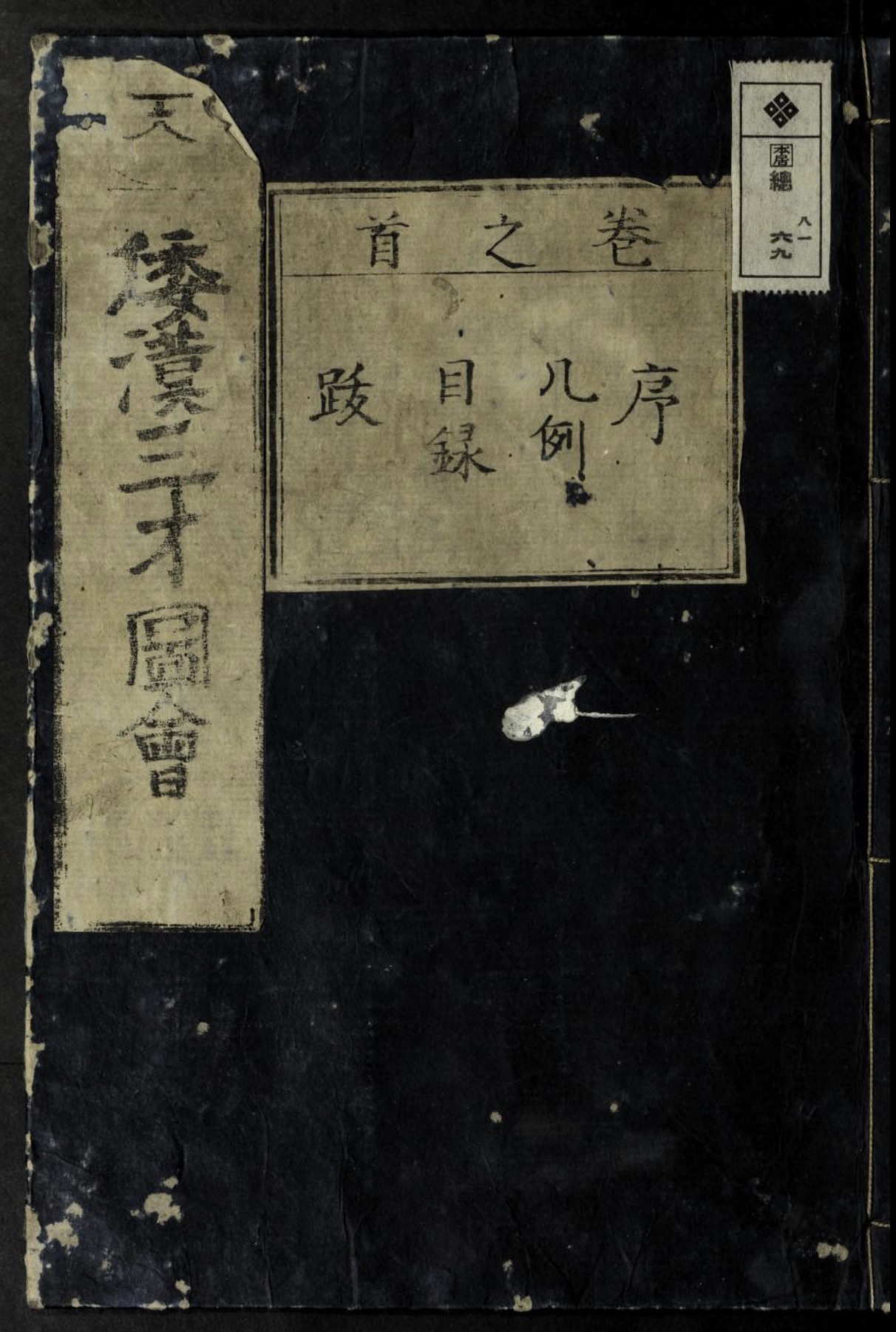
Wakan Sansai Zue [Illustrated Sino-Japanese Encyclopedia of the Three Realms]
和漢三才図会
Book
Terajima, R. (1712) Wakan Sansai Zue [Illustrated Sino-Japanese Encyclopedia of the Three Realms]. [和漢三才図会] Osaka, 105 vols. in 81 books
Record No. 28806  |  Sinkankas/Born No.: 6969  |  Language: in Japanese  |  RWHL
Sinkankas: The lapidary extracted from this work is reproduced by them in the usual reversed-text order, p. 144 top l., with many small woodcut figures in the text. A detailed commentary appears after the preliminaries on p. 1–150, with material on precious stones 56–67, but with ornamental stones on later pages, as in the case of diamond, on p. 124–125. Notes on gemstones are also provided on p. 178–188, while the stones themselves are identified on p. 253–264, i.e., jade, coral, petrified coral, agate, rock crystal, sagenite, glass, lapis lazuli (?), talc (or nacre?), fluorite (or amethyst?), and several ornamental stones. The notes frequently cite Les produits de la nature japonaise et chinoise, and Beiträge zur Geschichte der Edelsteine und des Goldes.

A Voyage to the Islands Madera, Barbados, Nieves, S. Christophers and Jamaica
Book
Sloane, H. (1707, 1725) A Voyage to the Islands Madera, Barbados, Nieves, S. Christophers and Jamaica. London, B.M., 264, 499 pp.
Record No. 6806  |  Sinkankas/Born No.: NIS/NIB  |  RWHL
Hans Sloane’s A Voyage to the Islands Madera, Barbados, Nieves, S. Christophers and Jamaica is an extensive two-volume natural history and travel account based principally on his visit to Jamaica in 1687–1689. The work describes the geography, climate, inhabitants, agriculture, commerce, plants, animals, medicines, and natural products of the Caribbean islands, accompanied by numerous detailed illustrations. Sloane combined firsthand observations and specimens with information obtained from local inhabitants, Indigenous and African knowledge, earlier authors, and colonial contacts. Of particular interest to gemologists and mineral historians are his notices of rocks, minerals, precious and ornamental stones, metals, pearls, and other natural materials occurring or traded in the Caribbean. The work provides important early evidence for European investigation and collecting of the region’s mineral resources and became a major contribution to 18th-century natural history.

Voyages de François Bernier

François Bernier's Travels
Book
Bernier, F. (1699, 1710, 1724, 1830) Voyages de François Bernier. [François Bernier's Travels] Amsterdam, Paul Marret, 2 Vols. (see Vol. 2, pg. 38).
Record No. 7114  |  Sinkankas/Born No.: NIS/NIB  |  Language: in French  |  RWHL
François Bernier’s Voyages records his travels in the Mughal Empire during the 17th century, where he spent several years as a physician and became associated with the courts of Dara Shikoh and Aurangzeb. The work describes Mughal politics, court life, cities, religion, society, agriculture, commerce, Kashmir, and the empire’s relations with neighboring regions. Of particular interest to gemologists are Bernier’s observations on diamonds, precious stones, pearls, jewelry, and the enormous jeweled wealth of the Mughal court, as well as information concerning Indian diamond mines and the trade in gems and luxury goods. His descriptions provide valuable contemporary evidence for the ownership, display, valuation, and circulation of precious stones in Mughal India and for the international commercial networks connecting India with Persia, Central Asia, and Europe.

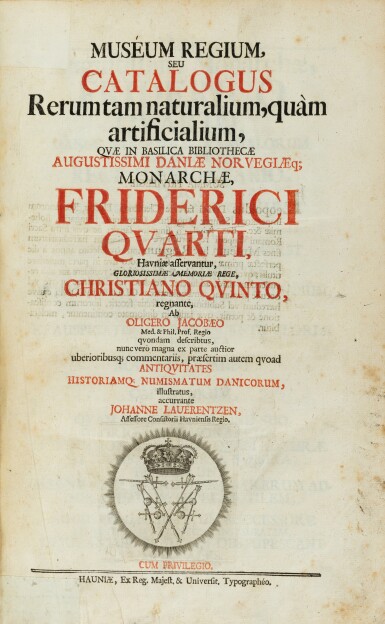
Museum regium seu catalogus rerum tam naturalium, quam artificialium, quae in basilica bibliothecae Friderici Qvarti, Havniae asservantur... ab Oligero Jacobeo,... describtus, nunc vero magna ex parte auctior uberioribusq ; commentariis... accurante Johanne Lauerentzen
The Royal Museum, etc., by Oliger Jacobaeus, Royal Professor of Medicine and Philosophy, formerly described, […] with revisions by Lauerentzen, assessor of the Royal Consistory of Copenhagen
Book
Jacobaeo, O. (1696) Museum regium seu catalogus rerum tam naturalium, quam artificialium, quae in basilica bibliothecae Friderici Qvarti, Havniae asservantur... ab Oligero Jacobeo,... describtus, nunc vero magna ex parte auctior uberioribusq ; commentariis... accurante Johanne Lauerentzen. [The Royal Museum, etc., by Oliger Jacobaeus, Royal Professor of Medicine and Philosophy, formerly described, […] with revisions by Lauerentzen, assessor of the Royal Consistory of Copenhagen] Havniae, ex Reg. majest.et Universit
Record No. 29443  |  Sinkankas/Born No.: NIS/NIB  |  Language: in Latin  |  RWHL
Oliger Jacobaeus’s Museum regium, seu Catalogus rerum tam naturalium, quam artificialium is an illustrated catalogue of the royal Danish collection of natural and artificial curiosities preserved in the library of King Frederik IV at Copenhagen. The collection encompasses specimens from the animal, vegetable, and mineral kingdoms together with antiquities, ethnographic objects, works of art, and other manufactured curiosities. Minerals, stones, metals, fossils, and related natural objects form part of the catalogue, reflecting the encyclopedic organization characteristic of seventeenth-century cabinets of curiosities. The work is an important source for the history of collecting, museums, and natural history in Denmark and documents the types of natural specimens and artifacts assembled and classified in a major European royal collection at the end of the seventeenth century.

De jaspide antinephritico

On the anti-nephritic jasper
Journal Article
Menzel, C. (1689) De jaspide antinephritico. [On the anti-nephritic jasper] Miscellanea Curiosa, sive Ephemiridum Medico-Physicarum Germanicarum Academiae Naturae Curiosorum, Vol. 7, Dec. 2, 1688, pp. 4–5.
Record No. 10938  |  Sinkankas/Born No.: NIS  |  Language: in Latin  |  RWHL
Christian Menzel’s De jaspide antinephritico is a short medical-mineralogical notice concerning the so-called “anti-nephritic jasper,” a stone believed to possess therapeutic properties against ailments of the kidneys and urinary tract. Menzel discusses the material within the early modern European tradition of lapis nephriticus, in which certain stones—particularly jade-like materials brought from the Americas and Asia—were worn or otherwise employed as remedies for renal complaints. The article is of particular interest to historians of gemology because it documents the medical reputation, identification, and use of ornamental stones associated with nephrite before jade was recognized mineralogically as a distinct material. It illustrates the close relationship between mineralogy, medicine, commerce, and traditional lapidary beliefs in the late 17th century.

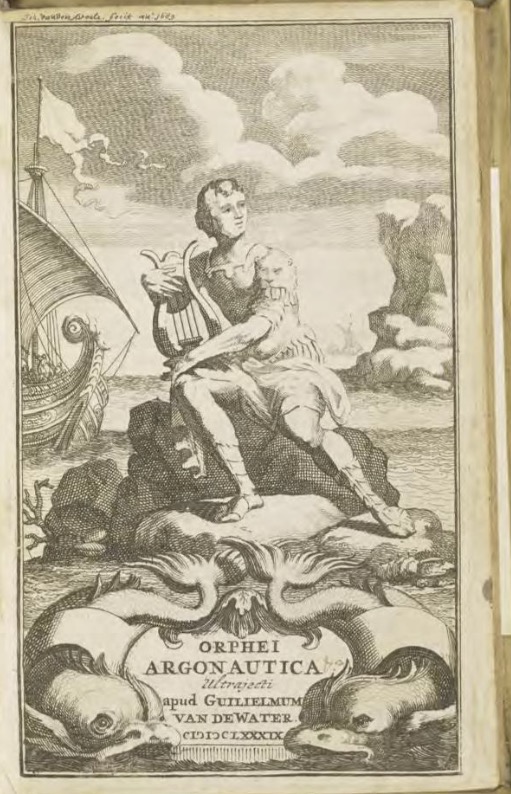
Orpheos Argonautika Hymnoi kai Peri lithon = Orphei Argonautica hymni et De lapidibus / curante Andrea Christiano Eschenbachio, Noribergense, cum ejusdem ad Argonautica notis & emendationibus. Accedunt Henrici Stephani in omnia & Josphi Scaligeri in hymnos notae
Orpheus' Argonautica, Hymns, and On Stones = Orpheus' Argonautica, hymns, and On Stones / edited by Andreas Christian Eschenbach, from Nuremberg, with his notes and corrections on Argonautica. Also included are Henri Estienne's notes on everything & Joseph Scaliger's notes on the hymns
Book
Orpheos (1689) Orpheos Argonautika Hymnoi kai Peri lithon = Orphei Argonautica hymni et De lapidibus / curante Andrea Christiano Eschenbachio, Noribergense, cum ejusdem ad Argonautica notis & emendationibus. Accedunt Henrici Stephani in omnia & Josphi Scaligeri in hymnos notae. [Orpheus' Argonautica, Hymns, and On Stones = Orpheus' Argonautica, hymns, and On Stones / edited by Andreas Christian Eschenbach, from Nuremberg, with his notes and corrections on Argonautica. Also included are Henri Estienne's notes on everything & Joseph Scaliger's notes on the hymns], G. vande Water, 329 pp.
Record No. 7497  |  Sinkankas/Born No.: 4891  |  Language: in Latin  |  RWHL
Sinkankas: The most important poem, or hymn, for the gemologist is the Lithica, where in 770 lines the virtues of some thirty gems are set forth with considerable allusion to magic...From the content, the form, the viewpoint and the style of this poem, it is most apparent the composer could only have lived...before the Emperor Constantine and not long after Emperor Valentine."

Gedenkweerdige Brasiliaense Zee- en Lant- reize

Memorable Brazilian sea and land journey
Book
Nieuhof, J. (1682) Gedenkweerdige Brasiliaense Zee- en Lant- reize. [Memorable Brazilian sea and land journey] Amsterdam, Jacob van Meurs, 308 pp.
Record No. 7951  |  Sinkankas/Born No.: NIS/NIB  |  Language: in Dutch  |  RWHL
Johan Nieuhof’s Gedenkweerdige Brasiliaense Zee- en Lant-reize is an illustrated account of Dutch Brazil based on the author’s residence there during the period of Dutch West India Company rule. It describes the geography, settlements, Indigenous peoples, colonial society, agriculture, commerce, plants, animals, and natural resources of Brazil, supplemented by observations from Nieuhof’s travels and later editorial material. The work is notable for its engravings of Brazilian landscapes, peoples, flora, and fauna and provides an important European record of 17th-century northeastern Brazil. Of particular interest to gemologists are its references to mineral resources, gold, precious stones, and other valuable natural products, reflecting contemporary European knowledge of Brazil’s potential mineral wealth before the major diamond discoveries of the 18th century.

Exploring the Literature of Jade

Jade literature spans gemology, mineralogy, archaeology, art history, mining, carving and connoisseurship, and includes works on both jadeite and nephrite from around the world.

For an introduction to collecting books on this subject, read Hidden Treasure — Collecting the Literature of Jade.

About Four Treasures

Four Treasures is Lotus Gemology's freely accessible gemological reference database. Use the full database to search by author, title or keyword and explore literature on gemology, mineralogy, jewelry and related fields. Where available, hyperlinks on titles may lead directly to the full publication.

Search the Complete Four Treasures Database