Ruby & Sapphire Bibliography

Ruby & Sapphire Bibliography

Explore books, articles and historical sources on ruby, sapphire and corundum in Four Treasures, the Lotus Gemology reference database. This bibliography brings together matching records from the collection, with publication details, abstracts and cover images where available.

Ruby & Sapphire References

The list below matches the terms ruby, rubies, sapphire or corundum in the database's searchable fields. Some references discuss these gems as part of a broader subject. Linked titles take you to external links where you may find the full reference.

81–100 of 4,669 matching references
Fluxed up: The fracture healing of ruby

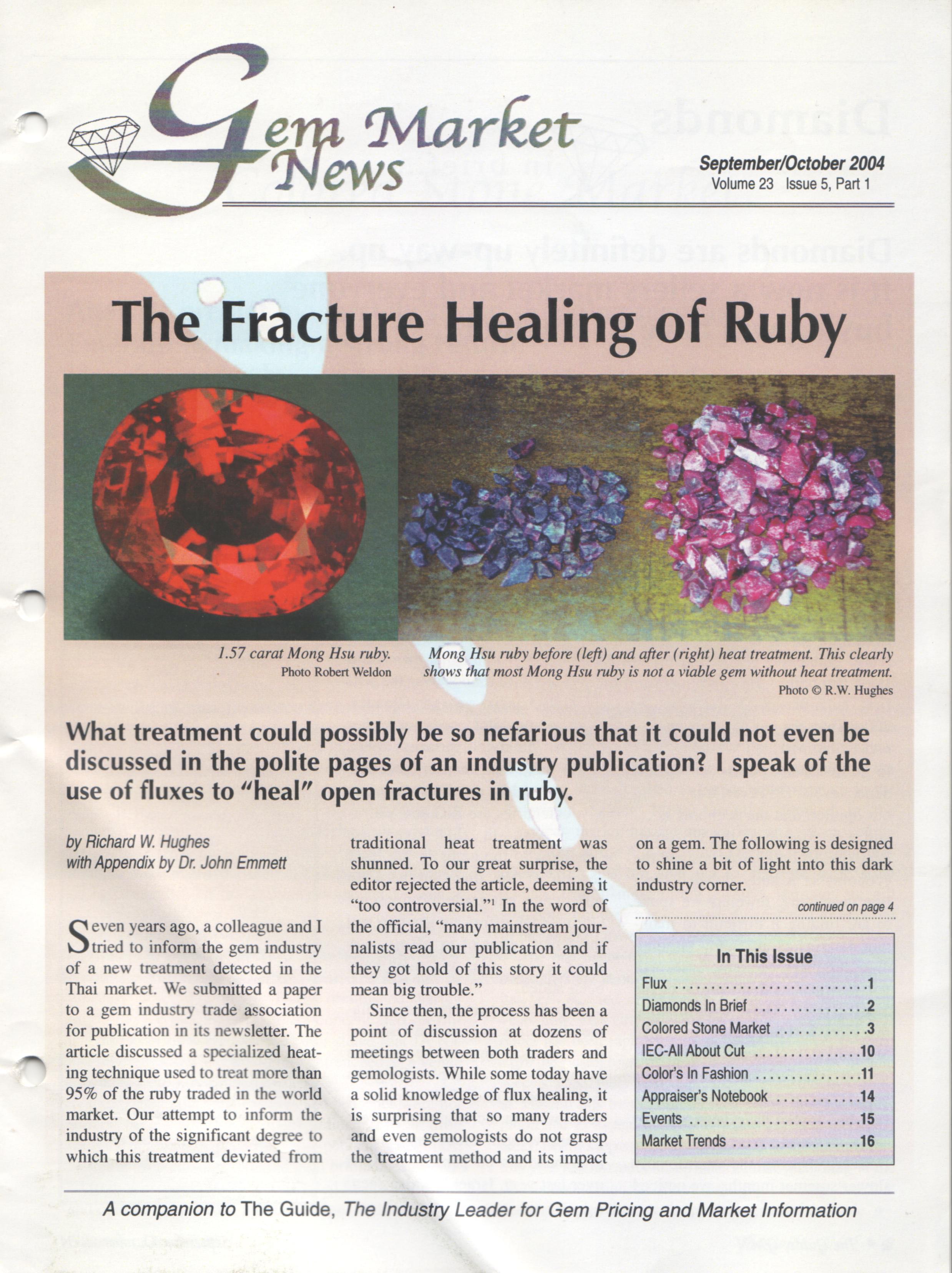
Fluxed up: The fracture healing of ruby

Hughes, R.W. and Emmett, J.L. (2004)

Journal Article · Source: The Guide · Volume: Vol. 23 · Issue: Issue 5, Part 1, Sept.–Oct. · Pages: pp. 1, 4–9

Abstract
In 1997, a colleague and I submitted a paper to a gem industry trade association for publication in their newsletter. The article discussed a specialized heating technique used to treat over 95% of the ruby traded in the world market. To our great surprise, the editor rejected the article, deeming it “too controversial.” In the words of the official, “many mainstream journalists read our publication and if they got hold of this story it could mean big trouble.” Just what treatment could possibly be so nefarious that it could not even be discussed in the polite pages of an industry publication? I speak of the use of fluxes to “heal” open fractures in ruby. Since that time, the process has been a point of discussion at dozens of meetings between both traders and gemologists. While some today have a solid knowledge of flux healing, it is surprising that so many traders and even gemologists do not grasp the treatment method and its impact on a gem. The following is designed to shine a bit of light into this dark industry corner.
Keywords
corundum, treatments.6, flux healing, heat treatment, surface repair, gems
Fluxed up: The fracture healing of ruby

Fluxed up: The fracture healing of ruby

Hughes, R.W. and Emmett, J.L. (2004)

Journal Article · Source: IDEX · Volume: Vol. 19 · Issue: No. 173, September · Pages: pp. 110–120

Abstract
In 1997, a colleague and I submitted a paper to a gem industry trade association for publication in their newsletter. The article discussed a specialized heating technique used to treat over 95% of the ruby traded in the world market. To our great surprise, the editor rejected the article, deeming it “too controversial.” In the words of the official, “many mainstream journalists read our publication and if they got hold of this story it could mean big trouble.”Just what treatment could possibly be so nefarious that it could not even be discussed in the polite pages of an industry publication? I speak of the use of fluxes to “heal” open fractures in ruby. Since that time, the process has been a point of discussion at dozens of meetings between both traders and gemologists. While some today have a solid knowledge of flux healing, it is surprising that so many traders and even gemologists do not grasp the treatment method and its impact on a gem. The following is designed to shine a bit of light into this dark industry corner.
Keywords
corundum, treatments.6, flux healing, heat treatment, surface repair, gems
The history and politics of heat

The history and politics of heat

Hughes, R.W. (2003)

Journal Article · Source: The Guide · Volume: Vol. 22 · Issue: Issue 5, Part 1, Sept.–Oct. · Pages: pp. 1, 4–9, 15

Abstract
The author reviews the history of ruby and sapphire heat treatment, including some of the contentious issues regarding disclosure of that treatment.
Keywords
corundum, treatments.6, bulk diffusion, surface diffusion, beryllium, flux healing, heat treatment, gems
Digital Devil: Big time

Digital Devil: Big time

Hughes, R.W. (2002)

Journal Article · Source: GK Magazine · Volume: Vol. 3 · Issue: No. 4, March–April · Pages: pp. 48, 72

Abstract
In this world, there's a nipple for every sucker. But why, oh why, does the gem business have to prove the truth of that axiom? This an industry that makes an awful lot of noise about integrity. We are the pompous and the proud, quick to declare that our word is our bond. And yet every now and again we are brought down by the few among us for whom greed is just the Hindenberg waiting for a match.
Keywords
corundum, quality.10, gems
Walking the line in ruby & sapphire

Walking the line in ruby & sapphire

Hughes, R.W. (2002)

Journal Article · Source: The Guide · Volume: Vol. 21 · Issue: Issue 4, Part 1, July–Aug. · Pages: pp. 4–8

Abstract
Ever notice how gemologists and dealers toss the term padparadscha around like some kinda überrock. If the gem isn’t buff enough to make the centerfold of Gem & Gemology, it is sniffed at as a “lesser being” unworthy of the name. And when it comes to the crimson corundums, despite a decade’s worth of McCarthyism we Yanks still cannot sort out the difference between a pinko and a true red. By this point, I know what you’re thinking. Do I really want to continue reading? Straight out of the gate this man is three sheets into a gale-force Beat ramble. But follow me here, people. The crux of what I’m about to discuss is a desire – most human I admit – for a simple word to Separate something that has stymied the best minds of my generation. The question is whether or not a variety name should encompass hue position alone, or segregate gems of the same hue into different groups based on often poorly understood tone and saturation ranges – factors that often have a direct bearing on quality.
Keywords
corundum, color.4, quality.10, Sri Lanka.12, gems
Conspiracy Theory: Gems & junkies in Burma

Conspiracy Theory: Gems & junkies in Burma

Hughes, R.W. (2002)

Journal Article · Source: The Guide · Volume: Vol. 20 · Issue: No. 4, Issue 5, Part 1, March–April · Pages: pp. 8–14

Abstract
From a distance life is simple, every hand the same. Hold yours out and take a look. Highs and lows, ridges and whorls, the maker's strokes, we all have them. Our lives, our intellectual development are just like our fingerprints. Begin from a tiny point and spin gently outward, drip-dreary accumulation. Birth, death and what happens in between. Here I sit, contemplating my hands. Yes, I see the spirals. But also other lines that follow no maker's mold, bold strokes that leap directly from ridge to distant ridge, bypassing the mundane maze of daily drudgery. These raw, wrong-way gashes exist not by grand design, but are unique to me alone. You could call them self-inflicted. Yes, self-inflicted. In particular, I remember two such slashes. The first was 1973, my sophomore year in high school. The event the Saturday Night Massacre" – a political throat slitting – when President Richard Nixon fired Watergate special prosecutor Leon Jaworski. Intellectually riding this thunderbolt to ground shattered the façade so carefully erected by my parents, teachers, preachers and political leaders. From that point on, nothing was the same. Childhood was gone. The final severing of innocence, though, did not occur until some five years later. I found myself in a small hostelry in the northern Thai opium town of Fang, where a book lurked quietly on the lobby table. It was Alfred McCoy's The Politics of Heroin in Southeast Asia. Its premise – the US government's war on drugs was a sham. While Washington piously lectured the world on the evils of narcotics and used the hammer of foreign aid to blackmail other governments into doing the same, US intelligence agencies were simultaneously engaged in and supporting countless individuals and groups whose major business was – to paint it black – running dope. The book was not completely new. I had come across a reference in a magazine a few months earlier, and had actually located a copy in a university library. But seeing it on that table in northern Thailand lent a certain legitimacy. Just a day later, as I walked the jungle paths of nearby opium-growing hill tribe villages, my ex-CIA Shan guide confirmed many of McCoy's statements. This was a terrorist bombing of my middle-American psyche, exploding my final illusions about official behavior. Slash. I entered adulthood."
Keywords
corundum, Burma.12, gems
Love and Hate

Love and Hate

Hughes, R.W. (2002)

Journal Article · Source: The Guide · Volume: Vol. 21 · Issue: No. 1, Part 1, Jan.–Feb. · Pages: pp. 4–9, 16

Abstract
From outside, the Madrid Bar looks no different than any other watering hole on Bangkok's Patpong Road. But step inside and one enters a dark world of societal misfits, heat-seeking mercenaries, out-and-out spooks and the merely semi-diaphanous. If you wanted to make an in-depth tour of the bars and bordellos of Thailand, any of the Madrid regulars would make a perfect guide.
Keywords
corundum, Laos.12, gems
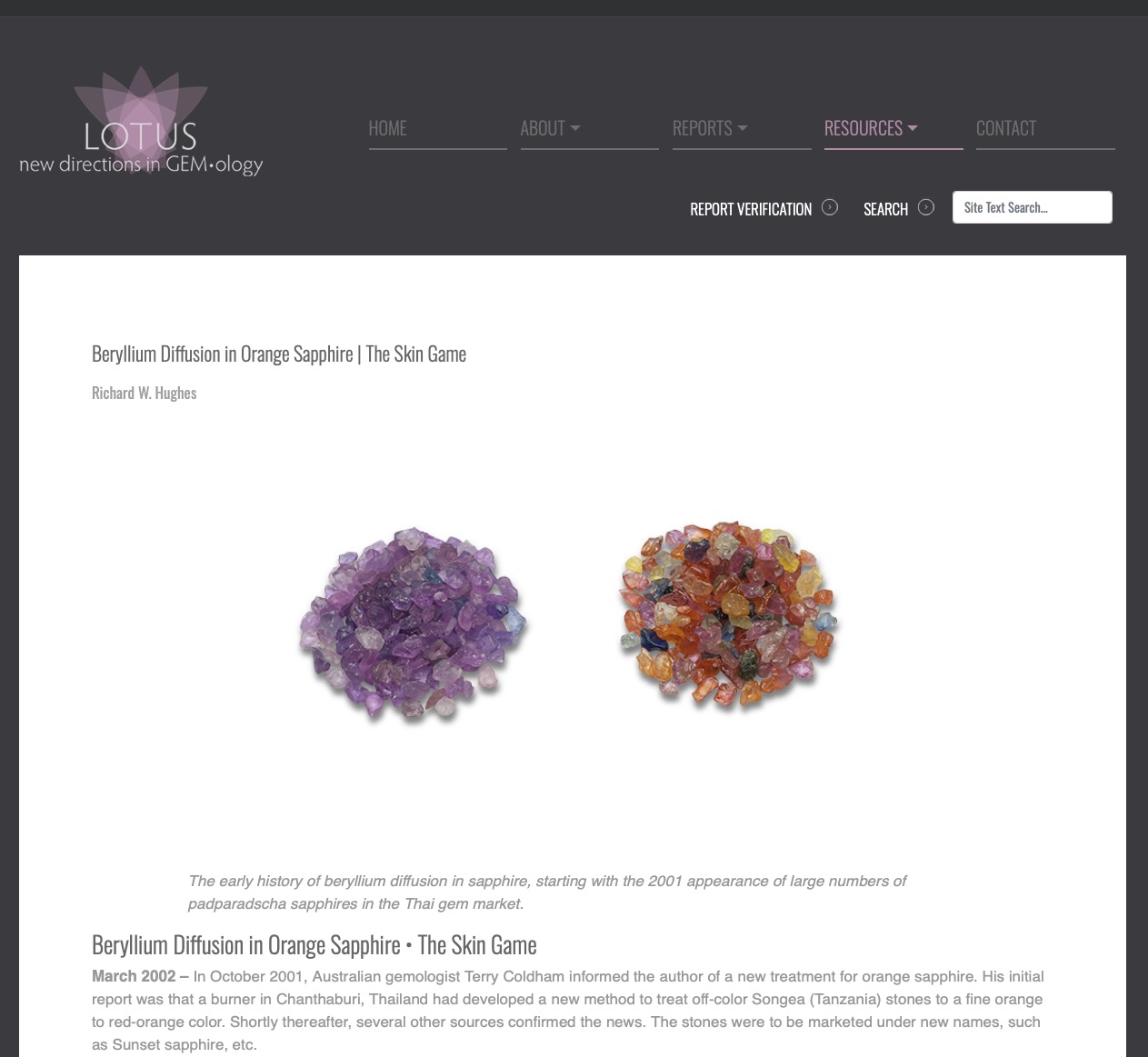
The Skin Game: Orange sapphire treatment raises controversy

The Skin Game: Orange sapphire treatment raises controversy

Hughes, R.W. (2002)

Journal Article · Source: The Guide · Volume: Vol. 21 · Issue: No. 2, Part 1, March–April · Pages: pp. 3–7

Abstract
In October 2001, Australian gemologist Terry Coldham informed the author of a new treatment for orange sapphire. His initial report was that a burner in Chanthaburi, Thailand had developed a new method to treat off-color Songea (Tanzania) stones to a fine orange to red-orange color. Shortly thereafter, several other sources confirmed the news. The stones were to be marketed under new names, such as Sunset sapphire, etc. AGTA Lab Director Ken Scarratt visited Bangkok last December and obtained samples. Pala International's Bill Larson also purchased samples of these stones in early December 2001 in Bangkok. When Scarratt examined his stones back in New York, he found that all had been exposed to high-temperature heat treatment. But under immersion, many displayed unusual orange color rims surrounding pink cores, suggesting there might be more to this than a simple bake job. On December 28, 2001, Scarratt asked the author if he knew anything about the stones, mentioning the orange color rims. We quickly examined the Pala stones just purchased in Bangkok and found identical color rims on most pieces. Shortly thereafter, the AGTA issued a Lab Alert and we sent a number of stones to the GIA for analysis. The following is based upon the AGTA Report of Jan. 8, 2002 and GIA reports of Jan. 28, 2002 and Feb. 16, 2002, along with discussions we have had with American experts, such as John Emmett, [1] and other dealers and gemologists around the world. [Note: new online reports by the GIA and AGTA were issued on April 19, 2002, with further updates on May 3, 2002 and 5 Sept., 2002]
Keywords
sapphire, treatments.6, diffusion, bulk diffusion, surface diffusion, lattice diffusion, heat treatment, gems
Seeing red: A guide to ruby connoisseurship

Seeing red: A guide to ruby connoisseurship

Hughes, R.W. (2001)

Journal Article · Source: The Guide · Volume: Vol. 20 · Issue: No. 6, Part 1, Nov.–Dec. · Pages: pp. 4–7, 16

Abstract
Blue, green and red – sapphire, emerald and ruby – the colored-stone trinity. There is something primal about our attraction to these gems. Each relates to a familiar part of life. Blue is ocean/sky. Green – verdant soothing. And red? Red is fire, blood, the very life-giver itself – passion. Women do not paint their lips green, nor do men send their love blue valentines. No, for thoughts of love and passion, only one color will do – red. And no more passionate gem exists than the ruby.
Keywords
corundum, quality.10, gems
Passion fruit: A lover’s guide to blue sapphire

Passion fruit: A lover’s guide to blue sapphire

Hughes, R.W. (2001)

Journal Article · Source: The Guide · Volume: Vol. 20 · Issue: No. 2, Part 1, March–April · Pages: pp. 3–5, 15

Abstract
The appraisal of precious stones is an eclectic skill, not for the timid or shameless, for such decisions involve both conscious and unconscious action. Try as we may to slice, dice and pigeon-hole elements of quality, in the end an analysis requires more than just a formula, just as fine cooking involves not simply ingredients and a recipe. It is about reaching for factors beyond the immediate senses, and in that respect is quite like enjoyment of fine art, food and music.While one man's Miles Davis might be another's Kenny G, there are certain things the discerning among us look for. Thus, what I will try to convey to you in the following passages is educated emotion, something to help separate the long, languid lines of artistic truth from aimless noodling. Here you will find the ingredients, the recipe, the score. But without the passion that only the viewer himself can bring, both these gems and our time on this precious planet are a waste. With that introduction, let us now examine blue sapphires. Here I have a confession to make. Blue is my favorite color. I love blue. Thus the following essay is one of love.
Keywords
corundum, sapphire, quality.10, Burma.12, Mogok, Madagascar, Kashmir, India.12, gems
Digital Devil: Getting out of the kitchen

Digital Devil: Getting out of the kitchen

Hughes, R.W. (2001)

Journal Article · Source: GK Magazine · Volume: Vol. 3 · Issue: No. 2, Jan.–Feb. · Pages: pp. 51, 73

Abstract
Nowadays the heat gets to me. Wasn't always that way. I used to enjoy it – revel in it. But no longer. Can't take the heat anymore. And right now it's hot. Very hot. Starts deep inside at the kernel, that storehouse of primal code and mad memories. I know when I enter. Perspiration seeps out like the trace from a jungle leech – only a single drop of blood as evidence of the bite. Next I know, I'm in a full-press sweat – red raining out. Forty-three years' old, I still crave warmth – need it like a junkie's fix – but no longer can stand where it takes me. And I'm writing this in a furnace. God, I wish the weather would change…
Keywords
Burma, ruby, Burmese politics, politics, gems

Blue velvet: Kashmir sapphires

Hughes, R.W. and Vock, R. (2000)

Journal Article · Source: The Professional Gemologist · Volume: Vol. 3 · Issue: No. 1, Spring/Summer · Pages: pp. 2–3

Abstract
This article detailed a parcel of gems that the authors thought was from Kashmir. Christopher Smith correctly informed the authors after publication that the gems were probably from Pailin, Cambodia.
Keywords
corundum, sapphire, Kashmir, India.12, gems, Thailand.12, Cambodia.12, Pailin
Digital Devil: If it’s doubly refractive like a duck… [C3: I see through you]

Digital Devil: If it’s doubly refractive like a duck… [C3: I see through you]

Hughes, R.W. (2000)

Journal Article · Source: Gemkey Magazine · Volume: Vol. 2 · Issue: No. 4, May–June · Pages: pp. 64, 107

Abstract
It was Tucson. Show over. The last supper. One of those marvelous evenings which Tucson regularly delivers. Sitting down with a bunch of friends, this was one top-fuel conversation. Pure ethanol. We had a red-faced Bangkok ruby dealer, a Colombian talking big green, an ex-Dead Head and the 1% of the gemological world that mattered. I was along merely to document the occasion, to maintain the steady hand of sobriety on the wheel of discourse. Adult supervision, if you will.
Keywords
diamond simulants, moissanite, synthetic moissanite, gems
Foreign affairs: Fracture healing/filling of Möng Hsu ruby

Foreign affairs: Fracture healing/filling of Möng Hsu ruby

Hughes, R.W. and Galibert, O. (1998)

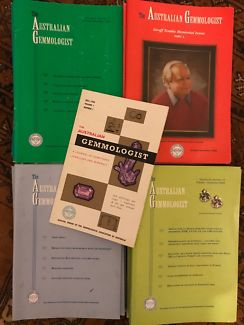
Journal Article · Source: Australian Gemmologist · Volume: Vol. 20 · Issue: No. 2, April–June · Pages: pp. 70–74

Abstract
Today, courts are increasingly being called upon to arbitrate such disputes, largely because sellers have failed to disclose the flux healing of fractures in Möng Hsu ruby from Burma. The problem is a huge one, a corundum conundrum that will only escalate until the trade begins to enforce a policy of full disclosure of all gemstone enhancements. The following article examines the roots of the issue.
Keywords
corundum, treatments, ruby, Burma.12, Möng Hsu, gems
Catfights—Enhancement Codes and Trade Wars

Catfights—Enhancement Codes and Trade Wars

Hughes, R.W. and Zajicek, R. (1997)

Journal Article · Source: ICA Gazette · Issue: June · Pages: pp. 7–9

Abstract
IT is ICA Congress time and that means once again it's time for the biannual cat-fight over enhancements. For this year's main event, we nominate emerald and ruby. This article will deal primarily with emerald.
Keywords
treatments, gem enhancement, beryl, emerald, gems
Sang de pigeon: Un pélerinage à Mogok – Vallée des rubis

Sang de pigeon: Un pélerinage à Mogok – Vallée des rubis

Pigeon blood: A pilgrimage to Mogok – Valley of rubies

Hughes, R.W. (1997)

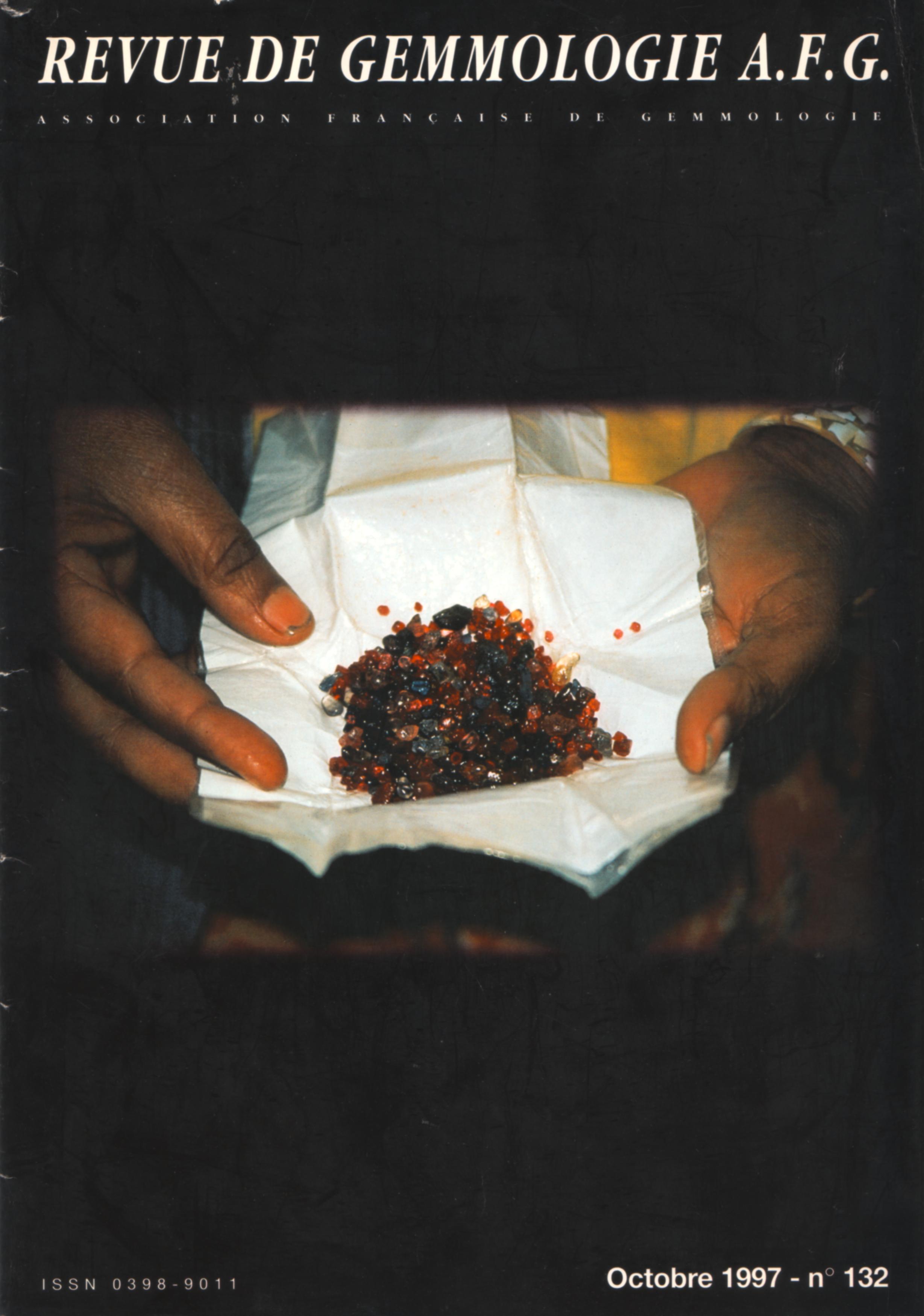
Journal Article · Source: Revue de Gemmologie A.F.G. · Issue: No. 132, October · Pages: pp. 8–13 · Language: in French

Abstract
The author’s account of his first pilgrimmage to Burma's Mogok Stone Tract in 1996.
Keywords
gems, corundum, Burma.12, Mogok, ruby, sapphire
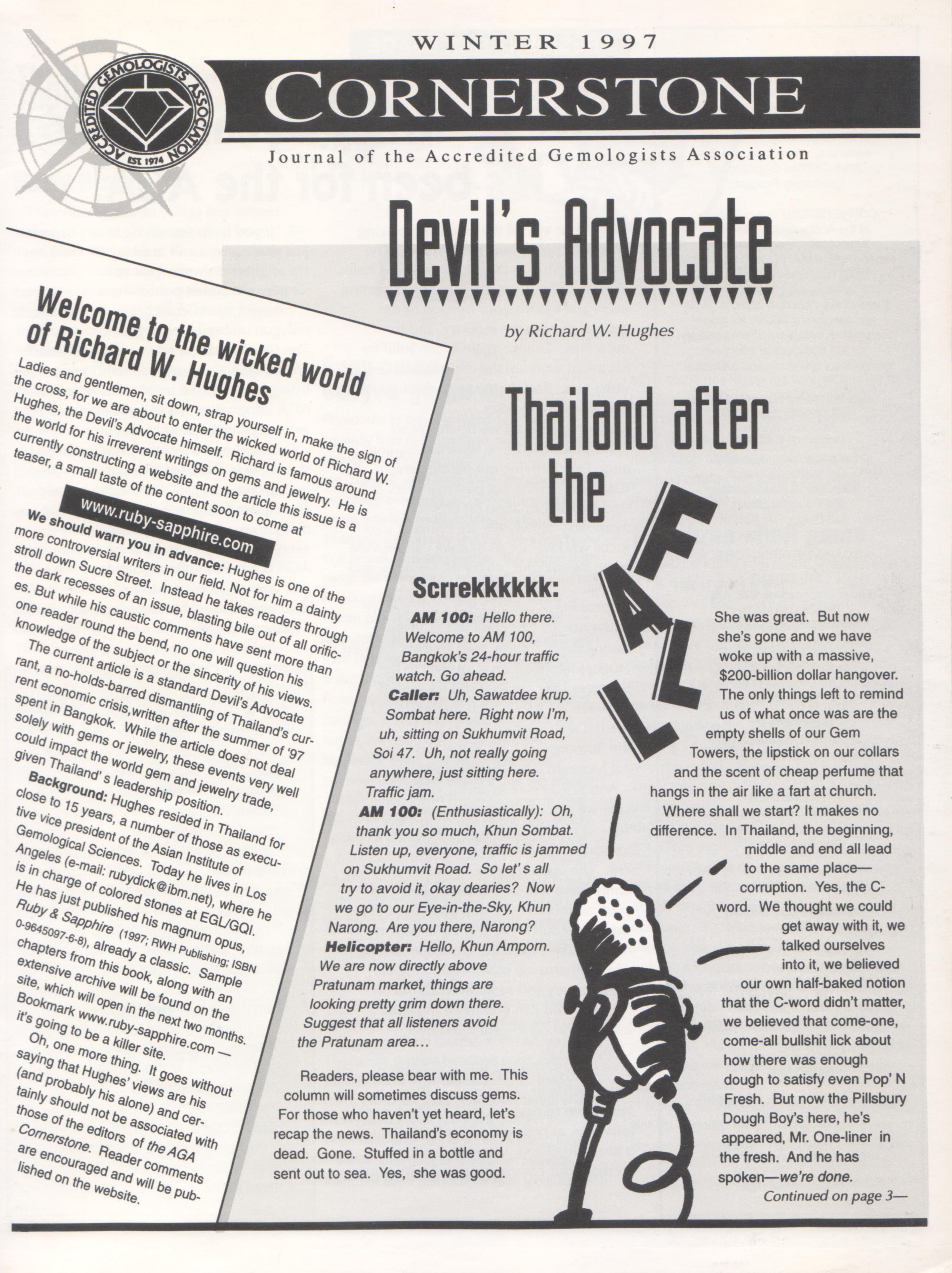
Devil’s Advocate: Thailand after the fall

Devil’s Advocate: Thailand after the fall

Hughes, R.W. (1997)

Journal Article · Source: Cornerstone · Issue: Winter, 1997 · Pages: pp. 1, 3–6

Abstract
Discussion of Thailand after the 1997 economic crash, a.k.a. the dom yum gung event.
Keywords
corundum, ruby, sapphire, Thailand, politics, gems
Devil‘s Advocate: Life during wartime

Devil‘s Advocate: Life during wartime

Hughes, R.W. (1997)

Journal Article · Source: Asia Diamonds · Volume: Vol. 1 · Issue: No. 2, September-October · Pages: pp. 68–72

Abstract
It is always a pleasure to read comments on my articles. And so it was with Scott Montgomery's discussion of my column, Death of the Thai Ruby" (Letters: JewelSiam, Dec./Jan., 1997, pp. 14–15). But his letter brought particular joy, for, as someone whose self-righteousness is quite literally off the scale, it is rare that I find myself in similar company. Truth be told, I had written a sequel to my previous column, "Death of the Thai Ruby," in which I expanded upon some of the questions raised in the first piece. This is it, modified to address some of the issues raised by Mr. Montgomery in his letter, along with a few other thoughts germane to the subject. Readers bothered by discussion of sex, politics or religion should probably close the magazine now. Are we ready? Okay, let's go to war."
Keywords
Thailand, politics, RWHL, gems

Exploring the Literature of Corundum

Ruby and sapphire research spans mineralogy, gem deposits, identification, treatments, synthesis and the history of the gem trade. Older publications can also be useful for tracing terminology, early observations and accounts of mining localities. Publication dates and the original source should be considered when using historical descriptions.

For an introduction to collecting books on this subject, read Ruby & Sapphire Books: Collecting the Literature of Corundum.

About Four Treasures

Four Treasures is Lotus Gemology's freely accessible gemological reference database. Use the full database to search by author, title or keyword and explore literature on gemology, mineralogy, jewelry and related fields. Where available, hyperlinks on titles may lead directly to the full publication.

Search the Complete Four Treasures Database