Ruby & Sapphire Bibliography

Ruby & Sapphire Bibliography

Explore books, articles and historical sources on ruby, sapphire and corundum in Four Treasures, the Lotus Gemology reference database. This bibliography brings together matching records from the collection, with publication details, abstracts and cover images where available.

Ruby & Sapphire References

The list below matches the terms ruby, rubies, sapphire or corundum in the database's searchable fields. Some references discuss these gems as part of a broader subject. Linked titles take you to external links where you may find the full reference.

61–80 of 4,667 matching references
Andesine • Timeline of a controversy

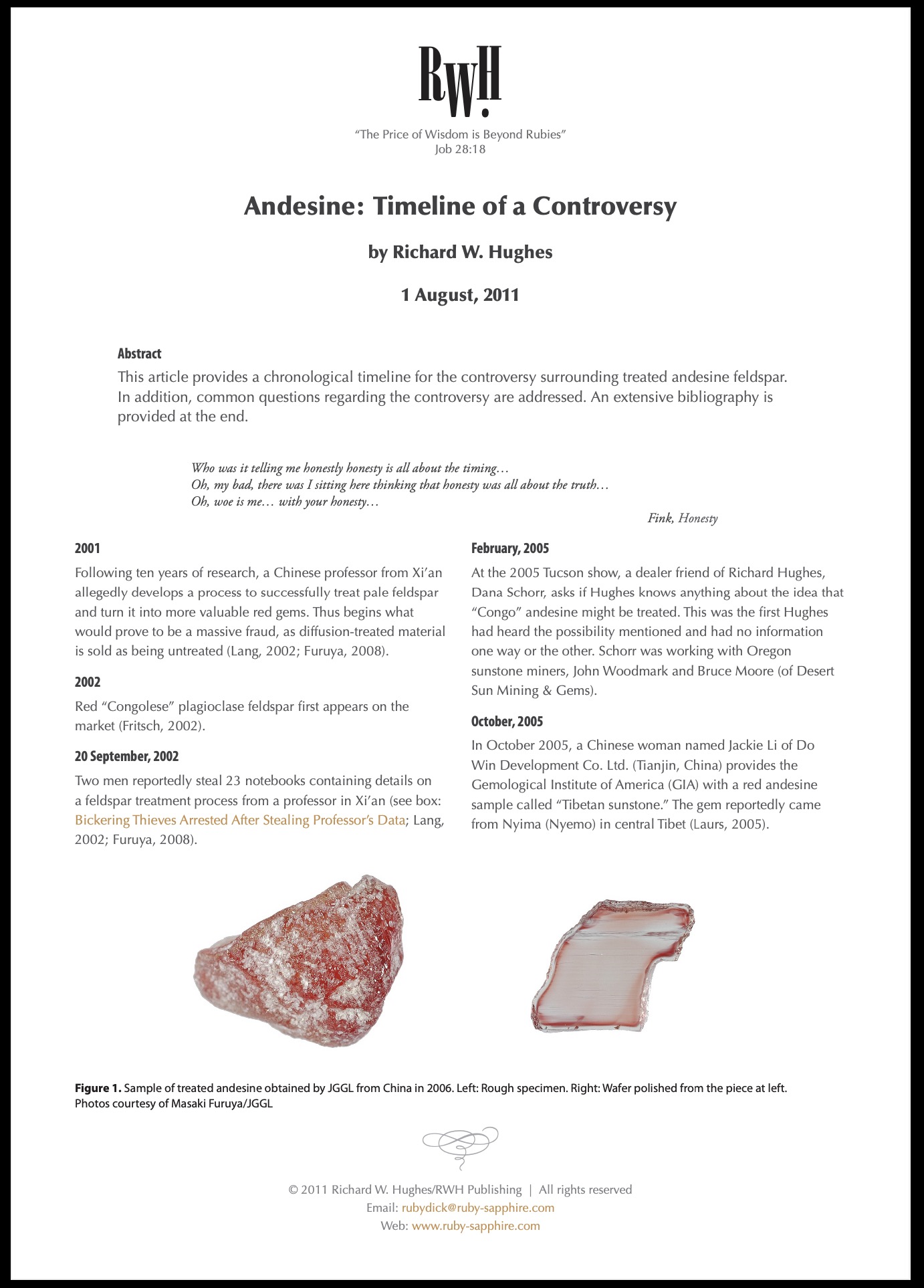
Andesine • Timeline of a controversy

Hughes, R.W. (2011)

Report · Publisher: www.ruby-sapphire.com

Abstract
This article provides a chronological timeline for the controversy surrounding treated andesine feldspar. In addition, common questions regarding the controversy are addressed. An extensive bibliography is provided at the end.
Keywords
gems, andesine, feldspar, Tibet, China
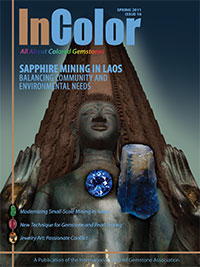
Laos – Land of a million elephants... and sapphires

Laos – Land of a million elephants... and sapphires

Hughes, R.W., Ishmael, A. and Isatelle, F. (2011)

Journal Article · Source: InColor · Issue: No. 16, Spring · Pages: pp. 12–19

Abstract
The history of the Lao sapphire mines at Ban Huay Xai is detailed, along with modern mining by Hong Kong based Sino Resources Mining Corp. Ltd. from 2006–2012.
Keywords
Corundum, Laos.12, Huay Xai, gems
Downtown: Gem hunting in Central & Southern Tanzania

Downtown: Gem hunting in Central & Southern Tanzania

Hughes, R.W. and Pardieu, V. (2011)

Web Page · Publisher: RWH Publishing · Volume: 2016 · Issue: 30 Sept.

Abstract
Since the late 1960's, East Africa has been home to some of planet earth's greatest gem discoveries. And yet, little has been written about certain of these finds. In the autumn of 2007, the authors set out to fill in the gaps, specifically regarding Tanzania's Mahenge, Songea and Tunduru regions.
Keywords
corundum, Tanzania.12, gems
Moontown: A history of Chanthaburi

Moontown: A history of Chanthaburi

Hughes, R.W. (2011)

Web Page · Publisher: RWH Publishing

Abstract
The Thai city of Chanthaburi (จันทบุรี) may be small, but it has played an important role in both the history of Thailand and the history of the gem trade. Taking its name from the Thai word for moon ('chan'), this petite town is among the most charming in the Land of Smiles. Richard W. Hughes takes a look at Thailand's No. 1 gem town.
Keywords
corundum, Thailand.12, Cambodia.12, gems
Gemology in the 21st century • Betwixt two worlds

Gemology in the 21st century • Betwixt two worlds

Emmett, J.L. and Hughes, R.W. (2010)

Journal Article · Source: The Guide · Volume: Vol. 29 · Issue: No. 1 · Pages: pp. 1, 4–7

Abstract
Traditional gemology considers itself a science, but typically omits a key element of the scientific method. And is gemology simply a science, or something more? Read on to learn the answer…
Keywords
gems, gem nomenclature, corundum, heat treatment, Broken Bangle
Hunting Barack Osama in Tibet: In search of the lost andesine mines

Hunting Barack Osama in Tibet: In search of the lost andesine mines

Hughes, R.W. (2010)

Web Page · Publisher: Ruby-Sapphire.com · Volume: 2010 · Issue: November 3

Abstract
The subject of andesine in Tibet has been one of controversy since 2008. This article examines the history of the controversy, along with detailing an October 2010 visit to the Tibetan andesine mines.
Keywords
andesine, Congo, Tibet, China, Oregon, sunstone, gems
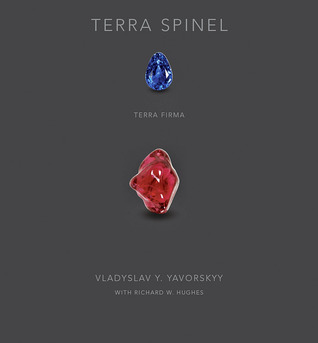
Terra Spinel: Terra Firma

Terra Spinel: Terra Firma

Yavorskyy, V. and Hughes, R.W. (2010)

Book · Publisher: Yavorskyy Co. · Pages: 202 pp.

Abstract
A celebration of the spinel gems and the lands from which they come.
Keywords
spinel, Burma, Tanzania, Vietnam, Sri Lanka, Madagascar, corundum, Quality.10, gems
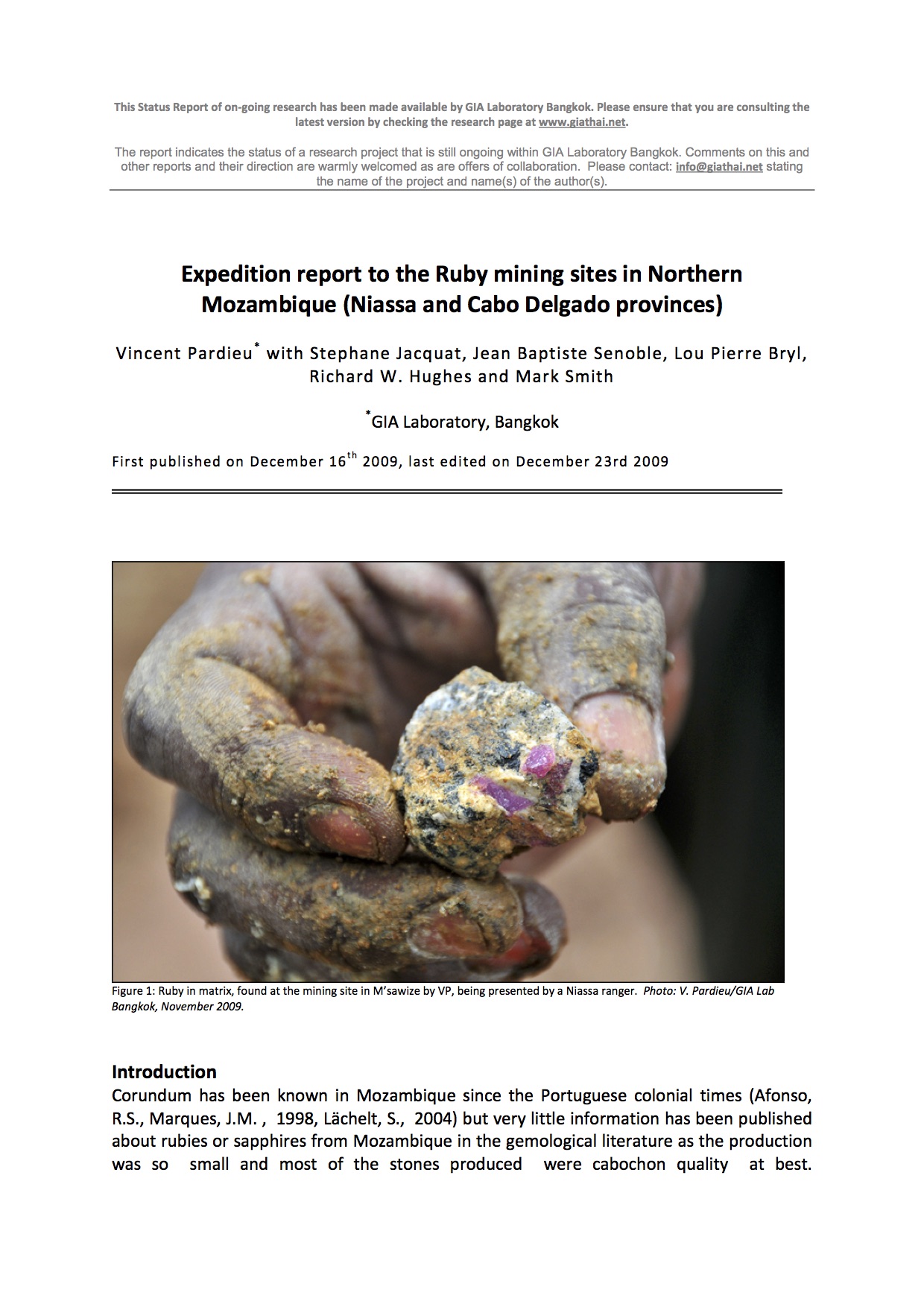
Expedition Report to the Ruby Mining Sites in Northern Mozambique (Niassa and Cabo Delgado Provinces)

Expedition Report to the Ruby Mining Sites in Northern Mozambique (Niassa and Cabo Delgado Provinces)

Pardieu, V., Jacquat, S., Senoble, J.B., Bryl, L.P., Hughes, R.W. and Smith, M. (2009)

Report · Publisher: GIA Laboratory · Pages: 46 pp.

Abstract
Corundum has been known in Mozambique since the Portuguese colonial times (Afonso, R.S., Marques, J.M. , 1998, Lächelt, S., 2004) but very little information has been published about rubies or sapphires from Mozambique in the gemological literature as the production was so small and most of the stones produced were cabochon quality at best. Nevertheless, the gem markets in Bangkok and other places have recently started to see an increase in rubies coming out of Mozambique. Most of the stones seen were heavily fractured and mainly used as a base material for lead glass treatment, but some stones seen at the GIA Laboratories in Bangkok, New York and Carlsbad were fine enough to be faceted and used in jewelry without any treatment. A preliminary study on rubies reportedly from the Niassa province was released by GIA gemologists on March 22nd 2009 (Pardieu, V.P., Thanachakaphad, J. , 2009). After some inquiries it soon became apparent that there were several sources and a GIA Field Expedition to the various ruby mining areas of Northern Mozambique took place and is still ongoing at the end of 2009. Rubies and sapphires in Northern Mozambique have been mined from 4 different deposits, 3 of them located in the Niassa province and one in the Cabo Delgado province, over recent years.
Keywords
corundum, geology.11, Mozambique.12, gems
Red sky at dusk: Hunting the last Siamese ruby miner

Red sky at dusk: Hunting the last Siamese ruby miner

Hughes, R.W., Pardieu, V., Rogers, M. and Segura, O. (2009)

Web Page · Publisher: RWH Publishing · Volume: 2012 · Issue: 17 November

Abstract
One may be the lonliest number, but thirteen is something else again. In most buildings, 13 is so cursed they skip that floor and, perhaps not coincidentally, childhood dies at that age. Roll the dice and you never hit 13. It's a fact. Thirteen years ago I set out with my wife and young daughter to find Thailand's last remaining ruby mine
Keywords
corundum, Thailand.12, Cambodia.12, gems
Spinel: Resurrection of a classic

Spinel: Resurrection of a classic

Pardieu, V., Hughes, R.W. and Boehm, E. (2008)

Journal Article · Source: InColor · Issue: Summer · Pages: pp. 10–18

Abstract
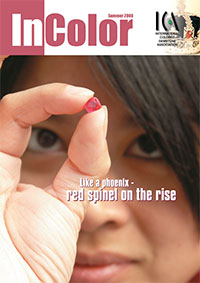
Spinel is rising. Like a phoenix, a gem that for centuries was associated with power, fire, beauty and life, is back again. Over the past several years, interest in spinel has grown and I am delighted to see the newfound fame for classic gem. I first became interested in gemology while studying the history of the 100 Years’ War between France and England. Who could forget the Black Prince’s Ruby, a stone given by the Spanish king to the Black Prince of England as payment for his military support in the civil war of 1366. Later, in 1415, the stone was said to have saved the life of King Henry V of England at the battle of Agincourt. Henry, who had placed the large red orb on his helmet, was struck by the battle axe of the French Duke of Alencon. Sword hit stone; both the ruby and Henry survived. If these stories were not already amazing enough, imagine a costly military campaign paid for entirely with a single gemstone. These are the legends of the Black Prince’s Ruby. But my greatest astonishment was learning that that the gem was not a ruby at all but, in fact, a red spinel. Since I had no idea what a spinel was, I decided to learn more about this mysterious gem. Thus began my interest in gemology. The gemology of spinel is a pleasure. Unlike ruby, there are few treatments and separation from both synthetics and simulants is straightforward. Nevertheless spinel is a rich subject, with a history nearly as long as ruby itself. The past fame, disgrace and recent resurrection of the gem are a lesson in the importance of nomenclature in marketing. Since gemology is truly a human science—mixing science, history, geography, art, trade and terminology—we must understand that human emotion is a crucial factor in marketing. Gems, even if rare and beautiful, also need a good name, and spinel is a classic example of that fact.
Keywords
spinel, Burma, Tanzania, Vietnam, Sri Lanka, Madagascar, gems
FTIR Intrigue: FTIR in gem testing

FTIR Intrigue: FTIR in gem testing

Hughes, R.W., Castoro, L., Hpone-Phyo Kan-Nyunt and Kiefert, L. (2007)

Web Page · Publisher: AGTA

Abstract
Most gemologists are familiar with the direct vision spectroscope. This instrument uses a series of prisms or a diffraction grating to separate white light into its spectral components. If white light is passed through a gem, it will reveal any areas of absorption or emission. The main limitation of the direct vision spectroscope is that it can only analyze the visible region (400–700 nm), but a small portion of the electromagnetic spectrum.
Keywords
corundum, color.4, gems
Beryllium-treated blue sapphires

Beryllium-treated blue sapphires

Du Toit, G., Hughes, R.W. and Koivula, J.I. (2006)

Web Page · Publisher: www.ruby-sapphire.com

Abstract
This article discusses the use of beryllium to treat blue sapphires.
Keywords
corundum, treatments.6, gems
Sorcerers & sapphires: A visit to Madagascar

Sorcerers & sapphires: A visit to Madagascar

Hughes, R.W., Pardieu, V. and Schorr, D. (2006)

Journal Article · Source: Gem Market News [The Guide] · Volume: Vol. 25 · Issue: Issue 1, Part 1, January–February · Pages: pp. 1, 4–6

Abstract
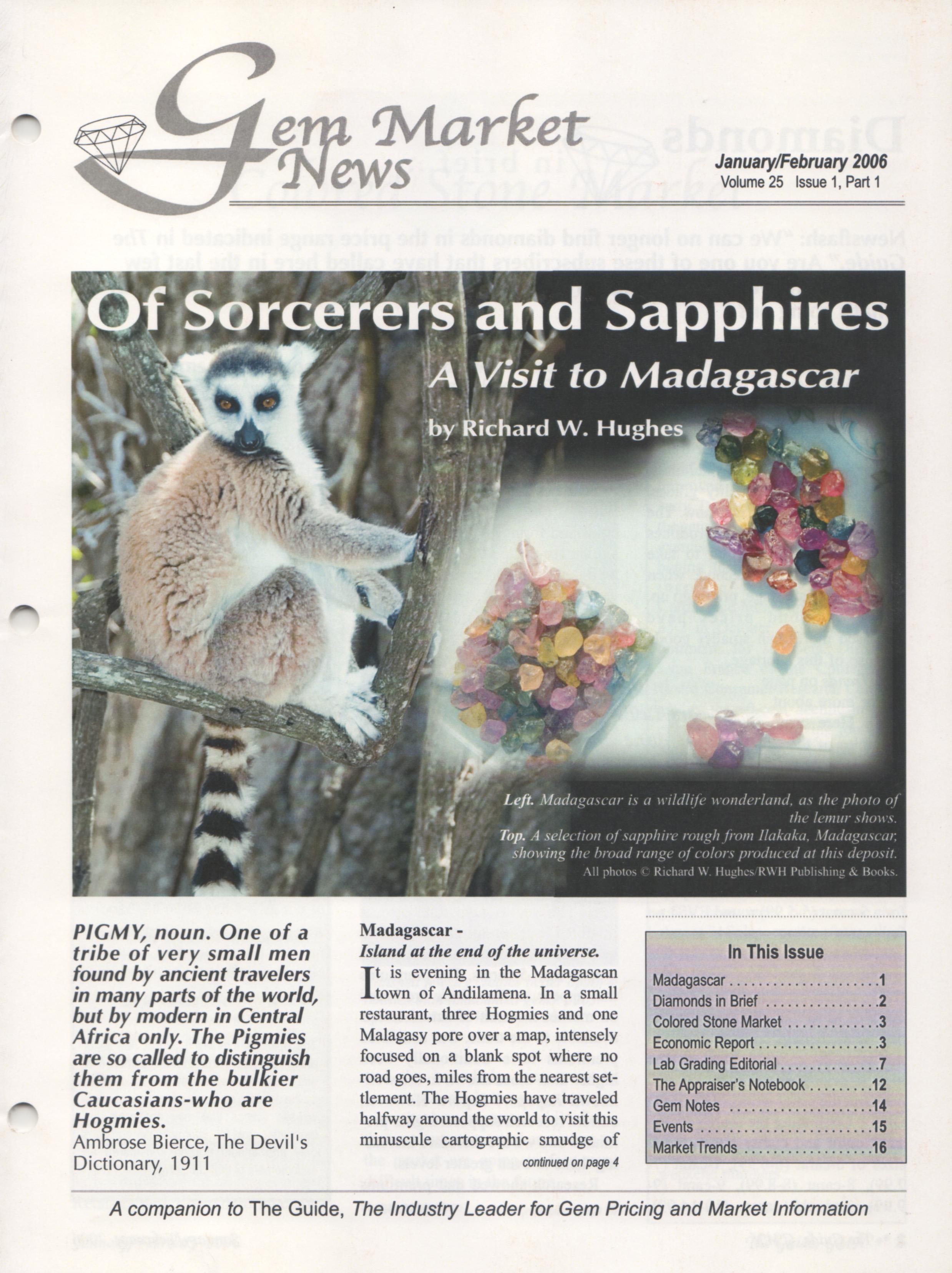
It is evening in the Madagascan town of Andilamena. In a small restaurant, three Hogmies and one Malagasy pore over a map, intensely focused on a blank spot where no road goes, miles from the nearest settlement. The Hogmies have traveled halfway around the world to visit this miniscule cartographic smudge of tightly wound contour lines. For it is here that Madagascar’s finest sapphires are said to be found. But perhaps I am getting ahead of myself. Let me begin a bit further back... My first recollection of Madagascar was grade school, where we dutifully learned that a prehistoric fish, long thought extinct, had been fished from the coastal waters of this errant isle. Later, in gemology class, my teacher again brought up the subject of this forgotten land, mentioning that the famous French naturalist, Alfred Lacroix had written a paper about it (Un Voyage au Pays des Béryls). From that moment on, Madagascar became known to me not just as something out of a Jules Verne novel, but as the “Beryl Island.” The Island of Madagascar is an anomaly in many respects. While lying just 400 km from the coast of Africa, it was not settled until roughly 2000 years ago, and not by Africans, but by adventurous sailors from the Malayo-Indonesian Archipelago, some 6400 km to the east. Today the country’s human population is a tumultuous stew spiced with Malay, African, Arab, French, Chinese and Indian ingredients.
Keywords
corundum, geology.11, Madagascar.12, gems
Moon over the Pamirs: Chasing ruby and spinel in Tajikistan

Moon over the Pamirs: Chasing ruby and spinel in Tajikistan

Hughes, R.W., Pardieu, V., Soubiraa, G. and Schorr, D. (2006)

Web Page · Publisher: Lotus Gemology Co. Ltd. · Volume: 2016 · Issue: 1-Oct

Abstract
In our business, travel should be de rigueur. But the headlines frighten so many away. Boo! Earth is one giant pool of war, disease and pestilence. Boo! International travel is undertaken only by the clinically insane or those with Special Ops experience. Boo! If the pox or pollution don't gettcha, al Qaeda is close behind. As Lou Reed sang: You've got a black .38 and a gravity knife. You still have to ride the train." Lou was singing about the New York subways. Having braved Manhattan's dangerous tunnels, we feel qualified to discuss what some might regard as an even greater peril: travel to Tajikistan. This article is based on a 2006 expedition to Tajikistan’s famous Kuh-i-Lal (spinel) and Snyzne (ruby) mines."
Keywords
corundum, Afghanistan.12, China.12, Tajikistan.12, spinel, gems
Living in the Dark Ages: The fiber-optic light

Living in the Dark Ages: The fiber-optic light

Koivula, J.I. and Hughes, R.W. (2005)

Web Page · Publisher: Lotus Gemology

Abstract
A gemologist’s life would be far easier if gems were cut as parallel-sided plates. But they’re not. Facets are designed to reflect light back to the viewer, not transmit it. This means light entering the gemstone from behind (transmitted light) will typically not pass straight through. If we want to see inclusions, we must constantly change the light paths through the gemstone. This is done by changing the position of the gemstone relative to the light and changing the light relative to the gem. The most versatile and controllable method of doing this is with the fiber-optic light, an illumination technique “darker” than even darkfield. During a recent routine identification of a natural chrysoberyl a startling difference in two distinctly different types of illumination commonly used in the examination of gemstones was clearly revealed. These two methods are darkfield and fiber-optic illumination. When this chrysoberyl was studied in darkfield (Figure 1), only a fine linear growth band was seen. However, when fiber-optic lighting was directed in along the girdle plane, bundles of fine light-scattering silky needles extending at 90˚ from the linear growth band became abundantly clear. At the same time the linear growth band itself was also more clearly detailed (Figure 2). The difference in the amount of visual information provided by these two different lighting techniques was startling. In this instance darkfield was clearly inferior to fiber-optic illumination.
Keywords
corundum, inclusions.5, photomicrography, gems
Passport to obscurity: Testing yellow sapphire

Passport to obscurity: Testing yellow sapphire

Koivula, J.I. and Hughes, R.W. (2005)

Web Page · Publisher: LotusGemology.com

Abstract
While a passport typically conjures up images of freedom, the open road and travel to exotic locales, not every destination is five-star. This point was driven home during the examination of a group of yellow sapphires recently sent to the laboratory for identification.
Keywords
corundum, treatments.6, gems
Dangerous curves: Verneuil synthetic corundum

Dangerous curves: Verneuil synthetic corundum

Hughes, R.W. and Koivula, J.I. (2005)

Web Page · Publisher: Lotus Gemology

Abstract
Virtually all gemologists are aware of the curved growth lines and gas bubbles in Verneuil (flame-fusion) synthetic corundum, but few understand exactly why they occur and how they are distributed in these stones. This article clarifies these important identifying features.
Keywords
corundum, synthetic corundum.7, gems
Following the Silk Road: Rutile in corundum

Following the Silk Road: Rutile in corundum

Koivula, J.I. and Hughes, R.W. (2005)

Web Page · Publisher: Lotusgemology.com · Volume: 2015 · Issue: 3-Nov

Abstract
What follows is a love story. We admit it. Our heart is on our sleeves. We are smitten, head-over-heels in love with the exotic and beguiling internal lattice that gemologists call silk." How do we love thee? Let us count the ways. You are the one that lets some of our rubies and sapphires sparkle like the night sky, your asterism such a wonder of nature. Not to mention your beauty as you wink up at us when the light is just so. And finally, you are our guardian, our coalmine canary, a tiny thermometer in our gems, willing to sacrifice your own life to let us know when Man’s ego has grown so large that he thinks he can play God. For this alone, we sing your praises."
Keywords
corundum, inclusions.5, gems
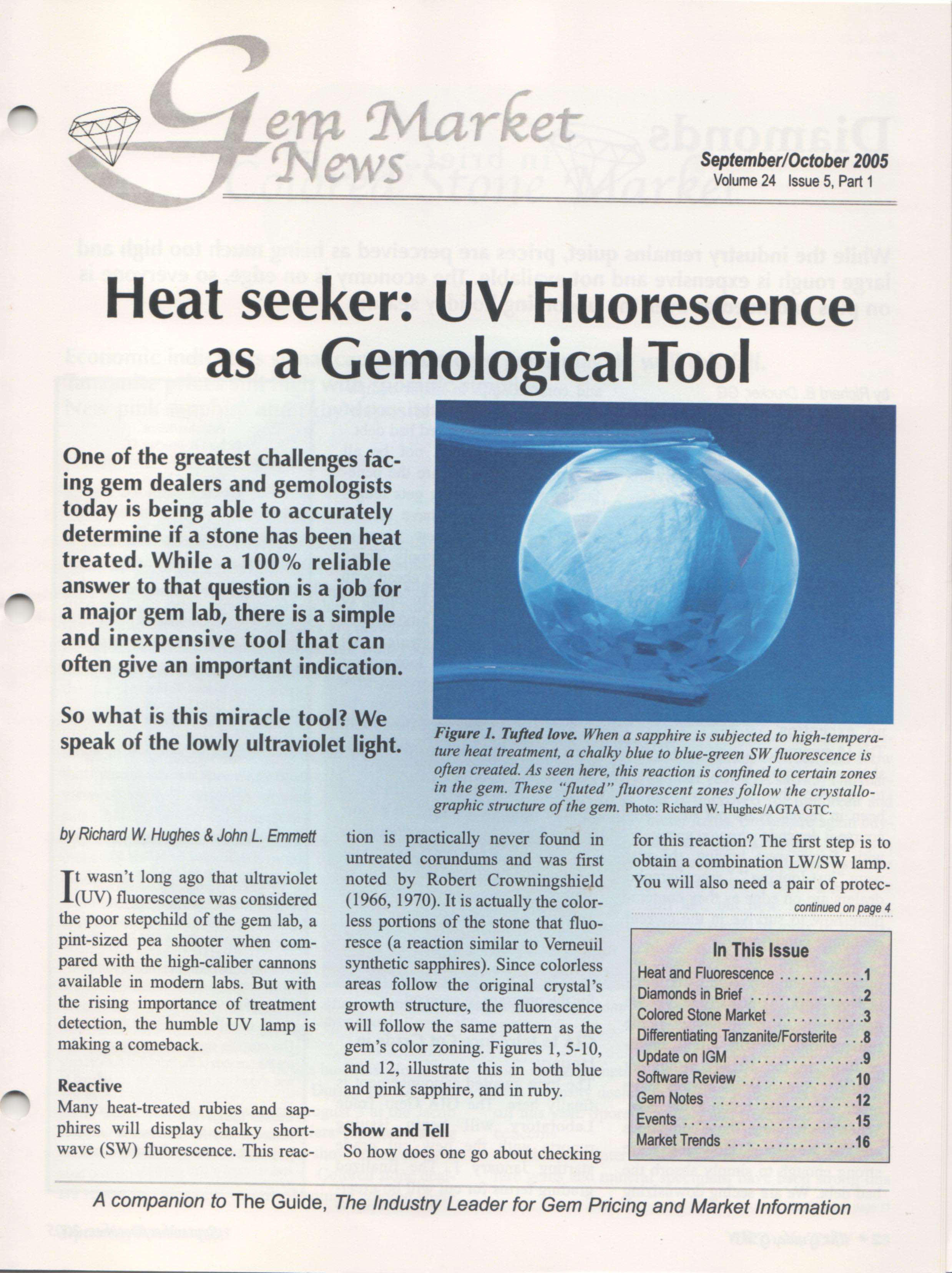
Heat Seeker: UV fluorescence as a gemological tool

Heat Seeker: UV fluorescence as a gemological tool

Hughes, R.W. and Emmett, J.L. (2005)

Journal Article · Source: Gem Market News [The Guide] · Volume: Vol. 24 · Issue: No. 5, Part 1, Sept.–Oct. · Pages: pp. 1, 4–7

Abstract
One of the greatest gemological challenges is determining if a ruby or sapphire has been heat treated. UV fluorescence can assist in that identification, as well as detecting fillers in emerald.
Keywords
corundum, color.4, treatments.6, gems

Exploring the Literature of Corundum

Ruby and sapphire research spans mineralogy, gem deposits, identification, treatments, synthesis and the history of the gem trade. Older publications can also be useful for tracing terminology, early observations and accounts of mining localities. Publication dates and the original source should be considered when using historical descriptions.

For an introduction to collecting books on this subject, read Ruby & Sapphire Books: Collecting the Literature of Corundum.

About Four Treasures

Four Treasures is Lotus Gemology's freely accessible gemological reference database. Use the full database to search by author, title or keyword and explore literature on gemology, mineralogy, jewelry and related fields. Where available, hyperlinks on titles may lead directly to the full publication.

Search the Complete Four Treasures Database