Explore books, articles and historical sources on ruby, sapphire and corundum in Four Treasures, the Lotus Gemology reference database. This bibliography brings together matching records from the collection, with publication details, abstracts and cover images where available.
Ruby & Sapphire References
The list below matches the terms ruby, rubies, sapphire or corundum in the database's searchable fields. Some references discuss these gems as part of a broader subject. Linked titles take you to external links where you may find the full reference.
141–160 of 4,669 matching references
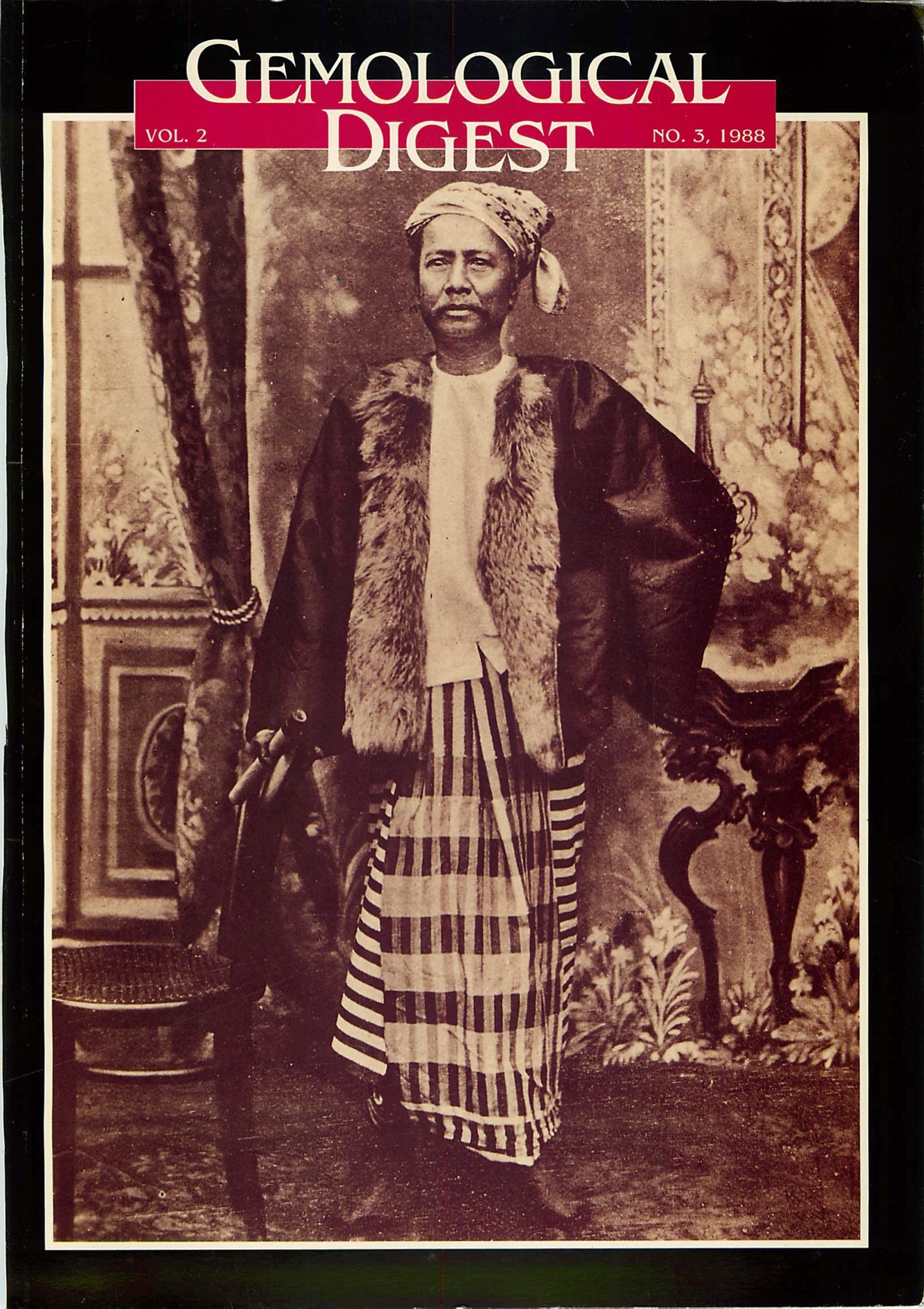
Hughes, R.W. (1988)
Journal Article · Source: Gemological Digest · Volume: Vol. 2 · Issue: No. 3 · Pages: pp. 40–41
Abstract
As many of our readers are well aware, the area around Mogok in Upper Burma is the world's premier source for rubies. Since 1962, however, it has been closed off to the outside world, merely adding to the mystery of a place already steeped in legend. With the utmost difficulty we have succeeded in obtaining modern pictures of Mogok
Keywords
corundum, Burma.12, gems
View full reference

Hughes, R.W. (1988)
Journal Article · Source: ICA Laboratory Alert · Issue: No. 12 · Pages: 2 pp.
Abstract
Pssst. pssst. Want a hot tip? Hit the library and dredge up a gem treatment, preferably one developed years ago, so that most have forgotten it. Spice it up a bit, give it a jazzier name. Then throw a piece into a parcel of naturals and take it round to a lab on… say… New Year's Eve. Did the lab muff the identification? Great! Call in the trade media to roll out the product (and don't forget to show them the natural report). Now promote the bejesus out of it by telling people that it's virtually unidentifiable.Sound crazy? It shouldn't. It should sound familiar, like deep surface diffusion. Most in the gem trade have now heard of the deep surface diffusion-treated sapphires. But few know how to spot them. And fewer still realize that surface diffusion is nothing new. But good treatments are a bit like vampires. No matter how often you kill them they always come back to haunt you.
Keywords
surface diffusion treatments.6, sapphire, corundum, Thailand, gems
View full reference
Hughes, R.W. (1988)
Journal Article · Source: Journal of Gemmology · Volume: Vol. 21 · Issue: No. 1, January · Pages: pp. 23–25
Abstract
This article describes two techniques for identifying yellow sapphire. The first uses a blue filter to detect color zoning in natural and synthetic yellow sapphire. Second is how gently heating heat-treated yellow sapphires under a lamp will cause their color to temporarily darken. It can thus be used to separate heated yellow sapphires from natural yellow sapphires.
Keywords
corundum, yellow sapphire, treatments.6, inclusions.5, synthetic corundum.7, gems
View full reference
Hughes, R.W. (1988)
Journal Article · Source: Journal of Gemmology · Volume: Vol. 21 · Issue: No. 1, January · Pages: pp. 8–10
Abstract
Describes an unusual ruby where glass was used to fuse one piece of natural ruby to a much larger piece of synthetic ruby. A second ruby appeared to have glass in fissures throughout. [in hindsight, this was probably exsolution of planes of boehmite or another mineral]
Keywords
corundum, treatments.6, gems
View full reference
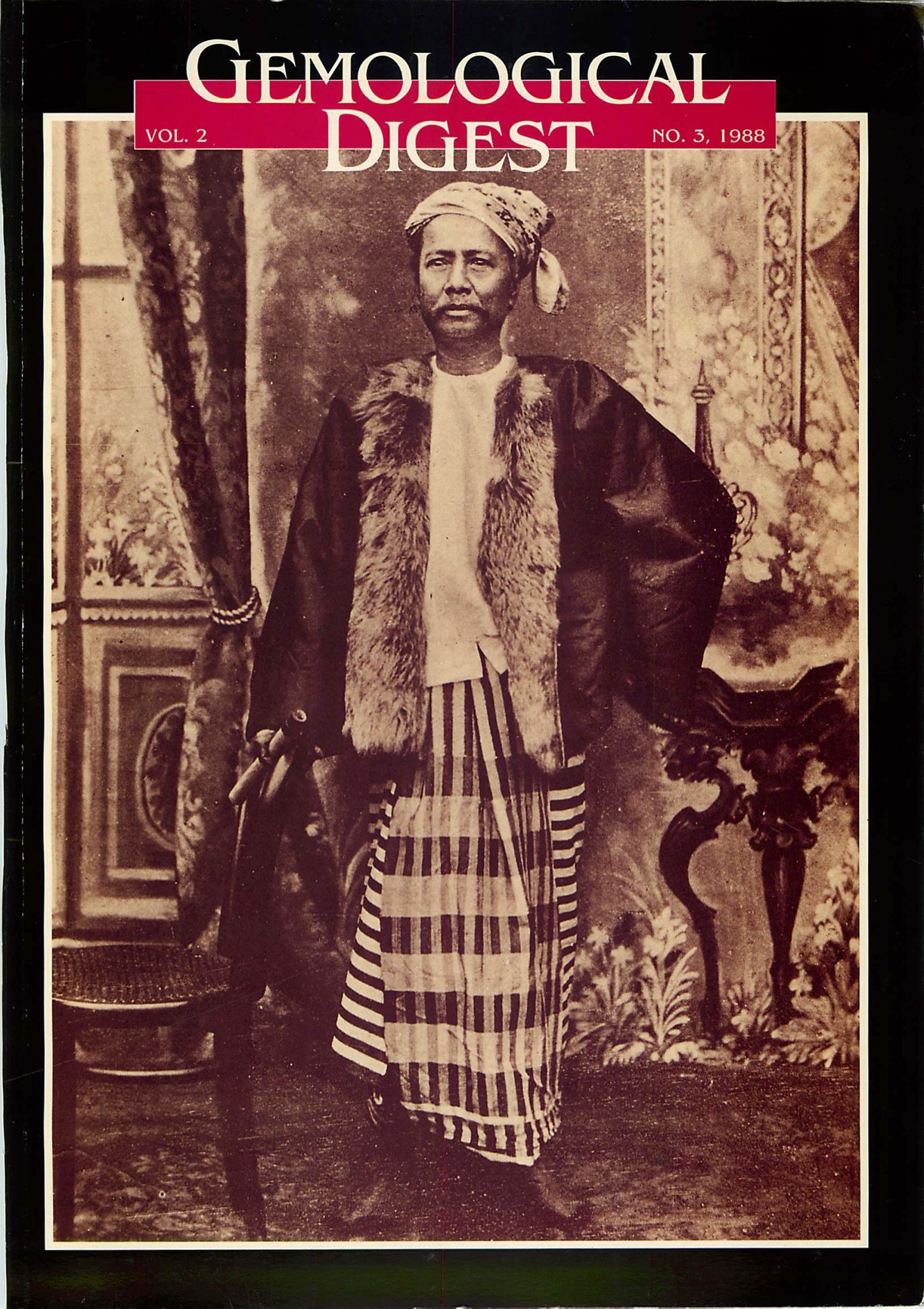
Hughes, R.W. (1988)
Journal Article · Source: Gemological Digest · Volume: Vol. 2 · Issue: No. 3 · Pages: pp. 16–24
Abstract
The phenomenon of pleochroism in doubly refractive (DR) gemstones is described, as it relates to overall color appearance in the context of faceted gems. With strongly pleochroic gems, pleochroism can be seen in faceted gems, even if the table facet is oriented perpendicular to an optic axis. This is because facets change the direction of light as it moves through the gem.
Keywords
gems, corundum, color.4
View full reference
Hughes, R.W. (1988)
Journal Article · Source: Gemological Digest · Volume: Vol. 2 · Issue: Nos. 1 & 2 · Pages: pp. 10–15
Abstract
A discussion of brilliance, windows and extinction as they relate to the face-up appearance of colored gemstones. Diagrams demonstrate that extinction is largely a function of cut.
Keywords
corundum, fashioning.9, gems
View full reference
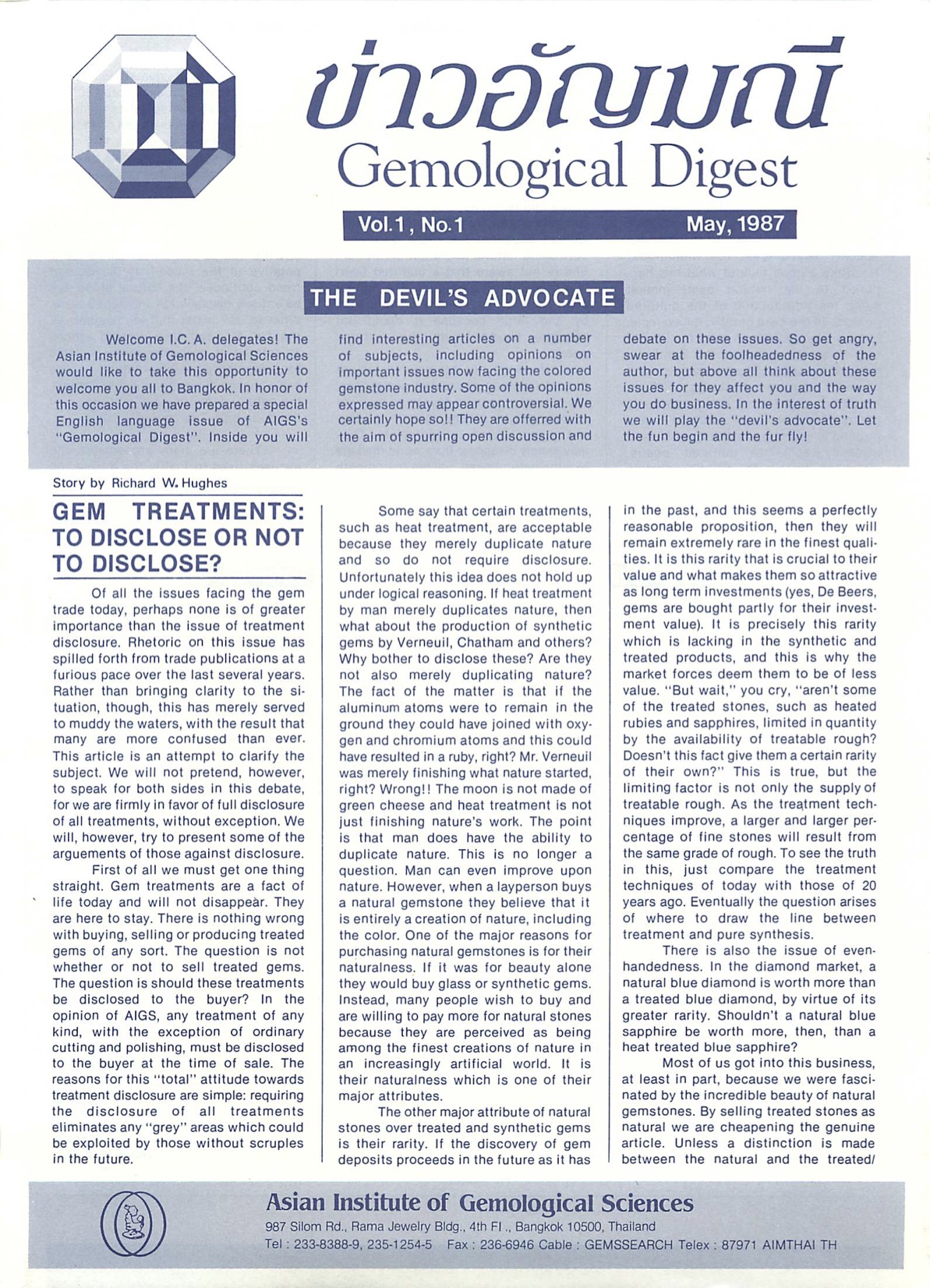
Hughes, R.W. (1987)
Journal Article · Source: Gemological Digest · Volume: Vol. 1 · Issue: No. 1 · Pages: p. 4
Abstract
During 1986, newspaper reports told of a most Incredible gem find. Mr. Roy Whetstine of Longview, Texas, went to the 1986 Tucson Gem and Mineral Show hoping to find a few pretty rocks for his two sons. He returned home with what he claimed to be the world's largest rough star. sapphire, bought for $10 from a bowl full of agates, and later appraised at $2.28 million. It was an amazing story and one that warmed the hearts of thousands of readers around the.world -a little man strikes-a bonanza! Slowly, however, clouds began to form and before long they were pouring down rain on Mr. Whetstlne's parade. What occurred was the exposure of one of the most ambitious gem cons of the twentieth century.
Keywords
corundum, star sapphire, quality.9, gems
View full reference

Hughes, R.W. (1987)
Journal Article · Source: ICA Laboratory Alert · Issue: No. 2 · Pages: 1:00 PM
Abstract
Description of a stone consisting of a small chunk of natural ruby glued to the side of a synthetic ruby and them the whole mass later repolished and represented as a single ruby.
Keywords
corundum, ruby, assembled stones.8, imitation, synthetic corundum.7, gems
View full reference

Hughes, R.W. (1987)
Journal Article · Source: ICA Laboratory Alert · Issue: No. 1 · Pages: 1 p.
Abstract
This article describes how gently heating heat-treated yellow sapphires under a lamp will cause their color to temporarily darken. It can thus be used to separate heated yellow sapphires from natural yellow sapphires.
Keywords
corundum, yellow/orange sapphire, Sri Lanka, heat treatments.6, gems
View full reference
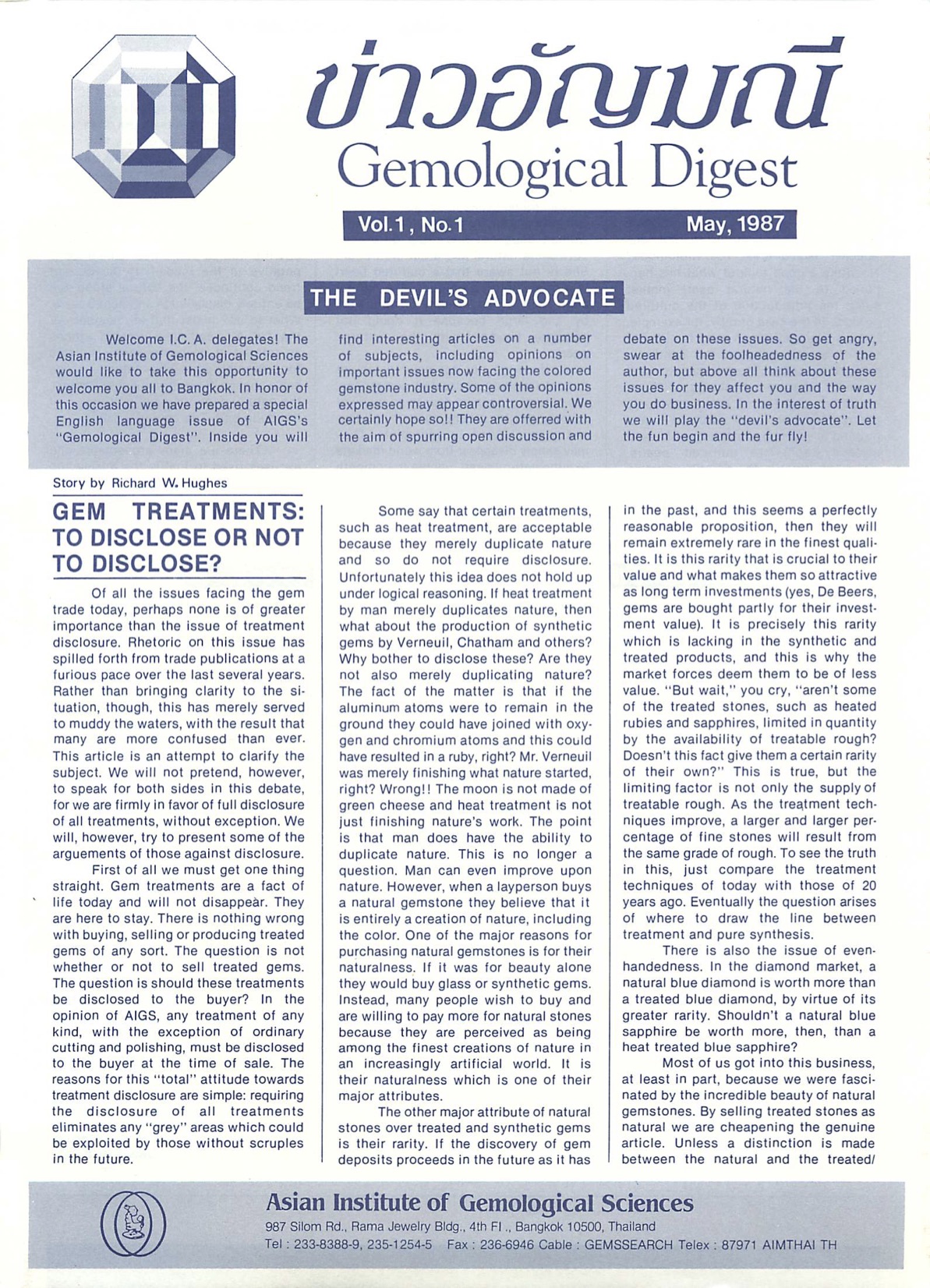
Hughes, R.W. (1987)
Journal Article · Source: Gemological Digest · Volume: Vol. 1 · Issue: No. 1 · Pages: p. 3
Abstract
Among the myriad problems facing the colored gemstone industry today is the question of pink sapphire and ruby – where and how do we draw the line between them? Over the past 10–20 years gemologists and gem dealers have struggled with this question, but a solution acceptable to the majority of the trade has yet to be found. With this in mind, we at AIGS would like to send our solution up the proverbial flag pole, hoping that you, the trade, will salute.
Keywords
corundum, ruby, sapphire, nomenclature, color.4, gems
View full reference
Hughes, R.W. (1987)
Journal Article · Source: Australian Gemmologist · Volume: Vol. 16 · Issue: No. 7 · Pages: pp. 259–261
Abstract
A plastic coated jadeite cabochon and a quartz coated with red plastic to imitate ruby are described.
Keywords
imitation gems, jade, jadeite, fei cui, ruby, star ruby, imitation ruby, quartz, corundum, synthetic corundum.7, gems
View full reference

Hughes, R.W. (1987)
Journal Article · Source: ICA Laboratory Alert · Issue: No. 3 · Pages: 1:00 PM
Abstract
A plastic coated jadeite cabochon and a quartz coated with red plastic to imitate ruby are described.
Keywords
jade, jadeite, fei cui, imitation star ruby, imitation gem, synthetic corundum.7, gems
View full reference
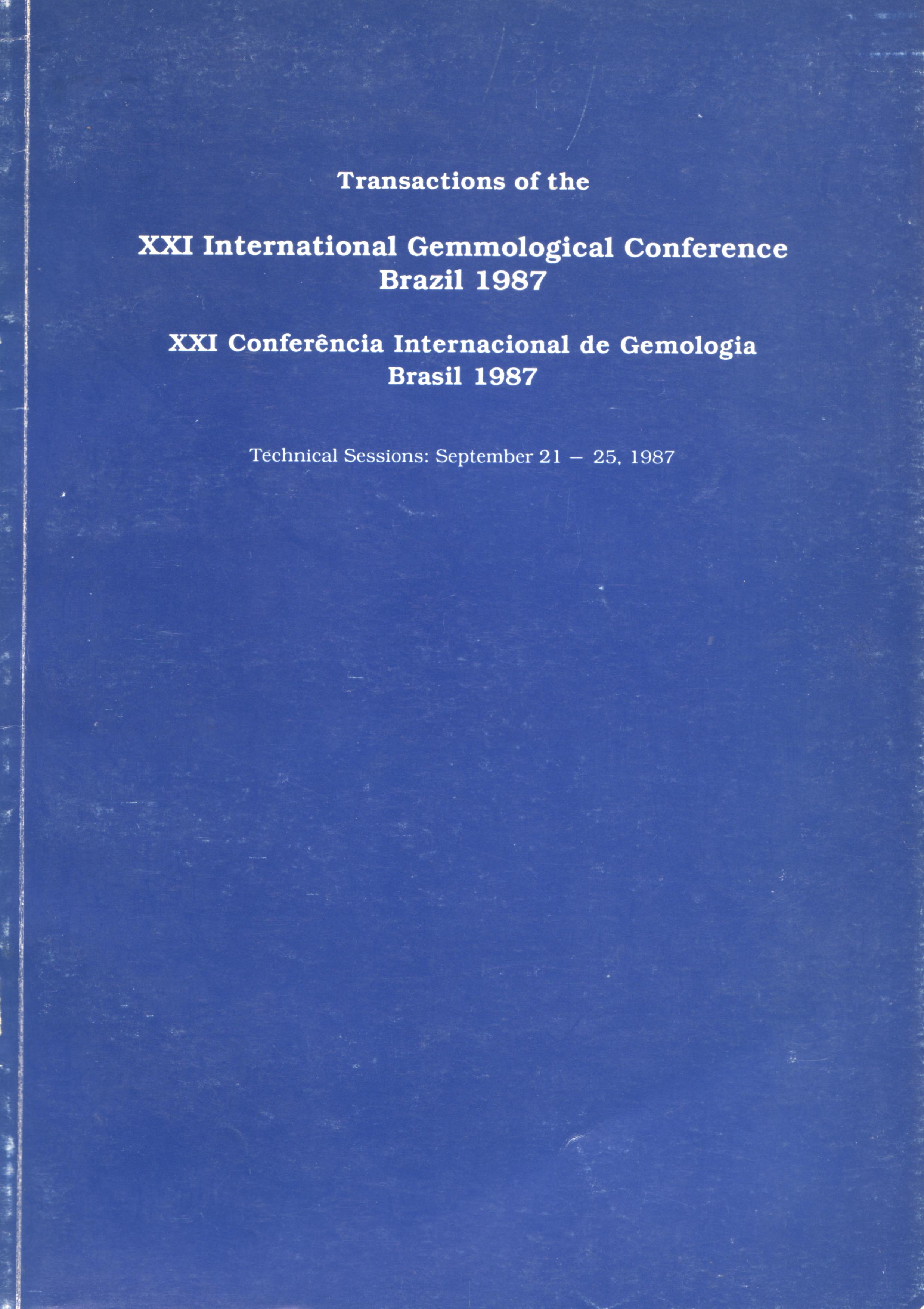
Hughes, R.W. (1987)
Conference Paper · Source: International Gemmological Conference · Publisher: Transactions of the XXI International Gemmological Conference · Pages: pp. 35–36
Abstract
This article describes two techniques for identifying yellow sapphire. The first uses a blue filter to detect color zoning in natural and synthetic yellow sapphire. Second is how gently heating heat-treated yellow sapphires under a lamp will cause their color to temporarily darken. It can thus be used to separate heated yellow sapphires from natural yellow sapphires.
Keywords
corundum, yellow sapphire, sapphire, treatments.6, synthetic gems.7, gems
View full reference

Hughes, R.W. (1987)
Journal Article · Source: ICA Laboratory Alert · Issue: No. 1 · Pages: 2 pp.
Abstract
This article describes how gently heating heat-treated yellow sapphires under a lamp will cause their color to temporarily darken. It can thus be used to separate heated yellow sapphires from natural yellow sapphires.
Keywords
heat treatments.6, corundum, yellow sapphire, gems
View full reference

Hughes, R.W. (1987)
Journal Article · Source: ICA Laboratory Alert · Issue: No. 4 · Pages: 1:00 PM
Abstract
A ruby appeared to have glass in fissures throughout. [in hindsight, this was probably exsolution of planes of boehmite or another mineral]
Keywords
ruby, corundum, treatments.6, gems
View full reference

Hughes, R.W. (1987)
Journal Article · Source: ICA Laboratory Alert · Issue: No. 5 · Pages: 1:00 PM
Abstract
This article describes an important technique using a blue filter to detect color zoning in natural and synthetic yellow sapphire.
Keywords
synthetic corundum.7, yellow sapphire, blue filter, treatments.6, gems
View full reference
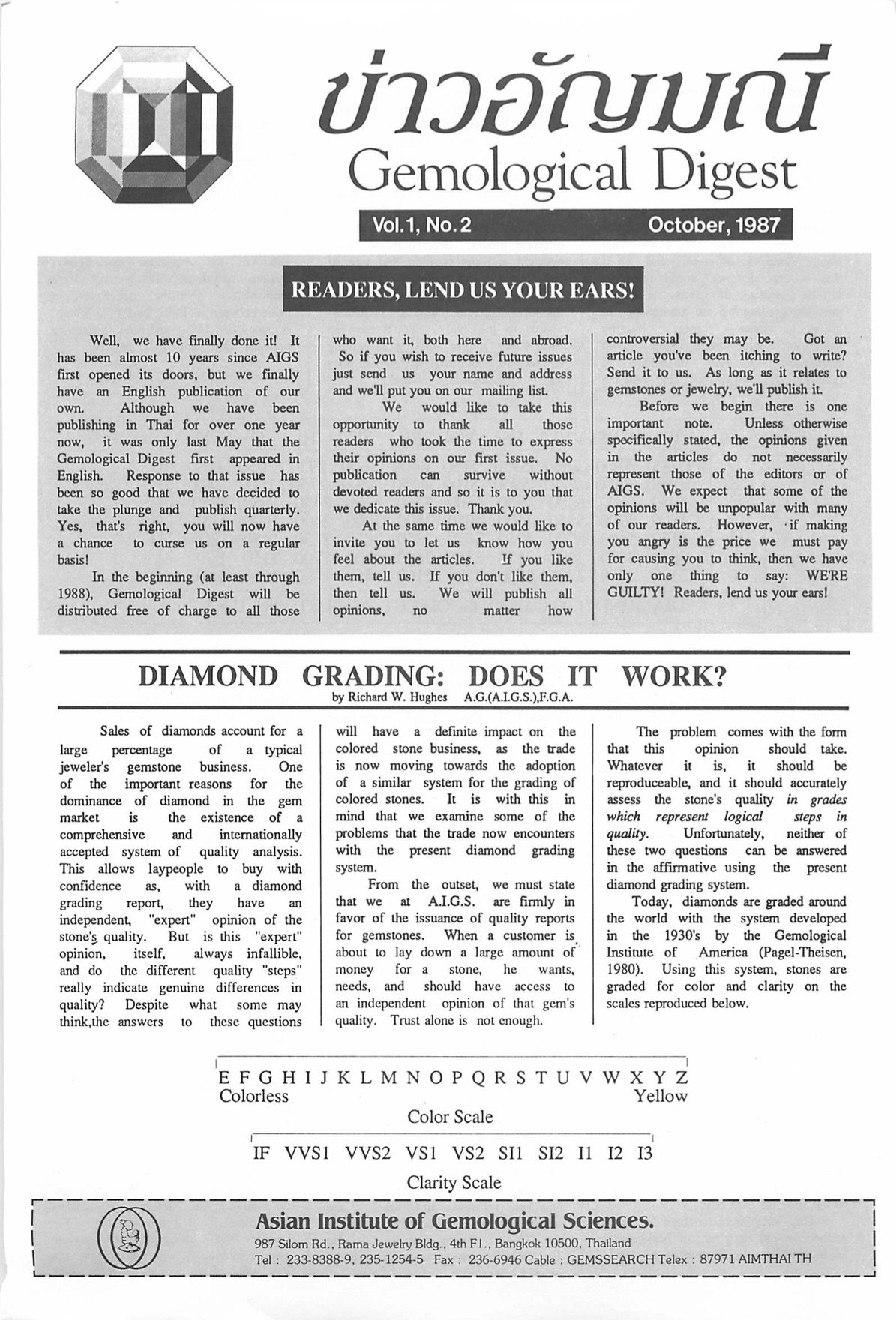
Hughes, R.W. (1987)
Journal Article · Source: Gemological Digest · Volume: Vol. 1 · Issue: No. 2 · Pages: pp. 1–3
Abstract
Sales of diamonds account for a large percentage of a typical jeweler's gemstone business. One of the important reasons for the dominance of diamond in the gem market is the existence of a comprehensive and internationally accepted system of quality analysis. Thls allows laypeople to buy with confidence as, with a diamond grading report, they have an independent, expert" opinion of the stone’s quality. But is this "expert" opinion, itself, always infallible, and do the different quality "steps" really indicate genuine differences in quality? Despite what some may think.the answers to these questions will have a definite impact on the colored stone business, as the trade is now moving towards the adoption of a similar system for the grading of colored stones. It is with this in mind that we examine some of the problems that the trade now encounters with the present diamond grading system."
Keywords
corundum, quality.9, gems
View full reference
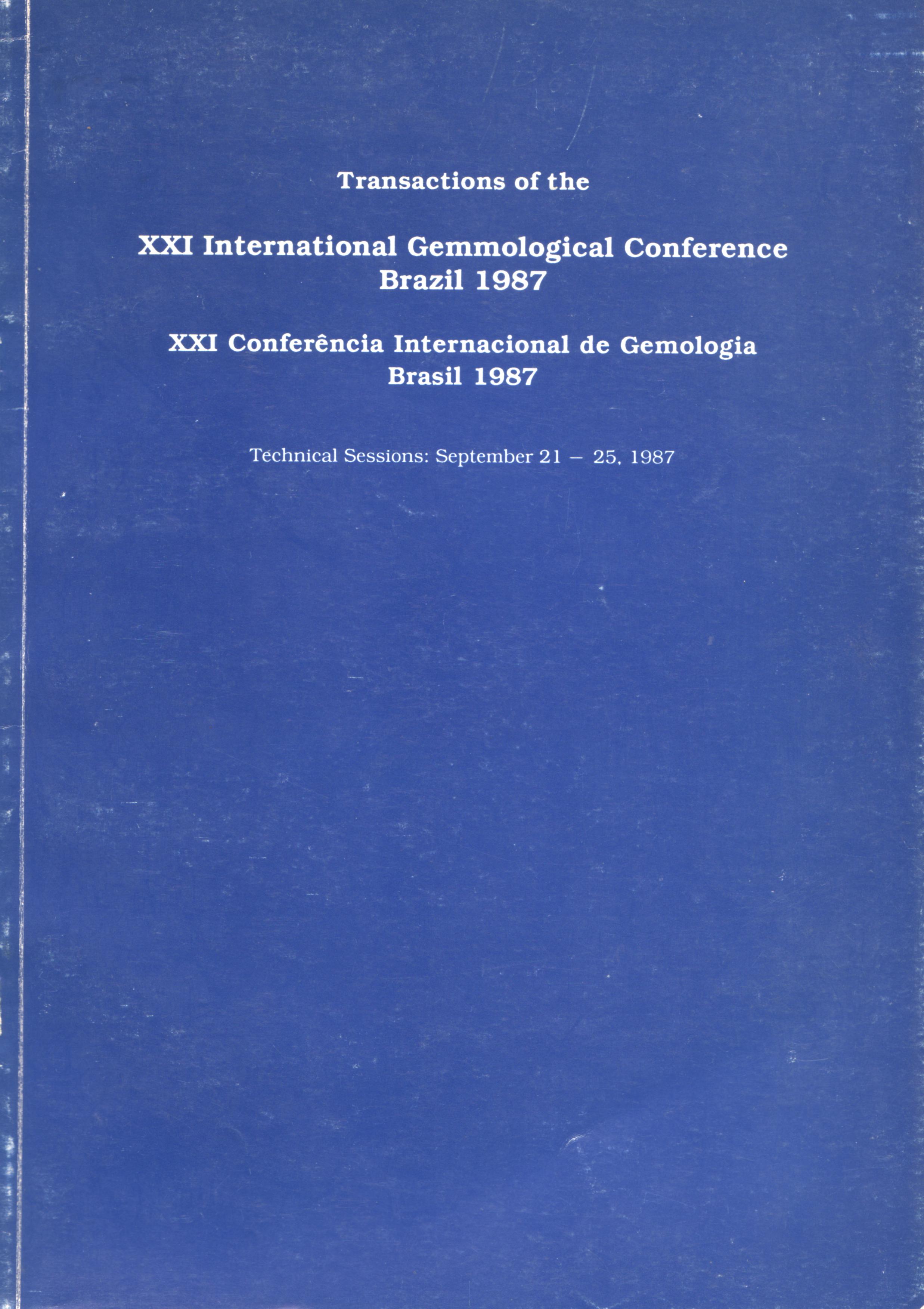
Hughes, R.W. (1987)
Conference Paper · Source: International Gemmological Conference · Publisher: Transactions of the XXI International Gemmological Conference—Brazil 1987 · Pages: pp. 31–33
Abstract
A plastic coated jadeite cabochon and a quartz coated with red plastic to imitate ruby are described.
Keywords
corundum, treatments, jade, jadeite, fei cui, assembled stones.8, ruby imitations, ruby, gems
View full reference
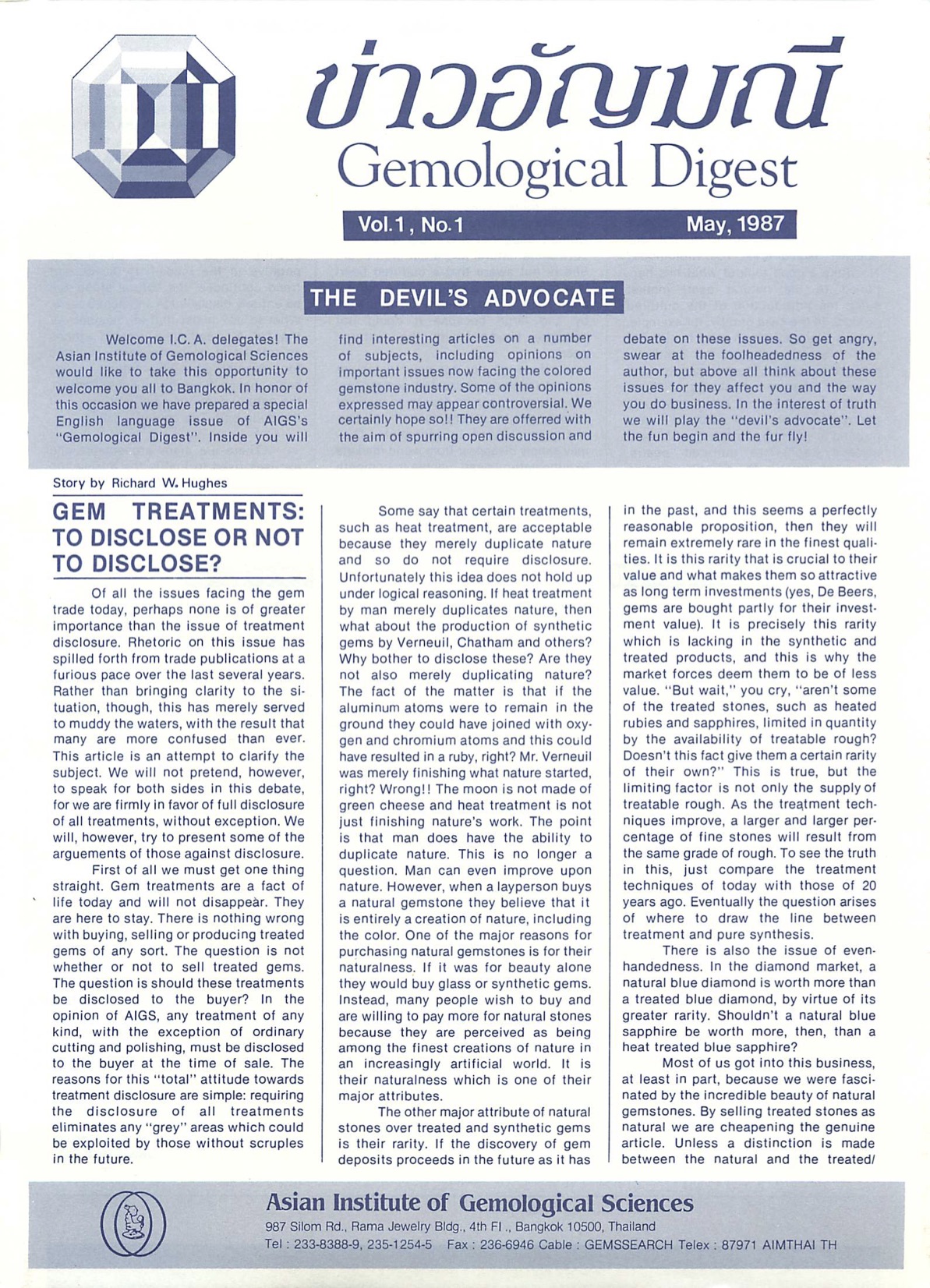
Hughes, R.W. (1987)
Journal Article · Source: Gemological Digest · Volume: Vol. 1 · Issue: No. 1 · Pages: pp. 1–2
Abstract
Of all the issues facing the gem trade today, perhaps none is of greater importance than the issue of treatment disclosure. Rhetoric on this issue has spilled forth from trade publications at a furious pace over the past several years. Rather than bringing clarity to the situation, though, this has merely served to muddy the waters, with the result that many are more confused than ever. This article is an attempt to clarify the subject. We will not pretend, however, to speak for both sides of the debate, for we are firmly in favor of full disclosure of all treatments, without exception. We will, however, try to present some of the arguements of those against disclosure.
Keywords
heat treatment, corundum, gems
View full reference
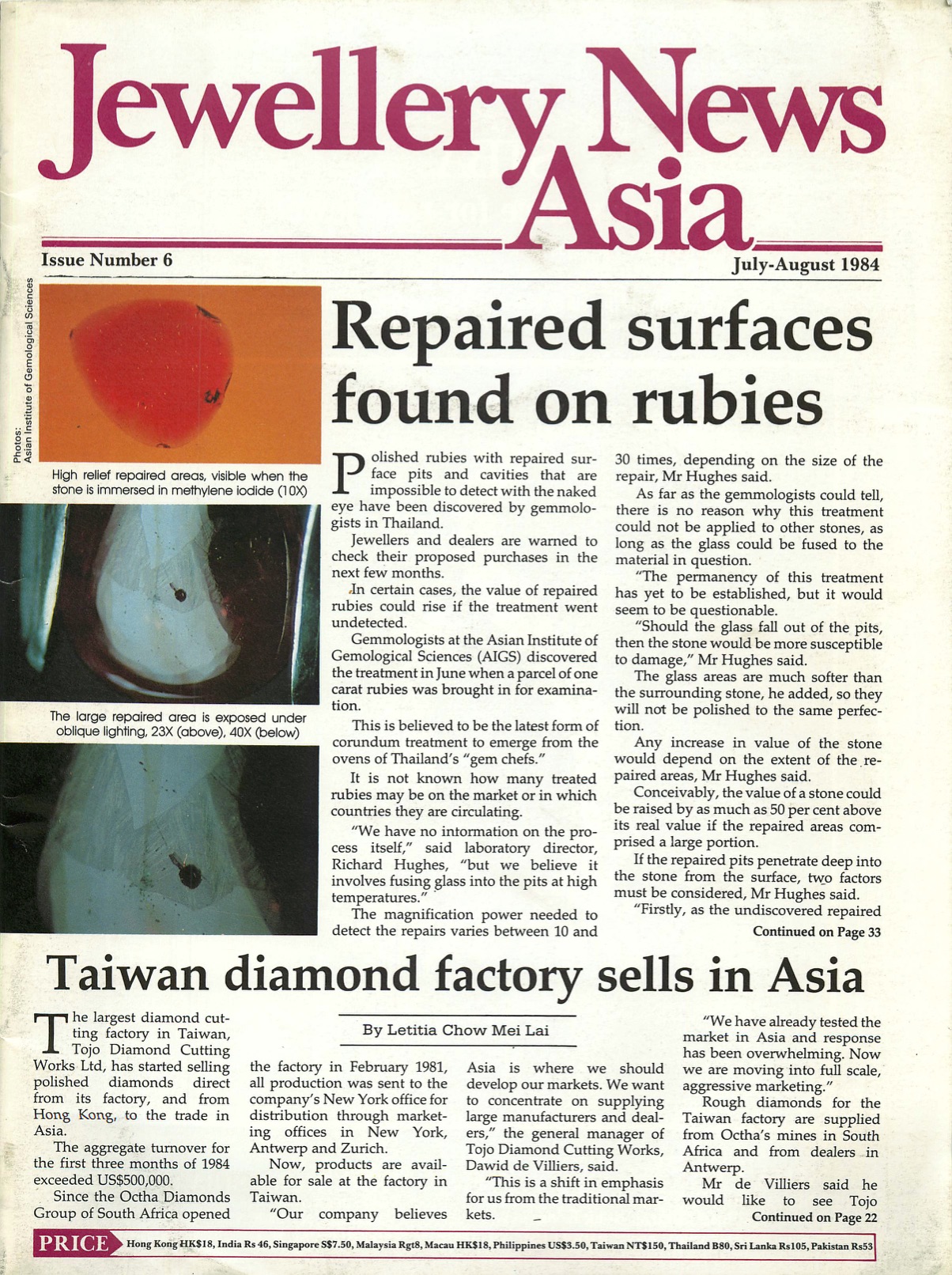
Hughes, R.W. (1984)
Journal Article · Source: Jewellery News Asia · Issue: No. 6 · Pages: pp. 1, 33
Abstract
Description of rubies treated by filling surface cavities with glass.
Keywords
ruby, corundum, treatments.6, glass infilling, gems
View full reference
Exploring the Literature of Corundum
Ruby and sapphire research spans mineralogy, gem deposits, identification, treatments, synthesis and the history of the gem trade. Older publications can also be useful for tracing terminology, early observations and accounts of mining localities. Publication dates and the original source should be considered when using historical descriptions.
For an introduction to collecting books on this subject, read Ruby & Sapphire Books: Collecting the Literature of Corundum.
About Four Treasures
Four Treasures is Lotus Gemology's freely accessible gemological reference database. Use the full database to search by author, title or keyword and explore literature on gemology, mineralogy, jewelry and related fields. Where available, hyperlinks on titles may lead directly to the full publication.
Search the Complete Four Treasures Database