Gemology Books Bibliography

Gemology Books Bibliography

Explore books on gems, gemology, jewelry and mineralogy in Four Treasures, the Lotus Gemology reference database. This bibliography brings together matching book records from the collection, with publication details, abstracts and cover images where available.

Gemology Book References

The list below matches books concerning gemology and related subjects in the database's searchable fields. Some works cover several branches of gems, jewelry or mineralogy.

101–120 of 3,436 matching references
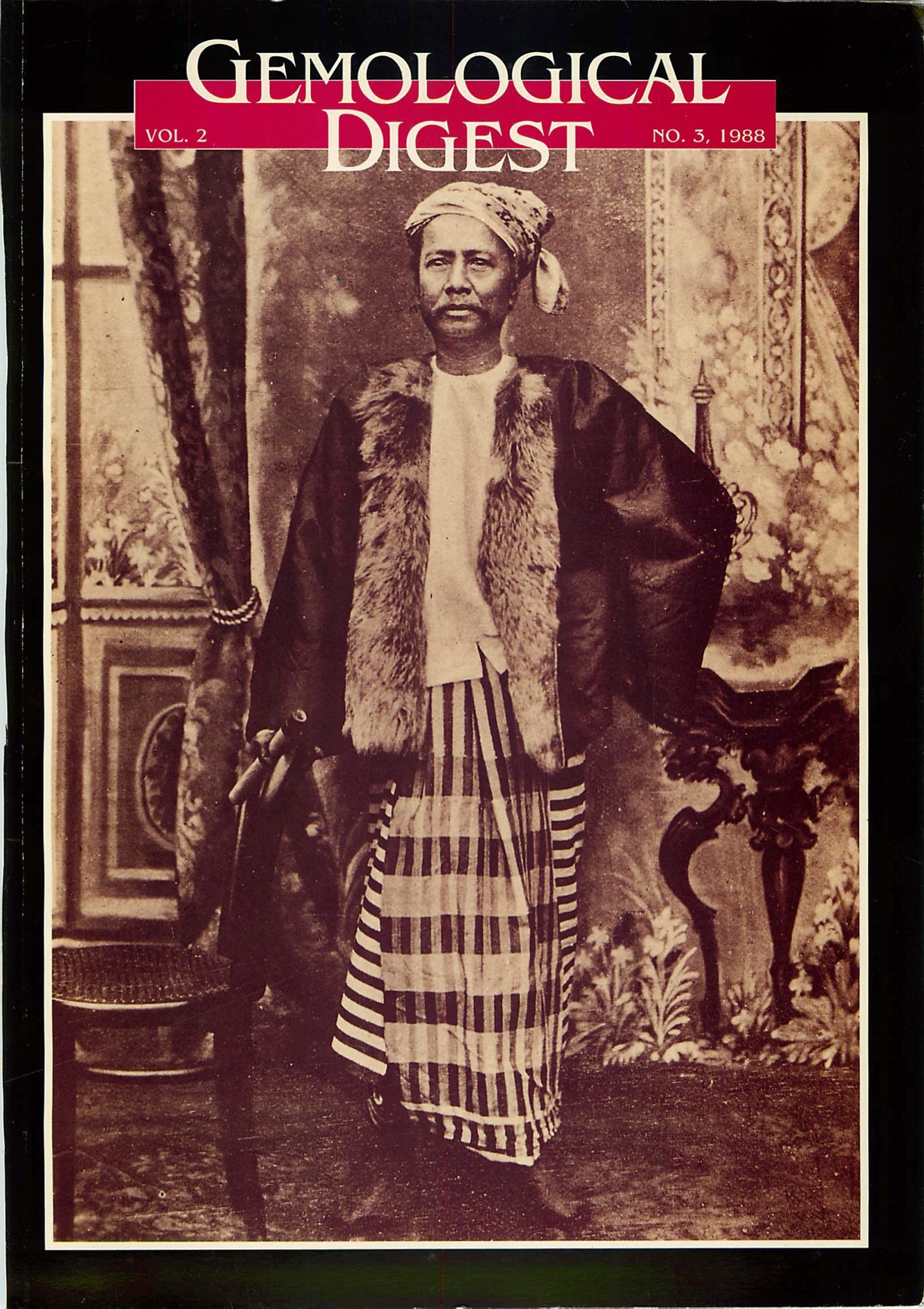
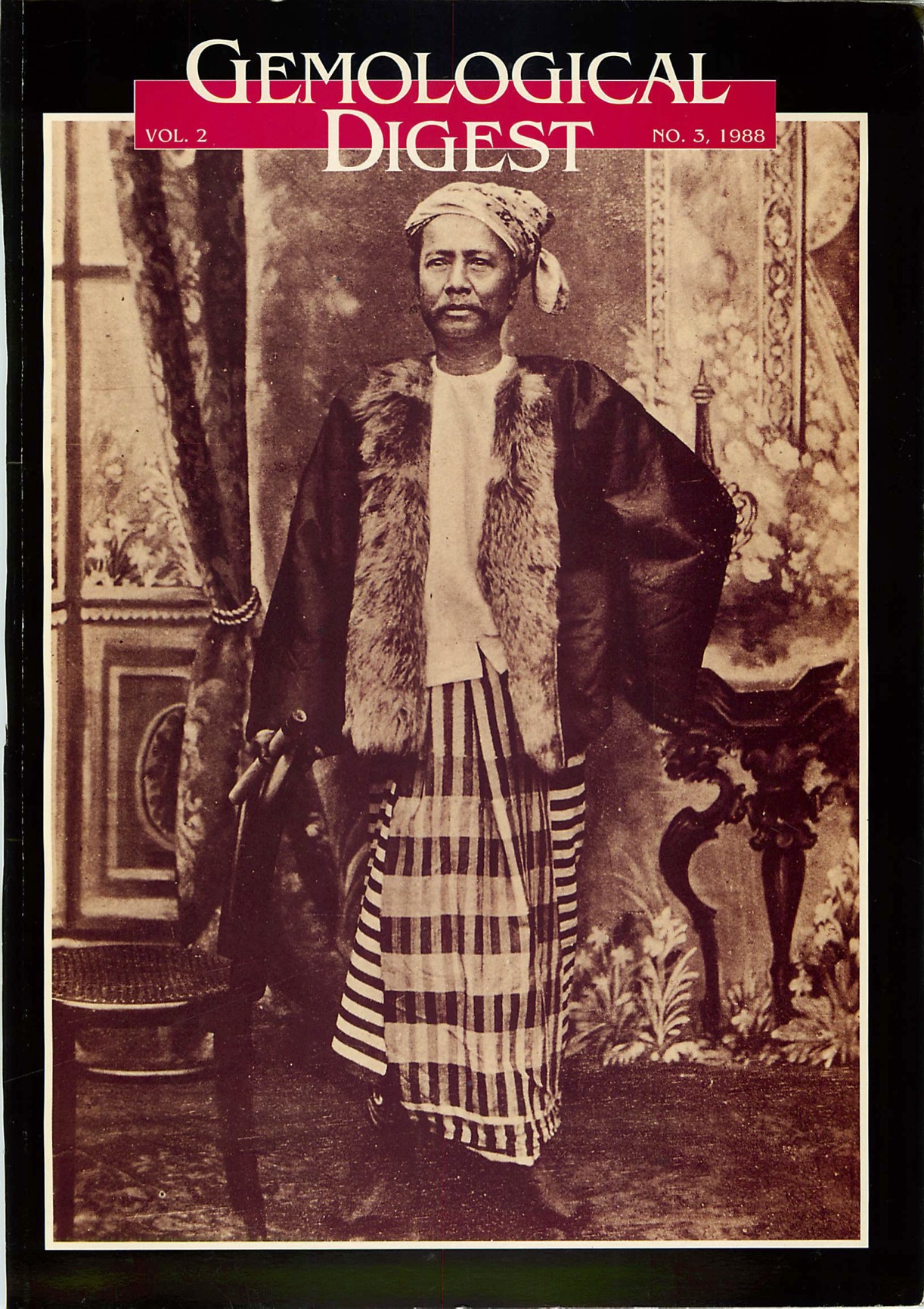
Mogok then and now

Mogok then and now

Hughes, R.W. (1988)

Journal Article · Source: Gemological Digest · Volume: Vol. 2 · Issue: No. 3 · Pages: pp. 40–41

Abstract
As many of our readers are well aware, the area around Mogok in Upper Burma is the world's premier source for rubies. Since 1962, however, it has been closed off to the outside world, merely adding to the mystery of a place already steeped in legend. With the utmost difficulty we have succeeded in obtaining modern pictures of Mogok
Keywords
corundum, Burma.12, gems
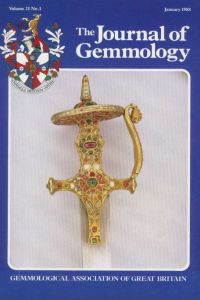
Identifying yellow sapphires—two important techniques

Identifying yellow sapphires—two important techniques

Hughes, R.W. (1988)

Journal Article · Source: Journal of Gemmology · Volume: Vol. 21 · Issue: No. 1, January · Pages: pp. 23–25

Abstract
This article describes two techniques for identifying yellow sapphire. The first uses a blue filter to detect color zoning in natural and synthetic yellow sapphire. Second is how gently heating heat-treated yellow sapphires under a lamp will cause their color to temporarily darken. It can thus be used to separate heated yellow sapphires from natural yellow sapphires.
Keywords
corundum, yellow sapphire, treatments.6, inclusions.5, synthetic corundum.7, gems
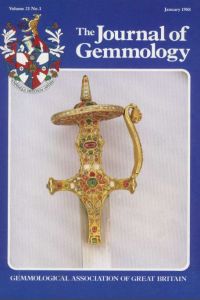
Surface repaired corundum—two unusual variations

Surface repaired corundum—two unusual variations

Hughes, R.W. (1988)

Journal Article · Source: Journal of Gemmology · Volume: Vol. 21 · Issue: No. 1, January · Pages: pp. 8–10

Abstract
Describes an unusual ruby where glass was used to fuse one piece of natural ruby to a much larger piece of synthetic ruby. A second ruby appeared to have glass in fissures throughout. [in hindsight, this was probably exsolution of planes of boehmite or another mineral]
Keywords
corundum, treatments.6, gems
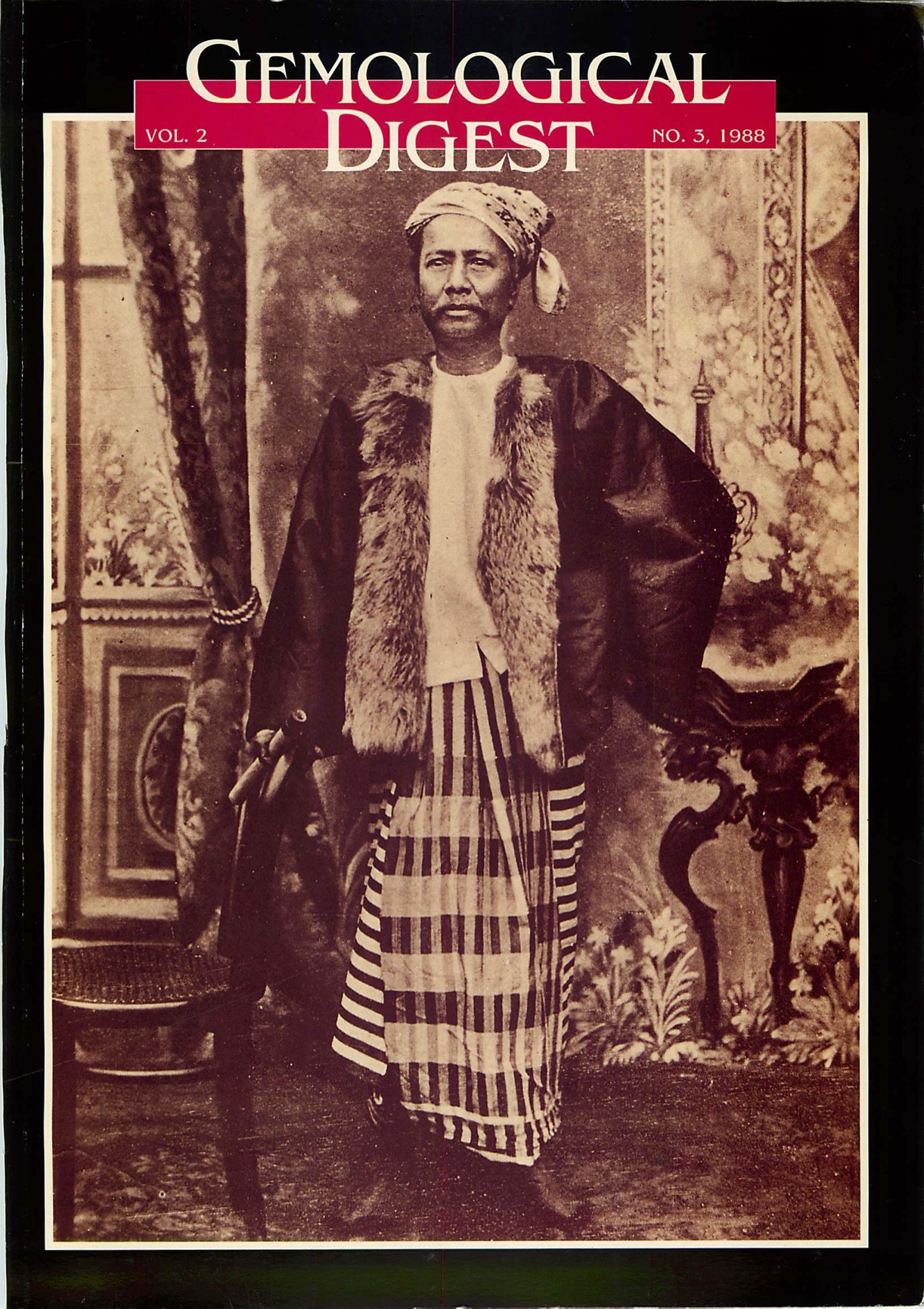
Pleochroism and colored stone grading

Pleochroism and colored stone grading

Hughes, R.W. (1988)

Journal Article · Source: Gemological Digest · Volume: Vol. 2 · Issue: No. 3 · Pages: pp. 16–24

Abstract
The phenomenon of pleochroism in doubly refractive (DR) gemstones is described, as it relates to overall color appearance in the context of faceted gems. With strongly pleochroic gems, pleochroism can be seen in faceted gems, even if the table facet is oriented perpendicular to an optic axis. This is because facets change the direction of light as it moves through the gem.
Keywords
gems, corundum, color.4
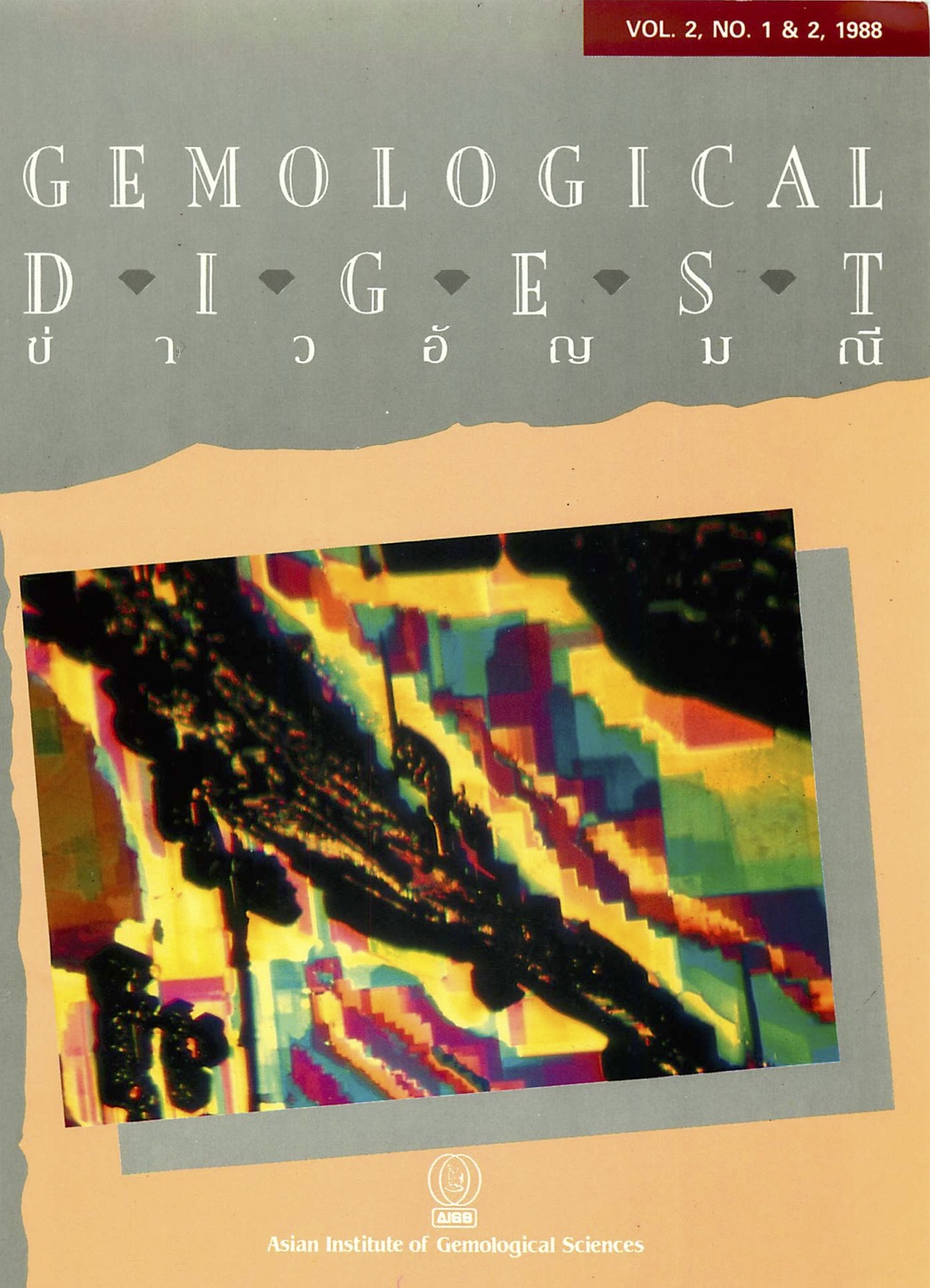
Brilliance, windows and extinction in gemstones

Brilliance, windows and extinction in gemstones

Hughes, R.W. (1988)

Journal Article · Source: Gemological Digest · Volume: Vol. 2 · Issue: Nos. 1 & 2 · Pages: pp. 10–15

Abstract
A discussion of brilliance, windows and extinction as they relate to the face-up appearance of colored gemstones. Diagrams demonstrate that extinction is largely a function of cut.
Keywords
corundum, fashioning.9, gems
The world's largest—bonanza or banana?

The world's largest—bonanza or banana?

Hughes, R.W. (1987)

Journal Article · Source: Gemological Digest · Volume: Vol. 1 · Issue: No. 1 · Pages: p. 4

Abstract
During 1986, newspaper reports told of a most Incredible gem find. Mr. Roy Whetstine of Longview, Texas, went to the 1986 Tucson Gem and Mineral Show hoping to find a few pretty rocks for his two sons. He returned home with what he claimed to be the world's largest rough star. sapphire, bought for $10 from a bowl full of agates, and later appraised at $2.28 million. It was an amazing story and one that warmed the hearts of thousands of readers around the.world -a little man strikes-a bonanza! Slowly, however, clouds began to form and before long they were pouring down rain on Mr. Whetstlne's parade. What occurred was the exposure of one of the most ambitious gem cons of the twentieth century.
Keywords
corundum, star sapphire, quality.9, gems
Ruby or pink sapphire? A lesson from the past

Ruby or pink sapphire? A lesson from the past

Hughes, R.W. (1987)

Journal Article · Source: Gemological Digest · Volume: Vol. 1 · Issue: No. 1 · Pages: p. 3

Abstract
Among the myriad problems facing the colored gemstone industry today is the question of pink sapphire and ruby – where and how do we draw the line between them? Over the past 10–20 years gemologists and gem dealers have struggled with this question, but a solution acceptable to the majority of the trade has yet to be found. With this in mind, we at AIGS would like to send our solution up the proverbial flag pole, hoping that you, the trade, will salute.
Keywords
corundum, ruby, sapphire, nomenclature, color.4, gems
Identifying yellow sapphires—two important techniques

Identifying yellow sapphires—two important techniques

Hughes, R.W. (1987)

Conference Paper · Source: International Gemmological Conference · Publisher: Transactions of the XXI International Gemmological Conference · Pages: pp. 35–36

Abstract
This article describes two techniques for identifying yellow sapphire. The first uses a blue filter to detect color zoning in natural and synthetic yellow sapphire. Second is how gently heating heat-treated yellow sapphires under a lamp will cause their color to temporarily darken. It can thus be used to separate heated yellow sapphires from natural yellow sapphires.
Keywords
corundum, yellow sapphire, sapphire, treatments.6, synthetic gems.7, gems
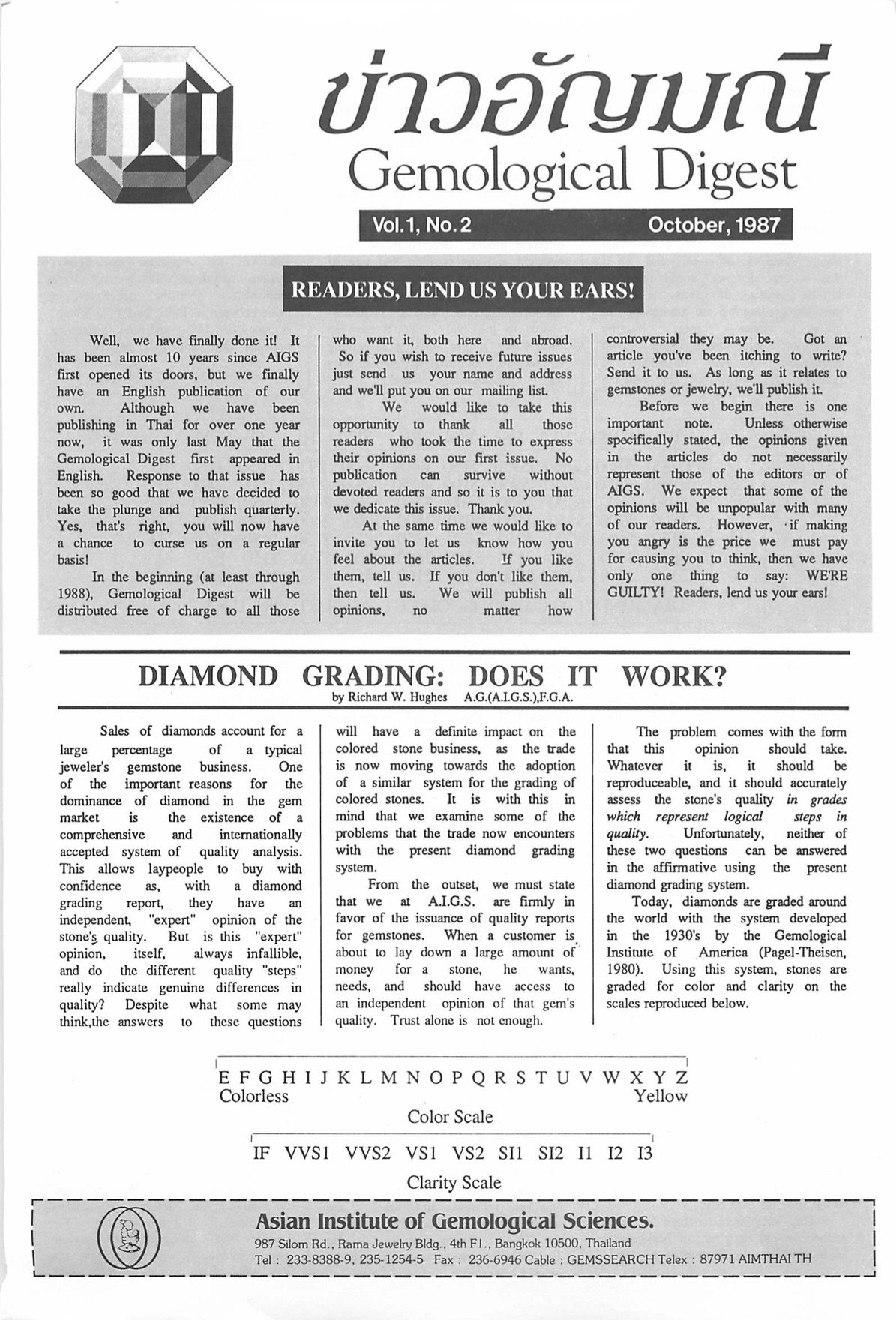
Diamond grading: does it work?

Diamond grading: does it work?

Hughes, R.W. (1987)

Journal Article · Source: Gemological Digest · Volume: Vol. 1 · Issue: No. 2 · Pages: pp. 1–3

Abstract
Sales of diamonds account for a large percentage of a typical jeweler's gemstone business. One of the important reasons for the dominance of diamond in the gem market is the existence of a comprehensive and internationally accepted system of quality analysis. Thls allows laypeople to buy with confidence as, with a diamond grading report, they have an independent, expert" opinion of the stone’s quality. But is this "expert" opinion, itself, always infallible, and do the different quality "steps" really indicate genuine differences in quality? Despite what some may think.the answers to these questions will have a definite impact on the colored stone business, as the trade is now moving towards the adoption of a similar system for the grading of colored stones. It is with this in mind that we examine some of the problems that the trade now encounters with the present diamond grading system."
Keywords
corundum, quality.9, gems
The plastic coating of gemstones

The plastic coating of gemstones

Hughes, R.W. (1987)

Conference Paper · Source: International Gemmological Conference · Publisher: Transactions of the XXI International Gemmological Conference—Brazil 1987 · Pages: pp. 31–33

Abstract
A plastic coated jadeite cabochon and a quartz coated with red plastic to imitate ruby are described.
Keywords
corundum, treatments, jade, jadeite, fei cui, assembled stones.8, ruby imitations, ruby, gems
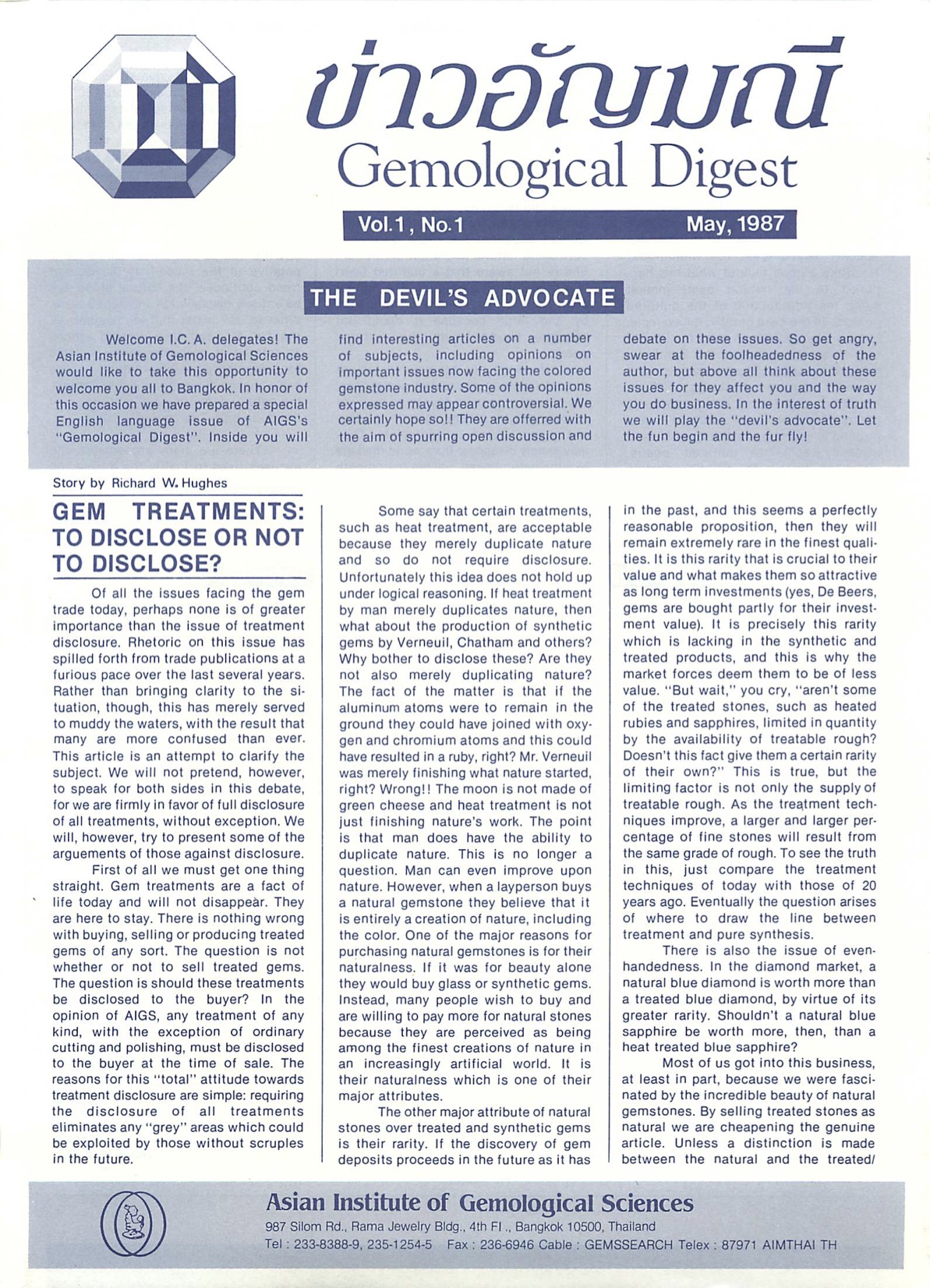
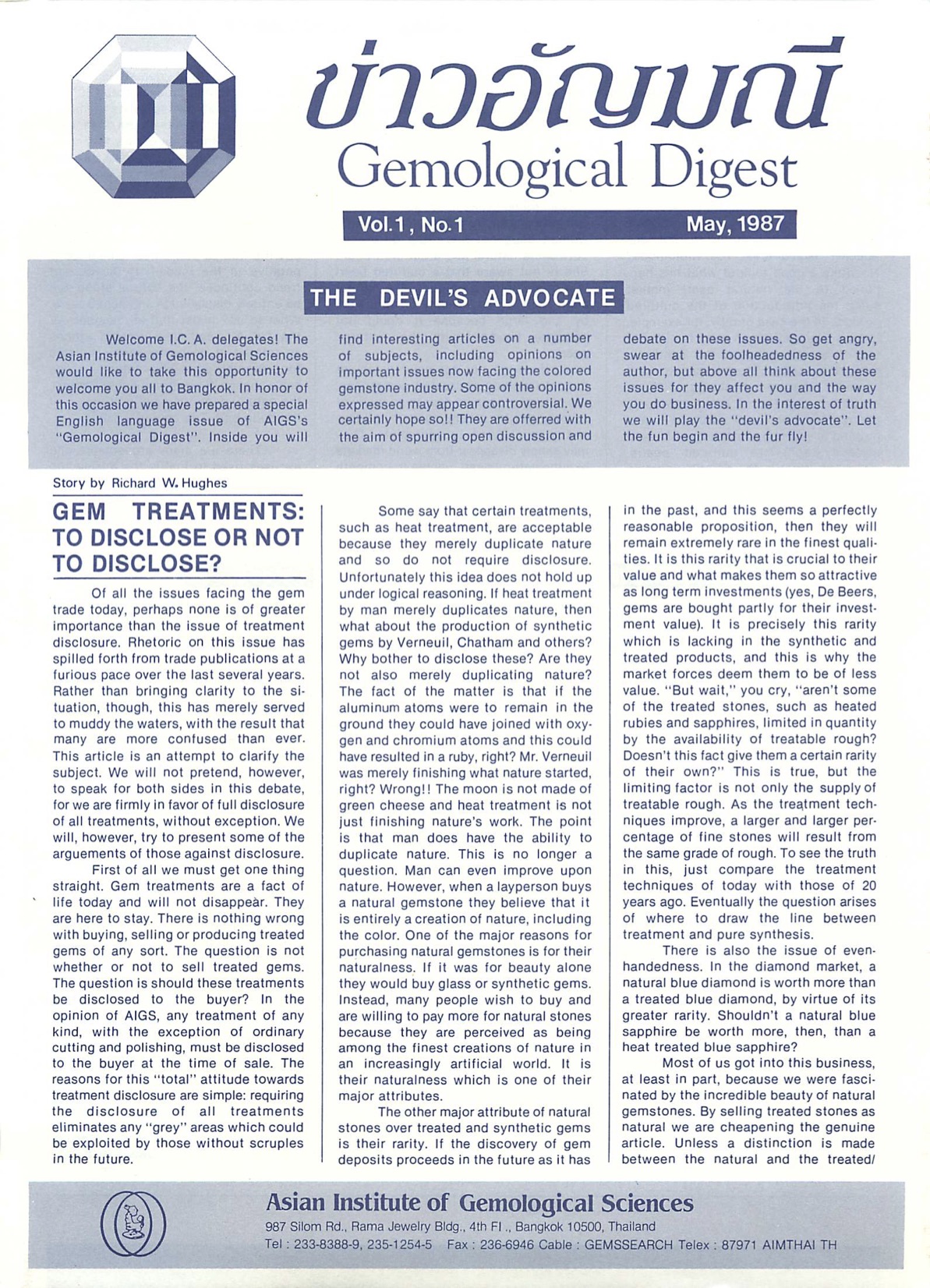
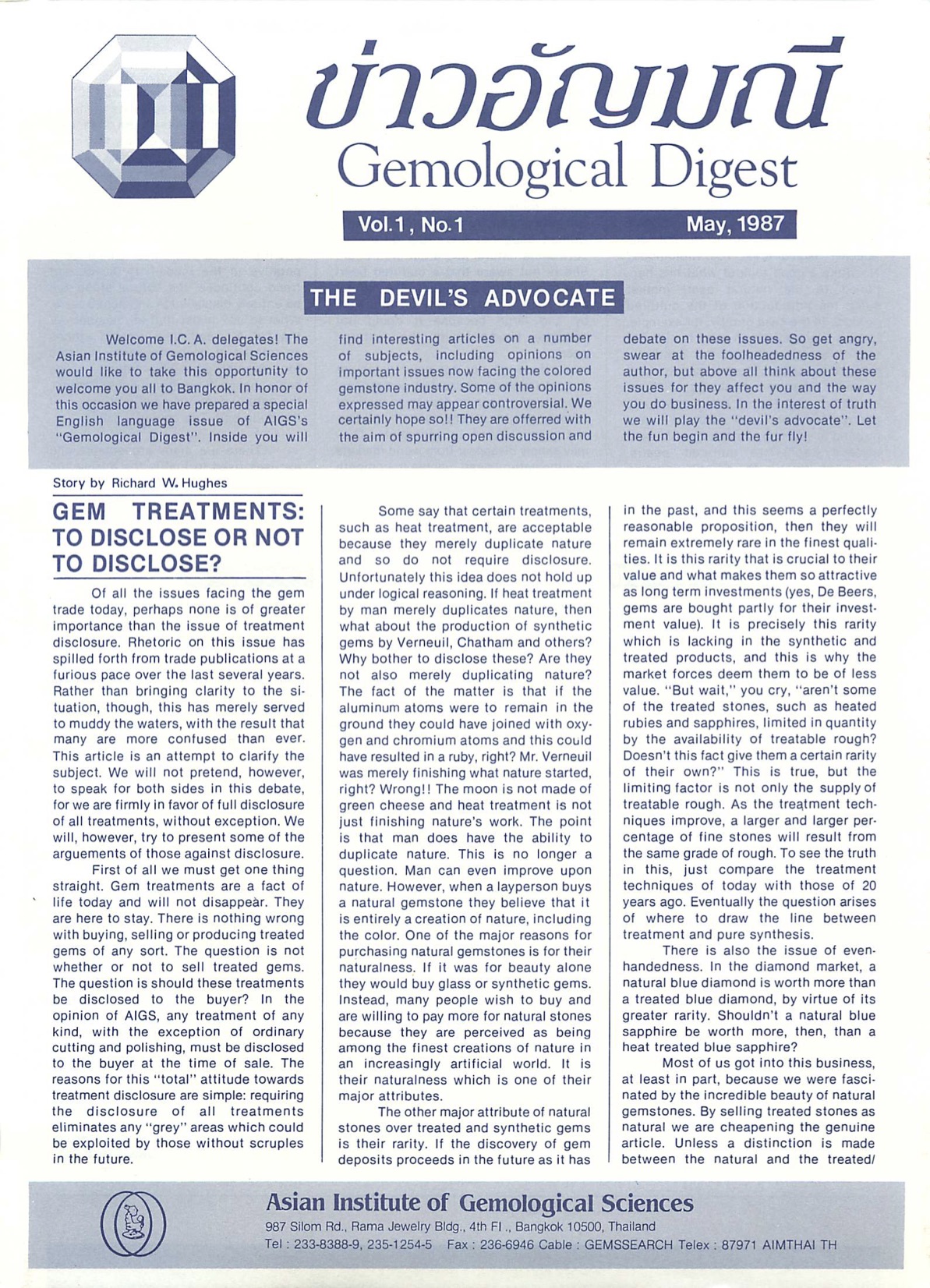
Gem treatments: To disclose or not to disclose

Gem treatments: To disclose or not to disclose

Hughes, R.W. (1987)

Journal Article · Source: Gemological Digest · Volume: Vol. 1 · Issue: No. 1 · Pages: pp. 1–2

Abstract
Of all the issues facing the gem trade today, perhaps none is of greater importance than the issue of treatment disclosure. Rhetoric on this issue has spilled forth from trade publications at a furious pace over the past several years. Rather than bringing clarity to the situation, though, this has merely served to muddy the waters, with the result that many are more confused than ever. This article is an attempt to clarify the subject. We will not pretend, however, to speak for both sides of the debate, for we are firmly in favor of full disclosure of all treatments, without exception. We will, however, try to present some of the arguements of those against disclosure.
Keywords
heat treatment, corundum, gems
Archaeogemmology and ancient literary sources on gems and their origins

Archaeogemmology and ancient literary sources on gems and their origins

Thoresen, L. (2017)

Book Section · Source: Gemstones in the First Millennium AD: Mines, Trade, Workshops and Symbolism · Publisher: Römisch-Germanischen Zentralmuseum (RGZM) · Volume: RGZM Tagungen 30 · Pages: pp. 155–217

Abstract
The gemstones believed to have been known in Classical Antiquity – their mineralogical identities and their geographic sources – were inferred almost exclusively from literary sources until the turn of the 20th century. Typological and thematic classifications of ancient glyptic were first proposed in Adolph Furtwängler’s monumental work, Die antiken Gemmen (1900), and for the first time objective empirical criteria were employed to organise gemstones according to their materials. Furtwängler set a standard that gem scholars would follow and develop further. Gem catalogues came to feature a materials index, comparanda of materials related to engraved subjects, and typologies of gem and jewellery shape, toolwork, and carving style. Analysis of distribution patterns of gem materials revealed cultural preferences for specific gemstones and also artists’ and workshop associations, which improved the overall picture of the gemstones used in different periods of Classical Antiquity. Gems and jewellery recovered from archaeological contexts enabled firmer dating and cultural attribution of glyptic otherwise based on iconographic or stylistic features. This is a superb article. Highly recommended.
Keywords
corundum, History.1, gems
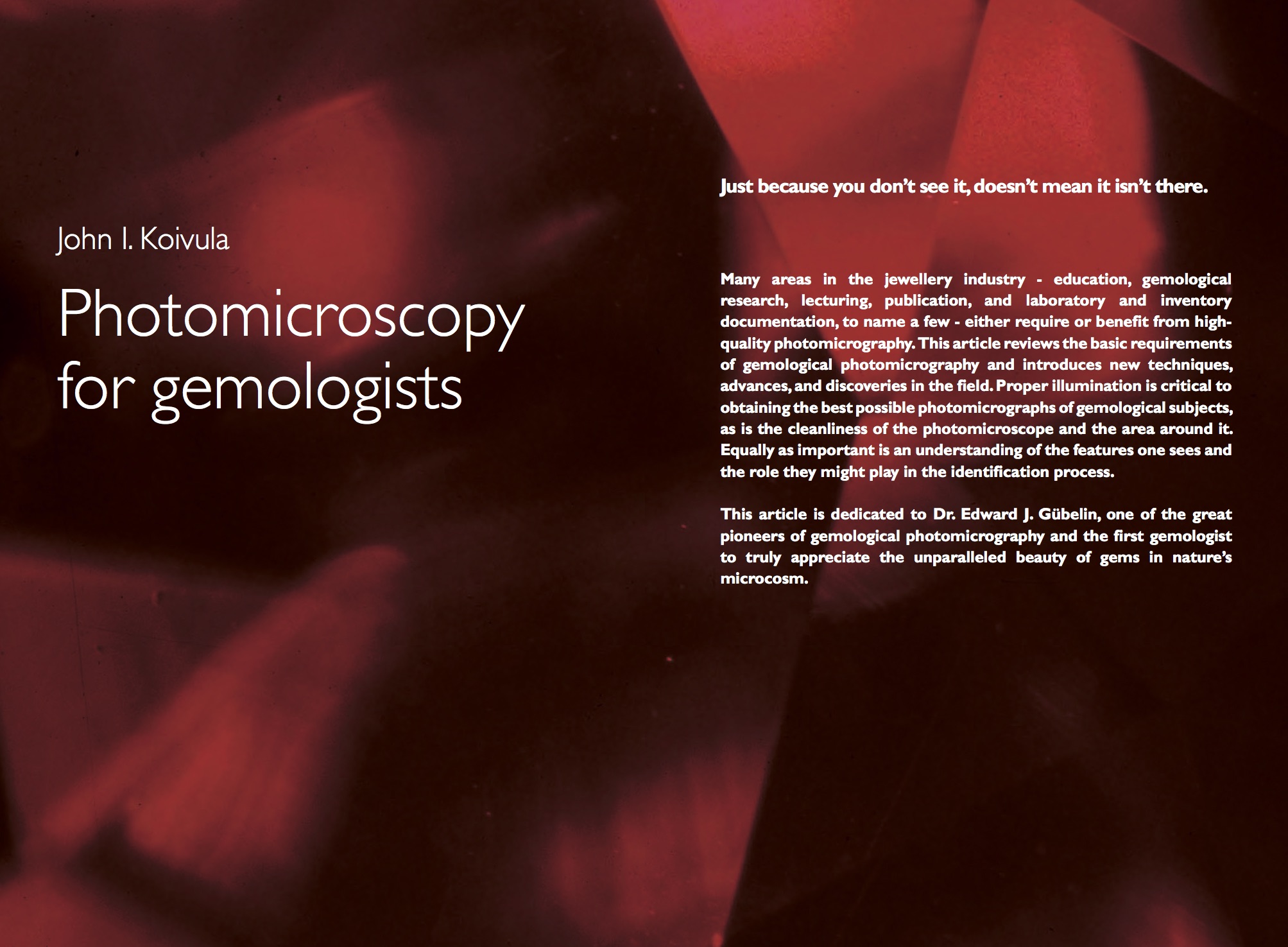
Photographing gems

Photographing gems

Koivula, J.I. (2007)

Journal Article · Source: InFocus · Issue: No. 7, September · Pages: pp. 24–59

Abstract
Without photomicrography, gemology as we know it would be virtually nonexistent. The photomicrographer explores the surfaces and interiors of gems with a microscope, and prepares images that record and convey information that is normally hidden from view. Today, nearly all professional gemological researchers take and publish their own photomicrographs. When researchers report the identifying features of new synthetics, treatments, and natural gems from new geographic localities, they include photomicrographs that are instrumental to the jeweller/gemologist in identifying these new materials. One needs only to look through issues of Gems & Gemology, or any of the various international gemological journals, to see how dependent gemology has become on these illustrations of the microscopic features of gems. Via the printed page, these photomicrographs instantly update the reader.
Keywords
corundum, inclusions.5, gems
The history and importance of heat treatment of Australian sapphire

The history and importance of heat treatment of Australian sapphire

Coldham, T.S. (2003)

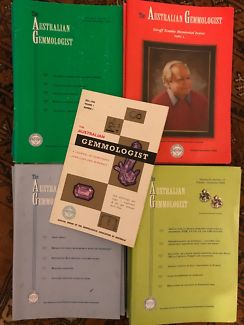
Journal Article · Source: Australian Gemmologist · Volume: Vol. 21 · Issue: No. 11, July–September · Pages: pp. 450–462

Abstract
The late Geoff Tombs was always interested in heat treatment, publishing several papers on the subject (Tombs 1978, 1979, 1991). However the paper that sticks in my mind the most was written in 1974 and titled ‘Synthetic-like fluorescence in a natural sapphire’ Tombs 1974. At the time of writing I suspect Geoff While describing a Fine blue Ceylon sapphire submitted for testing………., Geoff was surprised by the results he obtained when examining the stone under UV light, summing up his report: Microscopic examination proved the stone to be natural. This stone is particularly interesting as it is the first naturai sapphire I have examined in which blue sections showed fluorescence characteristics exactly the same as those exhibited by the typical Verneuil synthetic blue corundum. The fluorescing areas (under S/W) were curious in that they did not follow the blue colour zoning. (Tombs 1974). In hindsight I believe Geoff was examining a heat-treated Ceylon blue sapphire a few years before such a treatment became generally known amongst the gemmological community. Most importantly, he recognised that here was something different enough to be worth reporting in his favourite magazine, The Australian Gemmologist. I dedicate this paper to him. I would like you to join me in tracing the lives and interests of several people associated with Australian sapphire. They come from widely differing backgrounds and cultures. Some are university educated, while some never went to school. Some are even still alive today. It is through their fascinating testimonies that I have been able to put this story together.
Keywords
gems, corundum, treatments.6, Australia.12
Gemology: An Annotated Bibliography

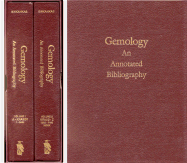
Gemology: An Annotated Bibliography

Sinkankas, J. (1993)

Book · Publisher: The Scarecrow Press, Inc. · Pages: 1179 pp.

Abstract
It is difficult to overstate the importance of this two-volume work, which was the product not just of John’s writing career, but also of his home business, Peri Lithon, which he operated for decades with his wife, Marge. No authors ever worked harder on a single work. Over 6,000 entries, virtually all of which are annotated. There is a limited edition in fake leather with a siipcase. My pick for the greatest gem book of all time.
Keywords
corundum, ruby, sapphire, history.1, chemistry.2, properties.3, geology.11, inclusions.5, sources.12, synthetic corundum.7, treatments.6, assembled stones.8, color.4, fashioning.9, quality.10, introduction.0, bibliography, books on books, jade, jadeite, fei cui, nephrite, gems
Jade: A Taxonomy for Fei Cui (翡翠), Jade, Jadeite, Jadeitite, Nephrite, and Yu (玉)

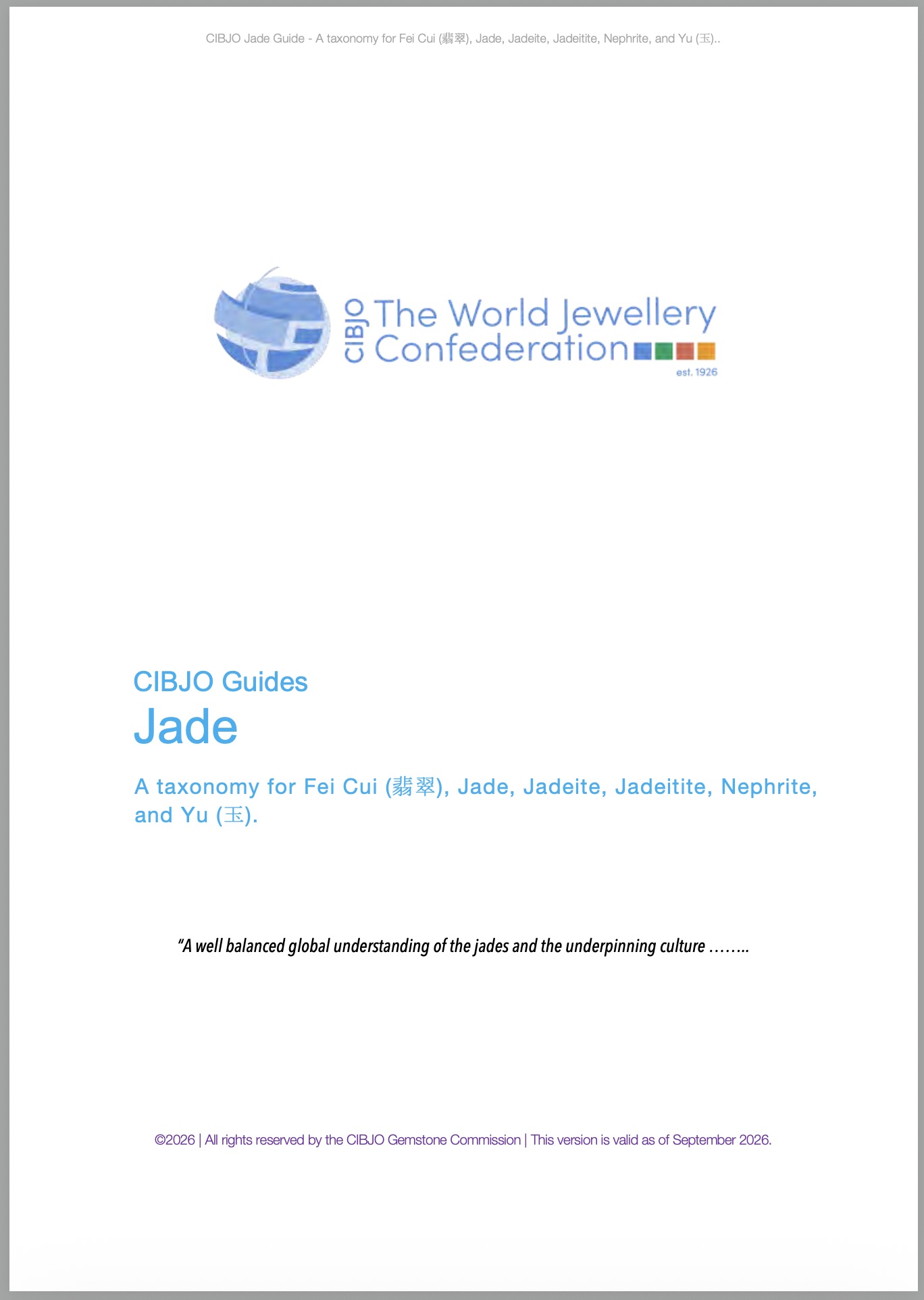
Jade: A Taxonomy for Fei Cui (翡翠), Jade, Jadeite, Jadeitite, Nephrite, and Yu (玉)

CIBJO (2026)

Book · Source: CIBJO Guides · Publisher: CIBJO · Pages: 104 pp.

Abstract
At its core, any nomenclature system is a means of classification, a way to create logical categories that can be used to educate others. Like a garden, nomenclature systems require regular maintenance to remove overgrowth and “deadwood”. Nomenclature evolves naturally over time as it reflects the current state of knowledge. As understanding deepens, we often discover that items once thought to belong to one category more properly fit into another. At that point, we face a choice: move the item to the category that best represents it, or allow it to remain where it is as an exception. Every nomenclature system has these exceptions. This CIBJO guide examines one such case with jade, where mineral species names may have been improperly applied to gem materials that are actually rocks. This is not a purely academic exercise as financial costs may apply as a real consequence in a world where third-party verification of gem materials is a requirement, i.e., gem testing costs that involve the non-destructive analyses of rocks can be prohibitive, particularly at the low-value end. CIBJO takes no official position on this question. We recognize that many parties, particularly in China and across the East, consider the replacement of the terms/names jadeite, omphacite, and kosmochlor with the collective term/name fei cuì to be consistent with modern gemmological practice. Accordingly, they see no deception in marketing a gem whose constituent minerals are intimately intergrown under this unified term, a tradition that dates back to the early 1700s. At the same time, CIBJO acknowledges that traders, gemmologists, and consumers may prefer to divide pyroxene jade into its individual mineral components. CIBJO remains neutral on these differing approaches and accepts that variations in practice may exist between regions and that neither approach should be considered an unfair trade practice. There are sound reasons why nomenclature cannot, and should not, be expected to be identical everywhere. Each culture uses language to describe the world in its own way. The issue of ‘yù’ versus ‘jade’ illustrates this clearly: the two words carry distinct meanings, and neither has an exact equivalent in the other language. The proliferation of different languages and dialects reflects the diversity of human cultures. Nomenclature, therefore, inevitably carries a cultural dimension and must accommodate meaningful regional and linguistic differences where they arise. In the pages that follow, we aim to present this complex subject logically and consistently, bearing these principles in mind. The discussion represents the outcome of extensive dialogue among representatives from around the world. Jade is a human treasure. It is our hope that this guide will foster greater understanding of this remarkable natural canvas, beloved by jeweller and carver alike.
Keywords
gems, jade, pyroxene jade, fei cui, Burma, China, Hetian yu, Chinese jade, nephrite, yu, Guatemala, New Zealand, Japan, Russia, Kazakhstan, Canada, USA, Burma, Myanmar
Records from a luxurious past: Gem inventory of a seventeenth-century Armenian merchant

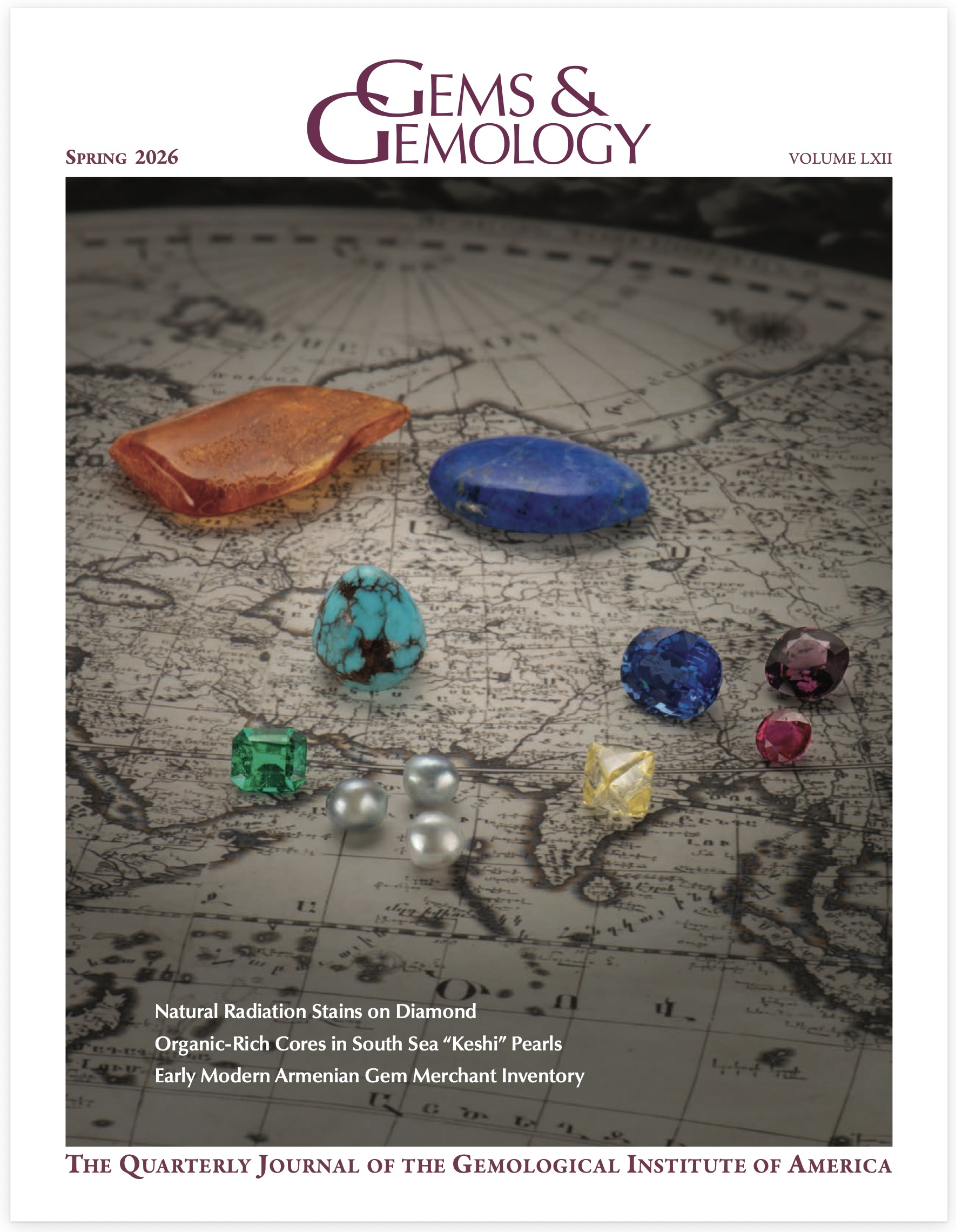
Records from a luxurious past: Gem inventory of a seventeenth-century Armenian merchant

Tajiryan, S. (2026)

Journal Article · Source: Gems & Gemology · Volume: Vol. 62 · Issue: No. 1, Spring · Pages: pp. 38–66

Abstract
A rare 1688 probate inventory documents the extensive gem collection of Gregorio di Girach-Mirman (1612–1688), a prominent Armenian merchant active in Venice and Livorno, Italy. Originally written in Armenian and later translated into Italian, this archival record lists more than 100,000 gemstones, including diamonds, sapphires, emeralds, and pearls, as well as more than 1,700 kilograms of rough amber, garnet, lapis lazuli, and turquoise. Housed in the State Archives of Venice, the inventory offers a uniquely detailed window into the early modern luxury trade and highlights the global commercial reach of Armenian merchant families like the Girach-Mirmans. Drawing on this previously unstudied source, along with a broader set of archival documents from across Europe and Armenia, the present article reconstructs the world of seventeenth-century gem dealing and collecting. It argues that Armenian merchants were central figures in the global trade of luxury goods, operating alongside and sometimes in competition with better-known European contemporaries. The provenance and diversity of Gregorio’s gem holdings, likely sourced from as far as modern-day Colombia, Sri Lanka, Iran, and Myanmar, attest to the geographic reach of Armenian trading networks and the sophistication of their market knowledge. By placing this inventory in its global and material context, the article contributes to ongoing discussions around early modern economic history, material culture, and global commodity flows across Eurasia and the New World. It demonstrates that gem inventories, often overlooked as solely bureaucratic and estate documents, can illuminate the complexity of merchant strategies, the transcontinental mobility of luxury goods, and the dynamics of status and prestige in the early modern period. Finally, one of the central aims of this article is to illuminate the inner workings of gem dealing in this period, including practices of sourcing and collecting, through a rare body of obscure commercial correspondence. These materials offer an exceptional view into a dimension of the trade that remains largely inaccessible and nearly absent from existing historiography.
Keywords
gems, gem trade in Asia, gem business, trade between Europe and Asia, corundum, history.1, Early Modern trade, Armenia, Armenians, Iran, Myanmar, Sri Lanka, India, Turkey
Evidence for an ‘uncommon’ geographic origin (Pakistan) of emeralds in two rings of historical significance

Evidence for an ‘uncommon’ geographic origin (Pakistan) of emeralds in two rings of historical significance

Karampelas, S., Hennebois, U., Delaunay, A., Herreweghe, A. and Cassius-Duranton, M.-L. (2026)

Journal Article · Source: Journal of Gemmology · Volume: Vol. 40 · Issue: No. 2 · Pages: pp. 188–194

Abstract
An emerald from the late Hellenistic (or early Roman) period and another emerald from the end of the Middle Ages, both set in small rings, were studied using non-destructive methods. Their microscopic, spectroscopic and chemical characteristics are consistent with those of emeralds from the Swat Valley, Pakistan. This suggests that Swat Valley emeralds may have been more common in ancient jewellery than previously thought. This study highlights the importance of combining gemmological analytical techniques with archaeology to draw more reliable conclusions about the origins of historical gemstones.
Keywords
gems, beryl, emerald, Afghanistan, anthropology, Pakistan, Central Asia, Swat
HFSE-enriched metamorphic blue sapphires: FTIR and trace-element study, and implications for heat-treatment detection

HFSE-enriched metamorphic blue sapphires: FTIR and trace-element study, and implications for heat-treatment detection

Hardman, M.F., Shigley, J.E., Sun, Z. and Palke, A.C. (2026)

Journal Article · Source: Journal of Gemmology · Volume: Vol. 40 · Issue: No. 2 · Pages: pp. 157–169

Abstract
This study examines sapphires naturally enriched in high-field-strength elements (HFSE) from metamorphic origins in Sri Lanka and Madagascar. These sapphires display distinctive chemical inhomogeneities and microscopic growth features, as well as variable FTIR spectra, often including a broad absorption band near 3300 cm–1. Some of the studied samples also show FTIR spectral characteristics and short-wave UV luminescence typically associated with heat-treated stones, although all were unheated. Our findings demonstrate that commonly used indicators—such as specific FTIR band patterns (mainly the 3309 cm–1 triplet) and chalky bluish white short-wave UV fluorescence—are not always reliable for identifying heat treatment. Accurate distinction between heated and unheated sapphires requires detailed microscopic examination combined with advanced trace-element analysis and spectroscopic techniques, including Raman micro-spectroscopy of inclusions such as zircon, goethite and diaspore.
Keywords
gems, corundum, treatments.4, Sri Lanka.12, Madagascar.12, heat treatment, FTIR

Building a Gemological Library

Gemological books range from general identification manuals and textbooks to specialized works on individual gems, mineralogy, jewelry, treatments, synthesis, history and gem-producing regions.

For a curated selection of particularly useful books, read The Gemologist's Core Library — Classic Books on Gemology, Jewelry and Mineralogy.

About Four Treasures

Four Treasures is Lotus Gemology's freely accessible gemological reference database. Use the full database to search by author, title or keyword and explore literature on gemology, mineralogy, jewelry and related fields. Where available, hyperlinks on titles may lead directly to the full publication.

Search the Complete Four Treasures Database