Explore books on gems, gemology, jewelry and mineralogy in Four Treasures, the Lotus Gemology reference database. This bibliography brings together matching book records from the collection, with publication details, abstracts and cover images where available.
Gemology Book References
The list below matches books concerning gemology and related subjects in the database's searchable fields. Some works cover several branches of gems, jewelry or mineralogy.
gems, ancient gemology, early gemology, ancient mineralogy, early trade, ancient lapidary, glyptic, Greek, Roman, cameos, intaglios
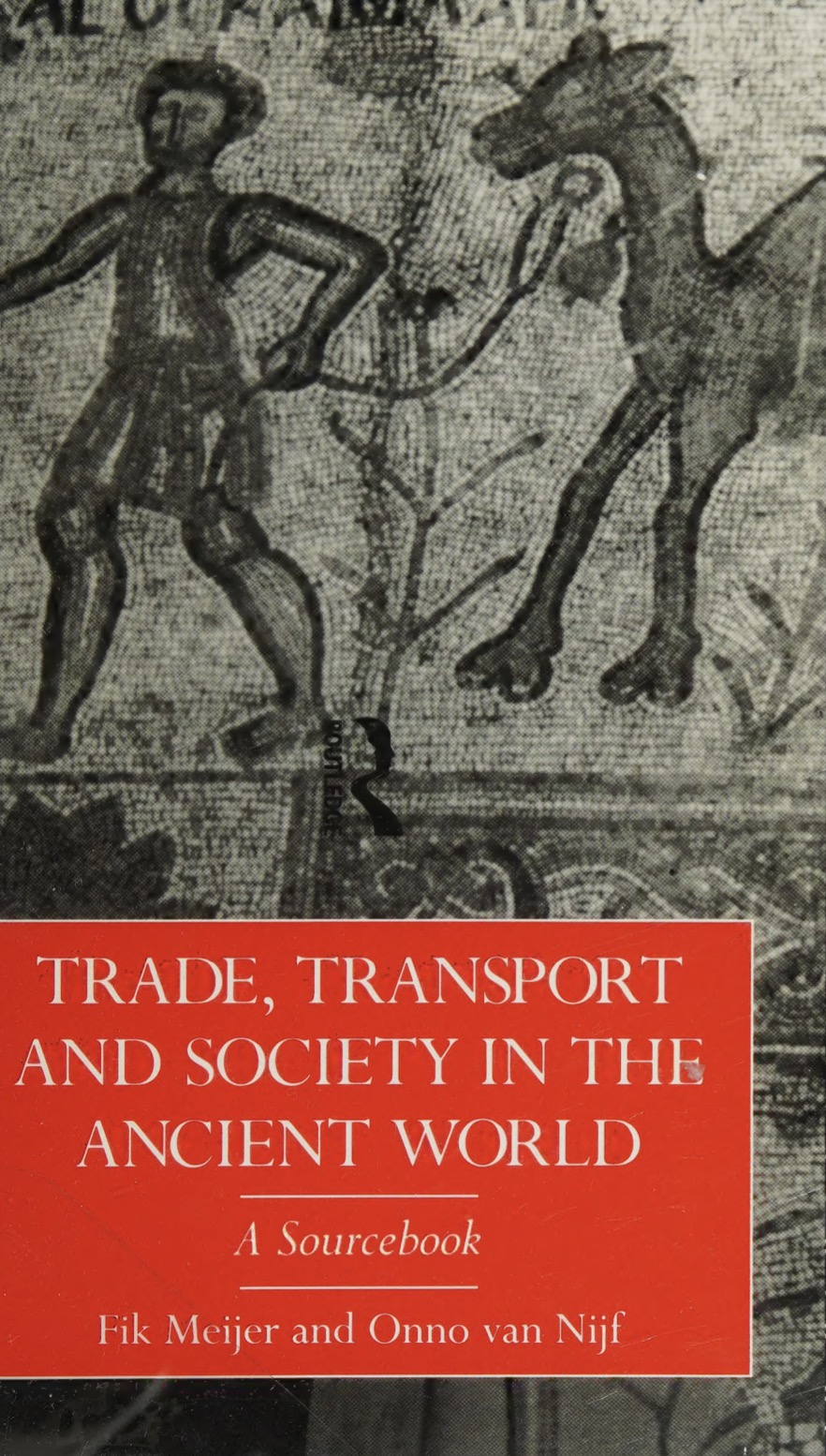
This book, first published in 1992, presents an introduction to the nature of trade and transport in antiquity through a selection of translated literary, papyrological, epigraphical and legal sources. These texts illustrate a range of aspects of ancient trade and transport: from the role of the authorities, to the status of traders, to the capacity and speed of ancient ships. It is clear that the actual means of transportation were crucial; the book illustrates the limitations of ancient transport technology and the consequences for the development of commerce. It focuses first on different aspects of transport over land and then on transport by river and concludes with a discussion of several aspects of ancient seafaring. This book is ideal for students of ancient history.
gems, ancient gems, glyptic, archaeology, archaeogemology, ancient history, beads, species, treatment nomenclature, Near Eastern, Western Asiatic, cylinder seals
A system of nomenclature for the consistent description of archaeological artefacts made from quartz has been developed, based upon published mineralogical texts. The system has been found to be useful in the description of cylinder seals from Western Asia and the results obtained suggest that the provision of consistent identifications may be valuable in tracing the evolution of material usage over time.
Emeralds from Madagascar
Journal Article
Schwarz, D. and Henn, U. (1992) Emeralds from Madagascar.Journal of Gemmology, Vol. 23, No. 3, pp. 140–149.
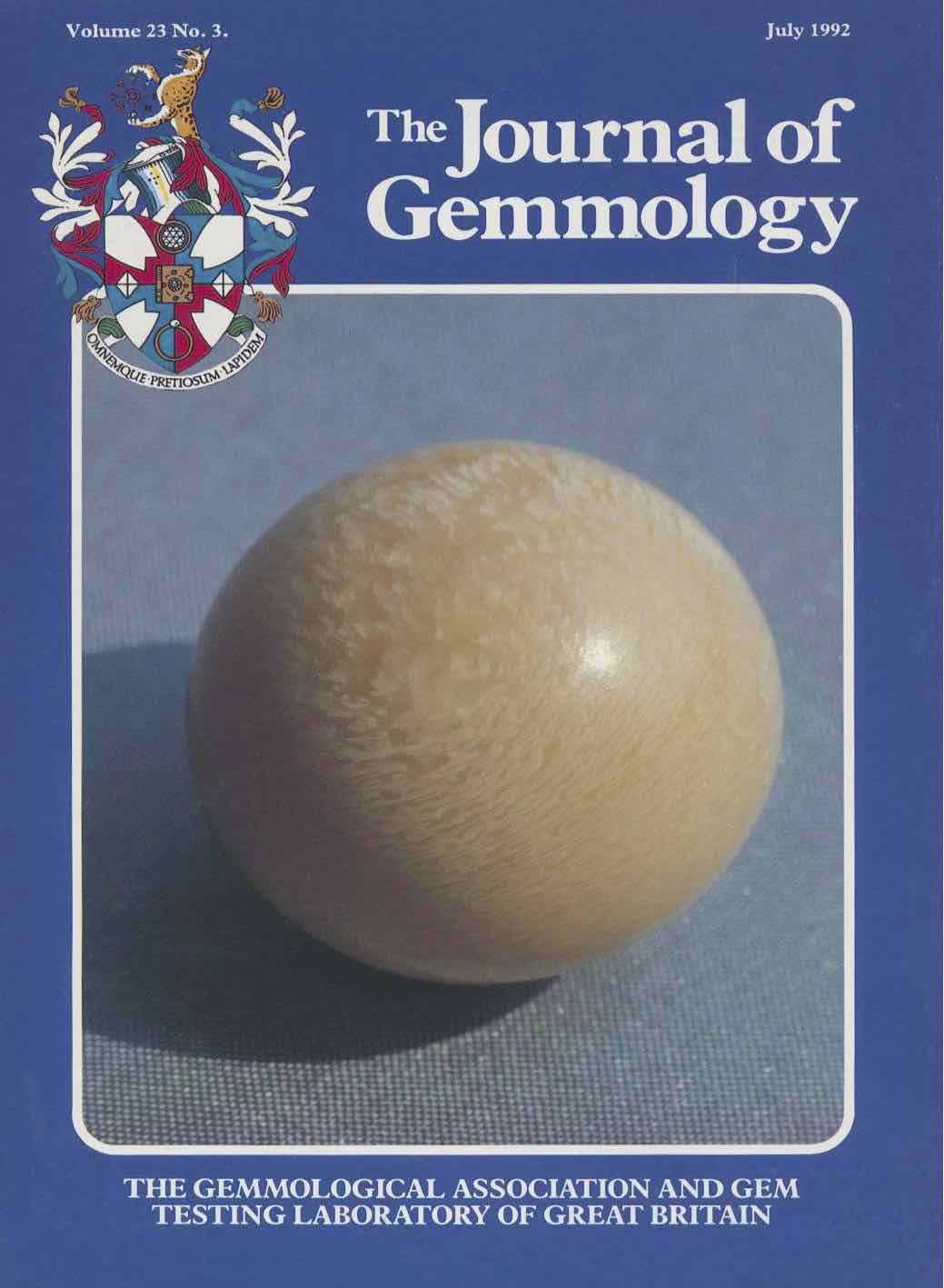
Emeralds from the Morafeno mining region near Mananjary, Madagascar, are characterized through measurements of physical properties, electron-microprobe analyses, polarized absorption spectroscopy, and microscopic examination of inclusions. The study places these commercially exploited mica-schist-hosted deposits within the history of Malagasy beryl discoveries and distinguishes true emerald from earlier reports of iron-coloured green beryl. Morafeno produces partly transparent emerald crystals several centimetres in size embedded in dark mica. Measured extraordinary refractive indices range from 1.580 to 1.582 and ordinary indices from 1.588 to 1.591, with birefringence of 0.008–0.009 and densities of 2.68–2.71 g/cm³. These properties broadly agree with earlier Malagasy data and overlap the lower range reported for Zambian emeralds, whose colour is also comparable. Analyses of six emeralds reveal medium to high magnesium and sodium concentrations, with 1.71–3.00 wt% MgO and 1.28–2.16 wt% Na₂O, together with 0.08–0.34 wt% Cr₂O₃ and 0.91–1.30 wt% total iron expressed as FeO. Element-correlation diagrams compare the samples with emeralds from other African deposits, Brazil, Australia, and Norway. Decreasing aluminium with increasing magnesium, accompanied by increasing sodium, is explained by magnesium substitution for aluminium and charge compensation by sodium occupying channels in the beryl structure. Visible and near-infrared spectra combine chromium-related emerald absorption with iron-related components characteristic of aquamarine. Principal iron features occur near 835 nm for divalent iron and 371 nm for trivalent iron. Chromium absorption is modified by overlapping iron bands, and observed pleochroism ranges from yellowish green in the ordinary direction to greenish blue or blue in the extraordinary direction. Longer-wavelength near-infrared absorptions are assigned to water molecules within structural channels. Characteristic inclusions comprise brown mica and unevenly distributed greenish-brown tremolite–actinolite rods and needles, commonly with a bamboo-like appearance. Colourless prismatic inclusions aligned with the c-axis and associated fluid inclusions resemble features of Brazilian emeralds from Belmont and Capoeirana, although the Malagasy material shows less fluid-inclusion diversity. Liquid–gas inclusions predominate, with three-phase and multiphase examples also present. Additional features include rounded transparent crystals, opaque grains and plates, healed or partly healed fractures, localized inclusion concentrations, and nearly colourless cores surrounded by green rims.
Lamellar inclusions in spinels from Morogoro area, Tanzania
Journal Article
Schmetzer, K. and Berger, A. (1992) Lamellar inclusions in spinels from Morogoro area, Tanzania.Journal of Gemmology, Vol. 23, No. 2, April, pp. 93–94.
Lamellar inclusions in gem spinels reportedly originating from the Morogoro area of Tanzania are identified as an iron-free, titanium-rich member of the högbomite series. The investigation concerns rough and faceted material obtained through several independent trade sources following the first receipt of samples in June 1987. The crystals include red, pink, orange, reddish purple, purplish blue and blue octahedra reaching approximately 1 cm. Most suppliers independently reported Morogoro as the source, and the occurrence of similar inclusions across the parcels supported a common locality; an earlier attribution to the Umba Valley was therefore considered probably incorrect. Conventional physical properties, trace-element compositions and absorption spectra did not distinguish these stones significantly from natural spinels from Sri Lanka and Myanmar. Their colour-related absorption was attributed to chromium, vanadium, iron in different valence states and cobalt, with cobalt detected by X-ray fluorescence despite concentrations below the electron microprobe detection limit. In contrast, approximately 70% of the examined Tanzanian samples contained characteristic lamellar inclusions. These occur in four orientations parallel to the octahedral {111} faces of the spinel host. Viewed along a ⟨110⟩ direction, two sets intersect at angles of 109.47° and 70.53°. Immersion microscopy with crossed polarizers established that the lamellae are doubly refractive. Their extreme thinness prevented successful identification by electron microprobe, but transmission electron microscopy of ion-beam-thinned petrographic sections resolved their structure and composition. Individual lamellae measured 0.01–0.1 µm thick. Electron diffraction indicated trigonal, rhombohedral symmetry, with unit-cell dimensions of approximately a = 5.7 Å and c = 55.8 Å. Quantitative energy-dispersive X-ray analyses using a 15 nm electron probe identified magnesium–aluminium–titanium oxides, supporting their assignment to iron-free, titanium-rich högbomite. The structural relationship between högbomite and spinel is discussed in terms of titanium substituting for magnesium, with related structures also occurring in taaffeite and musgravite. The authors propose these oriented, birefringent inclusions as a practical indication of natural Tanzanian spinel, potentially useful in distinguishing such material as flux-grown synthetic spinels become increasingly available.
Gem News: Sri Lanka; Update on gem production
Journal Article
Koivula, J.I., Kammerling, R.C. and Fritsch, E. (1992) Gem News: Sri Lanka; Update on gem production.Gems & Gemology, Vol. 28, No. 4, Winter, pp. 273–274.
Gem News: Blue spinel from Vietnam as sapphire imitator
Journal Article
Koivula, J.I., Kammerling, R.C. and Fritsch, E. (1992) Gem News: Blue spinel from Vietnam as sapphire imitator.Gems & Gemology, Vol. 28, No. 2, Summer, p. 138.
gems, spinel, corundum, sapphire imitation, Vietnam, blue spinel
Gem News: Diffusion-treated sapphire cabochons sold as natural
Journal Article
Koivula, J.I., Kammerling, R.C. and Fritsch, E. (1992) Gem News: Diffusion-treated sapphire cabochons sold as natural.Gems & Gemology, Vol. 28, No. 3, Fall, pp. 204–205.
Oxidation treatment of the sapphires from Shandong province, China
Journal Article
Chuanfu, W., Yaoshan, Y. and Guoxun, L. (1992) Oxidation treatment of the sapphires from Shandong province, China.Journal of Gemmology, Vol. 23, No. 4, October, pp. 195–197.
Wang Chuanfu, Yang Yaoshan, and Li Guoxun compare conventional heating with an electrolytic oxidation treatment intended to improve the appearance of dark sapphire from Shandong Province, China. Much of the available corundum is described as unsuitable for gemstones because of its dark colour and pronounced pleochroism, appearing bluish violet perpendicular to the crystallographic c-axis and green or greenish yellow parallel to it. High-temperature heating can improve apparent clarity but commonly produces commercially undesirable bluish-grey or grey stones. The authors investigate whether stronger oxidation at a substantially lower temperature can lighten the material while retaining a desirable blue hue. Their alternative treatment uses a molten fluoride electrolyte containing cryolite, aluminium fluoride, calcium fluoride, titanium dioxide, and alumina near its saturation concentration. Sapphire specimens are attached to a platinum anode and immersed in the bath at 940 °C, with a carbon crucible serving as the cathode. Electrolysis is conducted at 3.0 V for 30–45 minutes. For comparison, other specimens are heated in carbon crucibles in air at 1,700 °C for ten hours. Treated samples are prepared with parallel polished faces and their absorption spectra measured perpendicular to the c-axis. Most electrolytically treated specimens change from dark to light blue and show improved clarity without the grey component observed after conventional heating. However, slight dissolution in the molten salts causes an approximately 8% weight loss. High-temperature treatment produces only modest clarity improvement and generally bluish-grey or grey colour. The proposed explanation centres on oxidation of ferrous to ferric iron, together with differences in titanium retention. The authors associate spectral changes near 450 nm and beyond 570 nm with increased ferric iron and interpret them as evidence of oxidation. In conventionally heated specimens, diminished absorption near 550 nm and titanium detected in the crucible are taken to indicate some titanium loss, which they link to greying. At 940 °C, titanium diffusion out of the sapphire is considered more restricted; the titanium-rich electrolyte may also permit inward diffusion. Persistence or strengthening of the approximately 550 nm absorption is presented as consistent with this possibility. The study concludes that molten-salt electrolysis can improve the colour of these dark sapphires through oxidation while retaining, or potentially increasing, titanium. Its mechanistic interpretation is offered as a model based on the observed appearance, absorption spectra, and limited supporting chemical evidence.
Magnetic resonance distinction between synthetic and natural ‘padparadscha’ sapphires
Journal Article
Troup, G.F., Hutton, D.R. and Turner, B. (1992) Magnetic resonance distinction between synthetic and natural ‘padparadscha’ sapphires.Journal of Gemmology, Vol. 23, No. 2, April, pp. 97–103.
Magnetic resonance spectroscopy is investigated as an additional means of distinguishing natural from synthetic sapphires in the padparadscha colour range when microscopic examination is inconclusive. Natural stones from Sri Lanka and Tanzania are compared with Verneuil flame-fusion material and a Chatham flux-grown synthetic sapphire. Measurements were performed at room temperature using a microwave frequency near 9.2 GHz. Spectra were recorded with the applied static magnetic field perpendicular to the crystal’s trigonal axis for every sample and parallel to that axis for selected specimens. All examined Sri Lankan natural sapphires showed readily detectable ferric iron (Fe³⁺) signals together with varying amounts of trivalent chromium (Cr³⁺); chromium increased as the colour changed from apricot towards pink. Tanzanian specimens likewise displayed strong ferric iron signals, but their resonance lines were substantially broader than those of the Sri Lankan material, and chromium appeared relatively less abundant. The authors interpret the greater iron signal strength and linewidth in the Tanzanian stones as evidence of higher ferric iron concentrations, suggesting that these characteristics may assist geographical origin determination. In the flame-fusion synthetics, ferric iron signals were absent or very weak, with inferred amounts approximately one hundredth of those in the natural comparison stones. Consequently, a sapphire of padparadscha hue containing little or no detectable ferric iron is considered very likely to be flame-fusion synthetic. The Chatham flux-grown specimen contained both ferric iron and chromium and broadly resembled the natural spectra, but its resonance lines were markedly narrower than even those of the best Sri Lankan comparison stone. This sharpness permitted observation of normally “forbidden” transitions in the ferric iron spectrum and hyperfine structure associated with chromium, reflecting a high degree of crystal lattice perfection. Comparison of parallel spectra provided further confirmation of the distinction. The results support magnetic resonance spectroscopy as a method for separating the examined natural and synthetic materials, differentiating synthetic growth processes, and providing indications of natural provenance. The authors acknowledge the small number of stones studied and recommend using the technique within a battery of gemmological tests, particularly where more readily available methods leave uncertainty.
Dyed natural corundum as a ruby imitation
Journal Article
Schmetzer, K., Hänni, H.A., Jegge, E.P. and Schupp, F.-J. (1992) Dyed natural corundum as a ruby imitation.Gems & Gemology, Vol. 28, No. 2, Summer, pp. 112–115.
Gem News: Synthetic blue and green sapphires grown by Czochralski pulling
Journal Article
Koivula, J.I., Kammerling, R.C. and Fritsch, E. (1992) Gem News: Synthetic blue and green sapphires grown by Czochralski pulling.Gems & Gemology, Vol. 28, No. 1, Spring, p. 66.
Gemological books range from general identification manuals and textbooks to specialized works on individual gems, mineralogy, jewelry, treatments, synthesis, history and gem-producing regions.
Four Treasures is Lotus Gemology's freely accessible gemological reference database. Use the full database to search by author, title or keyword and explore literature on gemology, mineralogy, jewelry and related fields. Where available, hyperlinks on titles may lead directly to the full publication.