Gemology Books Bibliography

Gemology Books Bibliography

Explore books on gems, gemology, jewelry and mineralogy in Four Treasures, the Lotus Gemology reference database. This bibliography brings together matching book records from the collection, with publication details, abstracts and cover images where available.

Gemology Book References

The list below matches books concerning gemology and related subjects in the database's searchable fields. Some works cover several branches of gems, jewelry or mineralogy.
2,241–2,260 of 3,681 matching references

Gem News: Rubies and pink sapphires from Azad Kashmir, Pakistan
Journal Article
Koivula, J.I., Kammerling, R.C. and Fritsch, E. (1992) Gem News: Rubies and pink sapphires from Azad Kashmir, Pakistan. Gems & Gemology, Vol. 28, No. 1, Spring, p. 61.
Record No. 4877  |  ISBN/ISSN: 0016626X  |  Sinkankas/Born No.: NIS / NIB  |  RWHL
View Individual Record ↗

Gem News: New ruby deposit in Namibia
Journal Article
Koivula, J.I., Kammerling, R.C. and Fritsch, E. (1992) Gem News: New ruby deposit in Namibia. Gems & Gemology, Vol. 28, No. 1, Spring, p. 61.
Record No. 4876  |  ISBN/ISSN: 0016626X  |  Sinkankas/Born No.: NIS / NIB  |  RWHL
View Individual Record ↗

Gem News: Gemstones from Laos

Journal Article
Koivula, J.I., Kammerling, R.C. and Fritsch, E. (1992) Gem News: Gemstones from Laos. Gems & Gemology, Vol. 28, No. 2, Summer, pp. 132–133.
Record No. 4875  |  ISBN/ISSN: 0016626X  |  Sinkankas/Born No.: NIS / NIB  |  RWHL
View Individual Record ↗

Gem News: New ruby treatment?

Journal Article
Koivula, J.I., Kammerling, R.C. and Fritsch, E. (1992) Gem News: New ruby treatment? Gems & Gemology, Vol. 28, No. 3, Fall, pp. 206–207.
Record No. 4874  |  ISBN/ISSN: 0016626X  |  Sinkankas/Born No.: NIS / NIB  |  RWHL
View Individual Record ↗

Gem News: Faceted ruby from Longido, Tanzania
Journal Article
Koivula, J.I., Kammerling, R.C. and Fritsch, E. (1992) Gem News: Faceted ruby from Longido, Tanzania. Gems & Gemology, Vol. 28, No. 3, Fall, p. 203.
Record No. 4873  |  ISBN/ISSN: 0016626X  |  Sinkankas/Born No.: NIS / NIB  |  RWHL
View Individual Record ↗

Gem News: Large hydrothermal synthetic ruby
Journal Article
Koivula, J.I., Kammerling, R.C. and Fritsch, E. (1992) Gem News: Large hydrothermal synthetic ruby. Gems & Gemology, Vol. 28, No. 4, Winter, pp. 278–279.
Record No. 4872  |  ISBN/ISSN: 0016626X  |  Sinkankas/Born No.: NIS / NIB  |  RWHL
View Individual Record ↗

Gem News: Update on Vietnam gems

Journal Article
Koivula, J.I., Kammerling, R.C. and Fritsch, E. (1992) Gem News: Update on Vietnam gems. Gems & Gemology, Vol. 28, No. 4, Winter, pp. 274–275.
Record No. 4871  |  ISBN/ISSN: 0016626X  |  Sinkankas/Born No.: NIS / NIB  |  RWHL
View Individual Record ↗

Application of geochemistry to exploration for gem deposits in Sri Lanka
Journal Article
Dissanayake, C.B. and Rupasinghe, M.S. (1992) Application of geochemistry to exploration for gem deposits in Sri Lanka. Journal of Gemmology, Vol. 23, No. 3, July, pp. 165–175.
Record No. 4755  |  ISBN/ISSN: 221252  |  Sinkankas/Born No.: NIS / NIB  |  RWHL
View Individual Record ↗
Geochemical analysis of stream sediments, integrated with heavy-mineral surveys, is evaluated as a means of identifying prospective areas for placer gem deposits in Sri Lanka’s high-grade metamorphic terrain. The approach exploits distinctive chemical signatures of rarer minerals associated with gemstones rather than relying solely on direct recovery of gems by panning. Minerals such as monazite, zircon, niobian rutile, fergusonite and other accessory phases carry anomalous concentrations of rare-earth elements, thorium, uranium, tantalum, niobium, yttrium and related elements that can serve as exploration pathfinders. Their usefulness depends on the local geology and the relationship between indicator minerals and gem-bearing assemblages. Several applications illustrate the method. Around Rattota and Matale, analysis of nearly 200 groundwater samples revealed fluoride dispersion halos associated with topaz- and fluorite-bearing zones, demonstrating the potential of hydrogeochemical exploration when supported by stream-sediment mineralogy. Gem-bearing sediments from Ratnapura and Elahera show enrichment in rare-earth elements relative to shale and crustal reference compositions, particularly in the light rare earths, together with a prominent negative europium anomaly. These patterns are interpreted in relation to a charnockite–granite source association. Elevated niobium and yttrium concentrations provide further indicators, while thorium- and uranium-rich monazite associated with ilmenite and garnet illustrates how accessory-mineral chemistry can help trace gem-bearing formations. A separate investigation examines strontium-to-rubidium ratios as a regional screening tool. Sampling comprised 430 stream-sediment samples collected at intervals of 200–400 m and 35 profile samples from four gem pits, analysed by X-ray fluorescence spectrometry. Strontium and rubidium concentrations varied substantially between areas but less within individual areas. Low Sr/Rb ratios generally characterised productive gem-bearing terrain, whereas higher ratios occurred in areas of low or negligible gem potential. Contrasts within the Opanayake field likewise distinguished productive sectors from areas lacking known gem pits. Ratios around one or below are proposed as a rough guide for selecting targets for detailed exploration rather than as an absolute diagnostic threshold. The study concludes that combining elemental anomalies, mineralogical identification and geological interpretation can improve the delineation of prospective gem-bearing areas and help locate their source regions.

Gem Trade Lab Notes: Dyed sapphire as a ruby imitation
Journal Article
Crowningshield, G.R. and Reinitz, I. (1992) Gem Trade Lab Notes: Dyed sapphire as a ruby imitation. Gems & Gemology, Vol. 28, No. 3, Fall, pp. 196–197.
Record No. 4746  |  ISBN/ISSN: 0016626X  |  Sinkankas/Born No.: NIS / NIB  |  RWHL
View Individual Record ↗

Vietnamese ruby fakes: A problem requiring urgent resolution
Journal Article
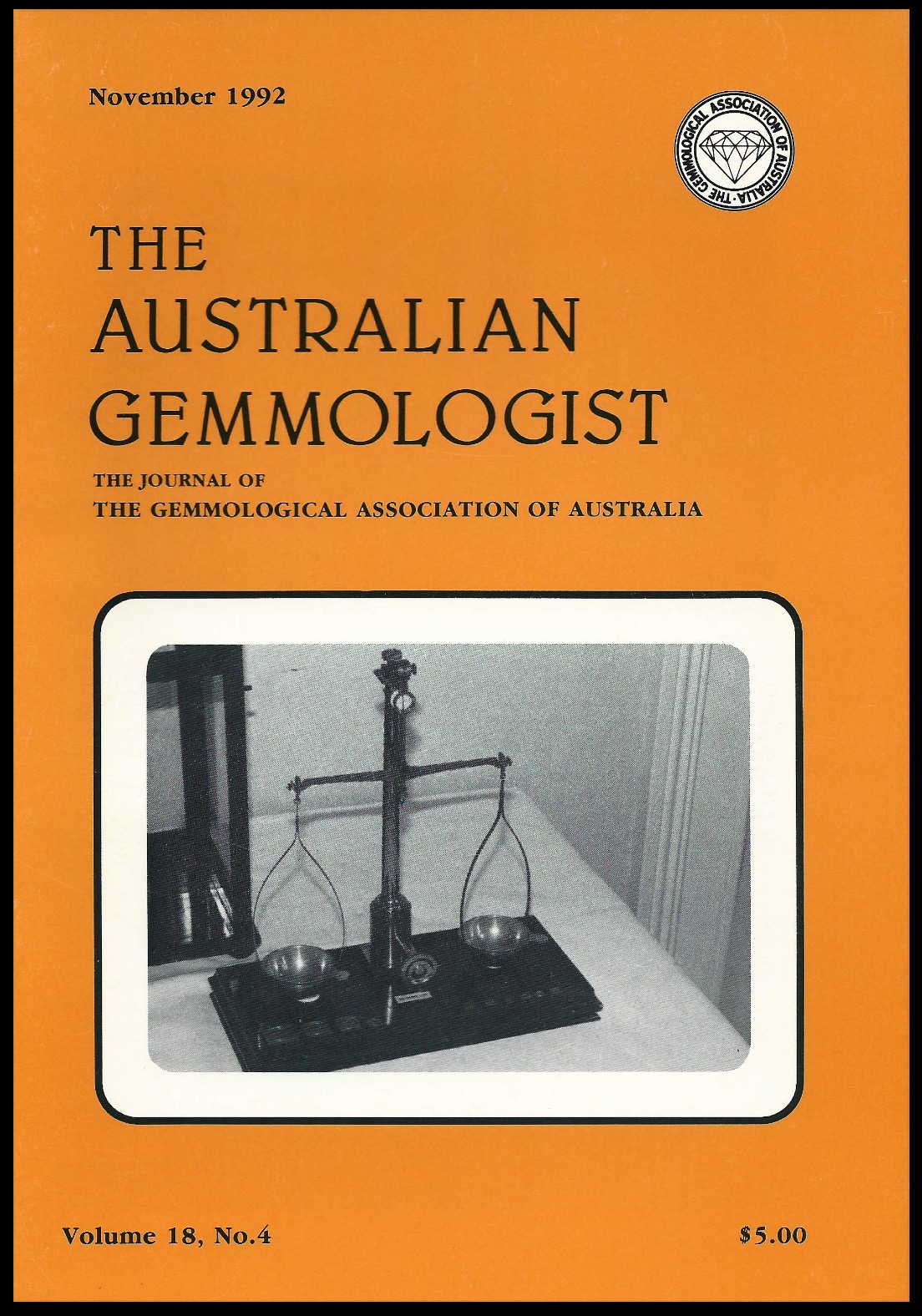
Brown, G. and Beattie, R. (1992) Vietnamese ruby fakes: A problem requiring urgent resolution. Australian Gemmologist, Vol. 18, No. 4, pp. 108–114.
Record No. 4724  |  Sinkankas/Born No.: NIS / NIB  |  RWHL
View Individual Record ↗
Investigates fraudulent ruby and sapphire marketed as Vietnamese material following the emergence of commercial production at Luc Yen and Quy Chau and the arrival of such stones in Australia from mid-1990. A collection assembled over twelve months from parcels purchased in Vietnam or Bangkok revealed numerous methods of mixing synthetic material with natural rough and faceted stones. The principal substitutes were Verneuil synthetic ruby and sapphire subjected to heating, deliberate fracture induction, tumbling, or combinations of these processes to imitate natural appearance. Faceted specimens were comparatively easy to identify through curved colour banding, occasional rounded or elongated gas bubbles, and dark, surface-reaching fractures. Synthetic blue sapphires also lacked the 450 nm absorption characteristic of the natural material considered. Manufactured ruby crystals were shaped and incised to simulate natural crystal faces and growth striations, but some displayed inappropriate bipyramidal habits, painted blue terminations, or patches of partly fused, bubble-bearing alumina. Polished windows exposed internal curved colour banding and other evidence of flame-fusion origin. More elaborate constructions included a natural, low-quality ruby crystal incorporating synthetic ruby fragments and synthetic rough with drilled cores or saw cuts filled with fused blue sapphire fragments. These additions simulated natural blue zoning, with glassy coatings sometimes concealing the openings. Other deceptive modifications included colourless oil or wax in fractures, blue dye impregnation, blue wax in surface depressions, and dark red nail polish applied to natural pink sapphire. Tumbled rough presented the greatest identification difficulty because its abraded surface obstructed microscopic inspection. Even after windows were polished, inclusion-free pieces could remain inconclusive without laboratory methods such as energy-dispersive X-ray fluorescence, examination for Sandmeier–Plato twinning, or short-wave ultraviolet immersion photography. The authors note practical limitations: twinning examination could require parallel polished windows and immersion between crossed polars, while ultraviolet photography required darkroom facilities and primarily distinguished iron-poor from iron-bearing material. A comparative inclusion list outlines features supporting natural Vietnamese origin, while recognising substantial similarities with Myanmar ruby. The investigation demonstrates that basic gemmological properties and attractive natural-looking surfaces cannot establish authenticity, especially for rough. Brown and Beattie call for guarantees from authorised suppliers, sanctions against deliberately adulterating parcels, and widespread publication of identification methods. They argue that urgent action is necessary to protect buyers and the reputation of Vietnam’s developing ruby and sapphire industry, since reliable testing of the most deceptive rough was unavailable on the mining fields.

Gem Trade Lab Notes: Repaired jadeite
Journal Article
DelRe, N. (1992) Gem Trade Lab Notes: Repaired jadeite. Gems & Gemology, Vol. 28, No. 3, Fall, pp. 193–194.
Record No. 3699  |  ISBN/ISSN: 0016626X  |  Sinkankas/Born No.: NIS / NIB  |  RWHL
View Individual Record ↗
A pair of ear clips set with an opaque green material were submitted to the East Coast laboratory for identification. Although the material resembled jade (figure 71), the jewelry was constructed in such a way that we could not conduct certain basic gemological tests, such as refractive index and specific gravity. However, a 437-nm absorption line visible in the handheld spectroscope proved them to be jadeite jade. Furthermore, the negative color-filter reaction and lack of a dye band" in the visible spectrum proved these to be natural-color jadeite. The distinctive color, luster, and – on closer examination – coarse-grained nature of this material were reminiscent of jadeite from Guatemala (for more information, see the article on jadeite from Guatemala by Hargett, Gems & Gemology, Summer 1990, pp. 134–141).These 35-mm hololiths are quite similar in appearance to ancient carved Mayan ear flares. Once a material has been conclusively identified, it is still prudent to try other tests to either support the identification or uncover something that might be amiss. Sure enough, short-wave ultraviolet radiation revealed-by the pale blue fluorescence of the cement (figure 8) that one of the jadeite pieces had been repaired with a nonjadeite material (it had no 437 line). Close examination of figure 7 shows how well this replacement component blends in."

Gem Trade Lab Notes: Durability of diffusion-treated sapphire
Journal Article
Crowningshield, G.R. (1992) Gem Trade Lab Notes: Durability of diffusion-treated sapphire. Gems & Gemology, Vol. 28, No. 4, Winter, p. 266.
Record No. 2974  |  ISBN/ISSN: 0016626X  |  Sinkankas/Born No.: NIS / NIB  |  RWHL
View Individual Record ↗

Gemstones of East Africa

Book
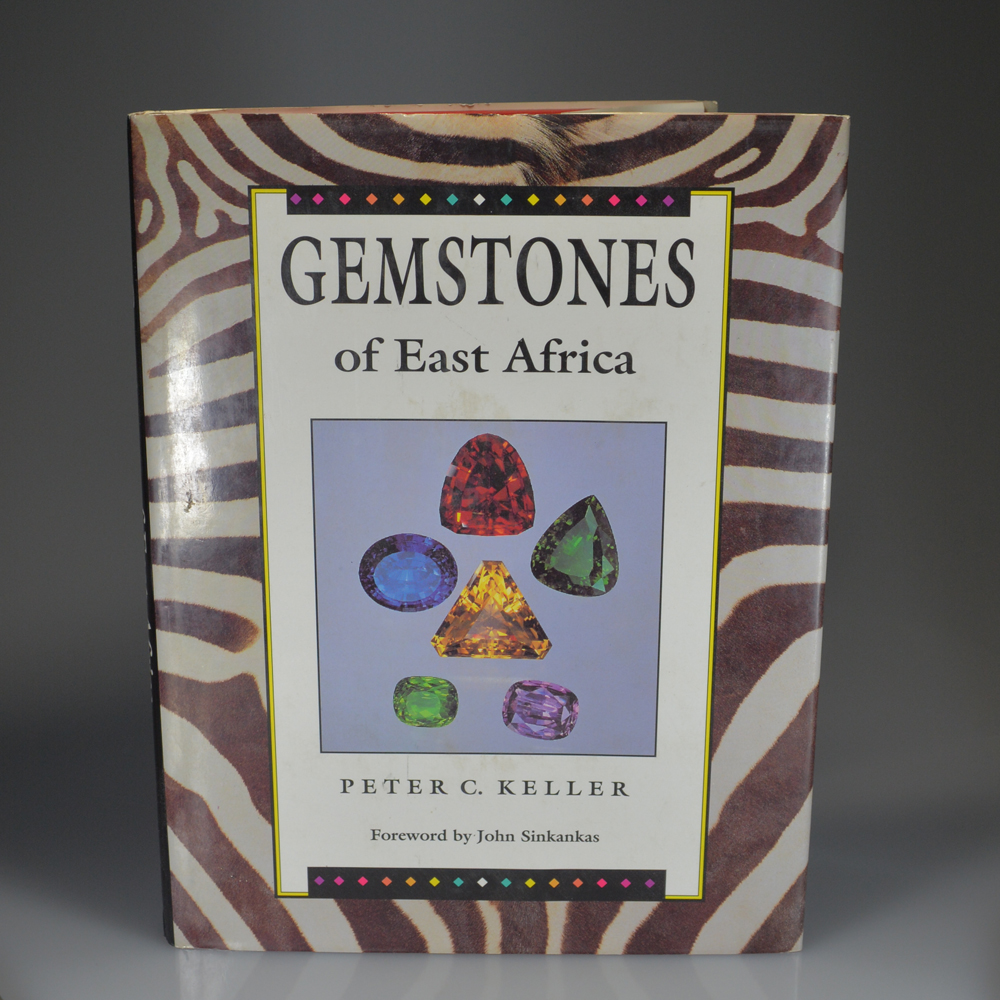
Keller, P.C. (1992) Gemstones of East Africa. Phoenix, Geoscience Press, [with photos by E.J. Gübelin], 160 pp.
Record No. 2204  |  Sinkankas/Born No.: NIS / NIB  |  RWHL
View Individual Record ↗
An illustrated survey of East African gemstones, emphasizing the deposits of Kenya and Tanzania and combining regional geology with accounts of discovery, exploration, mining, and gemological properties. Following an introduction to the geological setting, Keller discusses diamonds, ruby and sapphire, emerald and alexandrite, tanzanite, garnets, tourmaline, and green opal, with a concluding chapter on less prominent gem materials. Individual accounts place the deposits within their geological environments while recording their development and the people involved. Particular subjects include tanzanite from Merelani and prase opal from Haneti Hill, Tanzania. Photographs of rough and cut stones, inclusions, mining operations, and historical scenes complement locality maps, including some previously unpublished examples. Contributors include E.J. Gübelin, Harold and Erica Van Pelt, and J.I. Koivula. Appendices list 177 noteworthy gem localities with geographical coordinates and document East African gemstones in the collections of the Los Angeles County Natural History Museum and the Smithsonian Institution. References accompanying each chapter provide access to the region’s geological and gemological literature. The volume offers a substantial record of East African gem deposits and industry as understood at the beginning of the 1990s.

The Sri Lankan ruby: Fact or fable?

Journal Article
Mahroof, M.M.M. (1992) The Sri Lankan ruby: Fact or fable? Journal of Gemmology, Vol. 23, No. 1, January, pp. 20–24.
Record No. 1216  |  ISBN/ISSN: 221252  |  Sinkankas/Born No.: NIS / NIB  |  RWHL
View Individual Record ↗
The prominence of Sri Lankan ruby in historical literature is examined against the rarity of fine, deeply red corundum in the island’s gem production. Drawing on chronicles, literary works, travelers’ accounts, official publications, and reports of the modern gem trade, the author questions the consistent use of ruby as a mineralogically and commercially precise designation. References in the Mahavamsa and Sanskrit and Sinhala literature, together with descriptions by Marco Polo, Ibn Battuta, and later European visitors, establish the stone’s longstanding cultural prestige but do not necessarily demonstrate abundant local production of fine ruby. Accounts of exceptionally large royal rubies are treated skeptically, and confusion with spinel, historically called balas ruby, is suggested. Several possible explanations for the discrepancy between literary reputation and natural occurrence are considered: exhaustion of formerly productive deposits; conventional poetic imagery; substitution of other red stones in jewelry; possible use of reconstructed or treated material; importation of rubies through South Indian trading ports; and reluctance to challenge claims made about royal possessions. These possibilities are advanced as hypotheses rather than established explanations. The discussion then follows the persistence of ruby’s reputation into colonial and modern times, considering the organization of the Sri Lankan gem trade, imported Myanmar rubies, wartime supply disruption, expanding luxury demand, and the influence of synthetic substitutes on appreciation of fine natural stones. Particular attention is given to the commercial effects of converting geuda into blue sapphire by heat treatment. The author argues that Thai participation in this trade strengthened Bangkok’s position, depressed sapphire prices, and disrupted established Sri Lankan intermediary networks, encouraging renewed interest in pink and red corundum. A reported recommendation at the 1989 International Colored Gemstone Association conference in Colombo to include pink sapphire within the ruby classification is discussed in terms of its potential commercial consequences and the need for precise color terminology. The article concludes that Sri Lankan ruby is far more abundant in literature than in nature, and suggests that its historical prominence reflects a limited supply of genuine local stones supplemented by imports and the prestige associated with royal ownership.

What did you say the name was?

Journal Article
Liddicoat, R.T. (1992) What did you say the name was? Gems & Gemology, Vol. 28, No. 4, Winter, p. 219 (see also letters, p. 220), 3 pp..
Record No. 1189  |  ISBN/ISSN: 0016626X  |  Sinkankas/Born No.: NIS / NIB  |  RWHL
View Individual Record ↗

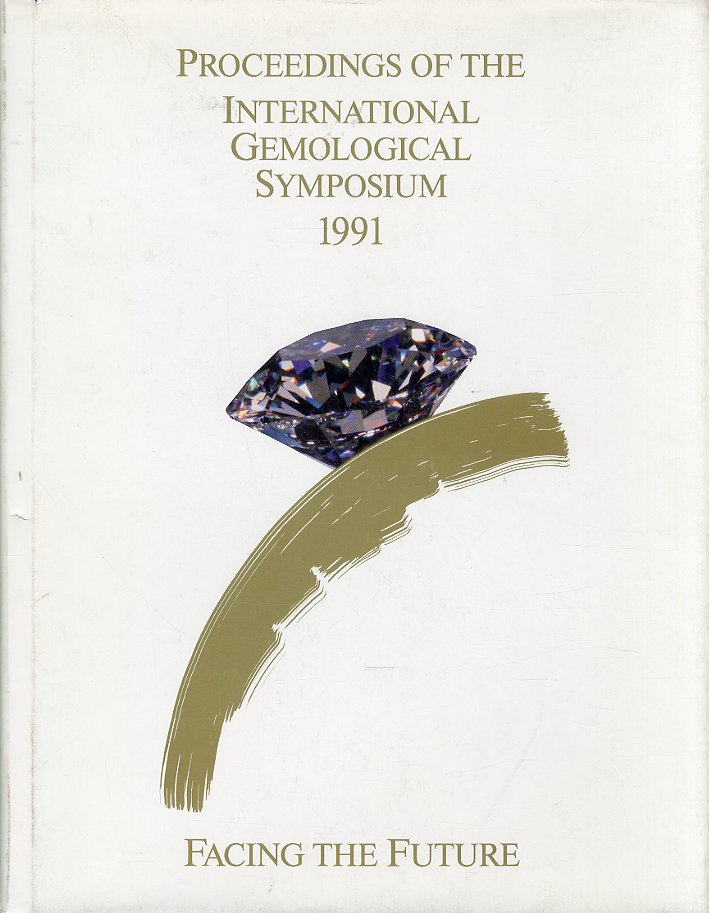
Proceedings of the International Gemological Symposium 1991
Edited Book
Keller, A.S., editor (1992) Proceedings of the International Gemological Symposium 1991.. Santa Monica, CA, Gemological Institute of America, 192 pp..
Record No. 1091  |  Sinkankas/Born No.: NIS / NIB  |  RWHL
View Individual Record ↗

Gem Trade Lab Notes: Identifying curved striae in yellow synthetic sapphire
Journal Article
Hargett, D. (1992) Gem Trade Lab Notes: Identifying curved striae in yellow synthetic sapphire. Gems & Gemology, Vol. 28, No. 2, Summer, p. 128.
Record No. 936  |  ISBN/ISSN: 0016626X  |  Sinkankas/Born No.: NIS / NIB  |  RWHL
View Individual Record ↗

Gem Trade Lab Notes: Sapphire, durability of heat-treated stones
Journal Article
Crowningshield, G.R. (1992) Gem Trade Lab Notes: Sapphire, durability of heat-treated stones. Gems & Gemology, Vol. 28, No. 2, Summer, pp. 127–128.
Record No. 638  |  ISBN/ISSN: 0016626X  |  Sinkankas/Born No.: NIS / NIB  |  RWHL
View Individual Record ↗

Gem Trade Lab Notes: “Geneva [synthetic] ruby”
Journal Article
Crowningshield, G.R. (1992) Gem Trade Lab Notes: “Geneva [synthetic] ruby”. Gems & Gemology, Vol. 28, No. 2, Summer, p. 127.
Record No. 637  |  ISBN/ISSN: 0016626X  |  Sinkankas/Born No.: NIS / NIB  |  RWHL
View Individual Record ↗

Surface features on natural rubies and sapphires derived from volcanic provinces

Journal Article
Coenraads, R.R. (1992) Surface features on natural rubies and sapphires derived from volcanic provinces. Journal of Gemmology, Vol. 23, No. 3, July, pp. 151–160.
Record No. 592  |  ISBN/ISSN: 221252  |  Sinkankas/Born No.: NIS / NIB  |  RWHL
View Individual Record ↗
R.R. Coenraads examines the surface morphology of natural rubies and sapphires from volcanic-associated placer deposits in eastern Australia and Thailand, distinguishing features inherited from crystal growth and magmatic transport from damage acquired in alluvial environments. Samples from the New England gemfields and the Bo Phloi and Chanthaburi–Trat districts were studied with binocular microscopy, followed by scanning electron microscopy of selected cleaned and gold-coated specimens. The observed features fall into three broad categories: negative crystal impressions, resorption and etching structures, and fractures or impact damage associated with subsequent transport. Deep, sharply bounded geometric sockets are interpreted as impressions left by neighbouring minerals in a coarse crystalline aggregate containing corundum, anorthoclase, zircon, and spinel. Coenraads proposes that corundum-bearing assemblages formed from evolved, silica-poor magmas and were subsequently disaggregated and partly dissolved by alkaline basaltic carrier magmas during ascent. Most rounded surfaces are attributed to this magmatic resorption rather than prolonged stream wear. Their sculpturing reflects corundum’s trigonal symmetry and varies with surface orientation relative to the c-axis. Features include triangular prismatic hillocks, pyramids, inverted pyramidal pits, and shallow triangular or hexagonal depressions containing central remnants. Surfaces approximately parallel to the c-axis may display inclined stacks resembling elongated triangular bricks, while intermediate orientations favour triangular pyramidal depressions. Continued dissolution enlarges and merges these structures into irregular channels, porous textures, and deeply sculptured surfaces. Fine corrosion pits and microscopic steps indicate superimposed etching and successive layer removal. Curved or subparallel chatter marks are interpreted as products of mechanical stress; crystallographically controlled etching within them suggests that they formed before or during magmatic ascent and were subsequently modified by dissolution. Later mechanical damage includes conchoidal fractures radiating from impact points, chipped edges, and broken hillocks exposing clean fracture surfaces. Breakage along previously healed or partly healed fractures can reveal fingerprint-like networks of fine tubes, connecting external surface observations with familiar internal inclusions. Despite these examples of damage, many delicate surface projections remain intact. Their preservation, considered alongside spatial differences in corundum characteristics within individual placers, indicates limited downstream reworking and mixing. Coenraads concludes that the sources are likely to lie close to the placer deposits. The study demonstrates how successive generations of surface features can preserve evidence of crystal association, reaction with carrier magma, stress, and fluvial history, allowing rounded gem corundum to be interpreted through processes more specific than abrasion alone.

Building a Gemological Library

Gemological books range from general identification manuals and textbooks to specialized works on individual gems, mineralogy, jewelry, treatments, synthesis, history and gem-producing regions.

For a curated selection of particularly useful books, read The Gemologist's Core Library — Classic Books on Gemology, Jewelry and Mineralogy.

About Four Treasures

Four Treasures is Lotus Gemology's freely accessible gemological reference database. Use the full database to search by author, title or keyword and explore literature on gemology, mineralogy, jewelry and related fields. Where available, hyperlinks on titles may lead directly to the full publication.

Search the Complete Four Treasures Database