Gemology Books Bibliography

Gemology Books Bibliography

Explore books on gems, gemology, jewelry and mineralogy in Four Treasures, the Lotus Gemology reference database. This bibliography brings together matching book records from the collection, with publication details, abstracts and cover images where available.

Gemology Book References

The list below matches books concerning gemology and related subjects in the database's searchable fields. Some works cover several branches of gems, jewelry or mineralogy.
2,361–2,380 of 3,681 matching references

Notes from the laboratory [spectrophotometers]
spectrophotometers
Journal Article
Scarratt, K. (1989) Notes from the laboratory [spectrophotometers]. Journal of Gemmology, Vol. 21, No. 6, April, pp. 339–346.
Record No. 3252  |  ISBN/ISSN: 221252  |  Sinkankas/Born No.: NIS / NIB  |  RWHL
View Individual Record ↗
The expanding role of recording spectrophotometers in gem identification is illustrated through the development of the Gem Testing Laboratory of Great Britain’s equipment and several diagnostic case studies. Although the hand-held spectroscope remains valuable, its limitations become significant when precise wavelength measurements, absorption-band shapes, or information outside the visible region are needed to distinguish synthetic gems and treated natural material. Diamond absorption features provide an example: the H3 zero-phonon line at 503.2 nm and the H4 line at 496 nm require careful distinction because an H3 phonon sideband can be mistaken for the latter, potentially affecting interpretation of color origin. Cooling diamonds to approximately 120 K improves visual resolution, but recording instruments provide more complete spectral information. The laboratory initially acquired a Pye Unicam PU 8800 ultraviolet-visible spectrophotometer and subsequently added a Nicolet 510 Fourier-transform infrared spectrometer as infrared analysis became increasingly important. Guidance is given on interpreting absorbance and transmittance curves and relating recorded features to observations through a hand spectroscope. Examination of De Beers synthetic yellow to greenish yellow and brownish yellow diamonds combines ultraviolet luminescence, growth-sector zoning, metallic and dust-like inclusions, and infrared spectra. The examined synthetic stones show isolated-nitrogen absorption characteristic of type Ib diamond without aggregated-nitrogen features, whereas a natural yellow type Ib comparison stone also contains an aggregated-nitrogen peak. Infrared spectroscopy also identifies amber in mounted earclips and beneath artificial coatings on beads when conventional tests are restricted by mounting or surface treatment. The earclips display colored outer layers surrounding colorless interiors, consistent with heat treatment; the beads have an additional orange artificial coating over a yellow surface layer. A further case concerns a 5.80 ct diamond whose appearance varies among green, gray, and brown under different lighting. Its visible spectrum does not fit a straightforward conventional category. Strong blue-green phosphorescence following short-wave ultraviolet exposure and electrical conductivity suggest type IIb diamond, and comparison of its infrared spectrum with recorded reference spectra confirms that classification despite its atypical color. These examples demonstrate how instrumental spectroscopy complements microscopy and routine gemological observations, providing decisive information in cases where appearance or simpler tests are insufficient. The article argues that increasing identification challenges justify advanced instrumentation and that clearly presented spectral curves remain accessible and useful to practicing gemologists.

Gem Trade Lab Notes: Synthetic star ruby, early flame-fusion
Journal Article
Hargett, D. (1989) Gem Trade Lab Notes: Synthetic star ruby, early flame-fusion. Gems & Gemology, Vol. 25, No. 3, Fall, p. 175.
Record No. 3013  |  ISBN/ISSN: 0016626X  |  Sinkankas/Born No.: NIS / NIB  |  RWHL
View Individual Record ↗

Gem Trade Lab Notes: Damaged Burma" ruby"
Journal Article
Hargett, D. (1989) Gem Trade Lab Notes: Damaged Burma" ruby". Gems & Gemology, Vol. 25, No. 4, Winter, pp. 240—241.
Record No. 3011  |  ISBN/ISSN: 0016626X  |  Sinkankas/Born No.: NIS / NIB  |  RWHL
View Individual Record ↗

Gem Trade Lab Notes: Ruby, natural color
Journal Article
Kane, R.E. (1989) Gem Trade Lab Notes: Ruby, natural color. Gems & Gemology, Vol. 25, No. 2, Summer, pp. 105–106.
Record No. 2980  |  ISBN/ISSN: 0016626X  |  Sinkankas/Born No.: NIS / NIB  |  RWHL
View Individual Record ↗

Inclusions: nature's artwork

Journal Article
Goutiere, A., de (1989) Inclusions: nature's artwork. Gemological Digest, Vol. 2, No. 4, p. 45.
Record No. 1971  |  Sinkankas/Born No.: NIS / NIB  |  RWHL
View Individual Record ↗
De Goutière presents a brief photographic essay celebrating the visual interest of gemstone inclusions through three colour photomicrographs of two specimens. The emphasis is on the striking patterns revealed by microscopic observation and their resemblance to recognizable scenes or abstract compositions. The first photograph shows a thin film within a light green beryl crystal that has been ground to a thickness of 1 mm. Its intricate, multicoloured forms are likened to a tropical garden containing a palm tree and butterflies. Branching and fan-like details occupy a broad field of yellow, blue, green, and violet, with darker areas framing the composition. The comparison concerns the appearance of the photographed inclusion rather than the presence of biological material. The remaining two photographs depict unusual tubular inclusions in a 0.07 ct round brilliant-cut diamond. In one view, bright, angular, tube-like forms appear among the stone’s reflected facet patterns and several dark rounded features. The accompanying caption humorously compares their extraordinary configuration to uncontrolled laser drilling. A second photograph presents a pavilion view of the same diamond, revealing the network from another direction. Here the tubes form a conspicuous labyrinth of straight segments and sharp changes in direction against contrasting bright and dark areas. De Goutière characterizes the effect as natural abstract art, using the change of viewpoint to present a different composition within the same small gemstone. The editorial introduction places these photographs within an ongoing presentation of the author’s work with camera and microscope and frames the specimens as subjects created by nature. The contribution is descriptive and pictorial: it provides the host materials, the preparation thickness of the beryl, and the weight and cut of the diamond, but does not identify the thin film’s composition, explain the tubular inclusions’ formation, or supply magnification and illumination details. Its central purpose is to demonstrate the aesthetic possibilities of inclusions and the distinctive internal images that gem photomicrography can reveal.

Synthetische smaragde aus Australien (synthetische 'Pool emeralds')
Synthetische 'Pool emeralds'
Journal Article
Bank, H., Henn, Ulrich and Lind, T. (1989) Synthetische smaragde aus Australien (synthetische 'Pool emeralds'). [Synthetische 'Pool emeralds'] Zeitschrift der Deutschen Gemmologischen Gesellschaft, Vol. 38, pp. 11–16.
Record No. 1964  |  Sinkankas/Born No.: NIS / NIB  |  Language: In German  |  RWHL
View Individual Record ↗
Examines the Australian hydrothermally grown synthetic emerald marketed as the “Pool Emerald.” The authors describe its gemological properties, chemical composition, absorption characteristics and diagnostic internal features, with emphasis on separation from natural emerald. Pool emeralds show features characteristic of hydrothermal growth, including distinctive growth structures and inclusions. Chemical analysis indicates relatively high chlorine and magnesium contents, while alkalis are low or absent—features later studies also found characteristic of this material. The paper provides practical criteria for recognizing Pool synthetic emeralds and documents an important Australian contribution to commercial hydrothermal emerald synthesis during the 1980s.

Expensive thumbsucks or valuable documents? The valuations/assessments/appraisals minefield
Journal Article
Backler, B. (1989) Expensive thumbsucks or valuable documents? The valuations/assessments/appraisals minefield. Gemological Digest, Vol. 2, No. 4, pp. 8–12.
Record No. 1962  |  Sinkankas/Born No.: NIS / NIB  |  RWHL
View Individual Record ↗
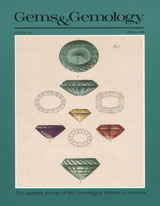
Backler criticizes inadequately researched jewellery valuations and sets out the knowledge, documentation, equipment, and ethical standards required for a defensible professional appraisal. She treats the valuation report as a legal document that must describe the object fully, substantiate its conclusions, and communicate clearly to both specialists and clients. Insurance valuations are distinguished from probate assessments: the former concern current replacement on a like-for-like basis, while the latter are described as assessments based on material values without workmanship, taxes, or commercial mark-ups. Reliable practice requires gemmological training, continuing education, suitable testing instruments, reference literature, current diamond and coloured-stone prices, and familiarity with precious-metal testing and markets. Appraisers must also understand exchange rates, inflation, import duties, taxation, labour costs, and the successive mark-ups affecting retail replacement. Detailed worksheets and retained records provide the evidence needed to explain conclusions, resolve later disputes, and support testimony in court. Backler condemns valuations altered to accommodate clients’ wishes and deliberate undervaluation intended to discredit competitors or secure goods cheaply. She emphasizes the client’s dependence on professional honesty and the obligation to disclose gemstone treatments, including oiling, glass filling, laser drilling, dyeing, impregnation, heating, and irradiation. Poor valuations can leave clients seriously underinsured, while incomplete descriptions impede identification and encourage disputes over alleged stone substitution. She recommends examination in the client’s presence where practicable and warns that cleaning can markedly change a jewel’s appearance. A case study contrasts a brief, inaccurate retail appraisal with a detailed replacement assessment of a diamond engagement ring and matching wedding band. The deficient report underestimated the principal diamond’s weight, assigned a substantially lower clarity grade, and was followed by an offer to purchase it cheaply. The fuller assessment records metal fineness and weight, construction, gemstone measurements, estimated weights, colour, clarity, fluorescence, finish, identifying marks, and condition. Editorial annotations by R.W. Hughes qualify several of Backler’s assertions. They stress that some treatments are difficult or impossible to detect, that observing an appraisal may introduce security problems and pressure to rush, and that distinctive inclusions or surface features can help establish identity before cleaning. The concluding editorial also cautions against condemning all retail appraisers and emphasizes specialization, practical experience, and candid acknowledgement of uncertainty. Both author and editor ultimately argue that trustworthy valuation depends on documented evidence, sustained professional competence, integrity, and recognition of the limits of one’s expertise.

Gem Trade Lab Notes: Sapphire—an unusual green star
Journal Article
Kane, R.E. (1989) Gem Trade Lab Notes: Sapphire—an unusual green star. Gems & Gemology, Vol. 25, No. 1, Spring, p. 39.
Record No. 1079  |  ISBN/ISSN: 0016626X  |  Sinkankas/Born No.: NIS / NIB  |  RWHL
View Individual Record ↗

Gem Trade Lab Notes: Ruby; Verneuil synthetic with needle-like inclusions; Sapphire; A large fine-color star
Journal Article
Hargett, D. (1989) Gem Trade Lab Notes: Ruby; Verneuil synthetic with needle-like inclusions; Sapphire; A large fine-color star. Gems & Gemology, Vol. 25, No. 1, Spring, pp. 38–39.
Record No. 934  |  ISBN/ISSN: 0016626X  |  Sinkankas/Born No.: NIS / NIB  |  RWHL
View Individual Record ↗

A fourteenth century crown

Journal Article
Gray, A. (1989) A fourteenth century crown. Journal of Gemmology, Vol. 21, No. 7, pp. 431–432.
Record No. 842  |  ISBN/ISSN: 221252  |  Sinkankas/Born No.: NIS / NIB  |  RWHL
View Individual Record ↗
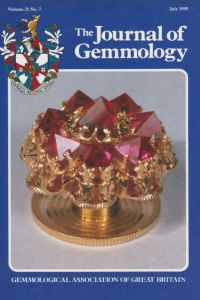
The fourteenth-century “English Crown”, exhibited at the Royal Academy’s Age of Chivalry exhibition and normally preserved in Munich’s Residence Museum, is described in terms of its gemstones, metalwork, construction and uncertain origins. The crown passed to the Wittelsbach family as part of the dowry of Blanche, daughter of Henry IV, on her marriage to Ludwig III of Bavaria in 1401. Although its individual gemstones are judged unexceptional, their arrangement with gold, pearls and coloured enamel produces a striking decorative effect. The two-tier structure comprises twelve lower rosettes supporting twelve golden lilies of alternating heights. Each rosette contains an enamelled hexagon with fine gold tracery and a central pale blue sapphire, usually fashioned as an oval cabochon. Drilled examples suggest reuse of earlier beads, while one flat hexagonal stone appears to be a slice of a corundum crystal. Alternating red and blue enamel grounds carry small white enamel flowers and are complemented by ruby cabochons or clusters of drilled pearls surrounding small diamond octahedra. The taller lilies combine trefoil gold leaves with beaded margins, ruby and sapphire cabochons, pearl clusters and diamond crystals. Smaller lilies vary this arrangement through different gemstone combinations and suspended single pearls. The pearls’ good condition may partly reflect restoration undertaken in 1925, although replacement is not established. Elaborately enamelled connecting plaques allow the crown to fold for transport, and a fitted case survives. Numbering of the rosettes ensures that the detachable lilies can be returned to their correct positions. Historical evidence establishes the crown’s presence in an inventory of royal valuables in 1399 but does not securely identify its earlier owner. A possible association with Anne of Bohemia, who married Richard II in 1382, is considered alongside similarities to crowns represented in contemporary religious and royal imagery. Enamelling techniques and beaded goldwork suggest French workmanship, but comparable features occur on English objects, and French-trained craftspeople could also have worked in Prague. The article therefore leaves both the place of manufacture and original ownership unresolved, emphasising the crown’s historical importance, ingenious portability and coordinated use of materials and colour.

PACT 23: Technology and Analysis of Ancient Gemstones
Edited Book
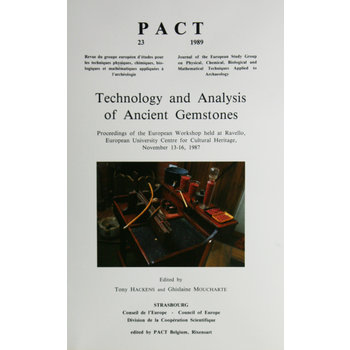
Hackens, T. and Moucharte, G., editor (1989) PACT 23: Technology and Analysis of Ancient Gemstones.. Strasbourg, Council of Europe, 458 pp..
Record No. 615  |  Sinkankas/Born No.: NIS / NIB  |  RWHL
View Individual Record ↗

The Periplus Maris Erythraei | Text with Introduction, Translation, and Commentary
Book
Periplus Maris Erythraei and Casson, L. (1989) The Periplus Maris Erythraei | Text with Introduction, Translation, and Commentary. Princeton, NJ, Princeton University Press, 320 pp. (see p. 230)
Record No. 559  |  ISBN/ISSN: 691040605  |  Sinkankas/Born No.: NIS / NIB  |  RWHL
View Individual Record ↗
A scholarly edition, English translation, and detailed commentary on the Periplus Maris Erythraei (Voyage Around the Erythraean Sea), an anonymous Greek merchant’s guide to maritime commerce in the Red Sea, Gulf of Aden, Persian Gulf, Arabian Sea, and Indian Ocean, probably composed during the middle of the first century AD. Lionel Casson provides the Greek text alongside an English translation, supported by an extensive introduction and commentary examining the geographical, historical, linguistic, and commercial significance of the document. The Periplus describes the principal ports, sailing routes, seasonal winds, navigational conditions, trading communities, and commodities exchanged between Roman Egypt, northeastern Africa, Arabia, India, and regions farther east. Particular attention is devoted to the exploitation of the monsoon winds, which permitted ships to cross the Arabian Sea directly between the Red Sea and western India. Important Indian trading centers include Barygaza (Bharuch), Muziris on the Malabar Coast, and ports along the southeastern coast. Of considerable gemological interest are references to pearls, diamonds, sapphires, onyx, agate, carnelian, and other precious stones traded through Indian Ocean commercial networks. The text also describes the commerce in ivory, tortoiseshell, frankincense, myrrh, spices, silk, cotton textiles, and metals, revealing the diversity and geographical extent of ancient luxury trade. Casson’s commentary evaluates the identification of ancient place names, the meanings of obscure commodity terms, and the relationship between the Periplus and other classical sources, particularly Pliny the Elder and Ptolemy. The work is an essential primary source for reconstructing the maritime trade routes linking the Mediterranean world with India and for understanding the movement of gemstones and other valuable materials in antiquity.

Une gemme métamicte: l’ékanite

A metamict gem: Ekanite
Journal Article
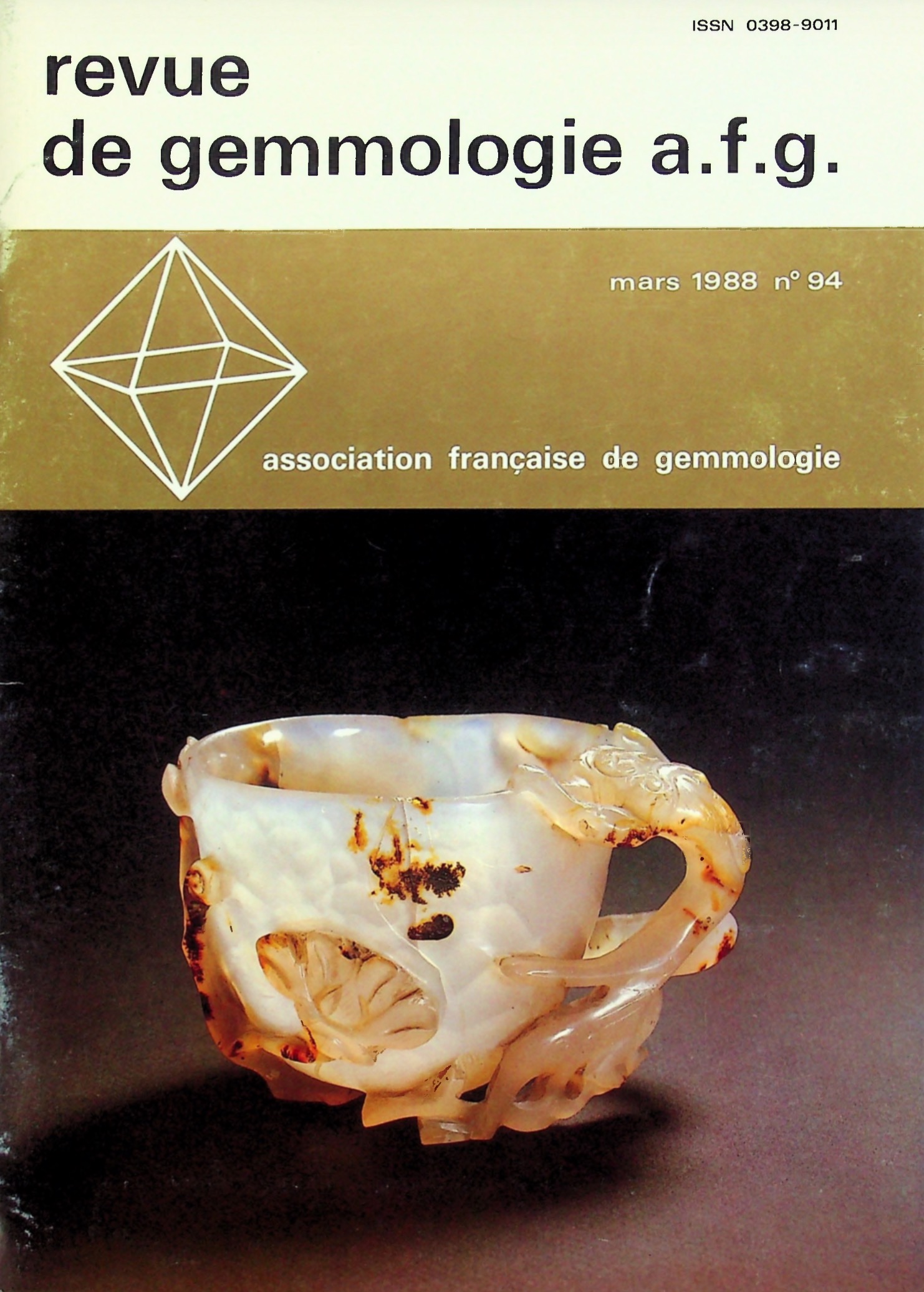
Gauthier, J.P. and Fumey, P. (1988) Une gemme métamicte: l’ékanite. [A metamict gem: Ekanite] Revue de Gemmologie A.F.G., No. 94, pp. 3–7.
Record No. 29633  |  Sinkankas/Born No.: NIS / NIB  |  Language: in French  |  RWHL
View Individual Record ↗
Gauthier and Fumey examine ekanite as an unusual metamict gemstone, discussing the structural damage produced by its natural radioactivity and the resulting effects on its gemological properties. They describe the stone’s appearance and physical and optical characteristics and consider the difficulties that metamictization creates for conventional mineral identification. The study emphasizes the relationship between ekanite’s thorium-bearing composition, internal irradiation, and progressive destruction of its original crystalline structure, making the mineral an instructive example of a naturally metamict gem material.

Evaluacion petroarqueologica del «jade» precolombino en la coleccion del Museo Nacional de Nicaragua
Petroarchaeological evaluation of pre-Columbian “jade” in the collection of the National Museum of Nicaragua
Journal Article
Mrázek, I. (1988) Evaluacion petroarqueologica del «jade» precolombino en la coleccion del Museo Nacional de Nicaragua. [Petroarchaeological evaluation of pre-Columbian “jade” in the collection of the National Museum of Nicaragua] Annals of the Naprstek Museum, Vol. 15, pp. 111–120.
Record No. 28518  |  Sinkankas/Born No.: NIS / NIB  |  Language: in Spanish  |  RWHL
View Individual Record ↗
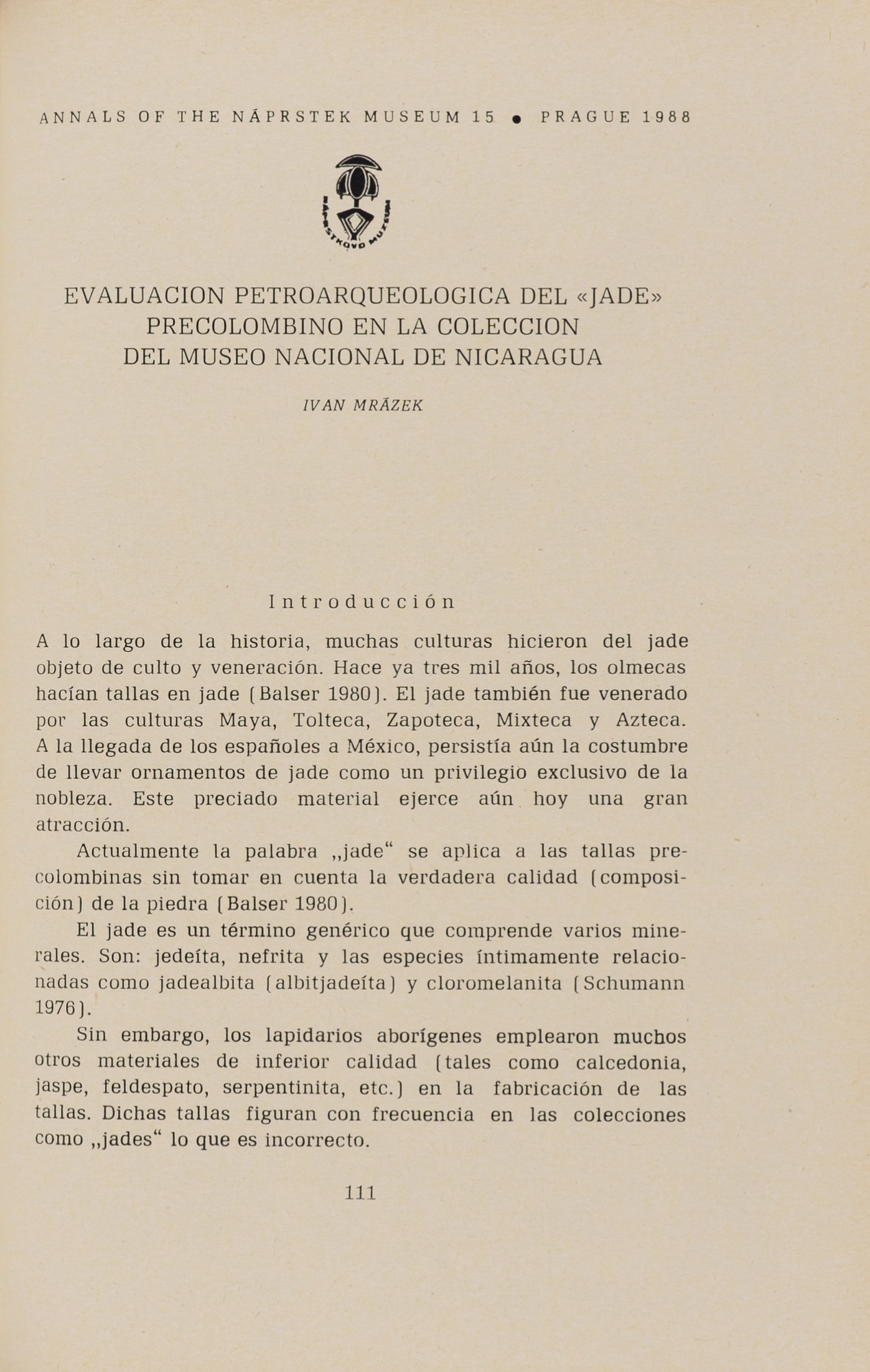
Throughout history, many cultures made jade an object of worship and veneration. As early as three thousand years ago, the Olmecs were carving jade (Balser 1980). Jade was also venerated by the Maya, Toltec, Zapotec, Mixtec, and Aztec cultures. At the arrival of the Spaniards in Mexico, the custom still persisted of wearing jade ornaments as an exclusive privilege of the nobility. This precious material still exerts a great attraction today. At present, the word “jade” is applied to pre-Columbian carvings without taking into account the true quality (composition) of the stone (Balser 1980). Jade is a generic term that includes several minerals: jadeite, nephrite, and closely related species such as jade albite (albite-jadeite) and chloromelanite (Schumann 1976). However, indigenous lapidaries employed many other materials of inferior quality (such as chalcedony, jasper, feldspar, serpentinite, etc.) in the manufacture of carvings. Such carvings frequently appear in collections as “jades,” which is incorrect.

The distinction of natural from synthetic alexandrite by infrared spectroscopy
Journal Article
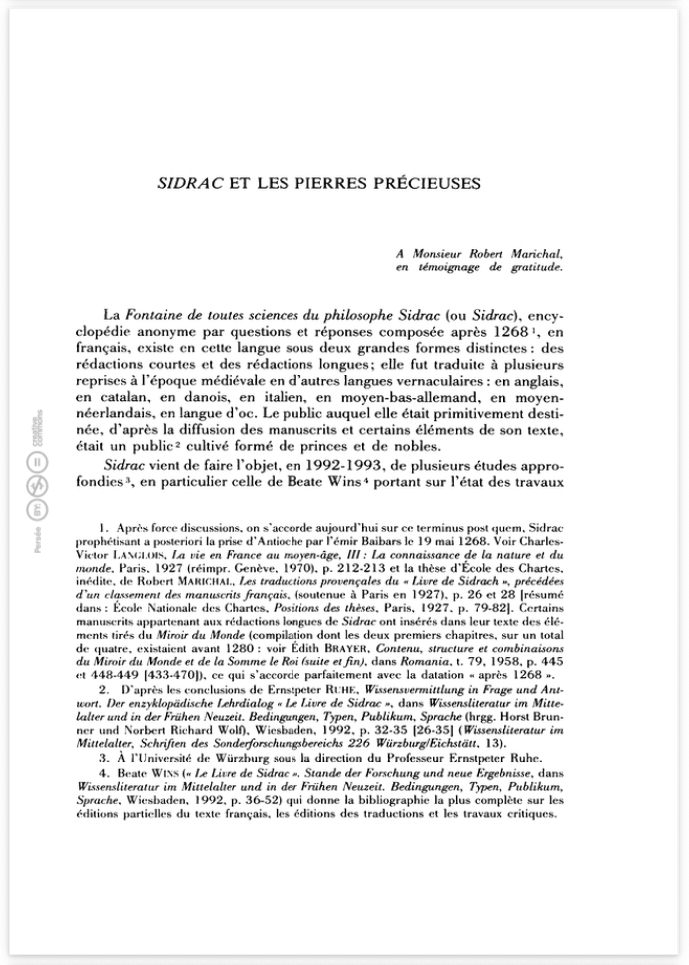
Stockton, C.M. and Kane, R.E. (1988) The distinction of natural from synthetic alexandrite by infrared spectroscopy. Gems & Gemology, Vol. 24, No. 1, Spring, pp. 44–46.
Record No. 28100  |  Sinkankas/Born No.: NIS / NIB  |  RWHL
View Individual Record ↗
Infrared spectroscopy provides a means to distinguish natural from synthetic alexandrites in the range 2000–4200 cm⁻¹, as determined by a study of spectra obtained from 15 natural and 28 synthetic alexandrites from a variety of sources. The technique is nondestructive and, with Fourier transform instrumentation, extremely rapid. It is especially useful for identifying stones that contain no distinguishing inclusions.

Sydrac et les pierres précieuses

Sydrac and precious stones
Journal Article
Fery-Hue, F. (1988) Sydrac et les pierres précieuses. [Sydrac and precious stones] Revue d’Histoire des Textes, Vol. 28, pp. 93–181.
Record No. 27889  |  Sinkankas/Born No.: NIS / NIB  |  Language: in French  |  RWHL
View Individual Record ↗
The encyclopedia titled Fontaine de toutes sciences du philosophe Sidrac includes, at the end of its text, a lapidary that describes 24 stones in 24 articles, typically introduced by a short prefatory notice listing the number and names of the stones to be discussed. The table of contents at the beginning of the encyclopedia refers to the headings and numbers of all articles in the work, including those of the lapidary. This study’s classification of the manuscripts and printed editions of the French text of Sidrac is based on comparing the sequence of the 24 stones across the table of contents, the prefatory notice, and the lapidary itself. The “correct order” follows biblical tradition (Exodus 28:17–21 and Revelation 21:19–20) and is supported by the article arrangement in the Lapidaire Chrétien en vers (a source for Sidrac) and the Lapidaire du roi Philippe (which draws on Sidrac). This comparison yields four principal manuscript families. A common scribal mistake—misplacing stones 13 and 14 after 17 in the prefatory list—likely occurred near the time Sidrac was composed and affects three families (II, III, and IV), marking the first major textual development. Close in time to the original composition, but later than the prefatory error, is the complete reordering of the lapidary in family IV. Other, more minor textual changes—slightly later but already present in late 13ᵗʰ-century witnesses—are also analyzed. Grouping the manuscripts by stone sequence bridges the traditional divide between the short and long redactions of Sidrac. The findings largely—but not entirely—align with R. Manchal’s partial classification from 1927 and B. Weisel’s full classification from 1933. Comparing the three classification methods reveals useful overlaps that could inform a future edition of the French text of Sidrac.

Gem News: Change-of-color garnets

Journal Article
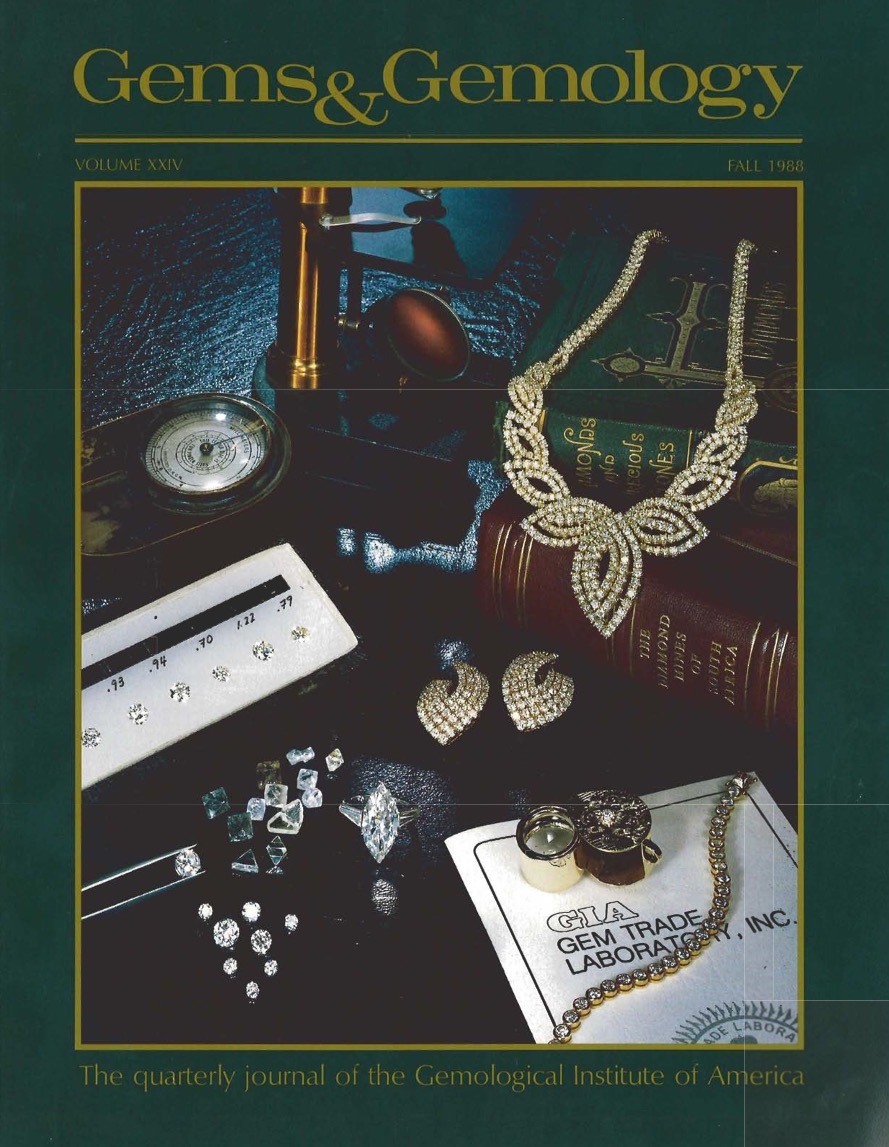
Koivula, J.I. and Kammerling, R.C. (1988) Gem News: Change-of-color garnets. Gems & Gemology, Vol. 24, No. 3, Fall, pp. 176–177.
Record No. 26750  |  Sinkankas/Born No.: NIS / NIB  |  RWHL
View Individual Record ↗
Over the past 18 months, four exceptional change-of-color garnets from East Africa have been observed, notable for exhibiting a striking color shift similar to that of fine Russian alexandrite—green in daylight or fluorescent light and red under incandescent light. While East African color-change garnets have been known for years, most are either too dark or lack a dramatic shift, particularly when cut. GIA’s Research Department examined three of these remarkable stones, which showed refractive indices of 1.770 and 1.763. Spectroscopic analysis using a Beck prism spectroscope and a Pye Unicam UV-visible dual-beam spectrophotometer confirmed the presence of absorption features typical of pyrope-spessartine garnets. Semiquantitative chemical analysis via energy dispersive X-ray fluorescence (EDXRF) revealed compositions consistent with pyrope-spessartine garnets containing relatively high manganese levels. Interestingly, only a trace amount of chromium (0.1 wt.% Cr₂O₃) was detected, while the vivid color change was attributed almost entirely to more than 1 wt.% V₂O₃ (vanadium oxide) present in each sample.

Quantitative cathodoluminescence—a modern approach to gemstone recognition
Journal Article
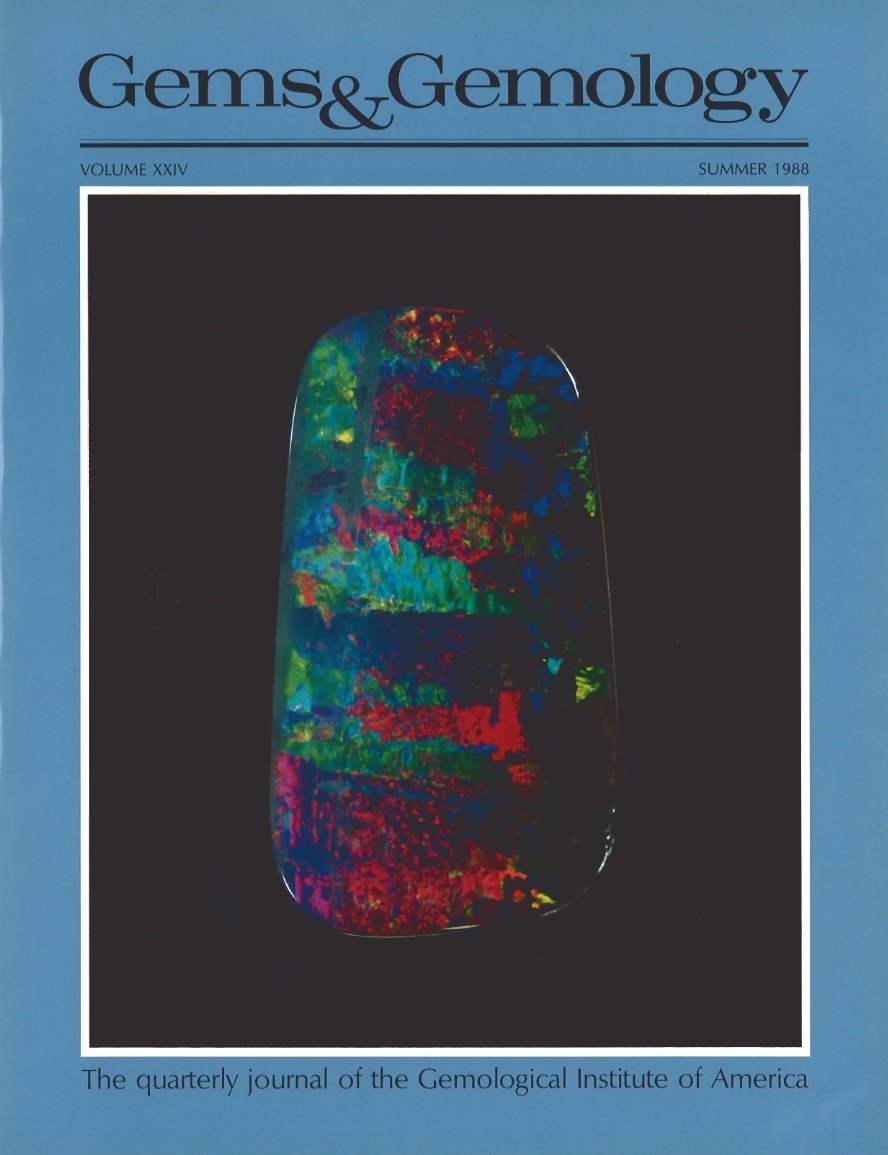
Ponahlo, J. (1988) Quantitative cathodoluminescence—a modern approach to gemstone recognition. Journal of Gemmology, Vol. 21, No. 3, pp. 182–193.
Record No. 26733  |  ISBN/ISSN: 221252  |  Sinkankas/Born No.: NIS / NIB  |  RWHL
View Individual Record ↗
The use of cathodorays is well known among physicists, dating back more than one century. But the use of cathodoluminescence (CL) as a means for gemstone recognition is not so well established among gemmologists of today. It was an Italian mineralogist, A. Pochettino, who, apparently, was the first to investigate the CL-effects in minerals, observing and measuring them as early as 1910. At about the same time the Austrian mineralogist, H. Michel, then keeper of the mineralogical department of the Austrian Museum for Natural History, also one of the first gemmologists of central Europe, began, by visual inspection of CL-colours, to differentiate between genuine and synthetic gemstones. Later on CL of gemstones, unfortunately, became a nearly forgotten or discredited method. Its renaissance in gemmology started when Gaal published his work in the seventies. Besides books by Marfunin and Lumb, information on CL of minerals is still sparse and papers are widely scattered among numerous periodicals. Practically nothing is published on CL of gemstones.

Pastel pyropes

Journal Article
Stockton, C.M. (1988) Pastel pyropes. Gems & Gemology, Vol. 24, No. 2, Summer, pp. 104–106.
Record No. 26346  |  ISBN/ISSN: 0016626X  |  Sinkankas/Born No.: NIS / NIB  |  RWHL
View Individual Record ↗
Pyrope garnets occur in near-colorless to light orange and pink, as well as the familiar red. Because the pale-hued pyropes are unfamiliar to gemologists, their low refractive index usually results in their misidentification as grossular. This note clarifies the means by which these unusual garnets, predominantly from East Africa, can be properly and easily identified with a refractometer and a spectroscope.

Chrysoberyl and alexandrite from pegmatite districts Minas Gerais, Brazil

Journal Article
Proctor, K. (1988) Chrysoberyl and alexandrite from pegmatite districts Minas Gerais, Brazil. Gems & Gemology, Vol. 24, No. 1, pp. 16–32.
Record No. 8043  |  ISBN/ISSN: 0016626X  |  Sinkankas/Born No.: NIS / NIB  |  RWHL
View Individual Record ↗
Chrysoberyl, cat’s-eye chrysoberyl and alexandrite from the pegmatite districts of Minas Gerais, Brazil, are reviewed through accounts of discovery, geological occurrence, mining methods, production and gem quality. The Americana and Santana valleys near Padre Paraíso are identified as the principal recent sources of chrysoberyl and cat’s-eye chrysoberyl in the state, with particular attention to the Faísca, Cilindro, Gil and Barro Preto workings. At Barro Preto, gems occur in two gravel horizons separated by clay and sand. An upper, largely colluvial horizon supplies a smaller proportion of production, while a lower gravel layer over decomposed gneiss accounts for approximately 80–85%. Angular fragments and preserved crystal faces suggest that some material travelled only short distances from its primary source. Severe weathering obscures whether most chrysoberyl originally crystallized within pegmatites or their surrounding rocks. Mining combines hand excavation, pumping, mechanical removal of overburden, washing and sorting through screens of different mesh sizes. The recovered gems range from pale yellow and yellowish green through honey colour to brown, with fine cat’s-eye material particularly valued. The Malacacheta region became an important alexandrite source after a discovery in 1975, but production remained small and the primary host rock was unidentified. Its alluvial deposits yielded notable alexandrites and rare cat’s-eye alexandrites, generally showing yellowish green daylight colours and pink colours under incandescent illumination. The discovery of Lavra de Hematita in October 1986 transformed Brazilian alexandrite production. Intensive mining in 1987 reportedly yielded approximately 50 kg of rough, including about 10 kg of especially good clarity and colour change, from a remarkably small deposit. The ensuing rush brought thousands of miners, violent disputes, police intervention and repeated closures. Geological observations indicate several gravel horizons and both alluvial and colluvial concentrations. Abundant kaolin, angular alexandrite fragments and preserved crystal forms suggest a nearby source; a pegmatitic origin is proposed but remains unconfirmed because no crystals were found in situ. The finest Hematita stones change from greenish blue or blue in daylight to strong pink, raspberry or red under incandescent light, comparing favourably with fine Russian material. Inclusions reported include apatite, fluorite, biotite-group mica and multiphase fluids. The article emphasizes Minas Gerais’s importance as a supplier of these rare gems, the varied secondary environments in which they are recovered and the uncertainty of future production.

Building a Gemological Library

Gemological books range from general identification manuals and textbooks to specialized works on individual gems, mineralogy, jewelry, treatments, synthesis, history and gem-producing regions.

For a curated selection of particularly useful books, read The Gemologist's Core Library — Classic Books on Gemology, Jewelry and Mineralogy.

About Four Treasures

Four Treasures is Lotus Gemology's freely accessible gemological reference database. Use the full database to search by author, title or keyword and explore literature on gemology, mineralogy, jewelry and related fields. Where available, hyperlinks on titles may lead directly to the full publication.

Search the Complete Four Treasures Database