Gemology Books Bibliography

Gemology Books Bibliography

Explore books on gems, gemology, jewelry and mineralogy in Four Treasures, the Lotus Gemology reference database. This bibliography brings together matching book records from the collection, with publication details, abstracts and cover images where available.

Gemology Book References

The list below matches books concerning gemology and related subjects in the database's searchable fields. Some works cover several branches of gems, jewelry or mineralogy.
2,341–2,360 of 3,681 matching references

La microspectrofluorescence et ses applications en gemmologie
Microspectrofluorescence and its applications in gemology
Journal Article
Dubois-Fournier, J., Lenain, B. and Le Maguer, D. (1989) La microspectrofluorescence et ses applications en gemmologie. [Microspectrofluorescence and its applications in gemology] Revue de Gemmologie A.F.G., No. 100, September, pp. 15–18.
Record No. 5922  |  Sinkankas/Born No.: NIS / NIB  |  Language: in French  |  RWHL
View Individual Record ↗
Describes the principles and gemological applications of microspectrofluorescence, with particular emphasis on corundum and ruby. The authors discuss chromium-induced luminescence in ruby and describe a prototype microspectrofluorimeter capable of recording high-resolution emission spectra from areas as small as approximately 0.5 μm. Spectra obtained from a series of Verneuil synthetic rubies are examined in detail, including emission lines associated with isolated Cr³⁺ ions, pairs of Cr³⁺ ions, and phonon interactions. The relative intensities of these features vary with crystallographic orientation and chromium concentration. The technique demonstrates the potential of highly localized fluorescence spectroscopy for detecting and characterizing trace elements and growth-related variations in gemstones.

Reflectance infrared spectroscopy in gemology
Journal Article
Martin, F., Mérigoux, H. and Zecchini, P. (1989) Reflectance infrared spectroscopy in gemology. Gems & Gemology, Vol. 25, No. 4, Winter, pp. 226–231.
Record No. 5498  |  ISBN/ISSN: 0016626X  |  Sinkankas/Born No.: NIS / NIB  |  RWHL
View Individual Record ↗
External reflectance infrared spectroscopy permits a very rapid and nondestructive determination of the species of a mineral. It is particularly useful with polished gems in that it requires no more than plac-ing the stone, loose or mounted, on a reflection de-vice in the infrared spectrometer and observing the recorded spectrum. Therefore, compared to the classi-cal methods of physical measurement such as refrac-tive index, specific gravity, and the like, reflectance spectroscopy provides a much faster means of estab-lishing the species of the gem and, in some cases, whether it is natural or synthetic.

Gem New: Underwater treasure hunt in Thailand
Journal Article
Koivula, J.I. and Kammerling, R.C. (1989) Gem New: Underwater treasure hunt in Thailand. Gems & Gemology, Vol. 25, No. 3, Fall, p. 181.
Record No. 5432  |  ISBN/ISSN: 0016626X  |  Sinkankas/Born No.: NIS / NIB  |  RWHL
View Individual Record ↗

Gem News: Kanchanaburi sapphires

Journal Article
Koivula, J.I. and Kammerling, R.C. (1989) Gem News: Kanchanaburi sapphires. Gems & Gemology, Vol. 25, No. 3, Fall, p. 181.
Record No. 5431  |  ISBN/ISSN: 0016626X  |  Sinkankas/Born No.: NIS / NIB  |  RWHL
View Individual Record ↗

Gem News: Synthetic corundum crystals""
Journal Article
Kammerling, R.C. and Koivula, J.I. (1989) Gem News: Synthetic corundum crystals"". Gems & Gemology, Vol. 25, No. 4, Winter, pp. 249—250.
Record No. 5430  |  ISBN/ISSN: 0016626X  |  Sinkankas/Born No.: NIS / NIB  |  RWHL
View Individual Record ↗

Gem News: Padparadscha" sapphire"

Journal Article
Koivula, J.I. and Kammerling, R.C. (1989) Gem News: Padparadscha" sapphire". Gems & Gemology, Vol. 25, No. 2, Summer, pp. 114—115.
Record No. 5404  |  ISBN/ISSN: 0016626X  |  Sinkankas/Born No.: NIS / NIB  |  RWHL
View Individual Record ↗

Gem News: An interesting zoned Australian sapphire
Journal Article
Koivula, J.I. and Kammerling, R.C. (1989) Gem News: An interesting zoned Australian sapphire. Gems & Gemology, Vol. 25, No. 2, Summer, p. 114.
Record No. 5403  |  ISBN/ISSN: 0016626X  |  Sinkankas/Born No.: NIS / NIB  |  RWHL
View Individual Record ↗

Gem News: Sapphire in Ontario

Journal Article
Koivula, J.I. and Kammerling, R.C. (1989) Gem News: Sapphire in Ontario. Gems & Gemology, Vol. 25, No. 2, Summer, pp. 114.
Record No. 5402  |  ISBN/ISSN: 0016626X  |  Sinkankas/Born No.: NIS / NIB  |  RWHL
View Individual Record ↗

Gem News: Blue sapphires from Kenya

Journal Article
Koivula, J.I. and Kammerling, R.C. (1989) Gem News: Blue sapphires from Kenya. Gems & Gemology, Vol. 25, No. 2, Summer, p. 114.
Record No. 5401  |  ISBN/ISSN: 0016626X  |  Sinkankas/Born No.: NIS / NIB  |  RWHL
View Individual Record ↗

Star sapphire from Kenya

Journal Article
Gübelin, E.J., Barot, N.R., Flamini, A. and Graziani, G. (1989) Star sapphire from Kenya. Journal of Gemmology, Vol. 21, No. 8, October, pp. 467–473.
Record No. 5066  |  ISBN/ISSN: 221252  |  Sinkankas/Born No.: NIS / NIB  |  RWHL
View Individual Record ↗
Examines cabochon-cut sapphires from northwestern Kenya to characterise their inclusions, explain their asterism and distinguish them from synthetic star sapphires. Material entering the Kenyan market from mid-1987 was collected from superficial secondary deposits west of Lake Turkana, although its primary geological source remained unidentified. Ten cabochons, ranging from blue and greenish blue to greenish yellow and dark brown, were investigated using conventional gemmological testing, optical microscopy, electron-microprobe analysis and X-ray diffraction. Eight displayed six- or twelve-rayed asterism of varying quality, while two showed concentrated silky areas rather than a complete star. Some specimens produced exceptionally sharp, evenly developed six-rayed stars resembling those of Linde synthetic sapphires. Refractive-index measurements gave an approximate value of 1.765, and the stones were inert under long- and short-wave ultraviolet radiation. Visible absorption commonly showed iron-related features near 450, 460 and 470 nm. Microscopic examination documented cloudy areas, acicular structures, rutile silk, tubular cavities, transparent crystals, fluid feathers and healed fractures. The structures associated with asterism were separated into microstriae compositionally similar to the sapphire host and distinct needle-like inclusions interpreted as rutile or hematite. Their crystallographically controlled orientations and variable distribution were considered responsible for differences in star development. Rutile was supported by weak reflections in bulk X-ray diffraction patterns. Darker colours were associated with iron-rich inclusions, including hematite needles and iron oxide or hydroxide material occupying channels and healed fractures. Transparent, low-relief hexagonal crystals were assigned to corundum, while reddish-brown prismatic titanium-rich inclusions were interpreted as rutile. Straight-edged colour bands and angular growth zoning record successive growth episodes and changing chemical conditions. Together with the absorption spectrum, these features help distinguish the natural material from synthetic star sapphire despite similarities in the appearance of the stars. The authors reconstruct an initial history of crystal growth and inclusion formation followed by fluid penetration, fracture healing and deposition or transformation of iron compounds. They suggest that some iron hydroxides subsequently dehydrated to oxides as temperature increased. Mineral-equilibrium considerations are used to propose high-temperature, high-pressure growth, with maximum crystallisation temperatures exceeding approximately 500 °C. The study links the stones’ optical effects to their internal structures while leaving their precise primary occurrence unresolved.

Gem News: Sapphires found in Burundi

Journal Article
Koivula, J.I. and Kammerling, R.C. (1989) Gem News: Sapphires found in Burundi. Gems & Gemology, Vol. 25, No. 4, Winter, p. 247.
Record No. 4860  |  ISBN/ISSN: 0016626X  |  Sinkankas/Born No.: NIS / NIB  |  RWHL
View Individual Record ↗

Gem News: Huge, doubly-terminated sapphire crystal
Journal Article
Koivula, J.I. and Kammerling, R.C. (1989) Gem News: Huge, doubly-terminated sapphire crystal. Gems & Gemology, Vol. 25, No. 4, Winter, p. 247.
Record No. 4859  |  ISBN/ISSN: 0016626X  |  Sinkankas/Born No.: NIS / NIB  |  RWHL
View Individual Record ↗

Gem News: Large bicolored sapphire

Journal Article
Koivula, J.I. and Kammerling, R.C. (1989) Gem News: Large bicolored sapphire. Gems & Gemology, Vol. 25, No. 3, Fall, p. 181.
Record No. 4858  |  ISBN/ISSN: 0016626X  |  Sinkankas/Born No.: NIS / NIB  |  RWHL
View Individual Record ↗

The characteristics and identification of filled diamonds
Journal Article
Koivula, J.I., Kammerling, R.C., Fritsch, E., Fryer, C.W., Hargett, D. and Kane, R.E. (1989) The characteristics and identification of filled diamonds. Gems & Gemology, Vol. 25, No. 2, Summer, pp. 68–83.
Record No. 4857  |  ISBN/ISSN: 0016626X  |  Sinkankas/Born No.: NIS / NIB  |  RWHL
View Individual Record ↗

Heat treatment of geuda stones: Spectral investigation
Journal Article
Ediriweera, R.N. and Perera, S.I. (1989) Heat treatment of geuda stones: Spectral investigation. Journal of Gemmology, Vol. 21, No. 7, July, pp. 403–404.
Record No. 4762  |  ISBN/ISSN: 221252  |  Sinkankas/Born No.: NIS / NIB  |  RWHL
View Individual Record ↗
Ediriweera and Perera investigate the spectral changes accompanying the conversion of Sri Lankan geuda corundum into blue sapphire by heat treatment. Approximately fifty initially non-transparent stones, ranging from white through yellowish brown to light blue, were heated for varying periods between 1200 and 1900 °C. Specimens were cut and polished with parallel faces, placed in alumina crucibles, and heated in an alumina furnace chamber using an oxyacetylene flame adjusted to neutral or slightly reducing conditions. After successive heating stages, transmitted-light spectra were measured over 420–720 nm using a monochromator and radiometer–photometer. Above 1500 °C, approximately 90% of the samples became blue sapphires of differing colour intensities, with higher temperatures producing darker blue colours and improved clarity. Three recurring spectral changes accompanied the transformation: development of a broad absorption band beyond 560 nm, weakening or disappearance of an initially weak band at 540 nm, and persistence of a weak absorption at 450 nm. A representative silky bluish-grey specimen, initially brownish in transmitted light, became blue after heating at 1700 °C and dark blue after further treatment at 1800–1850 °C. Its successive spectra illustrate the relationship between the emerging blue colour and these absorption changes. Drawing on published assignments, the authors associate the broad absorption beyond 560 nm with an iron–titanium pair denoted (Fe–Ti)⁶⁺, the 540 nm band with Ti³⁺, and the 450 nm band with Fe³⁺. They interpret the observations as evidence that pair formation produces the blue colour, while the concentration of isolated Ti³⁺ decreases appreciably and that of Fe³⁺ changes relatively little. Their proposed model assumes that both trivalent ions are initially present, with iron in excess. Heating promotes iron–titanium pair formation, consuming enough titanium to markedly diminish its individual absorption, whereas the larger iron population retains a detectable and comparatively unchanged absorption. The study thus links visible colour development to systematic spectral changes and offers a model for their interpretation, with the inferred changes in ionic populations based on absorption-band behaviour.

Star sapphire from Kenya

Journal Article
Barot, N.R., Flamini, A., Graziani, G. and Gübelin, E.J. (1989) Star sapphire from Kenya. Journal of Gemmology, Vol. 21, No. 8, October, pp. 467–473.
Record No. 4705  |  ISBN/ISSN: 221252  |  Sinkankas/Born No.: NIS / NIB  |  RWHL
View Individual Record ↗
Investigates the gemmological properties, inclusions, and causes of asterism in ten sapphire cabochons from northwestern Kenya, where commercially available rough began appearing on the local market in mid-1987. The material was reportedly collected from Quaternary surface sediments west of Lake Turkana, but its primary geological source remained unidentified. The samples ranged from blue through greenish-blue and greenish-yellow to dark brownish or nearly black, with transparency varying from moderately transparent to opaque. Eight displayed asterism, including six- and twelve-rayed effects, while two showed only concentrated silky patches. Four stones exhibited particularly sharp six-rayed stars with equally bright, narrow rays extending across the cabochons. Standard gemmological testing gave an approximate spot refractive index of 1.765, moderate pleochroism, and no reaction under long- or short-wave ultraviolet radiation or through the Chelsea filter. Most specimens showed iron-related absorption lines at 450, 460, and 470 nm; darker specimens instead showed a faint 470 nm line and a band between 450 and 460 nm. Microscopy, electron microprobe analysis, and X-ray diffraction distinguished cloudy areas, acicular features, silk, tubular cavities, transparent crystals, and feathers or healed fractures. The acicular systems responsible for asterism comprised microstriae chemically resembling the host corundum and needles attributed to rutile and hematite. Their crystallographic alignment and distribution governed the strength and completeness of the stars. Fine rutile needles contributed to silk, while hematite and other iron compounds were associated with darker colours. Additional inclusions comprised colourless tabular corundum crystals, brown prismatic crystals interpreted as rutile, and iron oxides or hydroxides filling channels and healed fractures. Angular blue colour zoning and inclusion arrangements were interpreted as records of successive growth episodes under changing physical and chemical conditions. Later fluid penetration introduced or redistributed iron compounds along fractures and cavities. Haloes around healed areas were tentatively linked to dehydration of iron hydroxides and formation of oxides during increasing temperature. The authors inferred high-temperature, high-pressure growth conditions and proposed that maximum crystallisation temperatures exceeded 500 °C. Although the finest stars closely resembled those of Linde synthetic star sapphires, straight angular growth zoning and characteristic iron absorption provided distinguishing evidence of natural origin. The study emphasises that an exceptionally regular star does not alone establish synthetic origin and that inclusion examination and spectroscopy are needed to characterise these Kenyan sapphires.

Schleifwürdiger, transparenter blauer saphir aus Kenia
Cuttable, transparent blue sapphire from Kenya
Journal Article
Bank, H. and Henn, U. (1989) Schleifwürdiger, transparenter blauer saphir aus Kenia. [Cuttable, transparent blue sapphire from Kenya] Zeitschrift der Deutschen Gemmologischen Gesellschaft, Vol. 38, No. 2/3, pp. 105–106.
Record No. 4701  |  Sinkankas/Born No.: NIS / NIB  |  Language: In German  |  RWHL
View Individual Record ↗
A brief gemological note describing transparent, facetable blue sapphire from the Lodwar area near Lake Turkana, Kenya. Microscopic examination revealed lamellar twinning and distinct growth structures, features useful in characterizing the material. The report documents Kenya as a source of transparent blue gem-quality corundum and provides concise observations on the internal characteristics of the stones.

Le jade en Méso-Amérique, symbole de pureté et de vie
Jade in Mesoamerica, symbol of purity and life
Journal Article
Gendron, F. (1989) Le jade en Méso-Amérique, symbole de pureté et de vie. [Jade in Mesoamerica, symbol of purity and life] Revue de Gemmologie A.F.G., No. 98, March, pp. 5–10.
Record No. 3994  |  ISBN/ISSN: 03 989011  |  Sinkankas/Born No.: NIS / NIB  |  Language: in French  |  RWHL
View Individual Record ↗
A historical survey of the use and significance of jade in the civilizations of Mesoamerica. Gendron discusses jade as a highly valued material among pre-Columbian peoples and examines its cultural associations with purity and life. The article reviews the roles of jade objects within Mesoamerican societies and distinguishes useful terminology and categories employed for the various materials traditionally grouped as jade or greenstone. It provides a concise introduction to the archaeological and cultural importance of jade from the major civilizations of ancient Mesoamerica. A contemporary Journal of Gemmology abstract characterizes the paper specifically as a historical review of jade use in Central American civilizations.

Jadeite in Guatemala

グアテマ ラのヒスイ
Journal Article
Chihara, K. (1989) Jadeite in Guatemala. [グアテマ ラのヒスイ] Journal of The Gemmological Society of Japan [宝石学会誌], Vol. 14, No. 1–4, pp. 26–35.
Record No. 3913  |  DOI: https://doi.org/10.14915/gsjapan.14.1-4_26  |  Sinkankas/Born No.: NIS / NIB  |  Language: in Japanese with English abstract  |  RWHL
View Individual Record ↗
Chihara reviews Guatemalan jadeite from geological, petrological, mineralogical and cultural perspectives. He discusses the occurrence of jadeite in Guatemala and its relationship to serpentinite, and describes the characteristics and mineralogical variation of the material. Drawing particularly on earlier work by Foshag, he recognizes seven types of Guatemalan jade, differentiated by appearance and composition, and relates these materials to jade objects of the Olmec, Maya and Aztec cultures, including the chalchihuitl of the Aztecs. The paper thus combines discussion of the geological occurrence and mineralogy of Guatemalan jadeite with its archaeological use in Mesoamerica.

Stones of Virtue: Chinese Jades from the Gerald Godfrey Collection

Book
Kelley, C.W. (1989) Stones of Virtue: Chinese Jades from the Gerald Godfrey Collection. Dayton, OH, The Dayton Art Institute, 52 pp.
Record No. 3741  |  Sinkankas/Born No.: NIS / NIB  |  RWHL
View Individual Record ↗
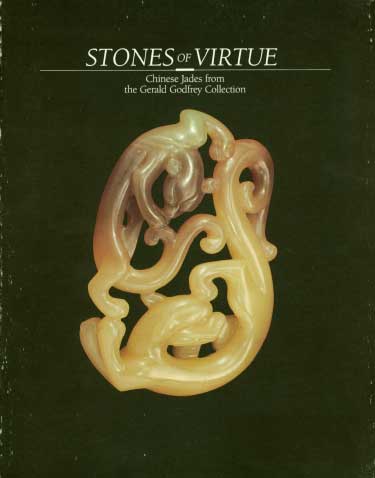
Clarence W. Kelley’s Stones of Virtue: Chinese Jades from the Gerald Godfrey Collection (1989) is an illustrated exhibition catalogue published by the Dayton Art Institute, Ohio, to accompany an exhibition held from January 21 to March 26, 1989. The volume presents selections from Gerald Godfrey’s important private collection of Chinese jade carvings, spanning the Neolithic period through the Qing dynasty. Illustrated with 30 colour plates, the catalogue documents the remarkable diversity of Chinese jade working across several millennia, encompassing ritual objects, ceremonial implements, personal ornaments, animal sculptures, and decorative carvings. The objects represented include bi discs, cong, ceremonial blades, pendants, belt buckles, plaques, rings, toggles, and figures of real and mythical animals. Neolithic and Bronze Age material is represented by objects associated with early Chinese ritual traditions, including a notched ceremonial disc (xuanji) with three deeply cut indentations and incised decoration, subsequently published in other studies of archaic Chinese jade. The collection also encompasses material attributed to the Shang, Zhou, Han, Tang, Song, Ming, and Qing dynasties, illustrating changes in carving techniques, ornamentation, and artistic preferences. Among the later pieces is a Ming dynasty carving of two recumbent geese in pale celadon jade with blackish-brown markings, published as catalogue number 169. Other documented examples include animal carvings and archaistic vessels, demonstrating the continuing importance of earlier Chinese forms as models for later craftsmen. The catalogue is particularly relevant to gemological studies because of its photographic documentation of carved jade objects, including differences in colour, translucency, surface appearance, and the use of natural markings within the stone. The collection provides examples of how Chinese lapidaries adapted the properties of their materials to produce objects ranging from relatively simple prehistoric ceremonial forms to highly elaborate imperial-period carvings. The title reflects the longstanding Chinese association of jade with moral qualities and cultivated virtue, although the historical meaning of Chinese yu encompasses a broader range of valued ornamental stones than the modern mineralogical definition of jade. The publication’s principal value lies in its visual record of an important private collection and its contribution to the chronology and typology of Chinese jade carving. Individual objects have subsequently appeared in international auction catalogues, where Kelley’s publication continues to be cited as a reference for their identification, exhibition history, and provenance.

Building a Gemological Library

Gemological books range from general identification manuals and textbooks to specialized works on individual gems, mineralogy, jewelry, treatments, synthesis, history and gem-producing regions.

For a curated selection of particularly useful books, read The Gemologist's Core Library — Classic Books on Gemology, Jewelry and Mineralogy.

About Four Treasures

Four Treasures is Lotus Gemology's freely accessible gemological reference database. Use the full database to search by author, title or keyword and explore literature on gemology, mineralogy, jewelry and related fields. Where available, hyperlinks on titles may lead directly to the full publication.

Search the Complete Four Treasures Database