Gemstone Inclusions Bibliography

Gemstone Inclusions Bibliography

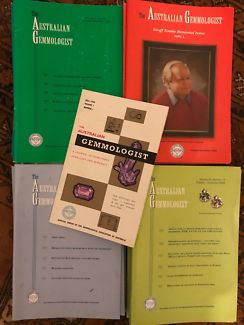
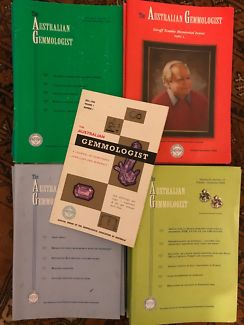
Explore books, articles and historical sources on inclusions in gemstones in Four Treasures, the Lotus Gemology reference database. This bibliography brings together matching records from the collection, with publication details, abstracts and cover images where available.

Gemstone Inclusion References

The list below matches the terms inclusion or inclusions in the database's searchable fields. Some references discuss inclusions as part of a broader subject.

881–900 of 1,111 matching references

Identification characteristics of flux grown synthetic orange sapphires

Identification characteristics of flux grown synthetic orange sapphires

Gunawardene, M. (1985)

Journal Article · Source: Journal of Gemmology · Volume: Vol. 19 · Issue: No. 5, January · Pages: pp. 389–403

Abstract
Gunawardene examines the identification of Chatham flux-grown synthetic orange sapphire, material produced to imitate the orange-pink colour associated with Sri Lankan padparadscha sapphire. The paper documents the material’s gemmological properties and concentrates particularly on microscopic characteristics useful for separating it from natural sapphire. Diagnostic features associated with flux growth include residual flux and characteristic inclusions, together with growth features related to synthetic crystallization. The author also discusses platinum inclusions, derived from the crucibles used during growth, as an important indication of synthetic origin. The study compares these observations with natural orange sapphires and emphasizes microscopic examination as a practical means of identification.
Keywords
corundum, synthetic corundum.7, synthetic orange sapphire, Chatham, flux, gems
An electron microscope study of exsolved phases in natural black Australian sapphire

An electron microscope study of exsolved phases in natural black Australian sapphire

Moon, A.R. and Phillips, M.R. (1984)

Journal Article · Source: Micron and Microscopica Acta · Volume: Vol. 15 · Issue: No. 3 · Pages: pp. 143–146

Abstract
Natural Australian sapphire (α-Al₂O₃ with around 1% Fe and up to 0.03% Ti) occurs in many colours, generally with an abundance of exsolved phases. Such ‘silky’ stones, cut en cabochon, exhibit the well-known phenomenon of asterism. For stones with a well-defined ‘star’ needle-like precipitate phases can be seen under an optical microscope. The needle axes are perpendicular to the star axes and generally parallel to the prism a-axes. (For artificial star sapphire the precipitate needle axes are perpendicular to the prism axes, e.g. Phillips et al., 1980.) Many authors have assumed that these precipitate phases in natural sapphire were needles of rutile (TiO₂) only, as is the case for artificial sapphire (Phillips et al., 1980). Our studies on natural Australian black sapphire, however, confirm the existence of a variety of iron/titanium rich phases, as well as rutile. Sample specimens were prepared by illuminating a polished basal plane with a He-Ne laser to obtain the star directions and then cutting slices of the stone parallel to the star axes. The polished sections were then ion-beam thinned and examined in a JEOL 100CX (S)TEM, equipped with an energy dispersive X-ray spectrometer. Precipitate phases were identified by electron diffraction and from their X-ray spectrum.
Keywords
corundum, sapphire, inclusions.5, Australia.12, gems
Sapphires from Kanchanaburi Province, Thailand

Sapphires from Kanchanaburi Province, Thailand

Gunawardene, M. and Chawla, S.S. (1984)

Journal Article · Source: Journal of Gemmology · Volume: Vol. 19 · Issue: No. 3, July · Pages: pp. 228–239

Abstract
Gunawardene and Chawla describe the sapphire deposits of Bo Phloi, Kanchanaburi Province, western Thailand, a locality that had become an important source of commercial blue sapphire during the preceding decade. The paper gives details of the locality and its accessibility and reviews geological investigations of Kanchanaburi, comparing the occurrence with the better-known basalt-associated gemfields of Chanthaburi–Trat in eastern Thailand. The authors present chemical and physical data for the sapphires and grade their colours using the DIN colour system. Particular attention is given to microscopic examination: characteristic internal features are illustrated with photomicrographs and analyzed for their value in characterizing Kanchanaburi material. The study provides an early detailed gemmological description of sapphires from this important Thai basalt-related deposit.
Keywords
Thailand.12, Bo Ploi, blue sapphire, inclusions.5, corundum, gems
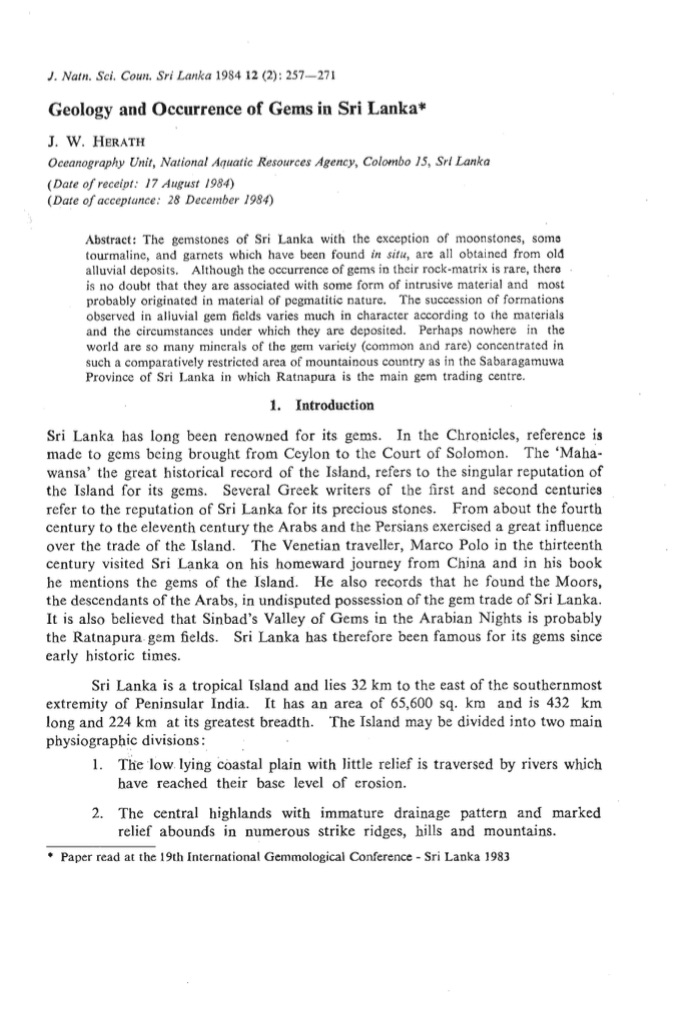
Geology and occurrence of gems in Sri Lanka

Geology and occurrence of gems in Sri Lanka

Herath, J.W. (1984)

Journal Article · Source: Journal of the Natural Science Council of Sri Lanka · Volume: Vol. 12 · Issue: No. 2 · Pages: pp. 257–271

Abstract
As known to the gemmologist and jeweller, East Africa's famous gem locality, Tanzania, is well known not only for garnets of various colour varieties, but also for corundums of many colours and hues. The occurrence of corundum in Tanzania is reported by many researchers (Zwaan, 1974; Dolenc, 1976; Amstutz & Bank, 1977; Bank, 1978). However, these reports mainly describe the common corundum varieties such as ruby and blue and yellow sapphires. Recent observations made by the author on new occurrences of sapphires from Umba Valley revealed a reddish-brown colour variety which has often been termed as 'padparadschah* in the trade. It therefore became necessary to investigate systematically the differences between the 'real' padparadschah and this new occurrence. The chemical and physical properties of the latter are given with special emphasis on the cause of colour. Further, the inclusions are reported, which may be of help in documenting the locality.
Keywords
corundum, Sri Lanka.12, gems
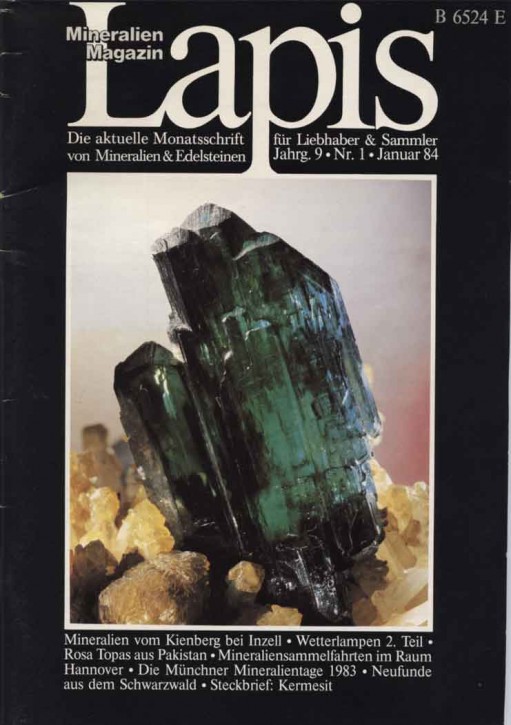
Rosa-Topas aus Pakistan

Rosa-Topas aus Pakistan

Pink topaz from Pakistan

Gübelin, E.J. (1984)

Journal Article · Source: Lapis · Volume: Vol. 9 · Issue: No. 1, January · Pages: pp. 23–28 · Language: in German

Abstract
Gübelin describes gem-quality rose to pink topaz from the Katlang area, northeast of Peshawar, Pakistan. The crystals are well developed and occur together with colorless and brown topaz. Gemological examination gave refractive indices of approximately 1.629–1.642, birefringence 0.009–0.011, and specific gravity 3.515–3.53. The stones show yellow, purple, and lilac-to-violet pleochroism and weak dark-red fluorescence under long-wave ultraviolet radiation. Chemical analysis showed small amounts of chromium and vanadium, with Cr³⁺ principally responsible for the pink coloration. Characteristic internal features include two-phase inclusions and parallel needle-like growth features. The article contains 17 color illustrations.
Keywords
Pakistan, pink topaz, gems
The first-order red compensator: An effective gemological tool

The first-order red compensator: An effective gemological tool

Koivula, J.I. (1984)

Journal Article · Source: Gems & Gemology · Volume: Vol. 20 · Issue: No. 2, Summer · Pages: pp. 101–105

Abstract
This note deals with some gemologjcal applications for n tool well known to microscopists: the first-order red compensator. In gemological microscopy, the compensator can be useful in locating interfer-ence colors and optic figures in birefringent materials and in delipeating strain in gemstones. -Inpolarized-light photomicrography, a properly positioned com-pensator &in reduce the exposure time required and thus the risk of film reciprocity failure and of poor-quality images resulting from random vibrations of the microscope and its accessories.
Keywords
corundum, inclusions.5, photomicrography, gems
Inclusions in a better light

Inclusions in a better light

Koivula, J.I. (1984)

Journal Article · Source: Zeitschrift der Deutschen Gemmologischen Gesellschaft · Volume: Vol. 33 · Issue: No. 1/2 · Pages: pp. 43–47

Keywords
corundum, inclusions.5, photomicrography, gems
“Ramaura”—A new synthetic ruby made in U.S.A.

“Ramaura”—A new synthetic ruby made in U.S.A.

Gunawardene, M. (1984)

Journal Article · Source: Journal of Gemmology · Volume: Vol. 19 · Issue: No. 2, April · Pages: pp. 125–138

Abstract
Gunawardene examines the gemmological properties and identification characteristics of the newly introduced Ramaura synthetic ruby, marketed by Overland Gems Inc. of California and first announced at the 1983 Tucson gem and mineral show. The material is flux-grown and was commercially available as faceted stones as well as lower-grade material, single crystals and crystal clusters. The study describes the external crystal morphology, standard gemmological properties, fluorescence and absorption characteristics, and especially the microscopic features of Ramaura ruby. Particular attention is given to flux-related inclusions and growth structures that distinguish the material from natural ruby and from other contemporary synthetic rubies. The author stresses that some specimens may be relatively straightforward to recognize, whereas cleaner stones require careful microscopic examination and comparison with the diagnostic features of other flux-grown synthetics.
Keywords
corundum, synthetic corundum.7, synthetic ruby, flux, Ramaura, gems
Reddish-brown sapphires from Umba Valley, Tanzania

Reddish-brown sapphires from Umba Valley, Tanzania

Gunawardene, M. (1984)

Journal Article · Source: Journal of Gemmology · Volume: Vol. 19 · Issue: No. 2, April · Pages: pp. 139–144

Abstract
As known to the gemmologist and jeweller, East Africa's famous gem locality, Tanzania, is well known not only for garnets of various colour varieties, but also for corundums of many colours and hues. The occurrence of corundum in Tanzania is reported by many researchers (Zwaan, 1974; Dolenc, 1976; Amstutz & Bank, 1977; Bank, 1978). However, these reports mainly describe the common corundum varieties such as ruby and blue and yellow sapphires. Recent observations made by the author on new occurrences of sapphires from Umba Valley revealed a reddish-brown colour variety which has often been termed as 'padparadschah* in the trade. It therefore became necessary to investigate systematically the differences between the 'real' padparadschah and this new occurrence. The chemical and physical properties of the latter are given with special emphasis on the cause of colour. Further, the inclusions are reported, which may be of help in documenting the locality.
Keywords
corundum, orange sapphire, Umba, Tanzania.12, inclusions.5, gems
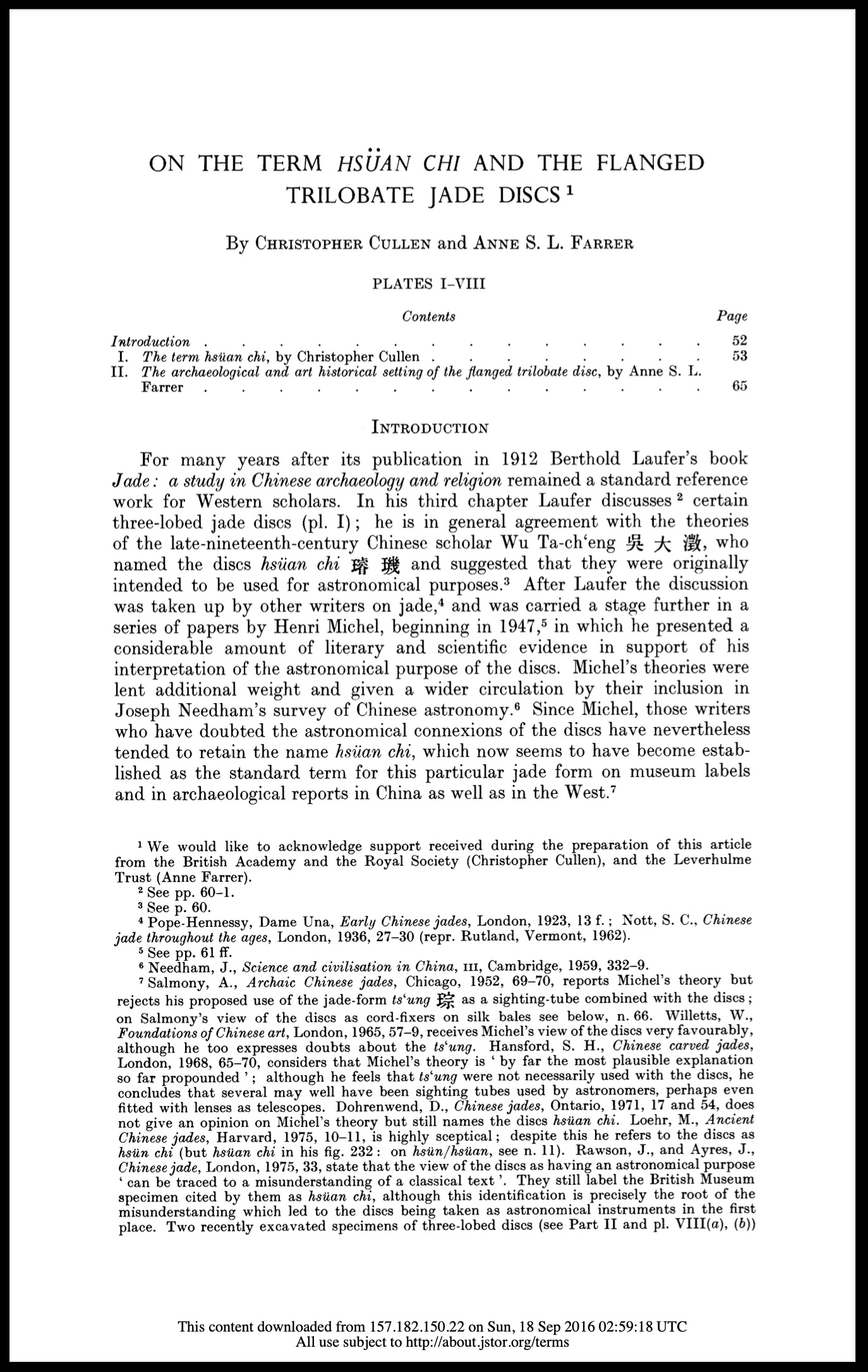
On the term hsüan chi" and the flanged trilobate jade discs"

On the term hsüan chi" and the flanged trilobate jade discs"

Cullen, C. and Anne, S.L.F. (1983)

Journal Article · Source: Bulletin of the School of Oriental and African Studies, University of London · Publisher: [Cambridge University Press, School of Oriental and African Studies] · Volume: Vol. 46 · Issue: No. 1 · Pages: pp. 52–76

Abstract
For many years after its publication in 1912 Berthold Laufer's boo Jade : a study in Chinese archaeology and religion remained a standard referen work for Western scholars. In his third chapter Laufer discusses certain three-lobed jade discs (pl. I); he is in general agreement with the theories of the late-nineteenth-century Chinese scholar Wu Ta-ch'eng, who named the discs hsiian chi and suggested that they were origina intended to be used for astronomical purposes. After Laufer the discussion was taken up by other writers on jade, and was carried a stage further in series of papers by Henri Michel, beginning in 1947, in which he presented considerable amount of literary and scientific evidence in support of his interpretation of the astronomical purpose of the discs. Michel's theories were lent additional weight and given a wider circulation by their inclusion in Joseph Needham's survey of Chinese astronomy. Since Michel, those writers who have doubted the astronomical connexions of the discs have nevertheless tended to retain the name hsian chi, which now seems to have become established as the standard term for this particular jade form on museum labels and in archaeological reports in China as well as in the West.
Keywords
gems, jade, archaic jade, China, Chinese jade carving, nephrite, amphibole jade, cong, hsuen chi
Neues vom Smaragd-Vorkommen von Sta. Terezinha de Goiás, Goiás, Brasilien

Neues vom Smaragd-Vorkommen von Sta. Terezinha de Goiás, Goiás, Brasilien

News from the emerald deposit of Santa Terezinha de Goiás, Goiás, Brazil

Hänni, H.A. and Kerez, C.J. (1983)

Journal Article · Source: Zeitschrift der Deutschen Gemmologischen Gesellschaft · Volume: Vol. 32 · Issue: No. 1 · Pages: pp. 50–58 · Language: in German

Abstract
Hänni and Kerez report gemological and mineralogical investigations of emerald crystals and host rocks from the then-new Santa Terezinha de Goiás deposit in Brazil. The emeralds occur as hexagonal prismatic crystals in talc and biotite schists and range from light to dark green, commonly with a bluish cast. Refractive indices range from 1.585–1.587 to 1.592–1.595, birefringence from 0.006 to 0.008, and specific gravity from 2.752 to 2.764. Electron-microprobe examination identified characteristic solid inclusions of dolomite and picotite (chromian spinel). Many crystals contain internal fractures but lack the liquid films or feather-like inclusions typical of some other emerald deposits. The authors also describe mining conditions: the original southern workings had been largely abandoned in favor of better material found about 500 m to the north, where numerous small claims were worked by blasting and the material transported to washing sites on the Rio Peixe.
Keywords
gems, inclusions, beryl, emerald, Brazil, Santa Terezinha de Goiás
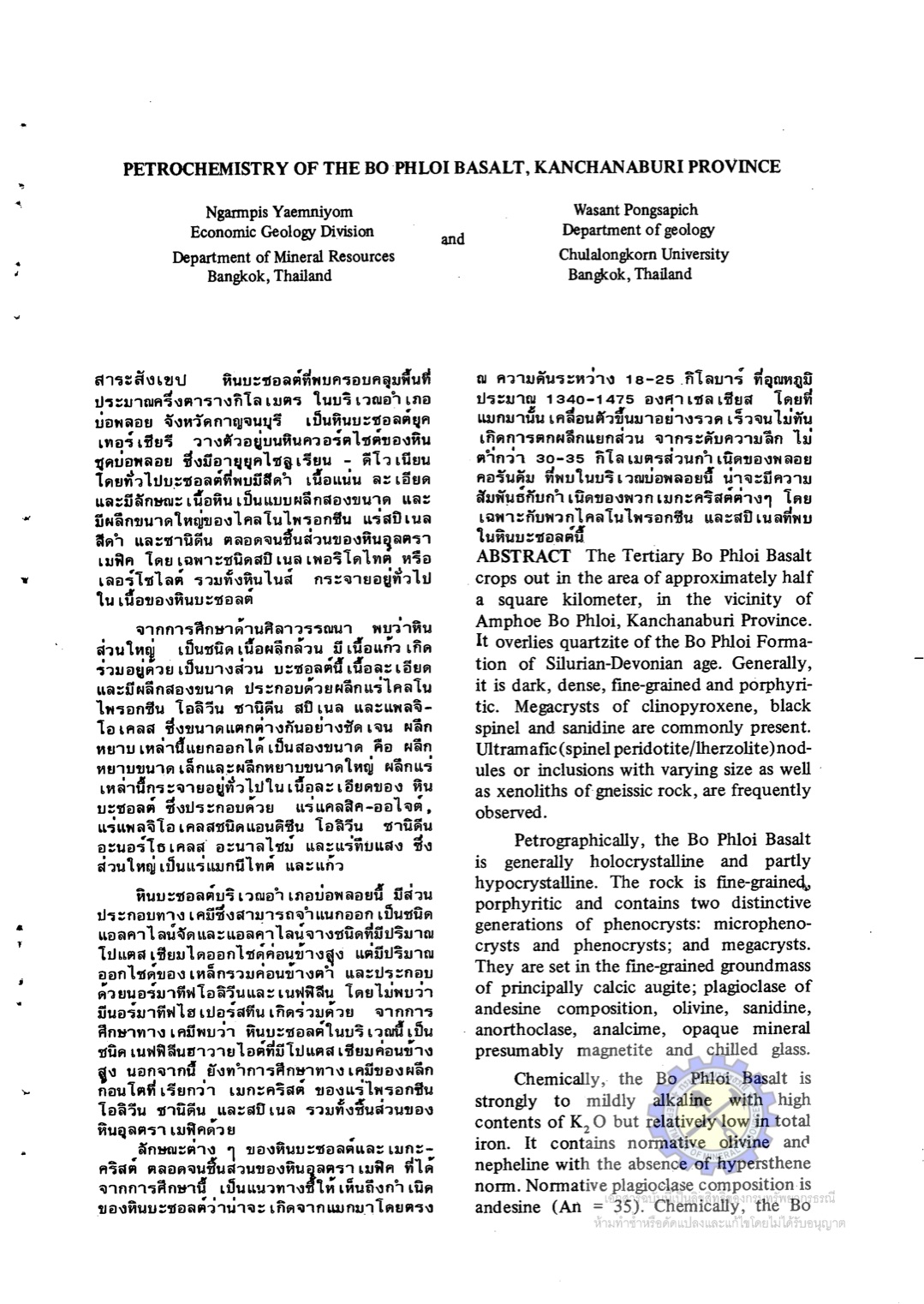
Petrochemistry of the Bo Phloi basalt, Kanchanaburi Province

Petrochemistry of the Bo Phloi basalt, Kanchanaburi Province

Yaemniyom, N. and Pongsapich, W. (1983)

Conference Paper · Source: Proceedings of the Annual Technical Meeting Chiang Mai University · Pages: pp. 19–52

Abstract
The Tertiary Bo Phloi Basalt crops out in the area of approximately half a square kilometer, in the vicinity of Amphoe Bo Phloi, Kanchanaburi Province. It overlies quartzite of the Bo Phloi Formation of Silurian Devonian age. Generally, it is dark, dense, fme-grained and porphyritic. Megacrysts of clinopyroxene, black spinel and sanidine are commonly present. Ultramafic (spinel/peridotite/lherzolite) nodules or inclusions with varying size as well as xenoliths of gneissic rock, are frequently observed.
Keywords
corundum, Thailand.12, gems
Über die synthetischen blauen und orange-farbenen sapphire von Chatham

Über die synthetischen blauen und orange-farbenen sapphire von Chatham

On the synthetic blue and orange-colored sapphires from Chatham

Gunawardene, M. (1983)

Journal Article · Source: Zeitschrift der Deutschen Gemmologischen Gesellschaft · Volume: Vol. 32 · Pages: pp. 196–203 · Language: In German

Abstract
Gunawardene examines the gemological characteristics of Chatham flux-grown synthetic blue and orange sapphires, emphasizing the increasing difficulty of separating such products from natural corundum. Microscopic examination is presented as the most reliable means of identification. Diagnostic internal features include remnants of the flux melt and platinum inclusions, while growth structures may closely resemble those found in natural sapphire, although subtle differences can aid identification. The paper illustrates these features with eight figures, six in color, and discusses their usefulness in distinguishing Chatham synthetic sapphires from natural stones.
Keywords
corundum, synthetic corundum.7, flux, Chatham, gems
Synthetic rubies made by Knischka

Synthetic rubies made by Knischka

Gunawardene, M. (1983)

Journal Article · Source: Journal of Gemmology · Volume: Vol. 18 · Issue: No. 5, January · Pages: pp. 365–378

Abstract
Gunawardene examines the gemmological and crystallographic characteristics of the newly developed Knischka synthetic ruby, produced by Paul Otto Knischka of Austria using a modified gradient-transport technique involving supercooling and supersaturation. The paper describes the unusual crystal morphology of the material, including the development of numerous additional crystal faces, and compares these forms with those of natural corundum. Particular attention is given to microscopic identification. Characteristic internal features include turbid clouds, swirls of colour, liquid or feather-like patterns, negative crystals associated with elongated crystalline tubes, metallic platelets, melt residues and two-phase inclusions. Although some inclusions can resemble features in natural ruby or other synthetic rubies, their morphology and associations provide useful criteria for recognizing Knischka material. The study emphasizes microscopy as the principal means of identification and illustrates the diagnostic inclusions and crystal-growth features in detail.
Keywords
corundum, synthetic corundum.7, flux, Knischka, gems

Exploring the Literature of Gemstone Inclusions

The literature of gemstone inclusions covers identification, origin determination, treatments, synthesis, mineral inclusions, fluid inclusions and other internal features of natural and synthetic gems.

For a curated selection of important sources, read Inclusions in Gemstones — Hyperion Literature Sources.

About Four Treasures

Four Treasures is Lotus Gemology's freely accessible gemological reference database. Use the full database to search by author, title or keyword and explore literature on gemology, mineralogy, jewelry and related fields. Where available, hyperlinks on titles may lead directly to the full publication.

Search the Complete Four Treasures Database