Gemstone Inclusions Bibliography

Gemstone Inclusions Bibliography

Explore books, articles and historical sources on inclusions in gemstones in Four Treasures, the Lotus Gemology reference database. This bibliography brings together matching records from the collection, with publication details, abstracts and cover images where available.

Gemstone Inclusion References

The list below matches the terms inclusion or inclusions in the database's searchable fields. Some references discuss inclusions as part of a broader subject.

1,081–1,100 of 1,109 matching references
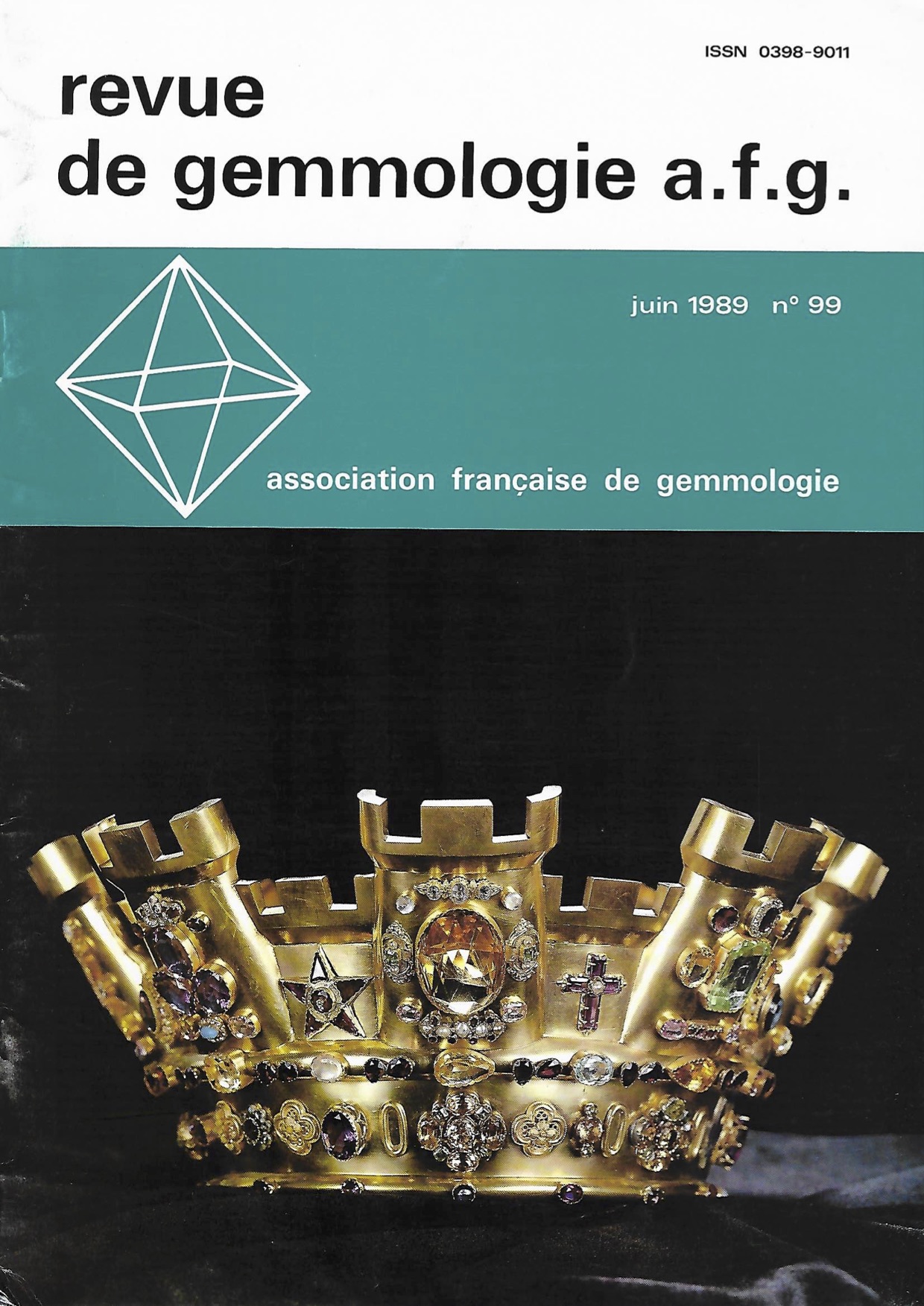
Deux nouveaux produits artificiels sur le marché des pierres précieuses: Le rubis synthétique “Ramaura” et le gallo-aluminate d’yttrium

Deux nouveaux produits artificiels sur le marché des pierres précieuses: Le rubis synthétique “Ramaura” et le gallo-aluminate d’yttrium

Two new artificial products on the gemstone market: Synthetic ruby “Ramaura” and yttrium gallo-aluminate

Gübelin, E.J. (1985–1986)

Journal Article · Source: Revue de Gemmologie A.F.G. · Issue: No. 85, pp. 13–16; No. 86, p. 15; No. 87, pp. 15–16 · Language: in French

Abstract
Gübelin describes two recently introduced artificial gem materials: Ramaura flux-grown synthetic ruby and yttrium gallium aluminate (YAG), the latter marketed as a green imitation of tsavorite garnet. The first portion discusses the manufacture and gemological properties of Ramaura ruby and emphasizes microscopic features useful for separating it from natural ruby, particularly characteristic flux residues and growth-related inclusions. The later installments treat yttrium gallium aluminate, describing its physical and optical properties and characteristic inclusions. The green material has a high refractive index and specific gravity and contains distinctive reddish-brown flux inclusions and wispy veil-like features. The series illustrates the importance of inclusion microscopy in recognizing artificial gem materials whose appearance may closely resemble natural gemstones. Contemporary abstracts confirm that the second installment concentrates on characteristic inclusions and the third on the physical and optical properties and inclusions of yttrium gallium aluminate.
Keywords
corundum, synthetic corundum.7, Ramaura, synthetic garnet, gems
Genetische Aspekte der Mineral-Einschlüsse in Farbsteinen

Genetische Aspekte der Mineral-Einschlüsse in Farbsteinen

Genetic aspects of mineral inclusions in colored gemstones

Gübelin, E.J. (1983)

Journal Article · Source: Zeitschrift der Deutschen Gemmologischen Gesellschaft · Volume: Vol. 32 · Issue: No. 1 · Pages: pp. 10–27 · Language: In German

Abstract
Gübelin discusses mineral inclusions in colored gemstones from the standpoint of their genesis and the information they provide about the geological environment in which their host crystals formed. He distinguishes inclusions according to their relationship to the growth history of the host—pre-existing minerals incorporated during growth, minerals formed contemporaneously with the host, and minerals produced by later alteration or exsolution. Particular attention is given to the morphology, orientation and mineralogical identity of inclusions and to mineral associations characteristic of different geological environments. Such inclusion assemblages can provide evidence for the conditions and sequence of gemstone formation and, in favorable cases, assist in determining geographic origin. The article represents Gübelin’s broader approach of treating inclusions not merely as identification features but as records of gemstone genesis.
Keywords
inclusions, gems
Marques de distinction des nouveaux rubis synthétiques

Marques de distinction des nouveaux rubis synthétiques

Distinguishing marks of new synthetic rubies

Gübelin, E.J. (1983)

Journal Article · Source: Revue de Gemmologie A.F.G. · Issue: No. 76, septembre · Language: in French

Abstract
Gübelin describes the diagnostic characteristics of the newer flux-grown synthetic rubies produced by Chatham, Kashan and Knischka. Particular emphasis is placed on microscopic examination of their characteristic inclusions, some of which may resemble features encountered in natural ruby and therefore complicate identification. The article illustrates and compares the internal features of the three products, showing how inclusion morphology and growth-related characteristics can be used to distinguish these synthetic rubies from natural stones. The paper contains 42 figures, 41 in color.
Keywords
corundum, synthetic corundum.7, gems
Peridot von Zabargad, Rotes Meer

Peridot von Zabargad, Rotes Meer

Peridot from Zabargad, Red Sea

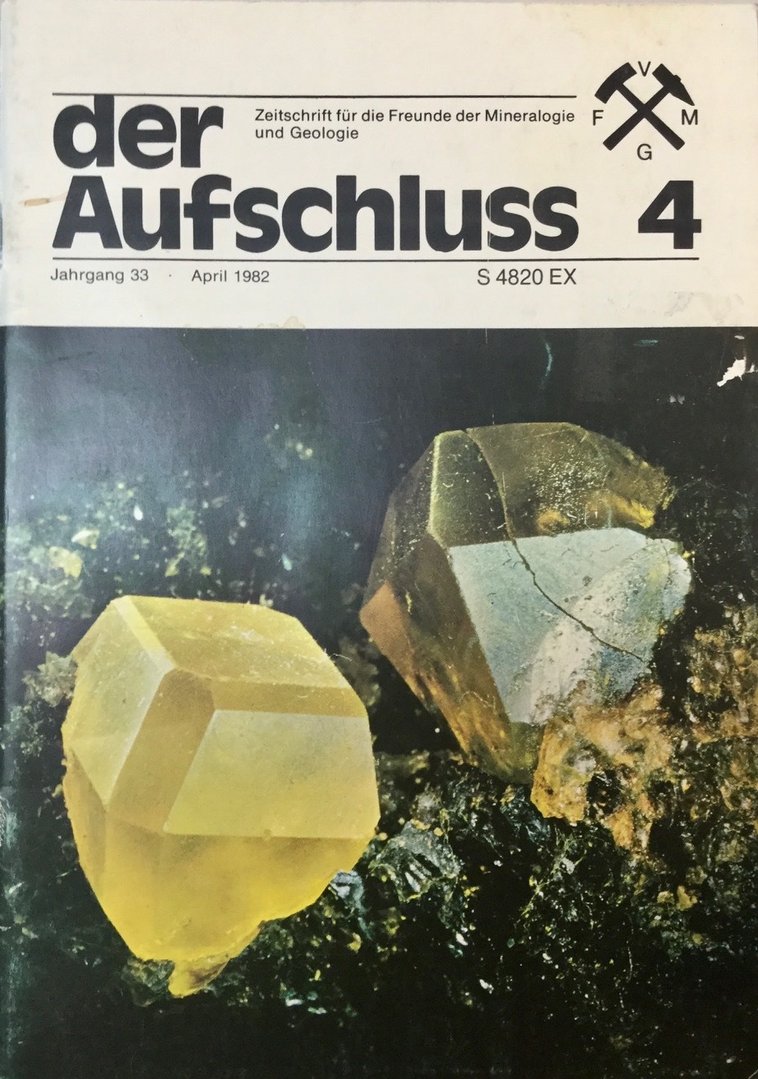
Kurat, G., Niedermayr, G. and Pring, M. (1982)

Journal Article · Source: Der Aufschluss · Volume: Vol. 33 · Pages: pp. 169–182 · Language: in German

Abstract
Sinkankas: Account of a personal visit in 1980: geology, petrology, deposits, peridot & inclusions, chemistry, genesis,mineral associates, etc.- valuable firsthand information.
Keywords
peridot, St. John’s Island, Egypt, gems, Classical world
Eine neue Edelstein-Varietät aus Tansania: Gelbe, grüne und rötlich-braune Apatit-Katzenaugen

Eine neue Edelstein-Varietät aus Tansania: Gelbe, grüne und rötlich-braune Apatit-Katzenaugen

A new gemstone variety from Tanzania: Yellow, green, and reddish-brown apatite cat's eyes

Gübelin, E.J. and Schmetzer, K. (1982)

Journal Article · Source: Zeitschrift der Deutschen Gemmologischen Gesellschaft · Volume: Vol. 31 · Issue: No. 4 · Pages: pp. 261–264 · Language: In German

Abstract
Gübelin and Schmetzer describe a new occurrence of cat’s-eye apatite from the Umba Valley, Tanzania, occurring in yellow, green and reddish-brown colors. A small proportion of the material is clear and transparent, but most specimens contain abundant fine, fibre-like inclusions and are therefore suitable for cabochon cutting. Properly oriented cabochons display a strong, sharply defined cat’s-eye effect. Examination of the inclusions showed that the chatoyancy is produced by numerous minute needles of goethite. The article illustrates the material with four color photographs.
Keywords
apatite, Tanzania, gems
Naturfarbene und behandelte gelbe und orange-braune Saphire

Naturfarbene und behandelte gelbe und orange-braune Saphire

Natural and treated yellow and orange-brown sapphires

Schmetzer, K., Bosshart, G. and Hänni, H. (1982)

Journal Article · Source: Zeitschrift der Deutschen Gemmologischen Gesellschaft · Volume: Vol. 31 · Pages: pp. 265–279 · Language: In German

Keywords
corundum, sapphire, color.4, inclusions.5, treatments.6, East Africa.12, Sri Lanka.12, Tanzania.12, gems
Neue Mikrosonden-Analysen von Mineral-Einschlüssen einschliesslich eines Rubins im Diamant

Neue Mikrosonden-Analysen von Mineral-Einschlüssen einschliesslich eines Rubins im Diamant

New microprobe analyses of mineral inclusions including a ruby in diamond

Gübelin, E.J. (1982)

Journal Article · Source: Zeitschrift der Deutschen Gemmologischen Gesellschaft · Volume: Vol. 31 · Issue: No. 1/2 · Pages: pp. 23–40 · Language: In German

Abstract
Gübelin reports electron-microprobe analyses of mineral inclusions from nine diamonds. The inclusions were studied either after crushing the host diamond and separating the enclosed mineral, or by cutting and polishing the diamond until an inclusion was exposed at the surface; separated inclusions could also be examined by X-ray methods. The analytical results are presented for the various inclusion minerals, with discussion of their significance for the origin and formation of their diamond hosts. Of particular interest is the identification of a red inclusion as corundum (ruby), the first substantiated occurrence of ruby as an inclusion in natural diamond; this ruby is assigned to the eclogitic suite of diamond inclusions. The paper contains 17 figures, 16 in color, and two tables.
Keywords
diamond, inclusions, gems

Förklaring av den optiska teorin om kattöque- och stjärn-effekt i ädelstenar

Explanation of the optical theory of cat’s-eye and star effects in gemstones

Gübelin, E.J. (1982)

Journal Article · Source: Gem: Bulletinen Stockholms Gemmologiska Förening · Issue: No. 2 · Pages: pp. 5–10 · Language: in Swedish

Abstract
Gübelin explains the optical principles responsible for chatoyancy (the cat’s-eye effect) and asterism (the star effect) in gemstones. He relates these phenomena to the reflection and scattering of light by numerous regularly oriented inclusions within a transparent or translucent host crystal. Parallel inclusions produce a single luminous band perpendicular to their orientation, giving the cat’s-eye effect when the stone is appropriately cut en cabochon. When inclusions occur in two or more intersecting crystallographic directions, the corresponding bands intersect to produce a star. The geometry and orientation of the inclusions, together with the orientation and shape of the cabochon, therefore determine the position and appearance of the optical effect.
Keywords
chatoyancy, asterism, gems
Erkennungsmerkmale der neuen synthetischen Saphire

Erkennungsmerkmale der neuen synthetischen Saphire

Identification features of the new synthetic sapphires

Gübelin, E.J. (1982)

Journal Article · Source: Deutsche Goldschmiede-Zeitung · Volume: Vol. 80 · Issue: No. 11, November · Pages: pp. 51–57 · Language: in German

Abstract
Gübelin discusses the identification of newly available synthetic and treated blue sapphires, concentrating on Chatham flux-grown synthetic sapphire and on natural sapphires whose color has been modified by heat treatment or surface diffusion. He describes the crystal habits and physical and optical properties of rough and faceted Chatham material, followed by a detailed examination of diagnostic inclusions, some of which closely resemble inclusions in natural sapphire. Twenty-three color photomicrographs illustrate these features. A further 15 photomicrographs document characteristics of color-enhanced sapphires, including altered mineral inclusions surrounded by tension cracks, pockmarked girdle surfaces, pronounced color zoning, and concentrations of color in surface-reaching fractures.
Keywords
corundum, synthetic corundum.7, gems
Taprobanit: Ein neuer Edelstein aus Sri Lanka

Taprobanit: Ein neuer Edelstein aus Sri Lanka

Taprobanite: A new gemstone from Sri Lanka

Gübelin, E.J. (1981)

Journal Article · Source: Zeitschrift der Deutschen Gemmologischen Gesellschaft · Volume: Vol. 30 · Issue: No. 3/4 · Pages: pp. 179–206 · Language: In German

Abstract
Gübelin describes “taprobanite,” a rare red gemstone from Sri Lanka initially thought to be taaffeite because of its similar appearance and gemological properties. Detailed examination showed it to represent a distinct member of the taaffeite mineral group, characterized by differences in chemical composition, crystallographic properties, and optical behavior. The study discusses its identification, physical and optical constants, absorption characteristics, inclusions, and relationship to taaffeite, emphasizing the difficulty of recognizing such rare stones by conventional gemological testing alone. The name derives from Taprobane, the ancient name for Sri Lanka.
Keywords
taaffeite, Sri Lanka, gems
Einschlüsse im Granat aus dem Umba-Tal

Einschlüsse im Granat aus dem Umba-Tal

Inclusions in garnet from the Umba Valley

Gübelin, E.J. (1981)

Journal Article · Source: Zeitschrift der Deutschen Gemmologischen Gesellschaft · Volume: Vol. 30 · Issue: No. 3/4 · Pages: pp. 182–194 · Language: In German

Abstract
Gübelin examines the internal features of garnets from Tanzania’s Umba Valley, a locality producing garnets across the pyrope–almandine–spessartine compositional range. The paper documents and illustrates their characteristic inclusions and considers their value for gemological identification and for interpreting the conditions under which the garnets formed. Later inclusion literature specifically records crystallographically oriented networks and star-like arrangements of rutile needles in Umba Valley garnets, citing Gübelin’s work on this material.
Keywords
garnet, Umba Valley, Tanzania, gems
Étude par spectroscopie raman d'inclusions dans les diamants, saphirs et émeraudes

Étude par spectroscopie raman d'inclusions dans les diamants, saphirs et émeraudes

Study by Raman spectroscopy of inclusions in diamonds, sapphires, and emeralds

Dele-Dubois, M.-L., Dhamelincourt, P. and Schubnel, H.-J. (1980)

Journal Article · Source: Revue de Gemmologie A.F.G. · Issue: No. 63 · Pages: pp. 11–14 · Language: in French

Abstract
Dele-Dubois, Dhamelincourt, and Schubnel examine the application of Raman spectroscopy to the non-destructive identification of mineral inclusions in diamonds, sapphires, and emeralds. The technique permits inclusions to be analyzed in situ through the host gemstone by means of their characteristic Raman spectra, avoiding the need to extract or otherwise damage them. The authors demonstrate the usefulness of Raman spectroscopy for identifying very small inclusions that may be difficult to determine by conventional microscopy, illustrating its value both for gemological identification and for investigating the mineral assemblages trapped during gemstone formation.
Keywords
corundum, inclusions.5, diamond, beryl, emerald, spectroscopy, gems
Synthetische Rubine mit Edelsteinqualität, isometrischem Habitus und hoher Zahl unbeschädigter Kristallflächen

Synthetische Rubine mit Edelsteinqualität, isometrischem Habitus und hoher Zahl unbeschädigter Kristallflächen

Synthetic rubies with gemstone quality, isometric habit, and a high number of undamaged crystal faces

Gübelin, E.J. and Knischka, P.O. (1980)

Journal Article · Source: Zeitschrift der Deutschen Gemmologischen Gesellschaft · Volume: Vol. 29 · Issue: No. 3/4 · Pages: pp. 155–185 · Language: In German

Abstract
Gübelin and Knischka describe a new gem-quality synthetic ruby produced by Paul O. Knischka using a proprietary “gradient technique” involving supersaturation and controlled cooling. The resulting crystals have an unusual nearly isometric or pseudocubic habit and exceptionally numerous well-developed, undamaged crystal faces, with examples possessing 32 or 38 faces. The authors compare several types of Knischka synthetic ruby with natural and Verneuil synthetic ruby, examining crystal morphology, trace-element chemistry, optical and gemological properties, fluorescence, and inclusions. In color and general appearance the material closely resembles natural ruby, although it tends toward a more violet red; refractive index, birefringence, and other standard properties offer little assistance in separation. Microscopic features include folded or feather-like inclusions, color zoning, two-phase inclusions, negative crystals, and occasional metallic platelets, some of which can resemble features in natural stones. The study emphasizes the increasing difficulty of distinguishing high-quality synthetic ruby from natural material and the potential diagnostic value of inclusions and trace-element composition.
Keywords
corundum, synthetic corundum.7, gems
Natur und Bedeutung der Mineral-Einschlüsse im natürlichen Diamanten: Eine Uebersicht

Natur und Bedeutung der Mineral-Einschlüsse im natürlichen Diamanten: Eine Uebersicht

Nature and significance of mineral inclusions in natural diamonds: An overview

Gübelin, E.J. (1978)

Journal Article · Source: Zeitschrift der Deutschen Gemmologischen Gesellschaft · Volume: Vol. 27 · Issue: No. 2 · Pages: pp. 61–101 · Language: In German

Abstract
Gübelin reviews the nature and significance of mineral inclusions in natural diamond, considering included minerals as evidence bearing on diamond formation and its geological environment. The paper surveys the principal types of mineral inclusions recognized in diamonds and discusses their mineralogical relationships and importance for understanding the conditions and processes of diamond genesis.
Keywords
diamond, inclusions, gems
Schwarze Einschlüsse in Diamanten

Schwarze Einschlüsse in Diamanten

Black inclusions in diamonds

Gübelin, E.J. (1974)

Journal Article · Source: Zeitschrift der Deutschen Gemmologischen Gesellschaft · Issue: No. 2 · Language: In German

Abstract
Gübelin discusses black inclusions occurring in diamonds and their appearance under gemological examination. The article concerns the nature and identification of these dark internal features and their significance as inclusions in natural diamond.
Keywords
diamond, inclusions, gems
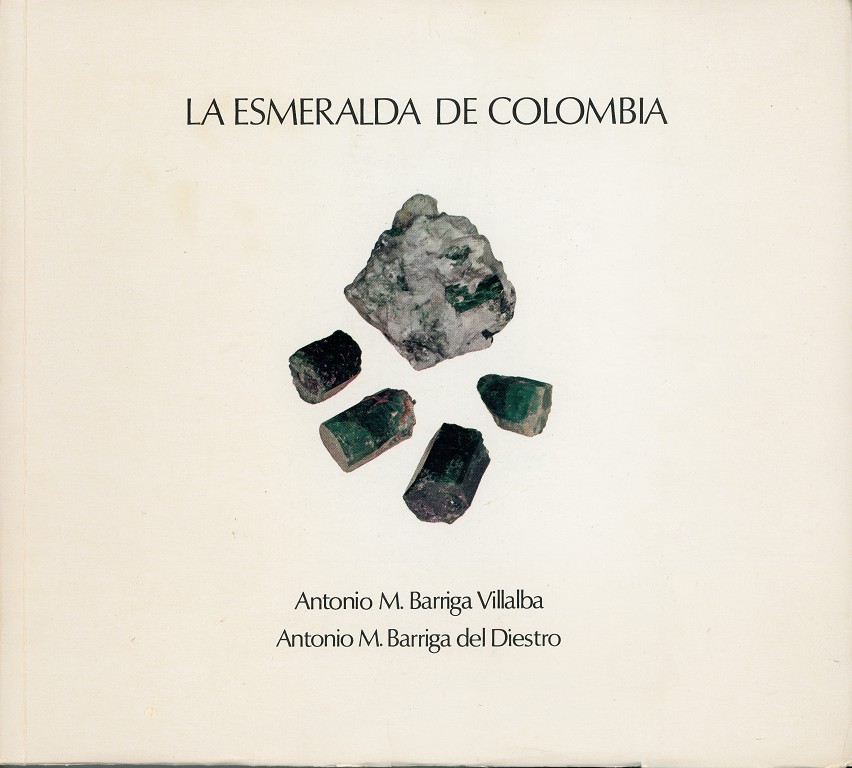
La esmeralda de Colombia: Descripción y Propiedades

La esmeralda de Colombia: Descripción y Propiedades

The Emerald of Colombia: Description and Properties

Barriga Villalba, A.M. and Barriga del Diestro, A.M. (1973)

Book · Publisher: Colegio Mayor de Nuestra Señora del Rosario, Departamento de Publicaciones · Pages: 100 pp. · Language: in Spanish

Abstract
Barriga Villalba and Barriga del Diestro present a monographic study of Colombian emerald, describing its principal characteristics and properties. The work considers emerald as a mineral and gemstone, with attention to its physical and optical properties, characteristic color and inclusions, and the features associated with Colombian material. It also discusses the geological occurrence and principal emerald-producing areas of Colombia, particularly the deposits of the Eastern Cordillera, and addresses aspects of mining and the evaluation of emeralds. The volume provides a contemporary Colombian account of the country’s most important gemstone and its distinguishing gemological and geological characteristics.
Keywords
beryl, emerald, Colombia, gems
Die Natur der Mineraleinschlüsse in Edelsteinen

Die Natur der Mineraleinschlüsse in Edelsteinen

On the nature of mineral inclusions in gemstones

Gübelin, E.J. (1969)

Journal Article · Source: Deutsche Goldschmiede-Zeitung · Issue: March, April, June · Language: in German

Abstract
Gübelin examines the nature and significance of mineral inclusions in gemstones, treating inclusions as evidence of the geological conditions and processes under which their host crystals formed. He discusses the morphology, identification, orientation, and genetic relationships of included minerals and shows how inclusion assemblages and their relationships to other internal features can assist in gemstone identification and provide information on genesis and, in favorable cases, origin. Particular emphasis is placed on systematic microscopic observation and on interpreting inclusions as records of a gemstone’s crystallization and subsequent geological history.
Keywords
inclusions, gems
Die Natur der Mineraleinschlüsse in Edelsteinen

Die Natur der Mineraleinschlüsse in Edelsteinen

The nature of mineral inclusions in gemstones

Gübelin, E.J. (1968)

Journal Article · Source: Schweizer Goldschmied · Issue: mit fortsetzungen · Language: in German

Abstract
First comprehensive article on the determination of inclusions in gemstones by means of the electron microprobe. Techniques are described and results explained. Fine color illustrations. Essentially the same article appeared in Journal of Gemmology, 11(5), 1969, pp. 149–192, with 80 color photographs, 3 figures, and 49 references.
Keywords
inclusions, gems
Black star corundum

Black star corundum

Peterson, H. (1968)

Journal Article · Source: Rocks & Minerals · Volume: Vol. 43 · Pages: pp. 492–493

Abstract
Peterson discusses black star corundum, a dark variety of corundum that displays asterism when cut en cabochon. The article describes the appearance and gemological characteristics of the material and the inclusions responsible for the star effect, produced by oriented needle-like inclusions that reflect light along crystallographically controlled directions. It considers the relationship between the dark body color, inclusions, and visibility of the star, as well as the orientation required in cutting to display the phenomenon effectively. The brief account provides a practical description of black star corundum and the optical phenomenon responsible for its distinctive appearance.
Keywords
corundum, Canada.12, gems

Exploring the Literature of Gemstone Inclusions

The literature of gemstone inclusions covers identification, origin determination, treatments, synthesis, mineral inclusions, fluid inclusions and other internal features of natural and synthetic gems.

For a curated selection of important sources, read Inclusions in Gemstones — Hyperion Literature Sources.

About Four Treasures

Four Treasures is Lotus Gemology's freely accessible gemological reference database. Use the full database to search by author, title or keyword and explore literature on gemology, mineralogy, jewelry and related fields. Where available, hyperlinks on titles may lead directly to the full publication.

Search the Complete Four Treasures Database