Gemstone Inclusions Bibliography

Gemstone Inclusions Bibliography

Explore books, articles and historical sources on inclusions in gemstones in Four Treasures, the Lotus Gemology reference database. This bibliography brings together matching records from the collection, with publication details, abstracts and cover images where available.

Gemstone Inclusion References

The list below matches the terms inclusion or inclusions in the database's searchable fields. Some references discuss inclusions as part of a broader subject.

1,061–1,080 of 1,109 matching references
Alexandrit aus einem heuentdeckten Vorkommen in Brasilien

Alexandrit aus einem heuentdeckten Vorkommen in Brasilien

Alexandrite from a newly discovered deposit in Brazil

Gübelin, E.J. (1988)

Journal Article · Source: Schweizerische Uhrmacher- und Goldschmiede-Zeitung (SUZ) · Issue: No. 2 · Pages: pp. 16–22 · Language: in German

Abstract
Gübelin reports on the newly discovered Hematita alexandrite deposit in Minas Gerais, Brazil, discovered in 1987 and notable for producing unusually fine and relatively clean material. He describes the appearance and gemological characteristics of the alexandrite, including its pronounced color change from greenish hues in daylight to reddish or purplish red under incandescent illumination. Particular attention is given to internal features useful for identifying the Brazilian material. Among the characteristic mineral inclusions subsequently identified in Hematita alexandrite are fluorite and apatite, together with mica and fluid inclusions. The discovery was significant because Hematita rapidly became an important source of fine alexandrite at a time when supplies from the traditional Russian and Sri Lankan sources were limited.
Keywords
alexandrite, Brazil, gems
Die Abkühlungsgeschwindigkeit als Ursache für die Bildung entweder von Sternkorunden oder von kornblumenblauen Saphiren

Die Abkühlungsgeschwindigkeit als Ursache für die Bildung entweder von Sternkorunden oder von kornblumenblauen Saphiren

The cooling rate as the cause for the formation of either star corundums or cornflower blue sapphires

Harder, H. and Schneider, A. (1987)

Journal Article · Source: Neues Jahrbuch fuer Mineralogie Monatshefte · Issue: No. 8 · Pages: pp. 344—346 · Language: in German

Abstract
Harder and Schneider investigate experimentally how cooling rate controls whether Ti-bearing corundum develops asterism or a cornflower-blue color. They relate the two effects to the behavior of titanium during cooling: under conditions permitting exsolution, titanium is precipitated as oriented rutile needles, producing the silk responsible for asterism; under different cooling conditions, titanium remains incorporated in the corundum lattice, where interaction between iron and titanium produces blue coloration. Thus, corundum of essentially comparable composition can develop either the oriented rutile inclusions required for a star effect or the transparent blue appearance characteristic of sapphire, depending upon its thermal history. The paper emphasizes cooling rate as a decisive factor governing the distribution of titanium between the corundum lattice and exsolved rutile.
Keywords
corundum, chemistry.2, gems
Tiploidite in quartz

Tiploidite in quartz

Koivula, J.I., Fryer, C.W. and Gübelin, E.J. (1987)

Journal Article · Source: Indian Gemmologist · Volume: Vol. 1 · Issue: No. 2 · Pages: pp. 5–7

Keywords
quartz, inclusions, gems
Die Feldspäte als Wirt- und Gastmineralien

Die Feldspäte als Wirt- und Gastmineralien

The feldspars as host and guest minerals

Gübelin, E.J. and Koivula, J.I. (1986)

Journal Article · Source: Schweizerische Uhrmacher- und Goldschmiede-Zeitung (SUZ) · Issue: No. 11 · Pages: pp. 26–29, 30–31 · Language: in German

Abstract
Gübelin and Koivula examine feldspars both as gemstones containing inclusions and as mineral inclusions occurring within other gemstones. Using photomicrographs, they illustrate characteristic internal features of gem feldspars—including members of the orthoclase and plagioclase groups—and examples in which feldspar itself occurs as an included mineral. The article emphasizes the value of identifying such inclusions for understanding the geological environment and formation history of their host gemstones, while demonstrating the considerable variety of microscopic features associated with the feldspar group.
Keywords
gems, inclusions, feldspar, orthoclase, moonstone, sunstone
Les inclusions dans la péridot

Les inclusions dans la péridot

Inclusions in peridot

Gübelin, E.J. (1986)

Journal Article · Source: Monde et Mineraux · Issue: No. 76, November–December · Pages: pp. 28–29 · Language: in French

Abstract
Gübelin gives a brief illustrated account of inclusions characteristic of peridot. He describes the internal features encountered in gem-quality olivine, emphasizing mineral inclusions and their diagnostic appearance under the microscope. Typical features of peridot include chromite and other spinel-group crystals, commonly surrounded by stress fractures or disc-like halos, as well as negative crystals and partially healed fractures. Such inclusions are useful both for identifying natural peridot and for interpreting aspects of its geological formation.
Keywords
peridot, inclusions, gems
Les opales Mexicaines

Les opales Mexicaines

Mexican opals

Gübelin, E.J. (1986)

Journal Article · Source: Revue de Gemmologie A.F.G. · Issue: No. 88, September · Pages: pp. 3–6, with 11 color figures · Language: in French

Abstract
Gübelin provides a historical and technical survey of Mexican opal, discussing the principal varieties and their major localities. He notes the use of opal in pre-Columbian Mexico and describes the important deposits in the volcanic regions of Querétaro and Jalisco, where opal occurs in cavities and fractures in rhyolitic rocks. Particular attention is given to Mexican fire opal, with its characteristic yellow, orange and red body colors, as well as transparent precious opal displaying play-of-color. The article discusses the appearance, occurrence and characteristic inclusions of Mexican material; later studies cite Gübelin for two- and three-phase inclusions and mineral inclusions including hornblende, goethite, hematite, fluorite, quartz, cristobalite and chalcedony in Querétaro opal.
Keywords
opal, Mexico, gems
Die diagnostischen eigenschaften der neuen synthesen

Die diagnostischen eigenschaften der neuen synthesen

The diagnostic properties of the new syntheses

Gübelin, E.J. (1986)

Journal Article · Source: Deutsche Goldschmiede-Zeitung · Volume: Vol. 84 · Issue: No. 11 · Pages: pp. 69–76 · Language: in German

Abstract
Gübelin reviews the diagnostic properties of several recently introduced synthetic gemstones and the problems they pose for separation from their natural counterparts. Emphasis is placed on the combination of conventional gemological properties with microscopic examination of inclusions and growth structures, supplemented where necessary by spectroscopic and other analytical methods. The article discusses characteristic features of newer synthetic materials, particularly synthetic corundum and emerald, and shows that physical constants alone may be insufficient for identification as manufacturing techniques increasingly reproduce the appearance and properties of natural stones. Gübelin stresses the diagnostic importance of flux residues, metallic inclusions, growth zoning and other internal features associated with particular synthesis processes. The paper summarizes practical criteria by which these newer products can be recognized in gemological testing.
Keywords
beryl, synthetic beryl, emerald, synthetic corundum, gems
Rasterelektronen-mikroskopie. Einige anwendungen in der edelsteinforschung

Rasterelektronen-mikroskopie. Einige anwendungen in der edelsteinforschung

Scanning electron microscopy. Some applications in gemstone research

Hofmann, C., Schrader, H.W. and Stender, E. (1985)

Journal Article · Source: Goldschmiede Zeitung · Volume: Vol. 83 · Issue: No. 6 · Pages: pp. 76–77 · Language: In German

Abstract
Hofmann, Schrader and Stender describe applications of scanning electron microscopy (SEM) to gemological research, emphasizing its usefulness for examining surface structures and extremely small features beyond the practical resolution of conventional gemological microscopy. Examples illustrate how the technique can reveal the morphology of inclusions, growth and dissolution features, fracture surfaces, and other microscopic structures relevant to gemstone investigation. When combined with electron-beam microanalysis, SEM also permits localized chemical characterization of minute inclusions or surface features. The brief article demonstrates the value of SEM as a complementary research technique where conventional optical microscopy alone provides insufficient morphological or compositional information.
Keywords
beryl, synthetic beryl, emerald, gems, SEM
Edelsteine und ihre Mineraleinschlüsse

Edelsteine und ihre Mineraleinschlüsse

Gemstones and their mineral inclusions

Weibel, M. (1985)

Book · Publisher: ABC Verlag · Pages: 111 pp. · Language: in German

Abstract
Weibel provides a concise survey of the principal gemstones with particular emphasis on their mineral inclusions and what these reveal about gemstone formation. Rather than being solely an inclusion atlas, the book introduces the major gem species and relates their characteristic internal minerals and structures to their geological genesis. Numerous photomicrographs illustrate diagnostic inclusions and demonstrate their value for understanding the conditions under which their host gemstones crystallized. The volume was prepared with the assistance of Eduard J. Gübelin, who also supplied some of the photographs. It contains 83 color and 23 black-and-white illustrations. A contemporary Journal of Gemmology review specifically praises its treatment of inclusions and the accompanying explanations of their formation.
Keywords
inclusions, gems
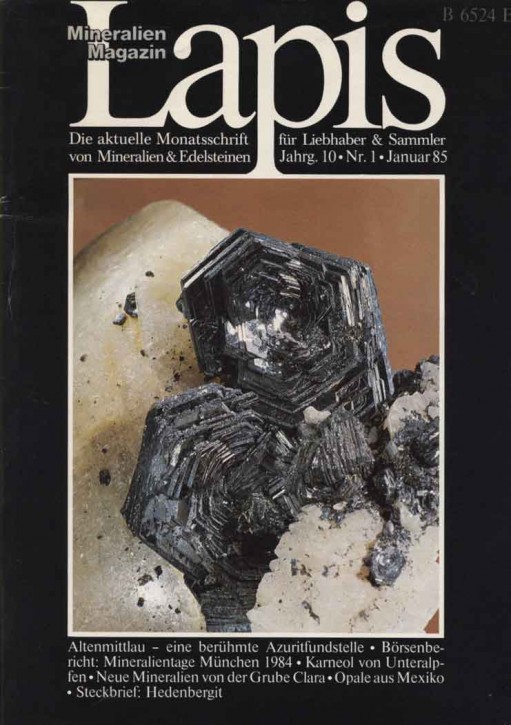
Opale aus Mexico

Opale aus Mexico

Opals from Mexico

Gübelin, E.J. (1985)

Journal Article · Source: Lapis · Volume: Vol. 10 · Issue: No. 1, Januar · Pages: pp. 23–30 · Language: in German

Abstract
Gübelin describes the opal deposits of Mexico, concentrating on the important occurrences in Querétaro and their characteristic transparent to translucent precious and fire opals. He discusses the volcanic geological setting, occurrence of opal in cavities and fractures in rhyolitic rocks, mining and recovery of the material, and the considerable range of body colors and play-of-color displayed by Mexican opals. Particular attention is given to the internal characteristics of the stones, including mineral and fluid inclusions, and to the differences between Mexican volcanic opal and opal from other major producing regions. The article provides both a description of the deposits and a gemological characterization of their products. Gübelin’s article is subsequently cited specifically for opal from the Carbonera mine at La Trinidad, Querétaro.
Keywords
opal, Mexico, gems
Zwei neue Kunstprodukte auf dem Edelsteinmarkt

Zwei neue Kunstprodukte auf dem Edelsteinmarkt

Two new synthetic products on the gemstone market

Gübelin, E.J. (1985)

Journal Article · Source: Deutsche Goldschmiede-Zeitung · Issue: November · Pages: 7 pp. · Language: in German

Abstract
Gübelin describes two recently introduced artificial gem materials: Ramaura flux-grown synthetic ruby and yttrium aluminium gallium garnet (YAGG), a green artificial material used as an imitation of tsavorite. For Ramaura ruby, he discusses manufacture by flux growth at about 1250°C, the use of chromium as the coloring agent, and the effects of flux constituents and growth conditions on crystal form. Because its conventional physical properties closely resemble those of natural ruby, identification relies heavily on microscopic examination; numerous characteristic inclusions are illustrated, while UV-visible spectroscopy is reported to offer no certain separation. The second material, YAGG, differs markedly from tsavorite in its physical properties, with refractive index around 1.90 and specific gravity 5.06–5.08. Gübelin describes its composition and characteristic yellowish flux inclusions and notes that, despite its garnet structure, it is not a silicate. The article contains 42 photographs and illustrations.
Keywords
gems, corundum, synthetic corundum.7, Ramaura, flux, YAAG, synthetic garnet

Gemmologisk Mikroskopi genom Faskontrast Metoden

Gemmological Microscopy through Phase Contrast Method

Gübelin, E.J. (1985)

Journal Article · Source: Gem: Bulletinen Stockholms Gemmologiska Förening · Issue: No. 1 · Language: in Swedish

Abstract
Gübelin describes the application of phase-contrast microscopy to gemology, a technique that greatly increases the visibility of otherwise faint internal structures in transparent gemstones. Phase contrast converts small differences in optical path—caused by variations in refractive index or thickness—into differences in image brightness, making extremely low-contrast inclusions and growth features easier to observe. Gübelin discusses the optical principle and the adaptation of a conventional gemological microscope for phase-contrast observation, emphasizing its usefulness for studying minute inclusions, growth structures and other internal features that may be difficult or impossible to recognize with ordinary bright-field illumination. The technique thus extends the diagnostic possibilities of inclusion microscopy in gemstone identification and research.
Keywords
phase-contrast microscopy, gems
Identification des nouveaux saphirs synthétiques et des saphirs traités

Identification des nouveaux saphirs synthétiques et des saphirs traités

Identification of new synthetic sapphires and treated sapphires

Gübelin, E.J. (1985)

Journal Article · Source: Revue de Gemmologie A.F.G. · Issue: No. 82, March · Language: in French

Abstract
Gübelin examines the identification of newly introduced Chatham flux-grown blue and orange synthetic sapphires and of natural sapphires whose color has been altered by heat treatment or surface diffusion. The physical properties of the Chatham synthetics differ little from those of natural sapphire, making microscopic examination particularly important. Blue Chatham sapphires may show irregular blue, yellow, and colorless zoning, straight or angular growth structures, polysynthetic twinning, coarse or delicate flux residues forming feathers, veils, nets, lace-like patterns, and misleading “fingerprints,” together with black platinum platelets, rods, splinters, and needles that reflect with a characteristic silvery metallic lustre; X-ray analysis confirmed the metallic inclusions as platinum. Some blue specimens also fluoresce intense pale green under long-wave ultraviolet radiation. Chatham orange sapphires range from brownish orange through orange-red to pinkish-orange “padparadschah” colors and likewise contain flux residues and platinum inclusions that provide important evidence of synthetic origin; ultraviolet absorption and electron-spin-resonance measurements are also investigated as possible means of separation from natural stones. Gübelin then discusses heat-treated natural sapphires, in which high temperatures may produce pockmarked surfaces, altered or melted mineral inclusions, circular tension fractures with lace-like rims, enhanced cloudy or phantom-like zoning, and fine exsolved particles producing turbidity. Diffusion-treated sapphires may additionally show strongly colored surface-reaching fissures and inclusions, irregular surface coloration, and concentrations of color along facet junctions and the girdle; immersion in a highly refractive liquid makes these features particularly conspicuous. Gübelin emphasizes that no single characteristic is universally diagnostic and recommends careful comparison of macroscopic appearance, physical properties, ultraviolet response, spectra, and especially microscopic inclusions when distinguishing natural, synthetic, heat-treated, and diffusion-treated sapphires.
Keywords
corundum, synthetic corundum.7, gems

Exploring the Literature of Gemstone Inclusions

The literature of gemstone inclusions covers identification, origin determination, treatments, synthesis, mineral inclusions, fluid inclusions and other internal features of natural and synthetic gems.

For a curated selection of important sources, read Inclusions in Gemstones — Hyperion Literature Sources.

About Four Treasures

Four Treasures is Lotus Gemology's freely accessible gemological reference database. Use the full database to search by author, title or keyword and explore literature on gemology, mineralogy, jewelry and related fields. Where available, hyperlinks on titles may lead directly to the full publication.

Search the Complete Four Treasures Database