Gemstone Inclusions Bibliography

Gemstone Inclusions Bibliography

Explore books, articles and historical sources on inclusions in gemstones in Four Treasures, the Lotus Gemology reference database. This bibliography brings together matching records from the collection, with publication details, abstracts and cover images where available.

Gemstone Inclusion References

The list below matches the terms inclusion or inclusions in the database's searchable fields. Some references discuss inclusions as part of a broader subject.
661–680 of 1,175 matching references

Corundum of the Russian Far East

Journal Article
Buravleva, S.U., Pakhomova, V.A., Zalishchak, B.L., Ushkova, M.A., Ekimova, H.I., Fedoseev, D.G. and Kamynin, V.A. (2008) Corundum of the Russian Far East. Journal of the Gemmological Association of Hong Kong, Vol. 29, pp. 13–16.
Record No. 5253  |  Sinkankas/Born No.: NIS/NIB  |  RWHL
The only placer deposit of gem corundum (sapphire) and zircon (jacinth) in the Russian Far East is located in the Primorsky Kray (the Nezametnoye deposit). The origin of these corundum still remains an issue for debate. Some researchers believe that the corundum crystallised from granosyenite melts(1, 2, 3), and others consider alkali-basalts to be the source(4, 5). The authors’ investigation of corundum and their inclusions was undertaken in order to clarify these problems of origin and source.

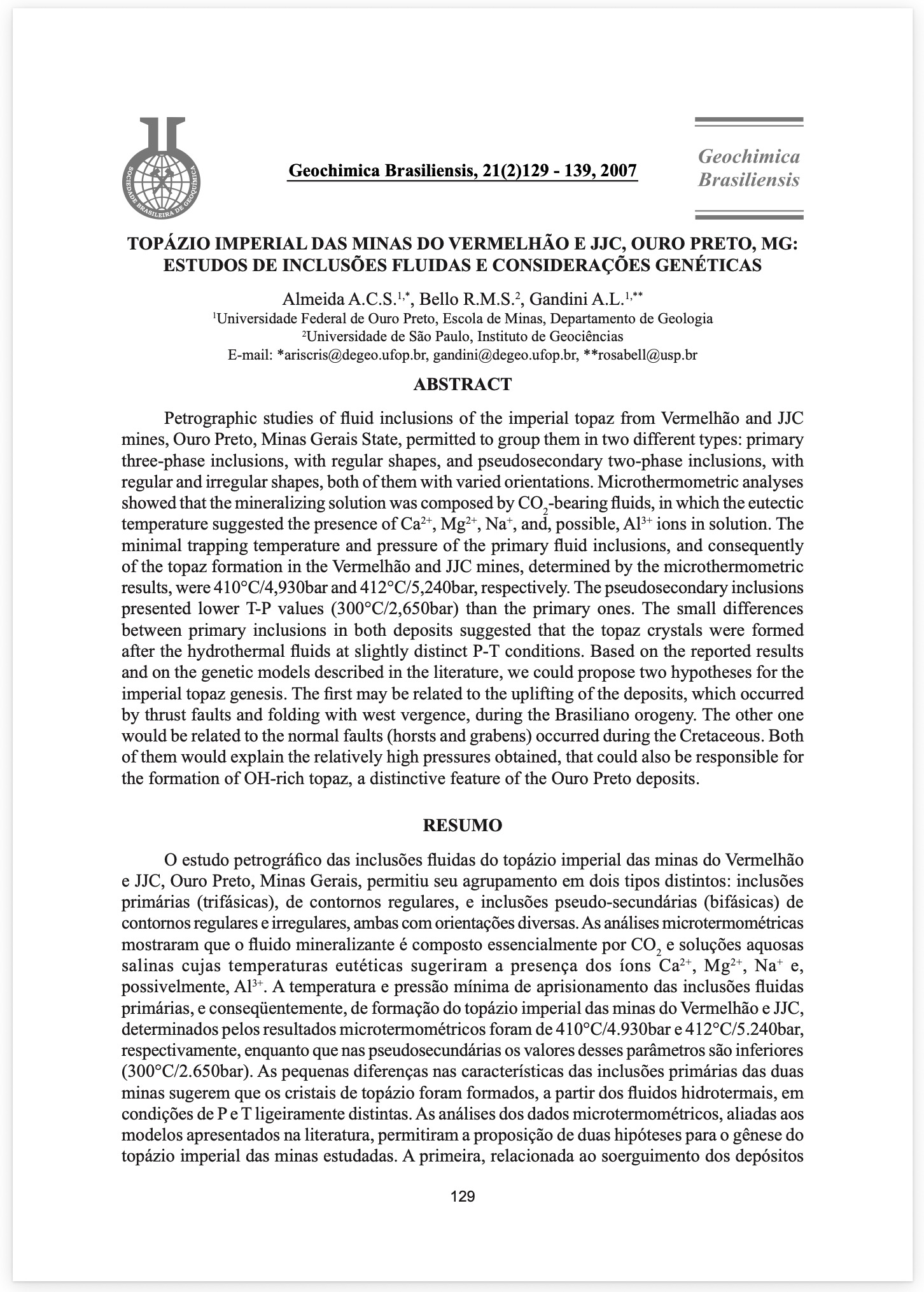
Marble-hosted ruby deposits from Central and Southeast Asia: Towards a new genetic model
Journal Article
Garnier, V., Giuliani, G., Ohnenstetter, D., Fallick, A.E., Dubessy, J., Banks, D., Vinh, H.Q., Lhomme, T., Maluski, H., Pêcher, A., Bakhsh, K.A., Long, P.V., Trinh, P.T. and Schwarz, D. (2008) Marble-hosted ruby deposits from Central and Southeast Asia: Towards a new genetic model. Ore Geology Reviews, Vol. 34, No. 1–2, pp. 169–191.
Record No. 5231  |  ISBN/ISSN: 1691368  |  Sinkankas/Born No.: NIS/NIB  |  RWHL
Marble-hosted ruby deposits represent the most important source of colored gemstones from Central and Southeast Asia. These deposits are located in the Himalayan mountain belt, which formed during the Tertiary collision of the Indian plate moving northward into the Eurasian plate. Spatially associated with granitoid intrusions and hosted in platform carbonates that underwent high-grade metamorphism, these ruby deposits occur near major tectonic features formed during Himalayan orogenesis—either directly in suture zones in the Himalayas or in shear zones that facilitated the extrusion of the Indochina block following the collision in Southeast Asia. Ar–Ar dating of micas syngenetic with ruby and U–Pb dating of zircon inclusions confirm that ruby formation occurred during Himalayan orogenesis, reflecting extensional tectonics active from Afghanistan to Vietnam between the Oligocene and Pliocene. Petrographic analysis shows that ruby-bearing marbles formed under amphibolite facies conditions (T = 610–790 °C, P ~6 kbar), while fluid inclusion studies define ruby crystallization conditions during the retrograde metamorphic path (620–670 °C, 2.6–3.3 kbar) at Jegdalek, Hunza, and northern Vietnam. Whole-rock analyses of non-ruby-bearing marbles reveal sufficient aluminum and chromium to account for all observed ruby. Stable isotope data (C, O) confirm a closed metamorphic fluid system, uninfluenced by external sources. Graphite’s carbon isotopic composition indicates an organic origin, with isotopic exchange with carbonate minerals during metamorphism; ruby oxygen isotopes were buffered by CO₂ released from devolatilizing carbonates, and mica hydrogen isotopes support a metamorphic water source. The C–O–H isotopic data and fluid inclusions containing CO₂–H₂S–COS–S₈–AlO(OH) suggest ruby formed at ~3 kbar and 620–670 °C through thermal reduction of evaporite by organic matter during high-temperature, medium-pressure metamorphism of platform carbonates during the India–Asia collision. These carbonates were enriched in detrital Al- and Cr-bearing clays and organic matter. Ruby crystallized during retrogression, primarily via destabilization of muscovite or spinel, in a CO₂-rich metamorphic fluid system enhanced by fluorine, chlorine, and boron from molten salts (NaCl, KCl, CaSO₄). The presence of evaporites was critical, as molten salts mobilized aluminum and transition metals in situ, enabling ruby crystallization.

Topázio imperial das minas do Vermelhão e JJC, Ouro Preto, MG: Estudos de inclusões fluidas e consideraçces genéticas
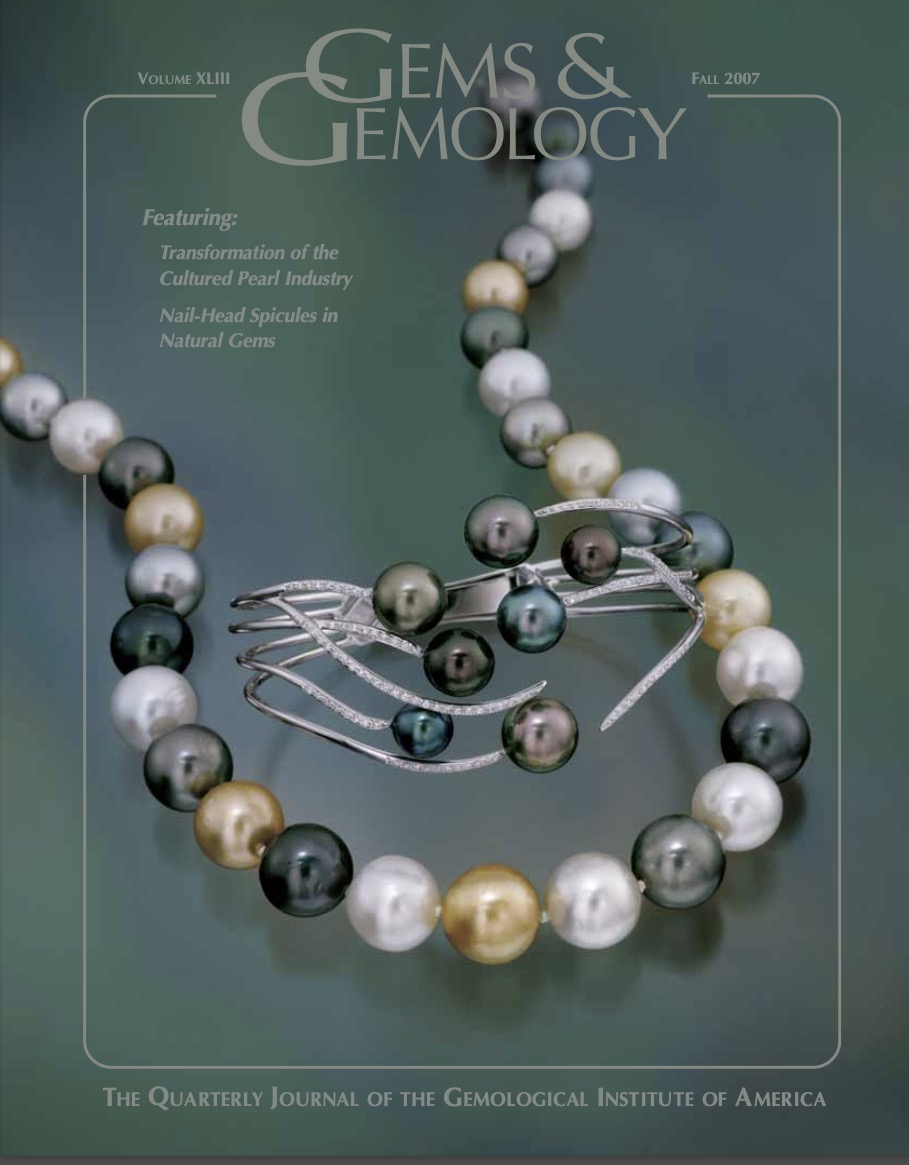
Imperial Topaz from the Vermelhão and JJC Mines, Ouro Preto, Minas Gerais: Fluid-Inclusion Studies and Genetic Considerations
Journal Article
Almeida, A.C.S., Bello, R.M.S. and Gandini, A.L. (2007) Topázio imperial das minas do Vermelhão e JJC, Ouro Preto, MG: Estudos de inclusões fluidas e consideraçces genéticas. [Imperial Topaz from the Vermelhão and JJC Mines, Ouro Preto, Minas Gerais: Fluid-Inclusion Studies and Genetic Considerations] Geochimica Brasiliensis, Vol. 21, No. 2, pp. 129–139.
Record No. 29389  |  Sinkankas/Born No.: NIS/NIB  |  Language: in Portuguese  |  RWHL
Petrographic studies of fluid inclusions in imperial topaz from the Vermelhão and JJC mines, Ouro Preto, Minas Gerais State, permitted them to be grouped into two different types: primary three-phase inclusions, with regular shapes, and pseudosecondary two-phase inclusions, with regular and irregular shapes, both with varied orientations. Microthermometric analyses showed that the mineralising solution was composed of CO₂-bearing fluids, in which the eutectic temperature suggested the presence of Ca²⁺, Mg²⁺, Na⁺ and, possibly, Al³⁺ ions in solution. The minimum trapping temperatures and pressures of the primary fluid inclusions, and consequently of topaz formation in the Vermelhão and JJC mines, as determined by the microthermometric results, were 410°C/4,930 bar and 412°C/5,240 bar, respectively. The pseudosecondary inclusions presented lower T–P values (300°C/2,650 bar) than the primary ones. The small differences between primary inclusions in the two deposits suggested that the topaz crystals were formed from hydrothermal fluids under slightly different P–T conditions. Based on the reported results and on the genetic models described in the literature, two hypotheses for the genesis of imperial topaz could be proposed. The first may be related to the uplift of the deposits, which occurred through thrust faulting and folding with westward vergence during the Brasiliano orogeny. The other would be related to the normal faulting (horsts and grabens) that occurred during the Cretaceous. Both would explain the relatively high pressures obtained, which could also be responsible for the formation of OH-rich topaz, a distinctive feature of the Ouro Preto deposits.

Gem News International: Blue-green opal from Iran
Journal Article
Nagle, K.G. (2007) Gem News International: Blue-green opal from Iran. Gems & Gemology, Vol. 43, No. 3, Fall, pp. 257–258.
Record No. 26693  |  Sinkankas/Born No.: NIS/NIB  |  RWHL
Gem-grade blue-green opal, traditionally sourced from Peru, has recently been discovered in Iran, approximately 110 km northwest of Shahr-e Babak in Kerman Province. According to Makhmout Douman (Arzawa Mineralogical Inc., New York), mining at this new locality had nearly ceased by October 2007 due to groundwater intrusion, and few polished stones have been produced because of the fractured and thin nature of the rough. Mr. Douman loaned GIA two cabochons (2.40 and 2.59 ct) and one rough piece for analysis. The cabochons showed bluish green and green-blue color, were translucent, and had refractive indices of 1.45 and 1.47, respectively, with specific gravities of 2.06 and 2.00. No reaction was observed under a Chelsea filter or UV light, and a 600 nm cutoff was seen in the spectroscope. Microscopic examination revealed milky white clouds and, in one sample, a moss-like inclusion. Although the 1.47 RI is slightly above the typical opal range (1.44–1.46), Raman spectra matched those of standard opal. Near-IR spectroscopy confirmed hydroxyl-related features characteristic of opal, while EDXRF analysis detected major Si, minor Cu, and trace Fe. UV-Vis-NIR spectroscopy indicated Cu²⁺ absorptions between 527–1176 nm, confirming copper as the chromophore responsible for the opal’s blue-green coloration.

Gem News International: Synthetic star sapphire with hexagonal features
Journal Article
Choudhary, G. and Golecha, C. (2007) Gem News International: Synthetic star sapphire with hexagonal features. Gems & Gemology, Vol. 43, No. 2, Summer, pp. 177.
Record No. 16885  |  ISBN/ISSN: 0016626X  |  Sinkankas/Born No.: NIS/NIB  |  RWHL
From G&G: At the Gem Testing Laboratory in Jaipur, India, a 4.63 ct synthetic star sapphire displaying hexagonal zoning was initially mistaken for a natural sapphire with a diffusion-induced star due to its wavy star rays and “silk” inclusions. The cabochon fluoresced chalky blue under short-wave UV radiation and exhibited chromium lines in a desk-model spectroscope. Upon magnification and immersion, a hexagonal zone was visible in the core, surrounded by a wavy stress pattern, with fine needles in three directions creating the star effect. However, when viewed from the back, numerous tiny whitish pinpoints, likely gas bubbles, were arranged in curved clouds, and immersion with diffused illumination revealed curved color bands—diagnostic of a flame-fusion synthetic origin. The cause of the hexagonal zoning remains uncertain, but it may result from a crystallographically oriented concentration of silk in the core. Higher magnification with a strong fiber-optic light revealed a denser concentration of needles in the core compared to the surrounding area. This was the first documented case of both hexagonal zoning and curved color bands appearing together in a single specimen, highlighting the importance of thorough gemological analysis to avoid misidentification, especially in closed-back settings where key diagnostic features may be obscured.

Gem News International: Heat-treated Kashan flux-grown synthetic ruby
Journal Article
Singbamroong, S. and Ahmed, N. (2007) Gem News International: Heat-treated Kashan flux-grown synthetic ruby. Gems & Gemology, Vol. 43, No. 2, Summer, pp. 175–176.
Record No. 16884  |  ISBN/ISSN: 0016626X  |  Sinkankas/Born No.: NIS/NIB  |  RWHL
From G&G: In March 2006, a 10.12 ct transparent purplish red oval mixed-cut gemstone was submitted to the Dubai Gemstone Laboratory for identification, initially reported by the client as a natural ruby from Myanmar. Standard gemological testing confirmed properties consistent with ruby, but strong chalky blue fluorescence under short-wave UV radiation suggested heat treatment. Microscopic examination revealed inclusions resembling those in flux-assisted heated natural rubies; however, further analysis identified various forms of flux residue, characteristic features of Kashan flux-grown synthetic rubies, along with white high-relief parallel rods, fingerprint-like structures, rain-like comet formations, and discoid features with paint-splash inclusions. Additional signs of heat treatment included dissolved white flux-filled negative crystals with associated discoid fissures. UV-Vis absorption spectroscopy exhibited broad bands typical of ruby color, but also showed UV transmission at 305 nm stronger than visible-region transmission at ~475 nm, indicative of synthetic origin. This pattern was previously documented in heat-treated Kashan synthetic rubies and linked to higher titanium content. Infrared spectroscopy revealed no hydroxyl-related peaks, consistent with flux-grown synthetics, while EDXRF analysis detected trace elements distinguishing Kashan flux-grown rubies, with slightly higher titanium and traces of vanadium and gallium. Comparison with a reference collection confirmed a match to Kashan specimens. Since the 1990s, heat-treated synthetic rubies have posed increasing identification challenges, necessitating advanced testing for accurate distinction.

Espectrometría infrarroja de reflexión en miineralogía. avanzada, gemología y arqueometría
Infrared Reflection Spectrometry in Advanced Mineralogy, Gemology, and Archaeometry
Book
Ostrooumov, M. (2007) Espectrometría infrarroja de reflexión en miineralogía. avanzada, gemología y arqueometría. [Infrared Reflection Spectrometry in Advanced Mineralogy, Gemology, and Archaeometry] México, 89 pp.
Record No. 6817  |  Sinkankas/Born No.: NIS/NIB  |  Language: in Spanish  |  RWHL
This monograph presents infrared reflection spectrometry as a nondestructive method for identifying and characterizing minerals, gemstones, rocks, and archaeological materials. It describes applications to distinguishing gemstones and imitations, detecting inclusions, and investigating crystal zoning, optical orientation, and pleochroism. Emphasis is placed on obtaining spectroscopic and crystal-chemical information while preserving the objects examined, making the technique useful for gemological testing, museum collections, and cultural heritage research.

A study of nail-head spicule inclusions in natural gemstones
Journal Article
Choudhary, G. and Golecha, C. (2007) A study of nail-head spicule inclusions in natural gemstones. Gems & Gemology, Vol. 43, No. 3, Fall, pp. 228–235.
Record No. 5975  |  ISBN/ISSN: 0016626X  |  Sinkankas/Born No.: NIS/NIB  |  RWHL
Nail-head spicules are inclusions that have traditionally been associated with hydrothermal synthetic quartz and emerald. They are caused primarily by rapid growth conditions and disturbances during crystallization of their host. However, these or similar-looking inclusions have also been found in natural gems. The authors examined a natural emerald and blue sapphire showing true nail-head spicules, and a yellow sapphire, spinel, diamond, and rock crystal quartz with inclusions that strongly resembled them. Nail-head spicules remain a notable feature of rapid and disturbed growth, but they do not confirm a stone’s natural or synthetic origin without further examination.

Colour zoning in heat-treated yellow to yellowish-orange Montana sapphires

Journal Article
Schmetzer, K. and Schwarz, D. (2007) Colour zoning in heat-treated yellow to yellowish-orange Montana sapphires. Journal of Gemmology, Vol. 30, No. 5/6, January/April, pp. 268–278.
Record No. 5355  |  ISBN/ISSN: 221252  |  Sinkankas/Born No.: NIS/NIB  |  RWHL

Noble gases in corundum megacrysts from the basalts in Changle, Shandong Province, eastern China
Journal Article
Hu, W.X., Song, Y.C., Chen, X.M., Tao, M.X. and Zhang, L.P. (2007) Noble gases in corundum megacrysts from the basalts in Changle, Shandong Province, eastern China. Chinese Science Bulletin, Vol. 52, No. 3, pp. 380–387.
Record No. 5291  |  Sinkankas/Born No.: NIS/NIB  |  RWHL
This study presents noble gaseous data of the corundum megacrysts from the Cenozoic basalts in Changle, Shandong Province, eastern China. It is known that no noble gaseous data of corundum megacryst have been documented before. The ³He/⁴He ratios (1.13–7.37 Ra) of the corundums from Changle vary from atmosphere to MORB values; the ²⁰Ne/²²Ne (9.67–10.75) and ²¹Ne/²²Ne (0.0280–0.0372) data define two linear trends on Ne three-isotope diagram, respectively, along the MFL and the correlation line between atmosphere and MORB; the ³⁸Ar/³⁶Ar (0.177–0.194) ratios, the ⁴⁰Ar/³⁶Ar (280.9–404.2) ratios and the ¹²⁸–¹³⁶Xe/¹³²Xe ratio with obvious ¹²⁹Xe excess are generally higher than atmospheric component, but the ⁴⁰Ar/³⁶Ar ratios are much closer to atmospheric ratio. The isotopic compositions of noble gases (particularly for He and Ar) of the corundums are similar to those of pyroxene, anorthoclase megacrysts, and mantle-derived xenoliths from this area, and those of mantle-derived xenoliths from several areas in eastern China. Therefore, the noble gases trapped in the corundums probably are from mantle source, representing a “mixed fluid” produced by the interaction between the lithospheric mantle and fluids releasing from the convective plate. Both the noble gas isotopic compositions and the oxygen isotopic compositions of the solid corundums are not the characteristics of crustal source. These suggest that the corundums crystallized from mantle-derived magmas with minimal crustal contamination.

The influence of heat treatment on the phase relations in mineral growth systems
Thesis
Wanthanachaisaeng, B. (2007) The influence of heat treatment on the phase relations in mineral growth systems., Mainz, Germany: Johannes Gutenberg-Universität Mainz, 79 pp.
Record No. 3266  |  Sinkankas/Born No.: NIS/NIB  |  RWHL
Corundum is one of the most famous gem materials. Different heat treatment methods for enhancement purposes are commonly applied and accepted in the gem market. For this reason, the identification of natural, unheated corundum is intensively investigated. In this study, aluminium hydroxide minerals and zircon are focused on to observe the crystallization and phase change of these minerals during heat treatment procedures. Aluminium hydroxide minerals can be transformed to alumina with the corundum structure by heating. The reaction history of aluminium hydroxide minerals containing corundum was investigated by comparing diaspore, boehmite, gibbsite, and bayerite using TG and DTA methods. These hydroxide minerals were entirely transformed to corundum after heating at 600 °C. Zircon inclusions in corundums from Ilakaka, Madagascar, were investigated for the influence of different heat-treatment temperatures on the recovery of their crystalline structure and on possible reactions within and with the host crystals. The host corundum was heated at 500, 800, 1000, 1200, 1400, 1600, and 1800 °C. The crystallinity, the trapped pressure, and the decomposition of the zircon inclusions within the host corundum have been investigated by Raman spectroscopy. Radiation-damaged zircon inclusions may be used as an indicator for unheated Ilakaka corundum crystals. They are fully recrystallized after heating at 1000 °C, influencing the lowering of the ν₃ Raman band shift, the decrease of FWHM of the ν₃ Raman band, and the decrease of the trapped pressure between the inclusion and the host corundum. Under microscopic observation, surface alterations of the inclusions can first be seen, changing from transparent to a frosted-like appearance at 1400 °C. Then, between 1600 °C and 1800 °C, the inclusion becomes partly or even completely molten. The decomposition of the zircon inclusion to m-ZrO₂ and SiO₂-glass phases begins at the rim of the inclusion after heating from 1200 °C to 1600 °C, which can be detected by the surface change, the increase of the ν₃ Raman band position, and the trapped pressure. At 1800 °C, the zircon inclusions entirely melt, transforming to solid phases during cooling like m-ZrO₂ and SiO₂-glass, accompanied by an increase of pressure between the transformed inclusion and its host.

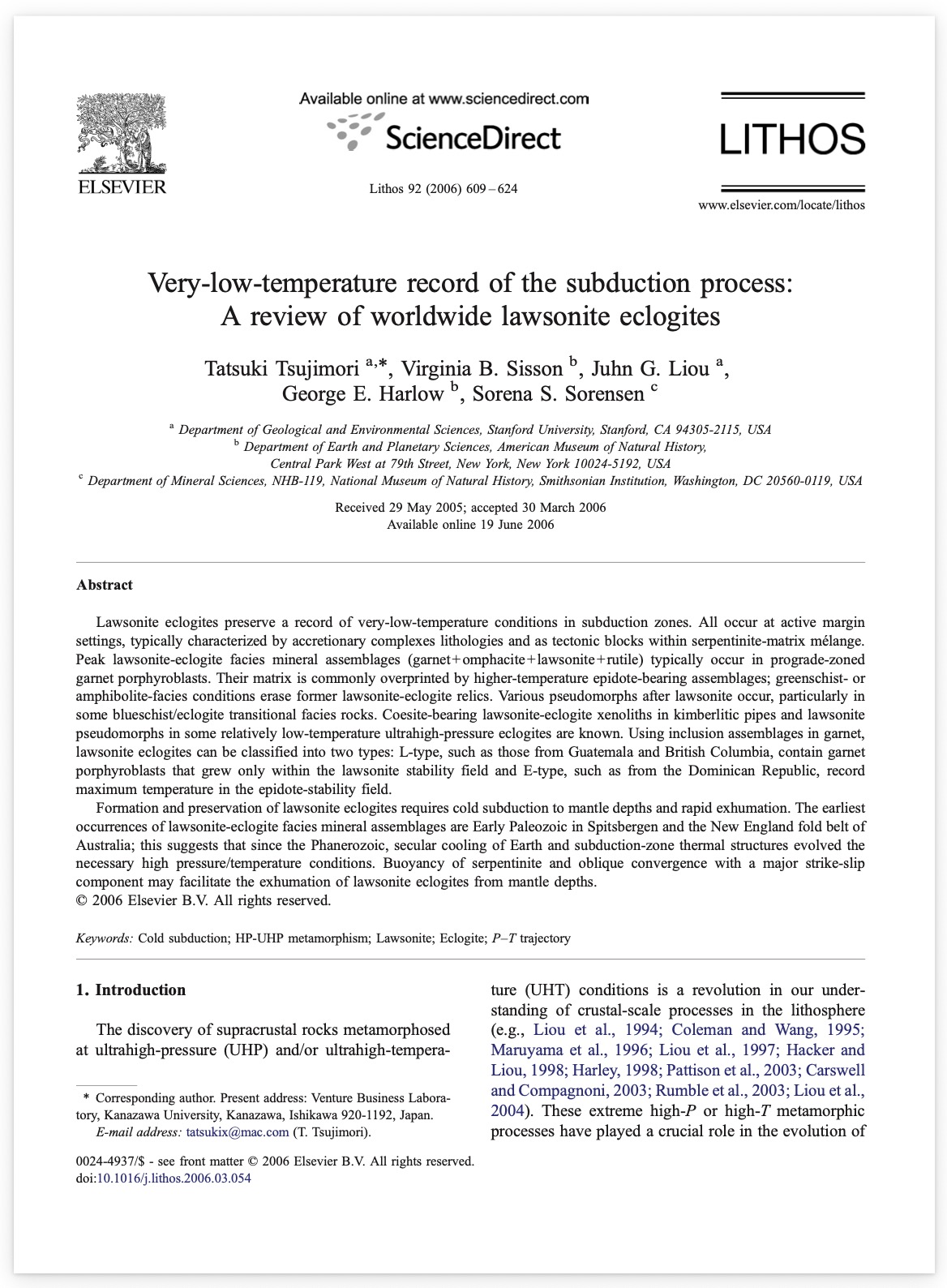
Very-low-temperature record of the subduction process: A review of worldwide lawsonite eclogites
Journal Article
Tsujimori, T., Sisson, V.B., Liou, J.G., Harlow, G.E. and Sorensen, S.S. (2006) Very-low-temperature record of the subduction process: A review of worldwide lawsonite eclogites. Lithos, Vol. 92, No. 3, pp. 609–624.
Record No. 28466  |  ISBN/ISSN: 0024-4937  |  DOI: https://doi.org/10.1016/j.lithos.2006.03.054  |  Sinkankas/Born No.: NIS/NIB  |  RWHL
Lawsonite eclogites preserve a record of very-low-temperature conditions in subduction zones. All occur at active margin settings, typically characterized by accretionary complexes lithologies and as tectonic blocks within serpentinite-matrix mélange. Peak lawsonite-eclogite facies mineral assemblages (garnet+omphacite+lawsonite+rutile) typically occur in prograde-zoned garnet porphyroblasts. Their matrix is commonly overprinted by higher-temperature epidote-bearing assemblages; greenschist- or amphibolite-facies conditions erase former lawsonite-eclogite relics. Various pseudomorphs after lawsonite occur, particularly in some blueschist/eclogite transitional facies rocks. Coesite-bearing lawsonite-eclogite xenoliths in kimberlitic pipes and lawsonite pseudomorphs in some relatively low-temperature ultrahigh-pressure eclogites are known. Using inclusion assemblages in garnet, lawsonite eclogites can be classified into two types: L-type, such as those from Guatemala and British Columbia, contain garnet porphyroblasts that grew only within the lawsonite stability field and E-type, such as from the Dominican Republic, record maximum temperature in the epidote-stability field. Formation and preservation of lawsonite eclogites requires cold subduction to mantle depths and rapid exhumation. The earliest occurrences of lawsonite-eclogite facies mineral assemblages are Early Paleozoic in Spitsbergen and the New England fold belt of Australia; this suggests that since the Phanerozoic, secular cooling of Earth and subduction-zone thermal structures evolved the necessary high pressure/temperature conditions. Buoyancy of serpentinite and oblique convergence with a major strike-slip component may facilitate the exhumation of lawsonite eclogites from mantle depths.

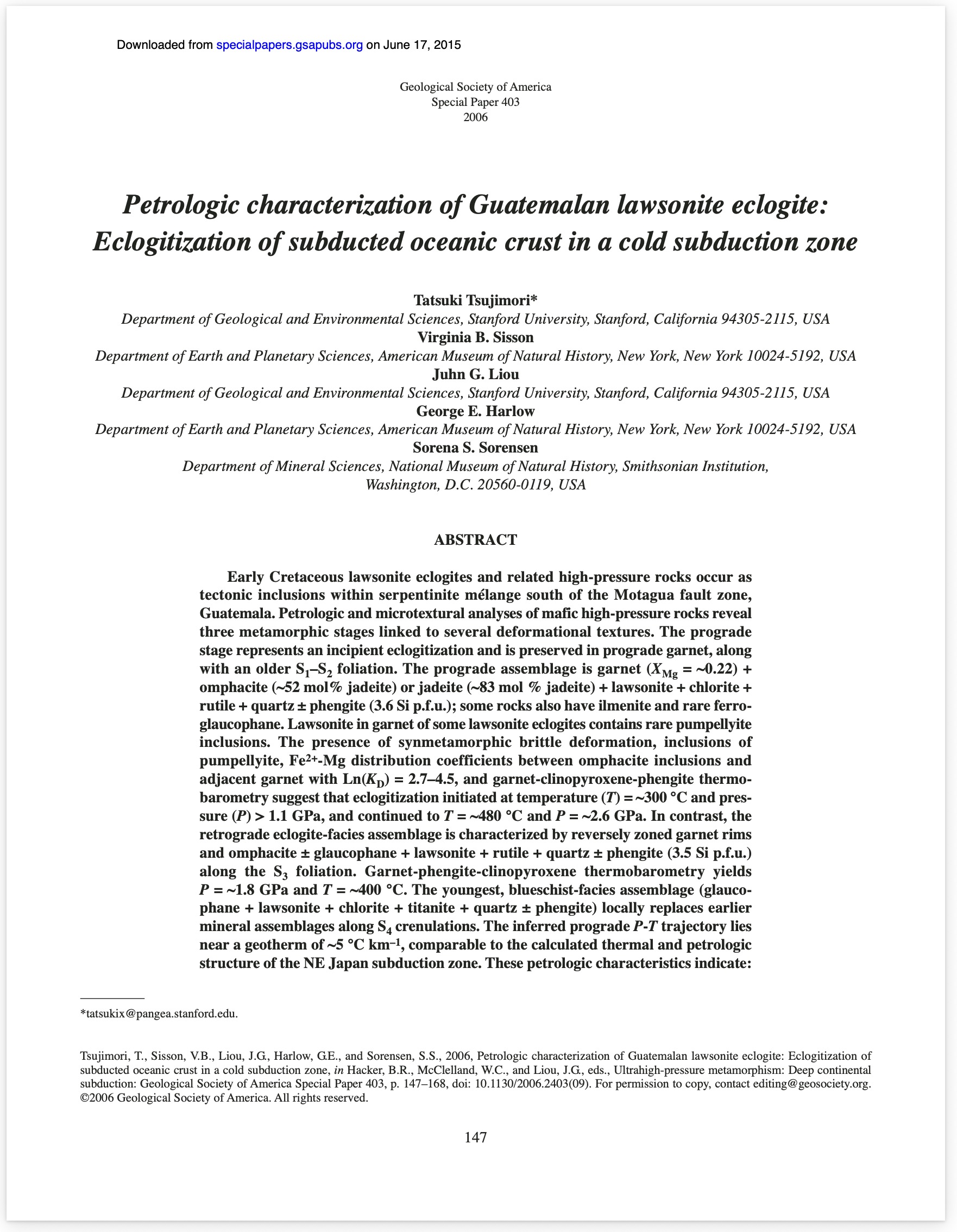
Petrologic characterization of Guatemalan lawsonite-eclogite: Direct information on eclogitization of subducted oceanic crust in a cold subduction zone
Book Section
Tsujimori, T., Sisson, V.B., Liou, J.G. and Harlow, G.E., and Sorensen, S.S. (2006) Petrologic characterization of Guatemalan lawsonite-eclogite: Direct information on eclogitization of subducted oceanic crust in a cold subduction zone. In: Ultrahigh-Pressure Metamorphism: Deep Continental Subduction, pp. 147–168.
Record No. 28465  |  DOI: https://doi.org/10.1130/2006.2403(09)  |  Sinkankas/Born No.: NIS/NIB  |  RWHL
Early Cretaceous lawsonite eclogites and related high-pressure rocks occur as tectonic inclusions within serpentinite mélange south of the Motagua fault zone, Guatemala. Petrologic and microtextural analyses of mafic high-pressure rocks reveal three metamorphic stages linked to several deformational textures. The prograde stage represents an incipient eclogitization and is preserved in prograde garnet, along with an older S₁–S₂ foliation. The prograde assemblage is garnet (Xₘg = ∼0.22) + omphacite (∼52 mol% jadeite) or jadeite (∼83 mol% jadeite) + lawsonite + chlorite + rutile + quartz ± phengite (3.6 Si p.f.u.); some rocks also have ilmenite and rare ferro-glaucophane. Lawsonite in garnet of some lawsonite eclogites contains rare pumpellyite inclusions. The presence of synmetamorphic brittle deformation, inclusions of pumpellyite, Fe²⁺-Mg distribution coefficients between omphacite inclusions and adjacent garnet with Ln(Kᴅ) = 2.7–4.5, and garnet-clinopyroxene-phengite thermobarometry suggest that eclogitization initiated at temperature (T) = ∼300°C and pressure (P) > 1.1 GPa, and continued to T = ∼480°C and P = ∼2.6 GPa. In contrast, the retrograde eclogite-facies assemblage is characterized by reversely zoned garnet rims and omphacite ± glaucophane + lawsonite + rutile + quartz ± phengite (3.5 Si p.f.u.) along the S₃ foliation. Garnet-phengite-clinopyroxene thermobarometry yields P = ∼1.8 GPa and T = ∼400°C. The youngest, blueschist-facies assemblage (glaucophane + lawsonite + chlorite + titanite + quartz ± phengite) locally replaces earlier mineral assemblages along S₄ crenulations. The inferred prograde P-T trajectory lies near a geotherm of ∼5°C km⁻¹, comparable to the calculated thermal and petrologic structure of the Northeast Japan subduction zone. These petrologic characteristics indicate: (1) the basalt-eclogite transformation may occur at T = ∼300°C in cold subduction zones, (2) glaucophane-bearing prograde assemblages are rare during incipient eclogitization in cold subduction zones, and (3) the chlorite-consuming reactions that form Fe-Mg-Mn garnet are more effective than the lawsonite-consuming reaction that forms a grossular component. At depths of ∼100 km in cold subduction zones, dehydration embrittlement may be caused by such chlorite-consuming reactions.

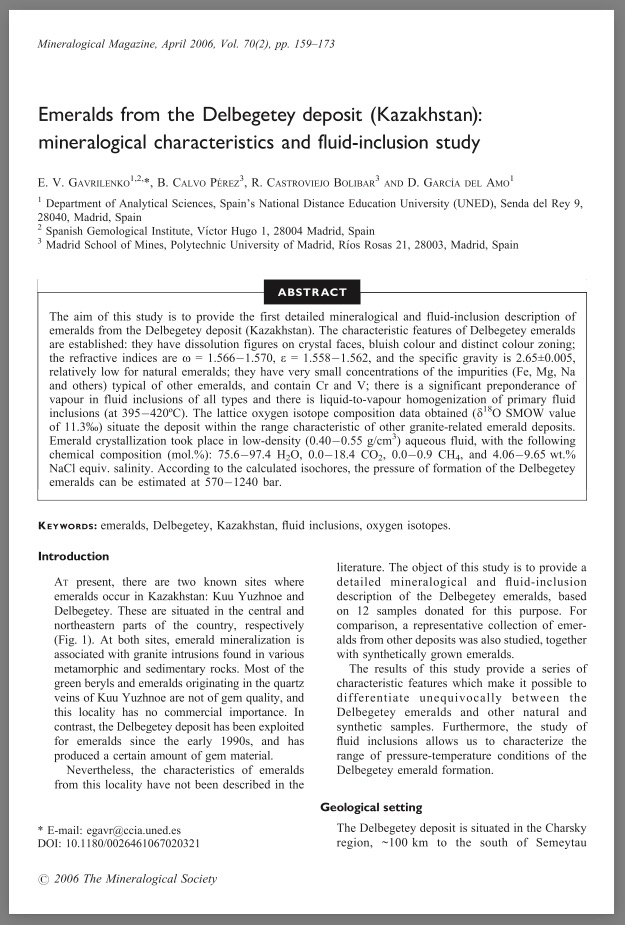
Emeralds from the Delbegetey deposit (Kazakhstan)
Journal Article
Gavrilenko, E.V., Calvo Pérez, B., Castroviejo Bolibar, R. and García del Amo, D. (2006) Emeralds from the Delbegetey deposit (Kazakhstan). Mineralogical Magazine, Vol. 70, pp. 159–173.
Record No. 27204  |  DOI: http://dx.doi.org/10.1180/0026461067020321  |  Sinkankas/Born No.: NIS/NIB  |  RWHL
The aim of this study is to provide the first detailed mineralogical and fluid-inclusion description of emeralds from the Delbegetey deposit (Kazakhstan). The characteristic features of Delbegetey emeralds are established: they show dissolution figures on crystal faces, a bluish colour with distinct colour zoning; their refractive indices are ω = 1.566–1.570 and ε = 1.558–1.562, while the specific gravity is 2.65 ± 0.005—relatively low for natural emeralds; they contain only trace amounts of common impurities (Fe, Mg, Na, etc.) and are coloured by Cr and V. Fluid inclusions of all types are strongly vapour-rich, and primary inclusions homogenize to liquid at 395–420 °C. The lattice oxygen-isotope composition (δ¹⁸O SMOW = 11.3 ‰) places the deposit within the range typical of other granite-related emerald occurrences. Emerald crystallization occurred in a low-density (0.40–0.55 g cm⁻³) aqueous fluid composed of (mol %) 75.6–97.4 H₂O, 0.0–18.4 CO₂, 0.0–0.9 CH₄, with a salinity of 4.06–9.65 wt % NaCl equiv. Isochore calculations indicate formation pressures of 570–1240 bar.

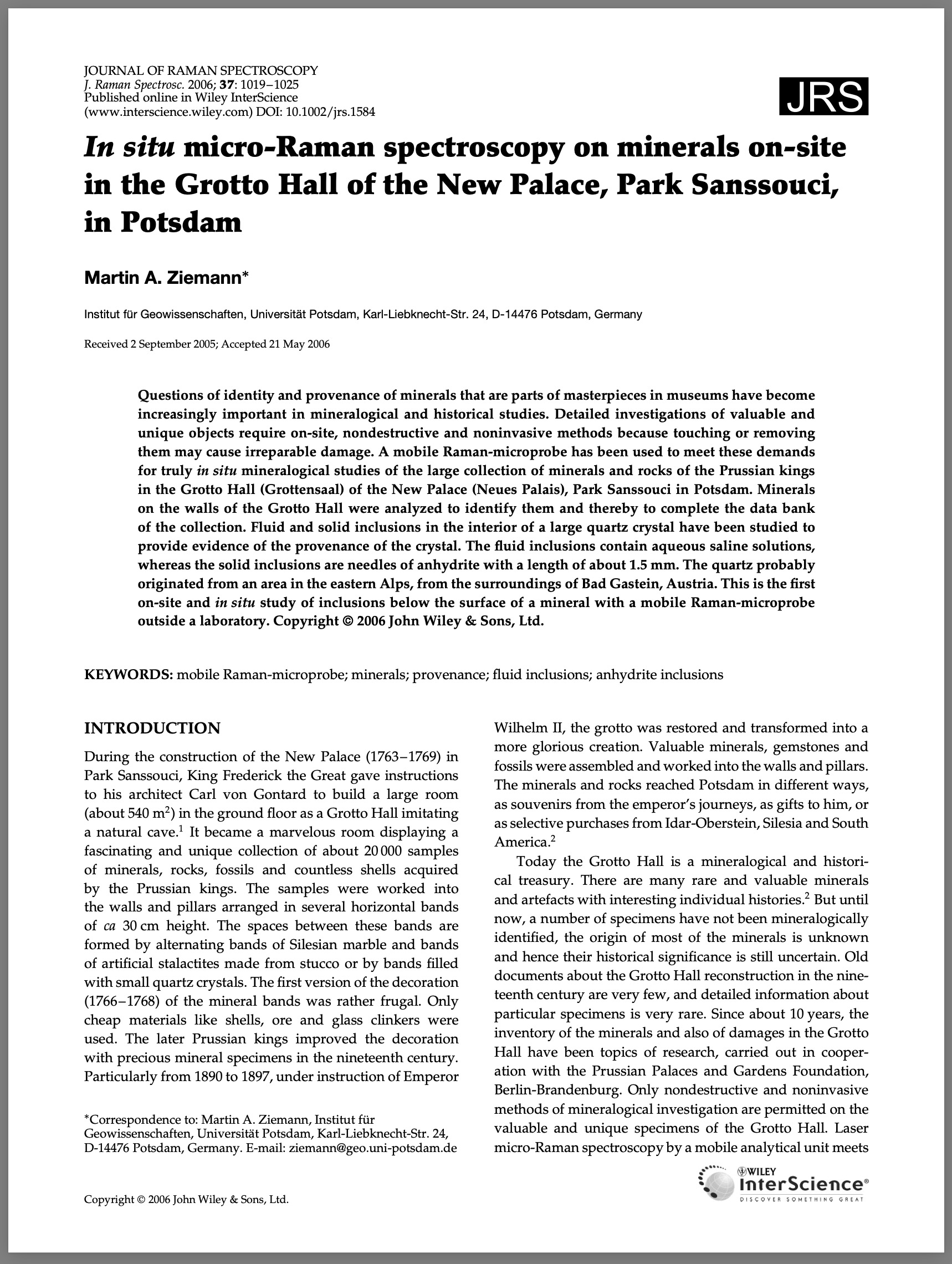
In situ micro-Raman spectroscopy on minerals on-site in the Grotto Hall of the New Palace, Park Sanssouci, in Potsdam
Journal Article
Ziemann, M.A. (2006) In situ micro-Raman spectroscopy on minerals on-site in the Grotto Hall of the New Palace, Park Sanssouci, in Potsdam. Journal of Raman Spectroscopy, Vol. 37, pp. 1019–1025.
Record No. 27195  |  DOI: https://doi.org/10.1002/jrs.1584  |  Sinkankas/Born No.: NIS/NIB  |  RWHL
Questions of identity and provenance of minerals that are parts of masterpieces in museums have become increasingly important in mineralogical and historical studies. Detailed investigations of valuable and unique objects require on-site, nondestructive and noninvasive methods because touching or removing them may cause irreparable damage. A mobile Raman-microprobe has been used to meet these demands for truly in situ mineralogical studies of the large collection of minerals and rocks of the Prussian kings in the Grotto Hall (Grottensaal) of the New Palace (Neues Palais), Park Sanssouci in Potsdam. Minerals on the walls of the Grotto Hall were analyzed to identify them and thereby to complete the data bank of the collection. Fluid and solid inclusions in the interior of a large quartz crystal have been studied to provide evidence of the provenance of the crystal. The fluid inclusions contain aqueous saline solutions, whereas the solid inclusions are needles of anhydrite with a length of about 1.5 mm. The quartz probably originated from an area in the eastern Alps, from the surroundings of Bad Gastein, Austria. This is the first on-site and in situ study of inclusions below the surface of a mineral with a mobile Raman-microprobe outside a laboratory.

Inclusions in chrysolite from the Kovdor Massif: Genetic and gemmological significance
Journal Article
Sokolov, S.V., Yarmishko, S.A. and Chistyakova, N.I. (2006) Inclusions in chrysolite from the Kovdor Massif: Genetic and gemmological significance. Geochemistry International, Vol. 44, No. 6, pp. 581–590.
Record No. 27179  |  Sinkankas/Born No.: NIS/NIB  |  RWHL
Gem-quality chrysolite (peridot) from a phlogopite deposit related to the Kovdor ultrabasic-alkaline massif in the Kola Peninsula, Russia, was studied using a variety of techniques (optical mineralogical microscopy, chemical, Mössbauer spectroscopy, and photoluminescence) to determine its chemical composition, the Fe²⁺/Fe³⁺ ratio, refraction indexes, density, as well as to examine inclusions in it. Much attention was devoted to the microprobe identification of crystalline inclusions in the host chrysolite (apatite, tetraferriphlogopite, amphibole, and magnetite), its exsolution products (diopside and magnetite), and the daughter phases of melt inclusions in this mineral (which were subdivided into primary and secondary genetic types). The daughter phases of these melt inclusions are silicates (forsterite, diopside, tetraferriphlogopite, clinohumite, and serpentine), various carbonates (Ca-dominated carbonates are characteristic of the primary inclusions, whereas Mg-rich carbonates were found only in the secondary inclusions), magnetite, djerfisherite (alkali sulfide), and Ba-Sr-REE carbonates. The presence of melt inclusions testifies to a magmatic genesis of the gem, and the simultaneous occurrence of these inclusions with crystalline inclusions can be used as an additional identification feature of gem chrysolite from the Kovdor Massif.

Pre-Columbian jadeite axes from Antigua, West Indies • Description and possible sources
Journal Article
Harlow, G.E., Murphy, A.R., Hozjan, D.J., de Mille, C.N. and Levinson, A.A. (2006) Pre-Columbian jadeite axes from Antigua, West Indies • Description and possible sources. The Canadian Mineralogist, Vol. 44, No. 2, pp. 305–321.
Record No. 6164  |  ISBN/ISSN: 84476  |  DOI: https://dx.doi.org/10.2113/gscanmin.44.2.305  |  Sinkankas/Born No.: NIS/NIB  |  RWHL
Excavation of ornamental and gem materials from workshop sites on the island of Antigua, West Indies, also uncovered jade celts (axe forms) and fragments thereof. All are jadeite jades (jadeitite), like jades from Mesoamerica. The Antigua sites date to the Saladoid period (ca. 250–500 AD), roughly equivalent to early Classic period for Mesoamerican cultures, and reveal “jades” used in a context (i.e., decorative celt) well developed by Mesoamericans some 3100 km to the West. Ten of these jade artifacts were examined by a combination of mineralogical and petrographic techniques to determine their mineral constituents, mineral compositions and petrographic textures, in order to place them in a context of possible sources among worldwide sources of jadeite jade. The common assemblage for six artifacts studied as polished sections include jadeite, omphacite, albite, a white-tan mica, quartz, zoisite or clinozoisite and titanite, with the exception o one artifact lacking albite and quartz, and one lacking mica. Allanite was found in the cores of zoisite in two jades, and glaucophane and lawsonite, each, were observed in single samples of jade. The other four jades, which could not be studied as well, seem to contain comparable assemblages. Conspicuous among the Antigua jades is the textural setting of quartz, a phase absent from jadeitite from most sources worldwide. Quartz exists either as a secondary matrix phase around corroded grains of jadeite (tiny omphacite grains in quartz decorate the boundaries of the jadeite) or as inclusions in jadeite associated with smaller regions of omphacite. In comparison with jadeitite from ~12 described occurrences worldwide, only jadeitite from south of the Motagua fault zone (MFZ) in Guatemala regularly contain the appropriate assemblage, including white mica and quartz. Moreover, glaucophane and lawsonite have also been observed in jadeitite from this source, and textures are also highly similar. However, differences include absence of zoisite or clinozoisite and paragonite, plus some divergences in pyroxene compositions in Guatemalan jadeitite from south of MFZ compared to the Antigua jades. Although Guatemala is a reasonable source for the Antigua jades, as yet unknown sources in a similar geological terrane (serpentinite–matrix mélange) on Cuba, Hispaniola or Jamaica cannot be ruled out.

Ar-Ar and U-Pb ages of marble-hosted ruby deposits from central and southeast Asia
Journal Article
Garnier, V., Maluski, H., Giuliani, G., Ohnenstetter, D. and Schwarz, D. (2006) Ar-Ar and U-Pb ages of marble-hosted ruby deposits from central and southeast Asia. Canadian Journal of Earth Sciences, Vol. 43, No. 4, pp. 509–532.
Record No. 5301  |  Sinkankas/Born No.: NIS/NIB  |  RWHL
Ruby deposits hosted by marbles are distributed along the Himalayan mountain fold belt that formed during the Tertiary collision of the Indian plate with Asia, as well as in the Indochina crustal block extruded along shear zones during this collision. These metamorphic deposits are found in Tajikistan, Afghanistan, Pakistan, Nepal, Myanmar, and Vietnam. This study was undertaken to relate the age of their formation to the geologic events associated with the continental collision. Ruby itself is not suitable for age dating, but inclusions in ruby, and certain associated minerals, can both be dated by certain techniques.. Ar-Ar age dates of between 25 and 4.6 Ma document Oligocene-Miocene cooling ages for the ruby-bearing metamorphic belts, which in turn represent minimum ages for ruby formation. These ages are in agreement with published data on the tectonic-metamorphic history of the marbles hosting the rubies. U-Pb age dates of 54–36 Ma for zircon inclusions give a maximum Eocene age for ruby mineralization in Vietnam. The specific time of formation of each ruby deposit depended on its location within the fold belt.

Study of melt inclusions in the Nezametnoye corundum deposit, Primorsky region of the Russian Far East: Petrogenetic consequences
Journal Article
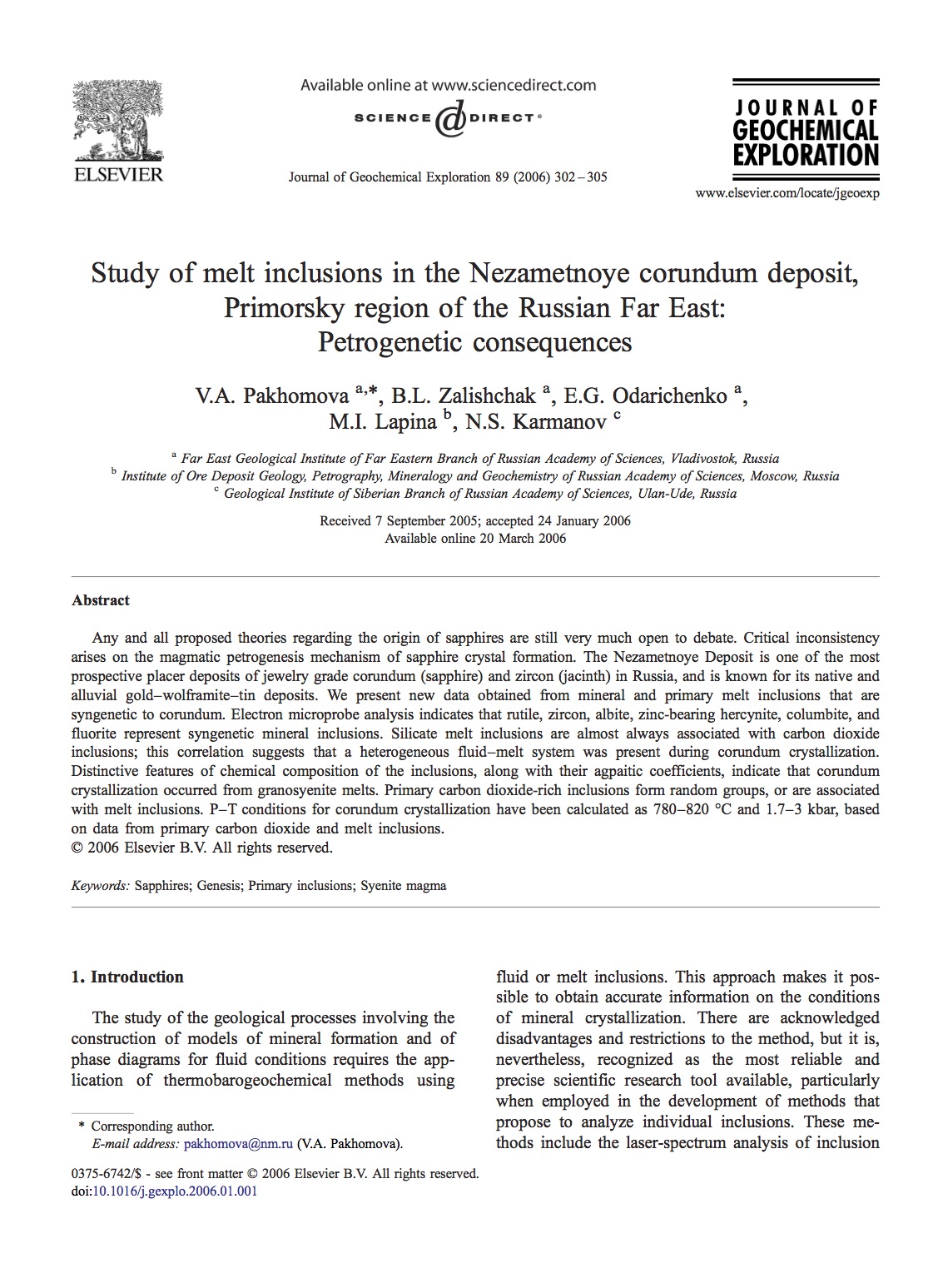
Pakhomova, V.A., Zalishchak, B.L., Odarichenko, E.G., Lapina, M.I. and Karmanov, N.S. (2006) Study of melt inclusions in the Nezametnoye corundum deposit, Primorsky region of the Russian Far East: Petrogenetic consequences. Journal of Geochemical Exploration, Vol. 89, No. 1–3, pp. 302–305.
Record No. 5277  |  ISBN/ISSN: 3756742  |  DOI: https://dx.doi.org/10.1016/j.gexplo.2006.01.001  |  Sinkankas/Born No.: NIS/NIB  |  RWHL
Any theories concerning the genesis of sapphires remain open to debate, particularly with regard to the magmatic petrogenesis of corundum, which is marked by unresolved inconsistencies; the Nezametnoye Deposit in Russia—renowned for its placer sapphires, zircon (jacinth), and associated native gold, wolframite, and tin—offers new insights into corundum formation based on the study of syngenetic mineral and melt inclusions, with electron microprobe data revealing co-crystallization of rutile, zircon, albite, zinc-bearing hercynite, columbite, and fluorite within the corundum, and silicate melt inclusions frequently accompanied by CO₂-rich fluid inclusions, implying a heterogeneous melt–fluid environment during crystal growth; the chemistry of the inclusions and their agpaitic index values suggest derivation from granosyenitic melts, while primary CO₂-rich inclusions occur either grouped or co-located with melt inclusions, and thermobarometric analysis places the conditions of corundum crystallization at approximately 780–820 °C and 1.7–3 kbar.

Contrasts in gem corundum characteristics, eastern Australian basaltic fields: Trace elements, fluid/melt inclusions and oxygen isotopes

Journal Article
Zaw, K., Sutherland, F.L., Dellapasqua, F., Ryan, C.G., Tzen-Fu Yui, Mernagh, T.P. and Duncan, D. (2006) Contrasts in gem corundum characteristics, eastern Australian basaltic fields: Trace elements, fluid/melt inclusions and oxygen isotopes. Mineralogical Magazine, Vol. 70, No. 6, pp. 669–687.
Record No. 5174  |  Sinkankas/Born No.: NIS/NIB  |  RWHL
Corundum xenocrysts from alkaline basalt fields differ in characteristics and hence lithospheric origins. Trace element, fluid/melt inclusion, and oxygen isotope studies on two eastern Australian corundum deposits are compared to consider their origins. Sapphires from Weldborough, NE Tasmania, are magmatic (high-Ga, av. 200 ppm) and dominated by Fe (av. 3300 ppm) and variable Ti (av. 400 ppm) as chromophores. They contain Cl, Fe, Ga, Ti, and CO₂-rich fluid inclusions and give δ¹⁸O values (5.1–6.2‰) within the mantle range. Geochronology on companion zircons suggests several sources (from 290 Ma to 47 Ma) were disrupted by basaltic melts (47 ± 0.6 Ma). Gem corundums from Barrington, New South Wales, also include magmatic sapphires (Ga av. 170 ppm; δ¹⁸O 4.6–5.8‰), but with more Fe (av. 9000 ppm) and less Ti (av. 300 ppm) as chromophores. Zircon dating suggests that gem formation preceded and was overlapped by Cenozoic basaltic melt generation (59–4 Ma). In contrast, a metamorphic sapphire–ruby suite (low-Ga, av. 30 ppm) here incorporates greater Cr into the chromophores (up to 2250 ppm). Fluid inclusions are CO₂-poor, but melt inclusions suggest some alkaline melt interaction. The δ¹⁸O values (5.1–6.2‰) overlap magmatic sapphire values. Interactions at contact zones (T = 780–940 °C) between earlier Permian ultramafic bodies and later alkaline fluid activity may explain the formation of rubies.

Exploring the Literature of Gemstone Inclusions

The literature of gemstone inclusions covers identification, origin determination, treatments, synthesis, mineral inclusions, fluid inclusions and other internal features of natural and synthetic gems.

For a curated selection of important sources, read Inclusions in Gemstones — Hyperion Literature Sources.

About Four Treasures

Four Treasures is Lotus Gemology's freely accessible gemological reference database. Use the full database to search by author, title or keyword and explore literature on gemology, mineralogy, jewelry and related fields. Where available, hyperlinks on titles may lead directly to the full publication.

Search the Complete Four Treasures Database