Explore books, articles and historical sources on inclusions in gemstones in Four Treasures, the Lotus Gemology reference database. This bibliography brings together matching records from the collection, with publication details, abstracts and cover images where available.
Gemstone Inclusion References
The list below matches the terms inclusion or inclusions in the database's searchable fields. Some references discuss inclusions as part of a broader subject.
721–740 of 1,165 matching references
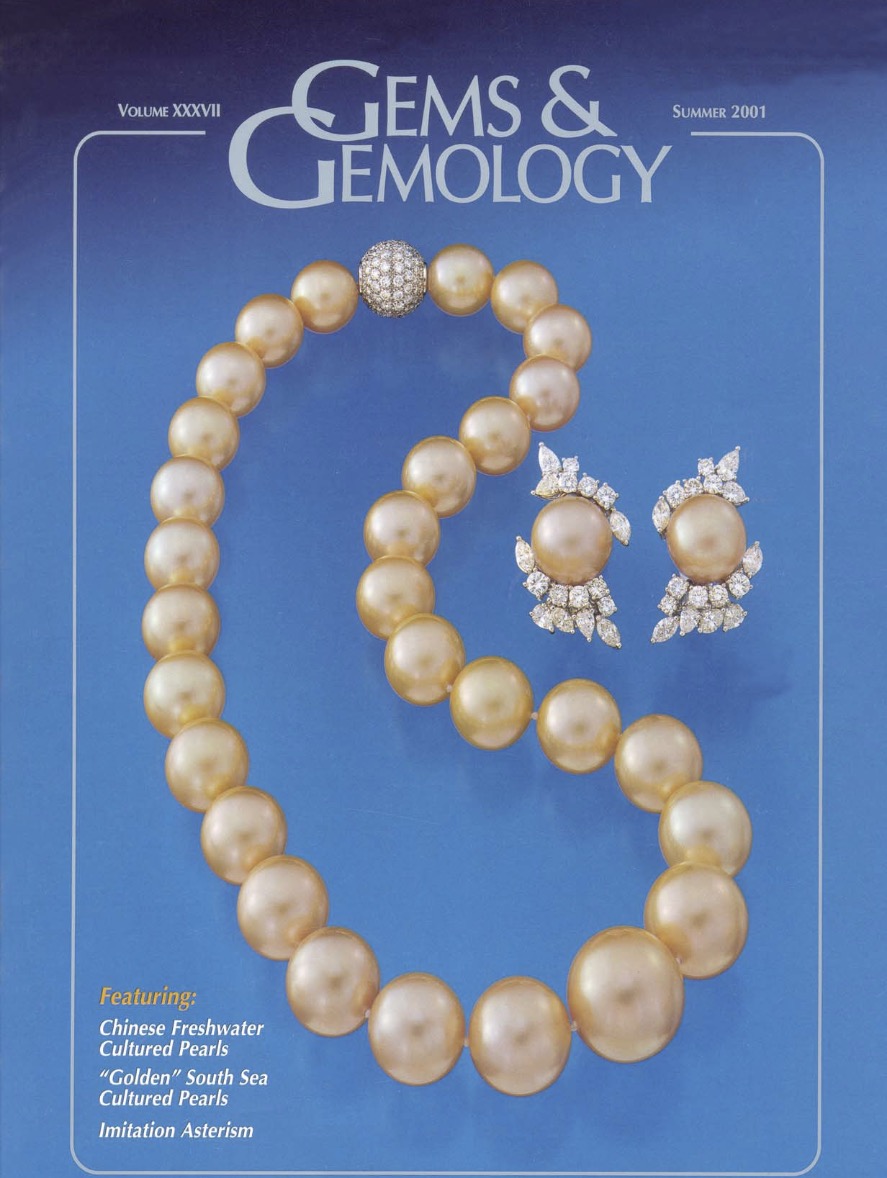
Gem News International: Amber (Burmite") from Myanmar: Production resumes"
Journal Article
Levinson, A.A. (2001) Gem News International: Amber (Burmite") from Myanmar: Production resumes".Gems & Gemology, Vol. 37, No. 2, Summer, pp. 142–143.
Record No. 26691 | Sinkankas/Born No.: NIS/NIB | RWHL
Amber (“Burmite”) from Myanmar: Production resumes. Amber from Myanmar—often called “Burmite”—has been used by Chinese artisans since the 1st century AD, but rarely entered Western markets before the late 19th century. Found in the Hukawng Valley of northern Kachin State, about 80 km north-northeast of the jadeite-rich Uru River valley, Burmite differs from Baltic and Dominican amber by being harder, denser, and often more richly colored, ranging from yellow to dark reddish brown. These traits make it especially suited to carving and jewelry use. Although commercial extraction occurred before World War II under British rule, internal strife rendered the deposits largely dormant after the 1940s. Mining briefly resumed from 1995 to 1997, when several shipments were sent to China, but exports soon ceased due to low prices and limited mining activity. A new joint venture began around 2000, when Leeward Capital Corp. of Canada contracted with a Myanmar company to purchase all amber mined near Tanai along the historic Ledo Road. Using open-pit mining and simple tools, up to 60 miners work the site during the dry season, recovering amber from narrow seams as disc-shaped fragments measuring a few millimeters to several centimeters. Large-scale mechanized extraction is unfeasible due to the material’s fragility. Leeward Capital acquired 78 kg of amber in 2000 and, by June 2001, had accumulated 300 kg of mixed-grade pieces up to 25 cm across. Inclusions of insects and plant material are relatively abundant in Burmite, occurring in roughly 30 fragments per kilogram, and indicate a Cretaceous origin (~100 million years ago)—much older than Dominican (~30 My) or Baltic (~40 My) amber. These inclusions have drawn scientific interest due to their exceptional preservation and paleontological significance.
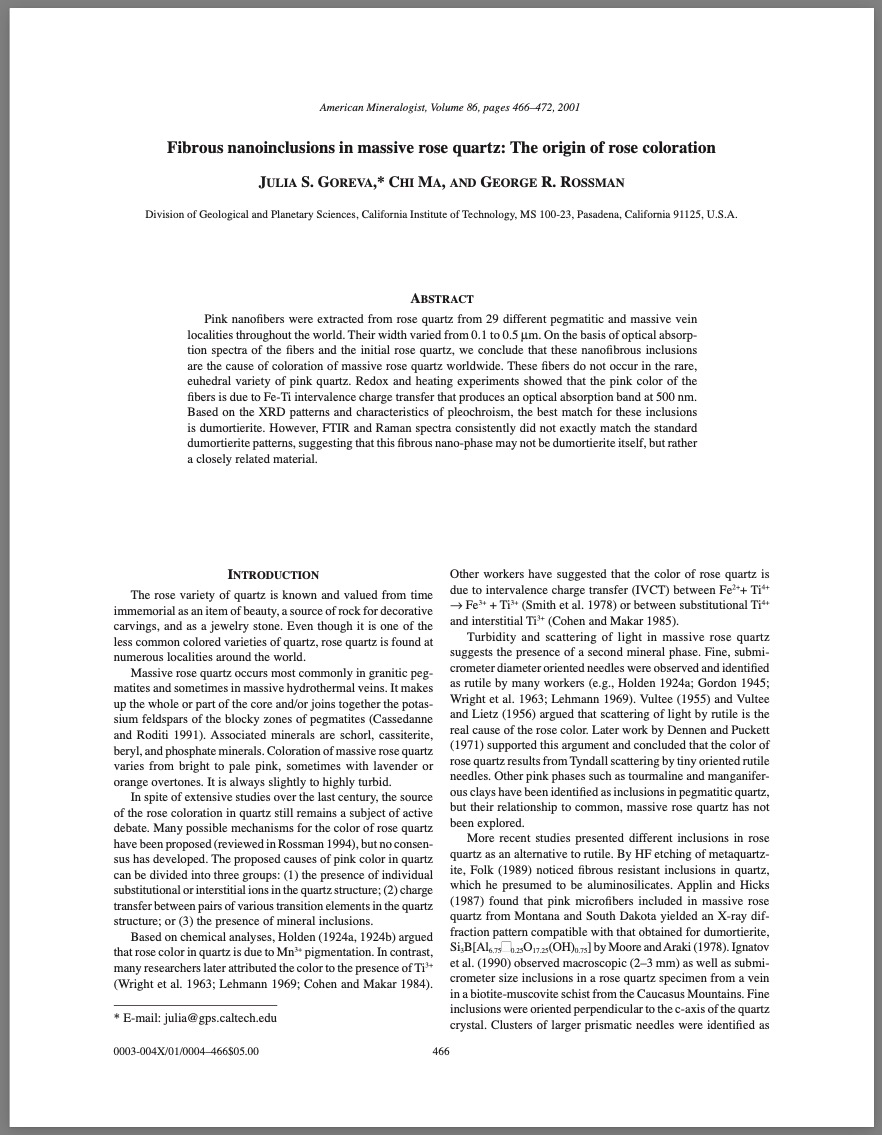
Goreva, J.S., Ma, C. and Rossman, G.R. (2001) Fibrous nanoinclusions in massive rose quartz: The origin of rose coloration.American Mineralogist, Vol. 86, No. 4, April, pp. 466–472.
Record No. 26673 | Sinkankas/Born No.: NIS/NIB | RWHL
Reference copied to clipboard!
gems, quartz, rose quartz, inclusions, fiber inclusions, silk, dumortierite, analytical
Pink nanofibers were extracted from rose quartz samples collected from 29 pegmatitic and massive vein localities worldwide, with fiber widths ranging from 0.1 to 0.5 µm. Optical absorption spectra of both the nanofibers and the original rose quartz indicate that these nanofibrous inclusions are responsible for the coloration of massive rose quartz globally. Notably, such fibers are absent in the rare, euhedral variety of pink quartz. Redox and heating experiments revealed that the pink color arises from Fe-Ti intervalence charge transfer, which generates an optical absorption band at 500 nm. X-ray diffraction patterns and pleochroic behavior suggest that the inclusions are most similar to dumortierite; however, FTIR and Raman spectra show consistent deviations from standard dumortierite signatures, implying that the fibrous nanophase may not be dumortierite itself but a closely related mineral species.
Petrology of jadeite-bearing serpentinized peridotite and its country rocks from Northwestern Myanmar (Burma)
Journal Article
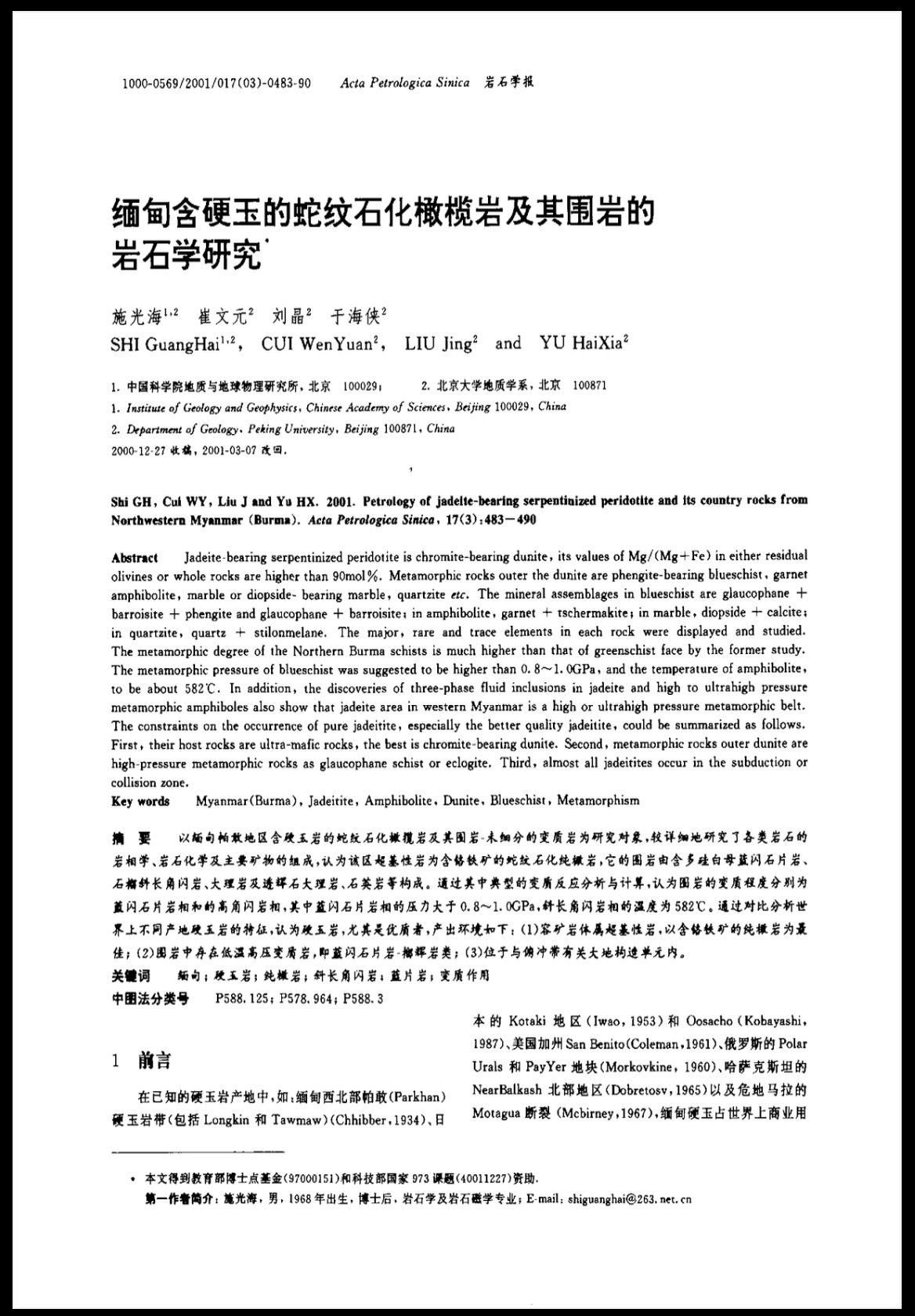
Shi, G., Cui, W.Y., Liu, J. and Yu, H.X. (2001) Petrology of jadeite-bearing serpentinized peridotite and its country rocks from Northwestern Myanmar (Burma).Acta Petrologica Sinica, Vol. 17,, 1-Jul pp. 483–490.
Record No. 6765 | Sinkankas/Born No.: NIS/NIB | Language: in Chinese with English abstract | RWHL
Reference copied to clipboard!
gems, jadeite, fei cui, Myanmar, geology
Jadeite-bearing serpentinized peridotite is a chromite-bearing dunite, its values of Mg/ (Mg+Fe) in either residual olivines or whole rocks are higher than 90mol%. Metamorphic rocks outer the dunite are phengite-bearing blueschist, garnet amphibolite, marble or diopside- bearing marble, quarzite etc. The mineral assemblages in blueschist are glaucophane + barroisite + phengite and glaucophane + barroisite; in amphibolite, garnet + tschermakite; in marble, diopside + calcite; in quartzite, quartz + stilonmelane. The major, rare and trace elements in each rock were displayed and studied. The metamorphic degree of the Northern Burma schists is much higher than that of greenschist face by the former study. The metamorphic pressure of blueschist was suggested to be higher than 0.8 ~ 1. OGPa, and the temperature of amphibolite, to be about 582°C. In addition, the discoveries of three-phase fluid inclusions in jadeite and high to ultrahigh pressure metamorphic amphiboles also show that jadeite area in western Myanmar is a high or ultrahigh pressure metamorphic belt. The constraints on the occurrence of pure jadeitite, especially the better quality jadeitite, could be summarized as follows. First, their host rocks are ultra-mafic rocks, the best is chromite-bearing dunite. Second, metamorphic rocks outer dunite are high-pressure metamorphic rocks as glaucophane schist or eclogite. Third, almost all jadeitites occur in the subduction or collision zone.
Moroz, I., Vapnik, Y., Eliezri, I. and Roth, M. (2001) Mineral and fluid inclusion study of emeralds from the Lake Manyara and Sumbawanga deposits, Tanzania.Journal of African Earth Sciences, Vol. 33, No. 2, pp. 377–390.
Record No. 6046 | Sinkankas/Born No.: NIS/NIB | RWHL
Reference copied to clipboard!
gems, inclusions, beryl, emerald, Tanzania
Mineral and fluid inclusions were investigated in Tanzanian emeralds sampled in the Lake Manyara and Sumbawanga deposits. Microthermometry and Raman microprobe analyses were applied for this study. Primary and pseudosecondary H₂O–CO₂ inclusions, with numerous daughter solid phases, are common in the emeralds from the Lake Manyara deposit. Magnesite, Mg-calcite, aragonite, dolomite, calcite, nahcolite, quartz, and chrysoberyl were identified as trapped solids in fluid inclusions. Similar mineral inclusions were also found in the emeralds themselves. The composition of the trapped fluid present at emerald growth is estimated to be a carbonic-rich solution with chloride content of about 6 wt% NaCl equivalent. The P–T conditions of emerald growth are as follows: T = 370–470 °C and P = 3.0–7.0 kbar. Mineral inclusions of phenakite, euclase, bertrandite, and helvite are common in the emeralds of the Sumbawanga deposit. CO₂-rich inclusions with an aqueous phase (usually below the detection limit), and CaCl₂-rich inclusions with salinity of up to 17 wt% NaCl equivalent, are related to emerald growth. The trapping of fluid inclusions postdates the growth of mineral inclusions. The P–T conditions of emerald growth are as follows: T = 220–300 °C and P = 0.7–3.0 kbar.
Gem News International: Anhydrite inclusion in a ruby from Myanmar
Journal Article
Smith, C.P. and Dunaigre, C. (2001) Gem News International: Anhydrite inclusion in a ruby from Myanmar.Gems & Gemology, Vol. 37, No. 3, Fall, p. 236.
As more advanced analytical techniques become commonplace in gemological laboratories, properties and features not report-ed previously will occasionally be encountered. Such was the case in the Gübelin Gem Lab (GGL) recently, when a 3.79 ct ruby was submitted for identification. The combination of inclusion features, internal growth structures, and chemical composition indicated that the ruby was unheated and originated from the Mogok stone tract of Myanmar. A crystalline inclusion situated just below the surface of the gemstone, however, had an unfamiliar appearance (figure 26). This colorless crystal had a roughly tabular habit with an irregular surface, and did not resemble any of the more common crystalline inclusions encountered in Burmese rubies, such as calcite, apatite, and sphene.
Star sapphire with two stars of two different colors
Journal Article
Koivula, J.I. and Tannous, M. (2001) Star sapphire with two stars of two different colors.Gems & Gemology, Vol. 37, No. 3, Fall, pp. 218–219.
corundum, phenomena, star sapphire, inclusions.5, gems
Black asteriated sapphires from Thailand that show distinct “silvery” white six-rayed stars are relatively well known in the gem trade, and they are also relatively common as compared to other colors of star sapphires. Occasionally, however, we see less typical asterism in this material. For example, some stars show 12 rays instead of six, or the star may appear “golden.”
Gem News International: Ruby crystal with large mobile gas bubble
Journal Article
Koivula, J.I. and Cole, J.E. (2001) Gem News International: Ruby crystal with large mobile gas bubble.Gems & Gemology, Vol. 37, No. 2, Summer, pp. 149–150.
Southern California gem dealer William Larson is always looking for unique or unusual items during his frequent buying trips to Myanmar. One such gemological curiosity found on a recent trip was a 2.46 ct ruby crystal with four ran-domly placed polished flats (figure 22). This specimen (which measured 7.92 × 5.85 × 5.38 mm) was unusual in that it contained a large (almost 4 mm) negative crystal with a 1-mm-diameter free-moving gas bubble (again, see figure 22). Also seen moving within the liquid phase were numerous tiny white solid parti-cles, which make this a three-phase inclusion. Although both primary and secondary fluid inclusions are known to occur in rubies from Myanmar, the very large size of this
Gem News International: A brownish green sapphire, with pyrochlore inclusions
Journal Article
Koivula, J.I. and Scarratt, K. (2001) Gem News International: A brownish green sapphire, with pyrochlore inclusions.Gems & Gemology, Vol. 37, No. 2, Summer, p. 150.
A large, slightly brownish green sapphire, reportedly from Myanmar, was recently seen in both the AGTA laboratory in New York and the GIA Gem Trade Laboratory in Carlsbad. The gem, an oval mixed cut that weighed 28.04 ct and measured 18.80 × 17.28 × 10.89 mm (figure 23), was brought to our attention by Joseph Krashes, of Krashes Dirnfeld, New York. It was interesting not only because of its size and color in relation to the stated locality, but also because of the inclusions it contained. The sapphire played host to a number of transparent to translucent brownish yellow inclusions (figure 24), a few of which had been exposed to the surface during faceting. When we examined some of the inclusions with higher magnification using a digital camera attached to a Raman microscope, we observed a crystal form that suggested that they were isometric, and no pleochroism was visible with polarized light. The slightly rounded surface of the inclusions suggested that dissolution might have occurred prior to their incorporation into the sapphire. The transparency and general condition of these inclusions and their immediate surroundings indicated that the host sapphire had not been subjected to high-temperature heat treatment—an important consideration in today’s sapphire market. Laser Raman microspectrometry of the inclusions at both laboratories identified them as pyrochlore. In the past, the pyrochlore inclusions we have encountered in sapphires have always been dark red to brownish red and observed in blue to blue-green sapphires (see, e.g., figure 25). This is the first time that either laboratory has identified brownish yellow pyrochlore inclusions in sapphire of any color.
Materialeigenschaften und Optimierungspotential von farbigen Korunden am Beispiel vietnamesischer und synthetischer Rubine
Material properties and optimization potential of colored corundums using Vietnamese and synthetic rubies as examples.
Thesis
Dung, P.T. (2001) Materialeigenschaften und Optimierungspotential von farbigen Korunden am Beispiel vietnamesischer und synthetischer Rubine. [Material properties and optimization potential of colored corundums using Vietnamese and synthetic rubies as examples.]., Mainz: Johannes Gutenberg-Universität Mainz, 152 pp.
Record No. 3903 | Sinkankas/Born No.: NIS/NIB | Language: in German | RWHL
Reference copied to clipboard!
gems, corundum, Vietnam.12
Ruby is the gemstone variety of the mineral corundum that is colored red by chromium; pure corundum (α-Al₂O₃) is colorless. In corundum, the coloring substances are generally transition metal ions, which produce a specific color effect or — in the presence of several such types of ions — can also create mixed colors. In addition, the crystal structure of corundum is also susceptible to so-called “lattice defects,” which can likewise contribute to coloration. Typical varieties of corundum have been given proper names that became famous as gemstone designations: red ruby (Cr), blue and yellow sapphire (Fe+Ti in place of 2Al, but also Fe alone and also lattice defects), orange padparadscha (Cr, Fe, defects, etc.); additional color nuances (green, pink, rose, iridescent, etc.) are produced by combinations of the individual color-causing agents and are marketed as fancy-colored. Corundums occurring as rock-forming minerals are generally rendered nearly opaque and dark in color by inclusions of foreign minerals, gas and liquid inclusions, microfractures, and structural defects. Only when the crystallization conditions during corundum formation have been such that nearly inclusion-free, transparent, and at the same time large crystals with a homogeneous, color-relevant trace-element concentration could grow, can exceptional material qualities be expected. Because these fundamental conditions occur only rarely in nature, these varieties of corundum can belong among the most highly valued gemstones.
Beobachtungen an hitzesehandeltem Rubin mit kunstlicher Rissheilung
Observations on heat-treated ruby with artificial fracture healing
Journal Article
Hänni, H.A. (2001) Beobachtungen an hitzesehandeltem Rubin mit kunstlicher Rissheilung. [Observations on heat-treated ruby with artificial fracture healing]Gemmologie: Zeitschrift der Deutschen Gemmologischen Gesellschaft, Vol. 50, No. 3, pp. 123–136.
Record No. 3197 | Sinkankas/Born No.: NIS/NIB | Language: In German | RWHL
Reference copied to clipboard!
corundum, color.4, gems
This retrospective study, based on samples analysed in the last twenty years, deals with heat treated rubies in respect of their content of foreign glassy fillings in fractures and subsequently healed fissures. Flux assisted heat treatment with borax, lithium tetraborate a.s.o. and additives of glass, quartz or melted natural inclusions may form a melt that spreads over the surface and is drawn in all fissures and cavities during heat treatment. The flux character of such melts produced during the treatment process enables a recrystallisation of former fissures. During cooling a small portion of (synthetic) ruby is formed that heals the former fissures. The flux may stay amorphous and glassy, but often precipitations of devitrification products are observed. The results of treatment under flux conditions are not only healing structures similar to natural ,,fingerprints“, but also residual portions of the flux material (commonly called ,,glass“) which is kept in fine droplets, channels, or thin films, up to surface reaching larger cavities. The different amounts of foreign residues in a ruby lead to the request of a quality scale. When residues are addressed in test reports, a scale with three levels has been widely accepted (e.g. minor, moderate, significant/prominent).
Saminpanya, S. (2001) Ti-Fe mineral inclusions in star sapphires from Thailand.Australian Gemmologist, Vol. 21, No. 3, pp. 125–128.
Record No. 2927 | Sinkankas/Born No.: NIS/NIB | RWHL
Reference copied to clipboard!
corundum, inclusions.5, Thailand.12, Chantaburi, star sapphire, gems
An examination of exsolved needles and mineral inclusions in star sapphires from Bang Kacha [also spelled Bang-kha-cha], Chanthaburi Province, Thailand, was conducted using electron microprobe and wavelength-dispersive spectrometry with the techniques of element mapping and spot analy-ses. Rather than being rutile or hematite, as previously reported, the exsolved “needles” consisted of a mineral of the ilmenite-hematite series, ilmenite, or a spinel; other opaque inclusions were magnetite-hercynite.RAH
Primary deposits in Sri Lanka will reinvigorate trade, gem sector notes
Journal Article
Henricus, J. (2001) Primary deposits in Sri Lanka will reinvigorate trade, gem sector notes.Jewellery News Asia, No. 206,, October pp. 55–56, 58–60.
Record No. 2925 | Sinkankas/Born No.: NIS/NIB | RWHL
Reference copied to clipboard!
corundum, sources.12, Sri Lanka.12, gems
Gem production in Sri Lanka has declined in recent years as the traditional alluvial (secondary) deposits have been depleted and new alluvial deposits become increasingly difficult to find. Yet this trend may be reversed as new in-situ (primary) gem deposits are being discovered with the help of modern satellite technology in areas not previously known to have gem occurrences. These primary deposits reportedly are hosted by skarns (carbonate rocks, such as limestone, affected by contact metamorphism accompanied by the introduction of additional elements). One of the new areas, near Kataragama in the extreme southeastern part of the island, is mainly producing blue sapphires, some of fine quality, along with other gems (including yellow and orange-pink sapphire, garnet, and red spinel). Although well-formed crystals have been found, they typically contain abundant inclusions and cracks. Both traditional hand methods and mechanized mining are being used, with careful attention to environmental matters.JEC
Gem News International: Iolite and corundum in Wyoming
Journal Article
Hausel, W.D. (2001) Gem News International: Iolite and corundum in Wyoming.Gems & Gemology, Vol. 37, No. 4, Winter, pp. 336–337.
In 1995, the Wyoming State Geological Survey discovered gem-quality iolite (cordierite) and corundum in the Palmer Canyon area of the central Laramie Range, southeastern Wyoming. Hosted in quartzofeldspathic gneiss, the iolite occurs as transparent to translucent grains and nodules, with some samples weighing up to 600 grams. A 10.8 × 6.4 × 3.2 cm specimen is believed to be the largest iolite found in Wyoming. GIA analysis of cut iolite (0.36–1.33 ct) confirmed gem-quality properties and internal features such as silk, biotite inclusions, and healed fractures. Nearby, pink to purplish pink corundum occurs in chlorite-biotite schist and mica-kyanite gneiss over a 300 m extent. Faceted and cabochon sapphires (up to 1.47 ct) displayed typical corundum properties, with pleochroism, chromium absorption lines, and rutile silk. No evidence of heat treatment was found. These discoveries confirm the commercial gem potential of Palmer Canyon. Wyoming is also known for other gem minerals, including diamond, aquamarine, jade, and pyrope garnet, and continued exploration is expected to reveal more deposits.
Gem News International: “Young” and “old” sapphires from Australia and Southeast Asia
Journal Article
Laurs, B.M. (2001) Gem News International: “Young” and “old” sapphires from Australia and Southeast Asia.Gems & Gemology, Vol. 37, No. 4, Winter, pp. 330–331.
Australia and Southeast Asia have been the sources of large amounts of sapphire associated with basaltic rocks. It is universally accepted by geologists that the sapphires did not crystallize directly from the basalts; rather, the basalts merely were the transporting mechanism that brought the sapphires to the surface. Over the past decade, two types of sapphires associated with basalts from these areas have been recognized, based on variations in their trace-element contents. Dr. F. L. Sutherland of the Australian Museum, Sydney, postulated that sapphires with a Cr₂O₃/Ga₂O₃ ratio less than 1 crystallized from a magma, whereas those with a Cr₂O₃/Ga₂O₃ ratio greater than 1 formed by a metamorphic process. To help prove this hypothesis, Dr. Sutherland and co-workers have obtained information on the age of sapphires from both inferred origins. Sapphires of such different geological origins should show discrete differences in their crystallization ages. Syngenetic zircon inclusions (figure 7) in both types of sapphire were dated by uranium-lead isotope methods. Vastly different ages (ranging from 2.8 to 900 million years) were obtained in a study of Australian sapphires of both types, from Queensland and New South Wales. The younger ages correspond to sapphires with a magmatic origin, while the older sapphires have trace-element ratios that indicate a metamorphic origin. The youngest ages obtained so far (1.1–1.5 million years) were found in magmatic-type sapphires from Laos.
Gem News International: An unusual “crystal” of synthetic ruby from Sri Lanka
Journal Article
Hyršl, J. (2001) Gem News International: An unusual “crystal” of synthetic ruby from Sri Lanka.Gems & Gemology, Vol. 37, No. 3, Fall, p. 243.
December 1999, a friend of this contributor purchased a 9.56 ct specimen in Sri Lanka that was represented as ruby. The sample looked like a typical broken bipyramidal crystal with waterworn surfaces, and showed a saturated red color (figure 38). Examination with a handheld spectroscope revealed a typical ruby spectrum. With strong back-lighting, straight parallel zones perpendicular to the per-ceived optic-axis direction could be seen with difficulty; these appeared to result from the presence of inclusions. The rough yielded a well-proportioned 4.17 ct pear shape. Prominent, eye-visible zoning appeared to be caused by dense concentrations of the “silk” inclusions that are typical of ruby (figure 39). When viewed with a microscope, however, slightly curved zones of tiny gas bubbles were seen. Between the zones of small bubbles were larger bub-bles, some with a long attached channel (figure 40). Also present were abundant, curved hollow cavities that were very similar to the “trichites” seen in many tourmalines. The gas bubbles proved that this sample was a flame-fusion synthetic ruby. However, this fake crystal was unusual in that it was fashioned from low-quality synthet-ic material containing abundant bubbles. While most gemdealers are suspicious of high-quality rough without inclu-sions, few expect to see clever imitations of rough crystals made from lower-quality synthetics. Such mistakes can be very costly.
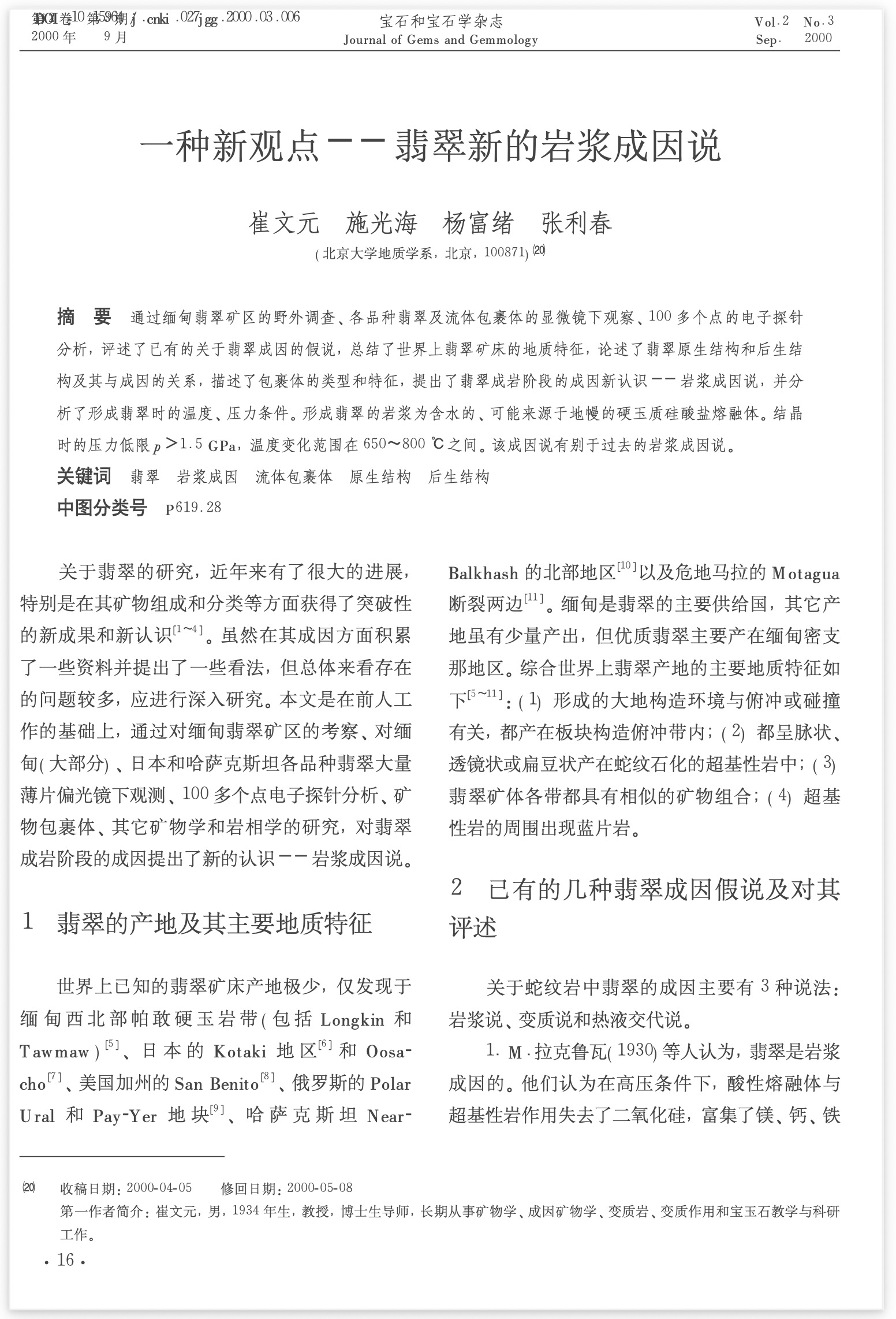
Cui, W., Shi, G., Yang, F. and Zhang, L. (2000) A new viewpoint—magma genesis of jadeite jade. [种新观点——翡翠新的岩浆成因说]Journal of Gems & Gemmology, Vol. 2, No. 3, pp. 16–21.
Through the field survey of Myanmar jadeite jade, the microscope observation of a lot of jadeite jade thin sections and fluid inclusions and more than one hundred EPMA analysis, the hypothesis of jadeite jade genesis is reviewed, the geological characteristics of jadeite jade in the world is summarized, the types and characteristics of fluid inclusions are described, the relationship between jadeite jade texture and its genesis is discussed, a new viewpoint—magma genesis of jadeite jade—is put forward, and the p t condition under which jadeite jade crystallized is analyzed. The magma from which jadeite jade crystallized is hydrous jadeitic silica melt which may come from mantle. The crystal condition is p >1.5 GPa, t=650~800℃. This hypothesis of magma genesis put forward before.
Nuclear microscopic studies of inclusions in natural and synthetic emeralds
Journal Article
Yu, K.N., Tang, S.M. and Tay, T.S. (2000) Nuclear microscopic studies of inclusions in natural and synthetic emeralds.X-Ray Spectrometry, Vol. 29, pp. 178–186.
Record No. 8103 | Sinkankas/Born No.: NIS/NIB | RWHL
Shi, G., Cui, W., Wang, C. and Zhang, W. (2000) The fluid inclusions in jadeitite from Pharkant area, Myanmar.Chinese Science Bulletin, Vol. 45, No. 20,, 10/1/00 pp. 1896–1901.
Numerous liquid–gas and liquid–gas–solid inclusions have been identified in jadeitites from the Pharkant region of northwestern Myanmar, and their characteristics, geological context, and the occurrence of porphyroclastic jadeite containing such inclusions have been thoroughly described. Raman spectroscopic analysis revealed that the fluid inclusions are composed of H₂O + CH₄ in the liquid–gas phase, and jadeite as the solid (daughter) phase. These findings suggest that the Pharkant jadeitites crystallized from a jadeitic melt bearing H₂O and CH₄, potentially of mantle origin. The inferred pressure–temperature conditions for their crystallization are estimated to be above 650 °C and greater than 1.5 GPa..
Oriented inclusions in spinels from Madagascar
Journal Article
Schmetzer, K., Gübelin, E., Bernhardt, H.-J. and Kiefert, L. (2000) Oriented inclusions in spinels from Madagascar.Journal of Gemmology, Vol. 27, No. 4, October, pp. 229–232.
Oriented inclusions in bluish-grey gem spinels from Madagascar were identified as enstatite (MgSiO₃) using a combination of qualitative and quantitative electron microprobe analysis along with laser Raman microspectroscopy. A possible origin of these spinels is briefly discussed in relation to the sapphire- and spinel-bearing deposits of Andranondambo and Ilakaka in southern Madagascar.
Abdalla, H.M. and Mohamed, F.H. (1999) Mineralogical and geochemical investigation of emerald and beryl mineralisation, Pan-African belt of Egypt: genetic and exploration aspects.Journal of African Earth Sciences, Vol. 28, No. 3, pp. 581–598.
Mineralogical, geochemical and fluid inclusion studies reveal two favorable environments for the localisation of beryl mineralisations in the Precambrian rocks of Egypt: (1) emerald–schist; and (2) beryl-specialised granitoid associations. Emerald occurs within the mica schists and is typically confined to the Nugrus major shear zone. However, beryl associated with granitoids occurs in pegmatite veins, greisen bodies, and cassiterite–quartz veins cutting the granites and the exocontacts of the volcanosedimentary country rocks. Compositionally, emerald is of octahedral type and its cell edge is lengthened along the a-axis, while beryl associated with granitoids is normal in composition and structural constants. Emerald is thought to be formed as the result of epitactic nucleation of Be, Al and alkali-rich solutions on the mica of the schist country rocks. Fluid inclusion studies show that the solutions are saline (8–22 wt% NaCl equiv.) and the reactions proceeded in the temperature range 260–382 °C. On the other hand, aqueous inclusions in beryl associated with granitoids show the following sequence of formation with decreasing temperatures and salinities: beryl pegmatite (320–480 °C and 7–16 wt% NaCl equiv.) → greisen bodies (190–400 °C and 4–7 wt% NaCl equiv.) → cassiterite–quartz veins (190–380 °C and 2–4 wt% NaCl equiv.). This study suggests that factors such as the chemistry of the Be-bearing fluids (rather than that of the bulk host schists) and syn-tectonic intrusions of leucogranites and pegmatites (Be-deriving sources) along major ductile shear zones are the important factors controlling emerald formation. However, the endogreisens and exogreisens are the most important targets characterising the metasomatically- and magmatically-specialised, Be-granitoids, respectively. The aqueous inclusions examined in greisen beryls of metasomatised granites show a shorter range of homogenisation temperatures (260–390 °C) and salinities (4.8–7 wt% NaCl equiv.) as compared to those of magmatically-specialised granitoids (190–400 °C and 4–7 wt% NaCl equiv.). This phenomenon can be partly attributed to the late development of the fracture system during the crystallisation history of the metasomatised granites, where little or no contribution from meteoric waters occurred.
Exploring the Literature of Gemstone Inclusions
The literature of gemstone inclusions covers identification, origin determination, treatments, synthesis, mineral inclusions, fluid inclusions and other internal features of natural and synthetic gems.
Four Treasures is Lotus Gemology's freely accessible gemological reference database. Use the full database to search by author, title or keyword and explore literature on gemology, mineralogy, jewelry and related fields. Where available, hyperlinks on titles may lead directly to the full publication.