Jade Bibliography

Jade Bibliography

Explore books, articles and historical sources on jade in Four Treasures, the Lotus Gemology reference database. This bibliography brings together matching records from the collection, with publication details, abstracts and cover images where available.

Jade References

The list below matches the terms jade, jadeite, nephrite or Fei Cui in the database's searchable fields. Some references discuss these materials as part of a broader subject.
181–200 of 3,779 matching references

Collecting Chinese jewellery at the Victoria and Albert Museum
Journal Article
Luk, Y.-p. (2018) Collecting Chinese jewellery at the Victoria and Albert Museum. Transactions of the Oriental Ceramic Society, Vol. 81 • 2016–17, pp. 31–43.
Record No. 6600  |  Sinkankas/Born No.: NIS/NIB  |  RWHL*

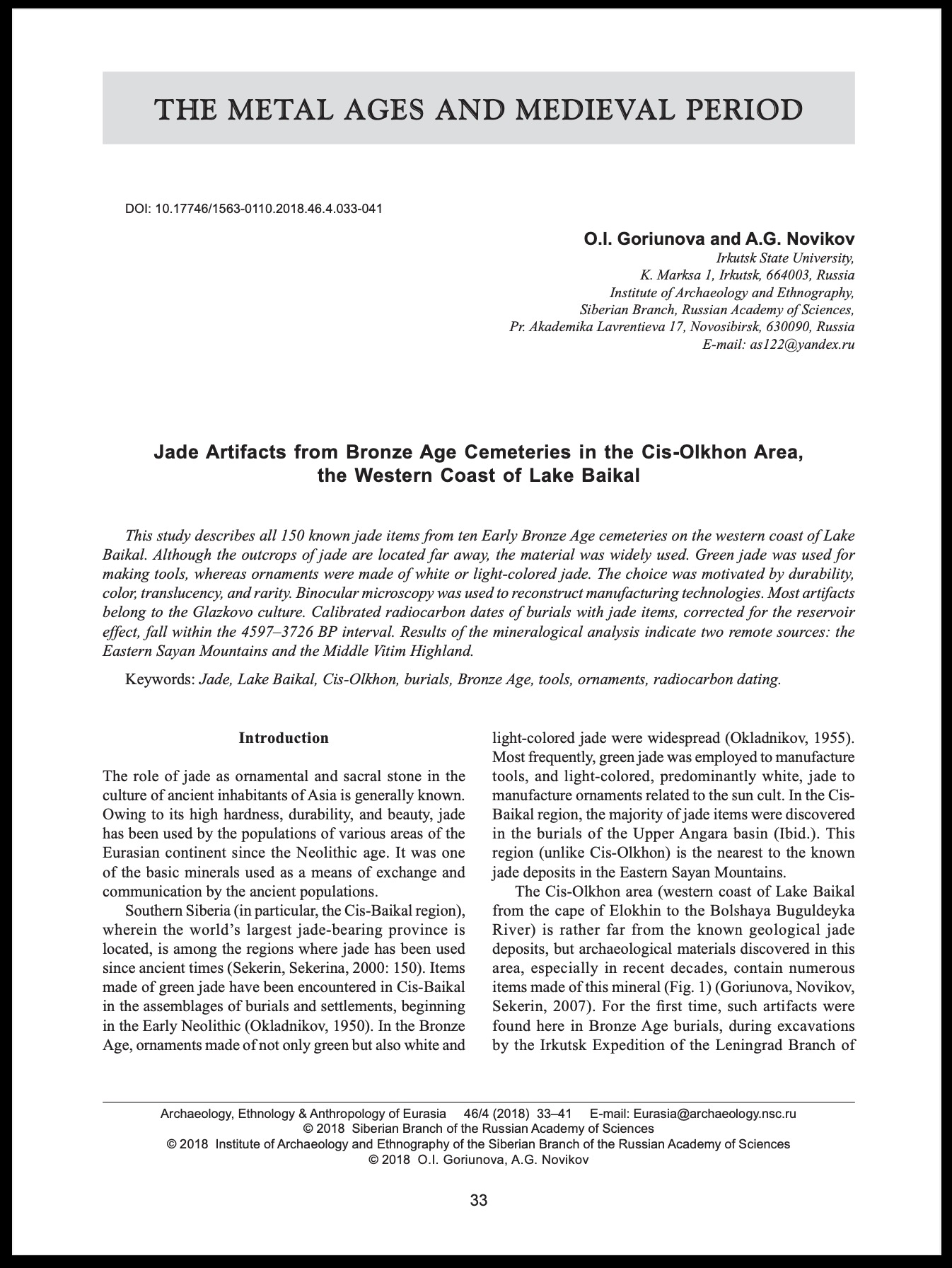
Jade artifacts from Bronze Age cemeteries in the Cis-Olkhon area, the western coast of Lake Baikal
Journal Article
Goriunova, O.I. and Novikov, A.G. (2018) Jade artifacts from Bronze Age cemeteries in the Cis-Olkhon area, the western coast of Lake Baikal. Archaeology, Ethnology & Anthropology of Eurasia, Vol. 46, No. 4, pp. 33–41.
Record No. 6236  |  DOI: https://doi.org/10.17746/1563-0102.2018.46.4.033-041  |  Sinkankas/Born No.: NIS/NIB  |  RWHL*
This study describes all known 150 jade items from ten Early Bronze Age cemeteries on the western coast of Lake Baikal. Although the outcrops of jade are located far away, the material was widely used. Green jade was employed for making tools, whereas ornaments were made of white or light-colored jade. The choice was motivated by durability, color, translucency, and rarity. Binocular microscopy was used to reconstruct manufacturing technologies. Most artifacts belong to the Glazkovo culture. Calibrated radiocarbon dates of burials with jade items, corrected for the reservoir effect, fall within the 4597–3726 BP interval. Results of the mineralogical analysis indicate two remote sources––the Eastern Sayan Range and the Middle Vitim Highland.

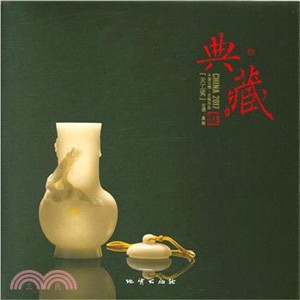
A method of determining heated ancient nephrite jades in China
Journal Article
Bao, Y., Zhao, C., Li, Y. and Yun, X. (2018) A method of determining heated ancient nephrite jades in China. Nature.com, online article, Scientific Reports, 11 pp..
Record No. 5951  |  DOI: https://dx.doi.org/10.1038/s41598-018-30564-w  |  Sinkankas/Born No.: NIS/NIB  |  RWHL*
Ancient jade is one of the most significant cultural relics in China. Despite the increasingly important role of heated jades in ancient jade study, there are still few in-depth material studies on heated jades for the time being, which results in limitations on archaeological research and conservation. In order to evaluate the appearance change of nephrite jades, we employ the heating simulation experiment to present these change under different heating temperature ranging from 100°C to 1300°C. In this study, a nondestructive identification method proposed is to help determine whether the ancient jades were heated before and what the approximate heating temperature was from 100°C to 1300°C though phase transformation, structure change and colour variation with several advanced characterization methods such as the X-ray diffraction (XRD), the thermo-gravimetric analyser (TGA), the ultraviolet-visible spectrophotometer (UV-Vis), the Fourier transform infrared spectroscopy (FTIR) and the scanning electron microscope (SEM). The hierarchy of colour (from ~500°C) and structure (from ~800°C) on heated jades in the jade research field were first proposed and discuss here. This method is considered useful and valuable in the study and protection of Chinese ancient jades.

Classic Collections of 2017 China Jade Carving & Stone Carving Works Awarded with Tian Gong Prize
Edited Book
Ao, Y., editor (2018) Classic Collections of 2017 China Jade Carving & Stone Carving Works Awarded with Tian Gong Prize.. Beijing, 中国地质大学出版社 [China University of Geosciences Press], 400 pp..
Record No. 4441  |  ISBN/ISSN: 9787120000000  |  Sinkankas/Born No.: NIS/NIB  |  Language: in Chinese  |  RWHL*
This catalogue documents the works selected for the 2017 China Jade Carving and Stone Carving “Tian Gong Award,” providing an extensive visual survey of contemporary Chinese lapidary art. Richly illustrated in color, it presents prize-winning and selected carvings in nephrite, Fei Cui, crystal, agate, turquoise, and numerous other gem and ornamental materials. The works encompass traditional subjects drawn from Chinese mythology, religion, landscape, flora and fauna alongside increasingly contemporary and experimental designs, demonstrating both continuity with established carving traditions and innovation in composition and technique. Individual pieces illustrate the carvers’ use of natural color, texture, skin, inclusions, and irregularities in the rough as integral elements of their designs. As an annual record of the Tian Gong competition, the volume documents important artists, materials, workmanship, and stylistic developments in Chinese jade and stone carving during 2017.

2017 2nd China Natural Crystal Works Jinghua Award Collection
2017年第二届中国天然水晶作品晶华奖典藏集
Edited Book
Ao, Y., editor (2018) 2017 2nd China Natural Crystal Works Jinghua Award Collection. [2017年第二届中国天然水晶作品晶华奖典藏集]. Beijing, 中国地质大学出版社 [China University of Geosciences Press], 329 pp..
Record No. 4169  |  ISBN/ISSN: 9787560000000  |  Sinkankas/Born No.: NIS/NIB  |  Language: in Chinese  |  RWHL*
In 2015, China Jewelry and Jade Jewelry Industry Association and Donghai County People's Government initiated and hosted the first China Natural Crystal “Jinghua Award” exhibition. Since then, this event has been held every two years. The works include crystal carving stone and ornamental stone. , jewelry, etc., through the strict and impartial selection of the expert review team, the gold, silver, bronze, best creative award, best craft award and excellence award. After the event, the winning work will be edited into a book, which is called Jing Yun Hua Zhang". This book is presented in the form of pictures and comments. It shows the whole and details of the work, which not only shows the natural beauty of the crystal, but also shows the author's exquisite skills. To make readers fully appreciate the artistic charm of combining natural crystals with traditional crafts. The compilation and completion of "Jing Yun Hua Zhang", on the one hand, focus on the award-winning works for readers to watch and exchange, on the other hand, it is also the encouragement and praise of the contestants to record their efforts and growth. At the same time, the book can not only observe the technological level and development status of contemporary crystal engraving, but also promote the spread of crystal culture and the development of the industry."

Hamin Jade Research

哈民玉器研究
Edited Book
Ji, P.D.C., editor (2018) Hamin Jade Research. [哈民玉器研究], 中华书局 [Zhonghua Book Company], 414 pp..
Record No. 4155  |  ISBN/ISSN: 9787100000000  |  Sinkankas/Born No.: NIS/NIB  |  Language: in Chinese  |  RWHL*
This volume presents a comprehensive study of the jade artifacts excavated from the Hamin prehistoric site in Inner Mongolia, an important late Neolithic settlement in northeastern China. The contributions examine the forms, materials, manufacture, use, and archaeological contexts of the Hamin jades, placing them within the broader development of prehistoric jade culture in the region. Particular attention is given to typology, technological features, traces of manufacture and use, and the relationships between jade objects and other excavated remains. Comparative discussion considers similarities and differences between the Hamin material and jade traditions at other contemporary or related archaeological sites, contributing to questions of cultural interaction, exchange, and the transmission of jade-working traditions. Rich archaeological documentation and specialist studies make the volume an important reference for understanding the role of jade at Hamin and its place within the prehistoric jade cultures of northeastern China. The characteristics of the exchange, the craftsmanship of the Hamin jade, the relationship between the Hamin jade and the Hongshan culture jade, the use of the hook-shaped jade and the Siberian shaman and the animal statues, make us have a deeper and more accurate understanding of the Haman jade.

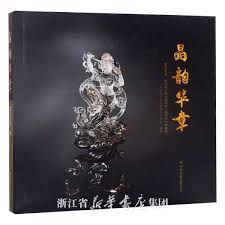
Jingyun Huazhang (2017 Second China Natural Crystal Works Jinghua Award Collection)
晶韵华章(2017年第二届中国天然水晶作品晶华奖典藏集)(精)
Edited Book
Shi Hongyue [史洪岳], editor (2018) Jingyun Huazhang (2017 Second China Natural Crystal Works Jinghua Award Collection). [晶韵华章(2017年第二届中国天然水晶作品晶华奖典藏集)(精)], China University of Geosciences Press Co., Ltd., 214 pp..
Record No. 4129  |  ISBN/ISSN: 9787560000000  |  Sinkankas/Born No.: NIS/NIB  |  Language: in Chinese  |  RWHL*
In 2015, China Jewelry and Jade Jewelry Industry Association and Donghai County People's Government initiated and hosted the first China Natural Crystal “Jinghua Award” exhibition. Since then, this event has been held every two years. The works include crystal carving stone and ornamental stones, jewelry, etc., through the strict and impartial selection of the expert review team, the gold, silver, bronze, best creative award, best craft award and excellence award. After the event, the winning work will be edited into a book, which is called Jing Yun Hua Zhang". This book is presented in the form of pictures and comments. It shows the whole and details of the work, which not only shows the natural beauty of the crystal, but also shows the artist’s exquisite skills. To make readers fully appreciate the artistic charm of combining natural crystals with traditional crafts. The compilation and completion of "Jing Yun Hua Zhang", on the one hand, focus on the award-winning works for readers to watch and exchange, on the other hand, it is also the encouragement and praise of the contestants to record their efforts and growth. At the same time, the book can not only observe the technological level and development status of contemporary crystal engraving, but also promote the spread of crystal culture and the development of the industry."

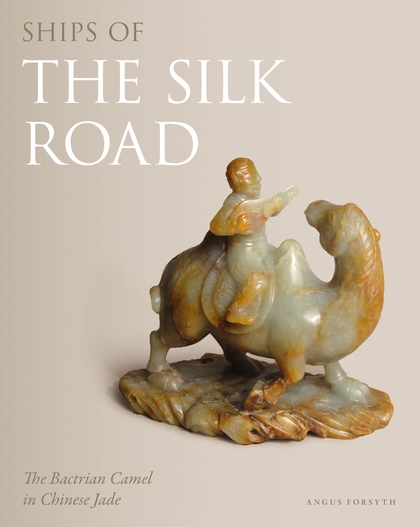
Ships of the Silk Road: The Bactrian Camel in Chinese Jade
Book
Forsyth, A. (2018) Ships of the Silk Road: The Bactrian Camel in Chinese Jade. London, Philip Wilson Publishers, 181 pp.
Record No. 4108  |  ISBN/ISSN: 9781780000000  |  Sinkankas/Born No.: NIS/NIB  |  RWHL*
For hundreds of years the Bactrian camel ploughed a lonely furrow across the vast wilderness of Asia. This bizarre-looking, temperamental yet hardy creature here came into its own as the core goods vehicle, resolutely and reliably transporting to China – over huge and unforgiving distances – fine things from the West while taking treasures out of the Middle Kingdom in return. Where the chariot, wagon and other wheeled conveyances proved useless amidst the shifting desert dunes, the surefooted progress of the camel – archetypal 'ship of the Silk Road' – now reigned supreme. The Bactrian camel was a subject that appealed particularly to Chinese artists because of its association with the exotic trade to mysterious Western lands. In his lavishly illustrated volume, Angus Forsyth explores diverse jade pieces depicting this iconic beast of burden. Almost one hundred separate objects are included, many of which have not been seen in print before. At the same time the author offers the full historical background to his subject. The book will have a strong appeal to collectors and art historians alike.

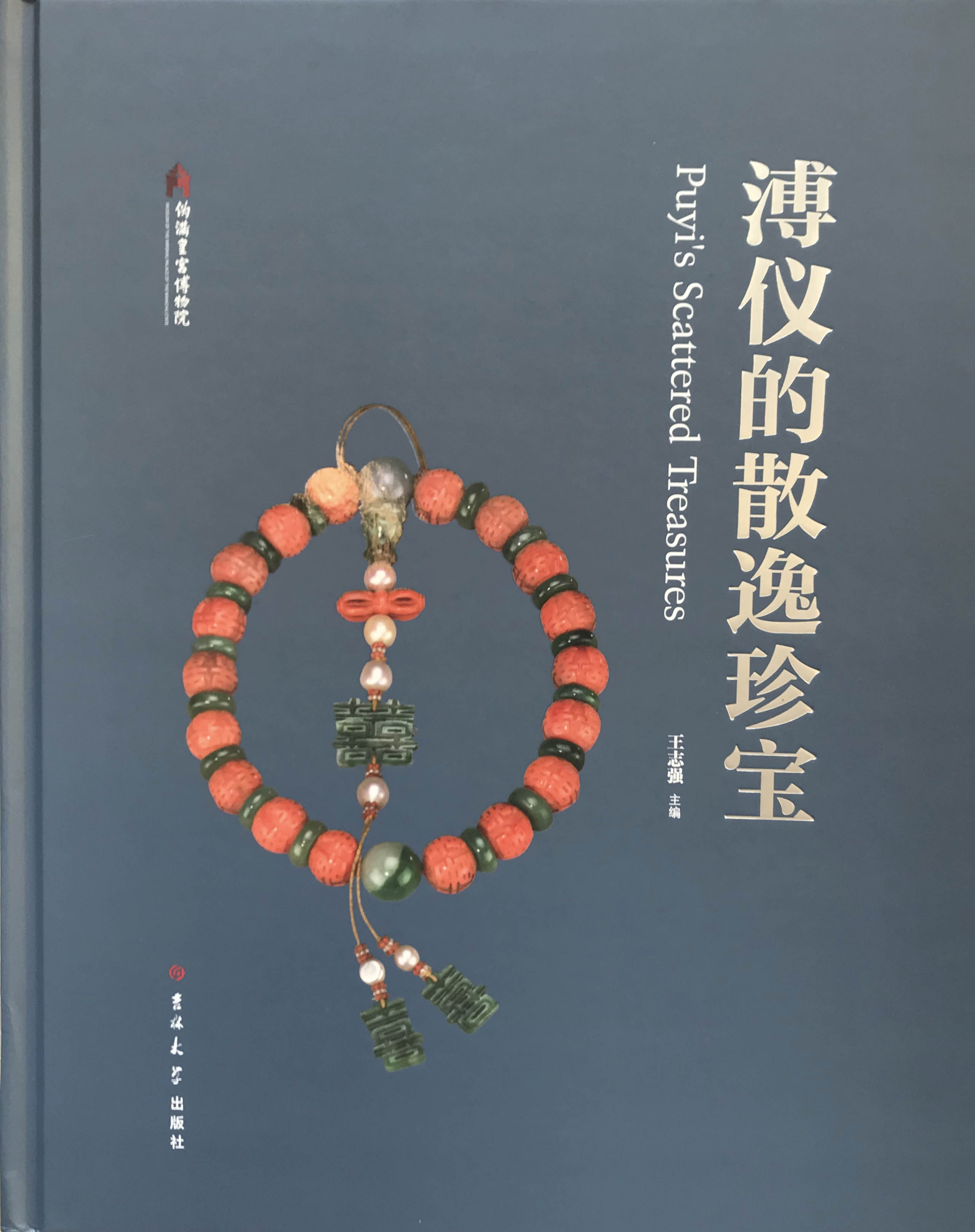
Puyi’s Scattered Treasures

溥仪的散逸珍宝
Edited Book
Wang, Z., editor (2018) Puyi’s Scattered Treasures. [溥仪的散逸珍宝]. Changchun, China, Jilin University Press, 170 pp..
Record No. 4040  |  ISBN/ISSN: 9787570000000  |  Sinkankas/Born No.: NIS/NIB  |  Language: in Chinese  |  RWHL*
This illustrated volume examines treasures formerly associated with Puyi (1906–1967), the last emperor of the Qing dynasty, that became dispersed following the collapse of the imperial household and the political upheavals of the twentieth century. Drawing on surviving objects and historical documentation, the catalogue traces the fate of items removed or separated from the former imperial collections and presents examples of jewelry, jade, precious objects, works of art, and other possessions connected with Puyi and the Qing court. The objects provide evidence of late imperial collecting, craftsmanship, court taste, and material culture while also illuminating the complicated dispersal of the imperial collections through removal, sale, loss, and changing ownership. Richly illustrated, the book serves both as a record of surviving scattered treasures and as a study of their relationship to Puyi and the final decades of China’s imperial tradition.

The art & science of reading rough jadeite jade: 2 parts science, 1 part art, and a lot of luck
Journal Article
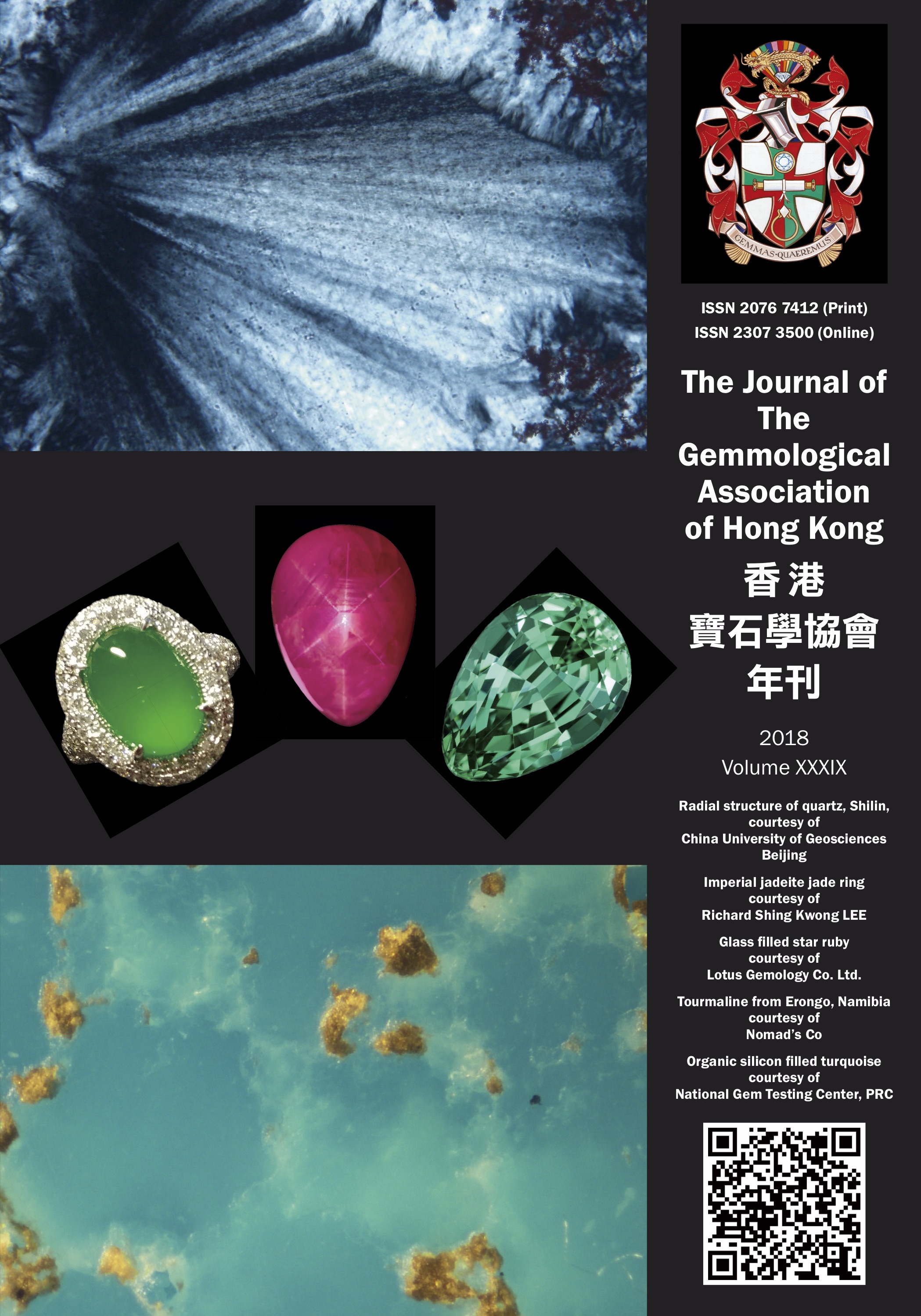
Lee, R.S.K. (2018) The art & science of reading rough jadeite jade: 2 parts science, 1 part art, and a lot of luck. Journal of the Gemmological Association of Hong Kong, Vol. 39, pp. 48–59.
Record No. 4021  |  Sinkankas/Born No.: NIS/NIB  |  RWHL*
Using a boulder owned by his family, the author describes and illustrates the process of assessing, cutting and evaluating jadeite jade rough to maximize its investment potential.

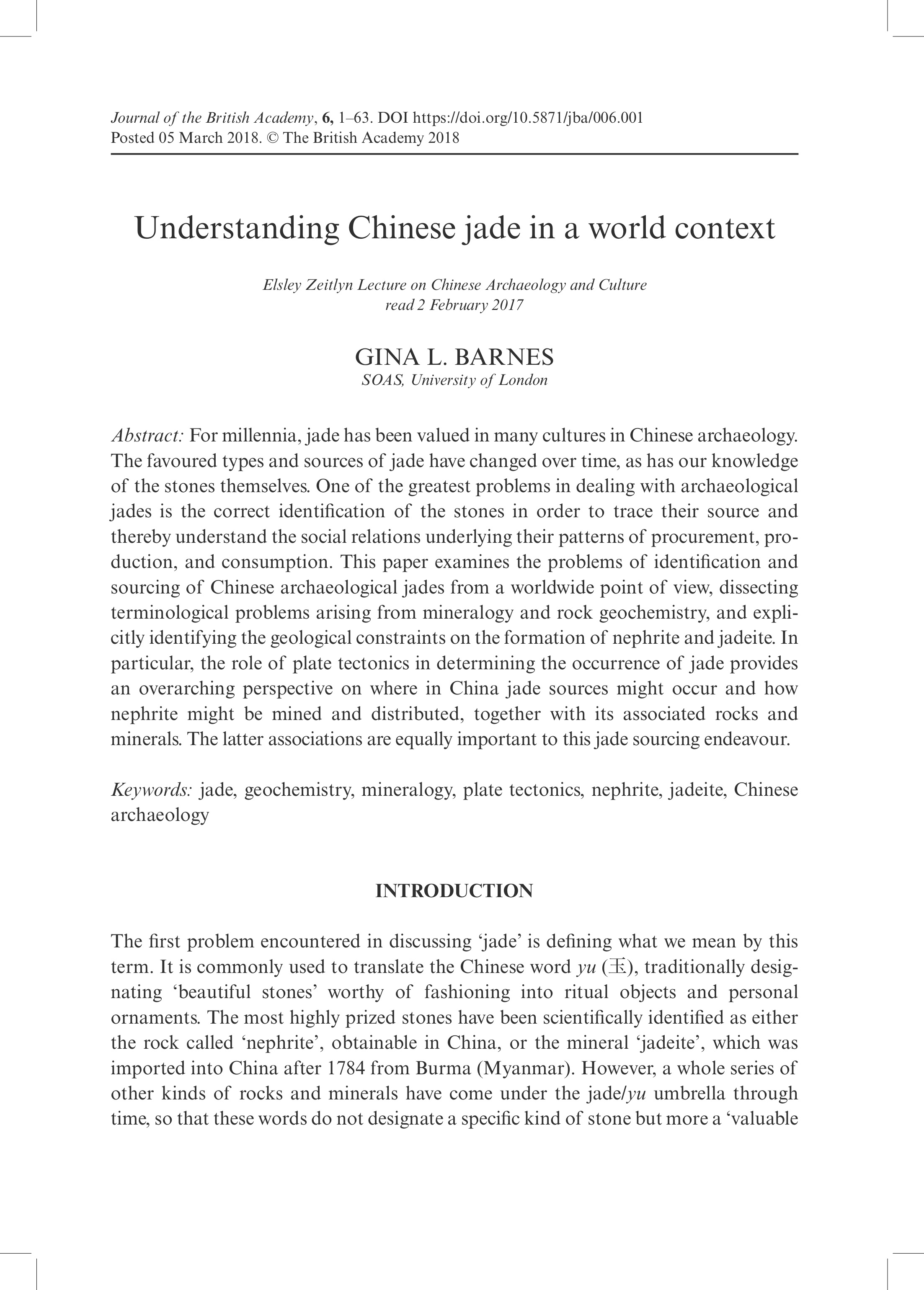
Understanding Chinese jade in a world context
Journal Article
Barnes, G.L. (2018) Understanding Chinese jade in a world context. Journal of the British Academy, Vol. 6, pp. 1–63.
Record No. 3938  |  Sinkankas/Born No.: NIS/NIB  |  RWHL*
For millennia, jade has been valued in many cultures in Chinese archaeology. The favoured types and sources of jade have changed over time, as has our knowledge of the stones themselves. One of the greatest problems in dealing with archaeological jades is the correct identi cation of the stones in order to trace their source and thereby understand the social relations underlying their patterns of procurement, pro­duction, and consumption. This paper examines the problems of identication and sourcing of Chinese archaeological jades from a worldwide point of view, dissecting terminological problems arising from mineralogy and rock geochemistry, and expli­citly identifying the geological constraints on the formation of nephrite and jadeite. In particular, the role of plate tectonics in determining the occurrence of jade provides an overarching perspective on where in China jade sources might occur and how nephrite might be mined and distributed, together with its associated rocks and minerals. The latter associations are equally important to this jade sourcing endeavour.

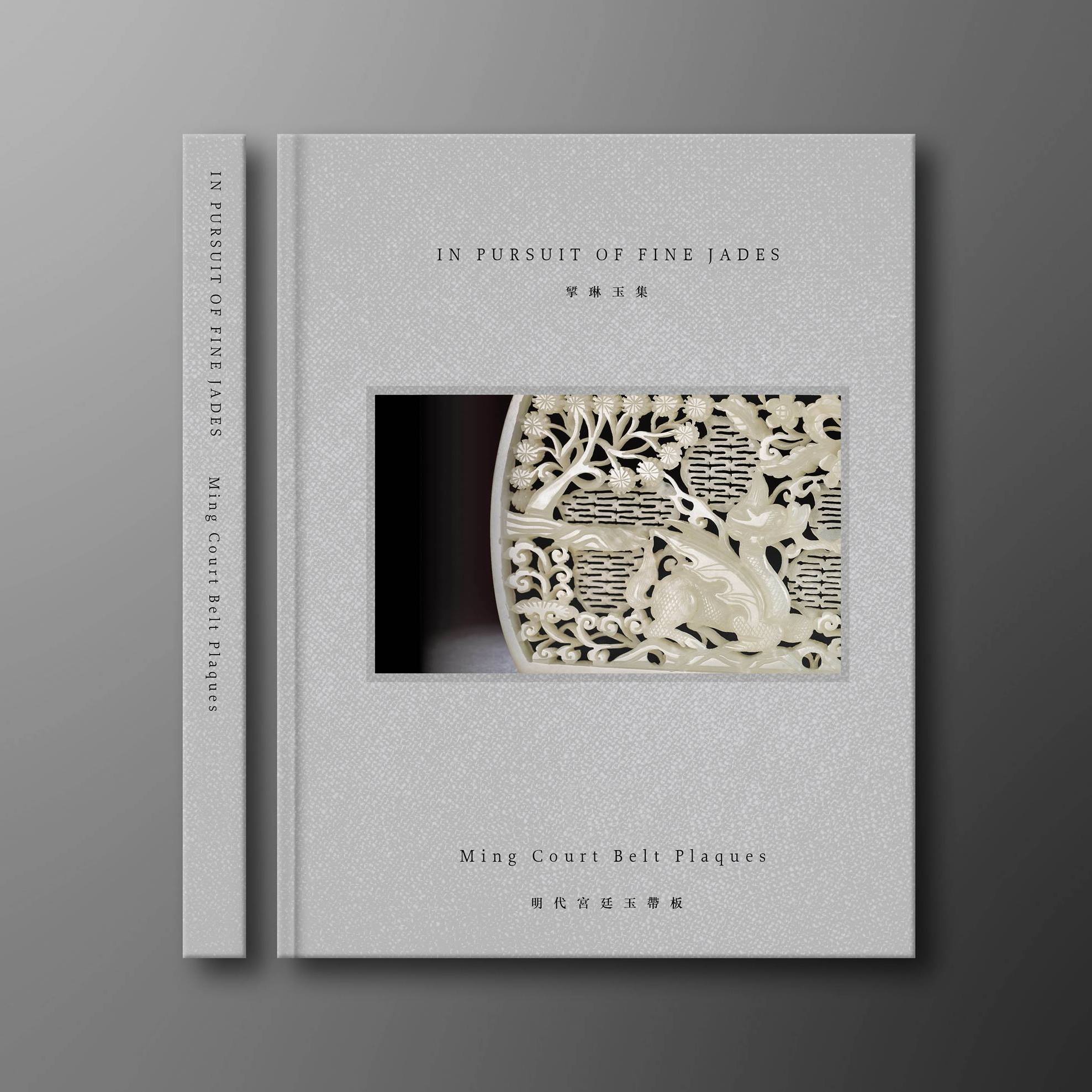
In Pursuit of Fine Jades | Ming Court Belt Plaques
Book
Liu, M.S.L. (2018) In Pursuit of Fine Jades | Ming Court Belt Plaques. Hong Kong, CA Design, 248 pp.
Record No. 3836  |  ISBN/ISSN: 9789890000000  |  Sinkankas/Born No.: NIS/NIB  |  RWHL*
In Pursuit of Fine Jades" is a series of books dedicated to the study of beautiful objects made of jade in ancient China from the Michael S. Liu collection."

Collecting guide: Jadeite jewellery

Web Page
Christie’s (2018) Collecting guide: Jadeite jewellery. Christie’s, <https://www.christies.com/features/Collecting-guide-Jadeite-jewellery-9166-1.aspx?sc_lang=en#FID-9166>
Record No. 3835  |  Sinkankas/Born No.: NIS/NIB  |  RWHL*
Prized for its translucency and the quality of reflecting ‘something like water inside’, jadeite continues to be the most sought-after gemstone in China. Senior specialist Fung Chiang offers an expert introduction, illustrated with pieces offered in Hong Kong Magnificent Jewels on 29 May

China: A History in Objects

Book
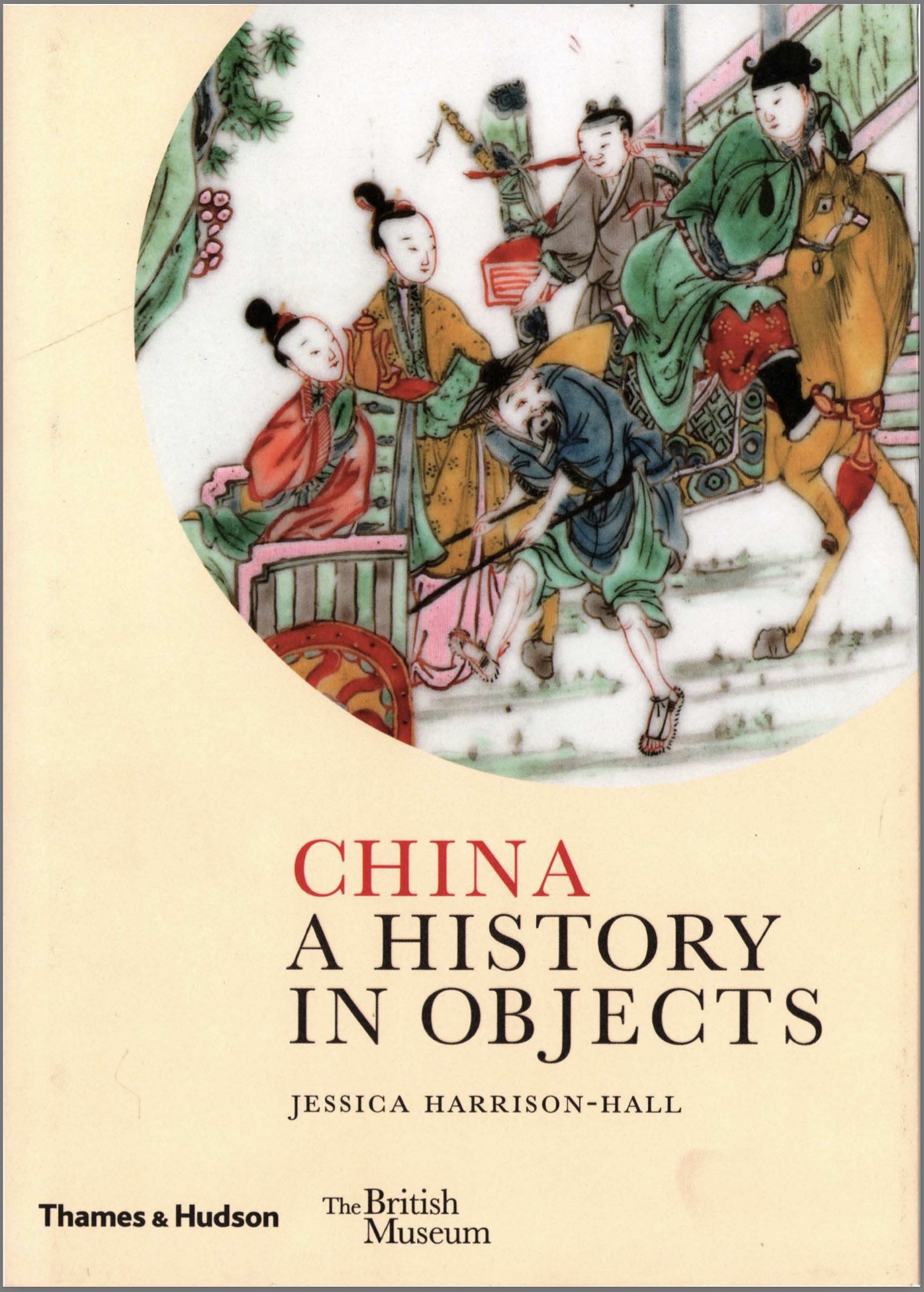
Harrison-Hall, J. (2017) China: A History in Objects. London, Thames & Hudson, 351 pp.
Record No. 26458  |  ISBN/ISSN: 9780500000000  |  Sinkankas/Born No.: NIS/NIB  |  RWHL*
This illustrated introduction to the history of China offers a fresh understanding of the country’s progress from the Neolithic age to the present. Told in six chapters arranged chronologically, through art, artefacts, people and places, and richly illustrated with expertly selected objects and artworks, it firmly connects today’s China with its internationally engaged past. From the earliest archaeological relics and rituals, through the development of writing and state, to the advent of empire, the author charts China’s transformation from ancient civilization into the world’s most populous nation and influential economy, offering the reader a myriad of historical insights and cultural treasures along the way. This accessible book presents an eclectic mix of materials including the decorative arts, costume, jewellery and furniture-making, running through to the most recent flourishing of Chinese culture. It will stimulate, fascinate and inform anyone interested in one of the greatest and most influential nations of the modern world. With over 600 illustrations.

Jeweled Splendors of the Art Deco Era: The Prince and Princess Sadruddin Aga Khan Collection
Book
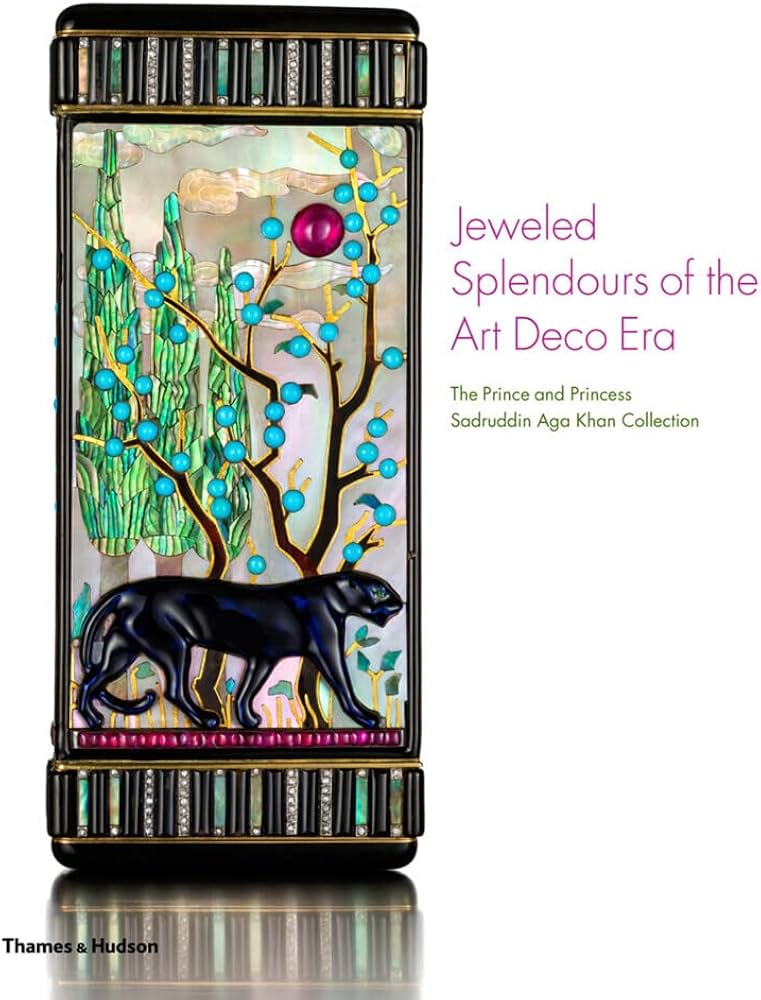
Aga Khan, C., Rainero, P., Posséme, É., Harrison, S., Coffin, S.D. and Davis, S. (2017) Jeweled Splendors of the Art Deco Era: The Prince and Princess Sadruddin Aga Khan Collection. London, Thames & Hudson, 256 pp.
Record No. 16886  |  ISBN/ISSN: 9780500000000  |  Sinkankas/Born No.: NIS/NIB  |  RWHL*
This is a splendid book. A visual celebration of jeweled masterworks from Paris in the Art Deco era. One Christmas Eve, Prince Sadruddin Aga Khan gave his wife, Princess Catherine, an exquisite jeweled box made by Cartier in the 1920s, thus starting the most magnificent collection of objects created in the Art Deco era by jewelers, at a time when the jeweler’s art was at the height of beauty and creativity. In the 1920s, rapid changes in society and technology were rejected in art through striking contrasts of line, color, and material. The innovative luxuries in this book―breathtaking bejeweled vanity and cigarette cases, timepieces, jewelry, and a photograph frame―take their inspiration from varied sources, including the natural world, exotic locations, and industrial design. Chinese dragons, Persian birds, and Japanese plum blossoms appear on boxes created with an explosion of colored gemstones and enamel juxtaposed with boxes in black, white, and gold stripped of excessive ornamentation. The exuberance of the boldest pieces contrasts with the starkly elegant machine-inspired designs, but both are equally considered and iconic of this era of excitement, change, and creativity. Smoky nightclubs, with flappers drinking cocktails, and exotically decorated apartments, resplendent for chic dinner parties, provided a new landscape for the designs of the great jewelry houses of Europe and America, with Paris as the undisputed center. In Jeweled Splendors of the Art Deco Era, published to coincide with an exhibition at Cooper Hewitt, Smithsonian Museum, New York., expert authors explore the development of this new artistic world by considering the exotic influences of the important jewelers―including Van Cleef & Arpels, Bulgari, Boucheron, Lacloche Frères, and, above all, Cartier―as well as the process of design and making, and the impact of changing femininity. Well over 100 pieces are accompanied by detailed descriptions and were specially photographed for this publication by the renowned photographer Doug Rosa. This collection from the most important period in the history of jewelry and the decorative arts is unsurpassed in quality and is beautifully shown here with a wealth of context and detail.

The colonial reinvention of the Hei Tiki: Pounamu, knowledge, and empire, 1860s–1940s
Thesis
Street, K. (2017) The colonial reinvention of the Hei Tiki: Pounamu, knowledge, and empire, 1860s–1940s., Wellington: Victoria University of Wellington, 181 pp.
Record No. 16463  |  Sinkankas/Born No.: NIS/NIB  |  RWHL*
This thesis examines the reinvention of pounamu hei tiki between the 1860s and 1940s. It asks how colonial culture was shaped by engagement with pounamu and its analogous forms greenstone, nephrite, bowenite and jade. The study begins with the exploitation of Ngāi Tahu’s pounamu resource during the West Coast gold rush and concludes with post-World War II measures to prohibit greenstone exports. It establishes that industrially mass-produced pounamu hei tiki were available in New Zealand by 1901 and in Britain by 1903. It sheds new light on the little-known German influence on the commercial greenstone industry. The research demonstrates how Māori leaders maintained a degree of authority in the new Pākehā-dominated industry through patron-client relationships where they exercised creative control. The history also tells a deeper story of the making of colonial culture. The transformation of the greenstone industry created a cultural legacy greater than just the tangible objects of trade. Intangible meanings are also part of the heritage. The acts of making, selling, wearing, admiring, gifting, describing and imagining pieces of greenstone pounamu were expressions of culture in practice. Everyday objects can tell some of these stories and provide accounts of relationships and ways of knowing the world. The pounamu hei tiki speaks to this history because more than merely stone, it is a cultural object and idea. In this study, it stands for the dynamic processes of change, the colonial realities of Māori resistance and participation and Pākehā experiences of dislocation and attachment. The research sits at an intersection of new imperial histories and studies of material culture. The power of pounamu to carry multiple meanings and to be continually reinterpreted represents the circulation of colonial knowledge, and is a central contention of the thesis.

De Anima, Physics

On the Soul
Book
Aristotle (2017, 2018) De Anima, Physics. [On the Soul] Indianapolis, Hackett, 227, 420 pp.
Record No. 16440  |  ISBN/ISSN: 9781620000000  |  Sinkankas/Born No.: NIS/NIB  |  RWHL*
These richly annotated, scrupulously accurate, and consistent translations of Aristotle's De Anima and Physics fit seamlessly with other volumes in the series. Sequentially numbered endnotes provide the information most needed at each juncture, while a detailed Index of Terms indicates places where focused discussion of key notions occurs. An illuminating general Introduction describes the book that lies ahead, explaining what sort of work it is and what sorts of evidence it relies on. The Physics is a foundational work of western philosophy, and the crucial one for understanding Aristotle's views on matter, form, essence, causation, movement, space, and time. This richly annotated, scrupulously accurate, and consistent translation makes it available to a contemporary English reader as no other does—in part because it fits together seamlessly with other closely associated works in the New Hackett Aristotle series, such as the Metaphysics, and forthcoming De Caelo and On Coming to Be and Passing Away. Eventually the series will include all of Aristotle's works.

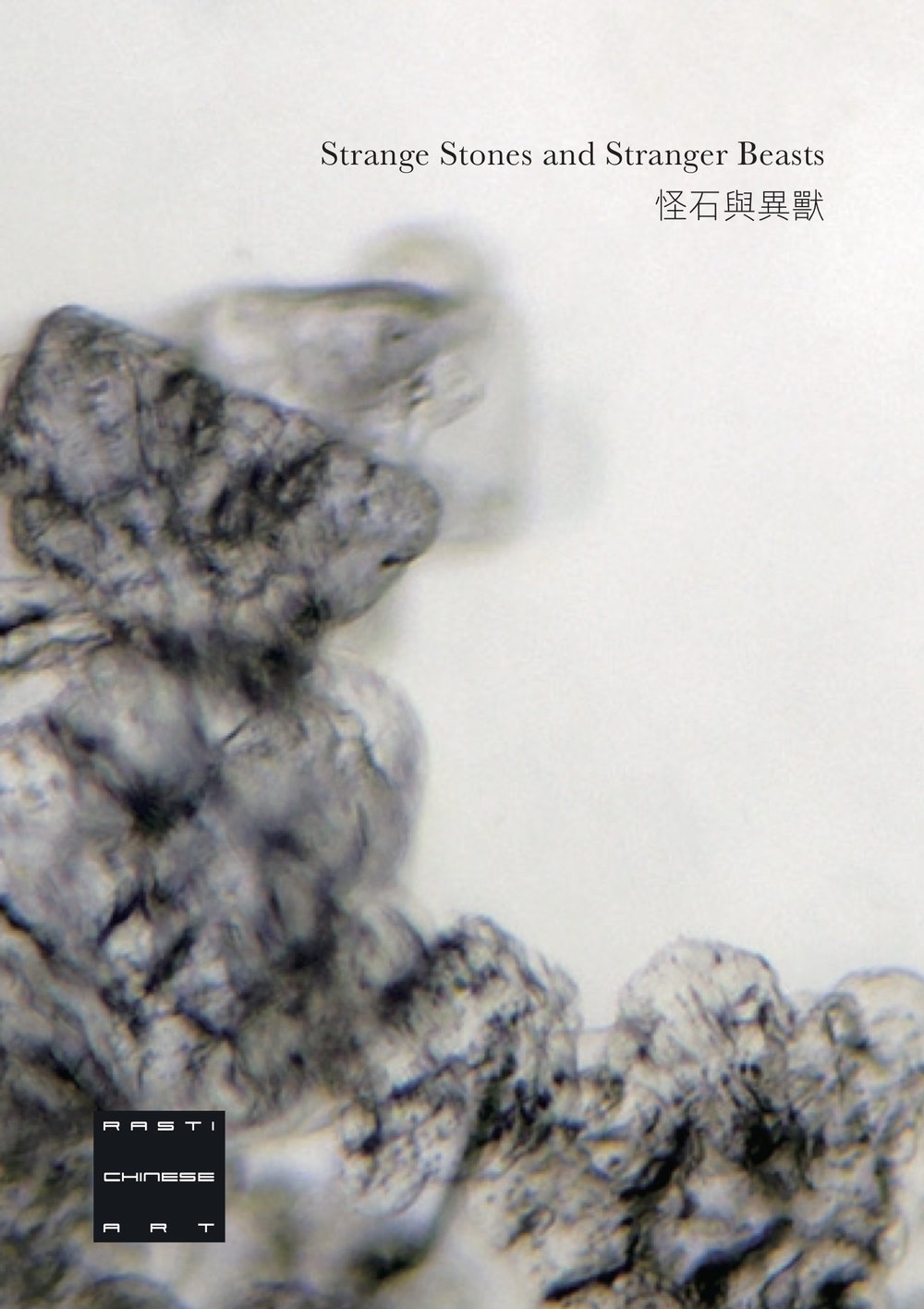
Strange Stones and Stranger Beasts

Catalog
Rasti, N. (2017) Strange Stones and Stranger Beasts. Hong Kong: Rasti Chinese Art, 88 pp..
Record No. 7484  |  ISBN/ISSN: 9789880000000  |  Sinkankas/Born No.: NIS/NIB  |  RWHL*
Beautifully photographed collection of unusual stones fashioned by Chinese artists in agate, amber, jade and scholar’s rocks.

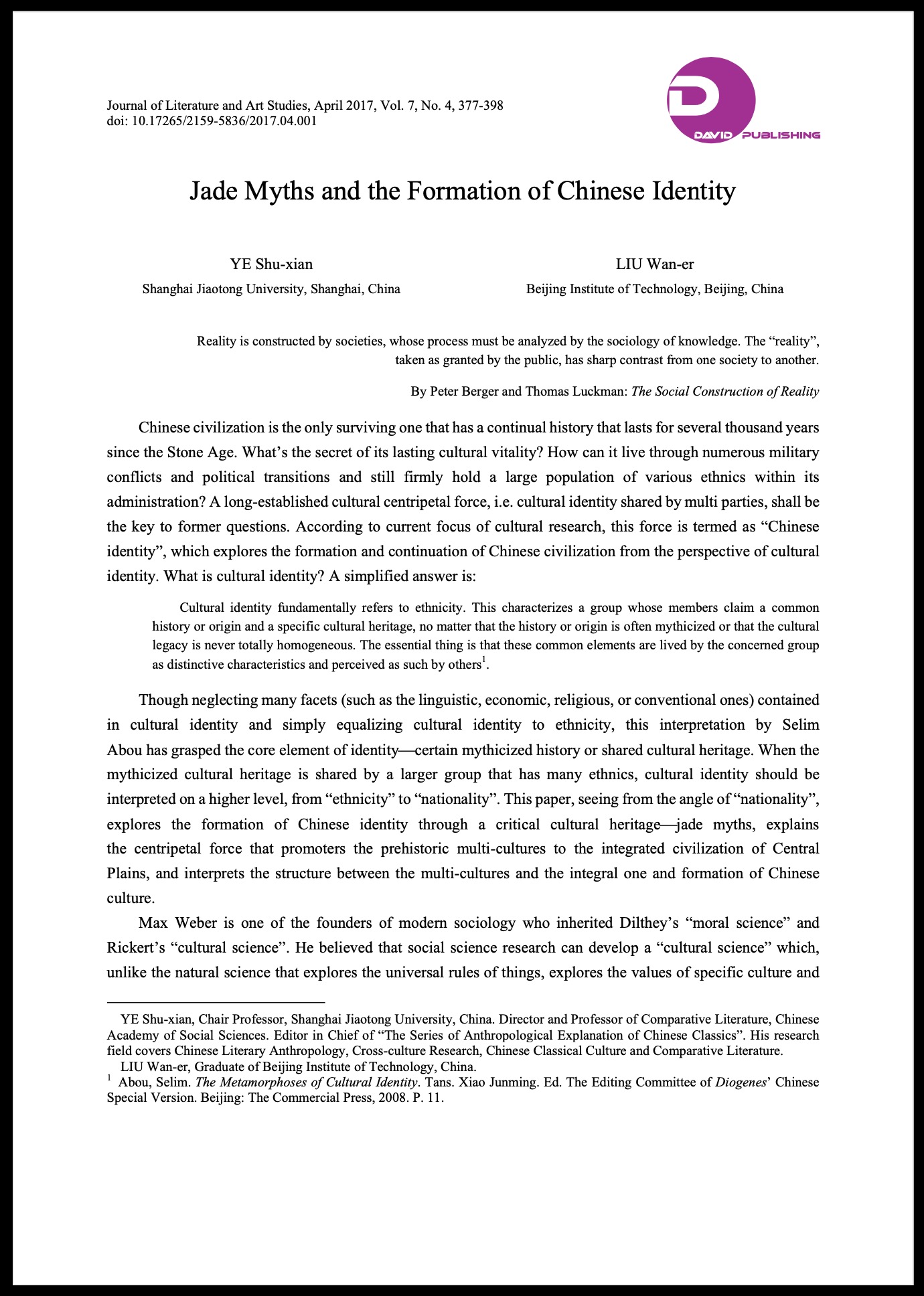
Jade myths and the formation of Chinese identity
Journal Article
Ye, S. and Liu, W. (2017) Jade myths and the formation of Chinese identity. Journal of Literature and Art Studies, Vol. 7, No. 4, pp. 377–398.
Record No. 7120  |  DOI: 10.17265/2159-5836/2017.04.001  |  Sinkankas/Born No.: NIS/NIB  |  RWHL*
Chinese civilization is the only surviving one that has a continual history that lasts for several thousand years since the Stone Age. What’s the secret of its lasting cultural vitality? How can it live through numerous military conflicts and political transitions and still firmly hold a large population of various ethnics within its administration? A long-established cultural centripetal force, i.e. cultural identity shared by multi parties, shall be the key to former questions. According to current focus of cultural research, this force is termed as “Chinese identity”, which explores the formation and continuation of Chinese civilization from the perspective of cultural identity. What is cultural identity? A simplified answer is: Cultural identity fundamentally refers to ethnicity. This characterizes a group whose members claim a common history or origin and a specific cultural heritage, no matter that the history or origin is often mythicized or that the cultural legacy is never totally homogeneous. The essential thing is that these common elements are lived by the concerned group as distinctive characteristics and perceived as such by others. Though neglecting many facets (such as the linguistic, economic, religious, or conventional ones) contained in cultural identity and simply equalizing cultural identity to ethnicity, this interpretation by Selim Abou has grasped the core element of identity—certain mythicized history or shared cultural heritage. When the mythicized cultural heritage is shared by a larger group that has many ethnics, cultural identity should be interpreted on a higher level, from “ethnicity” to “nationality”. This paper, seeing from the angle of “nationality”, explores the formation of Chinese identity through a critical cultural heritage—jade myths, explains the centripetal force that promoters the prehistoric multi-cultures to the integrated civilization of Central Plains, and interprets the structure between the multi-cultures and the integral one and formation of Chinese culture.

Jadeitite from Itoigawa, Niigata Prefecture, central Japan

Journal Article
Hirajima, T. (2017) Jadeitite from Itoigawa, Niigata Prefecture, central Japan. Journal of Mineralogical and Petrological Sciences, Vol. 112, No. 5, pp. 227–236.
Record No. 6687  |  Sinkankas/Born No.: NIS/NIB  |  RWHL*
This paper presents a review of Itoigawa’s jadeitite in history, culture, process of rediscovery, and geological characteristics. The people of the Jomon age used jadeitite as tools as far as 7000 years ago, making it one of the oldest jadeitite cultures in the world. The jadeitites from Itoigawa were the source of ornaments such as pendants or comma–shaped beads that can be dated to the Jomon age through to the Nara period. These ornaments are widely found in Japanese Islands from Hokkaido to Okinawa Prefecture, and also in the southern part of the Korean Peninsula. The jadeitite, however, was not used after the Nara period. The disappearance of jadeitite culture is not well understood, but it may have been caused by the introduction of Buddhism into Japan. Therefore, the existence of jadeitite in Japan was forgotten for a period of 1200 years after the Nara period. Mr. Eizo Ito rediscovered jadeitite from Itoigawa when he identified the durable green rock in the Kotakigawa River in 1938. His success was inspired by the idea of Mr. Gyofu Soma. The rediscovered jadeitite was studied by Dr. Yoshinori Kawano of the Tohoku Imperial University in 1939. There are large jadeitite boulders weighing more than 100 tons found in several areas of the Kotakigawa and Ohmigawa Rivers. These areas are designated national natural monuments. The jadeitite from Itoigawa can be found in various colors such as white, gray, black, lavender, and blue. These color variations are caused by the presence of trace elements such as iron and titanium in jadeite and omphacite, and tiny graphite inclusions in jadeitite. The absence of quartz and euhederal jadeite crystals with natrolite and veinlets of jadeitite indicates that the Itoigawa jadeitite does not form through decomposition of albite, but by hydrothermal activity. Some strontium dominant minerals such as itoigawaite were first found in jadeitite from Itoigawa. These strontium dominant minerals form in the calcium depleted hydrothermal solution in the late stages of jadeitite formation. The Jomon is the oldest jadeitite culture worldwide, and the first documented use of precious stones in the history of mankind. In addition, the jadeitite found in Itoigawa is the oldest known unit of its kind.

Exploring the Literature of Jade

Jade literature spans gemology, mineralogy, archaeology, art history, mining, carving and connoisseurship, and includes works on both jadeite and nephrite from around the world.

For an introduction to collecting books on this subject, read Hidden Treasure — Collecting the Literature of Jade.

About Four Treasures

Four Treasures is Lotus Gemology's freely accessible gemological reference database. Use the full database to search by author, title or keyword and explore literature on gemology, mineralogy, jewelry and related fields. Where available, hyperlinks on titles may lead directly to the full publication.

Search the Complete Four Treasures Database