Explore books, articles and historical sources on jade in Four Treasures, the Lotus Gemology reference database. This bibliography brings together matching records from the collection, with publication details, abstracts and cover images where available.
Jade References
The list below matches the terms jade, jadeite, nephrite or Fei Cui in the database's searchable fields. Some references discuss these materials as part of a broader subject.
3,021–3,040 of 3,819 matching references
Literatur [nephrite in New Zealand]
Literature
Newspaper Article
Rath, G., von (1876) Literatur [nephrite in New Zealand]. [Literature]Kölnische Zeitung, 22 February, Köln, p. 3.
Record No. 8012 | Sinkankas/Born No.: NIS/NIB | Language: in German | RWHL
Reference copied to clipboard!
gems, jade, Fischer-Book, nephrite, New Zealand
article draws attention to New Zealand nephrite as both a mineralogical substance and a material of particular importance to Māori implements and ornaments. It belongs to the growing nineteenth-century European literature on the geographical distribution of nephrite and the relationship between naturally occurring jade materials and prehistoric or Indigenous stone objects. Because I have not yet located and read the actual text on p. 3 of the 22 February 1876 Kölnische Zeitung, I would not make the description more specific than this. The issue itself is preserved in the digitized Kölnische Zeitungarchive at zeit.punktNRW.
An erratic granite block with Phoenician inscription found near Smolensk in Russia
Journal Article
Wankel, H. (1876) Ein erratischer Granitblock mit phönizischer Inschrift bei Smolensk in Russland gefunden. [An erratic granite block with Phoenician inscription found near Smolensk in Russia]Mittheilungen der anthropologischen Gesellschaft in Wien, Vol. 6, No. 5, pp. 129–136.
Record No. 8000 | Sinkankas/Born No.: NIS/NIB | Language: in German | RWHL
Reference copied to clipboard!
gems, jade, Fischer-Book
An archaeological notice by Heinrich Wankel concerning a pyramidal erratic granite block discovered in 1873 near Smolensk and bearing incised characters on two faces. Wankel had obtained an accurate copy of the stone at the 1874 archaeological congress in Kiev. The markings were examined by Aloys Müller, who rejected a runic interpretation and proposed that they represented ancient Phoenician characters, tentatively reading part of one inscription as a memorial to Baal; the longer inscription remained undeciphered. The paper is of interest as an example of nineteenth-century attempts to trace supposed Phoenician contacts far into northern and eastern Europe. The identification of the characters as Phoenician was speculative and should not be treated as established archaeological fact.
Description of stone objects of indigenous origin, preserved in the National Museum
Journal Article
Hartt, C.F. (1876) Descripção dos objectos de pedra de origem indigena, conservados no Museu Nacional. [Description of stone objects of indigenous origin, preserved in the National Museum]Archivos do Museu nacional do Rio de Janeiro, Vol. 1, pp. 45–53.
Record No. 7953 | Sinkankas/Born No.: NIS/NIB | Language: in Portuguese | RWHL
Reference copied to clipboard!
gems, jade, Fischer-Book
An early archaeological study by Charles Frederick Hartt of Indigenous stone objects preserved in the Museu Nacional in Rio de Janeiro. Hartt notes that the museum possessed a large collection of stone artifacts from different parts of Brazil, including axes, graters, arrowheads, pestles, mortars, rods and personal ornaments, and intended this paper as the beginning of a series describing and illustrating them. The present installment concentrates particularly on crescent-shaped stone axes, including examples associated with the Gavião and other Indigenous peoples, discussing their form, manufacture and possible functions as weapons, tools or insignia. Illustrated with plates and figures, the paper is an important early contribution to the archaeological study of Brazilian stone artifacts and to the documentation of collections formerly held by the Museu Nacional.
Anderson, J. (1876)Mandalay to Momien: A Narrative of the two Expeditions to Western China of 1868 and 1875 under Colonel Edward B. Sladen and Colonel Horace Browne. London, Macmillan and Co., 479 pp., 16 plates, 3 maps
Record No. 4602 | Sinkankas/Born No.: NIS/NIB | RWHL
Reference copied to clipboard!
jade, jadeite, fei cui, Burma, gems
The first expedition under Sladen proceeded as far as upper Burma and Yunnan. The author, John Anderson, was attached as the naturalist, as he was superintendent of the Calcutta Museum. The second expedition was not so successful owing to the murder of A. R. Margary, who had traveled ahead. This was the first account of the expedition, an enlarged version with details of natural history appeared in 1878–1979. Brief mentions of the cutting of jade are included.
Oceanic Jade: In deposits in Roguedas Bay, near Vannes (Morbihan)
Book
Limur, C.d. (1875)Le Jade Océanien: En gisement dans la baie de Roguedas, près Vannes (Morbihan). [Oceanic Jade: In deposits in Roguedas Bay, near Vannes (Morbihan)] Nantes, 36 pp.
Record No. 28781 | Sinkankas/Born No.: 3977; NIB | Language: in French | RWHL
Reference copied to clipboard!
gems, jade, nephite, France, New Caledonia
Sinkankas: A jade-like material from a vein in granite near Baie de Roguedas, Vannes, Morbihan, France, is compared to a nephrite from New Caledonia and, on the basis of appearance, specific gravity, and reaction to the blowpipe, is considered identical. The results of this testing are followed by sections on jade as described by various authorities: Dufrénoy, Damour, Des Cloizeaux, and Pisani. This is followed by a second paper, paged continuously, on blowpipe testing of a number of minerals such as tremolite and actinolite in massive, or jade-like, forms; results are reported together with specific gravities.
Scientific Information: On the Ethnology of Nicaragua
Journal Article
Berendt, C.H. (1875) Wissenschaftliche Mittheilungen: Zur Ethnologie von Nicaragua. [Scientific Information: On the Ethnology of Nicaragua]Correspondenz-Blatt der deutschen Gesellschaft für Anthropologie, Ethnologie und Urgeschichte, Vol. 1874, No. 9, September, pp. 70–72.
Record No. 16319 | Sinkankas/Born No.: NIS/NIB | Language: in German | RWHL
Reference copied to clipboard!
gems, jade, Fischer-Book
Berendt presents ethnological observations on Nicaragua, discussing the Indigenous peoples of the region, their languages, customs, historical relationships, and material culture. Drawing upon his extensive linguistic and ethnographic research in Central America, he considers evidence for the distribution and affinities of Nicaraguan peoples and their connections with neighboring Mesoamerican groups. The communication contributes to nineteenth-century attempts to reconstruct the pre-Columbian ethnography and population history of Nicaragua through linguistic, historical, and material evidence.
Issel, A. (1875) L’uomo Preistorico in Italia. [Prehistoric Times and the Origin of Civilisation] In: I tempi preistorici e l'origine dell'incivilimento, Torino: Unione Tipografico-Editrice via Carlo Alberto, pp. 733–859 (jade see pp. 772–773).
Record No. 7999 | Sinkankas/Born No.: NIS/NIB | Language: in Italian | RWHL
Reference copied to clipboard!
gems, jade, Fischer-Book
Issel surveys the evidence for prehistoric humans in Italy, discussing archaeological sites, cave deposits, human remains, stone implements, pottery, ornaments, and other material used to reconstruct the country’s earliest populations and stages of cultural development. He compares Italian discoveries with prehistoric finds elsewhere in Europe and considers their chronology and technological development. Of particular relevance to jade studies is his discussion on pp. 772–773 of polished implements made from jadeite, nephrite, and related green stones, whose occurrence in Italian prehistoric contexts formed part of the contemporary debate over the sources of European jade. Issel considers such objects within the broader evidence for prehistoric exchange and the distribution of raw materials, contributing to the nineteenth-century “jade question” and to the developing archaeological study of prehistoric Italy.
[Nephrite axe from near Mariinsk, Russia]
Nephrite axe from near Mariinsk, Russia
Journal Article
Hansen, G., von (1875) [Nephrite axe from near Mariinsk, Russia].Die Sammlungen inländischer Alterthümer etc. des Esthländischen Museums, p. 2.
Record No. 7940 | Sinkankas/Born No.: NIS/NIB | Language: in German | RWHL
Reference copied to clipboard!
gems, jade, Fischer-Book
Von Hansen records a nephrite axe reportedly found near Mariinsk in Russia among the antiquities represented in the collections of the Estonian Museum. The brief notice identifies the object by material and provenance, providing evidence for the occurrence of nephrite implements in the Russian archaeological record. Such finds were of particular interest during the nineteenth-century “nephrite question,” when archaeologists and mineralogists were compiling the geographical distribution of nephrite artifacts and comparing them with known geological sources in order to investigate prehistoric exchange, migration, and the provenance of jade implements.
Damigeron and Rose, V. (1875) Damigeron de Lapidibus. [Damigeron on stones]Hermes | Zeitschrift für classische Philologie, Vol. 9, No. 4, pp. 471–491.
Record No. 7546 | ISBN/ISSN: 180777 | Sinkankas/Born No.: 5546 | Language: in German | RWHL
Reference copied to clipboard!
gems, jade, Fischer-Book, early gemology, early mineralogy, Damigeron
Rose publishes and critically examines the Latin lapidary attributed to Damigeron, De lapidibus, an important late-antique text on stones and their supposed properties. The work describes numerous stones, giving their names, appearances, sources, and especially the magical, medicinal, protective, and divinatory powers attributed to them, including their use as amulets and engraved talismans. Rose’s edition compares manuscript readings and addresses textual and philological problems in an effort to reconstruct the surviving text and clarify its relationship to Greek and Roman lapidary traditions. The paper is an important source for the history of ancient and medieval gem lore and for understanding the transmission of beliefs concerning the occult and therapeutic properties of gemstones and minerals.
Rau, O. (1875) Ueber ein in Deutschland gefundenes Steinwerkzeug. [About a stone tool found in Germany]Correspondenz-Blatt der deutschen Gesellschaft für Anthropologie, Ethnologie und Urgeschichte, Vol. 1874, No. 2, February, pp. 13–14.
Record No. 7542 | Sinkankas/Born No.: NIS/NIB | Language: in German | RWHL
Reference copied to clipboard!
gems, jade, Fischer-Book
Rau describes a stone implement found in Germany, discussing its form, workmanship, material, and possible archaeological significance. Particular attention is given to the mineralogical identification of the stone and comparison with similar polished implements from other European sites. The object is considered in the context of contemporary interest in nephrite, jadeite, and related greenstone artifacts, whose occurrence in Europe had generated debate concerning the geographical sources of their raw materials. The notice contributes to the nineteenth-century “jade question” and to attempts to determine whether such prehistoric implements were manufactured from indigenous European stone or from material transported through long-distance exchange.
Professor Fischer from Freiburg i. /B. discussed the nephrite question/about mineralogical investigation of stone weapons, stone idols, etc.
Journal Article
Fischer, H. (1875) Herr Professor Fischer aus Freiburg i./B. besprach die Nephritfrage/über mineralogische Untersuchung von Steinwaffen, Stein-Idolen u.s.w. [Professor Fischer from Freiburg i. /B. discussed the nephrite question/about mineralogical investigation of stone weapons, stone idols, etc.]Zeitschrift für Ethnologie, Berliner Gesellschaft für Anthropologie, Ethnologie und Urgeschichte, Vol. 7, pp. 48–50; 71–76.
Record No. 7520 | Sinkankas/Born No.: NIS | Language: in German | RWHL
Reference copied to clipboard!
gems, jade, Fischer-Book
Fischer discusses the “nephrite question” and the importance of rigorous mineralogical examination of prehistoric and ethnographic stone weapons, idols, and related objects. He emphasizes that artifacts identified visually as jade or nephrite may in fact consist of different minerals and argues for microscopic, physical, and chemical investigation before drawing conclusions about their material or provenance. Fischer reviews nephrite and nephrite-like artifacts from different regions and considers what their identification might reveal about the geographical distribution of raw materials and prehistoric exchange. The communication reflects his central role in the nineteenth-century debate over whether European and American jade objects were manufactured from local materials or from stone transported over long distances and demonstrates the growing integration of mineralogical methods into archaeological and ethnographic research.
Schlagintweit-Sakünlünski, V.H., v. (1875) [Lecture on the geology of the Tian Shan mountains].Vierter und fünfter Jahresbericht der Geographischen Gesellschaft in München, Vol. for 1872–1874, pp. 234–236.
Record No. 7499 | Sinkankas/Born No.: NIS/NIB | Language: in German | RWHL
Reference copied to clipboard!
gems, jade, Fischer-Book
Schlagintweit-Sakünlünski reports on the geology of the Tian Shan Mountains, discussing the structure, rocks, mountain ranges, and geological relationships of this major Central Asian system. Drawing upon observations gathered during the Schlagintweit expeditions and contemporary geographical information, he places the Tian Shan within the broader geological framework of Central Asia and compares it with neighboring mountain systems. The lecture contributes to nineteenth-century efforts to establish the physical geography and geology of the poorly known interior of Asia and provides geological context for the mineral-producing regions and trade routes of Eastern Turkestan.
Aristotle and Rose, V. (1875) Aristoteles De lapidibus und Arnoldus Saxo. [Aristotle On Stones and Arnoldus Saxo]Zeitschrift für Deutsches Alterthum, New Series, No. 6, Vol. 18, pp. 321–455.
Record No. 4956 | Sinkankas/Born No.: 5547 | Language: in German | RWHL
Reference copied to clipboard!
corundum, history.1, gems, Arabic mineralogy, jade, Fischer, early lapidaries
Rose presents a philological study and edition of the medieval lapidary tradition associated with the pseudo-Aristotelian De lapidibus and Arnoldus Saxo, examining the textual relationships, sources, and transmission of writings on stones from antiquity into the Middle Ages. The texts describe numerous stones and minerals, including their names, appearances, places of origin, and especially the medicinal, magical, protective, and other marvelous properties attributed to them. Rose compares manuscript versions and related Greek, Arabic, and Latin traditions in an effort to establish their sources and development. The study is an important contribution to the history of medieval lapidary literature and documents the transmission of ancient and Arabic gemstone lore into medieval European works on precious stones and minerals.
Thomas, E. (1875) Note on a jade drinking vessel of the Emperor Jahángir.Journal of the Royal Asiatic Society of Great Britain and Ireland, Vol. 7, No. 2, pp. 384–389.
Thomas examines an inscribed jade drinking vessel associated with the Mughal emperor Jahangir, discussing its form, material, inscriptions, date, and historical significance. He translates and interprets the Persian inscriptions and considers the vessel in relation to Jahangir’s reign and the Mughal taste for finely worked jade objects. Particular attention is given to the chronological information supplied by the inscription and to the object’s place among imperial vessels and other works of Mughal glyptic and lapidary art. The paper provides an important early scholarly description of a documented Mughal jade object and illustrates the high status accorded to carved jade at the imperial court.
Brosset, M. (1874–1876)Collection D’Historiens Arméniens. St. Petersbourg, L’Académie Impériale des Sciences, 2 Vols., Vol. 1, 618, 696 pp.
Record No. 10940 | Sinkankas/Born No.: NIS/NIB | RWHL
Reference copied to clipboard!
gems, jade
A two-volume collection of Armenian historical texts edited and translated into French by the Orientalist Marie-Félicité Brosset. Drawing on Armenian chronicles and documentary sources, the work presents histories ranging from the medieval period into the eighteenth century, including accounts of the Ardzruni dynasty, Aghvank, the Safavids, David Bek and the reign of Nadir Shah, together with chronological tables and other historical documents. The collection is an important nineteenth-century vehicle for making Armenian historical sources accessible to European scholars and is valuable for the study of Armenia, the Caucasus and their relations with Persia and neighboring regions.
Richthofen, F.F., von (1874) Das Land und die Stadt “Caindu” von Marco Polo. [The country and the city “Caindu” by Marco Polo]Gesellschaft für Erdkunde zu Berlin [Society of Geography of Berlin], Vol. 1, Part 2, 3 January, pp. 33–39.
Record No. 8111 | Sinkankas/Born No.: NIS/NIB | Language: in German | RWHL
Reference copied to clipboard!
gems, jade, Fischer-Book, Central Asia, Xinjiang, nephrite, Khotan, Hetian
Richthofen examines the identity and location of the country and city called “Caindu” in Marco Polo’s account, comparing the Venetian traveler’s description with Chinese geographical and historical sources and with nineteenth-century knowledge of southwestern China. He analyzes Marco Polo’s itinerary, distances, place names, physical geography, and descriptions of local products in an attempt to identify Caindu with a specific region and settlement. Of particular gemological interest is Marco Polo’s description of precious stones and other mineral products associated with Caindu, which Richthofen considers alongside the geography and trade of the region. The paper forms part of nineteenth-century efforts to reconcile Marco Polo’s narrative with Chinese sources and modern geographical exploration.
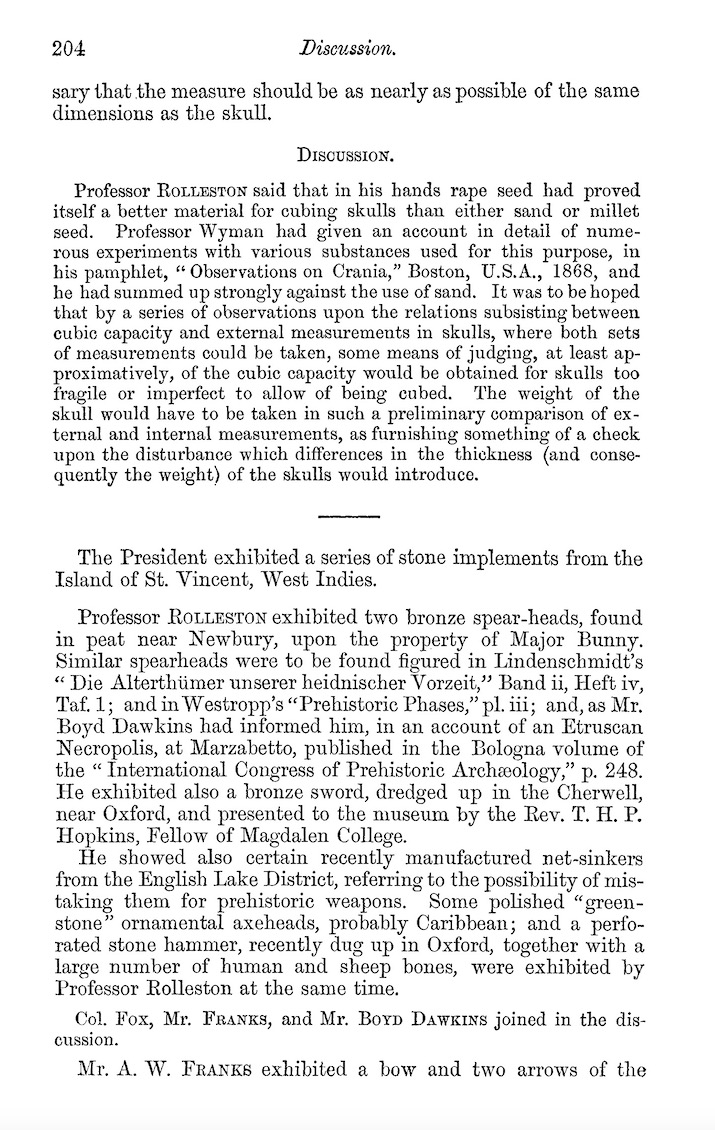
Notes on a greenstone axe, probably from the Caribbean (St. Vincent)
Journal Article
Rolleston, G. (1874) [Notes on a greenstone axe, probably from the Caribbean (St. Vincent)].Journal of the Anthropological Institute of Great Britain and Ireland, Vol. 3, see p. 204.
Record No. 8011 | Sinkankas/Born No.: NIS/NIB | RWHL
Reference copied to clipboard!
gems, jade, Fischer-Book
Rolleston comments on a polished greenstone axe, probably from St. Vincent in the Caribbean, considering its form, workmanship, and mineralogical character. The object is discussed in the context of similar stone implements from the West Indies and other regions and of contemporary attempts to identify the materials collectively described as jade or greenstone. Its possible Caribbean provenance made the specimen relevant to the question of whether nephrite or related jade-like minerals occurred among pre-Columbian artifacts of the Americas and whether such materials were locally obtained or introduced through exchange. The notice contributes to the nineteenth-century comparative study of polished stone implements and the developing debate over the geographical distribution and provenance of jade.
Study on the Herm cave, particularly from the point of view of the age of human remains, which have been removed from it
Journal Article
Noulet, J.B. (1874) Étude sur la caverne de l’Herm, particulièrement au point de vue de l’âge des restes humains, qui en ont été retirés. [Study on the Herm cave, particularly from the point of view of the age of human remains, which have been removed from it]Mémoires de l’Académie des Sciences | Inscriptions et Belles-Lettres de Toulouse, 7th Series, Vol. 6, No. 1, pp. 497–546, 3 plates.
Record No. 8009 | Sinkankas/Born No.: NIS/NIB | Language: in French | RWHL
Reference copied to clipboard!
gems, jade, Fischer-Book
Noulet examines the cave of L’Herm in Ariège and the human remains and archaeological materials recovered from it, with particular attention to determining their age. He describes the cave deposits, human skeletal remains, associated animal bones, stone and other artifacts, and their stratigraphic relationships, comparing the evidence with discoveries from other prehistoric caves in France. Noulet considers whether the human remains belong to a genuinely prehistoric population and evaluates their association with extinct or surviving fauna as evidence for chronology. The study contributes to nineteenth-century debates over the antiquity of humans in Europe and to the developing use of stratigraphy, paleontology, and archaeological association for dating prehistoric human remains.
Paleoethnological Discoveries Made in the Vibrata Valley
Journal Article
Rosa, C. (1874) Scoperte paleoetnologiche fatte nella valle della Vibrata [jadeite scapel from Abruzzo]. [Paleoethnological Discoveries Made in the Vibrata Valley]Archivio per l’antropologia e la etnologia, Vol. 4, pp. 190–204; see p. 196.
Record No. 7998 | Sinkankas/Born No.: NIS/NIB | Language: in Italian | RWHL
Reference copied to clipboard!
gems, jade, Fischer-Book
Rosa reports prehistoric discoveries made in the Vibrata Valley of Abruzzo, describing stone implements and other archaeological remains and considering their significance for the early occupation of the region. Of particular relevance to jade studies is a polished jadeite chisel described on p. 196, one of the unusual greenstone implements then attracting considerable attention among European prehistorians and mineralogists. Rosa discusses the artifact within the broader assemblage of prehistoric tools from the valley, providing evidence for the occurrence of jadeite objects in prehistoric Italy. The find contributed to the nineteenth-century “jade question,” concerning the geographical sources of European nephrite and jadeite artifacts and whether such materials were locally available or distributed through long-distance prehistoric exchange.
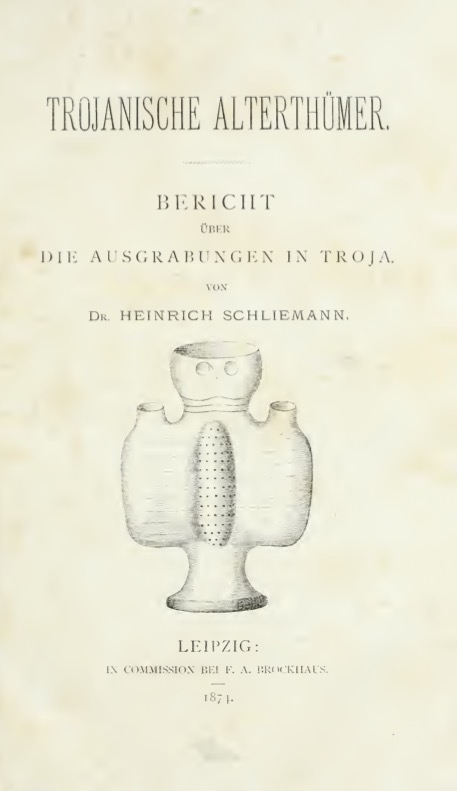
Trojan Antiquities, Report on the Excavations in Troy
Book
Schliemann, H. (1874)Trojanische Alterthümer, Bericht über die Ausgrabungen in Troja. [Trojan Antiquities, Report on the Excavations in Troy] Leipzig, F.A. Brockhaus, 2 Vols., 324 pp., plates (jade see plate 22).
Record No. 7985 | Sinkankas/Born No.: NIS/NIB | Language: in German | RWHL
Reference copied to clipboard!
gems, jade, Fischer-Book
Schliemann presents a detailed report on his excavations at Hisarlık, which he identified as ancient Troy, describing the successive archaeological strata, architecture, fortifications, burials, pottery, weapons, tools, ornaments, and other objects uncovered during the work. He attempts to correlate the different settlement levels with the Troy described in Homer and illustrates numerous finds in the accompanying plates. Of particular relevance to jade studies is an object illustrated on plate 22 and identified as jade, reflecting nineteenth-century interest in the occurrence of jade and jade-like stone implements at European and Near Eastern prehistoric sites. The work is a landmark in the history of Aegean archaeology, although Schliemann’s excavation methods, stratigraphic interpretations, and attribution of particular remains to Homeric Troy were substantially revised by later research.
Exploring the Literature of Jade
Jade literature spans gemology, mineralogy, archaeology, art history, mining, carving and connoisseurship, and includes works on both jadeite and nephrite from around the world.
Four Treasures is Lotus Gemology's freely accessible gemological reference database. Use the full database to search by author, title or keyword and explore literature on gemology, mineralogy, jewelry and related fields. Where available, hyperlinks on titles may lead directly to the full publication.