Explore books, articles and historical sources on jade in Four Treasures, the Lotus Gemology reference database. This bibliography brings together matching records from the collection, with publication details, abstracts and cover images where available.
Jade References
The list below matches the terms jade, jadeite, nephrite or Fei Cui in the database's searchable fields. Some references discuss these materials as part of a broader subject.
Meeting of the Berlin Anthropological Society on the 12th. July 1873
Journal Article
Reil, W. (1874) Sitzung der Berliner anthropologischen Gesellschaft am 12. Juli 1873. [Meeting of the Berlin Anthropological Society on the 12th. July 1873]Correspondenz-Blatt der deutschen Gesellschaft für Anthropologie, Ethnologie und Urgeschichte, No. 6, Juni, pp. 41–46.
Record No. 7543 | Sinkankas/Born No.: NIS/NIB | Language: in German | RWHL
Reference copied to clipboard!
gems, jade, Fischer-Book
Reil reports the proceedings of the Berlin Anthropological Society meeting of 12 July 1873, summarizing archaeological, anthropological, and ethnographic objects and observations presented by members. The discussions include prehistoric artifacts and questions concerning the materials from which stone implements were manufactured, reflecting contemporary efforts to combine mineralogical examination with archaeological classification. Of particular relevance to jade studies are references to nephrite and jade-like objects and their geographical occurrence, contributing to the nineteenth-century debate over the provenance of European prehistoric jade implements and the possibility of local sources versus long-distance exchange.
Pichler, A. (1874) [Stone axes from Tyrol].Neues Jahrbuch für Mineralogie, Geognosie, Geologie und Petrefaktenkunde, Vol. 1874, p. 961.
Record No. 7540 | Sinkankas/Born No.: NIS/NIB | Language: in German | RWHL
Reference copied to clipboard!
gems, jade, Fischer-Book
The discovery of stone weapons has so far been a rarity in Tyrol. We have already mentioned the wedge from Hungerburg near Innsbruck, but even more interesting are two wedges recently found near Roveredo. A farmer discovered two graves made of rough stone slabs on his field, and under the heads of the skeletons lay a stone wedge. He took these but, unfortunately, refilled the pits without further concerning himself with the skeletons. Mr. Cobelli, a professor at the Realschule in Roveredo, plans to conduct further excavations soon. One of the stone wedges was shown to me for inspection by him. It consists of a dark leek-green, nephrite-like mineral, pointed at the back and equipped with an edge about two inches long at the front. The length of the wedge is about four inches. Near Ampass, not far from Innsbruck, my son recently unearthed a bone shaped like an arrowhead alongside a bronze needle. Let me briefly mention a variety of clay mica schist or phyllite from the Innsbruck area. Stones were broken here for the railway, in the area at the front of the Sonnenburger hill. Here, a type of porphyroid is present, if we want to use this name for our rock: a quartz-bearing clay mica schist with scattered grains and lenses of bluish-black orthoclase. I have not yet come across a similar rock from the group of quartz-bearing clay mica schists.
Request for Mexican and South American (Brazilian), raw or processed nephrites or nephrite-like minerals
Journal Article
Fischer, H. (1874) Bitte um mexikanische und südamerikanische (brasilianische), rohe oder verarbeitete Nephrite oder nephritähnliche Mineralien. [Request for Mexican and South American (Brazilian), raw or processed nephrites or nephrite-like minerals]Correspondenz-Blatt der deutschen Gesellschaft für Anthropologie, Ethnologie und Urgeschichte, No. 5, May, pp. 36–38.
Record No. 7519 | Sinkankas/Born No.: NIS | Language: in German | RWHL
Reference copied to clipboard!
gems, jade, Fischer-Book
Fischer appeals to collectors, museums, travelers, and researchers for specimens of raw or worked nephrite and nephrite-like minerals from Mexico and South America, particularly Brazil, for comparative mineralogical study. His request reflects the difficulty of determining the true mineralogical identity and geographical sources of the greenstone artifacts known from the Americas. Fischer sought both unworked geological specimens and archaeological or ethnographic objects so that their physical, microscopic, and chemical characteristics could be compared with recognized nephrite and other jade-like materials. The notice forms part of his broader investigation of the nineteenth-century “jade question” and represents an early systematic effort to establish whether true nephrite occurred naturally or archaeologically in Mexico and South America.
Stoliczka, F. (1874) Note regarding the occurrence of jade in the Karakash Valley, on the southern borders of Turkestan.Records, Geological Survey of India, Vol. 7, Part 2, May, pp. 51–53.
Record No. 6718 | Sinkankas/Born No.: NIS/NIB | RWHL
Stoliczka reports firsthand observations of nephrite in the Karakash Valley on the southern border of Eastern Turkestan, made during his travels with the Yarkand Mission. He describes the occurrence of jade in the Kunlun region south of Khotan and distinguishes material obtained as transported boulders from that occurring in its geological source. Of particular importance is his description of the locality near Gulbashen, where nephrite occurs in situ as a bed or vein associated with metamorphic rocks, providing direct geological evidence for a primary source of Khotan jade. He also comments on abandoned workings and the former extraction of the material for export to China. The note is an important early scientific account of the geological occurrence of Kunlun nephrite and helped establish that the celebrated jade of Khotan was derived not only from river gravels but also from primary deposits in the surrounding mountains. One of the earliest eye-witness accounts of the nephrite mines near Hetian, China
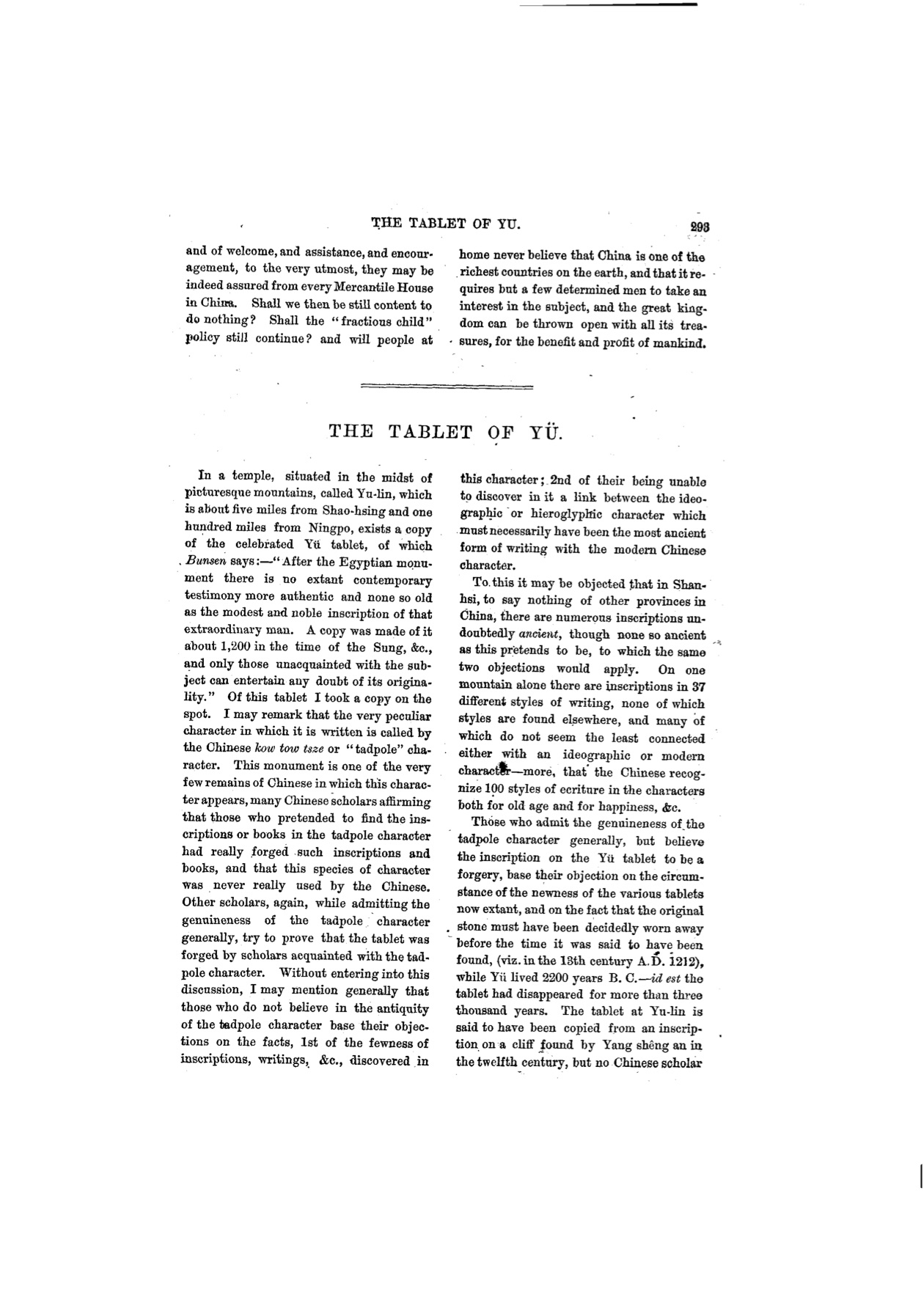
Gardner, C.T. (1874) The tablet of Yü.The China Review, Vol. 2, No. 5, pp. 293–306.
Record No. 3458 | Sinkankas/Born No.: NIS/NIB | RWHL
Reference copied to clipboard!
jade, Ancient China, Chinese history, gems
Gardner examines the celebrated “Tablet of Yü” (Yu bei), an inscription traditionally associated with the legendary emperor Yü the Great and his control of the great flood. He discusses the supposed antiquity, discovery, transmission, characters, and interpretations of the inscription, comparing copies and earlier Chinese accounts and considering claims that it represented one of China’s most ancient written monuments. Particular attention is given to attempts to decipher its unusual archaic characters and to the historical credibility of the traditions surrounding it. Gardner treats the inscription critically, questioning its attribution to the age of Yü and examining the evidence for a substantially later origin. The paper provides an important nineteenth-century Western discussion of a famous Chinese antiquarian inscription and of contemporary debates over the authenticity of purportedly ancient Chinese writing.
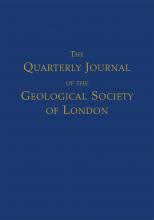
Stoliczka, F. (1874) Note regarding the occurrence of jade in the Karakash Valley, on the southern borders of Turkestan.Journal of the Geological Society, Vol. 30, No. 1–4, pp. 568–570.
Record No. 3359 | Sinkankas/Born No.: NIS/NIB | RWHL
Stoliczka reports firsthand observations of nephrite in the Karakash Valley on the southern border of Eastern Turkestan, made during his travels with the Yarkand Mission. He describes the occurrence of jade in the Kunlun region south of Khotan and distinguishes material obtained as transported boulders from that occurring in its geological source. Of particular importance is his description of the locality near Gulbashen, where nephrite occurs in situ as a bed or vein associated with metamorphic rocks, providing direct geological evidence for a primary source of Khotan jade. He also comments on abandoned workings and the former extraction of the material for export to China. The note is an important early scientific account of the geological occurrence of Kunlun nephrite and helped establish that the celebrated jade of Khotan was derived not only from river gravels but also from primary deposits in the surrounding mountains.
Meeting of the Berlin Anthropological Society on 15 February 1873
Journal Article
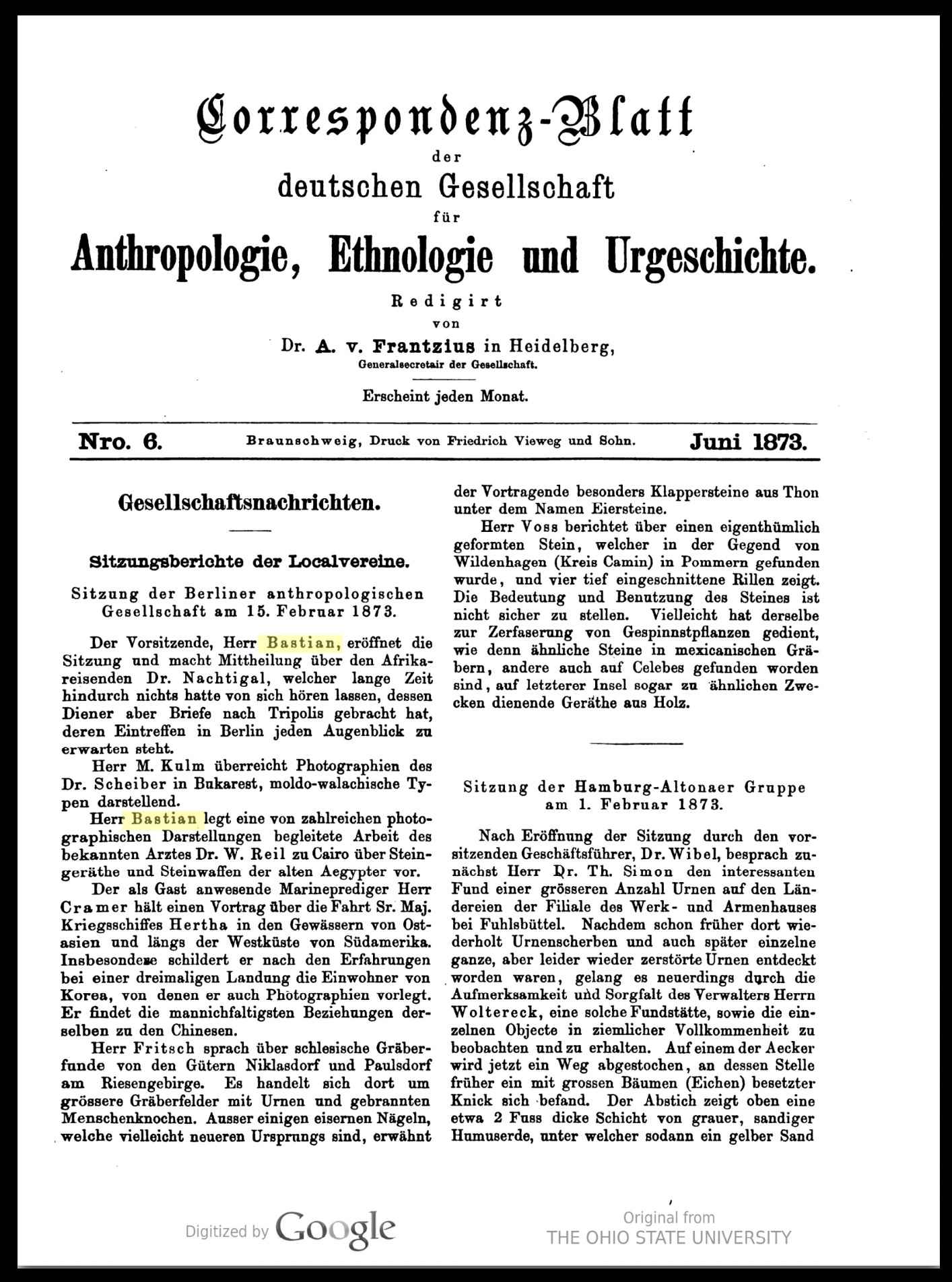
Bastian, A. (1873) Sitzung der Berliner anthropologischen Gesellschaft am 15. Februar 1873. [Meeting of the Berlin Anthropological Society on 15 February 1873]Correspondenz-Blatt der deutschen Gesellschaft für Anthropologie, Ethnologie und Urgeschichte, No. 6, June, p. 41.
Record No. 16570 | Sinkankas/Born No.: NIS/NIB | Language: in German | RWHL
Reference copied to clipboard!
gems, jade, Fischer-Book
Bastian reports on the meeting of the Berlin Anthropological Society held on 15 February 1873, summarizing objects and observations presented and discussed by members in the context of contemporary anthropology, ethnology, and prehistory. Of particular relevance to jade studies is the discussion of nephrite and jade objects, reflecting the contemporary debate over the identification, geographical distribution, and origins of the materials used for prehistoric stone implements. The notice forms part of the nineteenth-century “jade question,” in which archaeological finds of nephrite and related green stones were being compared with ethnographic specimens and known mineral sources in attempts to determine whether European jade artifacts were manufactured from indigenous material or imported from distant regions. Mentions Egyptian stone tools.
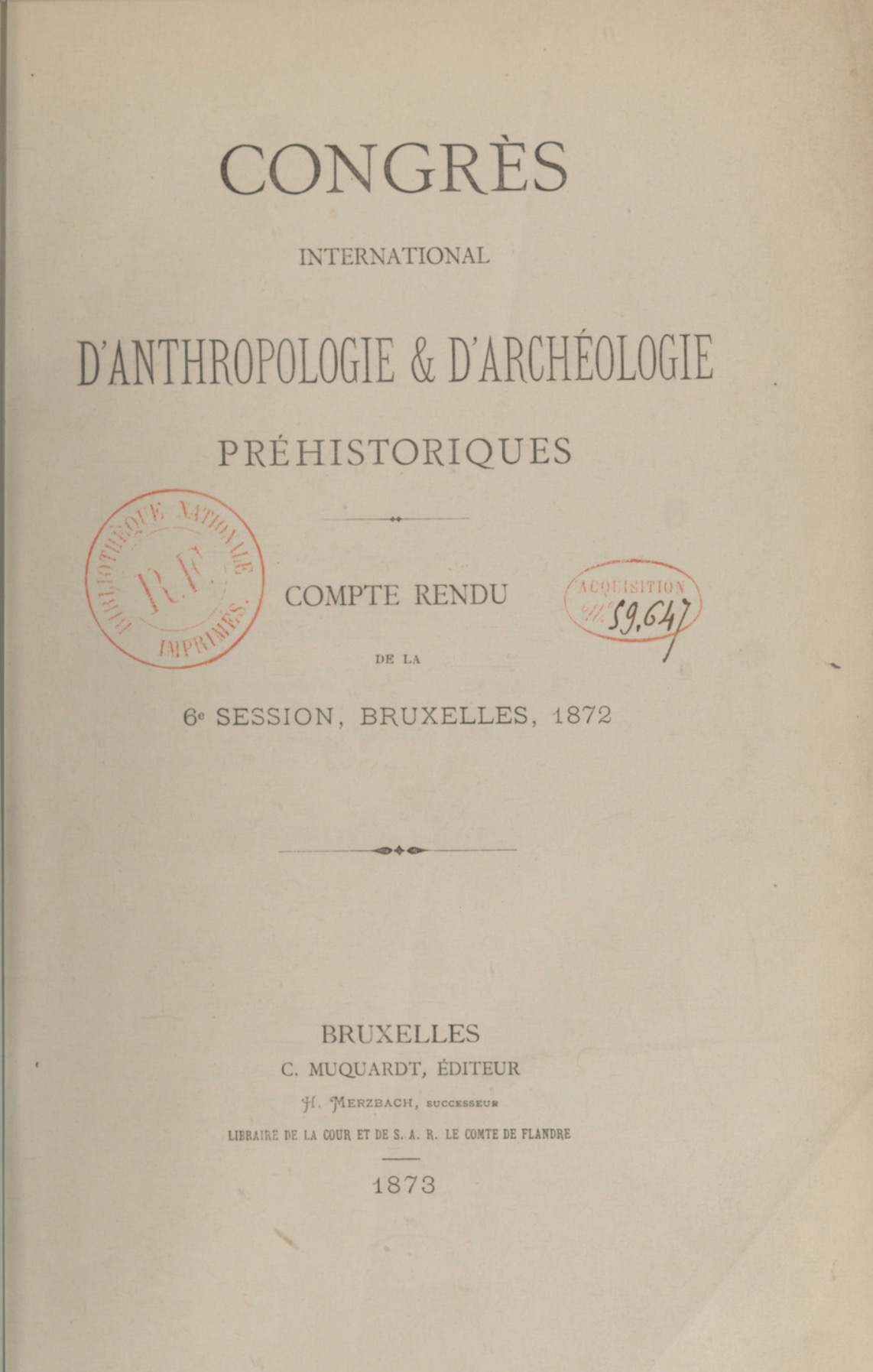
Hagemans, G. (1873)Sur les haches en jadeite découvertes en Belgique. [On the jadeite axes discovered in Belgium] Congrès International d’Antropologie et d’Archéologie Préhistoriques: Compte rendu de la 6e session, Bruxelles see pp. 351–354, 359–363, 369.
Record No. 16479 | Sinkankas/Born No.: NIS/NIB | Language: in French | RWHL
Reference copied to clipboard!
gems, jade, Fischer-Book, jade in Europe, jadeite, fei cui, Belgium
Hagemans discusses polished axes of jadeite discovered in Belgium, describing their form, archaeological occurrence, and mineralogical identification and comparing them with similar prehistoric implements found elsewhere in Europe. He considers the rarity of jadeite and the absence, as then understood, of known Belgian sources, raising the question of how the material reached the region. The discussion forms part of the nineteenth-century “jade question,” in which archaeologists and mineralogists debated whether European jadeite and nephrite artifacts were manufactured from undiscovered indigenous deposits or represented evidence for long-distance exchange. The Belgian finds thus provided important comparative evidence for investigating the distribution, provenance, and movement of jade materials in prehistoric Europe.
Desor, E. (1873)Sur les haches en néphrite et en jadéite. [On axes made of nephrite and jadeite] Congrès International d’Antropologie et d’Archéologie Préhistoriques: Compte rendu de la 6e session, Bruxelles pp. 351–354, 369.
Record No. 16478 | Sinkankas/Born No.: NIS/NIB | Language: in French | RWHL
Reference copied to clipboard!
gems, jade, Fischer-Book, jade in Europe, jadeite, fei cui, nephrite
Desor discusses prehistoric axes made of nephrite and jadeite, focusing on their mineralogical identification, geographical distribution, and the problem of the origin of their raw materials. He considers examples recovered from European archaeological sites, particularly the Swiss lake dwellings, and compares them with jade materials from known sources. The presence in prehistoric Europe of implements fashioned from nephrite and jadeite—materials for which satisfactory European sources were then uncertain—had become central to the nineteenth-century “jade question.” Desor considers whether these objects represented evidence for long-distance trade or movements of peoples from Asia, or whether undiscovered European deposits might account for them. The discussion illustrates the close interaction of mineralogy and prehistoric archaeology in contemporary attempts to use jade artifacts as evidence for ancient exchange and cultural connections.
On the hylodes martinicensis and its metamorphoses
Journal Article
Bavay, L. (1873) Sur l’hylodes martinicensis et ses métamorphoses. [On the hylodes martinicensis and its metamorphoses]Journal de zoologie, Vol. 2, pp. 13–21.
Record No. 7992 | Sinkankas/Born No.: NIS/NIB | Language: in French | RWHL
Reference copied to clipboard!
gems, jade, Fischer-Book
Bavay discusses Hylodes martinicensis, a frog from Martinique, and its development and metamorphosis. He examines the animal’s reproductive and developmental characteristics, particularly its departure from the more familiar amphibian pattern involving a free-swimming aquatic tadpole stage. The note concerns zoology and developmental biology rather than mineralogy or gemology and is of interest chiefly as a nineteenth-century observation on the life history of a Caribbean amphibian.
Di alcuni oggetti dell’epoca neolitica rinvenuti in Friuli
Some objects of the Neolithic era found in Friuli
Journal Article
Taramelli, T. (1873) Di alcuni oggetti dell’epoca neolitica rinvenuti in Friuli. [Some objects of the Neolithic era found in Friuli]Annali Scientifici del R. Istituto Tecnico di Udine, Vol. 7, pp. 83–85.
Record No. 7939 | Sinkankas/Born No.: NIS/NIB | Language: in Italian | RWHL
Reference copied to clipboard!
gems, jade, Fischer-Book
Torquato describes several Neolithic objects discovered in Friuli, northeastern Italy, discussing their forms, workmanship, materials, and archaeological context. Particular attention is given to polished stone implements and to the identification of the rocks and minerals from which they were made, including unusual green stones relevant to contemporary discussions of jadeite and nephrite. The finds are compared with similar prehistoric artifacts from elsewhere in Italy and Europe and contribute to the documentation of Neolithic material culture in Friuli. The paper also forms part of the nineteenth-century “jade question,” in which the occurrence of jade and jade-like implements in Europe prompted debate over their geological sources and prehistoric distribution.
Friedel, E. (1873) Ueber niederländische Alterthümer. [On Dutch antiquities]Zeitschrift für Ethnologie, Vol. 5, pp. 33–42.
Record No. 7938 | ISBN/ISSN: 442666 | Sinkankas/Born No.: NIS/NIB | Language: in German | RWHL
Reference copied to clipboard!
gems, jade, Fischer-Book
Friedel discusses prehistoric antiquities from the Netherlands, describing and comparing archaeological finds including stone implements, pottery, and other artifacts. Particular attention is given to polished stone axes and to the mineralogical identification of the materials from which they were made, including nephrite and jade-like stones. Friedel compares Dutch finds with similar objects discovered elsewhere in Europe and considers their distribution and possible origins. The paper contributes to the nineteenth-century “jade question,” in which archaeologists and mineralogists debated whether European nephrite and jadeite implements were made from indigenous raw materials or represented evidence of long-distance trade or cultural connections with regions outside Europe.
Stark, B. (1873) Kleinere Mittheilungen. [Smaller correspondence]Correspondenz-Blatt der deutschen Gesellschaft für Anthropologie, Ethnologie und Urgeschichte, No. 11, November, p. 88.
Record No. 7549 | Sinkankas/Born No.: NIS/NIB | Language: in German | RWHL
Reference copied to clipboard!
gems, jade, Fischer-Book
Stark contributes a brief notice in the miscellaneous correspondence section of the Correspondenz-Blatt der deutschen Gesellschaft für Anthropologie, Ethnologie und Urgeschichte, reporting an archaeological or ethnographic observation of interest to the society. The communication concerns prehistoric stone artifacts and their material identification, within the contemporary discussion of nephrite, jade, and related stones used for polished implements. The notice forms part of the nineteenth-century “jade question,” when anthropologists, archaeologists, and mineralogists were compiling reports of jade artifacts from European sites in an effort to determine their distribution and the geographical sources of the raw material.
Schaaffhausen, H. (1873) Ein römischer Fund in Bandorf bei Oberwinter. [A Roman find in Bandorf near Oberwinter]Jahrbücher des Vereins von Alterthumsfreunden im Rheinlande, Vol. 53/54, pp. 100–141.
Record No. 7547 | Sinkankas/Born No.: NIS/NIB | Language: in German | RWHL
Reference copied to clipboard!
gems, jade, Fischer-Book
Schaaffhausen describes and interprets a Roman archaeological find from Bandorf near Oberwinter on the Rhine, discussing the circumstances of discovery and the objects recovered from the site. He examines the artifacts in relation to Roman settlement and burial practices in the Rhineland, comparing them with material from other Roman sites and considering their chronology and cultural significance. The study combines archaeological description with contemporary antiquarian and anthropological interpretation and contributes to the nineteenth-century documentation of Roman-period remains in the Rhineland.
Richthofen’s Journey from Beijing to Sz'-tschwan, October 1871 to May 1872
Journal Article
Richthofen, F.F., von (1873) Richthofen’s Reise von Peking nach Sz’-tschwan, Oktober 1871 bis Mai 1872. [Richthofen’s Journey from Beijing to Sz'-tschwan, October 1871 to May 1872]Mittheilungen aus Justus Perthes’ Geographischer anstalt über Wichtige Neue Erforschungen auf dem Gesammtgebiete der Geographie von Dr. A. Petermann, Vol. 19, pp. 137–146, 216–224, 293–306.
Record No. 7544 | Sinkankas/Born No.: NIS/NIB | Language: in German | RWHL
Richthofen describes his journey from Peking (Beijing) to Sichuan between October 1871 and May 1872, presenting geographical, geological, economic, and ethnographic observations made while crossing northern and central China. He discusses routes, mountain systems, river valleys, settlements, agriculture, mineral resources, mining, industries, and trade, with particular attention to the relationship between geological formations and China’s economic resources. The account forms part of Richthofen’s pioneering scientific exploration of China and provides important nineteenth-century observations on regions that were then imperfectly known to European geographers. It contributed to his later comprehensive studies of Chinese geology and physical geography and to Western understanding of the country’s mineral resources and internal communications.
Hamy, E.-T. (1873) Sur l’âge des anthropolithes de la Guadeloupe. [On the age of the anthropoliths of the Guadeloupe]Comptes rendus hebdomadaires des séances de l'Académie des sciences, Vol. 76, Janvier–Juin, pp. 381–383.
Record No. 7526 | Sinkankas/Born No.: NIS/NIB | Language: in French | RWHL
Reference copied to clipboard!
gems, jade, Fischer-Book
Hamy discusses the age and geological context of the celebrated “anthropoliths” of Guadeloupe, human skeletal remains naturally cemented within hard calcareous beach rock and formerly regarded as possible evidence for great human antiquity in the Americas. He reviews their circumstances of discovery and their relationship to the surrounding deposits in an effort to determine whether the remains were genuinely ancient or comparatively recent. Hamy concludes that the geological formation containing the skeletons does not require a remote antiquity and relates them to the relatively recent Indigenous population of Guadeloupe. The paper contributes to nineteenth-century debates over the antiquity of humans in the Americas and the interpretation of human remains preserved in geological deposits.
Geinitz, H.B. (1873) Blicke auf die Wiener Weltausstellung im Jahre 1873. [Views of the Vienna World Exhibition in 1873]Neues Jahrbuch für Mineralogie, Geognosie, Geologie und Paläontologie, pp. 897–919.
Record No. 7524 | Sinkankas/Born No.: NIS/NIB | Language: in German | RWHL
Reference copied to clipboard!
gems, jade, Fischer-Book
Geinitz reports observations from the 1873 Vienna World Exhibition, concentrating on exhibits of geological, mineralogical, mining, and industrial interest. He surveys mineral specimens, rocks, ores, fossil materials, mining products, and manufactured objects displayed by participating countries, using the exhibition as an overview of contemporary developments in geology and the exploitation of mineral resources. Particular attention is given to noteworthy mineral occurrences and materials exhibited from different regions and to their scientific and economic significance. The paper provides a contemporary mineralogist’s view of the Vienna exhibition and documents mineral resources and specimens that were being introduced to an international scientific audience.
Fischer, H. (1873) Gewältigung eines grossen Nephrit-Blockes. [Supplying of a large nephrite block]Mineralogische und Petrographische Mittheilungen, Vol. 3, p. 135.
Record No. 7518 | Sinkankas/Born No.: NIS/NIB | Language: in German | RWHL
Reference copied to clipboard!
gems, jade, Fischer-Book
Fischer reports the acquisition and handling of a large block of nephrite, noting its exceptional size and importance for mineralogical study. The brief communication places the specimen within his continuing investigations of nephrite and jade-like materials, in which sufficiently large and well-characterized specimens were valuable for examining physical properties, texture, and mineralogical identity. The notice contributes to Fischer’s broader nineteenth-century work on the nature and occurrence of nephrite and to contemporary interest in comparing nephrite specimens from different geographical sources.
Hildebrandt, E. (1873)Reise um die Erde. [Journey Around the Earth] Berlin, 3 Vols., see Vol. 3, p. 36
Record No. 7493 | Sinkankas/Born No.: NIS/NIB | Language: in German | RWHL
Reference copied to clipboard!
gems, jade, Fischer-Book, Vietnam, Anam
Hildebrandt recounts his travels around the world, describing the landscapes, peoples, customs, architecture, monuments, and natural features encountered during journeys through Asia, the Pacific, the Americas, and other regions. Based on the travels of the German painter Eduard Hildebrandt, the work combines narrative observations with an artist’s attention to scenery, color, dress, and material culture. Of particular relevance is the passage in Vol. 3, p. 36, which records observations on a semi-transparent green stone of about one and a half cubic feet, called a ‘Gaetstein', as the host referred to it, which the King of Anam had entrusted to the house of Siemssen with the order to sell it advantageously, if possible. It was easy to see from Mestern’s expression that we were dealing with a pledge, and that His Majesty of Anam, who was notoriously not a very high-ranking monarch, had already received most of the value in hard currency. The price of the semi-precious stone was quoted at thirty-six thousand dollars, which the cash-strapped sovereign believed to be worth.
San Salvador and Honduras in the year 1576. Official report of Licentiate Dr. Diego Garcia de Palacio to the King of Spain about the Central American provinces of San Salvador and Honduras in the year 1576
Book
Palacio, D.G.a., de , Frantzius, A., von and Berendt, C.H. (1873)San Salvador und Honduras im jahre 1576. Amtlicher bericht des licenciaten dr. Diego Garcia de Palacio an den könig von Spanien ub̈er die centralamerikanischen provinzen San Salvador und Honduras im jahre 1576. [San Salvador and Honduras in the year 1576. Official report of Licentiate Dr. Diego Garcia de Palacio to the King of Spain about the Central American provinces of San Salvador and Honduras in the year 1576] Berlin, New York, D. Reimer; B. Westermann & Co., xv, 70 pp.
Record No. 7438 | Sinkankas/Born No.: NIS/NIB | Language: translated from the original Spanish to German | RWHL
Reference copied to clipboard!
gems, jade, Guatemala, Mesoamerica, Fischer-Book
García de Palacio’s 1576 report to the Spanish Crown, translated and edited by von Frantzius and Berendt, provides an early description of the provinces of San Salvador and Honduras and their Indigenous inhabitants during the first decades of Spanish colonial rule. Palacio records the geography, settlements, peoples, languages, customs, religious practices, political organization, agriculture, commerce, and natural resources of the region, as well as important pre-Columbian remains encountered during his travels. Particularly significant are his descriptions of Indigenous material culture and archaeological sites, including Copán, one of the earliest European accounts of Maya ruins. The work is an important primary source for sixteenth-century Central America, preserving observations made only a few decades after the Spanish conquest and providing evidence for Indigenous lifeways and material culture during the early colonial period.
Exploring the Literature of Jade
Jade literature spans gemology, mineralogy, archaeology, art history, mining, carving and connoisseurship, and includes works on both jadeite and nephrite from around the world.
Four Treasures is Lotus Gemology's freely accessible gemological reference database. Use the full database to search by author, title or keyword and explore literature on gemology, mineralogy, jewelry and related fields. Where available, hyperlinks on titles may lead directly to the full publication.