Jade Bibliography

Jade Bibliography

Explore books, articles and historical sources on jade in Four Treasures, the Lotus Gemology reference database. This bibliography brings together matching records from the collection, with publication details, abstracts and cover images where available.

Jade References

The list below matches the terms jade, jadeite, nephrite or Fei Cui in the database's searchable fields. Some references discuss these materials as part of a broader subject.
3,061–3,080 of 3,817 matching references

Notes on Hwen Thsang's Account of the Principalities of Tokháristán, in which some Previous Geographical Identifications are Reconsidered
Journal Article
Yule, H. (1873) Notes on Hwen Thsang's Account of the Principalities of Tokháristán, in which some Previous Geographical Identifications are Reconsidered. Journal of the Royal Asiatic Society of Great Britain and Ireland, Vol. 6, No. 1, pp. 92–120.
Record No. 6899  |  ISBN/ISSN: 0035869X  |  Sinkankas/Born No.: NIS/NIB  |  RWHL
Yule examines the account of Tokhāristān given by the seventh-century Chinese Buddhist pilgrim Xuanzang (Hwen Thsang), critically reconsidering earlier attempts to identify the principalities, towns, rivers, and mountain regions described in his travels. By comparing Xuanzang’s itinerary with Chinese, Islamic, classical, and contemporary geographical evidence, Yule seeks to reconstruct the historical geography of the upper Oxus region, including Badakhshan, Wakhan, and neighboring territories. Of particular gemological interest is the geographical context of Badakhshan, historically renowned for its balas rubies (spinel) and lapis lazuli. The paper provides an important nineteenth-century attempt to reconcile early Chinese descriptions with the physical and political geography of Central Asia and helps clarify the historical setting of some of its most celebrated gemstone-producing regions. Contains a brief mention of Khotan.

Memorandum on the metals and minerals of Upper Burmah
Journal Article
Strover, G.A. (1873) Memorandum on the metals and minerals of Upper Burmah. Chemical News and Journal of Physical Science, Vol. 28, No. 724,, October  10 pp. 187–190.
Record No. 2602  |  Sinkankas/Born No.: NIS/NIB  |  RWHL
Strover surveys the metals and minerals known from Upper Burma, describing their occurrence, geographical distribution, extraction, and economic importance. He discusses mineral resources including gold, silver, copper, lead, iron, coal, petroleum, and precious stones, drawing on contemporary information concerning mines and mineral-producing districts. Of particular gemological importance are his observations on Burmese gemstones and jade, including materials obtained from the northern districts and entering local and Chinese trade. The memorandum provides a useful nineteenth-century overview of Upper Burma’s mineral wealth and contemporary knowledge of the country’s economically important mineral and gemstone resources.

Steinbeile aus Nephrit oder Jade

Stone axes made of nephrite or jade
Journal Article
Anonymous (1872) Steinbeile aus Nephrit oder Jade. [Stone axes made of nephrite or jade] Korrespondenz-Blatt der Deutschen Gesellschaft für Anthropologie, Ethnologie und Urgeschichte, No. 6, June, pp. 46–48.
Record No. 16569  |  Sinkankas/Born No.: NIS/NIB  |  Language: in German  |  RWHL
The anonymous article discusses prehistoric stone axes identified as nephrite or jade and the problem of determining the nature and geographical origin of their raw material. It considers finds of polished jade implements from European archaeological sites and their comparison with nephrite and related green stones from known localities. The occurrence of such artifacts was central to the contemporary “jade question”: whether European prehistoric nephrite objects had been manufactured from as-yet-undiscovered indigenous deposits or whether the material had reached Europe through long-distance exchange from Asia. The article reflects the increasing application of mineralogical identification to archaeological stone tools and the broader nineteenth-century debate over what jade artifacts could reveal about prehistoric trade and cultural contacts.

Die vorgeschichtlichen Alterthümer der Stadt Olmütz und ihrer Umgebung
The prehistoric antiquities of the city of Olomouc and its surroundings
Journal Article
Jeitteles, L.H. (1872) Die vorgeschichtlichen Alterthümer der Stadt Olmütz und ihrer Umgebung. [The prehistoric antiquities of the city of Olomouc and its surroundings] Mitteilungen der anthropologischen Gesellschaft in Wien, Vol. 2, No. 1, pp. 18–32.
Record No. 7993  |  Sinkankas/Born No.: NIS/NIB  |  Language: in German  |  RWHL
Jeitteles surveys prehistoric antiquities discovered in and around Olmütz (Olomouc), Moravia, describing archaeological finds and their contexts as evidence for the region’s early inhabitants. He discusses stone implements, pottery, metal objects, ornaments, and other remains, comparing them with finds from elsewhere in Central Europe and considering their chronological and cultural significance. Particular attention is given to polished stone tools and the identification of the materials from which they were manufactured, including unusual green stones relevant to contemporary discussions of nephrite and jade artifacts. The paper contributes to the developing archaeological record of prehistoric Moravia and to nineteenth-century attempts to classify stone implements according to both form and mineralogical composition.

Antique Gems and Rings

Book
King, C.W. (1872) Antique Gems and Rings. London, Bell and Daldy, 2 Vols., 483 pp.
Record No. 2802  |  Sinkankas/Born No.: 3411; NIB  |  RWHL
King presents an extensive study of ancient engraved gems and finger rings, principally of Greek, Etruscan, and Roman origin, combining archaeological, historical, artistic, and gemological information. He discusses the materials used by ancient engravers—including carnelian, sard, chalcedony, jasper, agate, amethyst, garnet, emerald, sapphire, and other stones—the techniques of engraving and polishing, forms and construction of rings, and the identification and dating of intaglios and cameos. Considerable attention is given to subjects represented on gems, including deities, portraits, mythological scenes, animals, symbols, inscriptions, and magical devices, as well as to their use as seals, ornaments, amulets, and signet rings. King also examines ancient literary sources concerning precious stones, notable collections and individual gems, later imitations and forgeries, and the reuse of classical gems in subsequent periods. The work is an important nineteenth-century synthesis of glyptic art and remains valuable for its detailed observations on engraved gemstones, their materials, manufacture, iconography, and historical use.

Der Fetischismus. Ein Beitrag zur Anthropolgie und Religionsgeschichte
Fetishism. A Contribution to Anthropolgy and the History of Religion
Book
Schultze, F. (1871) Der Fetischismus. Ein Beitrag zur Anthropolgie und Religionsgeschichte. [Fetishism. A Contribution to Anthropolgy and the History of Religion] Leipzig, Carl Wilffereodt, 292 pp. (see p. 178).
Record No. 7548  |  Sinkankas/Born No.: NIS/NIB  |  Language: in German  |  RWHL
Schultze presents a comparative study of “fetishism” as understood in nineteenth-century anthropology and the history of religion, examining beliefs in supernatural powers attributed to material objects and natural phenomena among peoples in different parts of the world. Drawing on travel narratives, missionary reports, historical sources, and ethnographic literature, he discusses the religious and magical use of stones, amulets, idols, plants, animals, and other objects believed to possess protective, healing, divinatory, or spiritual powers. The discussion on p. 178 concerns stones within this broader treatment of objects invested with supernatural significance. The work is representative of nineteenth-century evolutionary theories of religion; its terminology and assumptions concerning Indigenous religions are now considered outdated.

Russische Arbeiten über Asien aus dem Jahre 1870
Russian works about Asia from 1870
Journal Article
Marthe, F. (1871) Russische Arbeiten über Asien aus dem Jahre 1870. [Russian works about Asia from 1870] Zeitschrift der Gesellschaft für Erdkunde zu Berlin, Vol. 6, pp. 440–475.
Record No. 7532  |  Sinkankas/Born No.: NIS/NIB  |  Language: in German  |  RWHL
Marthe reviews Russian geographical and exploratory publications concerning Asia issued during 1870, summarizing work on the geography, peoples, natural resources, routes, and exploration of the Russian Empire’s Asian territories and neighboring regions. The paper surveys contemporary Russian investigations of Central Asia, Siberia, Turkestan, and adjoining areas, making information published in Russian more accessible to German geographical readers. It includes notices of expeditions and regional studies dealing with mountain systems, rivers, settlements, trade routes, ethnography, geology, and mineral resources. The article provides a useful nineteenth-century bibliographical and geographical overview of Russian research into Asia during a period of rapidly expanding exploration and scientific investigation of Central Asia.

To High Tartary, Yârkand, and Kâshgar (formerly Chinese Tartary) and Return Journey over the Karakoram Pass
Book
Shaw, R. (1871) To High Tartary, Yârkand, and Kâshgar (formerly Chinese Tartary) and Return Journey over the Karakoram Pass. London, John Murray, 486 pp. (see pp. 474–475)
Record No. 7363  |  Sinkankas/Born No.: NIS/NIB  |  RWHL
Shaw recounts his journey from India across the Karakoram to Yarkand and Kashgar in Eastern Turkestan, describing the geography, peoples, customs, political conditions, commerce, and caravan routes of a region then rarely visited by Europeans. Of particular gemological importance are his remarks on pp. 474–475 concerning Khotan jade. He describes jade as an important product of the Khotan region, obtained both from river deposits and from workings in the mountains, and discusses its transport and trade. The material was particularly valued for the Chinese market, while local demand was comparatively limited. Shaw’s observations provide valuable nineteenth-century evidence for the sources, recovery, and commerce of Khotan nephrite and for the trade routes linking the jade-producing districts of the Kunlun with Yarkand and China.

A Report on the Expedition to Western Yunan via Bhamo
Book
Anderson, J. (1871) A Report on the Expedition to Western Yunan via Bhamo. Calcutta, Office of the Supt. of Govt. Printing, 458 pp., 2 maps
Record No. 2692  |  Sinkankas/Born No.: NIS/NIB  |  RWHL
Anderson reports on the British expedition from Bhamo in Upper Burma into western Yunnan, describing the route, geography, geology, natural history, peoples, political conditions, commerce, and resources of the region. Particular attention is given to the important overland trade between Burma and China, including the markets and caravan routes connecting Bhamo with Yunnan. Of gemological interest are observations on the mineral products and trade of northern Burma and southwestern China, including jade, which moved through this commercial network from the jade-producing districts of Upper Burma toward Chinese markets. The work provides an important nineteenth-century account of the geography and commerce of the Burma–Yunnan frontier and historical context for the development and organization of the Burmese jade trade.

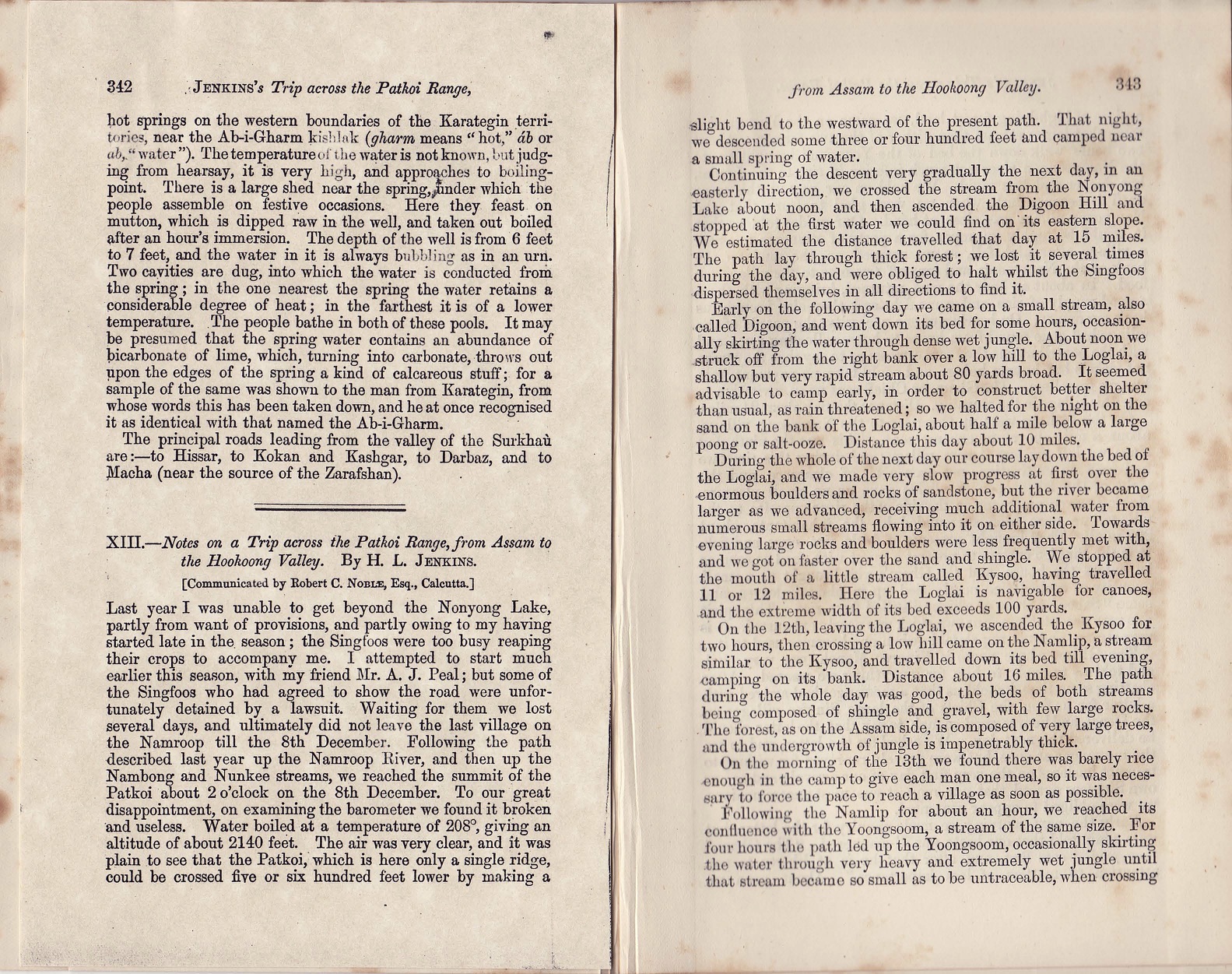
Notes on a trip across the Patkoi Range, from Assam to the Hookoong Valley
Journal Article
Jenkins, H.L. (1871) Notes on a trip across the Patkoi Range, from Assam to the Hookoong Valley. Journal of the Royal Geographical Society of London, Vol. 41, pp. 342–348 + map.
Record No. 172  |  Sinkankas/Born No.: NIS/NIB  |  RWHL
Jenkins describes a journey from Assam across the Patkoi Range into the Hookoong (Hukawng) Valley of northern Burma, recording the route, mountain passes, rivers, villages, peoples, and physical geography encountered. He discusses the difficulties of travel through the densely forested frontier region and provides observations on local communities and communications between Assam and the upper valleys of Burma. The paper is particularly relevant to the geography of the Hukawng region and the routes approaching the mineral-producing districts of northern Burma, providing a nineteenth-century account of an area that remained poorly known to Europeans and later became important in descriptions of the routes leading toward the jade-producing districts farther east.

Geognostisch-mineralogische Fragmente aus Italien
Geognostic-mineralogical fragments from Italy
Journal Article
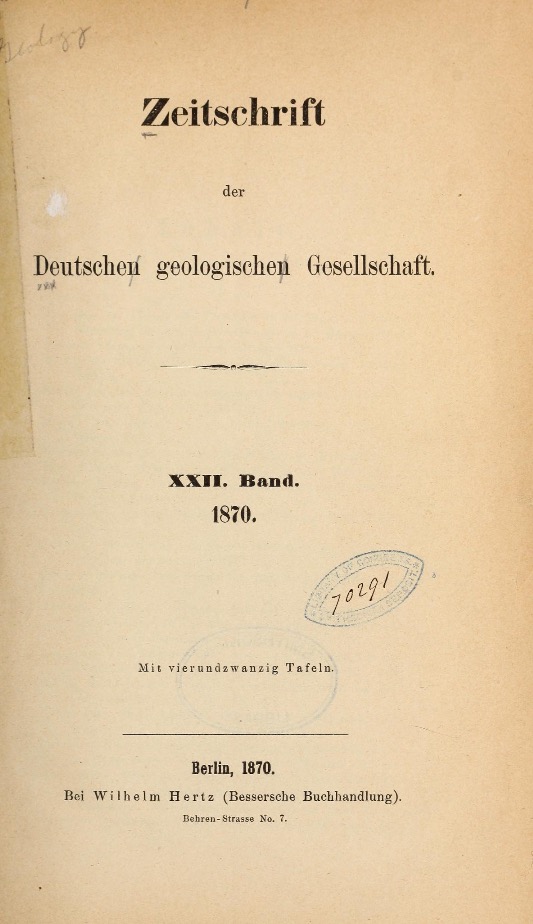
Rath, G., von (1870) Geognostisch-mineralogische Fragmente aus Italien. [Geognostic-mineralogical fragments from Italy] Zeitschrift der Deutschen Geologischen Gesellschaft, Vol. 22, pp. 591–732 (see pp. 637–638).
Record No. 7541  |  Sinkankas/Born No.: NIS/NIB  |  Language: in German  |  RWHL
Fischer: [Rath, Gerhard von, reports in his geognostic fragments from Italy, Part III, in: Zeitschr. der deutsch. geolog. Gesellsch. [Journal of the German Geological Society], Volume XXII, Berlin 1870, pages 637–38, in the note, about the presence of stone tools on Elba, of which over 1000 specimens from the collection of Mr. Raf. Foresi were exhibited at the Paris Industrial Exhibition in 1867. Since green saussurite is also mentioned among the materials for these stone weapons, I wanted to draw attention to this note for possible identification of nephrite or jadeite among them. See: Dell’eta della pietra all’isola d’Elba, letter from Raf. Foresi to Prof. J. Occhi, Extract from “Il Diritto” No. 231, August 24, 1865.]

Intorno una Antichità Messicana

Around a Mexican Antiquity
Book
Novelli, E. (1870) Intorno una Antichità Messicana. [Around a Mexican Antiquity] Roma, Dalla Tipografia Romana, 12 pp.
Record No. 7538  |  Sinkankas/Born No.: NIS/NIB  |  Language: in Italian  |  RWHL
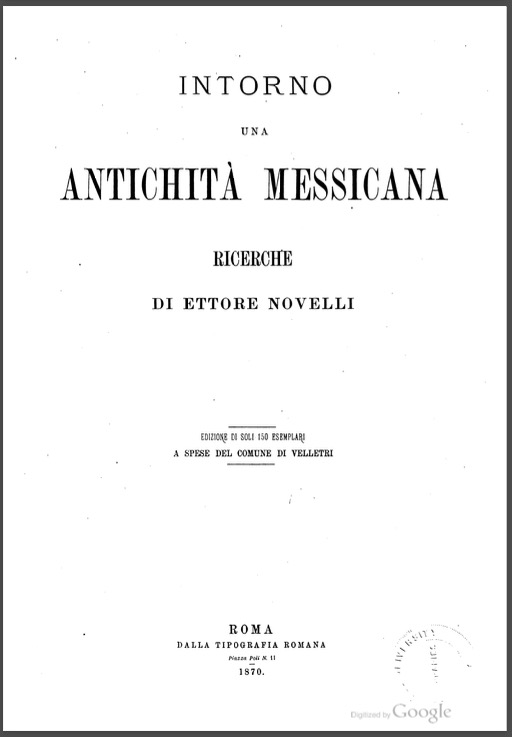
Novelli discusses a Mexican antiquity, describing the object’s form, workmanship, material, and presumed function and comparing it with other known remains of pre-Columbian Mexican culture. He considers its iconography and possible religious or symbolic significance and places it within contemporary European understanding of the civilizations of ancient Mexico. The brief study reflects nineteenth-century interest in recently collected Mesoamerican antiquities and attempts to interpret individual artifacts through comparison with early accounts and other archaeological objects.

Nephrit (Punamu) aus Neuseeland

Nephrite (Punamu) from New Zealand
Journal Article
Kenngott, A. (1870) Nephrit (Punamu) aus Neuseeland. [Nephrite (Punamu) from New Zealand] Vierteljahrsschrift der Naturforschenden Gesellschaft in Zürich, Vol. 15, pp. 372–377.
Record No. 7528  |  Sinkankas/Born No.: NIS/NIB  |  Language: in German  |  RWHL
Fischer: Kenngott, Ad. reports in the Züricher Vierteljahrschrift der naturforsch. Gesellsch. Zürich Quarterly Journal of the Natural History Society], XV. Year 1870, pg. 372–377 [Leonh. Gein. Yearbook 1871, 293] on two handpieces of punamu nephrite acquired for the Zürich collection of Edm. v. Fellenberg. These pieces were detached from a large erratic block* weighing 180 pounds that was brought to Europe. This is the same block mentioned and analyzed by L.R. v. Fellenberg (the father of the former) in his article from 1869–70 [see above, pg. 278]. Kenngott’s microscopic examination revealed that the mineral is homogeneous and polarization. There are hardly any significant foreign black inclusions, but there might be some traces of chrome iron or magnetite. According to Kenngott’s analysis, punamu nephrite can be classified as a variety of greenstone (like Damour), and he compiles 25 known nephrite analyses (note that the numbers given in analyses 10 and 11 by Damour do not match those in the original Damour article due to some error).

Journey from Leh to Yarkand and Kashgar, etc.
Journal Article
Hayward, G.W. (1870) Journey from Leh to Yarkand and Kashgar, etc. Journal of the Royal Geographical Society of London, Vol. 40, pp. 33–166.
Record No. 7527  |  Sinkankas/Born No.: NIS/NIB  |  RWHL
Hayward describes his journey from Leh across the Karakoram into Eastern Turkestan, including Yarkand, Kashgar, and surrounding regions, recording routes, mountain passes, rivers, settlements, political conditions, peoples, trade, and geography. Particular attention is given to the Kunlun and Karakash region and to Khotan, historically important as a source of jade. Hayward records information on jade obtained from the rivers and mountains of the Khotan region and its trade toward Yarkand and China, providing contemporary evidence for the exploitation and commerce of Central Asian nephrite. The paper is an important nineteenth-century geographical account of a region then rarely visited by Europeans and provides valuable historical context for the sources and trade routes of Khotan jade.

Kristische, mikroskopisch-mineralogische Studien
Critical, microscopic-mineralogical studies
Book
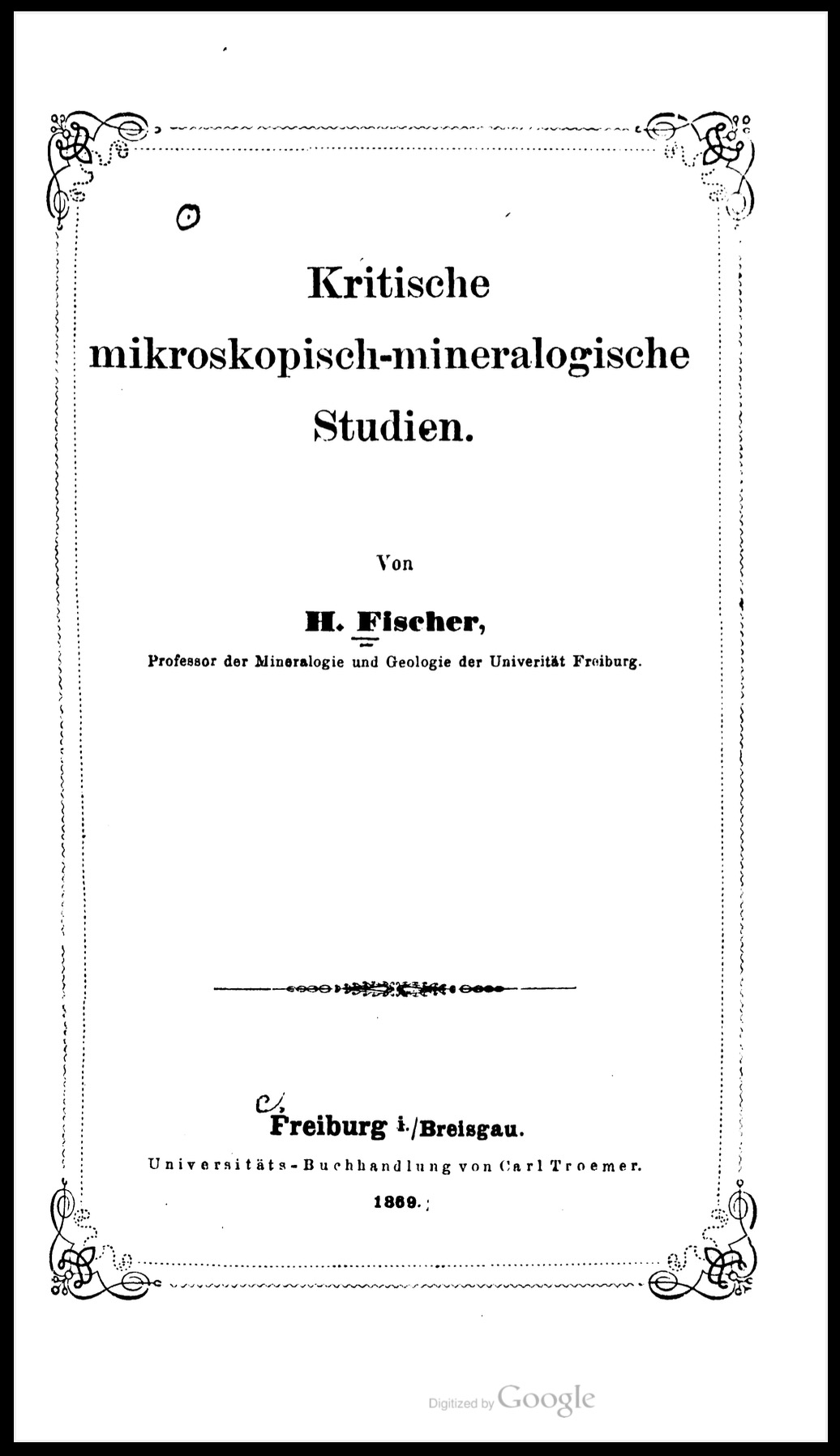
Fischer, H. (1869) Kristische, mikroskopisch-mineralogische Studien. [Critical, microscopic-mineralogical studies] Freiburg, 1st Fortsetzung , 96 pp., 2 plates (see pp. 9, 24–25, 48).
Record No. 16126  |  Sinkankas/Born No.: 2125  |  Language: in German  |  RWHL
Fischer presents the first continuation of his critical microscopic-mineralogical studies, applying microscopic examination to the identification and differentiation of minerals and rocks whose true nature could be difficult to establish from external appearance alone. He compares microscopic structure, texture, inclusions, and other diagnostic characteristics with chemical and physical evidence and critically reassesses earlier mineral identifications. Of particular relevance to jade research are the discussions on pp. 9, 24–25, and 48, where nephrite and related or superficially similar materials are considered as part of Fischer’s continuing effort to distinguish true nephrite from “pseudonephrite” and other jade-like substances. The work illustrates the increasing importance Fischer attached to microscopy in resolving the nineteenth-century “jade question” and in establishing more reliable mineralogical identifications of archaeological stone artifacts.

Analytical alphabet for the Mexican & Central American languages
Book
Berendt, C.H. (1869) Analytical alphabet for the Mexican & Central American languages. New York, American Ethnology Society, 8 pp.
Record No. 8138  |  Sinkankas/Born No.: NIS/NIB  |  RWHL
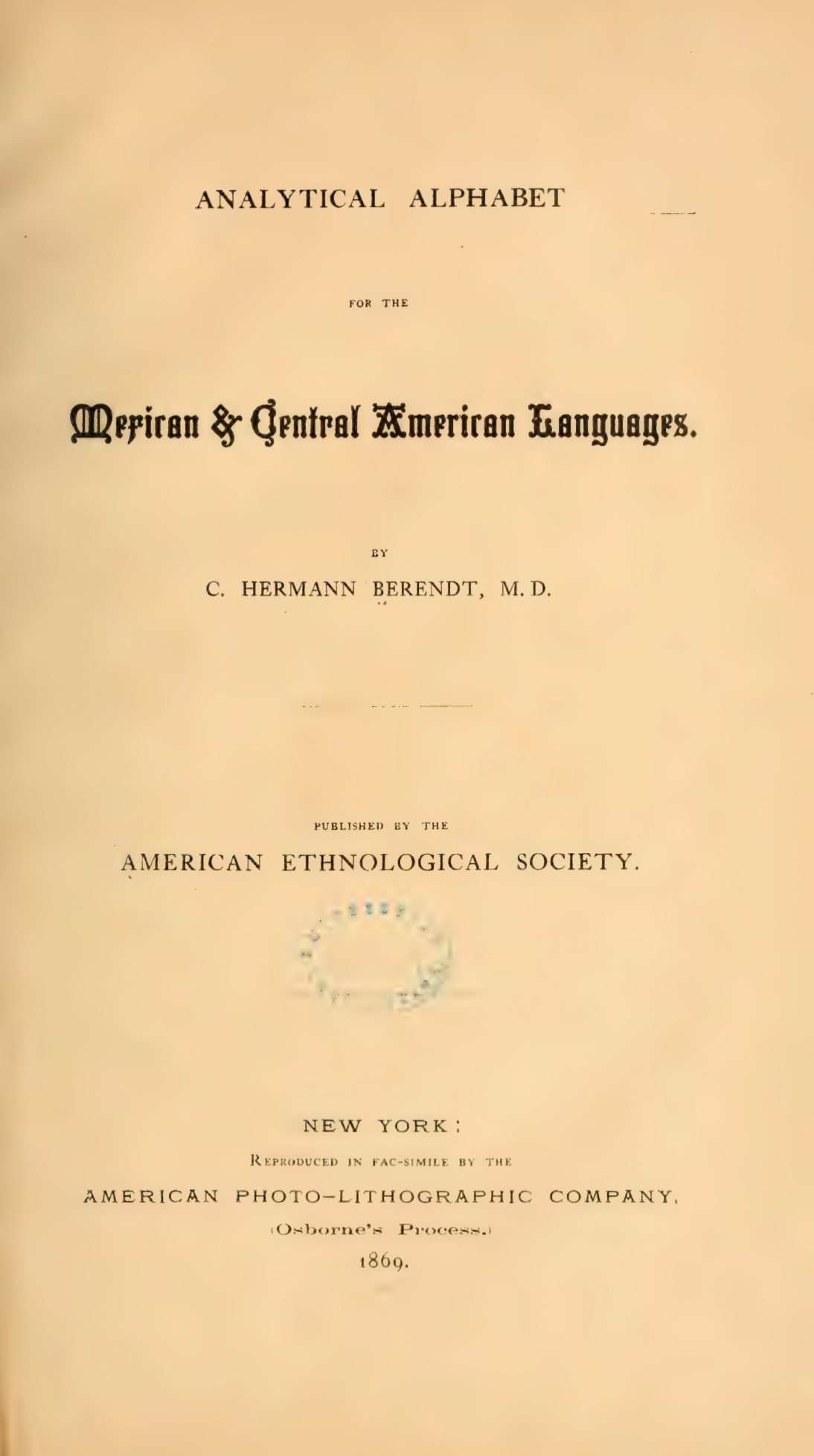
Berendt presents a proposed analytical alphabet for recording the Indigenous languages of Mexico and Central America, intended to provide a consistent system for representing sounds encountered in linguistic and ethnographic research. Drawing on his extensive study of Mesoamerican languages and manuscripts, he identifies significant speech sounds and assigns characters and diacritical signs for their transcription, with the aim of reducing the inconsistencies produced by Spanish and other European orthographies. The brief work is primarily linguistic rather than archaeological or gemological and reflects nineteenth-century efforts to establish systematic phonetic methods for documenting Indigenous American languages.

[Correspondence article from February 21 about the microscopic-mineralogical studies]
Correspondence article from February 21 about the microscopic-mineralogical studies
Journal Article
Fischer, H. (1869) [Correspondence article from February 21 about the microscopic-mineralogical studies]. Neues Jahrbuch fuer Mineralogie, Geognosie, Geologie und Petrefaktenkunde, pp. 344–347.
Record No. 7989  |  Sinkankas/Born No.: NIS/NIB  |  Language: in German  |  RWHL
Fischer reports in a correspondence dated 21 February on his continuing microscopic-mineralogical investigations, emphasizing the usefulness of microscopy for distinguishing minerals and examining fine-grained or otherwise difficult materials. He discusses observations made on mineral specimens under the microscope and the diagnostic value of microscopic structure and optical appearance when macroscopic examination alone is insufficient. The communication reflects Fischer’s broader efforts to establish microscopy as a practical method in mineralogy and petrography and belongs to the period when microscopic examination was becoming increasingly important for the identification and differentiation of minerals, including compact and closely similar materials.

Beiträge zur Kenntniss der Constitution mehrerer Silikate
Contributions to the knowledge of the constitution of several silicates
Journal Article
Rammelsberg, C.F. (1869) Beiträge zur Kenntniss der Constitution mehrerer Silikate. [Contributions to the knowledge of the constitution of several silicates] Zeitschrift der Deutschen Geologischen Gesellschaft, Vol. 21, pp. 84–99.
Record No. 7887  |  Sinkankas/Born No.: NIS/NIB  |  Language: in German  |  RWHL
Rammelsberg presents chemical investigations of several silicate minerals in an effort to clarify their composition and chemical constitution. Using quantitative analyses, he compares the proportions of silica, alumina, magnesia, lime, iron, alkalies, and other constituents and considers how analytical results should be expressed in mineral formulas and used to distinguish related species. The paper forms part of Rammelsberg’s broader work to place mineral classification on a rigorous chemical basis at a time when the compositions and relationships of many complex silicates were still being established. It provides contemporary analytical data relevant to the developing chemical understanding of silicate minerals, including groups containing species of mineralogical and gemological importance.

Voyage à travers l'Amérique du Sud, de l'Océan Pacifique à l'Océan Atlantique
Travel through South America, from the Pacific Ocean to the Atlantic Ocean
Book
Marcoy, P. and Riou, É. (1869) Voyage à travers l'Amérique du Sud, de l'Océan Pacifique à l'Océan Atlantique. [Travel through South America, from the Pacific Ocean to the Atlantic Ocean] Paris, Hachette, 2 Vols., 519 pp. (see Vol. 1, p. 630).
Record No. 7531  |  Sinkankas/Born No.: NIS/NIB  |  Language: in French  |  RWHL
Marcoy recounts his journey across South America from the Pacific coast through Peru and the Andes to the Amazon basin and onward toward the Atlantic, combining travel narrative with observations on geography, natural history, Indigenous peoples, settlements, customs, commerce, and material culture. The work describes routes through regions then little known to European readers and is extensively illustrated by Édouard Riou from Marcoy’s sketches and other material. Particular attention is given to the peoples of the Peruvian Andes and Amazonian regions, their ornaments, weapons, tools, dress, and use of local natural resources. The work provides a richly illustrated nineteenth-century record of western and Amazonian South America and contemporary European observations of its Indigenous cultures and material traditions.

Kristische, mikroskopisch-mineralogische Studien

Critical, microscopic-mineralogical studies
Book
Fischer, H. (1869, 1871, 1873) Kristische, mikroskopisch-mineralogische Studien. [Critical, microscopic-mineralogical studies] Freiburg, 64, 64, 96 pp., 2 plates; (see 1871, pp. 9, 24–25, 48).
Record No. 7517  |  Sinkankas/Born No.: 2125, 2128  |  Language: in German  |  RWHL
Fischer presents a series of critical microscopic-mineralogical studies applying microscopy to the identification and differentiation of minerals and rocks whose nature could not always be determined reliably from their external appearance. He examines microscopic structure, texture, inclusions, and other diagnostic features, comparing these observations with chemical and physical evidence and reassessing earlier mineral identifications. Of particular relevance to jade research are his discussions of nephrite and nephrite-like materials, in which microscopy is used to distinguish true nephrite from superficially similar substances. The studies form an important part of Fischer’s contribution to the nineteenth-century “jade question” and illustrate the growing use of microscopic methods for identifying compact mineral aggregates and archaeological stone materials.

Exploring the Literature of Jade

Jade literature spans gemology, mineralogy, archaeology, art history, mining, carving and connoisseurship, and includes works on both jadeite and nephrite from around the world.

For an introduction to collecting books on this subject, read Hidden Treasure — Collecting the Literature of Jade.

About Four Treasures

Four Treasures is Lotus Gemology's freely accessible gemological reference database. Use the full database to search by author, title or keyword and explore literature on gemology, mineralogy, jewelry and related fields. Where available, hyperlinks on titles may lead directly to the full publication.

Search the Complete Four Treasures Database