Explore books, articles and historical sources on jade in Four Treasures, the Lotus Gemology reference database. This bibliography brings together matching records from the collection, with publication details, abstracts and cover images where available.
Jade References
The list below matches the terms jade, jadeite, nephrite or Fei Cui in the database's searchable fields. Some references discuss these materials as part of a broader subject.
The Maori industry at the general exhibition in Auckland (New Zealand)
Journal Article
Peschel, O.F. (1866) Die Industrie der Maoris auf der allgeneinen Austellung in Auckland (Neu-Seeland). [The Maori industry at the general exhibition in Auckland (New Zealand)]Das Ausland, No. 51, 18 December, pp. 1212–1215.
Record No. 7344 | Sinkankas/Born No.: NIS/NIB | Language: in German | RWHL
Reference copied to clipboard!
gems, jade, amphibole jade, nephrite, New Zealand, punamu, Maori, Fischer
Peschel discusses Māori manufactures displayed at the General Exhibition in Auckland, New Zealand, describing traditional objects and the materials and techniques employed in their production. Particular attention is given to pounamu (greenstone or nephrite), highly valued by Māori and fashioned into weapons, tools, and personal ornaments, including mere and hei-tiki. He comments on the considerable labor required to cut, grind, drill, and polish this exceptionally tough material with traditional methods and on the value attached to finished objects. The article places these objects within a broader survey of Māori craftsmanship and material culture, providing a contemporary nineteenth-century European account of Māori nephrite working and the cultural importance of pounamu.
Desor, E. (1866)Die Pfahlbauten des Neuenburger Sees. [The Pile Dwellings of Lake Neuchâtel] Frankfurt am Main, Druck und Verlag von C. Adelmann, 157 pp.
Record No. 6831 | Sinkankas/Born No.: NIS/NIB | Language: in German | RWHL
Desor describes the prehistoric pile-dwelling settlements of Lake Neuchâtel in Switzerland, examining their construction, archaeological remains, material culture, and implications for the chronology and way of life of their inhabitants. Drawing upon excavations and finds recovered from the lake settlements, he discusses stone, bone, bronze, and other implements and ornaments, together with pottery, animal remains, and evidence for agriculture, hunting, fishing, and domestic activities. Of particular mineralogical and archaeological interest are polished stone implements made from unusual and exotic materials, including jade or nephrite, whose occurrence in Swiss lake dwellings contributed to contemporary debate over the provenance of such stones and the possibility of prehistoric long-distance exchange. The work is an important early synthesis of Swiss lake-dwelling archaeology and of the developing study of prehistoric stone materials.
Analyses of some nephrites from the Swiss pile dwellings
Journal Article
Fellenberg, L.R., von (1865) Analysen einiger Nephrite aus den schweizerischen Pfahlbauten. [Analyses of some nephrites from the Swiss pile dwellings]Neues Jahrbuch für Mineralogie, Geologie und Paläontologie, pp. 619–620.
Record No. 16489 | Sinkankas/Born No.: NIS/NIB | Language: in German | RWHL
Reference copied to clipboard!
gems, jade, Fischer-Book, nephrite analysis from Swiss pile dwellings
Fischer, C. (1865) [on pseudonephrite].Neues Jahrbuch für Mineralogie, Geologie und Paläontologie, pp. 448–449.
Record No. 16488 | Sinkankas/Born No.: NIS/NIB | Language: in German | RWHL
Reference copied to clipboard!
gems, jade, Fischer-Book
Fischer reports on a material termed “pseudonephrite,” so named because of its superficial resemblance to true nephrite. He distinguishes the substance mineralogically from nephrite, emphasizing that materials historically identified as jade on the basis of appearance and toughness could belong to quite different mineral species. The brief notice forms part of Fischer’s developing investigation into the mineralogical identity of jade and jade-like stones, work that ultimately helped establish the distinction between true nephrite, jadeite, and various substitutes or imitations. “Pseudonephrite” is now an obsolete and inconsistently applied mineral name, having subsequently been used for several materials unrelated to true nephrite.
Fouilles du Tumulus du Moustoir Carnec
Excavations of the Moustoir Tumulus in Carnac
Journal Article
Galles, R. (1865) Fouilles du Tumulus du Moustoir Carnec. [Excavations of the Moustoir Tumulus in Carnac]Revue Archéologique, No. 12, pp. 15–25.
Record No. 8105 | Sinkankas/Born No.: NIS/NIB | Language: in French | RWHL
Reference copied to clipboard!
gems, jade, Fischer-Book
Galles reports the excavation of the large Neolithic tumulus of Le Moustoir near Carnac, Brittany, undertaken to compare its structure and contents with those of other megalithic monuments in the Morbihan, particularly Mané-Lud. He describes the tumulus, its associated dolmen and menhirs, the successive stages of excavation, internal stone structures, chambers, hearths, and deposits encountered, together with human and animal remains and archaeological objects. Finds included pottery and polished-stone objects, among them a small axe-shaped pendant, as well as a serpentine object and a variscite bead. Galles emphasizes careful recording of the excavation rather than speculative interpretation, regarding the monument as further evidence for understanding the construction and funerary practices represented by the great tumuli of the Carnac region.
Materials for the Positive and Philosophical History of Man
Book
Mortillet, G., de (1865)Matériaux pour l’Histoire Positive et Philosophiqué de l’Homme. [Materials for the Positive and Philosophical History of Man] Paris, 580 pp. (jade see p. 244).
Record No. 7984 | Sinkankas/Born No.: NIS/NIB | Language: in French | RWHL
Reference copied to clipboard!
gems, jade, Fischer-Book
Mortillet’s Matériaux pour l’Histoire Positive et Philosophique de l’Homme is an early prehistoric and anthropological publication devoted to archaeological discoveries, human antiquity, prehistoric industries, and the material evidence for early peoples. Of particular gemological interest is the discussion of jade on p. 244, where nephrite implements from European prehistoric contexts are considered in connection with the problem of the geographical origin of their raw material. Such finds, especially polished nephrite axes from Swiss lake dwellings, contributed to the developing nineteenth-century debate over whether European prehistoric jade was obtained from indigenous sources or introduced through long-distance exchange with Asia. The publication provides contemporary evidence for the emergence of jade provenance as an important archaeological and mineralogical question.
Bonstetten, A., de (1865)Essai sur les Dolmens. [Essay on the Dolmens] Geneva, Jules-Guillaume Fick, 68 pp., map, plates
Record No. 7975 | Sinkankas/Born No.: NIS/NIB | Language: in French | RWHL
Reference copied to clipboard!
gems, jade, Fischer-Book
Bonstetten presents a comparative study of dolmens and other megalithic tombs, examining their construction, geographical distribution, archaeological contents, and possible cultural relationships across Europe and North Africa. He classifies different forms of dolmen and draws upon excavated examples from France, Switzerland, Germany, Scandinavia, Britain, Algeria, and elsewhere, illustrating the monuments and associated artifacts with woodcuts, five lithographic plates, and a large colored map showing their distribution. Of particular relevance to jade and prehistoric lapidary studies are the polished stone axes, beads, and other objects recovered from megalithic burials, including artifacts made from distinctive green stones; one illustrated assemblage, for example, includes serpentine beads from a dolmen in Morbihan. The work belongs to the formative period of prehistoric archaeology, when scholars were beginning to compare megalithic monuments and their stone artifacts systematically across large geographical areas. Although some of Bonstetten’s conclusions concerning the common origin and builders of dolmens are now obsolete, the volume remains useful for its documentation of nineteenth-century discoveries, artifact assemblages, and early attempts to understand the distribution and exchange of prehistoric stone materials.
Ancient Races of Europe. — Stone instruments. Swiss nephrite axes
Journal Article
Mortillet, G., de (1865) Anciennes Races d’Europe. — Instruments en pierre. Haches en néphrite de la Suisse. [Ancient Races of Europe. — Stone instruments. Swiss nephrite axes]Comptes rendus hebdomadaires des séances de l'Académie des sciences, Vol. 60, Janvier–Juin, pp. 83–85.
Record No. 7457 | Sinkankas/Born No.: NIS/NIB | Language: in French | RWHL
Mortillet discusses polished stone axes of nephrite found in the prehistoric lake-dwelling sites of Switzerland and considers the significance of their material for understanding prehistoric European populations and exchange. He notes the rarity of known European sources of nephrite and addresses the question of whether the Swiss objects were made from locally available material or introduced from distant regions. The occurrence of nephrite implements in the Swiss pile dwellings is considered in relation to other polished stone tools and to the broader problem of identifying the raw materials used by prehistoric peoples. The paper forms part of the nineteenth-century debate over the origin of European prehistoric nephrite, which subsequently developed into the major controversy between advocates of indigenous European sources and those proposing long-distance importation from Asia.
Leonhard, G. (1865) Briefwechsel. Mittheilungen an Professor G. Leonhard. [Correspondence. Releases to Professor G. Leonhard]Neues Jahrbuch für Mineralogie, Geognosie, Geologie und Petrefaktenkunde, pp. 435– (see p. 448–449 for C. Fischer’s note on nephrite).
Record No. 7345 | Sinkankas/Born No.: NIS/NIB | Language: in German | RWHL
Leonhard’s Briefwechsel. Mittheilungen an Professor G. Leonhard comprises correspondence and short communications submitted to Gustav Leonhard on contemporary mineralogical and geological subjects. Of particular interest is Heinrich Fischer’s communication on pp. 448–449 concerning nephrite and related materials. Fischer discusses the identification of supposed nephrite specimens and the problem of distinguishing true nephrite from macroscopically similar stones, referring to material that he regarded as “pseudonephrite.” The note forms part of Fischer’s broader investigations into jade and jade-like substances and illustrates the increasing mid-nineteenth-century application of mineralogical criteria to materials that had previously been grouped together largely on the basis of appearance, toughness, and traditional use.
Solinus, C.J. and Mommsen, T. (1864)Collectanea Rerum Memorabilium. [Collectibles of Memorable Things] Berlin, Friderici Nicolai, 287 pp.
Record No. 8078 | Sinkankas/Born No.: NIS/NIB | Language: in Latin | RWHL
Reference copied to clipboard!
gems, jade, Fischer-Book
Caius Julius Solinus was a Roman who lived in the third or fourth century AD, possibly worked as a grammarian, and is most widely recognized for his work, the Polyhistor. Possibly written sometime in the middle of the fourth century, the Polyhistor, alternatively known as the Collectanea rerum memorabilium and De situ orbis, relied heavily on Pliny's Natural History as well as Pomponius Mela's De situ orbis. The work touches on the natural history and geography of the regions known to the Roman Empire, as well as religious and social matters. Solinus's Polyhistor remained popular through the Middle Ages and Renaissance, particularly for its geographical content. The Polyhistor was first translated into English in 1587 by Arthur Golding.
Journey of the Austrian frigate Novara around the earth in 1857, 1858, 1859 under the commands of the Commodore B. von Wüllerstorf-Urbair. Geological part
Book
Hochstetter, F., von (1864–1868)Reise der oesterreichischen Fregatte Novara um die Erde in den Jahren 1857, 1858, 1859 unter den Befehlen des Commodore B. von Wüllerstorf-Urbair. Geologischer Theil. [Journey of the Austrian frigate Novara around the earth in 1857, 1858, 1859 under the commands of the Commodore B. von Wüllerstorf-Urbair. Geological part] Vienna, Karl Gerold's Sohn, 9 Vols., Vol. 4, Part 1, 274 pp.
Record No. 8015 | Sinkankas/Born No.: NIS/NIB | Language: in German | RWHL
Reference copied to clipboard!
gems, jade, Fischer-Book, New Zealand
An important, early, and well-illustrated account of the geology and palaeontology of New Zealand. The second part with contributions by Moriz Hörnes, Franz Ritter von Hauer (both listed as co-editors), Franz Unger (on fossil plants), Karl von Zittel (Mesozoic and Tertiary Mollusca and Echinodermata, with additional contributions by Eduard Suess and Von Hauer), Tertiary Foraminifera by Felix Karrer, fossil Bryozoa by Ferdinand Stoliczka, more Tertiary Foramanifera by Guido Stache, and the skull of the extinct Moa, Palapteryx by Gustav Jaeger. All papers well-illustrated, and - except the last paper - including descriptions of many new species.
On the occurrence and various varieties of New Zealand nephrite (pounamu of the Maoris)
Journal Article
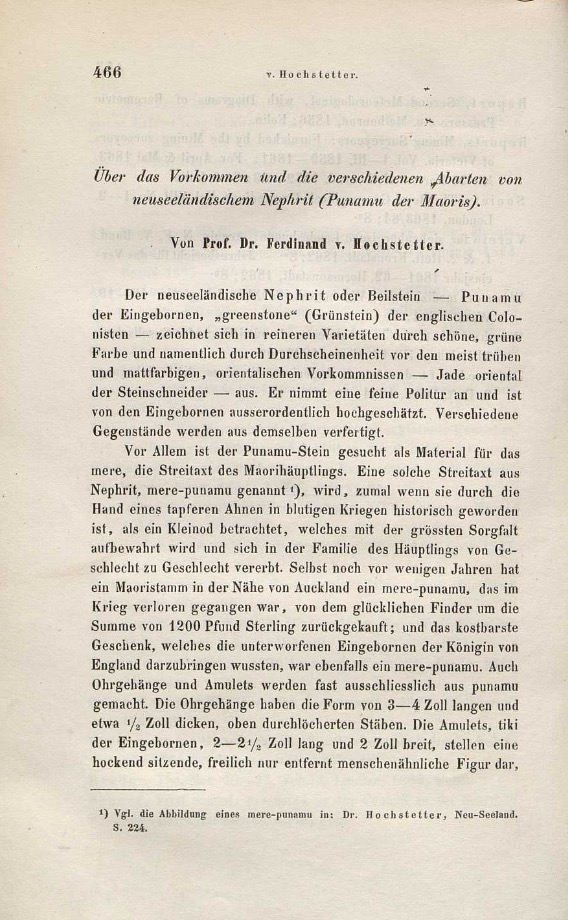
Hochstetter, F., von (1864) Über das Vorkommen und die verschiedenen Abarten von neuseeländischem Nephrit (Punamu der Maoris). [On the occurrence and various varieties of New Zealand nephrite (pounamu of the Maoris)]Sitzungsberichte der Kaiserlichen Akademie der Wissenschaften. Mathematisch-Naturwissenschaftliche Classe, Vol. 49, 12 May, pp. 466–480.
Record No. 7456 | Sinkankas/Born No.: 2969; NIB | Language: in German | RWHL
Reference copied to clipboard!
gems, jade, amphibole jade, nephrite, New Zealand, punamu, Maori, Fischer-Book
Hochstetter examines the occurrence, varieties, physical properties, and Māori use of New Zealand nephrite, or pounamu, drawing on specimens and observations obtained during his exploration of New Zealand. He discusses the principal localities from which the material was obtained, particularly on the South Island, and distinguishes varieties according to differences in color, translucency, texture, and appearance. The paper describes the exceptional toughness of nephrite and its manufacture by Māori into tools, weapons, and ornaments, including mere and hei-tiki, and considers traditional methods of working the difficult material. Hochstetter also compares New Zealand nephrite with similar materials from other parts of the world and discusses its mineralogical identity and geological occurrence. The study is an important early scientific account of New Zealand pounamu, combining mineralogical observations with information on its sources and cultural use by Māori.
Catalog of mineral species and their varieties found in Mexico
Book
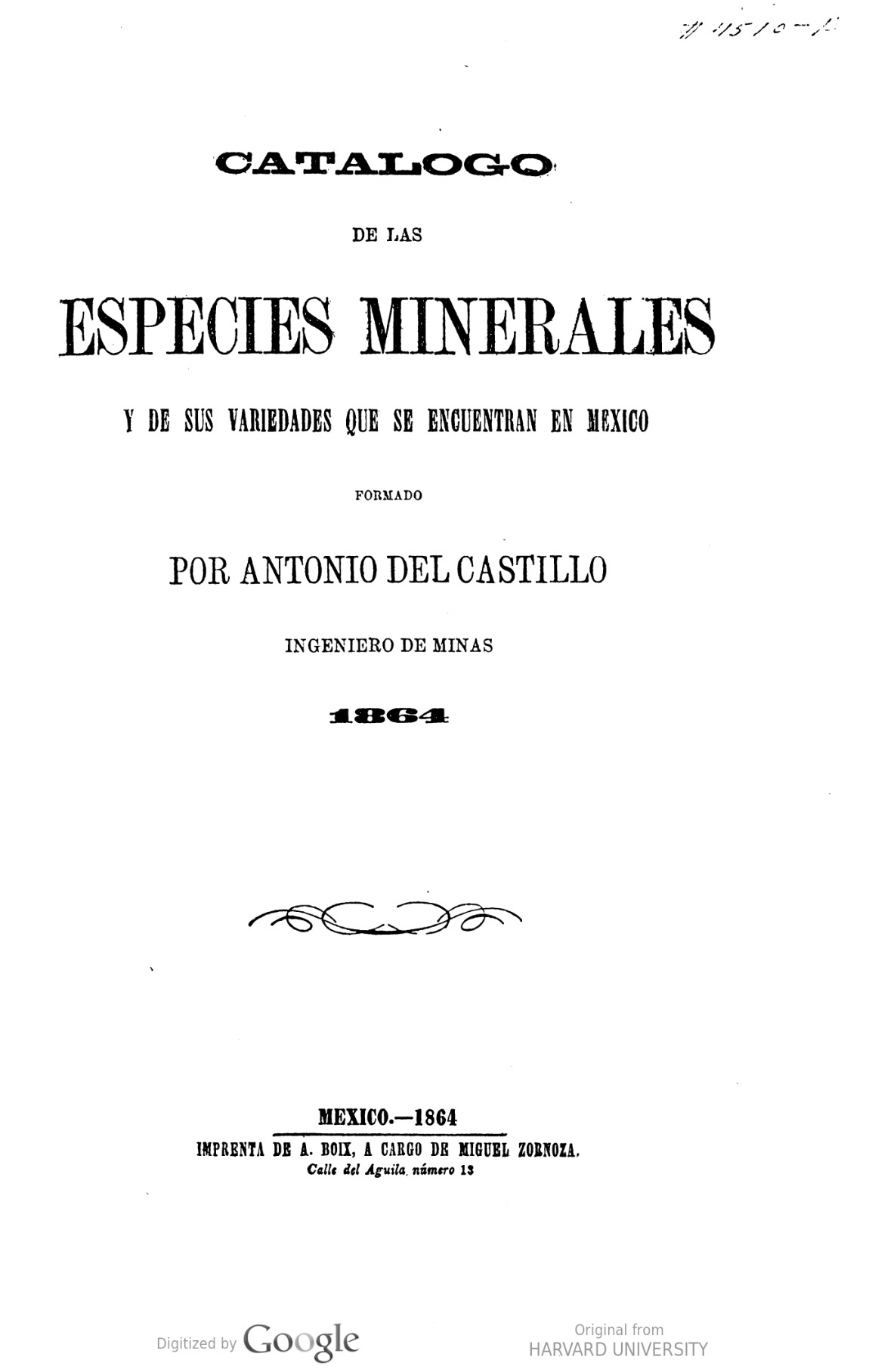
del Castillo, A. (1864)Catálogo de las especies minerales y de sus variedades que se encuentran en México. [Catalog of mineral species and their varieties found in Mexico] México, A. Boix, 9 pp.
Record No. 7355 | Sinkankas/Born No.: NIS/NIB | Language: in Spanish | RWHL
Reference copied to clipboard!
gems, jade, Fischer-Book
Del Castillo provides a concise catalogue of the mineral species and varieties then known to occur in Mexico, assembling information on their identification and geographical distribution from specimens, earlier literature, and contemporary mineralogical investigations. Despite its brevity, the work represents an early attempt to inventory Mexico’s mineral resources according to systematic mineralogical nomenclature rather than merely their economic uses. Of gemological interest are occurrences of precious and ornamental materials among the minerals listed, providing evidence for the state of knowledge of Mexican gem and lapidary resources in the mid-nineteenth century. The catalogue is an early contribution by Antonio del Castillo, who later became one of Mexico’s leading geologists and mineralogists, and is useful for tracing the development of systematic mineralogy and mineral-resource documentation in Mexico.
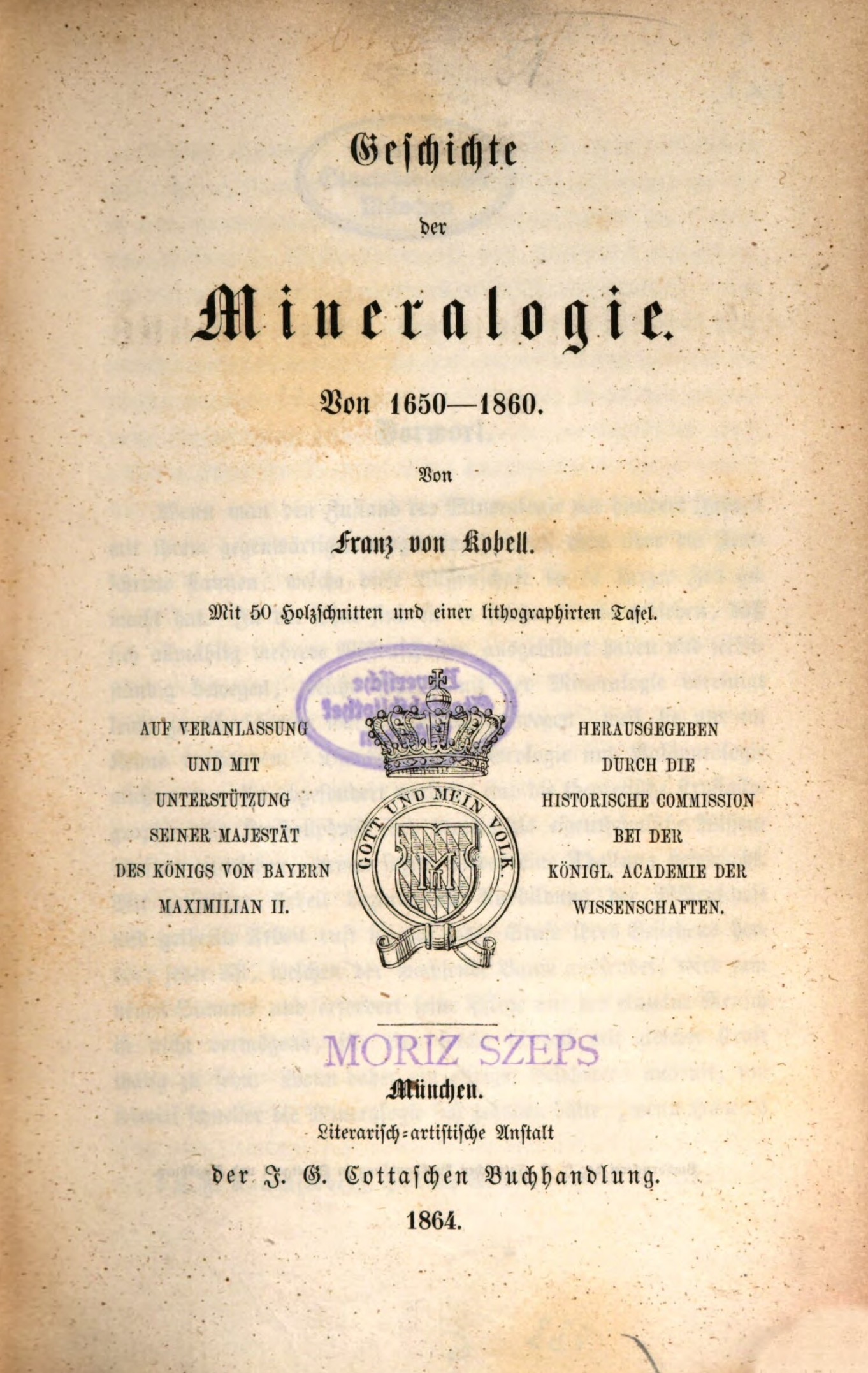
Kobell, F., von (1864)Geschichte der Mineralogie 1650–1860. [History of Mineralogy 1650–1860] Munich, J.G. Cottaschen Buchhandlung, 703 pp. (see p. 509)
Record No. 6901 | Sinkankas/Born No.: NIS/NIB | Language: in German | RWHL
Reference copied to clipboard!
gems, jade, Fischer-Book, history of mineralogy
Kobell’s Geschichte der Mineralogie von 1650–1860 is a major nineteenth-century history of mineralogy, tracing the development of the science over two centuries through advances in crystallography, mineral physics, chemistry, classification, and the recognition of individual mineral species. Kobell discusses the contributions of leading mineralogists and chemists and shows the transition from descriptive mineralogy to increasingly quantitative methods based on crystallographic measurement, chemical analysis, specific gravity, and optical properties. The second major portion of the book treats the historical development and identification of individual mineral species, including numerous precious and ornamental stones. Of particular relevance to jade studies, p. 509 discusses jade and related materials within the contemporary mineralogical debate over their identity and classification. The work is especially valuable for documenting nineteenth-century mineral nomenclature and changing concepts of mineral species and provides a contemporary perspective on the development of scientific mineralogy up to 1860. The original edition comprises xvi + 703 pp., with 50 woodcuts and one lithographic plate.
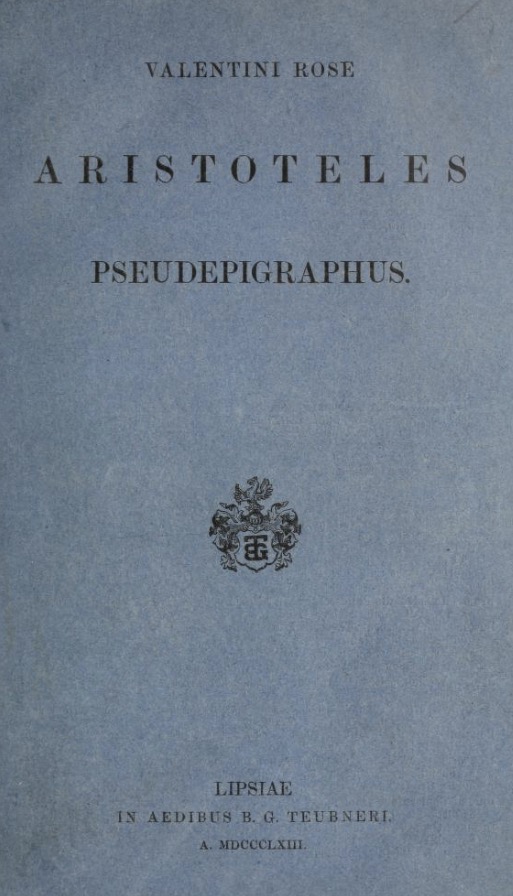
Aristotle and Rose, V. (1863)Aristoteles Pseudepigraphus. [Aristotle the Pseudepigrapher] Lipsiae, B.G. Teubneri, 728 pp.
Record No. 8116 | Sinkankas/Born No.: NIS/NIB | Language: Ancient Greek, Latin | RWHL
Reference copied to clipboard!
gems, jade, Fischer-Book
Rose’s Aristoteles Pseudepigraphus is a critical study and collection of works falsely or doubtfully attributed to Aristotle, examining the extensive pseudepigraphic tradition that developed around his name in antiquity and the Middle Ages. Drawing on Greek, Latin, Arabic, and other textual traditions, Rose identifies, describes, and compares writings on natural philosophy, medicine, astrology, magic, alchemy, physiognomy, and related subjects that circulated under Aristotle’s authority. Of particular relevance to the history of gems are the pseudo-Aristotelian lapidary traditions, in which precious stones are described according to their physical characteristics and supposed medicinal, magical, astrological, and talismanic powers. The work is especially useful for tracing the textual history and attribution of the influential Lapidary of Aristotle and related works transmitted through Arabic and medieval European literature. Rather than a work by Aristotle, the volume is Victor Rose’s nineteenth-century scholarly investigation of the large body of pseudonymous literature associated with his name.
Manné-er-Hroek. Dolmen discovered beneath a tumulus at Locmariaquer
Journal Article
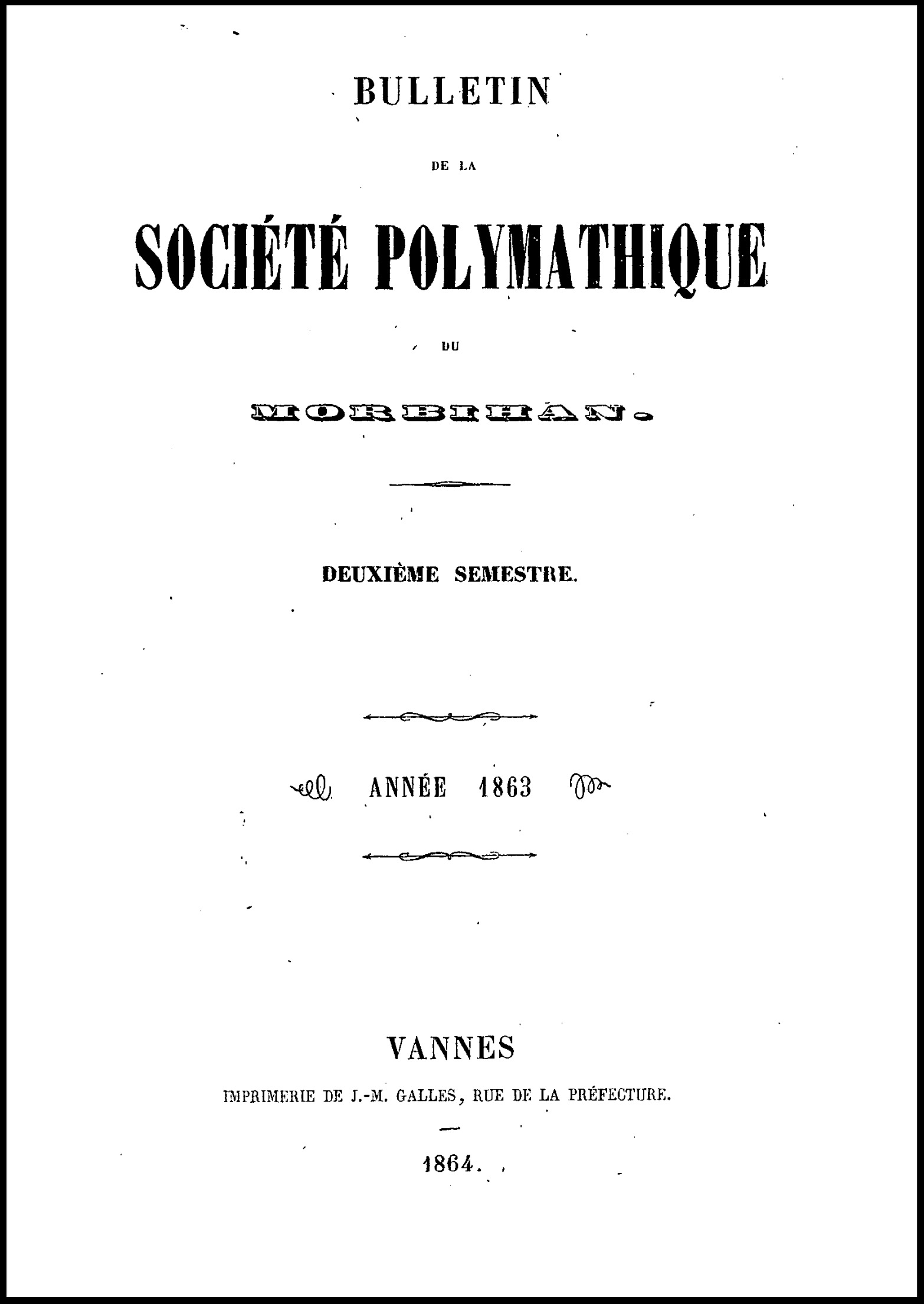
Galles, R. (1863) Manné-er-Hroek. Dolmen découvert sous un tumulus à Locmariaquer. [Manné-er-Hroek. Dolmen discovered beneath a tumulus at Locmariaquer]Société polymathique du Morbihan, Second Semester, pp. 18–33, 2 plates.
Record No. 8109 | Sinkankas/Born No.: NIS/NIB | Language: in French | RWHL
Reference copied to clipboard!
gems, jade, Fischer-Book
Galles describes the excavation of the Mané-er-Hroëk megalithic tomb at Locmariaquer in Brittany, discovered beneath a large tumulus and containing an unusually rich assemblage of prehistoric objects. He details the structure of the monument and the artifacts recovered from it, including numerous polished stone axes and ornaments. Of particular importance to jade studies are several exceptionally fine greenstone axes, some fashioned from jadeite and related hard stones, whose exotic appearance and mineralogical character later became central to the nineteenth-century European “jade question.” The discovery provided secure archaeological evidence that such materials had been used for prestigious objects in Neolithic Brittany and stimulated debate over whether their raw material came from unknown European sources or had reached western Europe through long-distance exchange. The paper is therefore an important early archaeological source for prehistoric European jade artifacts and their archaeological context.
Hochstetter, F., von and Petermann, A. (1863)Geologisch topographischer Atlas von Neu-Seeland. [Geological topographic atlas of New Zealand] Gotha, Justus Perthes, 20 pp. + maps
Record No. 7459 | Sinkankas/Born No.: NIS/NIB | Language: in German | RWHL
Reference copied to clipboard!
gems, jade, Fischer-Book, New Zealand
Hochstetter and Petermann’s atlas presents an early systematic cartographic synthesis of the geology and physical geography of New Zealand, based principally on Ferdinand von Hochstetter’s geological investigations during the Austrian Novara expedition and supplemented by contemporary geographical information. Its maps depict geological formations, topography, volcanic districts, mineral occurrences, and other physical features, accompanied by explanatory text. Of particular relevance to jade studies is its treatment of the geology and mineral resources of the South Island and the regions associated with Māori pounamu or greenstone. The atlas helped place New Zealand nephrite occurrences within a geological and geographical framework and provided European researchers with important information for discussions of the origin and distribution of pounamu. It is a significant early contribution to New Zealand geological cartography and to nineteenth-century attempts to relate indigenous greenstone sources to regional geology.
Hector, J. (1863) Geological Expedition to the West Coast of Otago, New Zealand.Otago Provincial Government Gazette, Vol. 6, No. 274, pp. 435–478.
Record No. 7458 | Sinkankas/Born No.: NIS/NIB | RWHL
Reference copied to clipboard!
gems, jade, amphibole jade, nephrite, New Zealand, punamu, Fischer-Book
Hector reports on a geological expedition to the largely unexplored west coast of Otago, New Zealand, describing the region’s geography, geology, mineral resources, rivers, and routes of travel. Of particular importance to jade studies are his observations on pounamu or New Zealand greenstone, including its geological occurrence and the areas from which Māori obtained material for implements and ornaments. Hector sought to relate the traditional greenstone localities to the geology of the Southern Alps and West Coast river systems, helping to establish a geological basis for understanding the origin of New Zealand nephrite. The report is an important early scientific source on pounamu, complementing contemporary Māori knowledge and travelers’ accounts, and contributed to nineteenth-century investigations of the composition, provenance, and distribution of New Zealand jade.
On the testing of minerals for their water content
Journal Article
Fischer, H. (1862) Ueber die Prüfung. der. Mineralien auf ihren Wassergehalt. [On the testing of minerals for their water content]Berichte über die Verhandlungen der naturforschenden Gesellschaft zu Freiburg, No. 25, pp. 400–402.
Record No. 10933 | Sinkankas/Born No.: NIS/NIB | Language: in German | RWHL
Reference copied to clipboard!
gems, jade, Fischer-Book
Fischer discusses methods for testing minerals for the presence of water, particularly the water released when specimens are heated. He considers the practical difficulties of distinguishing structurally or chemically bound water from moisture and describes procedures for detecting the small quantities evolved from mineral samples. The note reflects the increasing importance of chemical and blowpipe tests in nineteenth-century mineral identification and analysis. Of relevance to gemology and Fischer’s later research on jade and prehistoric stone implements, determination of water content provided an additional means of characterizing minerals and distinguishing superficially similar substances. The paper is a brief contribution to analytical mineralogy rather than a study devoted specifically to gemstones.
Catalogue of a Collection of Ancient and Modern Stone Implements, and of other Weapons, Tools, and Utensils of the Aborigines of Various Countries in the Possession of Henry Christy, F.G.S., F.L.S., &c.
Book
Christy, H. (1862)Catalogue of a Collection of Ancient and Modern Stone Implements, and of other Weapons, Tools, and Utensils of the Aborigines of Various Countries in the Possession of Henry Christy, F.G.S., F.L.S., &c. London, privately printed, 76 pp.
Record No. 7936 | Sinkankas/Born No.: NIS/NIB | RWHL
Reference copied to clipboard!
gems, jade, Fischer-Book
Christy catalogues his important private collection of ancient and ethnographic stone implements, weapons, tools, and utensils from Europe, the Americas, Oceania, Asia, and other regions. The collection was assembled comparatively, placing prehistoric European artifacts alongside implements then still used by indigenous peoples in order to investigate their manufacture, function, and cultural significance. Of particular relevance to jade studies are polished axes, adzes, ornaments, and other objects fashioned from hard green stones, including materials described at the time as jade, nephrite, or related rocks. Christy’s collection and catalogue became important sources in the developing nineteenth-century debate over the identification and geographical origin of jade implements and the possibility of prehistoric long-distance exchange. Following Christy’s death, his collections became a major component of the British Museum’s ethnographic holdings, making this catalogue an important record of their early provenance and classification.
Exploring the Literature of Jade
Jade literature spans gemology, mineralogy, archaeology, art history, mining, carving and connoisseurship, and includes works on both jadeite and nephrite from around the world.
Four Treasures is Lotus Gemology's freely accessible gemological reference database. Use the full database to search by author, title or keyword and explore literature on gemology, mineralogy, jewelry and related fields. Where available, hyperlinks on titles may lead directly to the full publication.