Jade Bibliography

Jade Bibliography

Explore books, articles and historical sources on jade in Four Treasures, the Lotus Gemology reference database. This bibliography brings together matching records from the collection, with publication details, abstracts and cover images where available.

Jade References

The list below matches the terms jade, jadeite, nephrite or Fei Cui in the database's searchable fields. Some references discuss these materials as part of a broader subject.
3,121–3,140 of 3,817 matching references

Nouveau cours de minéralogie, comprenant la description de toutes les espèces minérales avec leurs applications directes aux arts
New mineralogy course, including the description of all mineral species with their direct applications to the arts
Book
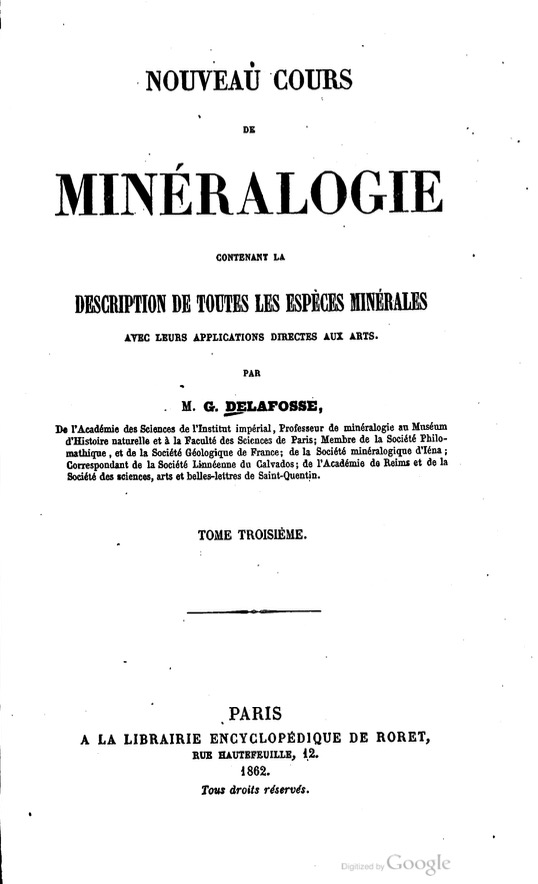
Delafosse, G. (1862) Nouveau cours de minéralogie, comprenant la description de toutes les espèces minérales avec leurs applications directes aux arts. [New mineralogy course, including the description of all mineral species with their direct applications to the arts] Paris, Roret, 3 Vols., 628 pp. (see Vol. 3, p. 428).
Record No. 7462  |  Sinkankas/Born No.: NIS/NIB  |  Language: in French  |  RWHL
Delafosse presents a comprehensive course in mineralogy covering the physical, crystallographic, chemical, and practical characteristics of the mineral species recognized in the mid-nineteenth century, with particular attention to their identification, classification, occurrence, and applications in the arts and industry. Minerals are described according to properties such as crystalline form, hardness, specific gravity, cleavage, color, luster, transparency, and chemical composition, together with information on important localities and uses. The work includes descriptions of precious and ornamental stones and thus provides a useful contemporary account of the mineralogical understanding and classification of gem materials.

Report on the Trade and Resources of the Countries on the North-western Boundary of British India
Book
Montgomery, R. and Davies, R.H. (1862) Report on the Trade and Resources of the Countries on the North-western Boundary of British India. Lahore, Printed at the Government Press, 377 pp. (see pp. 239–240).
Record No. 7460  |  Sinkankas/Born No.: NIS/NIB  |  RWHL
Montgomery and Davies compile official information on the commerce, communications, products, and economic resources of the territories lying beyond the north-western frontier of British India, including Afghanistan, Kashmir, the Punjab frontier regions, and the trade routes leading toward Central Asia. Based largely on reports from political officers, merchants, travellers, and local informants, the volume describes principal markets, caravan routes, imports and exports, duties, currencies, and commodities moving between India, Afghanistan, Turkistan, Persia, and adjoining regions. Of particular gemological importance are references to precious stones and mineral products entering these trading networks, including the celebrated rubies or “Balas rubies” of Badakhshan, lapis lazuli, turquoise, and other valuable materials. The report is a useful primary source for reconstructing the mid-nineteenth-century Central Asian gem trade and the routes by which stones from Afghanistan and the Pamir-Badakhshan region reached the markets of British India.

Le Lapidaire du Quatorzième Siècle

The Lapidary of the Fourteenth Century
Book
Sotto, I., del (1862) Le Lapidaire du Quatorzième Siècle. [The Lapidary of the Fourteenth Century] Vienna, Impremerie Impériale et Royale de la Cour et de l’État, 215 pp.
Record No. 5193  |  Sinkankas/Born No.: 6254; NIB  |  Language: in French  |  RWHL
Del Sotto publishes and studies a fourteenth-century French lapidary, providing a nineteenth-century edition of a medieval text devoted to precious stones and the properties traditionally attributed to them. The lapidary describes numerous stones, their names, appearance, supposed geographical origins, and methods of recognition, together with the medicinal, protective, magical, and astrological virtues they were believed to possess. As was characteristic of medieval lapidary literature, empirical observations concerning minerals are interwoven with traditions inherited from classical, biblical, Arabic, and earlier medieval authorities. The volume is particularly valuable for the history of gemology because it preserves medieval gemstone nomenclature and beliefs and illustrates how precious stones were understood before the development of modern mineralogical classification. Del Sotto’s edition also provides a useful philological source for tracing the transmission and changing meanings of European gemstone names.

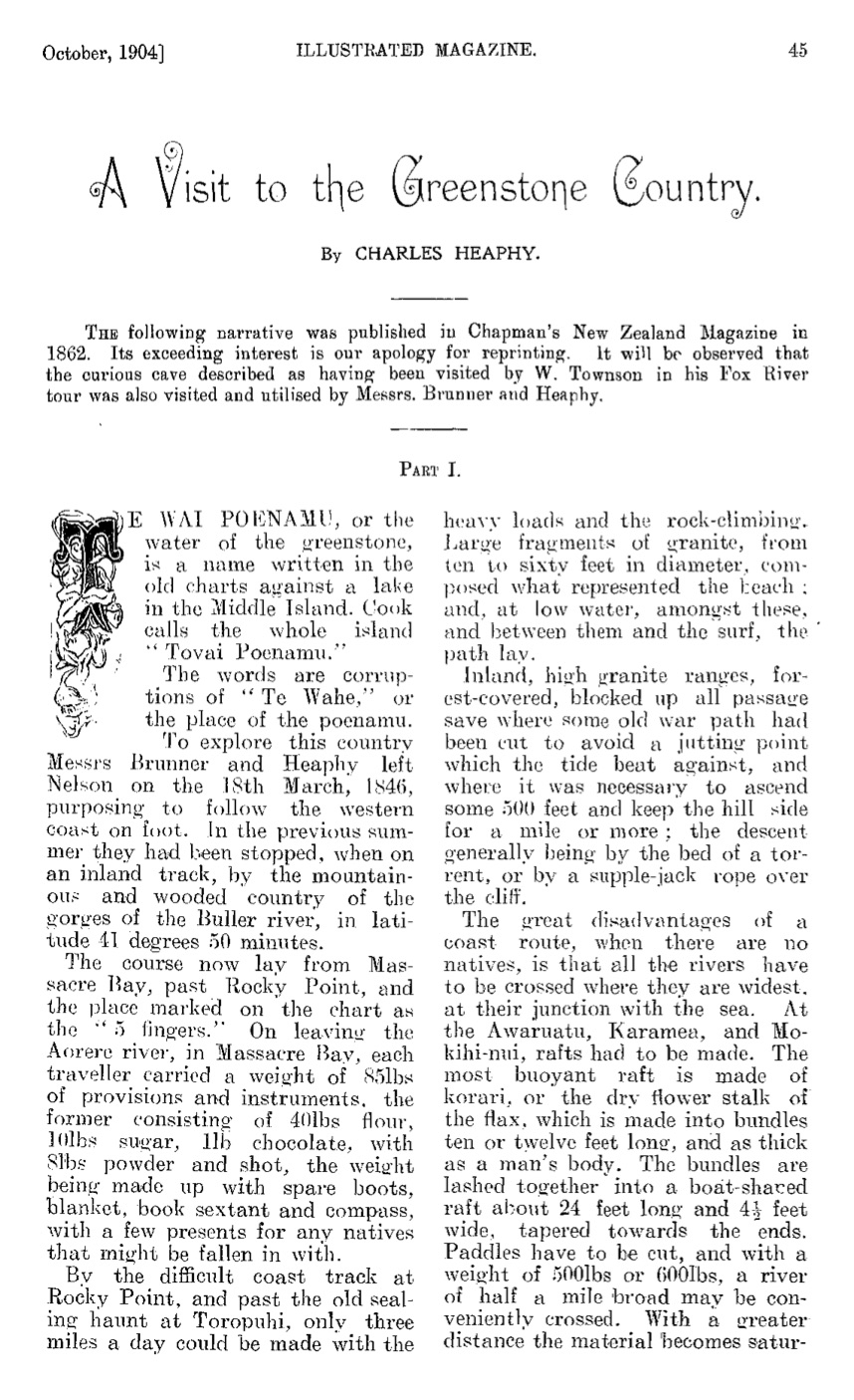
A visit to the greenstone country

Journal Article
Heaphy, C. (1862) A visit to the greenstone country. Chapman’s New Zealand Monthly Magazine, Vol. 24, October, pp. 107–111; November, pp. 166–171,
Record No. 2259  |  Sinkankas/Born No.: NIS/NIB  |  RWHL
Heaphy recounts a journey to the pounamu or greenstone-producing region of New Zealand’s South Island, describing the landscape, Māori communities, travel routes, and the occurrence and collection of the highly valued stone. He records Māori knowledge of greenstone localities and the methods used to obtain and work the material, as well as its importance for implements and ornaments. The account is particularly valuable for the history of nephrite because it provides an early firsthand description of New Zealand pounamu in its indigenous geographical and cultural setting, before its sources had been investigated systematically by geologists. Heaphy’s observations document the close relationship between particular greenstone sources, Māori exchange networks, and the manufacture of prized objects such as mere and hei-tiki, making the paper an important early source on the natural occurrence and traditional use of New Zealand jade.

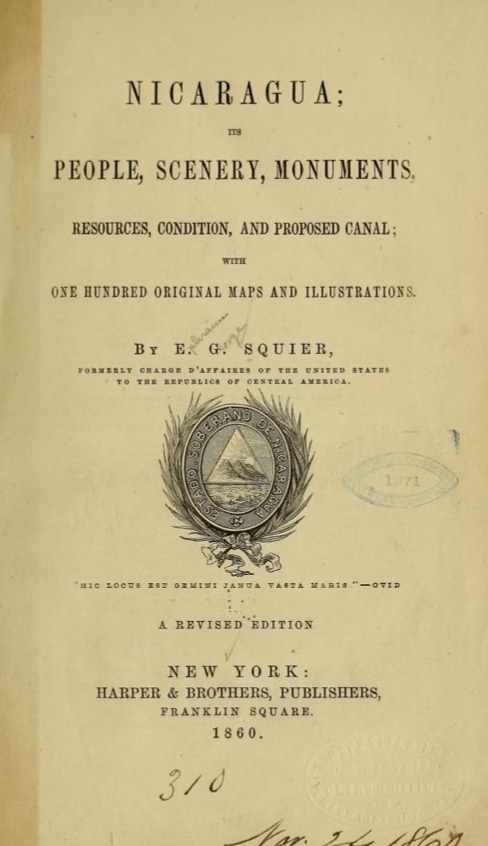
Nicaragua: Its People, Scenery, Monuments, Resources, Condition, and Proposed Canal
Book
Squirer, E.G. (1860) Nicaragua: Its People, Scenery, Monuments, Resources, Condition, and Proposed Canal. New York, Harper & Bros., 691 pp.
Record No. 16715  |  Sinkankas/Born No.: NIS/NIB  |  RWHL
This revised and expanded account of Nicaragua by American diplomat and archaeologist Ephraim George Squier describes the country’s geography, peoples, natural resources, antiquities, economy, political condition, and prospects for an inter-oceanic canal. Drawing on Squier’s travels and diplomatic service in Central America, it includes extensive observations on indigenous cultures and archaeological remains, with descriptions and illustrations of monuments, sculptures, pottery, stone implements, and personal ornaments. Of particular relevance to gemological and jade studies are references to pre-Columbian objects fashioned from valued green stones and other lapidary materials, as well as observations on Nicaragua’s mineral resources and indigenous use of stone. The volume is also important for documenting nineteenth-century interpretations of Central American antiquities before the development of modern archaeological methods. As a substantially revised, single-volume successor to Squier’s 1852 Nicaragua: Its People, Scenery, Monuments, and the Proposed Inter-oceanic Canal, it provides a useful early source for the archaeology, mineral resources, and material culture of Nicaragua.

Handbuch der Mineralchemie

Handbook of Mineral Chemistry
Book
Rammelsberg, C.F. (1860) Handbuch der Mineralchemie. [Handbook of Mineral Chemistry] Leipzig, Wilhelm Engelmann, 1039 pp. (nephrite see p. 777).
Record No. 8147  |  Sinkankas/Born No.: NIS/NIB  |  Language: in German  |  RWHL
Rammelsberg’s Handbuch der Mineralchemie is a comprehensive synthesis of mid-nineteenth-century knowledge of the chemical composition of minerals, assembling and critically comparing a large body of analytical data from his own investigations and those of other chemists and mineralogists. Minerals are treated systematically with their chemical formulas, analytical results, compositional variations, and relationships to allied species, linking chemical evidence with contemporary mineralogical classification. Numerous gem materials are included, among them diamond, corundum, spinel, chrysoberyl, beryl, topaz, tourmaline, garnet, zircon, quartz, and feldspar, as well as jade-related and other ornamental stones. The work is particularly valuable for tracing historical ideas about mineral composition and species identity at a time when increasingly accurate chemical analysis was transforming mineral classification. It represents an important reference for the development of mineral chemistry and for the nineteenth-century chemical characterization of gemstones.

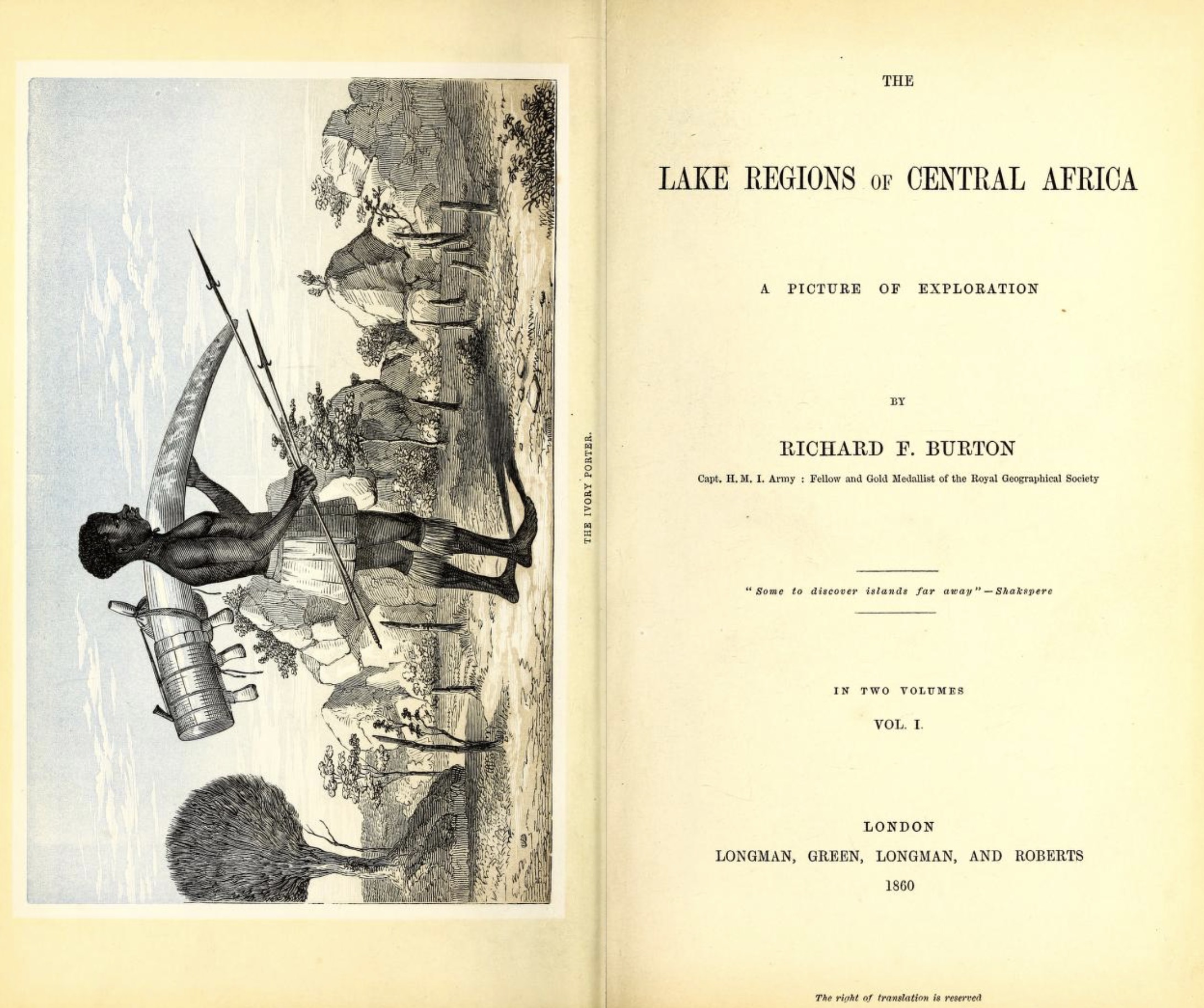
The Lake Regions of Central Africa

Book
Burton, R.F. (1860) The Lake Regions of Central Africa. New York, Harper & Bros., 572 pp.
Record No. 7950  |  Sinkankas/Born No.: NIS/NIB  |  RWHL
Burton recounts the East African expedition of 1857–1859 undertaken with John Hanning Speke, during which Europeans first documented Lake Tanganyika and gathered information on the interior of eastern and central Africa. He describes the routes from the Zanzibar coast through present-day Tanzania, the geography and peoples encountered, political conditions, natural history, and the extensive caravan trade linking the African interior with the Indian Ocean. Of particular relevance to gemological and mineralogical history are observations on mineral resources, ornaments, beads, and other valued materials employed in local and long-distance trade. Burton gives especially detailed attention to the commercial importance of beads as currency and barter goods, recording their varieties, colors, names, relative values, and differing regional preferences. The work provides valuable evidence for nineteenth-century East African trade networks and the role played by beads, ornaments, metals, ivory, and other prestige materials in exchanges between coastal merchants and communities of the interior.

Ricerche critico-bibliographiche intorno alla Storia naturale del Messico di Fr. Hernandez esposta in dieci libri dat N.A. Recchi ed illustrata dagli accademici Lincei
Critical-bibliographical research around the Natural History of Mexico by Fr. Hernandez exhibited in ten books dat N.A. Recchi and illustrated by Lincei academics
Journal Article
Proja, S. (1860) Ricerche critico-bibliographiche intorno alla Storia naturale del Messico di Fr. Hernandez esposta in dieci libri dat N.A. Recchi ed illustrata dagli accademici Lincei. [Critical-bibliographical research around the Natural History of Mexico by Fr. Hernandez exhibited in ten books dat N.A. Recchi and illustrated by Lincei academics] Atti Dell’ Accademia Pontificia de’ Nuovi Lincei, pp. 441–477.
Record No. 7356  |  Sinkankas/Born No.: NIS/NIB  |  Language: In Italian  |  RWHL
Proja presents a critical and bibliographical study of Francisco Hernández’s Natural History of Mexico and of the complex history by which Hernández’s sixteenth-century investigations were edited by Nardo Antonio Recchi and subsequently published and augmented by members of the Accademia dei Lincei. He examines the surviving manuscripts, editions, editorial interventions, and circumstances surrounding the preparation of the celebrated 1651 Rerum medicarum Novae Hispaniae thesaurus, attempting to distinguish Hernández’s original material from the contributions of Recchi and the Lincean scholars. The study is valuable for establishing the textual history and transmission of one of the earliest major European scientific accounts of the natural products of New Spain. Of gemological relevance, Hernández’s work included Mexican minerals and stones alongside its much more extensive treatment of plants and animals; Proja’s bibliographical analysis therefore helps establish the provenance and authority of early European descriptions of indigenous Mexican mineral materials.

Expeditions into the Valley of the Amazons, 1539, 1540, 1639
Book
Markham, C.R. (1859) Expeditions into the Valley of the Amazons, 1539, 1540, 1639. London, Hakluyt Society, 190 pp.
Record No. 16568  |  Sinkankas/Born No.: NIS/NIB  |  RWHL
Markham brings together English translations of early Spanish accounts of expeditions into the Amazon basin, principally those associated with Gonzalo Pizarro and Francisco de Orellana in 1539–1542 and Pedro Teixeira’s voyage of 1637–1639. The narratives describe journeys through the Andes and along the Amazon, encounters with Indigenous peoples, settlements, warfare, food and natural resources, geography, rivers, and the difficulties faced by the expeditions. Of particular historical interest is the account of Orellana’s descent of the Amazon and the reported encounter with female warriors that contributed to the river becoming known to Europeans as the River of the Amazons. The volume provides important early testimony concerning European exploration and perceptions of the Amazon basin, although many descriptions reflect the assumptions and uncertainties of sixteenth- and seventeenth-century observers.

Anthropologie der Naturvölker

Anthropology of Indigenous Peoples
Book
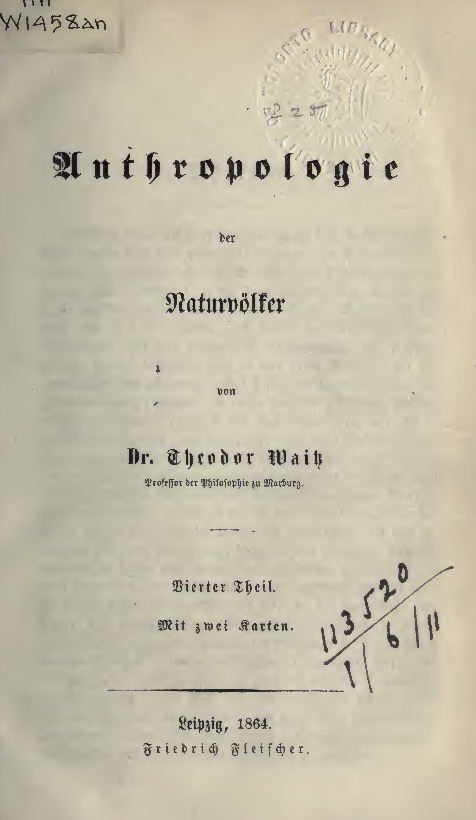
Waitz, T. (1859–1872) Anthropologie der Naturvölker. [Anthropology of Indigenous Peoples] Leipzig, Fleischer, 6 Vols. (see Vol. 4, pp. 28, 180–186).
Record No. 7987  |  Sinkankas/Born No.: NIS/NIB  |  Language: in German  |  RWHL
Waitz’s Anthropologie der Naturvölker is an ambitious six-volume comparative study of the peoples and cultures of the world, combining physical anthropology, ethnography, linguistics, history, religion, and material culture. The series appeared between 1859 and 1872; after Waitz’s death in 1864 it was continued by Georg Gerland. Volumes 3–4, Die Amerikaner (1862–1864), are devoted to the indigenous peoples of the Americas, with Volume 4 treating Mexico, Central America, the Chibcha region, and Peru. Of particular relevance to gemological and jade studies are Waitz’s accounts of Aztec and other Mesoamerican material culture, including precious objects, ornaments, stoneworking, metals, and valued green stones, assembled from early Spanish chronicles and nineteenth-century archaeological and ethnographic scholarship. The work is useful for tracing how indigenous American uses of precious and ornamental materials were understood in European scholarship during the formative period of scientific anthropology and archaeology.

Die Spuren der aztekifchen Sprache im nördlichen Mexico und höheren amerikanifchen Norden
The traces of the Aztec language in northern Mexico and higher American north
Journal Article
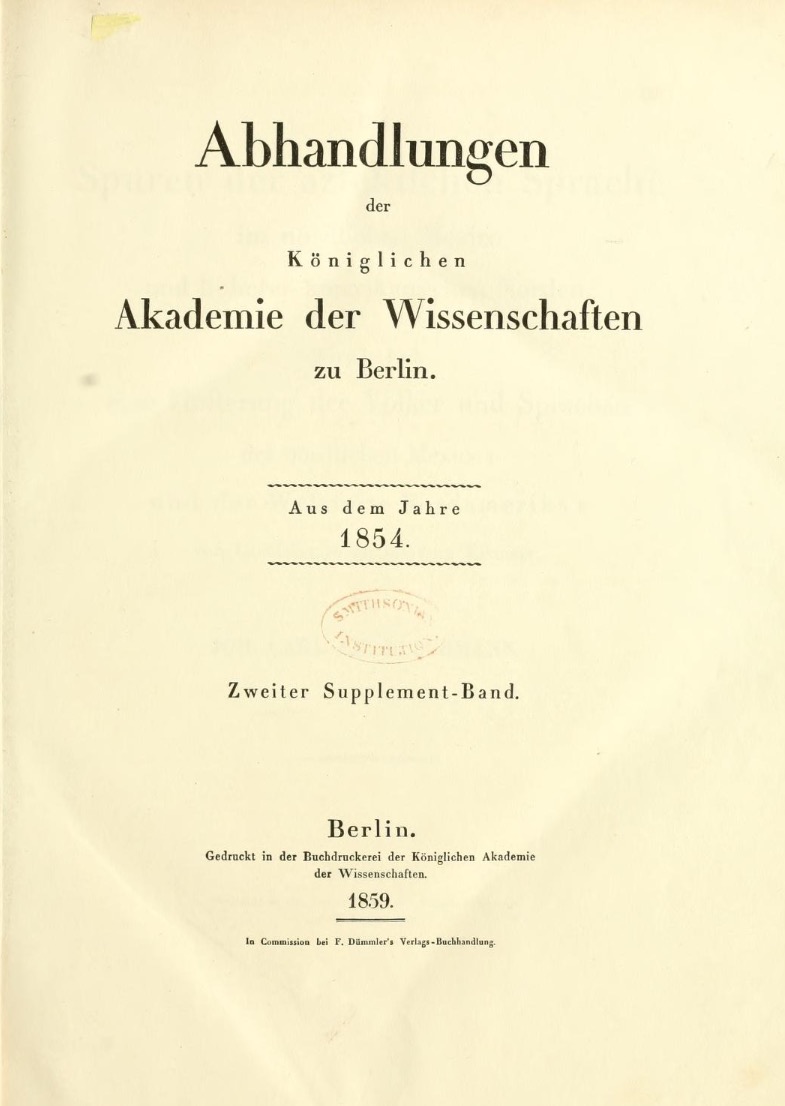
Buschmann, J.C.E. (1859) Die Spuren der aztekifchen Sprache im nördlichen Mexico und höheren amerikanifchen Norden. [The traces of the Aztec language in northern Mexico and higher American north] Abhandlungen der Königlichen Akademie der Wissenschaften zu Berlin, Vol. 1854, Supplement, 819 pp. (see p. 161).
Record No. 7469  |  Sinkankas/Born No.: NIS/NIB  |  Language: in German  |  RWHL
Buschmann presents an extensive comparative linguistic investigation of the geographical spread and relationships of Nahuatl (Aztec) and related languages, tracing linguistic evidence northward from central Mexico through northern Mexico and into the southwestern and western regions of North America. Using vocabularies, place names, early historical accounts, and comparative word lists, he attempts to identify relationships between Nahuatl and the languages of indigenous peoples farther north and to reconstruct patterns of migration and cultural contact. Of particular relevance to gemological history, p. 161 discusses terminology associated with chalchihuitl, the highly valued green or blue-green stone of the ancient Mexicans, in connection with indigenous mineral and color vocabulary. The work is valuable for the nineteenth-century history of attempts to interpret Nahuatl gemstone terminology and the geographical and linguistic distribution of terms associated with precious green stones.

Geschichte des Zeitalters der Entdeckungen
History of the Age of Discovery
Book
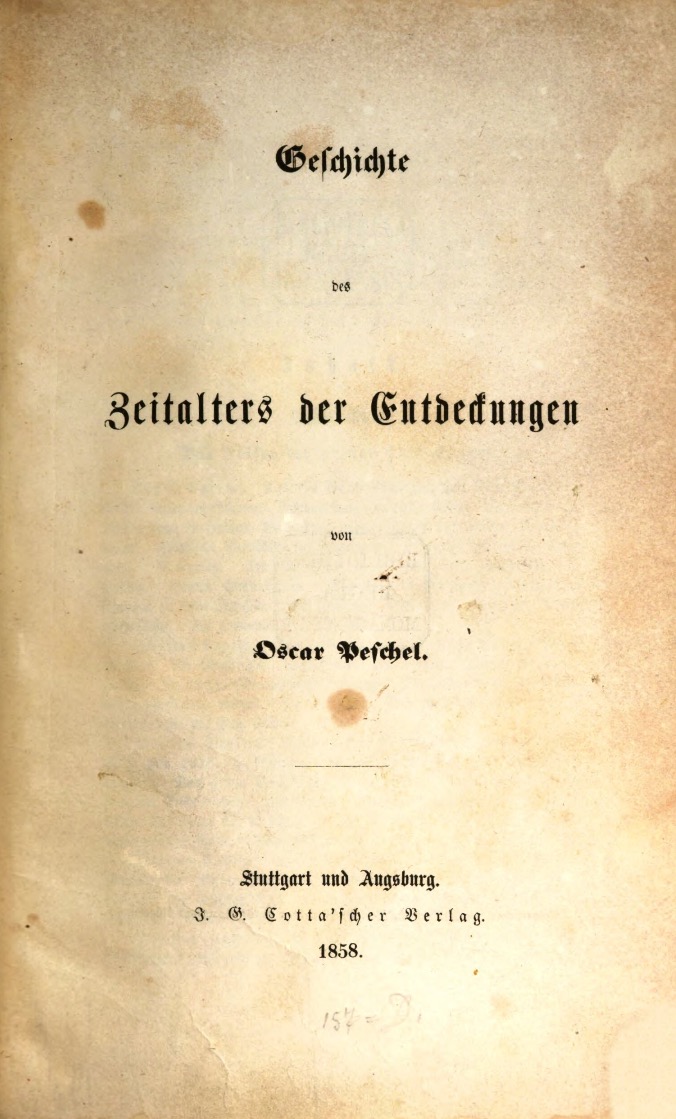
Peschel, O.F. (1858) Geschichte des Zeitalters der Entdeckungen. [History of the Age of Discovery] Stuttgart and Augsburg, 681 pp.
Record No. 10934  |  Sinkankas/Born No.: NIS/NIB  |  Language: in German  |  RWHL
Peschel presents a comprehensive history of the European age of geographical discovery, tracing the expansion of geographical knowledge from medieval exploration through the Portuguese voyages around Africa, Columbus and the discovery of the Americas, and subsequent Spanish and Portuguese exploration of the New World and Asia. Drawing critically on early travel narratives, chronicles, maps, and archival sources, he examines the motives, routes, achievements, and consequences of the principal voyages and the changing European conception of world geography. Of relevance to gemological history are discussions of the search for valuable commodities—including gold, pearls, precious stones, and other luxury products—which provided powerful incentives for exploration and shaped early European accounts of Africa, Asia, and the Americas. The work is particularly useful for placing early reports of gem resources and trade within the broader economic and geographical context of the Age of Discovery.

Traité Complet des Pierres Précieuses
Complete Treatise of Precious Stones
Book
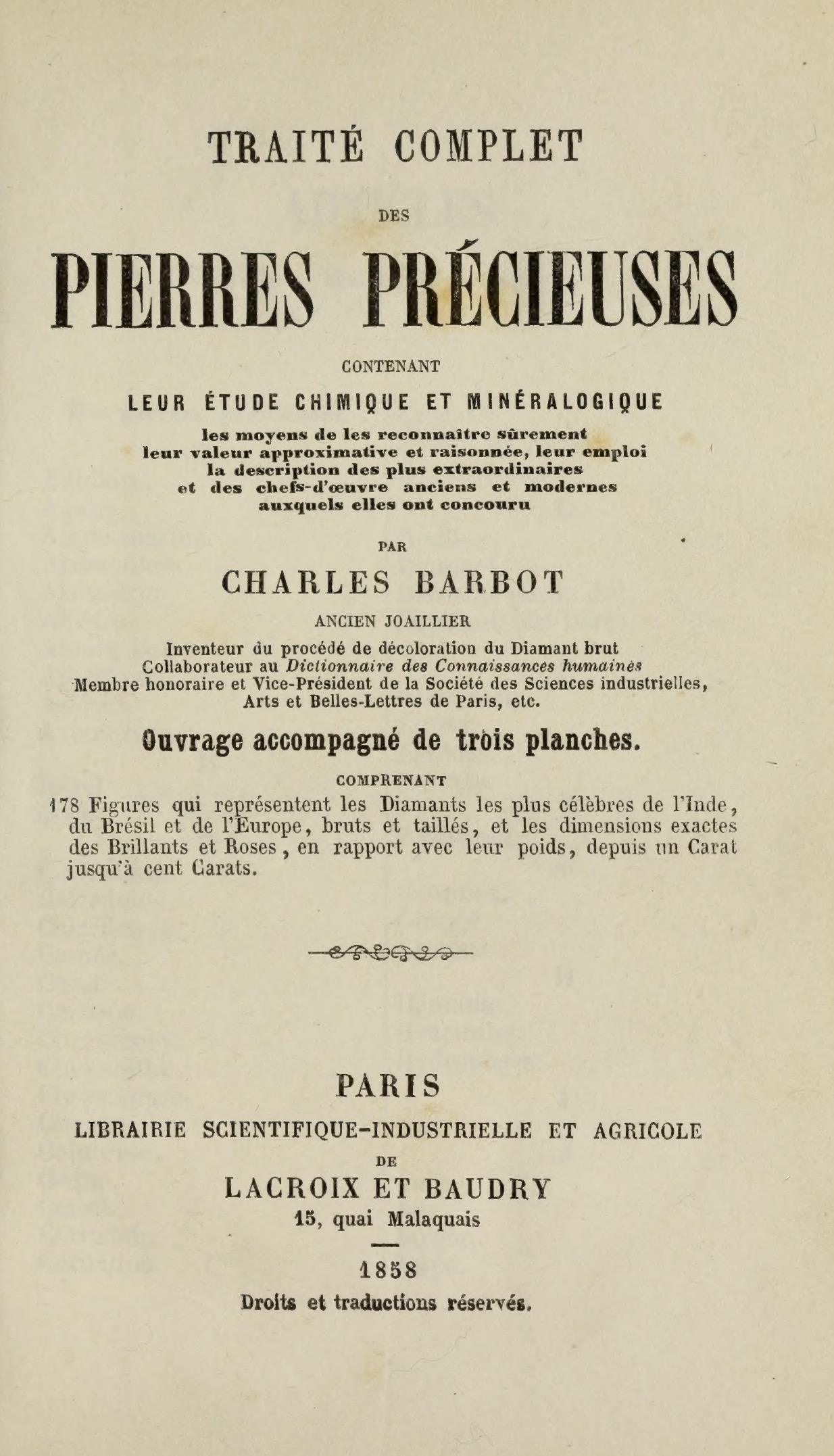
Barbot, C. (1858) Traité Complet des Pierres Précieuses. [Complete Treatise of Precious Stones] Paris, Morris et Compagnie, 567 pp., plates
Record No. 8067  |  Sinkankas/Born No.: 382–385  |  Language: in French  |  RWHL
Sinkankas: Essentially an encyclopedia of gemstones and technical terms connected with the jewelry trade presented in terse, informative language. There are 80 articles devoted to as many terms, including gemstone varieties as well as species, all in alphabetical order. Each gemstone article provides all essential data on properties, deposits, methods of cutting, uses, and specific retail prices as then current. The folding plates are of great interest and attractively and realistically drawn. The first depicts curiously-shaped rough diamond specimens as well as crystals but it is obvious that Barbot knew little about crystallography because several impossible crystal forms are shown, e.g., a pentagonal dodecahedron, and a 24-faced solid, classical geometrical solids not occurring in actual crystals. Also on this plate are sketches of lapidary apparatus and styles of brilliant and rose cuts. The second plate shows a large number of famous diamonds and the third plate gives several cutting styles of diamonds in addition to a graduated series of brilliants and rose cuts with corresponding carat weights. Noted in the title, Barbot’s “invention” of a diamond decolorizing process is only briefly discussed in vague terms (p. 229) with no details given except to say that heat and several strong chemicals are employed. Readers are encouraged to send in their stones for treatment and several pages are devoted to extolling the benefits to be expected.

Cabinet d’Antiquités Américaines à Copenhague: Rapport Ethnographique
Cabinet of American Antiquities in Copenhagen: Ethnographic Report
Book Section
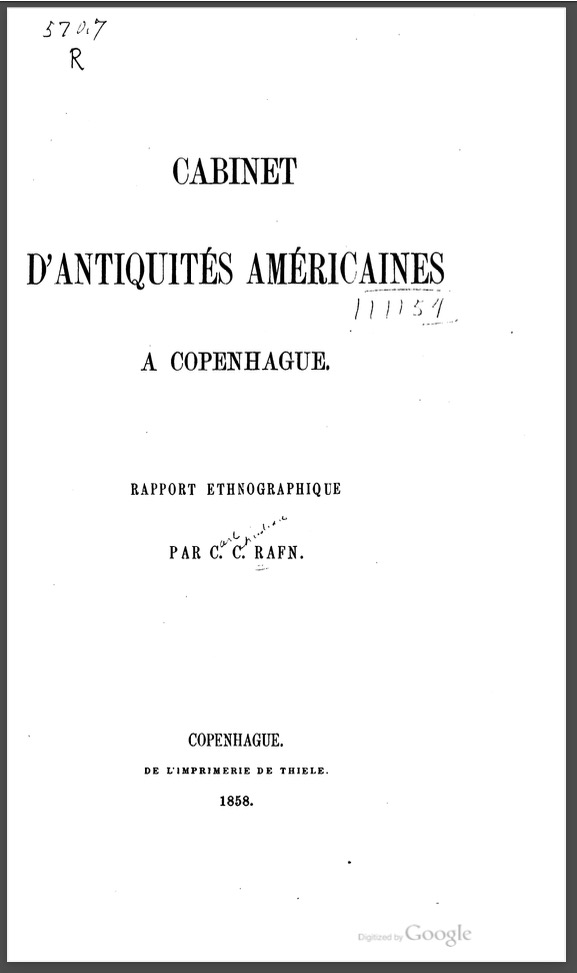
Rafn, C.C. (1858) Cabinet d’Antiquités Américaines à Copenhague: Rapport Ethnographique. [Cabinet of American Antiquities in Copenhagen: Ethnographic Report] In: Mémoires et de la Revue de la Société Royale des Antiquaires du Nord, Copenhagen: Thiele, unpaginated.
Record No. 7983  |  Sinkankas/Born No.: NIS/NIB  |  Language: in French  |  RWHL
Rafn describes the American antiquities preserved in the collections of the Royal Society of Northern Antiquaries in Copenhagen, presenting them as evidence for the archaeology and ethnography of the indigenous peoples of the Americas. The report discusses objects from several regions and cultural traditions, including implements, weapons, ornaments, and ceremonial objects manufactured from stone and other materials, with attention to their forms, uses, and geographical origins. Of particular relevance to gemological and jade studies are greenstone artifacts from the Americas and contemporary attempts to identify the materials from which such objects were fashioned. The report belongs to the early development of comparative American archaeology in Europe and is useful for documenting the provenance, terminology, and interpretation assigned to American stone artifacts in nineteenth-century museum collections.

Sztuka u Slowian

Art at the Slavs
Book
Kraszewski, J.I. (1858) Sztuka u Slowian. [Art at the Slavs] Wilna, 76 pp.
Record No. 7461  |  Sinkankas/Born No.: NIS/NIB  |  Language: in Polish  |  RWHL
Kraszewski’s Sztuka u Słowian examines the early art and material culture of the Slavic peoples, drawing on archaeological discoveries, historical sources, and comparative antiquarian studies. He discusses ornaments, weapons, vessels, sculpture, and objects of stone, metal, and other materials as evidence for the artistic development and everyday life of early Slavic communities. Particular attention is given to archaeological artifacts and their forms, decoration, manufacture, and possible cultural affiliations. Of relevance to mineralogical and prehistoric studies are polished stone implements and ornaments, including greenstone objects whose material and provenance became subjects of increasing archaeological interest during the nineteenth century. The work represents an early Polish contribution to the study of Slavic archaeology and material culture, at a time when archaeological classification and the identification of the raw materials used for prehistoric artifacts were still developing.

The States of Central America

Book
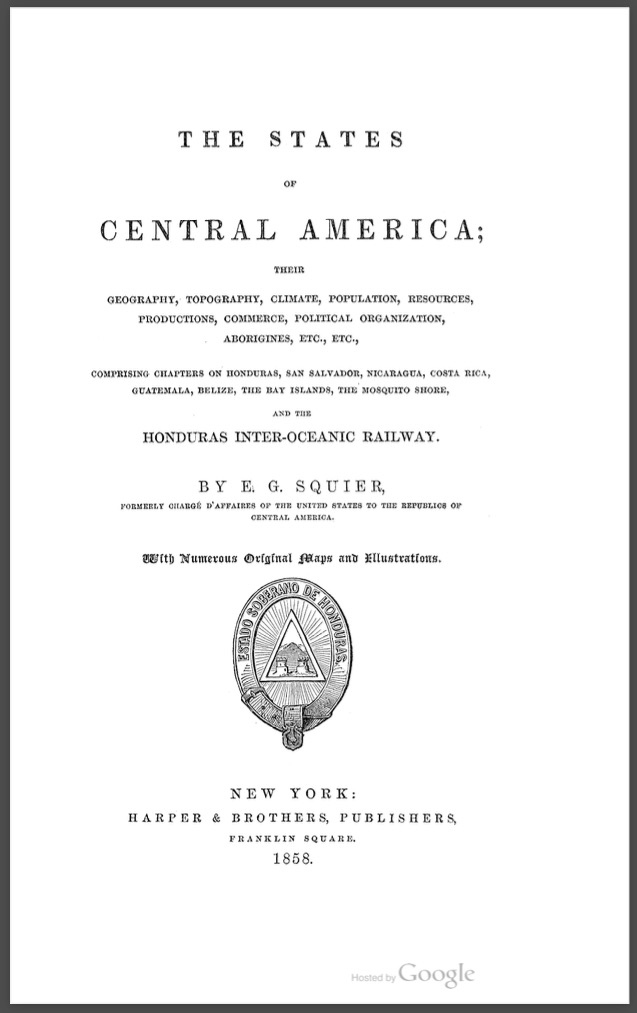
Squirer, E.G. (1858) The States of Central America. New York, Harper & Bros., 782 pp.
Record No. 6904  |  Sinkankas/Born No.: NIS/NIB  |  RWHL
Squier presents an extensive geographical, historical, political, and economic survey of Central America, principally Guatemala, Honduras, San Salvador, Nicaragua, and Costa Rica, drawing on his diplomatic service, travels, earlier publications, and contemporary documentary sources. He describes the region’s physical geography, population, indigenous peoples, antiquities, agriculture, commerce, transportation, and natural resources, with particular attention to routes proposed for inter-oceanic communication. Of gemological and mineralogical interest are his accounts of mines and mineral resources and his descriptions of pre-Columbian artifacts and indigenous materials, including objects fashioned from valued green stones. The volume provides an important mid-nineteenth-century synthesis of contemporary knowledge of Central America and is useful for tracing early reports of its mineral resources and archaeological stone objects.

The chalchihuitl of the ancient Mexicans: Its locality and association, and its identity with turquois
Journal Article
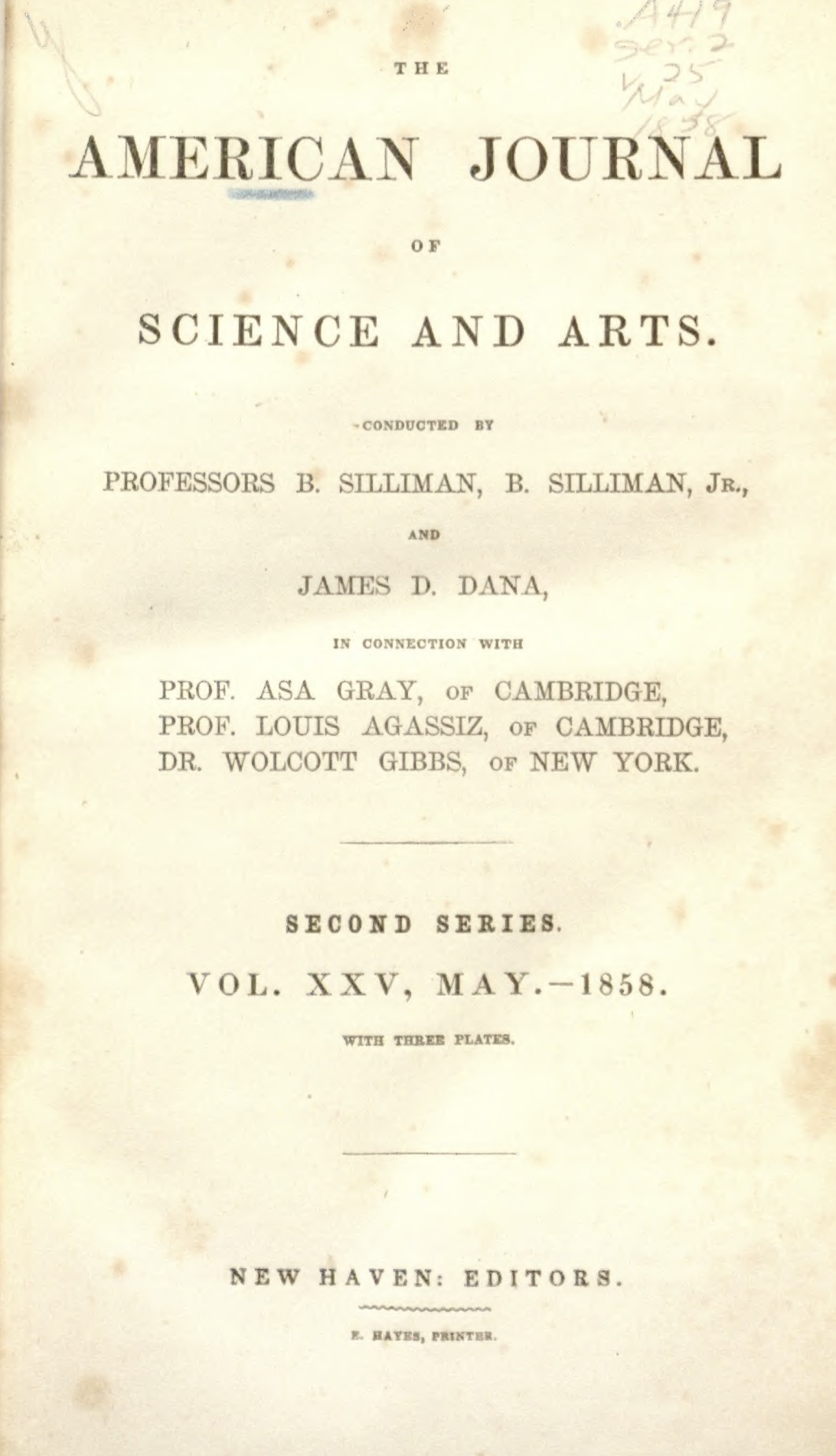
Blake, W.P. (1858) The chalchihuitl of the ancient Mexicans: Its locality and association, and its identity with turquois. American Journal of Sciences and Arts, Vol. 25, May, pp. 227–232.
Record No. 6576  |  Sinkankas/Born No.: NIS/NIB  |  RWHL
Blake examines the chalchihuitl of the ancient Mexicans, a highly valued blue-green stone frequently mentioned in early Spanish accounts, and argues that at least some material bearing this name was turquoise. Drawing on mineralogical specimens, archaeological objects, historical sources, and information on geological occurrence, he discusses turquoise deposits in the southwestern United States and northern Mexico and considers their possible relationship to stones used and traded in pre-Columbian Mexico. Blake compares the appearance and properties of turquoise with descriptions of chalchihuitl and addresses the geographical sources from which the material might have reached central Mexico. The paper is an important early mineralogical contribution to the long-running debate over the meaning of chalchihuitl, although the Nahuatl term is now understood to have encompassed green and blue-green precious materials more broadly and cannot simply be equated with turquoise.

Histoire des Nations Civilisées du Mexique et de l’Amérique-Centrale
History of the Civilized Nations of Mexico and Central America
Book
Brasseur de Bourbourg, É.-C. (1857–1859) Histoire des Nations Civilisées du Mexique et de l’Amérique-Centrale. [History of the Civilized Nations of Mexico and Central America] Paris, Madame Veuve Bouchard-Huzard, 4 Vols.
Record No. 7357  |  Sinkankas/Born No.: NIS/NIB  |  Language: in French  |  RWHL
Brasseur de Bourbourg presents an extensive history of the Indigenous civilizations of Mexico and Central America from their legendary and pre-Columbian origins through the Spanish conquest. Drawing on Indigenous manuscripts, early colonial chronicles, linguistic evidence, traditions, and archaeological remains, he discusses the histories, migrations, religions, political institutions, customs, arts, and material culture of peoples including the Maya, Toltec, Aztec, Mixtec, and Zapotec. Particular attention is given to mythology and religious practices, monumental architecture, calendrical and writing systems, dynastic histories, warfare, and the development and interaction of the principal civilizations of Mesoamerica. The work incorporates numerous early sources that Brasseur encountered during his research in Mexico and Central America and preserves traditions and documentary material that were then little known in Europe. Although many of his historical reconstructions and interpretations are now considered speculative or obsolete, the four-volume work was an important nineteenth-century synthesis of Mesoamerican history and remains valuable for its extensive use and discussion of early Indigenous and colonial sources.

Narrative of the Expedition of an American Squadron to the China Seas and Japan, Performed in the Years 1852, 1853, and 1854, under the command of Commodore M.C. Perry, United States Navy
Journal Article
Hawks, F.L. (1856) Narrative of the Expedition of an American Squadron to the China Seas and Japan, Performed in the Years 1852, 1853, and 1854, under the command of Commodore M.C. Perry, United States Navy. 537 pp..
Record No. 7982  |  Sinkankas/Born No.: NIS/NIB  |  RWHL
Compiled by Francis L. Hawks from the journals and official records of Commodore Matthew C. Perry and his officers, this volume presents the narrative of the United States naval expedition to Japan in 1852–1854 that resulted in the Convention of Kanagawa and the opening of Japanese ports to American vessels (at gunpoint; so much for the 'rule of law'). It describes the expedition’s voyages through the China Seas and Japan, diplomatic negotiations, geography, natural history, commerce, customs, industries, and material culture, with numerous illustrations and maps. Of mineralogical and gemological interest are observations on Japanese mineral resources, manufactured objects, ornaments, and the stones and other natural materials employed in decorative and practical arts. The work is also valuable for its detailed contemporary documentation of Japanese crafts and commodities immediately before the rapid expansion of Western contact during the Meiji era.

Life in Brazil: Or, A Journal of a Visit to the Land of the Cocoa and the Palm

Book
Ewbank, T. (1856) Life in Brazil: Or, A Journal of a Visit to the Land of the Cocoa and the Palm. New York, Harper & Bros., 469 pp.
Record No. 7949  |  Sinkankas/Born No.: NIS/NIB  |  RWHL
Ewbank records his travels in Brazil in 1845–1846, describing Rio de Janeiro and its surroundings, Brazilian society, slavery, religion, popular customs, architecture, technology, natural history, and material culture. Written as a detailed journal, the book contains numerous observations on minerals, jewelry, lapidary materials, and the use of precious and ornamental stones, reflecting Ewbank’s particular interest in the practical arts and manufactured objects. He also discusses Brazilian mineral resources and objects fashioned from locally available materials, while recording contemporary beliefs and practices associated with amulets and personal ornaments. Richly illustrated and based largely on firsthand observation, the work provides useful evidence for the gem trade, jewelry, ornamental stones, and material culture of mid-nineteenth-century Brazil.

Exploring the Literature of Jade

Jade literature spans gemology, mineralogy, archaeology, art history, mining, carving and connoisseurship, and includes works on both jadeite and nephrite from around the world.

For an introduction to collecting books on this subject, read Hidden Treasure — Collecting the Literature of Jade.

About Four Treasures

Four Treasures is Lotus Gemology's freely accessible gemological reference database. Use the full database to search by author, title or keyword and explore literature on gemology, mineralogy, jewelry and related fields. Where available, hyperlinks on titles may lead directly to the full publication.

Search the Complete Four Treasures Database