Natural Ruby Inclusions
Explore ruby inclusions in Hyperion, the Lotus Gemology inclusion database. Hyperion contains photomicrographs of inclusions and internal features in natural ruby, documented with information on geographic origin, treatment, lighting conditions, field of view, photographer and published references.
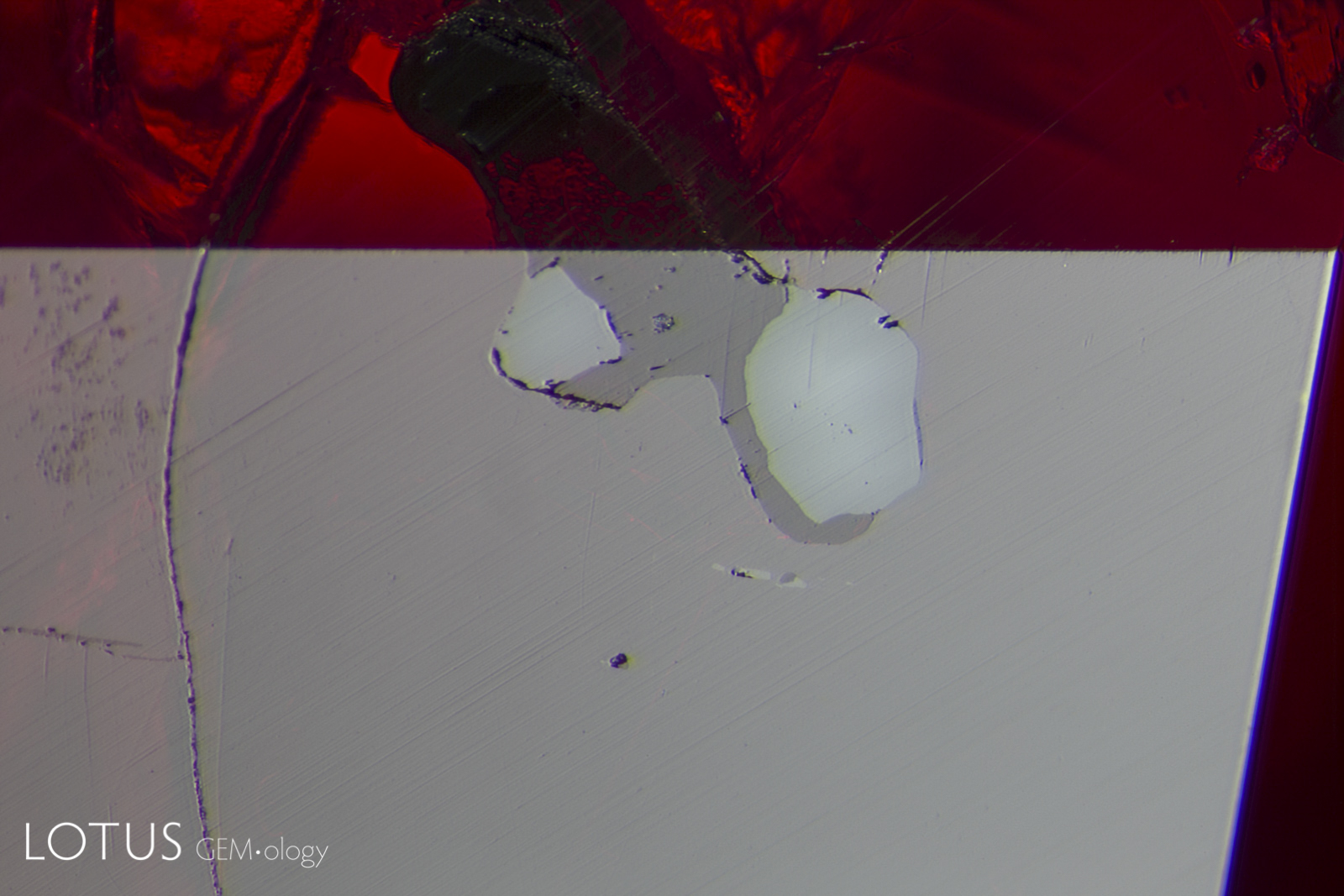
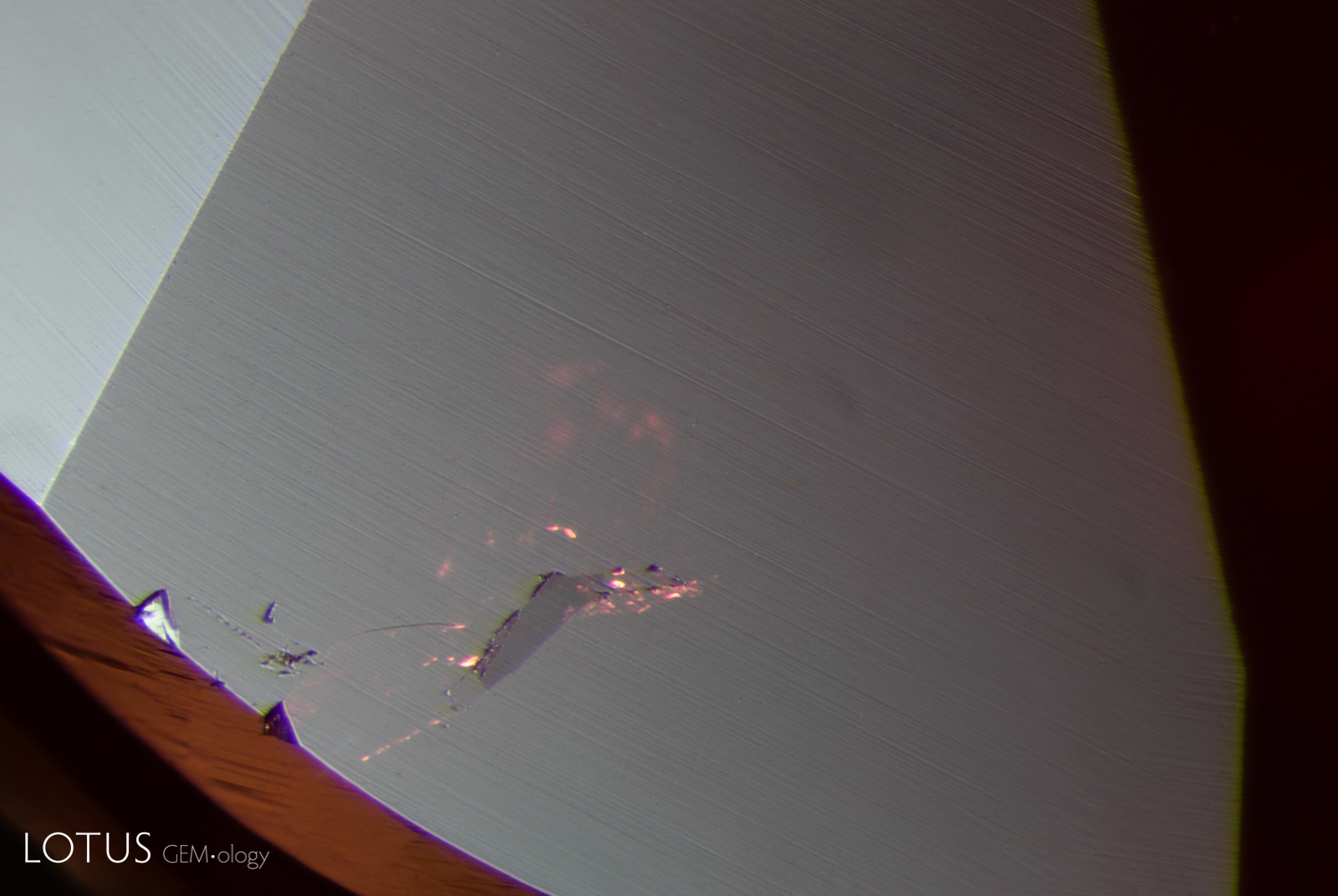
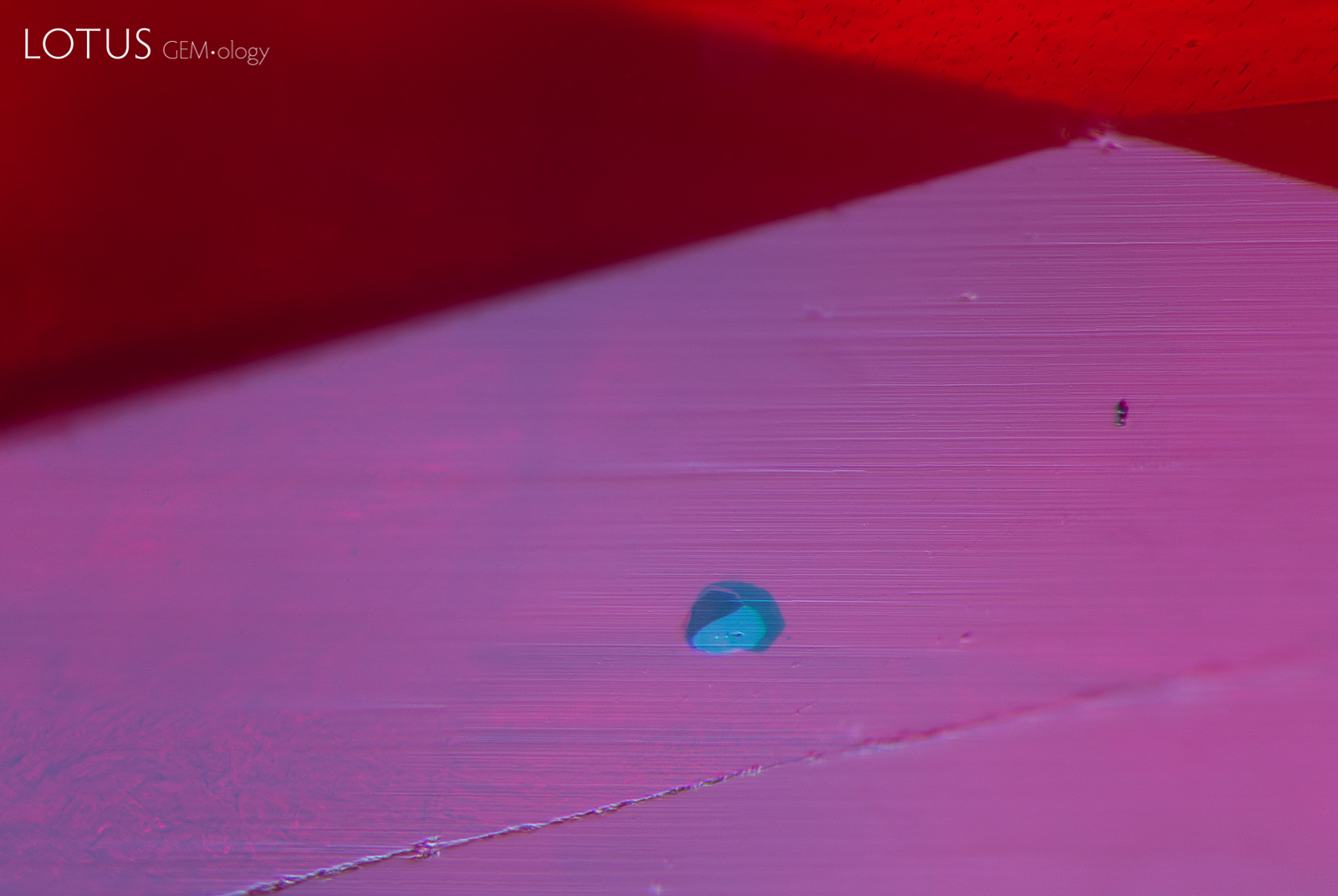
When we spotted the varying lusters on this crystal cut through on the surface of a ruby, we hypothesized that it was of mixed composition. Micro raman confirmed that the higher luster area is chromite, the area of medium luster on the left is kyanite, and the lowest luster area at the bottom is pargasite.
Natural Ruby •
Mozambique •
Enhancements:
None Detected (None) •
Lighting Conditions:
Dark Field + Diffuse Fiber Optic
Photographer:
E. Billie Hughes •
Image Number:
A-003-6677-1
• Field of View = 1mm
Hughes, R.W., Manorotkul, W. and Hughes, E.B. (2017) Ruby & Sapphire: A Gemologist's Guide. Bangkok, Lotus Publishing, 816 pp.; RWHL*.
Pardieu, V., Sangsawong, S. et al. (2013) Rubies from the Montepuez area (Mozambique). Gemological Institute of America, October 5, 84 pp.; RWHL*.
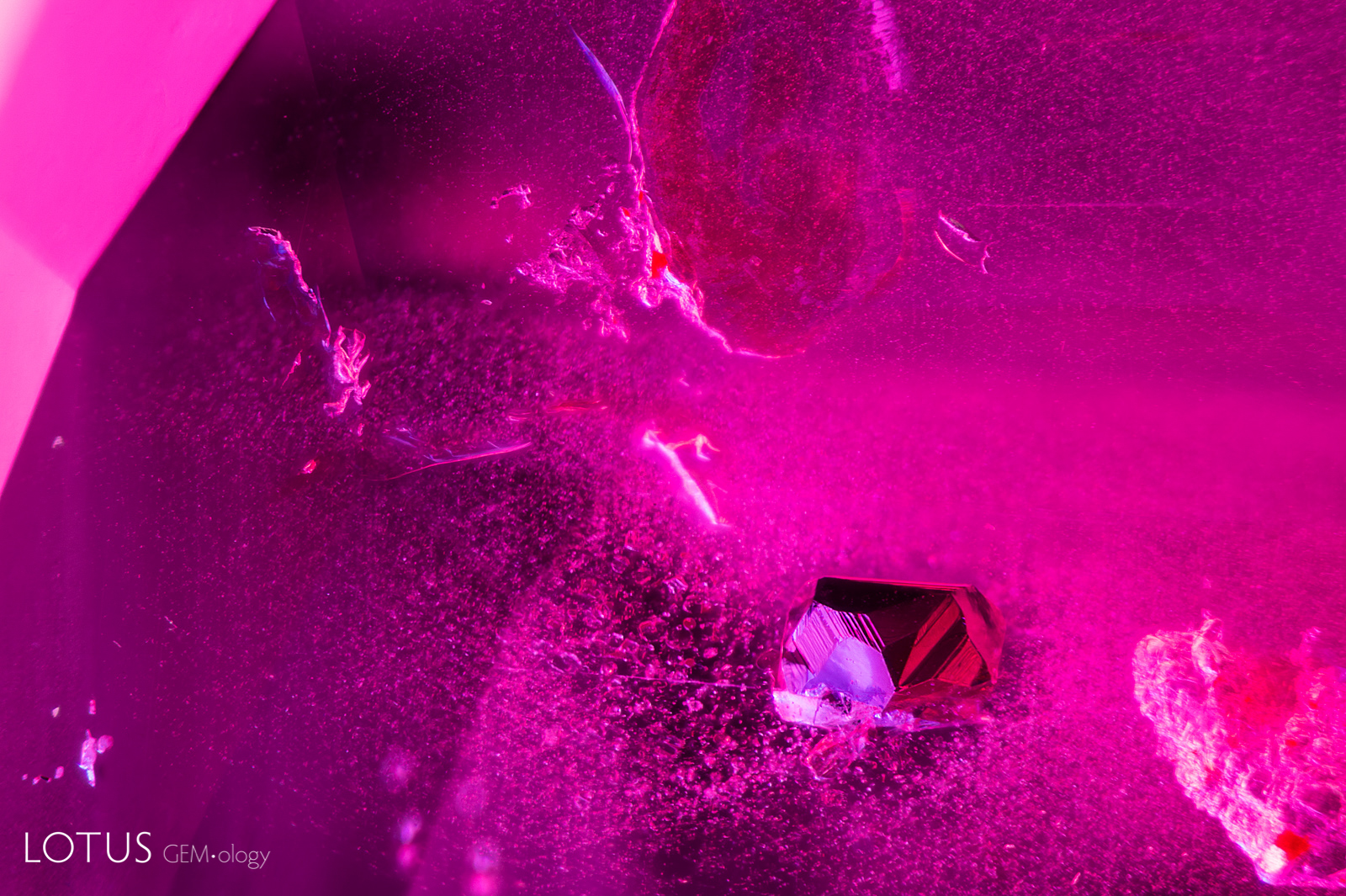
We noticed transparent crystals cut through on the surface of this ruby from Mozambique’s Montepuez region. Micro Raman revealed the lower luster crystal to be pargasite (amphibole), while the two higher relief crystals tested as spinel. Because their luster is even higher the surrounding ruby, their refractive index is above 1.77. This suggests that rather than being pure spinel (MgAl2O4), they are probably mixed with another species, such as chromite (Fe2+Cr3+2O4). Chromite has an RI of 2.08 to 2.16.
Natural Ruby •
Mozambique •
Enhancements:
None Detected (None) •
Lighting Conditions:
Dark Field + Diffuse Overhead Fiber Optic
Photographer:
Richard W. Hughes •
Image Number:
A-003-6687-1
• Field of View = 2mm
Hughes, R.W., Manorotkul, W. and Hughes, E.B. (2017) Ruby & Sapphire: A Gemologist's Guide. Bangkok, Lotus Publishing, 816 pp.; RWHL*.
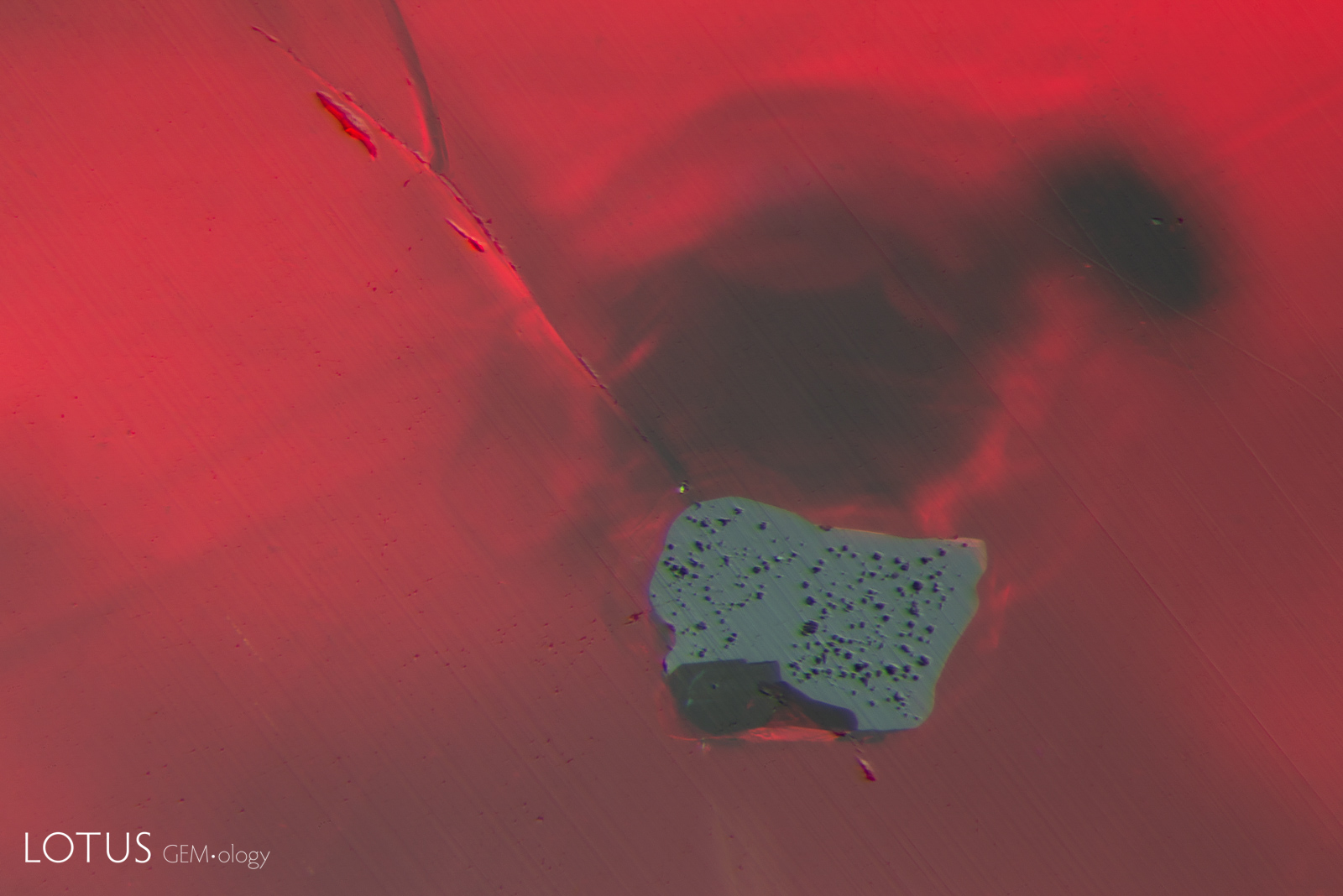
A small crystal, cut through on the surface, stood out in this ruby from Winza, Tanzania. The majority of the crystal is pargasite, while some slightly darker areas on the edges were ID’d as clinochlore with Raman spectroscopy.
Natural Ruby •
Tanzania; Winza •
Enhancements:
None Detected (None) •
Lighting Conditions:
Dark Field + Diffuse Fiber Optic
Photographer:
E. Billie Hughes •
Image Number:
A-003-6657-1
• Field of View = 2mm
Schwarz, D., Pardieu, V. et al. (2008) Rubies and sapphires from Winza, central Tanzania. Gems & Gemology, Vol. 44, No. 4, Winter, pp. 322–347; RWHL*.
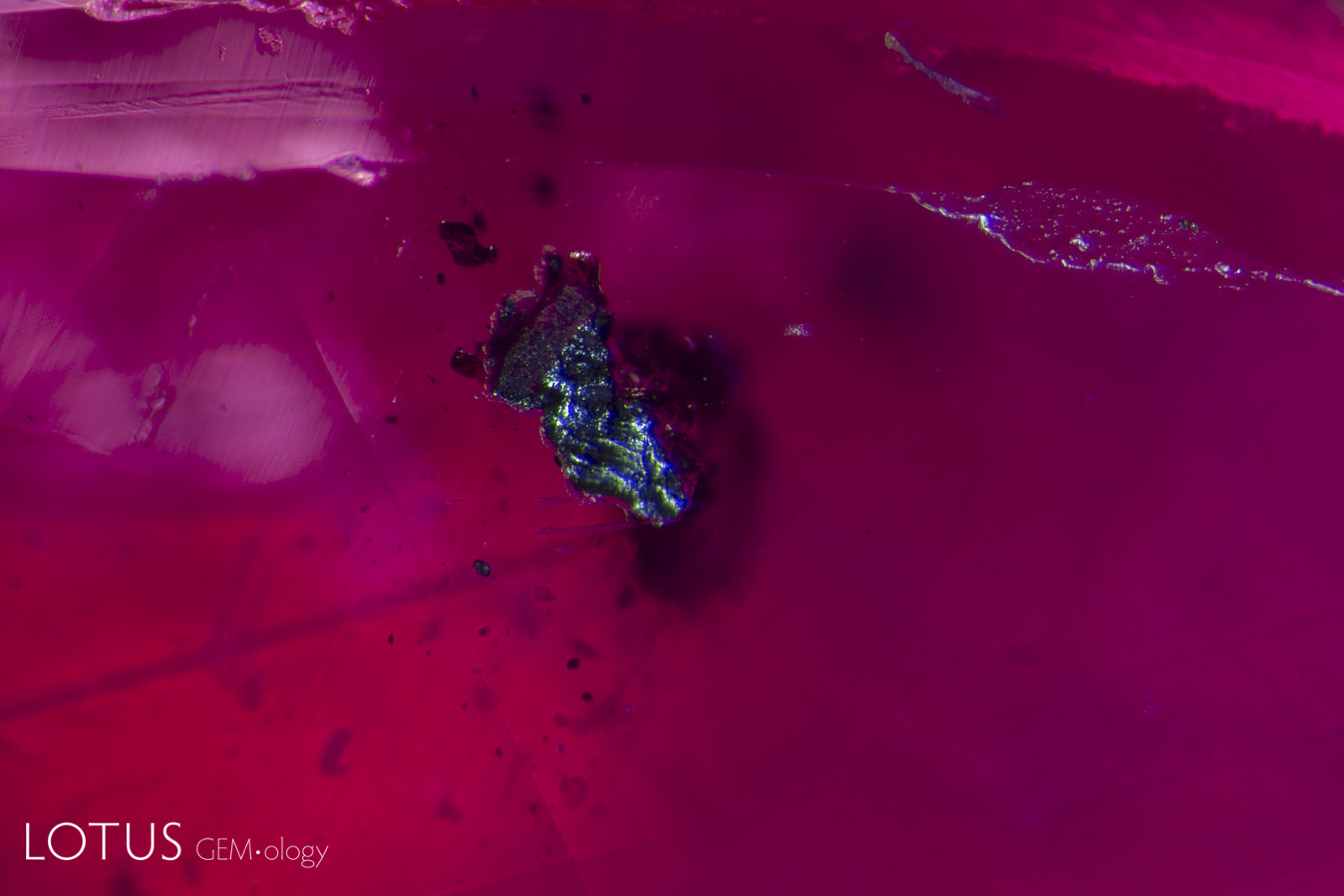
Mozambique ruby is one of the most important stones on the market today. This one contains a beautiful metallic crystal with nice surface markings.
Natural Ruby •
Mozambique •
Enhancements:
None Detected (None) •
Lighting Conditions:
Dark Field + Diffuse Fiber Optic
Photographer:
E. Billie Hughes •
Image Number:
A-003-6643-1
• Field of View = 4mm
Hughes, R.W., Manorotkul, W. and Hughes, E.B. (2017) Ruby & Sapphire: A Gemologist's Guide. Bangkok, Lotus Publishing, 816 pp.; RWHL*.
Pardieu, V., Saeseaw, S. et al. (2015) "Low temperature" heat treatment of Mozambique ruby: Results report. Gemological Institute of America, 16 April, 34 pp.; RWHL*.
This ruby believed to originate from the Montepuez region of Mozambique contained long crystals of a transparent, birefringent material. One was cut through on the surface. Analysis via micro Raman revealed it to be pargasite, a common guest in Mozambique rubies which come from an amphibolite schist host rock.
Natural Ruby •
Mozambique •
Enhancements:
None Detected (None) •
Lighting Conditions:
Dark Field + Diffuse Overhead Fiber Optic
Photographer:
Richard W. Hughes •
Image Number:
A-003-6642-2
• Field of View = 2mm
Pardieu, V., Sangsawong, S. et al. (2013) Rubies from the Montepuez area (Mozambique). Gemological Institute of America, October 5, 84 pp.; RWHL*.
Hughes, R.W., Manorotkul, W. and Hughes, E.B. (2017) Ruby & Sapphire: A Gemologist's Guide. Bangkok, Lotus Publishing, 816 pp.; RWHL*.
This ruby believed to originate from the Montepuez region of Mozambique contained long crystals of a transparent, birefringent material. One was cut through on the surface. Analysis via micro Raman revealed it to be pargasite, a common guest in Mozambique rubies which come from an amphibolite schist host rock.
Natural Ruby •
Mozambique •
Enhancements:
None Detected (None) •
Lighting Conditions:
Dark Field + Diffuse Overhead Fiber Optic
Photographer:
Richard W. Hughes •
Image Number:
A-003-6642-1
• Field of View = 2mm
Pardieu, V., Sangsawong, S. et al. (2013) Rubies from the Montepuez area (Mozambique). Gemological Institute of America, October 5, 84 pp.; RWHL*.
Hughes, R.W., Manorotkul, W. and Hughes, E.B. (2017) Ruby & Sapphire: A Gemologist's Guide. Bangkok, Lotus Publishing, 816 pp.; RWHL*.
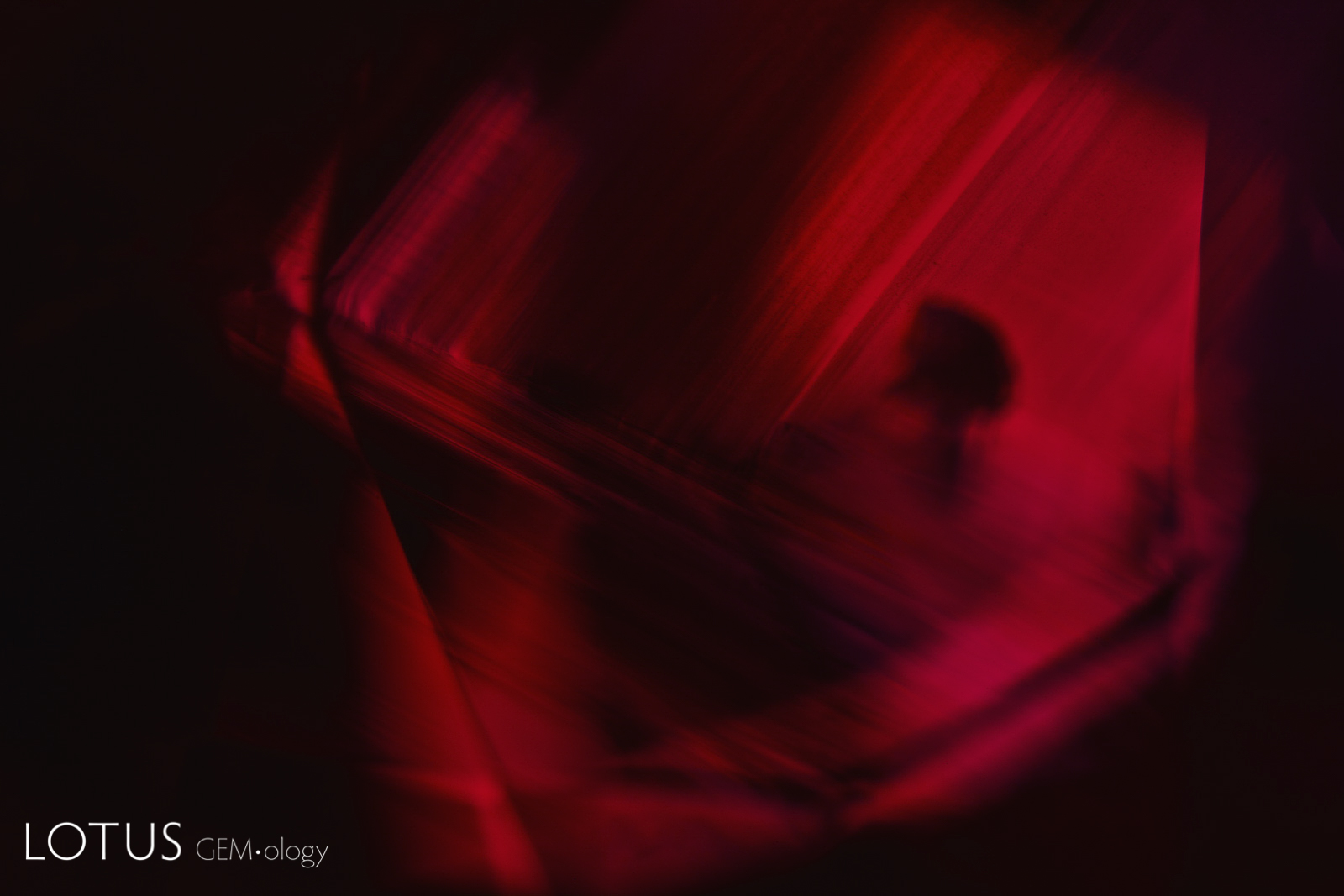
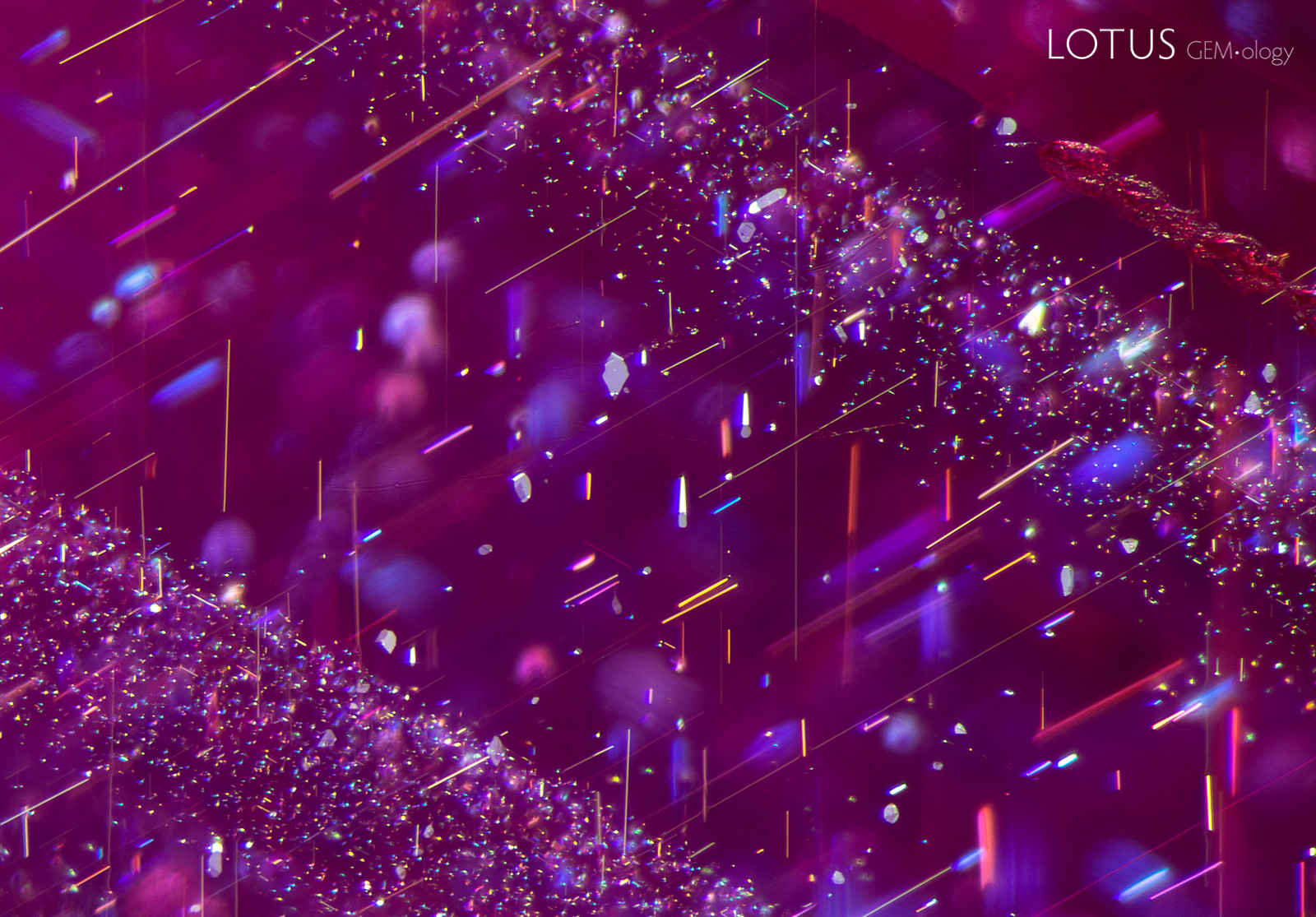
This star ruby is ready for its close-up. When cut in the right manner, some rubies and sapphires with rutile silk inclusions can display a “star,” a phenomenon known as asterism.
Natural Star Ruby •
Myanmar (Burma); Mogok/Namya •
Enhancements:
None Detected (None) •
Lighting Conditions:
Fiber Optic: Diffuse Overhead
Photographer:
E. Billie Hughes •
Image Number:
A-003-6623-1
• Field of View = 7.5mm
Hughes, R.W., Manorotkul, W. and Hughes, E.B. (2017) Ruby & Sapphire: A Gemologist's Guide. Bangkok, Lotus Publishing, 816 pp.; RWHL*.
Gübelin, E.J. and Koivula, J.I. (2008) Photoatlas of Inclusions in Gemstones, Volume 3. Basel, Switzerland, Opinio Publishers, 672 pp.; RWHL*.
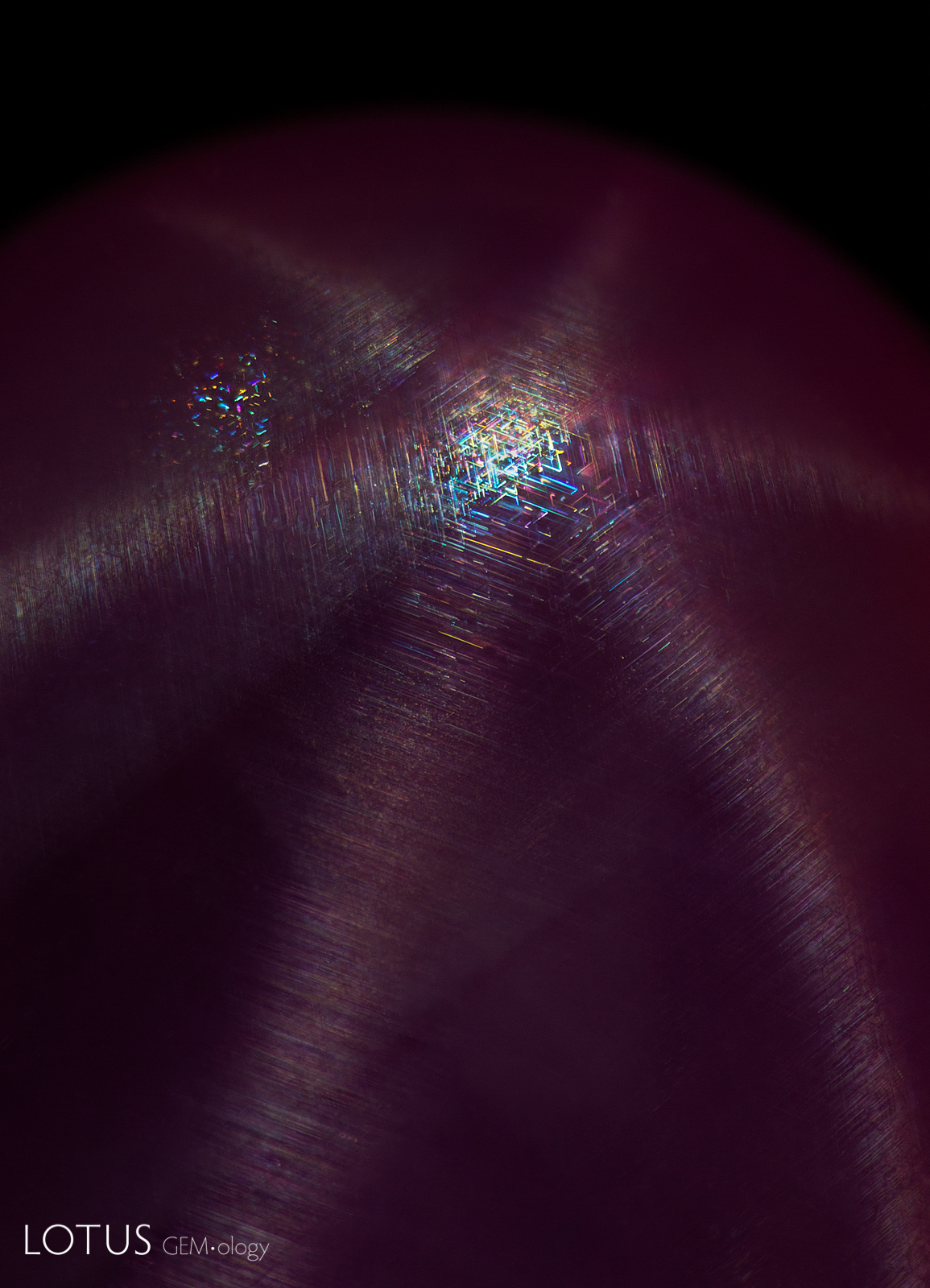
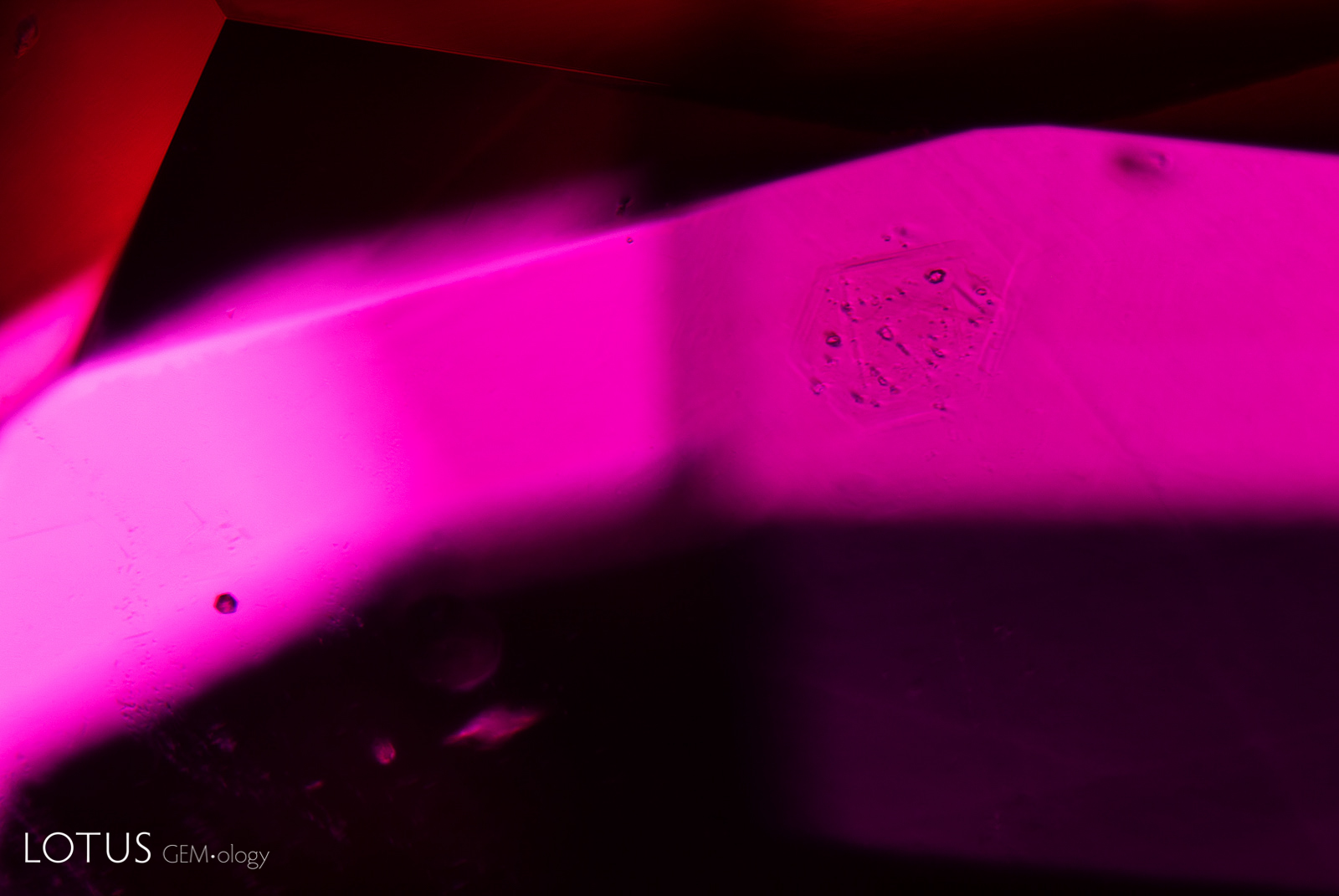
An extremely low relief hexagonal crystal with small inclusions inside can be seen in this Mozambique ruby. We have not yet been able to identify this crystal.
Natural Ruby •
Mozambique •
Enhancements:
None Detected (None) •
Lighting Conditions:
Dark Field + Shadowing
Photographer:
E. Billie Hughes •
Image Number:
A-003-6522-1
• Field of View = 2mm
Hughes, R.W., Manorotkul, W. and Hughes, E.B. (2017) Ruby & Sapphire: A Gemologist's Guide. Bangkok, Lotus Publishing, 816 pp.; RWHL*.
Pardieu, V., Saeseaw, S. et al. (2015) "Low temperature" heat treatment of Mozambique ruby: Results report. Gemological Institute of America, 16 April, 34 pp.; RWHL*.
478 Total Images
Results: 121 – 132 | Page 11 of 40 Pages
Search the Complete Hyperion Database
Natural ruby inclusions may include mineral crystals, rutile silk, healed fissures, fluid inclusions, negative crystals, color zoning and other features formed during or after crystal growth. Such features are important to gemologists because they can provide evidence useful in identifying ruby, understanding its geological history, recognizing treatment and, in some cases, determining geographic origin.
Natural Ruby Inclusion Photomicrographs
The Hyperion natural ruby gallery includes microscopic features found in rubies from major deposits around the world. Each entry is accompanied by descriptive information and, where available, references to the gemological literature.
What Inclusions Can Reveal About Natural Ruby
Inclusions are an important part of ruby identification. Their form, composition, orientation and alteration can help gemologists distinguish natural ruby from synthetic material, recognize evidence of heat treatment, and study the geological environment in which the ruby formed.
Hyperion combines inclusion photomicrography with supporting gemological information so that individual features can be compared with documented examples from known ruby deposits.
About Hyperion
Hyperion is the Lotus Gemology searchable inclusion database. It allows users to browse gemstone inclusions by gem type, geographic origin, treatment and keyword.