Gemology Books Bibliography

Gemology Books Bibliography

Explore books on gems, gemology, jewelry and mineralogy in Four Treasures, the Lotus Gemology reference database. This bibliography brings together matching book records from the collection, with publication details, abstracts and cover images where available.

Gemology Book References

The list below matches books concerning gemology and related subjects in the database's searchable fields. Some works cover several branches of gems, jewelry or mineralogy.

221–240 of 3,436 matching references
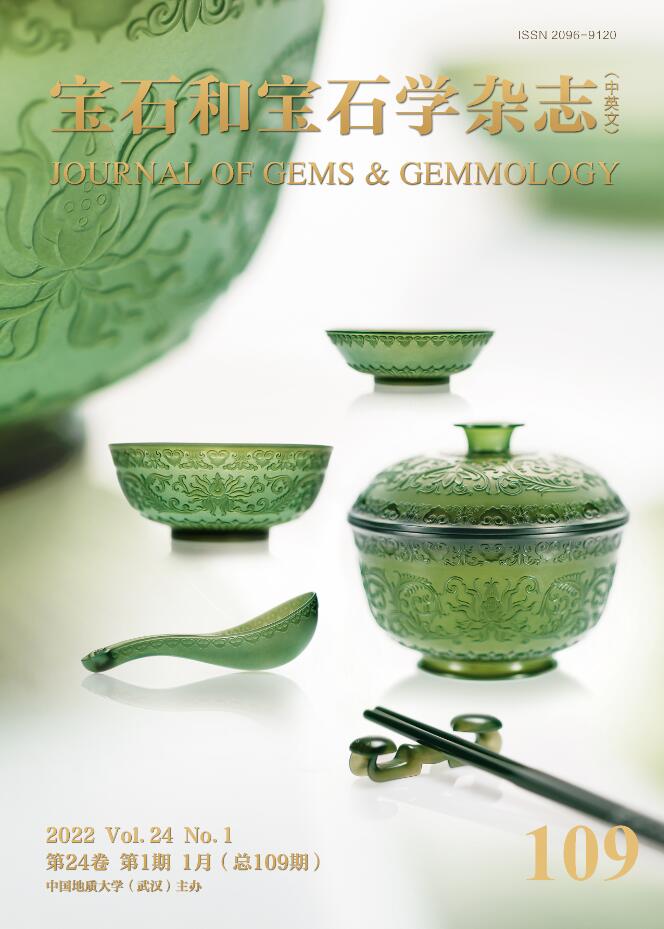
Inclusion and spectral characteristics of sapphire from Ilakaka, Madagascar

Inclusion and spectral characteristics of sapphire from Ilakaka, Madagascar

Liang, B. and Chen, M. (2022)

Journal Article · Source: Journal of Gems & Gemmology · Volume: Vol. 24 · Issue: No. 1 · Pages: pp. 28–38 · Language: in Chinese with English Abstract

Abstract
The inclusions and spectral characteristics of blue and orange sapphire from Ilakaka, Madagascar have been studied by Raman spectroscopy, infrared spectroscopy, LA-ICP-MS, UV-Vis-NIR absorption spectroscopy and fluorescence spectroscopy. This study aimed to enrich the information of characteristics of sapphire from Ilakaka, Madagascar. The results showed that the characteristic inclusions of sapphire from Ilakaka included a large number of liquid CO₂-filled negative crystals and healed fissures filled with pseudosecondary inclusions such as goethite and sulfur. It also contained a variety of solid inclusions, such as calcite, graphite, phlogopite, rutile, hematite and kaolinite. The content of Fe in sapphire was positively correlated with the intensity of blue tone. The absorption lines at 377, 387 nm and 451 nm associated with Fe³⁺ were found in all types of sapphire, and the increase of Fe content could promote the formation of Fe³⁺–Fe³⁺ exchange-coupled ion pairs and enhance the absorption at 377 nm and 451 nm. R1 (694 nm) and R2 (693 nm) fluorescence lines of Cr³⁺ were observed in the fluorescence spectra of almost all samples. Orange sapphires had wide fluorescence peaks at 400–480 nm. The low temperature annealing experiment showed that these fluorescence peaks had poor thermal stability and tended to disappear when heated to 250 °C, while the fluorescence peaks increased significantly when heated to 300 °C. The thermo behavior of those fluorescence peaks may be associated with hole centers [V_Al⁺ + O⁻] and [Mg²⁺ + O⁻].
Keywords
gems, corundum, Madagascar.12, Ilakaka, sapphire
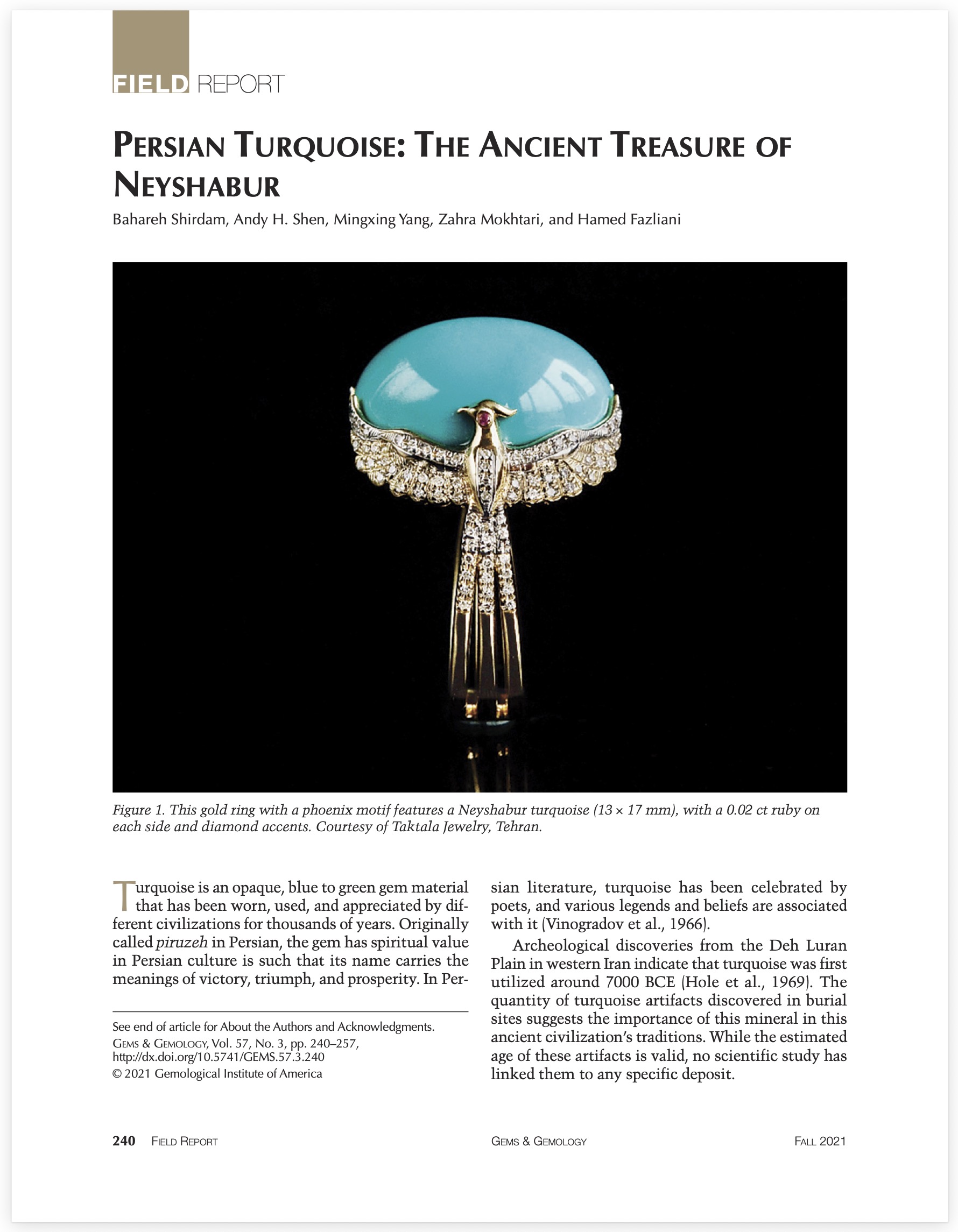
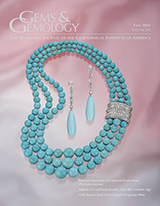
Persian turquoise: The ancient treasure of Neyshabur

Persian turquoise: The ancient treasure of Neyshabur

Shirdam, B., Shen, A.H., Yang, M.X., Mokhtari, Z. and Fazliani, H. (2021)

Journal Article · Source: Gems & Gemology · Volume: Vol. 57 · Issue: No. 3, Fall · Pages: pp. 240–257

Abstract
Turquoise is an opaque, blue-to-green gem material that has been worn, used, and appreciated by different civilizations for thousands of years. Originally called piruzeh in Persian, the gem has such spiritual value in Persian culture that its name carries the meanings of victory, triumph, and prosperity. In Persian literature, turquoise has been celebrated by poets, and various legends and beliefs are associated with it (Vinogradov et al., 1966). Archaeological discoveries from the Deh Luran Plain in western Iran indicate that turquoise was first utilized around 7000 BCE (Hole et al., 1969). The quantity of turquoise artifacts discovered in burial sites suggests the importance of this mineral in this ancient civilization’s traditions. While the estimated age of these artifacts is valid, no scientific study has linked them to any specific deposit. The Neyshabur (Latinized as Nishapur) deposit is known for yielding turquoise with unique color and quality. This production has historically been known as “Persian turquoise” (figure 1), yet Iran’s turquoise deposits were never limited to Neyshabur. Other important mines include the Baghu deposit in southern Semnan Province and the Shahr-i Babak deposit in western Kerman Province, the latter of which was mentioned in Marco Polo’s Book of the Wonders of the World between 1390 and 1430 (Weisgerber, 2004). Located in Razavi Khorasan Province of northeastern Iran, 53 km from the city of Neyshabur, the Neyshabur mine has produced the majority of Iranian turquoise for more than a millennium. Yet in recent decades there have been claims that the mine is on the verge of closure, that its turquoise quality has diminished, or that it is running out of material. Such claims often carry enormous weight with consumers. After visiting the Neyshabur turquoise mine in 2020, a report was conducted on the current state of the mine. This article seeks to uncover the facts and offer objective insight into the current state of the Neyshabur turquoise mine.
Keywords
gems, turquoise, Iran, Persia, Nishapur
Le minéral et l’invisible: Usages des pierres dans la magie islamique médiévale

Le minéral et l’invisible: Usages des pierres dans la magie islamique médiévale

The mineral and the invisible: Uses of stones in medieval Islamic magic

Coulon, J.-C. (2021)

Book Section · Source: Ce que peuvent les pierres · Publisher: Presses universitaires de Liège · Pages: pp. 163–191 · Language: in French

Abstract
The story of Evax, king of the Arabs, to whom Emperor Nero is said to have commissioned a lapidary, appears in the introduction to several medieval Christian lapidaries, such as the first Romance translation of the Lapidary of the Angevin Marbod of Rennes (1035–1123), which can be dated to the 13th century, or The Christian Lapidary. As for the lapidary of John of Mandeville (d. 1372), it claims to be a “lapidary compiled from the verified knowledge and beliefs of the Indians concerning the virtues and properties of precious stones.” Indeed, medieval European literature on stones links mineralogy with the Orient, where the deposits of imported precious stones were located, as well as a mastery in the art of working minerals. This association already existed among Greek and Latin authors of antiquity, but the prolific production of Arabic books on stones (al-aḥjār) throughout the Middle Ages certainly reinforced this idea. Starting in the 2nd/8th century, the Abbasid Caliphate initiated an active policy of building libraries and translating ancient treatises from Greek, Indian, Pahlavi, Mesopotamian, and other languages. Continuing in the tradition of Greek lapidaries of antiquity, stones (al-aḥjār) thus became the subject of treatises on mineralogy and lapidaries that aimed not only to describe them and specify their places of origin, but also to detail their virtues and physical, medicinal, and occult properties. Some mineralogical treatises also identify the planets associated with each stone. This abundant literature had a major influence on the scholarly culture of the time. Occult science treatises were no exception and drew heavily from this medieval Arabic mineralogical literature. Moreover, amulets and talismans often rely on the use of specific stones and minerals, which contribute to the object’s power. Thus, after presenting the Arabic mineralogical treatises and their connections to magical texts, we will show how stones were used—first for their natural properties, sometimes in combination with their associated planets, and later, as a more distinctly Islamic form of magic developed, increasingly less for their own properties and more as supports for writing, with the powers of letters coming to surpass those of substances.
Keywords
gems, magical gems, history of gemology, ancient gems, gem lore, gems and healing, medicinal use, alchemy, early lapidaries, Arabic mineralogy
Some Thoughts About the Evolution of Human Behavior: A Literature Survey

Some Thoughts About the Evolution of Human Behavior: A Literature Survey

Boucot, A.J., Saul, J.M. and Southard, J.B. (2021)

Book · Publisher: Archaeopress · Pages: 236 pp.

Abstract
On his death, Arthur Boucot (1924-2017) left an unfinished manuscript in which he surveyed the skeletal, behavioural, and cultural changes that have characterized Homo from its first recognition in the Late Pliocene to the present. The subjects he treated were as varied as the preparation of food for infants, the length of intestines, hafting, plastering, use of flint and metals, the domestication of grains and animals, and the prevalence of parasitic diseases. His text repeatedly notes the difficulties imposed by the enormous gaps in both fossil and archaeological records. Boucot deduced a continuity in basic human behaviours from the Oldowan and Acheulian into modern forms, and made a point of including Neandertals and Denisovans. But he also pointed out that morphological changes in successive species of Homo do not coincide in time with major changes in lithic technologies. Boucot concluded that a quantum evolutionary gap separates hominins from the great apes: that members of our line were sapient and had been using language long before they became sapiens. In his text he also indicates his concern for changes to the environment wrought by human activities. The results of this late-life effort, edited after his death, provide a heavily referenced sourcebook for future workers in diverse fields.
Keywords
gems, archaeology, archaeogemology, fossils, early Man
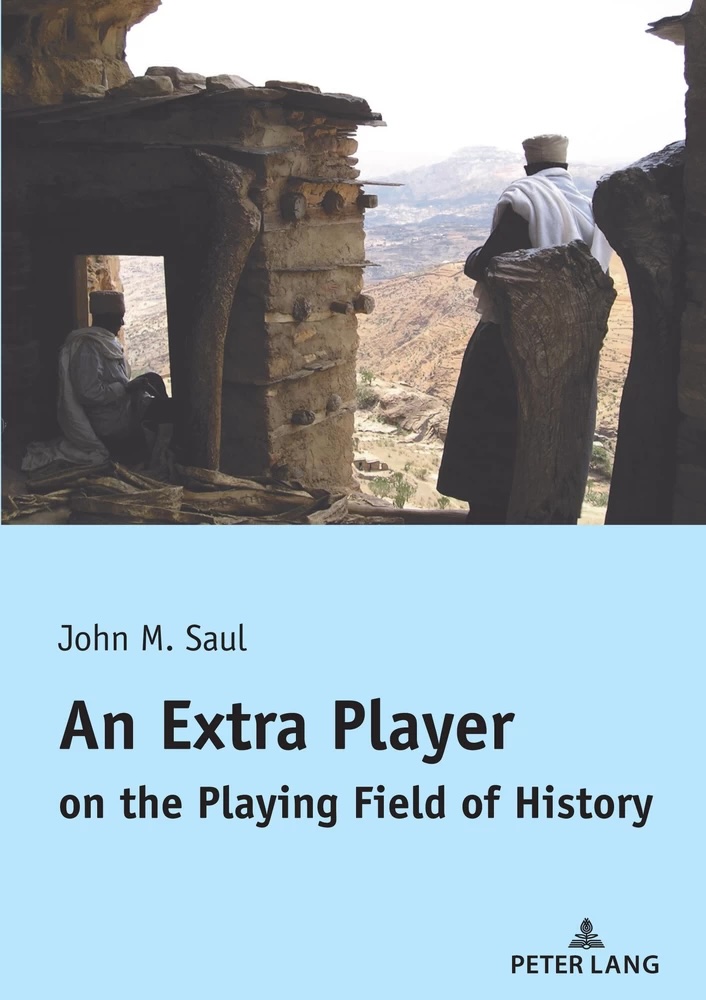
An Extra Player on the Playing Field of History

An Extra Player on the Playing Field of History

Saul, J.M. (2021)

Book · Publisher: Peter Lang · Pages: 274 pp.

Abstract
Cuneiform tablets from Mesopotamia tell of a time when “Kingship was lowered from Heaven”. The original king and his line were inherently legitimate because they provided a convincing strategy for the attainment of immortality. The fate of this line, also known as the Grail, is unclear. The Extra Player in the title of this work is the phantom and the fear by later rulers of possible descendants of the “real” king. Light was thrown on such matters after a hoard of documents was brought to France following Bonaparte's Egyptian Campaign, 1798–1801. These came into the possession of a secretive group, some of whose archives, dating to the 19th century, surfaced in the 1940s during the Occupation of Paris. Two decades later, a person who had seen part of the archive, speculated that it would address “the great Question of Origins”. Several more decades, and several misunderstandings later, the same materials would provide the ultimate inspiration for The Da Vinci Code.
Keywords
gems, archaeology, archaeogemology, Early Man, early history
The ends of the Earth

The ends of the Earth

Saul, J.M. (2021)

Journal Article · Source: Mother Tongue · Volume: Vol. 23 · Issue: No. 1 · Pages: pp. 179–190

Abstract
The appearance of cave paintings thirty to forty thousand years ago at the two extremities of the Eurasian continent (Spain/France and Sulawesi/Borneo²) but not in between appears as though it might be the consequence of incomplete data, sampling error, or similar, as may indeed be the case. Yet this is the data available to us (as of late 2019), and we should also consider that it might actually represent the reality of the matter. If so, an explanation would be required. In speculating on this matter, let us first assume that rock-paintings were already being made by our ancestors before they left Africa. This has not been demonstrated, but it seems safer than assuming otherwise. Early groups of our ancestors may have left Africa and migrated north in an effort to learn the “immortalizing secret” of the storks or cranes who would annually leave Africa and then return, seemingly born again, as I have proposed elsewhere.³ On reaching southern Europe or the Middle East, our ancestors would have discovered the disorienting ornithological truth. At that point, our ur-religion, if we may call it such, may have undergone a schism, as have all religions since, with some of our ancestors following the stars to the west and others heading east toward the birthplace of the life-giving Sun.
Keywords
gems, archaeology, archaeogemology, anthropology, prehistory, language, Africa
The emerald mines of Wadi Sikait (Egypt) from a diachronic perspective. Results of the 2020 and 2021 seasons of the Sikait Project

The emerald mines of Wadi Sikait (Egypt) from a diachronic perspective. Results of the 2020 and 2021 seasons of the Sikait Project

García-Dils De la Vega, S., Guzmán, J.O., Fernández Abella, D. and Trevín Pita, V. (2021)

Journal Article · Source: Trabajos de Egiptología: Papers on Ancient Egypt · Issue: No. 12

Abstract
This article outlines the preliminary results of the fieldwork carried out by the Sikait Project in the 2020 and 2021 seasons in the Smaragdos area (Egyptian Eastern Desert). Our work is focused on the study of beryl/emerald mining in the Roman and Late Antique periods from a diachronic perspective. By the end of the 2021 season, some 150 mines had been identified, with the total area of the delimited mining zones so far measuring about 100,000 m².
Keywords
gems, archaeology, archaeogemology, beryl, emerald, Egypt, Sikait Project
Overview of gemstone resources in China

Overview of gemstone resources in China

Yu, X., Long, Z., Zhang, Y., Qin, L., Zhang, C., Xie, Z., Wu, Y., Yan, Y., Wu, M. and Wan, J. (2021)

Journal Article · Source: Crystals · Volume: Vol. 11 · Issue: No. 10 · Pages: 22 pp.

Abstract
Gemstones are minerals of gem qualities used for adornment and decoration with the attributes of beauty, durability and rarity. Traditionally, although China has been regarded as the most important source for nephrite, over the past decades, a large variety of gemstone resources have been newly discovered in China owing to continuous exploration works. The vast land with various geological and geochemical backgrounds is rich in gemstone resources with potential for new deposits discoveries. In pegmatites, gemstones are related to granitic magma events and mainly occur in pegmatitic cavities, such as tourmaline, aquamarine, spodumene, spessartine, moonstone, quartz, apatite, and topaz. The eruption of Tertiary basaltic magma provides gem-quality sapphire, spinel, olivine, garnet, and zircon. The supergene oxidation zones of some copper and iron deposits in Hubei and Anhui province host gem-quality turquoise and malachite. Moreover, the formation of the nephrite deposit in China is mostly related to the carbonatite and serpentinite rocks involved in the metamorphic-metasomatic processes. This paper comprehensively introduces the distribution of gemstones deposits, as well as the gemological and mineralogical characteristics of gemstones in China. Our present investigation provides insights into the gemstone potential of China for further exploitation.
Keywords
gems, gem deposits, jade, gemology, mineralogy, China
Emerald mining during the Roman period in the Egyptian eastern desert: Recent evidence from Wadi Sikait (Taf. XXXI-XLVI)

Emerald mining during the Roman period in the Egyptian eastern desert: Recent evidence from Wadi Sikait (Taf. XXXI-XLVI)

Guzmán, J.O., Abella, D.F., Pita, V.T., Casas, O.A. and García-Dils De la Vega, S. (2021)

Journal Article · Source: Mannheimer Beiträge zur Archäologie und Geschichte der antiken Mittelmeerkulturen · Volume: Vol. 26 · Pages: pp. 25–36

Abstract
The archaeological seasons conducted in Wadi Sikait in 2020 and 2021 have significantly expanded our understanding of emerald mining in Roman Egypt, as well as the mining communities that inhabited large settlements like Sikait. This paper explores these developments by presenting the archaeological work carried out in construction complexes and religious buildings at the site, along with an intensive survey of the surrounding emerald mining areas. This research has led to a major breakthrough in our knowledge of emerald extraction and trade during the Graeco-Roman and Byzantine periods.
Keywords
gems, beryl, emerald, Egypt, Cleopatra, history of gemology, archaeology, archaeologemology
History of emerald mining in the Habachtal deposit of Austria, Part 1

History of emerald mining in the Habachtal deposit of Austria, Part 1

Schmetzer, K. (2021)

Journal Article · Source: Gems & Gemology · Volume: Vol. 57 · Issue: No. 4, Winter · Pages: pp. 338–371

Abstract
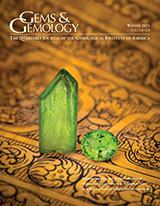
The Habachtal emerald deposit in Austria, one of Europe’s oldest known sources of emeralds, has a rich history dating back to at least 1797, when it was first described in scientific literature. While there are speculative links to Roman or Celtic exploitation, no definitive archaeological evidence confirms such early mining activities. Regular mining began in the early 1860s under Samuel Goldschmidt, a Viennese jeweler, who initiated operations that were later taken over by the English company Emerald Mines Limited in 1895. However, the venture faced legal and financial challenges, leading to its decline by 1903. By 1914, the property returned to Austrian ownership, acquired by local farmers and municipal leaders from Bramberg. This historical account, detailed in the Winter 2021 issue of Gems & Gemology, provides insights into the complex legal, geological, and economic factors that influenced the development of this unique alpine emerald source.
Keywords
gems, beryl, emerald, Austria, Habachtal
The Secret Teachings of Gemcutting — 50 Classic Gemstone Designs

The Secret Teachings of Gemcutting — 50 Classic Gemstone Designs

Prim, J.K. (2021)

Book · Publisher: Magus Publishing · Pages: 238 pp.

Abstract
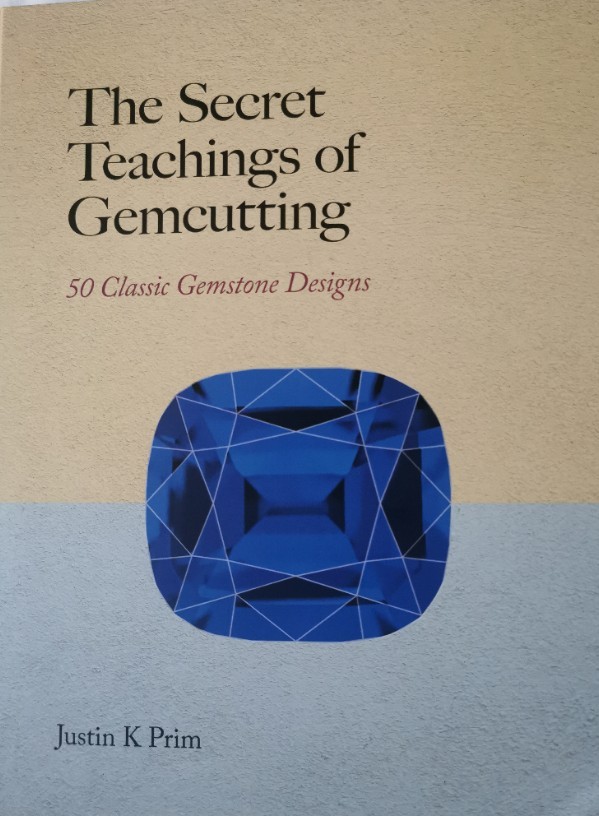
The Secret Teachings of Gemcutting is a collection of classic gemstone cutting designs spanning 500 years. 50 gemstone designs are presented here with full color photos, design information, cutting advice, and historical background. This collection consists of the time tested, industry-standard gemstone designs that can been found in the jewelry from high-end brands as well as independent bespoke jewelry designers. Each design is presented in two different height options so that they are compatible with both lower RI stones (such as amethyst and emerald) and higher RI stones (such as ruby, sapphire, and spinel). Aside from the designs, the book includes 30 pages of essential gemology for cutters which contains invaluable information about gemstone design, optics, crystal systems, hand preforming, gemstone physics, modifying diagrams, pairing rough gems with appropriate designs, and more. This information is critical for cutters who want to understand how these elements influence the appearance of the final stone.
Keywords
gems, lapidary, gem cutting, France, Jura mountains
An investigation of grinding hardness of some ornamental stones

An investigation of grinding hardness of some ornamental stones

Hänni, H., Brunk, R. and Franz, L. (2021)

Journal Article · Source: Journal of Gemmology · Volume: Vol. 37 · Issue: No. 6 · Pages: pp. 632–643

Abstract
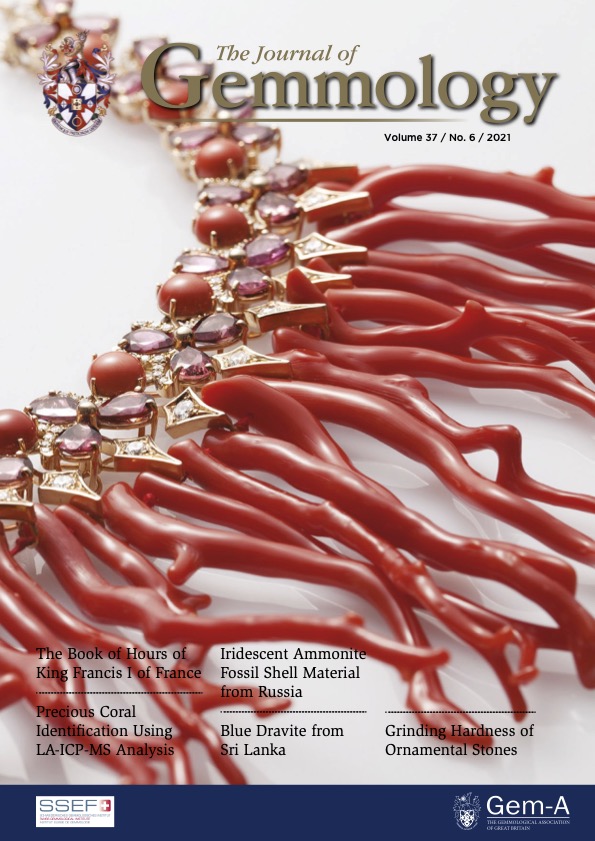
As an extension to the typical ‘scratch hardness’ (e.g. Mohs scale) of minerals, at the end of the 19th century Austrian mineralogist August Rosiwal postulated a ‘grinding hardness’ scale. He published values expressing different amounts of resistance to abrasion of ornamental and building stones in comparison to quartz. For the present paper, 25 different ornamental stone materials were ground under normalised conditions to measure their grinding hardness (GH) relative to single-crystal quartz (GH 100). Not surprisingly, the values varied greatly, from GH 174 for fibrous chalcedony to GH 11 for rhodochrosite. A remarkable result was the GH 103 value obtained for nephrite, which consists of monomineralic aggregates of clinoamphibole with a distinctly lower Mohs hardness than quartz. These investigations show that a fibrous, intensely interlocked texture provides increased resistance against grinding, which is consistent with previous investigations.
Keywords
gems, hardness, physical properties, jade, jadeite, fei cui, nephrite
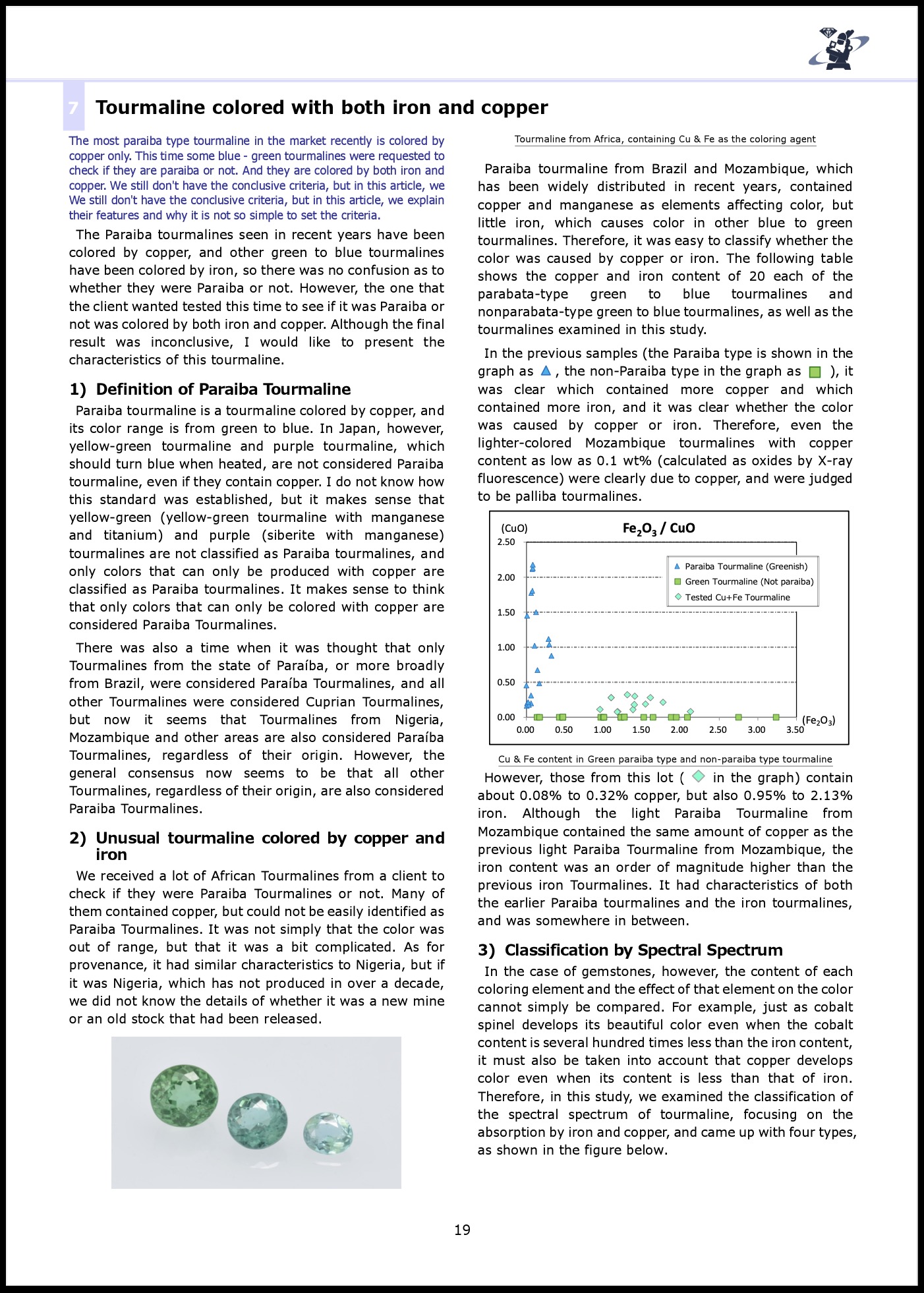
Tourmaline colored with both iron and copper

Tourmaline colored with both iron and copper

Furuya, M. (2021)

Report · Publisher: Japan Germany Gemmological Laboratory · Pages: pp. 19–21

Abstract
The most paraiba type tourmaline in the market recently is colored by copper only. This time some blue - green tourmalines were requested to check if they are paraiba or not. And they are colored by both iron and copper. We still don't have the conclusive criteria, but in this article we explain their features and why it is not so simple to set the criteria.
Keywords
gems, tourmaline, Paraíba tourmaline, Brazil, cuprian tourmaline, Mozambique, Nigeria
Purple gem spinel from Vietnam and Afghanistan: Comparison of trace element chemistry, cause of color, and inclusions

Purple gem spinel from Vietnam and Afghanistan: Comparison of trace element chemistry, cause of color, and inclusions

Belley, P.M. and Palke, A.C. (2021)

Journal Article · Source: Gems & Gemology · Volume: Vol. 57 · Issue: No. 3, Fall · Pages: pp. 228–238

Abstract
This study compares two purple gem spinel samples with regard to trace element chemistry and visible light absorption spectra, and presents the first reported example of a spinel with a saturated purple color caused predominantly by chromium and cobalt. Sample VN, from a placer deposit in the Luc Yen district of Vietnam, exhibited strong saturation, orange-red fluorescence in UV, and magnesite and graphite inclusions. Sample AF was from Badakhshan, Afghanistan, with light to medium saturation and containing phlogopite, amphibole, and probable fluid inclusions. UV-Vis-NIR spectra are compared along with trace element chemistry. Sample VN is colored primarily by cobalt (17.9 ppma) and chromium (593 ppma), with minor color contribution from Fe (2437 ppma), and contains significantly more cobalt than typical Cr-enriched red, pink, and purple gem spinels (
Keywords
gems, spinel, Afghanistan, Vietnam
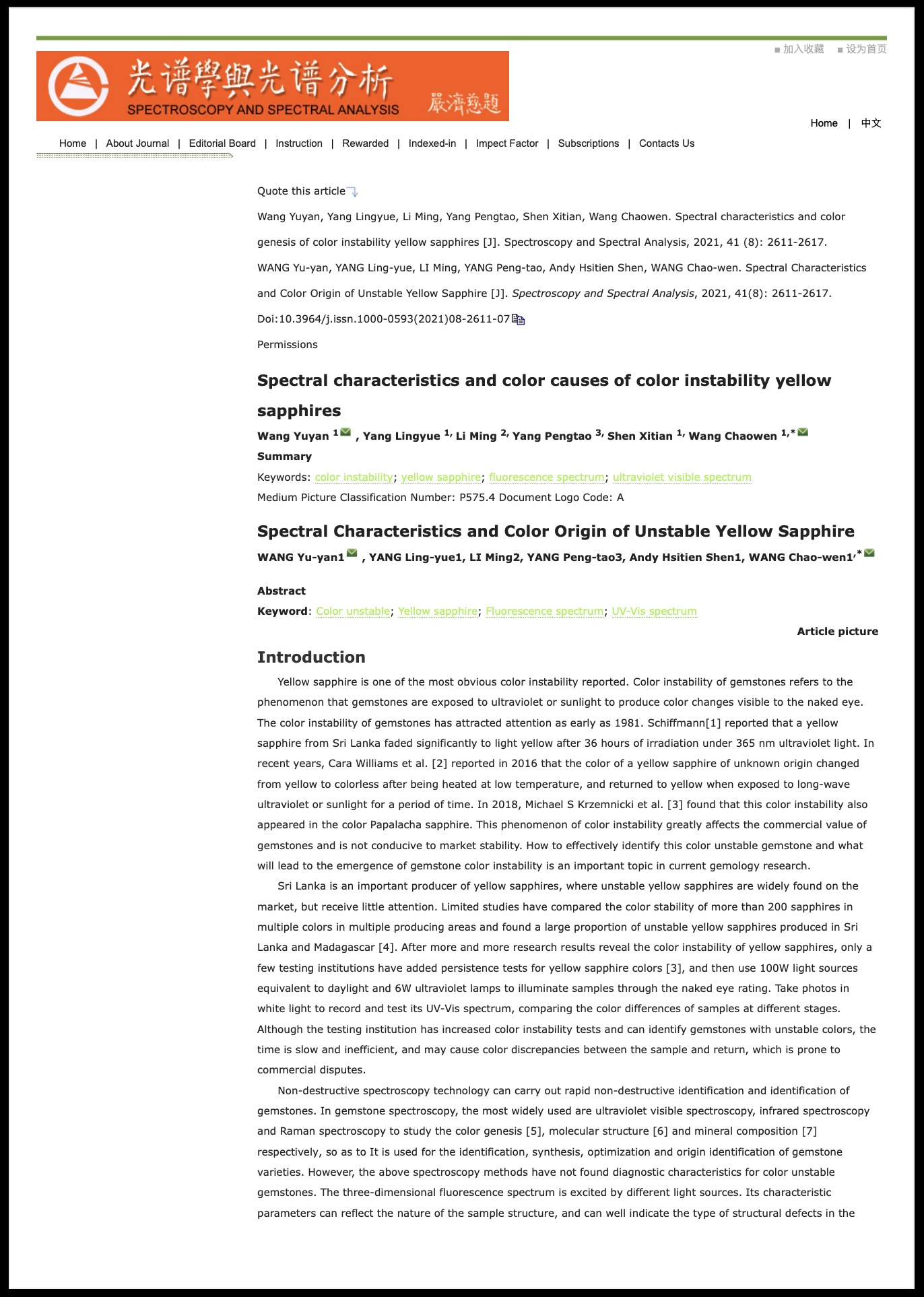
Spectral characteristics and color origin of unstable yellow sapphire

Spectral characteristics and color origin of unstable yellow sapphire

Wang, Y., Yang, L., Li, M., Yang, P., Shen, A.H. and Wang, C. (2021)

Journal Article · Source: Spectroscopy and Spectral Analysis · Volume: Vol. 41 · Issue: No. 8 · Pages: pp. 2611–2617 · Language: in Chinese

Abstract
Yellow sapphire is one of the most obvious color instability reported. Color instability of gemstones refers to the phenomenon that gemstones are exposed to ultraviolet or sunlight to produce color changes visible to the naked eye. The color instability of gemstones has attracted attention as early as 1981. Schiffmann[1] reported that a yellow sapphire from Sri Lanka faded significantly to light yellow after 36 hours of irradiation under 365 nm ultraviolet light. In recent years, Cara Williams et al. [2] reported in 2016 that the color of a yellow sapphire of unknown origin changed from yellow to colorless after being heated at low temperature, and returned to yellow when exposed to long-wave ultraviolet or sunlight for a period of time. In 2018, Michael S Krzemnicki et al. [3] found that this color instability also appeared in the color Papalacha sapphire. This phenomenon of color instability greatly affects the commercial value of gemstones and is not conducive to market stability. How to effectively identify this color unstable gemstone and what will lead to the emergence of gemstone color instability is an important topic in current gemology research.
Keywords
gems, corundum, color.4, treatments.6, irradiation, irradiation paper on ruby, yellow sapphire
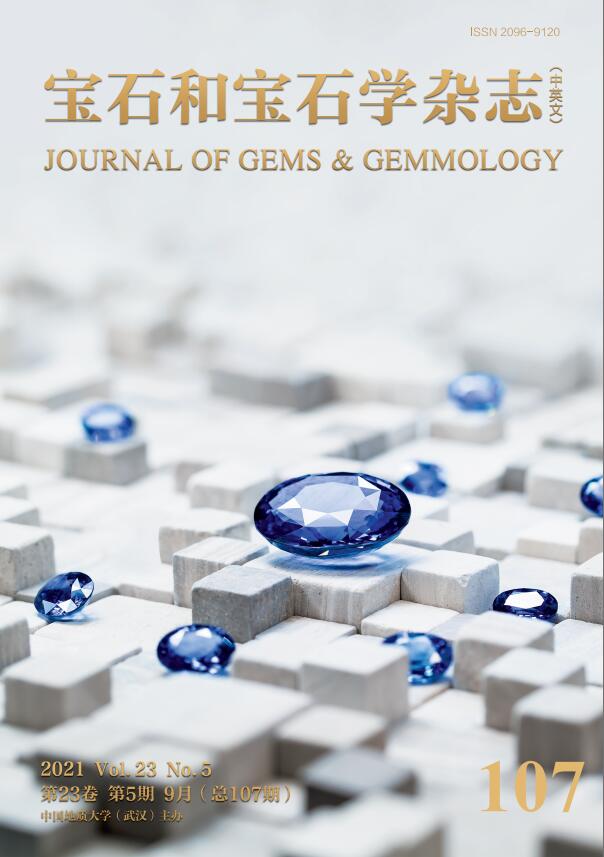
Identification characteristic of purple jadeite treated with bleaching, filling and dyeing

Identification characteristic of purple jadeite treated with bleaching, filling and dyeing

Yu, L., Dai, H., Li, L., Cao, S., Wang, F., Guo, L. and Yu, Z. (2021)

Journal Article · Source: Journal of Gems & Gemmology · Volume: Vol. 23 · Issue: No. 5 · Pages: pp. 65–74 · Language: in Chinese with English abstract

Abstract
To explore the identification characteristics of purple jadeite treated with bleaching, filling, and dyeing, gem microscope, refractometer, UV-Vis-NIR spectrophotometer, XRF spectrometer, DiamondView, FTIR, and Raman spectrometer were used. The results showed that the internal structure of the purple jadeite samples treated with bleaching, filling, and dyeing was destroyed, and epoxy resin was detected by infrared spectrometer and Raman spectrometer. A strong Raman peak at 1596 cm⁻¹ could be the characteristic peak of dyes. Luminescent images showed the characteristic blue-violet fluorescence of the polymers formed by epoxy resin and organic dyes. The UV-Vis spectra of the treated purple jadeite samples showed an absorption band of 200–350 nm, an absorption peak at 409 nm, and an absorption band near 569 nm. In contrast, the internal structure of jadeite stained by purple polishing powder was not damaged, and the purple color appeared only on the surface since the powder particles remained superficially. The luminescent images showed pinkish-purple fluorescence, caused by the purple polishing powder. The UV-Vis spectra showed a strong central absorption band at 558 nm and a weak central absorption band at 611 nm, which differ from those of natural purple jadeite.
Keywords
gems, jade, jadeite, fei cui, treated jadeite, fei cui, dyed jadeite, fei cui, lavender jadeite, fei cui

Building a Gemological Library

Gemological books range from general identification manuals and textbooks to specialized works on individual gems, mineralogy, jewelry, treatments, synthesis, history and gem-producing regions.

For a curated selection of particularly useful books, read The Gemologist's Core Library — Classic Books on Gemology, Jewelry and Mineralogy.

About Four Treasures

Four Treasures is Lotus Gemology's freely accessible gemological reference database. Use the full database to search by author, title or keyword and explore literature on gemology, mineralogy, jewelry and related fields. Where available, hyperlinks on titles may lead directly to the full publication.

Search the Complete Four Treasures Database