Gemology Books Bibliography

Gemology Books Bibliography

Explore books on gems, gemology, jewelry and mineralogy in Four Treasures, the Lotus Gemology reference database. This bibliography brings together matching book records from the collection, with publication details, abstracts and cover images where available.

Gemology Book References

The list below matches books concerning gemology and related subjects in the database's searchable fields. Some works cover several branches of gems, jewelry or mineralogy.

241–260 of 3,436 matching references
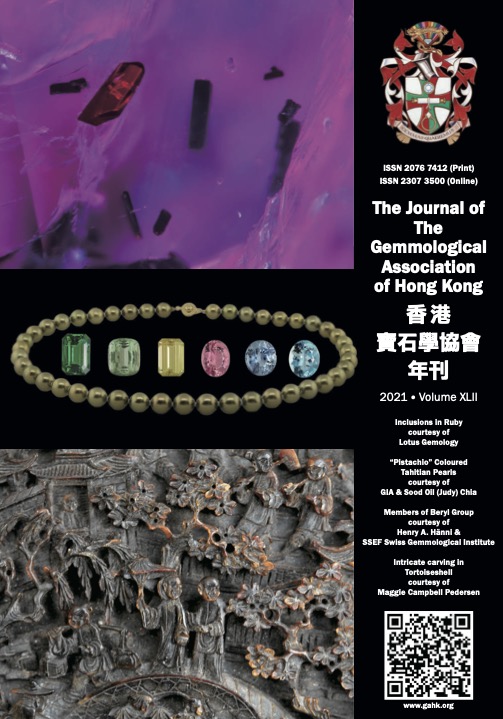
Gemmological characteristics of a “new style” bleached, filled and dyed fei cui that differs from traditional simulants

Gemmological characteristics of a “new style” bleached, filled and dyed fei cui that differs from traditional simulants

Long, T., He, L., Chen, N., Liao, B., Wang, D., Li, L., Deng, L., Liu, J. and Sun, M. (2021)

Journal Article · Source: Journal of the Gemmological Association of Hong Kong · Volume: Vol. 42 · Pages: pp. 62–68 · Language: in Chinese with English abstract

Abstract
In recent years, a new type of treated fei cui that is bleached, filled and dyed has entered the gem market, with most showing vivid colours and high transparency. Ultra-high-resolution microscopy, polarised light microscopy, DiamondView and FTIR are used to compare traditional treated B+C jadeite jade with this new type of treated B+C jadeite jade, with analysis under Raman and UV-Vis. The results show that, due to severe bleaching, more resin in the filling and a different variety of resin, this new B+C jadeite jade has greater transparency than the traditional B+C type. The new B+C type is dyed with an organic agent. The resulting dyed jadeite jade has the same colour but a different tone, and might show a different UV-Vis spectrum. Most samples of this new B+C type do not show a 437 nm absorption line. FTIR spectra of the resin filling (with curing agent) in the new B+C type show a broad absorption peak centred at 1594 cm⁻¹ and an absorption peak around 4052 cm⁻¹. Raman spectra show peaks at 1595 cm⁻¹ and 1142 cm⁻¹.
Keywords
gems, jadeite, fei cui, Myanmar, treated jadeite, fei cui
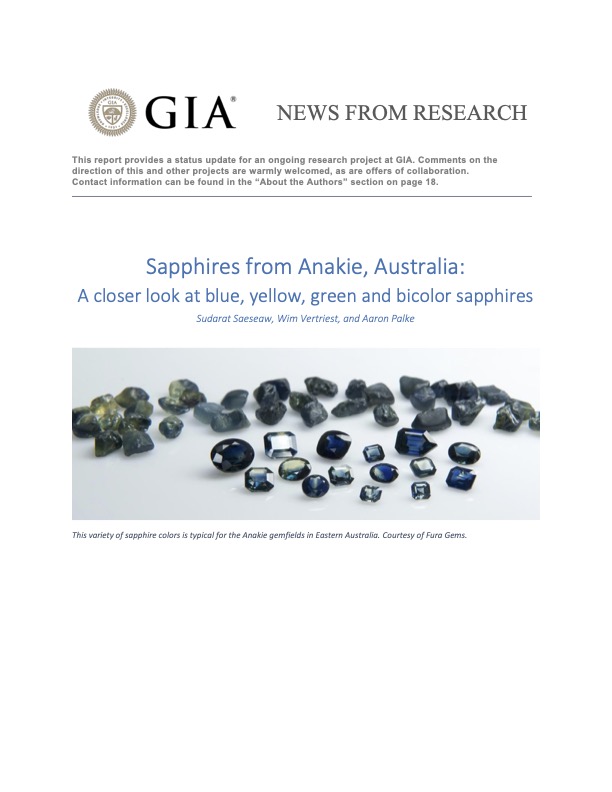
Sapphires from Anakie, Australia: A Closer Look at Blue, Yellow, Green and Bicolor Sapphires

Sapphires from Anakie, Australia: A Closer Look at Blue, Yellow, Green and Bicolor Sapphires

Saeseaw, S., Vertriest, W. and Palke, A. (2021)

Report · Source: GIA News from Research · Publisher: Gemological Institute of America · Pages: 18 pp.

Abstract
Australia has a long and rich sapphire mining history, yet the blue gems from Down Under have rarely been fully appreciated. While they were most desired in the early 1900s, their position has faded to the background. That doesn’t mean that mining stopped; both large and small operations kept operating in the last decades. Recent efforts have cast a new light on the variety of sapphires in Australia, which includes classic blues and yellow, green, and bicolor stones. This suite of colors is also referred to as BGY sapphires, which are classically related to alkali-basalt eruptions. In this study, we take a deeper look at the colors of these sapphires and what caused them, as well as the inclusion scenes observed in these gems.
Keywords
gems, corundum, Australia.12, Queensland, Rubyvale, Sapphire
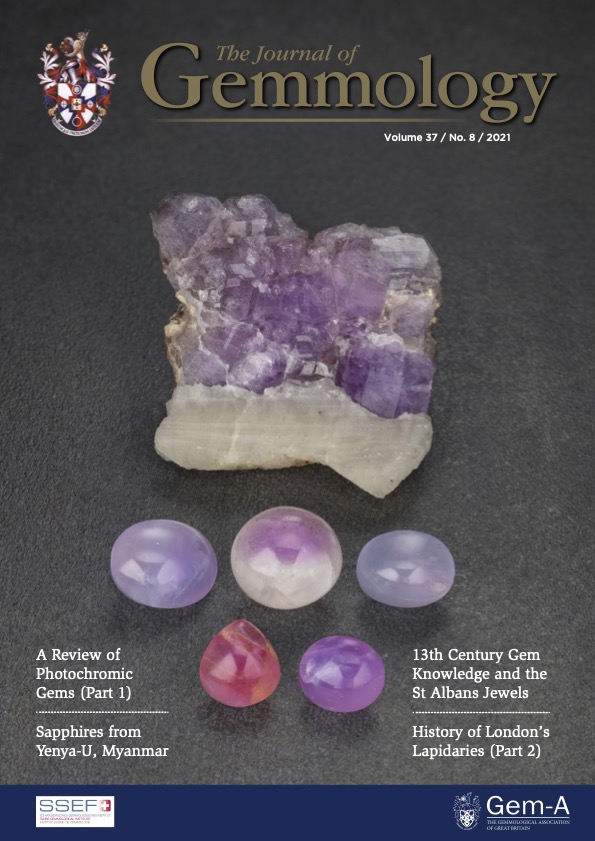
Gem knowledge in the thirteenth century: The St Alban jewels

Gem knowledge in the thirteenth century: The St Alban jewels

Ogden, J.M. (2021)

Journal Article · Source: Journal of Gemmology · Volume: Vol. 37 · Issue: No. 8 · Pages: pp. 816–834

Abstract
Medieval documents can provide information about the types of gems in use at that time and their terminology. Some such texts show a level of sophistication regarding what we might consider to be early gemmology, prompting questions as to how such knowledge was passed on. This article considers the range of gems used in thirteenth-century England and the level of gemmological knowledge at the time, based on an inventory of the treasures owned by St Albans Abbey that was drawn up in 1257. The compiler was the monk and polymath Matthew Paris (ca. 1200–1259), and the inventory is noteworthy for its detailed descriptions and colour paintings of each object. From these we can learn about the range of gems familiar during that period, as well as the way in which different qualities and origins were described, and even some terminology used for jewellery settings.
Keywords
gems, corundum, History.1, sapphire, ruby
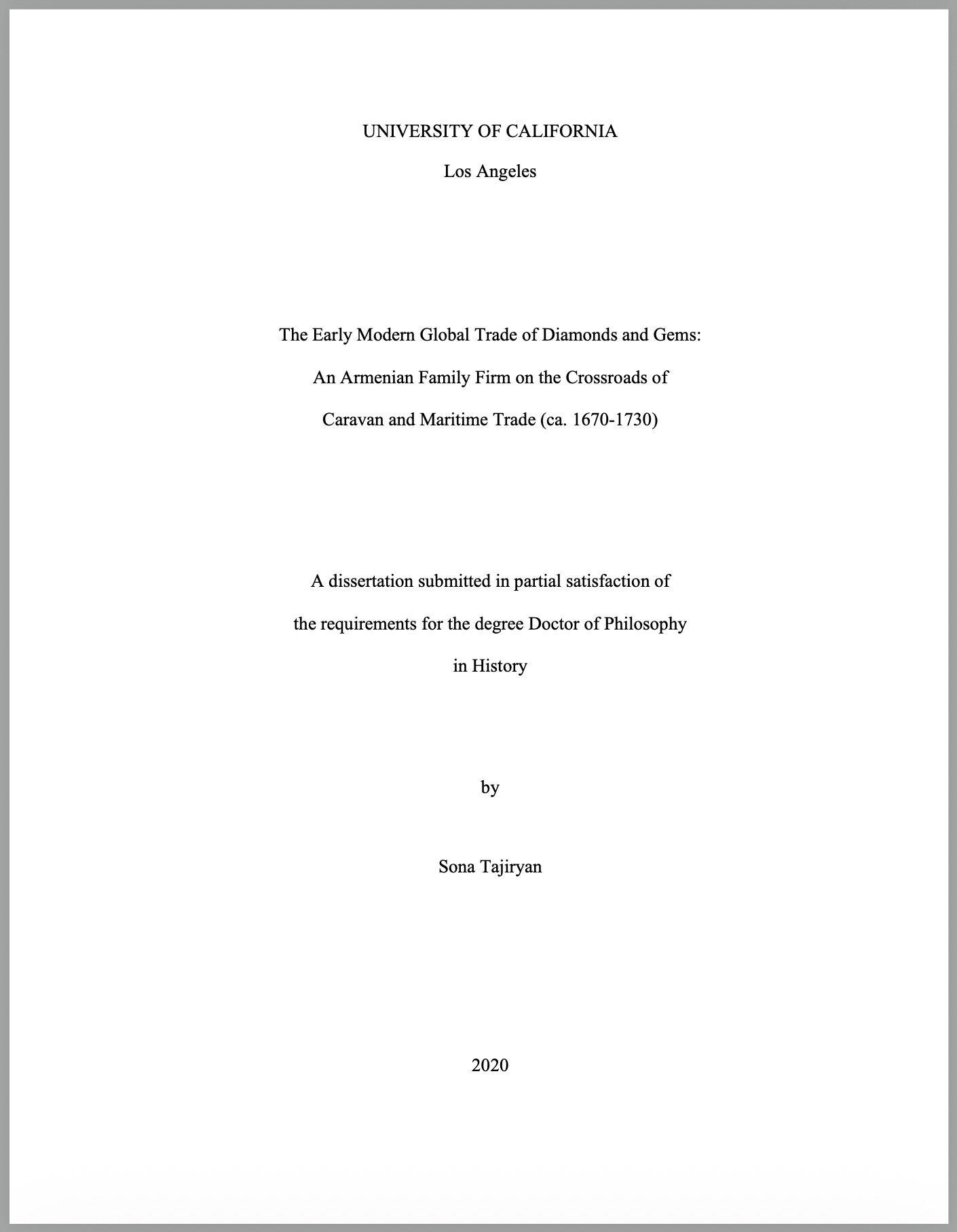
The early modern global trade of diamonds and gems: An Armenian family firm on the crossroads of caravan and maritime trade (ca. 1670–1730)

The early modern global trade of diamonds and gems: An Armenian family firm on the crossroads of caravan and maritime trade (ca. 1670–1730)

Tajiryan, S. (2020)

Thesis · Publisher: University of California, Los Angeles · Volume: PhD thesis · Pages: 293 pp.

Abstract
This dissertation analyzes the Early Modern global luxury commodity trade of diamonds and gems conducted between the Indian Subcontinent and the Mediterranean during 1670s and 1730s. It examines the involvement of the Armenian mercantile network of merchants from New Julfa, Isfahan in this global trade by focusing on the previously unpublished and unstudied body of archival documents from state and private archives in Italy, the UK, Armenia, Iran and beyond. By focusing on a single family firm of professional gem merchants, the Minasians, their network of agents and business activities, this dissertation argues against the previously presumed idea by economic historians that early modern Asian merchants and family firms were merely peddlers in the face of the European chartered joint-stock companies. Operating from Isfahan and Livorno all the way to the Russian, Ottoman and Mughal Empires, the previously little-studied Minasian archival documents demonstrate that these gem merchants’ business ventures covered vast distances and included all three “gunpowder empires” of the early modern period. This dissertation also sheds light on the specifics of decision making, as well as the role of social capital in the long-distance business operations of this family firm. It argues that the systematic circulation of information and market knowledge played a key role in the business and decision-making culture of this family firm. Moreover, their detailed knowledge of early modern gem markets and the efficient information circulation through correspondence provided the most accurate, combined use of the caravan and maritime trade routes, whichever was cheaper and safer at any one moment. By offering a new narrative on the agency of the Minasian family firm in the early modern Eurasian long-distance trade, this dissertation makes an argument that the above-mentioned practices could be representative of a bigger body of Asian family firms operating in late seventeenth and eighteenth century Eurasia.
Keywords
gems, history of gemology, history of the gem trade, Russia, Ottomans, Mughal, diamond, ruby
Fifteenth century magico-medicinal minerals: The Hortus Sanitatis (1491)

Fifteenth century magico-medicinal minerals: The Hortus Sanitatis (1491)

Duffin, C.J. (2020)

Electronic Article · Source: Deposits Magazine · Pages: 25 pp.

Abstract
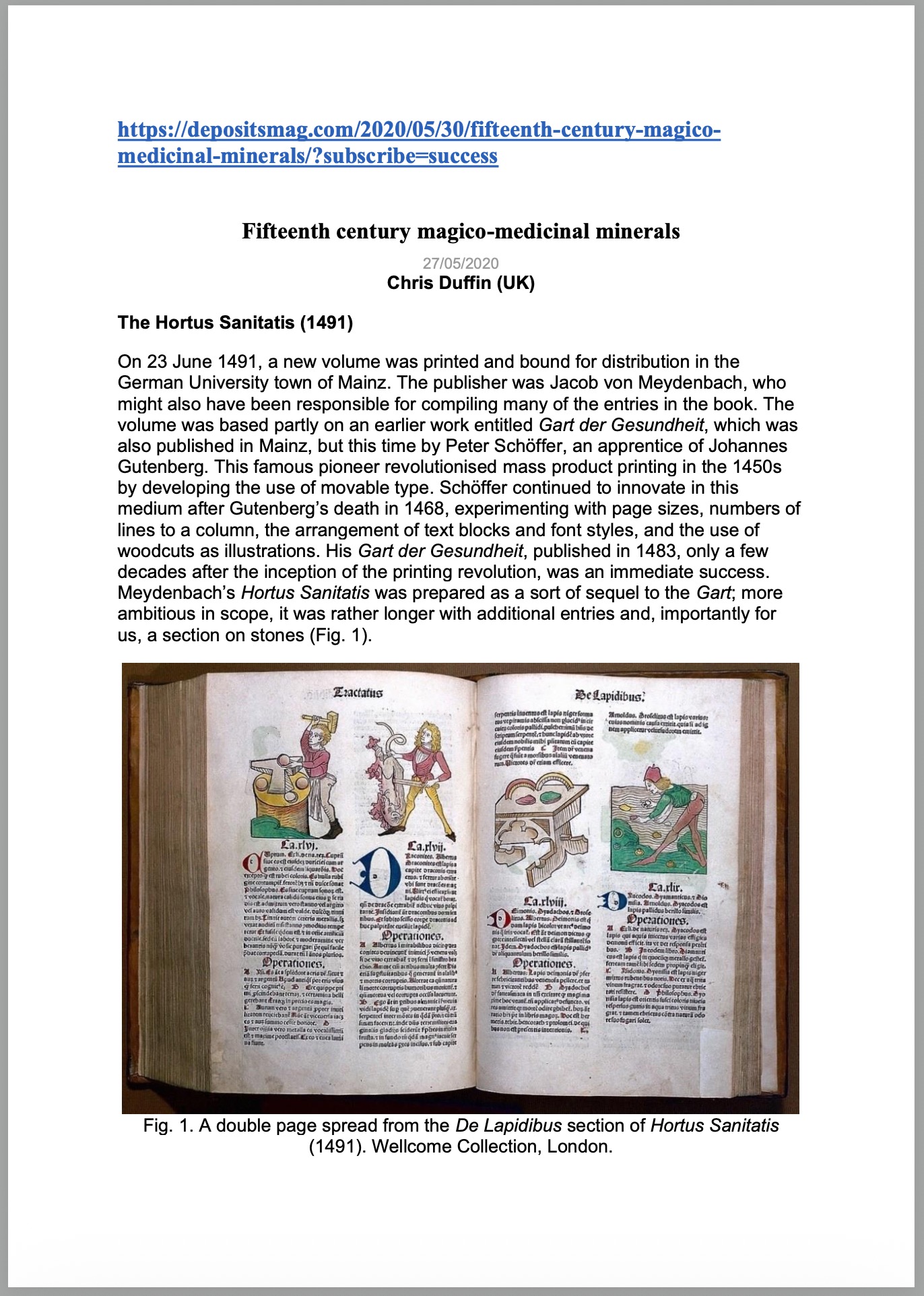
On 23 June 1491, a new volume was printed and bound for distribution in the German University town of Mainz. The publisher was Jacob von Meydenbach, who might also have been responsible for compiling many of the entries in the book. The volume was based partly on an earlier work entitled Gart der Gesundheit, which was also published in Mainz, but this time by Peter Schöffer, an apprentice of Johannes Gutenberg. This famous pioneer revolutionised mass product printing in the 1450s by developing the use of movable type. Schöffer continued to innovate in this medium after Gutenberg’s death in 1468, experimenting with page sizes, numbers of lines to a column, the arrangement of text blocks and font styles, and the use of woodcuts as illustrations. His Gart der Gesundheit, published in 1483, only a few decades after the inception of the printing revolution, was an immediate success. Meydenbach’s Hortus Sanitatis was prepared as a sort of sequel to the Gart; more ambitious in scope, it was rather longer with additional entries and, importantly for us, a section on stones (Fig. 1).
Keywords
gems, early lapidaries, Europe, Germany, Mainz, early gemology, history of gemology
The rules of construction of an Aztec deity: Chalchiuhtlicue, the goddess of water

The rules of construction of an Aztec deity: Chalchiuhtlicue, the goddess of water

Dehouve, D. (2020)

Journal Article · Source: Ancient Mesoamerica · Publisher: Cambridge University Press · Volume: Vol. 31 · Issue: No. 1 · Pages: pp. 7–28

Abstract
This article seeks to contribute to the development of a method for analyzing the attributes of the gods of central Mexico in the manuscripts and the statuary from the time of the Spanish conquest. I focus on the Goddess of Water, Chalchiuhtlicue, “Jade Her Skirt.” The method consists of isolating the component designs of her array and grouping them in semantic groups. I begin by examining these designs and show that all of them were used in the notation of toponyms. These findings call into question the traditional separation between glyphs and icons. I next study the semantic groups and show that they consist of a series of culturally selected manifestations of water. Hence, it follows that the rules of composition of the goddess were grounded on a process of “definition by extension.” Thus, most of the semantic groups referred to different secondary names of the goddess, allowing us to think that they represented theonyms of a particular type.
Keywords
gems, jade, pyroxene jade, fei cui, guatemala, Mesoamerica, Nicaragua, Mexico, Honduras, Costa Rica, archaeogemology, Mayan design, aesthetics, Olmec, Aztec, Guatemala, archaeology
Physico-chemical Characterization of Iranian Turquoises: A tentative [sic] to trace Middle-Eastern Turquoise-bearing Artifacts

Physico-chemical Characterization of Iranian Turquoises: A tentative [sic] to trace Middle-Eastern Turquoise-bearing Artifacts

Mousavipak, N. (2020)

Thesis · Source: Material Chemistry · Publisher: University of Lyon · Volume: PhD thesis · Pages: 128 pp.

Abstract
This study compares turquoise CuAl₆(PO₄)₄(OH)₈·4H₂O from historic Iranian mines—Neyshapour, Damghan, and Kerman—with turquoise from other regional sources to identify characteristics that may help determine the origin of turquoise artifacts or jewelry. Samples of varying colors and turquoise jewels from the Musée des Arts Décoratifs de Paris (MAD) were analyzed using Raman and FTIR spectroscopy. While FTIR revealed no major differences among colors, Raman spectra showed sharper linewidths in blue turquoise, indicating greater structural order than in green samples, likely due to OH and H₂O vibrational mode sensitivity to compositional substitutions. Absorption spectroscopy showed even the best blue turquoise had minor Fe³⁺ absorption; color is primarily influenced by Cu²⁺ and Fe³⁺, with Fe²⁺ having negligible effect, and Fe³⁺ substitution for Al³⁺ turning the turquoise green. LIBS mapping allowed quick identification of turquoise, pyrite, and silicate phases, and revealed minor Al-Fe substitution. XRF analysis quantified major (Al, P, Cu) and trace elements (Fe, Zn, As, Ca, Ti). Correlation and PCA analyses combining measured and bibliographic data showed that MAD turquoise jewelry aligns with Neyshapour turquoise signatures, while Kerman and Chinese sources do not match. This suggests the MAD turquoise pieces dating before the 19th century likely originated in Persia.
Keywords
gems, ancient gemology, ancient jewelry, turquoise, turquoise origin determination, Persia, Perisan turquoise, Iran, Nishapur, Neyshapour
Emerald mining in Sikait: Organization and distribution of emerald production in Roman Egypt

Emerald mining in Sikait: Organization and distribution of emerald production in Roman Egypt

Guzmán, J.O. (2020)

Journal Article · Source: Polish Archaeology in the Mediterranean · Volume: Vol. 29 · Issue: No. 1 · Pages: pp. 173–199

Abstract
The Smaragdos region, currently in the Wadi Gemal National Park (Eastern Desert, Egypt) was well known in antiquity for the emeralds that could be found there. The exploitation of emerald mines, especially in the Roman period, led to the creation of an important network of settlements linked to the procurement and commercial distribution of this semiprecious stone, which was considered highly valuable in ancient times. The overview of the emerald trade in Roman antiquity presented in this paper will focus on Sikait, the most important and best known of the mining settlements in the Eastern Desert.
Keywords
gems, beryl, emerald, Egypt, Cleopatra, history of gemology, archaeology, archaeologemology
Jadeite jade or 翡翠 fei cui?

Jadeite jade or 翡翠 fei cui?

Liu, S. (2020)

Podcast · Source: 15th Home Gemmology Webinar · Publisher: YouTube.com

Abstract
In the 15th Home Gemmology webinar, with the support of CIBJO - The World Jewellery Confederation, the discussion is made around the nomenclature debate that is happening at the time of broadcast (May 2020) around the so-called jadeite jade that is known in China as 翡翠 fei cui . To address the scientific angle of this matter, I've invited Dr Edward Liu FGA, Vice-Chairman of the Gemmological Association of Hong Kong, following the discussion presented at the last CIBJO Congress. At the time of the recording, a CIBJO working group is currently discussing this nomenclature with a resolution supposed be presented in the near future, having in mind that the mission statement of CIBJO is much about promoting consumer confidence. Edward Johnson, co-editor of the Home Gemmology webinar series, also shares his personal experience as a westerner that loved in Hong Kong in the late 1990 and dealt directly with jade.
Keywords
gems, jade, Fei cui, pyroxene jade, history of jadeite, fei cui, omphacite, kosmochlor
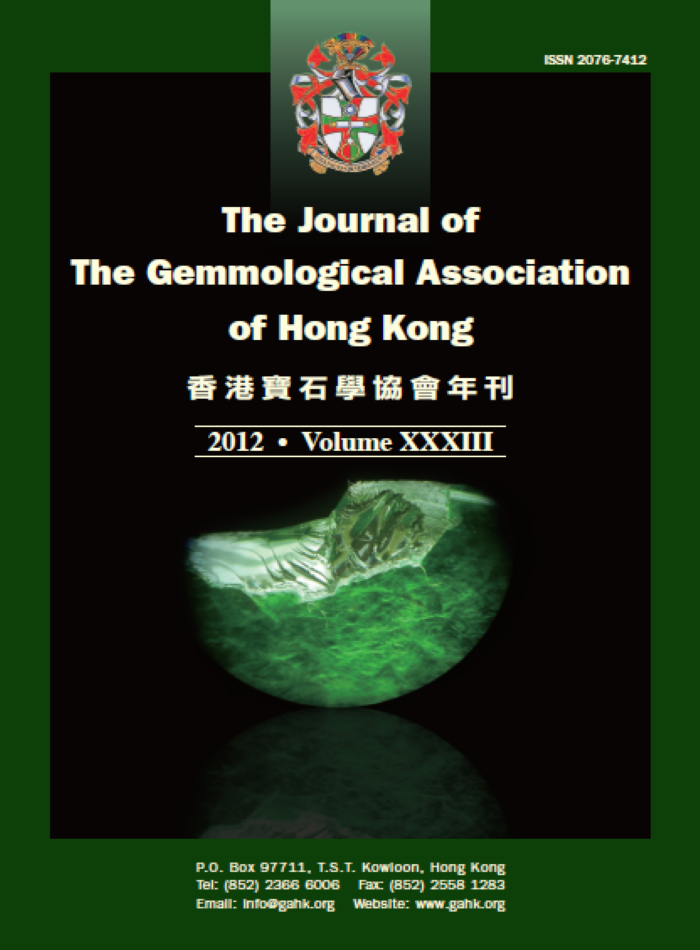
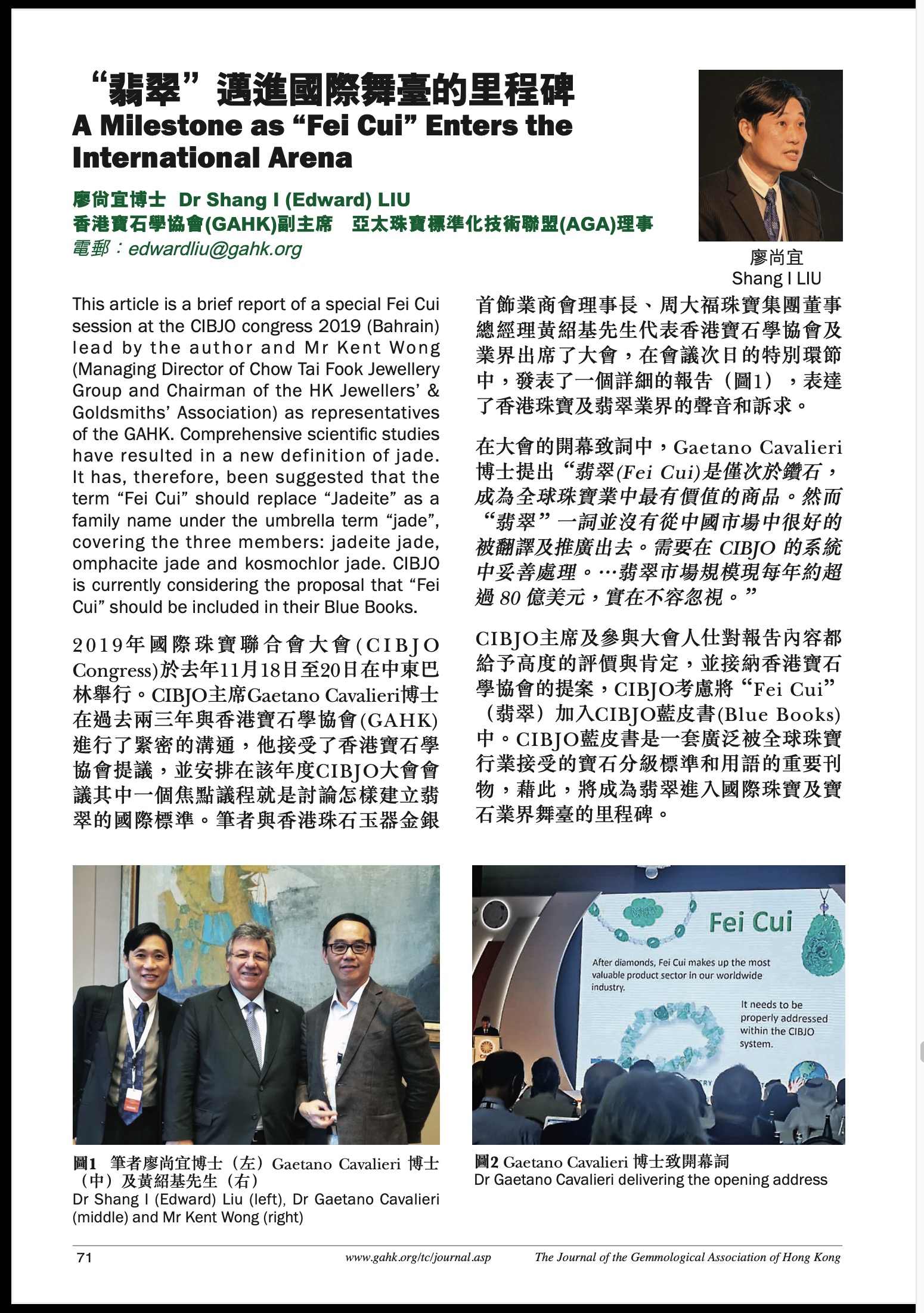
A milestone as “fei cui” enters the international arena

A milestone as “fei cui” enters the international arena

“翡翠”邁進國際舞臺的里程碑

Liu, S. (2020)

Journal Article · Source: Journal of the Gemmological Association of Hong Kong · Volume: Vol. 41 · Pages: pp. 71–75 · Language: in Chinese with English abstract

Abstract
This article is a brief report of a special Fei Cui session at the CIBJO congress 2019 (Bahrain) lead by the author and Mr Kent Wong (Managing Director of Chow Tai Fook Jewellery Group and Chairman of the HK Jewellers’ & Goldsmiths’ Association) as representatives of the GAHK. Comprehensive scientific studies have resulted in a new definition of jade. It has, therefore, been suggested that the term “Fei Cui” should replace “Jadeite” as a family name under the umbrella term “jade”, covering the three members: jadeite jade, omphacite jade and kosmochlor jade. CIBJO is currently considering the proposal that “Fei Cui” should be included in their Blue Books.
Keywords
gems, jade, pyroxene jade, jadeite, fei cui, omphacite, kosmochlor, jade nomenclature
Low-temperature heat treatment of pink sapphires from Ilakaka, Madagascar

Low-temperature heat treatment of pink sapphires from Ilakaka, Madagascar

Saeseaw, S., Khowpong, C. and Vertriest, W. (2020)

Journal Article · Source: Gems & Gemology · Volume: Vol. 56 · Issue: No. 4, Winter · Pages: pp. 448–457

Abstract
Rutile, titanium dioxide (TiO₂), is a tetragonal mineral that generally occurs in corundum as silk (exsolution-formed needles), dust-like exsolution particles, or macroscopic crystal inclusions. Rutile crystals can have orange to deep red-brown coloration, and the crystal shapes can be rounded or euhedral. The author recently examined a 4.24 ct faceted transparent blue sapphire from Afghanistan. The stone contained dusty flake-like inclusions, naturally healed fractures, lathe-like inclusions, twinning, rounded colorless crystals identified as apatite (RRUFF R040098), and an unusual long prismatic orange crystal identified as rutile (RRUFF R040049). This rutile crystal shape (figure 12) is not typical for corundum, particularly in blue sapphire.
Keywords
gems, corundum, treatments.6, inclusions.5, Madagascar.12, pink sapphire
Inclusion and trace element characteristics of emeralds from Swat Valley, Pakistan

Inclusion and trace element characteristics of emeralds from Swat Valley, Pakistan

Guo, H., Yu, X., Zheng, Y., Sun, Z. and Ng, M.F.-Y. (2020)

Journal Article · Source: Gems & Gemology · Volume: Vol. 56 · Issue: No. 3, Fall · Pages: pp. 336–355

Abstract
Swat Valley has become an important source of emeralds, including recently discovered trapiche-type crystals. In this study, emerald samples from Swat were examined by standard gemological testing, UV-Vis-NIR, FTIR, Raman analysis, EDXRF, and LA-ICP-MS. The study found three-phase hexagonal inclusions consisting of water, gaseous carbon dioxide and nitrogen, and a magnesite crystal. The gaseous mixture in two-phase inclusions is characteristic in both trapiche-type (CO₂ + N₂) and non-trapiche samples (CO₂ + N₂ + CH₄). Mineral inclusions of hematite, magnetite, rutile, graphite, and siderite are reported for the first time. Regular non-trapiche-type Swat emeralds contain high chromium (avg. 7471 ppmw), alkali metal (avg. 21,040 ppmw), magnesium (avg. 34,263 ppmw), and iron (avg. 9265 ppmw), as well as scandium (avg. 633 ppmw). Infrared spectra show that the absorption of type II H₂O is stronger than that of type I H₂O. Logarithm plots of trace elements appear to be diagnostic. Based on Raman spectroscopy, the trapiche-type emeralds’ colorless core, light green hexagonal growth zone area, and green rim are emerald, while the six black arms are a mixture of hematite and graphite.
Keywords
gems, beryl, emerald, Pakistan, Swat
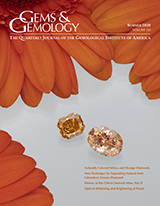
History of the Chivor emerald mine, Part II (1924–1970): Between insolvency and viability

History of the Chivor emerald mine, Part II (1924–1970): Between insolvency and viability

Schmetzer, K., Martayan, G. and Blake, A.R. (2020)

Journal Article · Source: Gems & Gemology · Volume: Vol. 56 · Issue: No. 2, Summer · Pages: pp. 230–257

Abstract
The history of the Chivor emerald mine in Colombia is a saga with countless twists and turns, involving parties from across the globe. Indigenous people initially exploited the property, followed by the Spanish in the sixteenth and seventeenth centuries, before abandonment set in for 200 years. The mine was rediscovered by Francisco Restrepo in the 1880s, and ownership over the ensuing decades passed through several Colombian owners and eventually to an American company, the Colombian Emerald Syndicate, Ltd., with an intervening but unsuccessful attempt by a German group organized by Fritz Klein to take control. With the Colombian Emerald Syndicate succumbing to bankruptcy in 1923, the property was sold and then transferred in 1924 to another American firm, the Colombia Emerald Development Corporation. Under the new ownership, stock market speculation played a far more prominent role in the story than actual mining. Nonetheless, periods of more productive mining operations did take place under managers Peter W. Rainier and Russell W. Anderton. Yet these were not enough to prevent the company, renamed Chivor Emerald Mines, Inc. in 1933, from entering insolvency in 1952 and being placed into receivership. Leadership by Willis Frederick Bronkie enabled the firm to regain independence in 1970 and shortly thereafter to be sold in a series of transactions, with Chivor gradually being returned to Colombian interests.
Keywords
gems, beryl, emerald, Colombia, Chivor

Building a Gemological Library

Gemological books range from general identification manuals and textbooks to specialized works on individual gems, mineralogy, jewelry, treatments, synthesis, history and gem-producing regions.

For a curated selection of particularly useful books, read The Gemologist's Core Library — Classic Books on Gemology, Jewelry and Mineralogy.

About Four Treasures

Four Treasures is Lotus Gemology's freely accessible gemological reference database. Use the full database to search by author, title or keyword and explore literature on gemology, mineralogy, jewelry and related fields. Where available, hyperlinks on titles may lead directly to the full publication.

Search the Complete Four Treasures Database