Gemology Books Bibliography

Gemology Books Bibliography

Explore books on gems, gemology, jewelry and mineralogy in Four Treasures, the Lotus Gemology reference database. This bibliography brings together matching book records from the collection, with publication details, abstracts and cover images where available.

Gemology Book References

The list below matches books concerning gemology and related subjects in the database's searchable fields. Some works cover several branches of gems, jewelry or mineralogy.
2,101–2,120 of 3,681 matching references

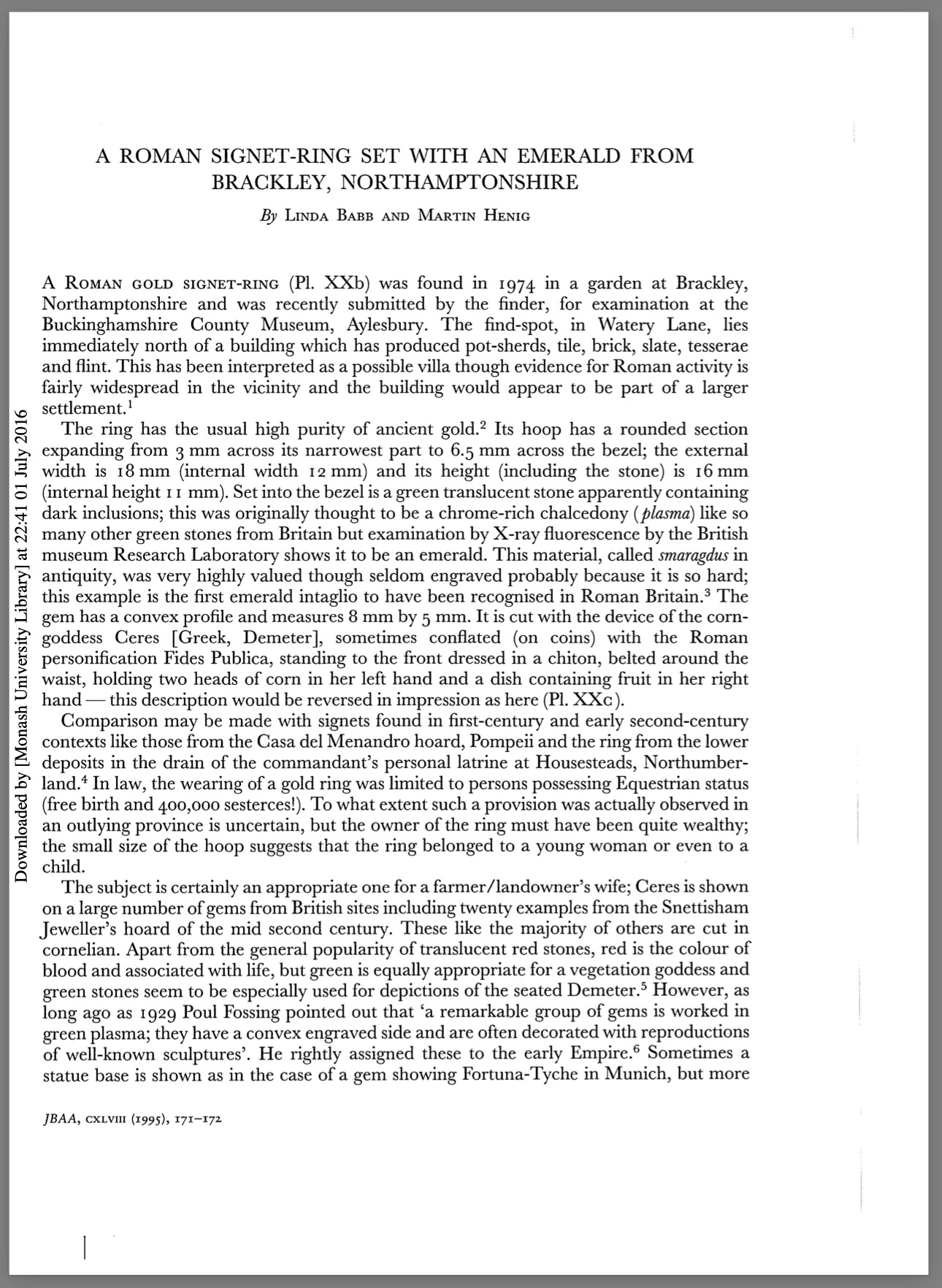
A Roman signet-ring set with an emerald from Brackley, Northamptonshire
Journal Article
Babb, L. and Henig, M. (1995) A Roman signet-ring set with an emerald from Brackley, Northamptonshire. Journal of the British Archaeological Association, Vol. 148, No. 1, pp. 171–172.
Record No. 26471  |  DOI: https://doi.org/10.1179/jba.1995.148.1.171  |  Sinkankas/Born No.: NIS / NIB  |  RWHL
View Individual Record ↗
A Roman gold signet-ring (Pl. XXb) was discovered in 1974 in a garden at Brackley, Northamptonshire, and was later submitted by the finder for examination at the Buckinghamshire County Museum, Aylesbury. The find-spot, located in Watery Lane, lies just north of a building that has yielded pot-sherds, tile, brick, slate, tesserae, and flint—suggesting a possible villa, though Roman activity appears widespread in the area, indicating the building may have been part of a larger settlement. The ring is made of high-purity ancient gold and features a hoop with a rounded section that expands from 3 mm at its narrowest point to 6.5 mm at the bezel; its external width is 18 mm (internal width 12 mm) and its height, including the stone, is 16 mm (internal height 11 mm). Set into the bezel is a green translucent stone with dark inclusions, initially believed to be a chrome-rich chalcedony (plasma), as is common in Britain, but identified through X-ray fluorescence analysis by the British Museum Research Laboratory as an emerald. Known in antiquity as smaragdus, emeralds were highly prized though rarely engraved due to their hardness—making this the first known emerald intaglio from Roman Britain. The gem, which has a convex profile and measures 8 mm by 5 mm, is engraved with the image of the corn-goddess Ceres (Greek, Demeter), sometimes conflated with the Roman Fides Publica on coins. She is depicted standing frontally, dressed in a belted chiton, holding two heads of corn in her left hand and a dish of fruit in her right—an image that would appear in reverse in impression (Pl. XXc).

Routes through the Eastern Desert of Egypt
Journal Article
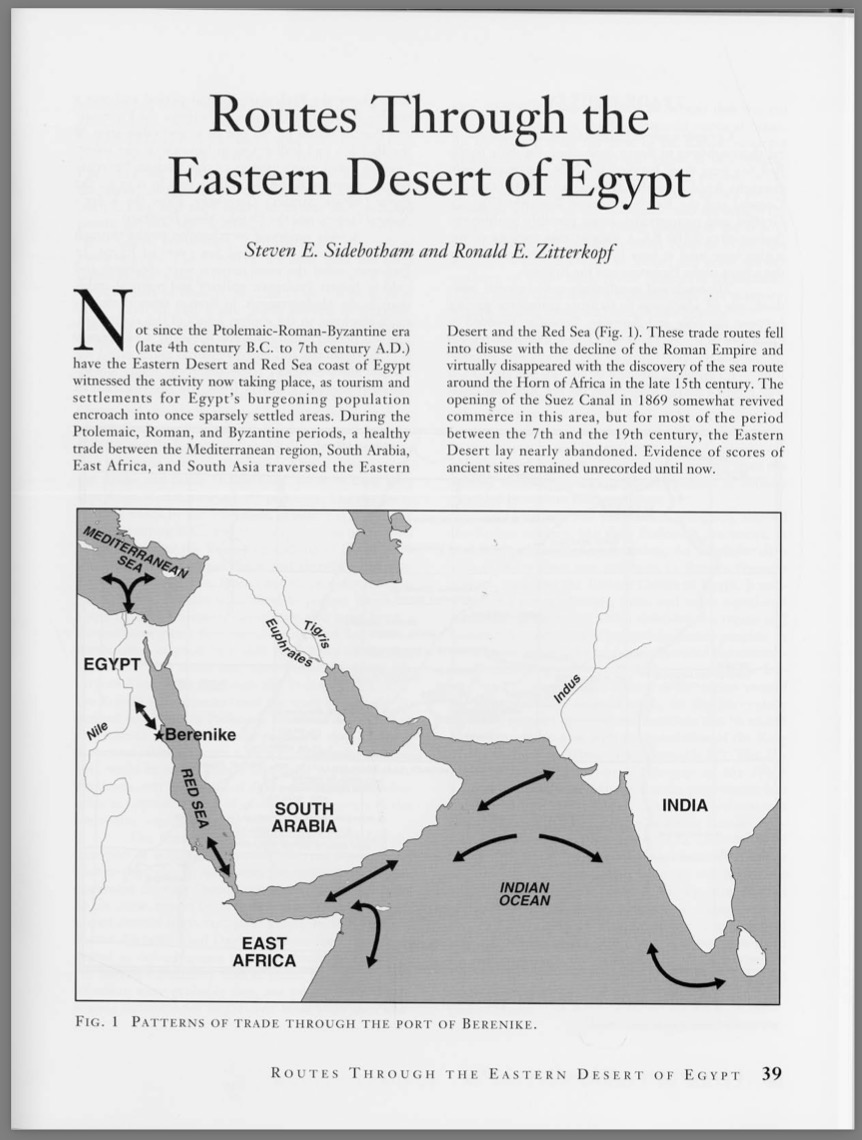
Sidebotham, S.E. and Zitterkopf, R.E. (1995) Routes through the Eastern Desert of Egypt. Expedition, Vol. 37, No. 2, pp. 39–51.
Record No. 17245  |  Sinkankas/Born No.: NIS / NIB  |  RWHL
View Individual Record ↗
Not since the Ptolemaic-Roman-Byzantine era (late 4th century B.C. to 7th century A.D.) have the Eastern Desert and Red Sea coast of Egypt witnessed the activity now taking place, as tourism and settlements for Egypt’s burgeoning population encroach into once sparsely settled areas. During the Ptolemaic, Roman, and Byzantine periods, a healthy trade between the Mediterranean region, South Arabia, East Africa, and South Asia traversed the Eastern Desert and the Red Sea (Fig. 1). These trade routes fell into disuse with the decline of the Roman Empire and virtually disappeared with the discovery of the sea route around the Horn of Africa in the late 15th century. The opening of the Suez Canal in 1869 somewhat revived commerce in this area, but for most of the period between the 7th and the 19th century, the Eastern Desert lay nearly abandoned. Evidence of scores of ancient sites remained unrecorded until now.

Gem News: Ruby market in Taunggyi

Journal Article
Kammerling, Robert C., Koivula, John I. and Johnson, Mary L. (1995) Gem News: Ruby market in Taunggyi. Gems & Gemology, Vol. 31, No. 4, Winter, p. 282.
Record No. 5501  |  ISBN/ISSN: 0016626X  |  Sinkankas/Born No.: NIS / NIB  |  RWHL
View Individual Record ↗

Gem News: Large spinel from Tajikistan
Journal Article
Kammerling, R.C., Koivula, J.I., Johnson, M.L. and Fritsch, E. (1995) Gem News: Large spinel from Tajikistan. Gems & Gemology, Vol. 31, No. 3, Fall, p. 212.
Record No. 5163  |  ISBN/ISSN: 0016626X  |  Sinkankas/Born No.: NIS / NIB  |  RWHL
View Individual Record ↗
Large spinel from Tajikistan. Spinel is another gem material being recovered from this former Soviet republic in Central Asia. We know of one particularly exceptional stone, a 532-ct piece of rough spinel, that was fashioned into a number of gems. The largest of these gems weighed 146.43ct and was named the Katherina" by the purchaser of the rough, the Netherlands-based ACT International (see "Spectacular Spinel," by P. Bancroft, Lapidary loiunal, February 1990, p. 25). The Katherina was subsequently recut to 123.14ct (E. Caplan, pers. comm., 1995) and the refashioned stone loaned to GIA for examination. Although recut, it retained its basic step-cut cushion shape (figure 16).The stone exhibited properties consistent with natural spinel from other localities. Described as "virtually flawless" in the Lapidary lournal article, the stone revealed a small plane of what appeared to be octahedral negative crystals near the culet when examined with magnification. These substantiate the stone's natural origin. EDXRF chemical analysis by GIA Research showed only a tiny amount of zinc (Zn), which is consistent with Zn concentrations that have been documented in other spinels from this locality."

Gem News: Sapphire mining in Laos

Journal Article
Kammerling, Robert C., Koivula, John I. and Johnson, Mary L. (1995) Gem News: Sapphire mining in Laos. Gems & Gemology, Vol. 31, No. 4, Winter, pp. 282–283.
Record No. 5146  |  ISBN/ISSN: 0016626X  |  Sinkankas/Born No.: NIS / NIB  |  RWHL
View Individual Record ↗

Gem News: Rubies from the Barrington volcanic field, East Australia
Journal Article
Kammerling, Robert C., Koivula, John I. and Johnson, Mary L. (1995) Gem News: Rubies from the Barrington volcanic field, East Australia. Gems & Gemology, Vol. 31, No. 4, Winter, pp. 281–282.
Record No. 5145  |  ISBN/ISSN: 0016626X  |  Sinkankas/Born No.: NIS / NIB  |  RWHL
View Individual Record ↗

Gem Trade Lab Notes: Synthetic sapphire, with color changed by UV radiation
Journal Article
Kammerling, R.C. and McClure, S.F. (1995) Gem Trade Lab Notes: Synthetic sapphire, with color changed by UV radiation. Gems & Gemology, Vol. 31, No. 4, Winter, p. 271.
Record No. 5144  |  ISBN/ISSN: 0016626X  |  Sinkankas/Born No.: NIS / NIB  |  RWHL
View Individual Record ↗
Laboratory irradiation has been used to change or develop color in many gem materials. Examples include the development of yellow in beryl, pink-to-red in tourmaline, blue in topaz, brown (the “smoky” color) in quartz, and various colors in diamond. (For more information, see K. Nassau’s comprehensive Gemstone Enhancement, 2nd ed., 1994, Butterworth/Heinemann, Oxford, England, and C. E. Ashbaugh’s “Gemstone Irradiation and Radioactivity,” Gems & Gemology, Winter 1988, pp. 196–213.)

Gem Trade Lab Notes: Ruby with atypically high R.I.’s
Journal Article
Kammerling, R.C. and McClure, S.F. (1995) Gem Trade Lab Notes: Ruby with atypically high R.I.’s. Gems & Gemology, Vol. 31, No. 4, Winter, pp. 269–270.
Record No. 5143  |  ISBN/ISSN: 0016626X  |  Sinkankas/Born No.: NIS / NIB  |  RWHL
View Individual Record ↗
The article Update on Diffusion-Treated Corundum: Red and Other Colors" (S. F. McClure et al., Gems d Gemology, Spring 1993, pp. 16-28) focused on treated stones in purplish pink, reddish purple to purplish red, and orangy red hues. One feature documented in many of these sample stones, in contrast to documented blue diffusion-treated sapphires, was the presence of unusually high refractive indices. The authors speculated that this was due to the high chromium content in the diffused surface layer, and they made reference to a report in the literature mentioning high R.I. readings from high-chromium-content rubies and orange sapphires from Malawi."

Jadeite Appreciation

翡翠鑒賞
Book
Ouyang, C.M. [歐陽秋眉] (1995) Jadeite Appreciation. [翡翠鑒賞] Hong Kong, Cosmos Books Ltd., 191 pp.
Record No. 5116  |  ISBN/ISSN: 9622575846, 9789622575844  |  Sinkankas/Born No.: NIS / NIB  |  Language: in Chinese  |  RWHL
View Individual Record ↗
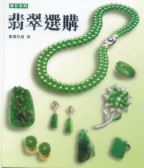
What is jade? From a lawsuit, remember that in the past few years, the Customs and Excise Department asked Hong Kong's gemologists to help with some technical consultants. Originally, a foreign buyer accused a company in Hong Kong of selling fake goods to it; The buyer ordered a thousand jade necklaces from the Hong Kong company. The Hong Kong company sent him a Dongling jade necklace. The buyer believed that Dongling jade is aventurine is not jade, while the seller said that Dongling Jade is only a different type of India jade." It should be jade, and the two sides can't hold each other's words, so they go to court. Hong Kong law stipulates that selling fake goods is subject to fines and can be sentenced to jail. Therefore, both sides have invited defense lawyers to fight the lawsuit, but lawyers can’t figure out what is real jade, so they can only ask for gemology. The family explained "What is jade". According to the definition of gemology, jade refers to two types of minerals, jadeite or nephrite, which have certain chemical and physical properties (see related chapters), while Dongling jade is neither jadeite nor nephrite. Strictly speaking, it cannot be called For jade. In the end, the judge sentenced the Hong Kong businessman to lose the case and needed compensation. This shows that the name "jade" cannot be used casually. We must understand its essence in order to be called jade. This book is a practical guide to the appreciation and evaluation of fei cui, relating its gemological characteristics to its appearance and commercial value. The discussion provides a basis for assessing finished fei cui and understanding the qualities sought by collectors and the jewellery trade."

Identification of bleached wax- and polymer-impregnated jadeite by X-ray photoelectron spectroscopy
Journal Article
Tan, T.L., Tay, T.S., Loh, F.C., Tan, K.L. and Tang, S.M. (1995) Identification of bleached wax- and polymer-impregnated jadeite by X-ray photoelectron spectroscopy. Journal of Gemmology, Vol. 24, No. 7, July, pp. 475–483.
Record No. 5090  |  ISBN/ISSN: 221252  |  Sinkankas/Born No.: NIS / NIB  |  RWHL
View Individual Record ↗
X-ray photoelectron spectroscopy (XPS) is investigated as a non-destructive method for identifying wax and polymer in bleached and impregnated fei cui and as a complement to infrared absorption spectroscopy. Sixteen specimens from Myanmar were examined, comprising four rough specimens, five naturally coloured polished specimens and seven bleached, wax- or polymer-impregnated polished cabochons. Preliminary testing included refractive index, immersion in di-iodomethane, visible absorption spectroscopy, ultraviolet fluorescence and Fourier-transform infrared spectroscopy. Refractive indices, immersion behaviour and visible absorption features did not reliably distinguish treated from untreated material; ultraviolet fluorescence provided indications of treatment in some specimens but was absent in others. Infrared spectra differentiated weak wax absorptions associated with conventional polishing from the much stronger absorptions of wax-impregnated specimens, while multiple strong bands between 2800 and 3100 cm⁻¹ identified polymer impregnation. XPS measurements, made after cleaning the surfaces with propanol, determined surface elemental composition and carbon bonding characteristics through survey scans and high-resolution carbon spectra. Untreated, unwaxed specimens showed the principal elements expected for jadeite, together with minor surface carbon and calcium. Their carbon-to-sodium signal ratio was approximately 2.5, compared with approximately 12 for wax-polished specimens, 11 for wax-impregnated specimens and 35 for polymer-impregnated specimens. The substantially greater carbon signal in the polymer-treated group distinguished it from the wax-bearing groups. Analysis of the carbon peak components provided further discrimination: wax-bearing material showed aliphatic, ether and ester contributions, whereas the polymer-impregnated specimens showed aliphatic, aromatic or phenyl, carbonyl and ester contributions. Ether carbon was characteristic of the wax examined, while phenyl and carbonyl components characterised the polymer used in these specimens. A significant limitation is that XPS samples only the outermost surface, to a depth of approximately 5 nm, and therefore could not distinguish conventional wax polishing from wax impregnation on the basis of their similar surface compositions. Infrared absorption measurements remained necessary to assess the greater bulk wax content associated with impregnation. The study demonstrates the complementary roles of surface-sensitive XPS and bulk-sensitive infrared spectroscopy: XPS identifies surface fillers and their chemical characteristics, while infrared spectroscopy helps establish their abundance within the material. Together, the methods provide stronger evidence for identifying treated fei cui than routine gemmological observations alone.

Gem News: Jade market in Mandalay; jadeite lapidaries in Myanmar
Journal Article
Kammerling, R.C., Koivula, J.I., Johnson, M.L. and Fritsch, E. (1995) Gem News: Jade market in Mandalay; jadeite lapidaries in Myanmar. Gems & Gemology, Vol. 31, No. 4, Winter, pp. 278–280.
Record No. 5079  |  ISBN/ISSN: 0016626X  |  Sinkankas/Born No.: NIS / NIB  |  RWHL
View Individual Record ↗
Although jadeite has been found in a number of countries, including Guatemala and Russia, the major commercid source of this important gem mate-rial is Myanmar(Burma).The main inining area in Upper Burma is situated between Hpalzan and Tawinaw, near the Um River. While some jadeite leaves the mining areas via China, most of the rough material travels south to the city of Mandalay.

Gem News: More on Czochralski “pulled” synthetic sapphires; tanzanite-colored synthetic sapphire
Journal Article
Kammerling, Robert C., Koivula, John I., Johnson, Mary L. and Fritsch, E. (1995) Gem News: More on Czochralski “pulled” synthetic sapphires; tanzanite-colored synthetic sapphire. Gems & Gemology, Vol. 31, No. 3, Fall, pp. 214–216.
Record No. 4835  |  ISBN/ISSN: 0016626X  |  Sinkankas/Born No.: NIS / NIB  |  RWHL
View Individual Record ↗
More on Czochralski “pulled” synthetic sapphires. The Spring 1993 and Summer 1994 Gem News sections contain entries on Czochralski-pulled synthetic sapphires seen at the 1993 and 1994 Tucson shows. All the colors mentioned in those entries—including blue—were again seen at the 1995 shows. According to one vendor of this material, Gerry Manning of Manning International, New York, the pulled synthetic blue sapphire crystals are unevenly colored. The first-grown portions of the rod-shaped crystals are lightest in color; the rods become increasingly darker toward the opposite end (the last part to crystallize). The color zoning described by Mr. Manning differs from that seen in split boules of flame-fusion synthetic blue sapphire. There, the color is typically lightest in the center and progressively darker toward the periphery. Mr. Manning provided two faceted blue specimens (figure 20) for gemological characterization. Properties determined were: R.I. – nₚ = 1.760; nₒ = 1.768; birefringence ≈ 0.008; S.G. (determined hydrostatically) ≈ 4.0 to 4.01. Both specimens were inert to long-wave UV and fluoresced a weak, chalky bluish green to short-wave UV. All these properties are similar to those of flame-fusion synthetic blue sapphires. We also noted weak red fluorescence to intense transmitted light from a fiber-optic light source, and the samples appeared faintly pink through the Chelsea color filter. These latter two reactions have been noted in some violetish blue flame-fusion synthetic sapphires that contain traces of chromium, as well as in some natural blue-to-violet sapphires from Sri Lanka that also contain traces of chromium. Magnification revealed minute gas bubbles in both samples. Unlike flame-fusion synthetic sapphires, however, although the color of our samples did not appear totally uniform, we could not resolve curved color banding using diffused transmitted light and magnification. Only when this lighting technique was combined with immersion of the samples in methylene iodide could we see wide, slightly curved blue banding, which is proof of synthesis.

Gem News: Update on “recrystallized” corundum
Journal Article
Kammerling, R.C., Koivula, J.I., Fritsch, E., Johnson, M.L., DeGhionno, D.G. and Hänni, H.A. (1995) Gem News: Update on “recrystallized” corundum. Gems & Gemology, Vol. 31, No. 2, Summer, p. 136.
Record No. 4834  |  ISBN/ISSN: 0016626X  |  Sinkankas/Born No.: NIS / NIB  |  RWHL
View Individual Record ↗

Gem News: Sapphires and other gems from Tanzania
Journal Article
Kammerling, R.C., Koivula, J.I., Fritsch, E., Johnson, M.L., DeGhionno, D.G. and Hänni, H.A. (1995) Gem News: Sapphires and other gems from Tanzania. Gems & Gemology, Vol. 31, No. 2, Summer, pp. 133–134.
Record No. 4833  |  ISBN/ISSN: 0016626X  |  Sinkankas/Born No.: NIS / NIB  |  RWHL
View Individual Record ↗

Gem News: Sapphires from Madagascar

Journal Article
Kammerling, R.C., Koivula, J.I., Fritsch, E., Johnson, M.L., DeGhionno, D.G. and Hänni, H.A. (1995) Gem News: Sapphires from Madagascar. Gems & Gemology, Vol. 31, No. 2, Summer, pp. 132–133.
Record No. 4832  |  ISBN/ISSN: 0016626X  |  Sinkankas/Born No.: NIS / NIB  |  RWHL
View Individual Record ↗

Gem News: Diffusion-treated sapphires
Journal Article
Kammerling, R.C., Koivula, J.I., Fritsch, E., Johnson, M.L. and DeGhionno, D.G. (1995) Gem News: Diffusion-treated sapphires. Gems & Gemology, Vol. 31, No. 1, Spring, p. 71.
Record No. 4831  |  ISBN/ISSN: 0016626X  |  Sinkankas/Born No.: NIS / NIB  |  RWHL
View Individual Record ↗

Gem News: “Recrystallized” synthetics
Journal Article
Kammerling, R.C., Koivula, J.I., Fritsch, E., Johnson, M.L. and DeGhionno, D.G. (1995) Gem News: “Recrystallized” synthetics. Gems & Gemology, Vol. 31, No. 1, Spring, p. 71.
Record No. 4830  |  ISBN/ISSN: 0016626X  |  Sinkankas/Born No.: NIS / NIB  |  RWHL
View Individual Record ↗

Gem News: Faceted Kashan synthetic rubies and sapphires
Journal Article
Kammerling, R.C., Koivula, J.I., Fritsch, E., Johnson, M.L. and DeGhionno, D.G. (1995) Gem News: Faceted Kashan synthetic rubies and sapphires. Gems & Gemology, Vol. 31, No. 1, Spring, p. 70.
Record No. 4829  |  ISBN/ISSN: 0016626X  |  Sinkankas/Born No.: NIS / NIB  |  RWHL
View Individual Record ↗

Gem News: Sapphires from Tanzania

Journal Article
Kammerling, R.C., Koivula, J.I., Fritsch, E., Johnson, M.L. and DeGhionno, D.G. (1995) Gem News: Sapphires from Tanzania. Gems & Gemology, Vol. 31, No. 1, Spring, pp. 64–65.
Record No. 4828  |  ISBN/ISSN: 0016626X  |  Sinkankas/Born No.: NIS / NIB  |  RWHL
View Individual Record ↗

Gem News: Miscellaneous notes on sapphires

Journal Article
Kammerling, R.C., Koivula, J.I., Fritsch, E., Johnson, M.L. and DeGhionno, D.G. (1995) Gem News: Miscellaneous notes on sapphires. Gems & Gemology, Vol. 31, No. 1, Spring, p. 64.
Record No. 4827  |  ISBN/ISSN: 0016626X  |  Sinkankas/Born No.: NIS / NIB  |  RWHL
View Individual Record ↗

Building a Gemological Library

Gemological books range from general identification manuals and textbooks to specialized works on individual gems, mineralogy, jewelry, treatments, synthesis, history and gem-producing regions.

For a curated selection of particularly useful books, read The Gemologist's Core Library — Classic Books on Gemology, Jewelry and Mineralogy.

About Four Treasures

Four Treasures is Lotus Gemology's freely accessible gemological reference database. Use the full database to search by author, title or keyword and explore literature on gemology, mineralogy, jewelry and related fields. Where available, hyperlinks on titles may lead directly to the full publication.

Search the Complete Four Treasures Database