Gemstone Inclusions Bibliography

Gemstone Inclusions Bibliography

Explore books, articles and historical sources on inclusions in gemstones in Four Treasures, the Lotus Gemology reference database. This bibliography brings together matching records from the collection, with publication details, abstracts and cover images where available.

Gemstone Inclusion References

The list below matches the terms inclusion or inclusions in the database's searchable fields. Some references discuss inclusions as part of a broader subject.

921–940 of 1,111 matching references
Taiwan cat’s eye

Taiwan cat’s eye

Huang, C.K. and Yeh, C.L. (1978)

Journal Article · Source: Journal of The Gemmological Society of Japan [宝石学会誌] · Volume: Vol. 5 · Issue: No. 4 · Pages: pp. 157–164

Abstract
The Taiwan Cat's-Eye"is a tremolite cat's-eye. The gem material, cat's-eye tremolite occurs as veins at the contacts of graphite-sericite schist and serpentinite sills in association with nephrite, asbestus, talc and diopside-dominant skarn in the Fengtien area, south of Hualien. It is greenish yellow, pale yellow, honey yellow, green, rarely dark green, dark brown or black in color; translucent to opaque. H. 6-7, G. 3.045. Under the microscope, cat's-eye tremolite is colorless or pale green in color, consisting solely of fine, long sub-parallel fibers of tremolite in contrast to nephrite. Twisting or bending and wavy extinction are common. c∧Z' 0゜-10゜. α 1.613, β 1.626, γ 1.637; γ-α 0.24. The X-ray data are very similar to those of tremolite from St. Gotthard, Switzerland. Four chemical analyses reveal no marked differences in composition between the varieties of different colors, showing about 10% of the ferro-actinolite molecule. Some gemological features are also given. Diopside shows more crystal forms than previously reported, and the occurrence of grossularite is limited to diopside-grossularite veins near the contacts. Minor uvarovite and vesuvianite were first found in Taiwan. The former occuring as minute inclusions in diopside has n l. 778 and a_0 11.87A, corresponding to uvarovite with 10% Cr_2O_3. The latter of small prismatic crystals shows similarity in X-ray data to vesuvianite from Canzoccoli, Italy. The mineralization of the Fengtien nephrite-asbestus deposits may be divided into two stages : skarn formation and ore deposition, which might have taken place during serpentinitization by hydrothermal solutions rich in silica and lime. Cat's-eye tremolite was formed evidently later than nephrite."
Keywords
gems, jade, nephrite, Taiwan, amphibole jade, jade cat’s eye, tremolite cat’s eye
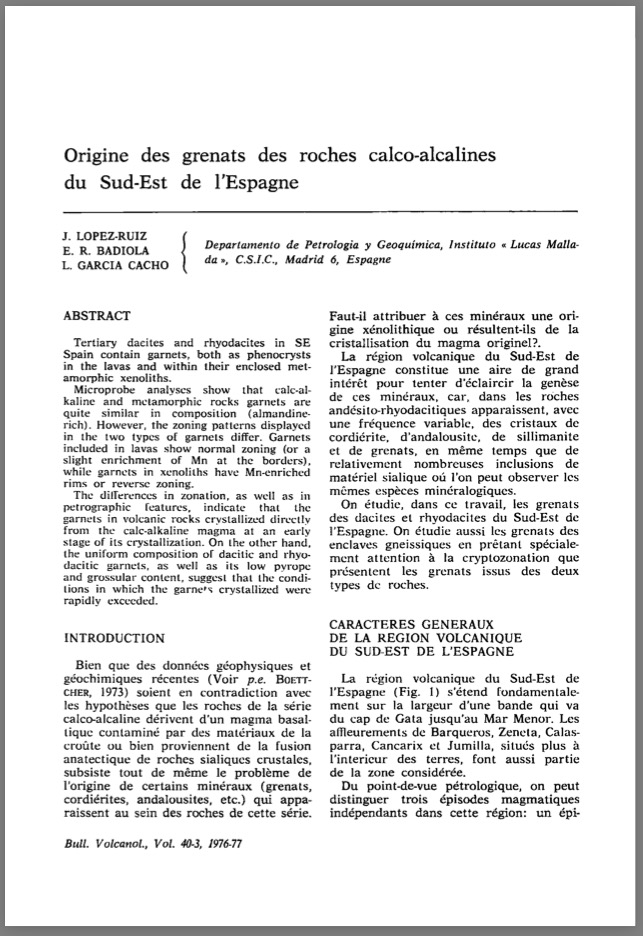
Origine des grenats des roches calco-alcalines du Sud-Est de l’Espagne

Origine des grenats des roches calco-alcalines du Sud-Est de l’Espagne

Origin of the garnets from the calc-alkaline rocks of southeastern Spain

Lopez-Ruiz, J., Badiola, E.R. and Garca, C.L. (1977)

Journal Article · Source: Bulletin Volcanologique · Volume: Vol. 40 · Issue: No. 3 · Pages: pp. 141–152 · Language: in French

Abstract
Tertiary dacites and rhyodacites in southeastern Spain contain garnets both as phenocrysts within the volcanic lavas and within enclosed metamorphic xenoliths. Microprobe analyses reveal that garnets from both the calc-alkaline lavas and the metamorphic inclusions are compositionally similar, being rich in almandine. However, their zoning patterns differ: garnets in the lavas exhibit normal zoning or slight manganese enrichment at the rims, while those in xenoliths show Mn-enriched edges or reverse zoning. These differences in zoning and petrographic features suggest that the volcanic garnets crystallized early from the calc-alkaline magma, whereas the more uniform composition and low pyrope and grossular content in the dacitic and rhyodacitic garnets imply that the crystallization conditions were only briefly maintained.
Keywords
gems, garnet, Spain
Einschlüsse im Fluorit

Einschlüsse im Fluorit

Inclusions in fluorite

Gübelin, E.J. (1977)

Journal Article · Source: Lapis · Volume: Vol. 2 · Issue: No. 5 · Pages: pp. 16–19 · Language: in German

Keywords
gems, fluorite, inclusions in fluorite
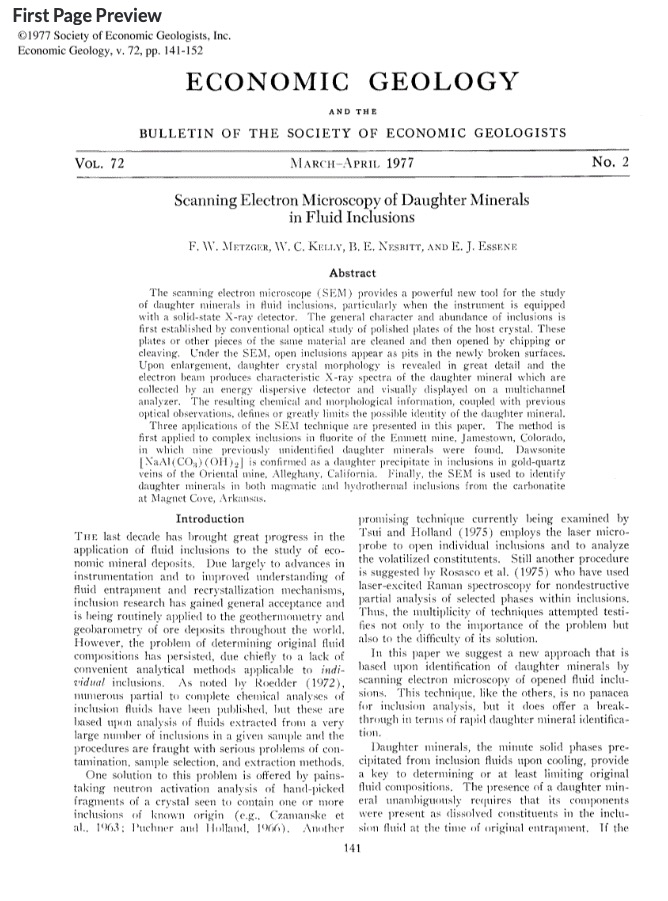
Scanning electron microscopy of daughter minerals in fluid inclusions

Scanning electron microscopy of daughter minerals in fluid inclusions

Metzger, F.W., Kelly, W.C., Nesbitt, B.E. and Essene, E.J. (1977)

Journal Article · Source: Economic Geology · Volume: Vol. 72 · Issue: No. 2, March–April · Pages: pp. 141–152

Abstract
The scanning electron microscope (SEM) provides a powerful new tool for the study of daughter minerals in fluid inclusions, particularly when the instrument is equipped with a solid-state X-ray detector. The general character and abundance of inclusions is first established by conventional optical study of polished plates of the host crystal. These plates or other pieces of the same material are cleaned and then opened by chipping or cleaving. Under the SEM, open inclusions appear as pits in the newly broken surfaces. Upon enlargement, daughter crystal morphology is revealed in great detail and the electron beam produces characteristic X-ray spectra of the daughter mineral which are collected by an energy dispersive detector and visually displayed on a multichannel analyzer. The resulting chemical and morphological information, coupled with previous optical observations, defines or greatly limits the possible identity of the daughter mineral. Three applications of the SEM technique are presented in this paper. The method is first applied to complex inclusions in fluorite of the Emmett mine, Jamestown, Colorado, in which nine previously unidentified daughter minerals were found. Dawsonite [NaAl(CO₃)(OH)₂] is confirmed as a daughter precipitate in inclusions in gold-quartz veins of the Oriental mine, Alleghany, California. Finally, the SEM is used to identify daughter minerals in both magmatic and hydrothermal inclusions from the carbonatite at Magnet Cove, Arkansas.
Keywords
corundum, inclusions.5, gems
Flashback

Flashback

Gübelin, E.J. (1977)

Journal Article · Source: Gems & Gemology · Volume: Vol. 15 · Issue: No. 10, Summer · Pages: p. 314

Keywords
inclusions, crystal angles, gems
Glass made imitation jade and its inclusions

Glass made imitation jade and its inclusions

Fujisaki, Y. (1976)

Journal Article · Source: Journal of The Gemmological Society of Japan [宝石学会誌] · Volume: Vol. 3 · Issue: No. 3 · Pages: pp. 99–105 · Language: in Japanese with English abstract

Abstract
Imitation jades currently circulating in jewellers market under the name of Syberian jade or Reformed jade were investigated by both non-destructive and destructive methods, with special attention to the inclusions. The imitation jades are made of sophisticatedly produced glass, and are dark green, translucent to opaque with glassy, somewhat greasy, luster, have Mohs' hardness of 5-5.5, sp. gr. 2.67 ± 0.02 at 20℃, refractive index 1.523 ± 0.005, and broad absorption spectrum at 4000-4600Å and 6300-7000Å. They contain characteristic inclusions of the following three types; 1) Needle-like inclusions which are identified to be hydroxyl apatite by optical and X-ray investigations, have hexagonal section, and are uniaxial negative, with no pleochroism, higher refractive index than the matrix. These are grouped into three by their length. 2) Dendrite inclusions with 90° braches are identified to be either vapour or liquid phase inclusions, and have lower refractive index than the matrix. 3) Four other types of inclusions, which are not identified. These imitation jades exhibit psudo-optical anisotropy due to apatite inclusions and are easily identified by their inclusions.
Keywords
gems, jade, jade imitations, glass
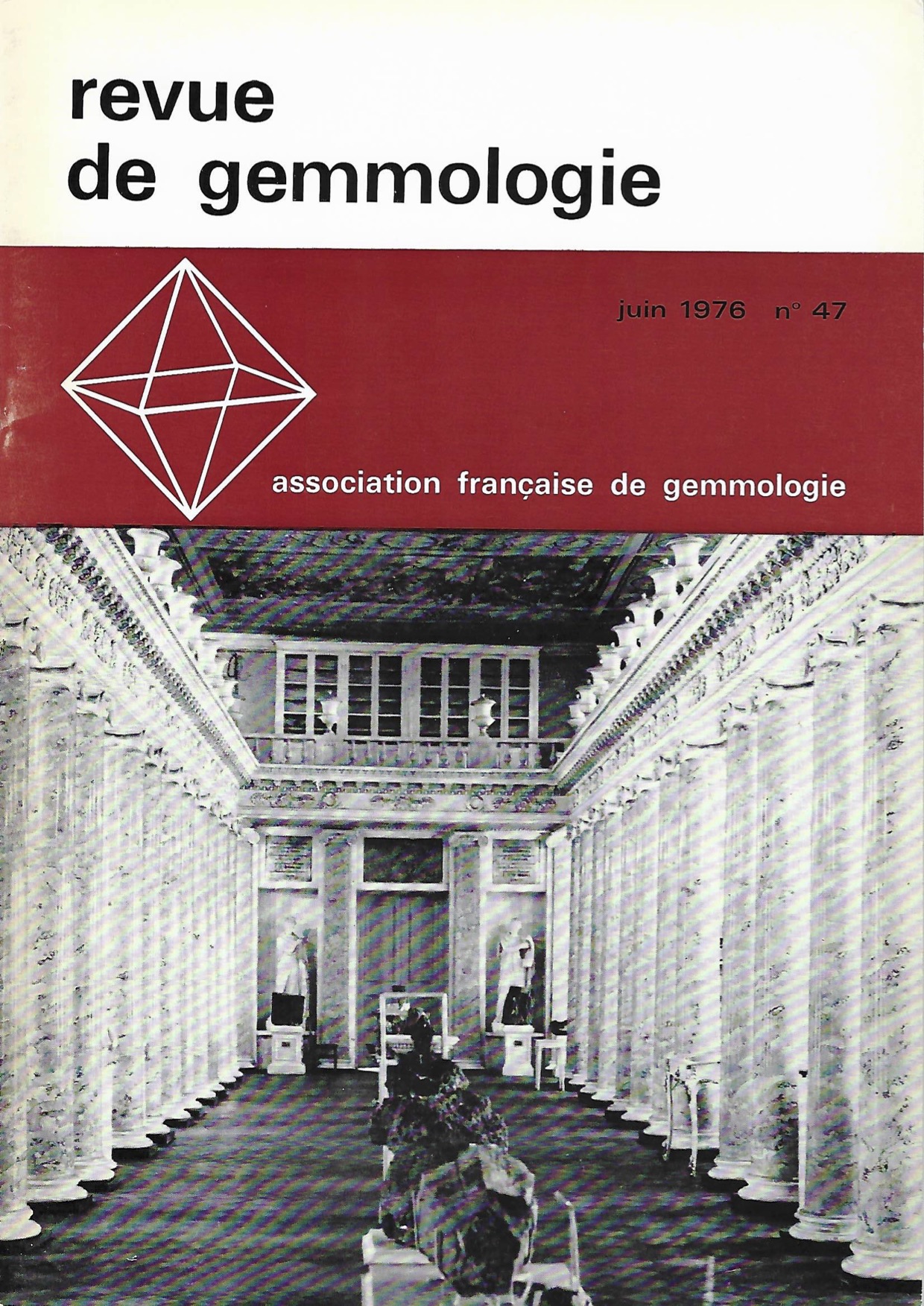
Nong Bon ou le rubis de Thailande

Nong Bon ou le rubis de Thailande

Nong Bon or the ruby of Thailand

Moreau, M. (1976)

Journal Article · Source: Revue de Gemmologie A.F.G. · Issue: No. 47, Juin · Pages: pp. 10–12 · Language: in French

Abstract
Moreau gives a first-hand account of a visit to the Nong Bon ruby mine, about 60 km from Chanthaburi and close to the Cambodian frontier. The deposit was worked by removing roughly 20 m of overburden to reach a gem-bearing alluvial layer about 1 m thick; powerful pumps and water jets broke up the material, after which the lighter fraction was washed away and the heavier gem-bearing concentrate collected and hand-sorted. Daily production was irregular, estimated at 1,000–2,000 carats, but only about 300 carats were considered gem material, including perhaps 2–3 carat stones; associated minerals included black opaque spinels, ilmenite, and black corundum. The rough ruby was generally sold not at the mine but at Bor Rai, where miners and dealers negotiated prices in a busy market. Photographs document the mine, hydraulic working, hand sorting, and trading, while a photomicrograph shows faceted inclusions in a Thai ruby.
Keywords
Thailand.12, Nong Bon, Chanthaburi, gems
Beobachtungen an rubinen aus Prilep, Jugoslawien

Beobachtungen an rubinen aus Prilep, Jugoslawien

Observations on rubies from Prilep, Yugoslavia

Schiffmann, C.A. (1974)

Journal Article · Source: Zeitschrift der Deutschen Gemmologischen Gesellschaft · Volume: Vol. 23 · Issue: No. 2, Juni · Pages: pp. 131–138 · Language: In German

Abstract
Schiffmann reports gemological observations on rubies from the Prilep area of Yugoslavia (now North Macedonia), describing the characteristics of the material and features useful in its identification. Particular attention is given to the appearance and internal characteristics of the corundum, including inclusions and other properties observed during examination. The study provides an early gemological description of ruby from this Balkan occurrence and documents material from a locality comparatively little represented in the gemological literature.
Keywords
corundum, Yugoslavia.12, Macedonia.12, gems
Über einige Einschlüsse in Birma-Rubin

Über einige Einschlüsse in Birma-Rubin

On some inclusions in Burmese ruby

Eppler, W.F. (1974)

Journal Article · Source: Zeitschrift der Deutschen Gemmologischen Gesellschaft · Volume: Vol. 23 · Issue: No. 2 · Pages: pp. 102–108, 9 figs. · Language: In German

Abstract
Eppler examines inclusions observed microscopically in Burmese ruby and discusses their value for characterizing the material. Illustrated with nine figures, the paper describes characteristic internal features, including mineral inclusions and growth-related structures, and considers their appearance and identification under the microscope. Particular attention is given to features useful in recognizing natural Burmese ruby and understanding its formation, demonstrating the importance of inclusions both as diagnostic gemological evidence and as indicators of the geological environment in which the corundum crystallized.
Keywords
Burma.12, corundum, ruby, inclusions.5, gems
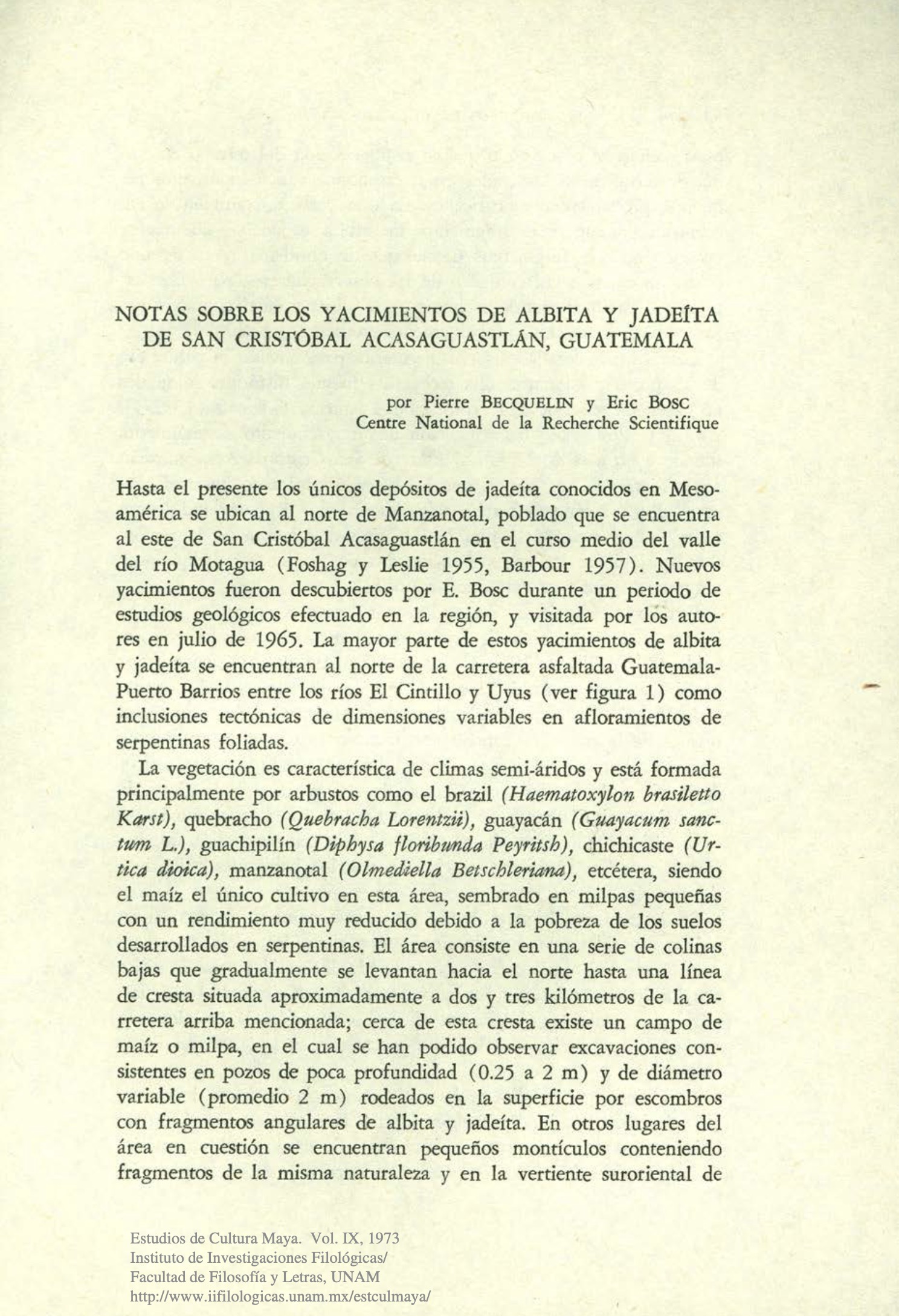
Notas sobre los yacimientos de albita y jadeita de San Cristobal Acasaguastlan, Guatemala

Notas sobre los yacimientos de albita y jadeita de San Cristobal Acasaguastlan, Guatemala

Notes on the albite and jadeite deposits of San Cristóbal Acasaguastlán, Guatemala

Becquelin, P. and Bosc, E. (1973)

Journal Article · Source: Estudios de Cultura Maya · Volume: Vol. 9 · Pages: pp. 67–73 · Language: in Spanish

Abstract
Up to the present, the only jadeite deposits known in Mesoamerica are located north of Manzanotal, a settlement situated east of San Cristóbal Acasaguastlán in the middle course of the Motagua River Valley (Foshag and Leslie 1955; Barbour 1957). New deposits were discovered by E. Böse during a period of geological studies carried out in the region and were visited by the authors in July 1965. Most of these albite and jadeite deposits are located north of the paved Guatemala–Puerto Barrios highway, between the El Cintillo and Uyús rivers (see Figure 1), occurring as tectonic inclusions of varying dimensions within outcrops of foliated serpentinite. Becquelin and Bosc describe newly identified albite and jadeite occurrences near San Cristóbal Acasaguastlán in Guatemala’s middle Motagua Valley, where the deposits occur as tectonic inclusions of varying dimensions within foliated serpentinite. The authors report shallow pits surrounded by angular fragments of albite and jadeite, small mounds, terraces, and nearby obsidian blade fragments, which together suggest rudimentary extraction, possibly in prehistoric times, although they stress that further investigation is required to establish the nature and age of the workings. Other jadeite occurrences in the region lack evidence of ancient exploitation. The archaeological evidence from nearby Guaytán, Manzanotal, and other middle Motagua sites includes jade fragments, partly worked beads and drills, and a jadeite block bearing percussion marks. The authors suggest that inhabitants of the valley collected albite and jadeite from terraces and gravels of the Motagua and perhaps directly from serpentinite sources, manufactured beads and other simple ornaments, and exported jade as blocks and, in some cases, finished objects. They conclude that exploitation and trade in jade probably flourished during the Classic period and that the San Cristóbal region may have supplied a substantial portion of the jade used elsewhere in Mesoamerica.
Keywords
gems, jade, jadeite, fei cui, Mesoamerica, Mexico, Guatemala, Costa Rica, Mayans, Olmecs, Aztecs, archaeology, history, archaeogemology

Exploring the Literature of Gemstone Inclusions

The literature of gemstone inclusions covers identification, origin determination, treatments, synthesis, mineral inclusions, fluid inclusions and other internal features of natural and synthetic gems.

For a curated selection of important sources, read Inclusions in Gemstones — Hyperion Literature Sources.

About Four Treasures

Four Treasures is Lotus Gemology's freely accessible gemological reference database. Use the full database to search by author, title or keyword and explore literature on gemology, mineralogy, jewelry and related fields. Where available, hyperlinks on titles may lead directly to the full publication.

Search the Complete Four Treasures Database