Gemology Books Bibliography

Gemology Books Bibliography

Explore books on gems, gemology, jewelry and mineralogy in Four Treasures, the Lotus Gemology reference database. This bibliography brings together matching book records from the collection, with publication details, abstracts and cover images where available.

Gemology Book References

The list below matches books concerning gemology and related subjects in the database's searchable fields. Some works cover several branches of gems, jewelry or mineralogy.
2,281–2,300 of 3,681 matching references

Analysis of Burmese and Thai rubies by PIXE
Journal Article
Tang, S.M., Tang, S.H., Tay, T.S. and Retty, A.T. (1991) Analysis of Burmese and Thai rubies by PIXE. Gemological Digest, Vol. 3, No. 2, pp. 57–62.
Record No. 5004  |  Sinkankas/Born No.: NIS / NIB  |  RWHL
View Individual Record ↗
Examines the potential of proton-induced X-ray emission (PIXE) analysis to distinguish Burmese from Thai rubies through their trace-element compositions, supplementing identification by color and inclusions. Sixty specimens were studied: 29 purchased as Burmese rubies in Thai wholesale markets and 31 obtained from cutters in Chanthaburi and initially regarded as Thai. Microscopic examination supported the proposed origins of 57 specimens, while three lacked diagnostic inclusions. Measurements employed 2 MeV protons from a Van de Graaff accelerator at the National University of Singapore, a silicon-lithium detector and a counting time of 150 seconds per specimen. Samples required only cleaning and mounting. X-ray spectra were processed using the AXIL least-squares fitting program, and calibration standards prepared in an aluminum oxide matrix allowed concentrations to be expressed as weight percentages relative to Al₂O₃. More than ten trace elements were detected, with chromium and iron producing prominent signals; other constituents included silicon, sulfur, chlorine, potassium, calcium, titanium, vanadium, manganese and gallium. Vanadium and iron provided the clearest distinction between the two groups. All initially identified Burmese specimens displayed detectable vanadium peaks, whereas all but one presumed Thai specimen contained very little vanadium. The exceptional specimen also had the lowest iron concentration among the presumed Thai stones and lacked diagnostic inclusions. Its Burmese-like composition led the authors to reassign it provisionally to the Burmese group, producing final groups of 30 specimens each. Average vanadium concentrations were approximately 0.048% in the Burmese group and 0.002% in the Thai group, while average iron concentrations were approximately 0.122% and 0.444%, respectively. Burmese rubies also had higher average concentrations of the other tabulated impurities, although substantial variation occurred within each group. A plot combining vanadium and iron concentrations separated the studied populations more effectively than either visual color assessment or iron content alone. The authors present these compositional relationships as preliminary criteria, emphasizing that additional specimens are needed to establish reliable boundaries and confidence levels. PIXE offers simultaneous multielement measurement, sensitivity at parts-per-million levels for many elements, and analysis without conductive coating, stringent surface preparation or induced radioactivity. Its principal limitation is shallow sampling: the technique measures surface layers rather than the stone’s interior, and near-surface inclusions may distort concentrations interpreted as representative of the ruby itself.

Anomalous behavior of certain geuda corundums during heat treatment
Journal Article
Perera, S.Z., Pannila, A.S., Gunasekera, H.P.N.F. and Ediriweera, R.N. (1991) Anomalous behavior of certain geuda corundums during heat treatment. Journal of Gemmology, Vol. 22, No. 7, July, pp. 405–407.
Record No. 4937  |  ISBN/ISSN: 221252  |  Sinkankas/Born No.: NIS / NIB  |  RWHL
View Individual Record ↗
The variable response of Sri Lankan “ottu” geuda corundum to heat treatment is investigated through electron probe microanalysis, with particular attention to unsuccessful blue colour development and the formation of an opaque white surface layer known in the trade as “dead milk”. Approximately 50 initially colourless or light blue stones bearing dark blue surface patches were heated for 1 hour at 1800–1850 °C under reducing conditions. Three outcomes were observed: clear stones with satisfactory blue colour, clear stones with insufficient blue colour, and stones with a thick white coating. More than half developed the coating. Subsequent heating under oxidizing conditions at 1600–1800 °C reduced the blue colour of the first two groups but produced no observable change in coated specimens; the coating persisted even after further heating at higher temperatures. Representative samples were examined using wavelength-dispersive electron probe microanalysis, including polished cross sections comparing blue interiors with white outer regions. Iron and titanium were estimated semiquantitatively against standards, with a reported detection limit of 0.03%, while other impurities were identified qualitatively. Well-coloured and poorly coloured clear stones contained similar iron levels, but the well-coloured group generally had lower titanium concentrations and fewer additional impurities. Sodium, potassium and manganese were the only additional elements detected in that group, and some specimens showed none. Poorly coloured stones contained a broader range, including sodium, potassium, calcium, zinc and silicon. White regions had higher iron and titanium concentrations than their blue interiors, with titanium exceeding iron, and contained a wider range of minor impurities. Vanadium was detected in every examined specimen with “dead milk”, although its concentration was not quantified. Analyses of specimens without the special surface preparation argued against preparation-induced contamination. Interpreting blue colour in terms of iron–titanium pairs, the authors suggest that additional impurities may hinder formation of the colour-producing centres despite the presence of both elements. They associate white-layer formation with elevated impurity concentrations, particularly iron and titanium, and propose that vanadium and other minor constituents may assist the process.

Gem Trade Lab Notes: Coated sapphire

Journal Article
Moses, T. and Reinitz, I. (1991) Gem Trade Lab Notes: Coated sapphire. Gems & Gemology, Vol. 27, No. 4, Winter, pp. 251–252.
Record No. 4923  |  ISBN/ISSN: 0016626X  |  Sinkankas/Born No.: NIS / NIB  |  RWHL
View Individual Record ↗
With the proliferation of diffusion treatment, heat treatment, and the filling of cavities in corundum, the laboratory is particularly diligent when examining rubies and sap-phires for enhancement.

Gem News: Tanzanian spinel

Journal Article
Koivula, J.I. and Kammerling, R.C. (1991) Gem News: Tanzanian spinel. Gems & Gemology, Vol. 27, No. 3, Fall, p. 183.
Record No. 4869  |  ISBN/ISSN: 0016626X  |  Sinkankas/Born No.: NIS / NIB  |  RWHL
View Individual Record ↗

Gem News: Deceptive color coating of sapphires in Sri Lanka
Journal Article
Koivula, J.I. and Kammerling, R.C. (1991) Gem News: Deceptive color coating of sapphires in Sri Lanka. Gems & Gemology, Vol. 27, No. 4, Winter, p. 265.
Record No. 4868  |  ISBN/ISSN: 0016626X  |  Sinkankas/Born No.: NIS / NIB  |  RWHL
View Individual Record ↗

Gem News: Czechoslovakian conference yields valuable information [Russian ruby]
Russian ruby
Journal Article
Koivula, J.I. and Kammerling, R.C. (1991) Gem News: Czechoslovakian conference yields valuable information [Russian ruby]. Gems & Gemology, Vol. 27, No. 4, Winter, p. 256.
Record No. 4867  |  ISBN/ISSN: 0016626X  |  Sinkankas/Born No.: NIS / NIB  |  RWHL
View Individual Record ↗

Gem News: Novel synthetic star sapphire
Journal Article
Koivula, J.I. and Kammerling, R.C. (1991) Gem News: Novel synthetic star sapphire. Gems & Gemology, Vol. 27, No. 4, Winter, pp. 263–264.
Record No. 4866  |  ISBN/ISSN: 0016626X  |  Sinkankas/Born No.: NIS / NIB  |  RWHL
View Individual Record ↗

Gem News: More synthetics sold as natural ruby in Vietnam
Journal Article
Koivula, J.I. and Kammerling, R.C. (1991) Gem News: More synthetics sold as natural ruby in Vietnam. Gems & Gemology, Vol. 27, No. 4, Winter, p. 260.
Record No. 4865  |  ISBN/ISSN: 0016626X  |  Sinkankas/Born No.: NIS / NIB  |  RWHL
View Individual Record ↗

Gem News: More on Vietnam gem finds

Journal Article
Koivula, J.I. and Kammerling, R.C. (1991) Gem News: More on Vietnam gem finds. Gems & Gemology, Vol. 27, No. 1, Spring, pp. 51–52.
Record No. 4864  |  ISBN/ISSN: 0016626X  |  Sinkankas/Born No.: NIS / NIB  |  RWHL
View Individual Record ↗

Rubine aus Vietnam

Rubies from Vietnam
Journal Article
Henn, U. and Bank, H. (1991) Rubine aus Vietnam. [Rubies from Vietnam] Zeitschrift der Deutschen Gemmologischen Gesellschaft, Vol. 40, No. 1, pp. 25–28.
Record No. 4808  |  Sinkankas/Born No.: NIS / NIB  |  Language: In German  |  RWHL
View Individual Record ↗
Reports on rubies from northern Vietnam, believed at the time to originate in Hoang Lien Son Province, about 250 km northwest of Hanoi. Rough crystals range from pale to strong red, sometimes with a distinct violet component, and show weak red to yellowish-red pleochroism. The authors describe their standard gemological properties, absorption characteristics and internal features, comparing the material with rubies from other deposits. The study was among the earliest gemological reports on the newly important Vietnamese ruby occurrences, whose material could closely resemble ruby from Myanmar.

Die chemischen Eigenschaften der Smaragde II, Australien und Norwegen
The chemical properties of the emerald II, Australia and Norway
Journal Article
Schwarz, D. (1991) Die chemischen Eigenschaften der Smaragde II, Australien und Norwegen. [The chemical properties of the emerald II, Australia and Norway] Zeitschrift der Deutschen Gemmologischen Gesellschaft, Vol. 40, No. 1, pp. 39–66.
Record No. 4199  |  Sinkankas/Born No.: NIS / NIB  |  Language: in German  |  RWHL
View Individual Record ↗
The second installment of Schwarz’s systematic study of the chemical properties of emeralds from different geographic sources, dealing with material from Australia and Norway. Norwegian specimens are from Eidsvoll near Lake Mjøsa, while the Australian material represents several occurrences, including Pilangoora, Wodgina, Calvert White Quartz Hill, Warda Warra, Melville, Torrington, Emmaville and Menzies. Chemical analyses are used to compare major and trace-element compositions and to evaluate variations among deposits and against previously studied Brazilian emeralds. Schwarz notes, among other distinctions, generally lower magnesium contents than in Brazilian material. The paper demonstrates the usefulness of chemical composition, considered together with gemological properties, for characterizing emeralds and assessing their geographic origin.

In the dark: Separating synthetic and natural gems by ultraviolet spectroscopy
Journal Article
Montgomery, R.S. (1991) In the dark: Separating synthetic and natural gems by ultraviolet spectroscopy. Gemological Digest, Vol. 3, No. 2, pp. 45–53.
Record No. 1998  |  Sinkankas/Born No.: NIS / NIB  |  RWHL
View Individual Record ↗
The Krüss UVS 2000 ultraviolet spectroscope is evaluated as a relatively inexpensive aid for distinguishing natural ruby, blue sapphire and red spinel from their synthetic counterparts. Tests comprised 121 natural and 118 synthetic rubies, 109 natural and 26 synthetic blue sapphires, and 36 natural Burmese and 37 synthetic red spinels. The instrument directs light from a mercury lamp through the gemstone and a quartz prism onto a fluorescent scale, allowing the relative transmission of selected visible and ultraviolet emission lines to be compared. Correct positioning is essential because external facet reflections can produce misleadingly strong spectra. Two broad transmission patterns are distinguished: Type I, dominated by visible lines, generally characterises natural stones, whereas Type II, with relatively strong ultraviolet transmission around 315 nm, generally characterises synthetic material. Among the rubies examined, 116 natural specimens showed Type I spectra and 104 synthetic specimens showed Type II spectra. Exceptions included some flux-grown and weakly coloured flame-fusion synthetic rubies, together with occasional natural Burmese and Sri Lankan stones. Blue sapphire separation additionally depends on transmission at approximately 295 nm: most natural stones lacked this line, whereas synthetic sapphires commonly showed either Type II spectra or Type I spectra with the line present. Exceptions included three heated Sri Lankan sapphires and the single flux-grown synthetic sapphire tested. All natural red spinels showed Type I spectra, while 32 of 36 flame-fusion specimens showed Type II spectra; the single flux-grown synthetic spinel resembled natural material. Results were also weighted against the proportions of stones submitted to the AIGS laboratory, although the author acknowledges that these submissions were biased towards suspicious, relatively clean gems and did not constitute a random market sample. Differences associated with heat treatment were statistically significant for particular transmitted lines in Thai ruby and Sri Lankan sapphire, but were insufficient for conclusive treatment identification. Greater ultraviolet absorption in natural specimens is tentatively attributed primarily to chemical impurities, particularly iron. The author recommends ultraviolet spectroscopy as a supplementary test used with microscopy and fluorescence, with due regard for exceptions and sampling limitations. Ultraviolet spectrophotometry remains preferable for detailed analysis because it records a continuous spectrum, while the UVS 2000 offers lower cost. Heat and ultraviolet exposure from the instrument may damage sensitive stones or alter their colour.

Diffusion confusion

Journal Article
Lumetta, P. (1991) Diffusion confusion. Gemological Digest, Vol. 3, No. 2, pp. 32–33.
Record No. 1993  |  Sinkankas/Born No.: NIS / NIB  |  RWHL
View Individual Record ↗
This trade commentary defends the commercial introduction of surface [bulk] diffusion-treated Sri Lankan sapphires and questions the distinction drawn by some dealers between this process and conventional heat treatment. Lumetta describes an improved technique, developed in the United States from earlier Linde diffusion technology, that reportedly increases the penetration of colour into corundum. The resulting stones combine attractive blue colour, calibrated dimensions and good cutting, qualities that the author regards as difficult to obtain together in ordinary Sri Lankan production. Drawing on published accounts of corundum colour and enhancement, the article explains blue colour through iron–titanium charge transfer and describes treatment by heating stones in contact with colouring compounds so that titanium enters their surface layers. The author contrasts this addition of colouring elements with heat-treatment processes that modify existing constituents or their oxidation states, arguing that both approaches enhance appearance and that commercial opposition to diffusion reflects unequal access to technology and competing financial interests. This equivalence is presented as the author’s position rather than demonstrated through experimental comparisons. Surface diffusion-treated stones are placed between lower-priced synthetic corundum and more expensive Sri Lankan sapphires whose colour is natural or improved by conventional heating. Lumetta considers better-quality Thai sapphires their principal price competitors, with colour preference influencing purchasing decisions. He rejects predictions that the new product will depress sapphire prices generally and instead suggests that independently certificated fine sapphires may gain value through clearer differentiation. Disclosure is central to the argument: earlier diffusion-treated stones had sometimes circulated without identification, whereas the products discussed are explicitly marketed as treated material. The author acknowledges his involvement in their marketing through Gem Source in Las Vegas, where stones are offered in calibrated sizes, several cutting styles and graded colour categories. Their intended customers include larger jewellery manufacturers requiring a consistent supply of matching stones. The article predicts consumer acceptance on the basis of colour, cutting and price, presenting diffusion-treated natural sapphire as a distinct commercial alternative whose place in the market depends on transparent description and product differentiation.

Watching your weight

Journal Article
Duffy, D. (1991) Watching your weight. Gemological Digest, Vol. 3, No. 2, pp. 41–42.
Record No. 1973  |  Sinkankas/Born No.: NIS / NIB  |  RWHL
View Individual Record ↗
Explains how buyers and sellers of gemstones and precious metals can protect themselves against weighing errors and deliberate manipulation through independent verification, suitable equipment and knowledge of measurement systems. Duffy begins with the operating principle of a balance, in which an unknown mass is compared with reference masses, and stresses that a displayed reading does not itself establish accuracy. When another person weighs goods, customers should examine the certification, condition and cleanliness of the weights and pans, confirm that the balance starts at zero, allow oscillations to cease and observe the final indication directly. Two hypothetical examples demonstrate the financial consequences of small discrepancies. An incorrectly marked troy-ounce weight can produce substantial cumulative losses in a high-volume gold business, while a gemstone recorded as 4.1 carats on one instrument and 4.0 carats on another creates a significant price difference without establishing which instrument is correct. The recommended safeguard is to maintain and use personally controlled, certified and calibrated weighing equipment, supported by reference masses and conversion tables. A suitable jeweller’s balance should provide resolution to two decimal places in carats and three in grams, with capacity chosen for normal requirements rather than occasional unusually heavy items. The author considers approximately 400 g sufficient for most jewellers and gold merchants. Recommended features include a stable, robust construction, protection against draughts, a facility for weighing below the balance during specific-gravity determinations, adjustable levelling feet and a spirit-level indicator, a clear electronic display, automatic calibration, full-capacity taring and the required weighing units. Certified reference masses should have documentation tracing their comparison to recognised standards and should be secured against interference or misuse. Besides the calibration mass specified for the instrument, users should possess masses corresponding to the smallest and largest items routinely weighed, allowing checks across their working range. The article also emphasises familiarity with relationships among carats, grams, troy ounces, pennyweights and other units, noting that weighing practices vary among countries and commodities. Its central argument is that financial protection requires verified measurement accuracy throughout a transaction, including the equipment used to challenge a seller’s reading, rather than confidence in appearances, digital displays or another operator’s assurances.

Into the abyss: inclusion photos

Journal Article
Goutiere, A., de (1991) Into the abyss: inclusion photos. Gemological Digest, Vol. 3, No. 2, p. 43.
Record No. 1972  |  Sinkankas/Born No.: NIS / NIB  |  RWHL
View Individual Record ↗
Two colour photomicrographs document an unusual thin-film inclusion in a 462 ct aquamarine crystal from Pakistan. Published under the subtitle “An Aquamarine Adventure”, the brief contribution combines the photographs with the author’s account of changes observed during gentle heating and subsequent cooling. The inclusion is described as apparently containing two immiscible liquids, one of which has a syrupy appearance. When the specimen is gently heated, this liquid disappears into a dark portion of the inclusion; as the aquamarine cools, it reappears as slowly moving droplets. The photographs show different configurations of the internal liquid features within a brightly coloured, irregularly bounded film. Yellow and orange areas dominate the central field, with green, blue and violet colours towards its margins, while dark elongated features interrupt the illuminated region. Rounded and extended droplet-like forms differ between the two views, illustrating the changing appearance that accompanies the author’s observations. On the basis of its response at approximately 32 °C, the author suggests that one liquid is probably liquid carbon dioxide. This identification is explicitly tentative: the note provides an observational interpretation rather than a chemically confirmed analysis of the trapped fluids. It does not identify the second liquid or establish the geological conditions under which the inclusion formed. The photographic procedure was adapted to record the changing features. Although the author normally used professional Ektachrome 160 Tungsten film for photomicrography, Ektar 1000 print film was selected for these images because its higher speed was needed to arrest movement. The contribution therefore records both the visual character of a colourful aquamarine inclusion and the practical challenge of photographing mobile internal phases. Its principal evidence consists of the paired images and the reported reversible behaviour during warming and cooling, rather than a detailed experimental or compositional investigation. Together, these observations present an example of dynamic fluid behaviour within a gemstone and demonstrate how photomicrography can preserve successive appearances of an inclusion that changes during examination.

Gemstones of the Southern Continents

Book
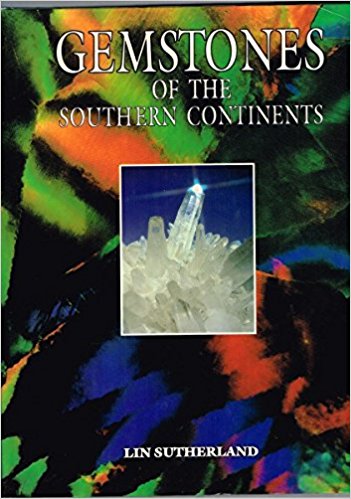
Sutherland, F.L. (1991) Gemstones of the Southern Continents. Balgowlah, NSW, Reed Books, 256 pp.
Record No. 1667  |  ISBN/ISSN: 730102726  |  Sinkankas/Born No.: NIS / NIB  |  RWHL
View Individual Record ↗
Throughout the ages, people have perceived gems as fascinating and desirable objects of beauty and worth. Early nomadic peoples like the Australian Aborigines had a keen eye for clear or attractively coloured stones. Though they had lapidary skills to shape stone tools, they lacked the technical means to facet and polish the eye-catching materials into finished gems. Gemstones are created and found in the natural rocks around and under us. Their detection and mining have a long history, progressing from the earlier, simpler methods to the more sophisticated techniques of modern times. Gemstones of the Southern Continents describes natural gemstones, how they form and what controls their characteristic colours and other gemmological properties. The subject is divided into five sections that lead the reader into more detailed expositions of the topics. Many points made in the text are illustrated with colour photographs of gemstones, host rocks or field occurrences. Most of the gemstone illustrations are based on specimens held in the collections of the Australian Museum in Sydney and made available by the Australian Museum Trust. The photography by Jim Frazier presents these gemstones in an unconventional way, and his pictures are supplemented by others from several sources. These include examples of the world’s famous gemstones provided by institutions and companies from many countries. The gem deposits of Gondwana, the former giant southern continent, are given special mention. In writing this book, Dr Lin Sutherland offers readers a wealth of knowledge of gems and minerals gleaned from Australasia and around the world. Dr Sutherland is an acknowledged expert in his field.

Contributions to a history of gemmology—Carl Peter Thunberg and Ceylon gemstones
Journal Article
Sinkankas, J. (1991) Contributions to a history of gemmology—Carl Peter Thunberg and Ceylon gemstones. Journal of Gemmology, Vol. 22, No. 8, October, pp. 463–470.
Record No. 1607  |  ISBN/ISSN: 221252  |  Sinkankas/Born No.: NIS / NIB  |  RWHL
View Individual Record ↗
Carl Peter Thunberg’s eighteenth-century account of the gemstones of Ceylon, now Sri Lanka, is reassessed as an early contribution to scientific gemmology. A biographical sketch places the Swedish physician and naturalist within the intellectual tradition of Linnaeus and outlines his travels, collecting activities, and later academic career. Earlier descriptions of the island’s gem wealth, particularly those of Marco Polo and Jean-Baptiste Tavernier, provide historical context and illustrate the difficulty of interpreting old gemstone names. Thunberg acquired much of his information during a stay at Matara, where medical duties afforded opportunities for local excursions and the purchase of rough and cut stones. His observations include the role of Muslim lapidaries and the export of locally fashioned gems to India. Drawing on his travel narrative and related publications, Sinkankas reviews four non-gem minerals and twenty gemstone entries, recording historical names in several languages and comparing descriptions with modern mineral identities. Colour, crystal form, hardness, transparency, and alluvial wear provide the principal evidence for confirming or revising the identifications. Several stones described as ruby or as differently coloured tourmalines are interpreted as probable zircon, while other identifications remain uncertain because their descriptions are insufficient or contradictory. The discussion distinguishes rock crystal, milky quartz, citrine, smoky quartz, grossular garnet, and probable schorl, and identifies Thunberg’s “pseudo-opal” cat’s-eye as chatoyant quartz rather than chrysoberyl. Particular attention is given to colourless zircon sold as Matara diamond. Thunberg’s account of heating stones, then enveloping them in fine lime and firing them with rice chaff, constitutes early documentation of gemstone treatment intended to improve colour and clarity. The article also examines the limitations of eighteenth-century analytical methods. Assistance from Torbern Olof Bergman did not eliminate identification errors, whereas Martin Heinrich Klaproth’s improved chemical procedures helped establish the compositions and distinctions of corundum and zircon. Tourmaline’s electrical properties and the inconsistent application of its name receive separate consideration. Later observations by John Davy and other writers demonstrate the persistence of misleading trade terminology. The study presents Thunberg’s collection and descriptions as historically important evidence while emphasizing that early gem names require critical interpretation rather than direct equivalence with modern species.

Gemmology

Book
Read, P.G. (1991) Gemmology. Oxford, Butterworth-Heinemann, 358 pp.
Record No. 1471  |  Sinkankas/Born No.: NIS / NIB  |  RWHL
View Individual Record ↗
This introductory textbook presents the scientific foundations and practical techniques of gemmology for students preparing for the Gemmological Association’s Preliminary and Diploma examinations. Developed from the author’s earlier Beginner’s Guide to Gemmology and his experience tutoring correspondence students, it emphasizes the technical properties used to identify gem materials. An opening historical survey traces major developments over approximately 150 years, followed by explanations of gemstone formation, geological occurrence, chemical composition and crystal structure. Cleavage, fracture, hardness and durability are related to the behaviour of gems during mining, testing and fashioning. Specific gravity, colour, lustre, refraction, polarization, pleochroism and absorption spectra provide the framework for instrumental identification. The treatment of these properties introduces the associated apparatus and measurement methods, including hydrostatic weighing, heavy liquids, refractometers, polariscopes, dichroscopes and spectroscopes. Luminescent, electrical and thermal characteristics, together with hand-lens and microscope examination, extend the range of diagnostic observations. Later sections cover gemstone enhancement, synthetic production, simulants and composite stones, with attention to distinguishing natural materials from manufactured counterparts. Organic gems and their imitations receive separate treatment, while chapters on cutting, polishing and diamond grading connect optical and physical principles with lapidary practice. Descriptive information on individual gemstones is concentrated in appendices, alongside reference constants, colour theory, measurement units and examination material. A contemporary review identifies the integration of fundamental properties with testing instruments as a particular strength, while observing that the relative usefulness of alternative instruments and techniques is not consistently evaluated. It also notes that the descriptive gemstone appendix is concise and unillustrated, that the four pages of colour illustrations are well reproduced, and that some monochrome illustrations are less satisfactory. Several statements concerning diamond fluorescence, diamond colour classification and synthetic amethyst production are questioned by the reviewer. Despite these reservations, the work is regarded as a useful educational resource reflecting the breadth of knowledge required of the practising gemmologist.
Indian gemmology

Indian gemmology

Conference Paper
Murthy, S.R.N. (1991) Indian gemmology. GSISOA 12th Bi-Ennial General Body, pp. 29–32.
Record No. 1320  |  Sinkankas/Born No.: NIS / NIB  |  RWHL
View Individual Record ↗

Gem Trade Lab Notes: Twinned synthetic sapphires

Journal Article
Moses, T. (1991) Gem Trade Lab Notes: Twinned synthetic sapphires. Gems & Gemology, Vol. 27, No. 4, Winter, pp. 252–253.
Record No. 1306  |  ISBN/ISSN: 0016626X  |  Sinkankas/Born No.: NIS / NIB  |  RWHL
View Individual Record ↗
Within a short period of time, the East Coast laboratory encountered two synthetic sapphires that the clients had assumed were natural because of the presence of repeated twinning (figure 13) and what appeared to be boehmite needles contained within the planes (figure 14). Straight twinning lamellae were considered proof of natural origin until 1920, when this feature was noted as an anomaly in synthetic sapphire by Sandmeier and corroborated by W. Plato. For a detailed description of this phenomenon, see the article “Polysynthetic Twinning in Synthetic Corundum,” by W. F. Eppler (Gems & Gemology, Summer 1964). More recently, we reported on the presence of these phenomena in the Summer 1984 (p. 111) and Spring 1989 (p. 38) Lab Notes sections. We conclusively identified the two recent examples described above as synthetic sapphires by the presence of small gas bubbles and curved growth bands, which we observed with magnification and diffused darkfield illumination. The appearance of repeated twinning in a synthetic sapphire can prove to be an identification challenge, especially when the stone in question may have been heat treated. Thermal treatment can diminish curved color banding so that it is only evident when the stone is examined with immersion.

Building a Gemological Library

Gemological books range from general identification manuals and textbooks to specialized works on individual gems, mineralogy, jewelry, treatments, synthesis, history and gem-producing regions.

For a curated selection of particularly useful books, read The Gemologist's Core Library — Classic Books on Gemology, Jewelry and Mineralogy.

About Four Treasures

Four Treasures is Lotus Gemology's freely accessible gemological reference database. Use the full database to search by author, title or keyword and explore literature on gemology, mineralogy, jewelry and related fields. Where available, hyperlinks on titles may lead directly to the full publication.

Search the Complete Four Treasures Database