Gemstone Inclusions Bibliography

Gemstone Inclusions Bibliography

Explore books, articles and historical sources on inclusions in gemstones in Four Treasures, the Lotus Gemology reference database. This bibliography brings together matching records from the collection, with publication details, abstracts and cover images where available.

Gemstone Inclusion References

The list below matches the terms inclusion or inclusions in the database's searchable fields. Some references discuss inclusions as part of a broader subject.

961–980 of 1,111 matching references
Mineralogische Untersuchungen an Granaten aus in Schweden gefundenen Schmuckgegenständen der Merowinger- und Karolingerzeit

Mineralogische Untersuchungen an Granaten aus in Schweden gefundenen Schmuckgegenständen der Merowinger- und Karolingerzeit

Mineralogical investigations of garnets from jewelry items found in Sweden dating to the Merovingian and Carolingian periods

Mellis, O. (1963)

Journal Article · Source: Arkiv för Mineralogi och Geologi · Volume: Vol. 3 · Issue: No. 4 · Pages: pp. 297–362 · Language: in German

Abstract
Mellis presents a nondestructive mineralogical investigation of 41 red stones from Merovingian- and Carolingian-period jewelry found in Sweden, undertaken both to establish whether the stones were actually garnets and, if possible, to determine their geographical origin. Because of the cultural and historical importance of the objects, the examination was restricted chiefly to refractive index, color and absorption spectra, specific gravity, anomalous birefringence, inclusions, and, for some specimens, single-crystal X-ray study. The small polished garnet plates are described individually, with detailed observations of their optical properties and inclusions, including various types of needles, prismatic and plate-like crystals, opaque minerals, zircon, and other phases. Chemical compositions were estimated from physical and optical properties and compared with established garnet compositional groups; the examined stones include pyrope-rich and almandine-rich varieties and mixtures of the principal garnet components. Mellis explores whether inclusions and composition can identify the geological environment and source of the stones, comparing the archaeological specimens particularly with garnets from Bohemia and other known occurrences. He concludes that inclusions alone cannot, at the existing state of knowledge, provide a reliable determination of geographical provenance, although inclusions combined with chemical composition can exclude certain geological environments and help characterize possible source rocks. The study demonstrates the value of detailed mineralogical examination of archaeological garnets while emphasizing the limitations of assigning ancient worked stones to specific deposits solely from their observable mineralogical properties.
Keywords
gems, garnet, red garnet, Dark Age garnet, Sweden
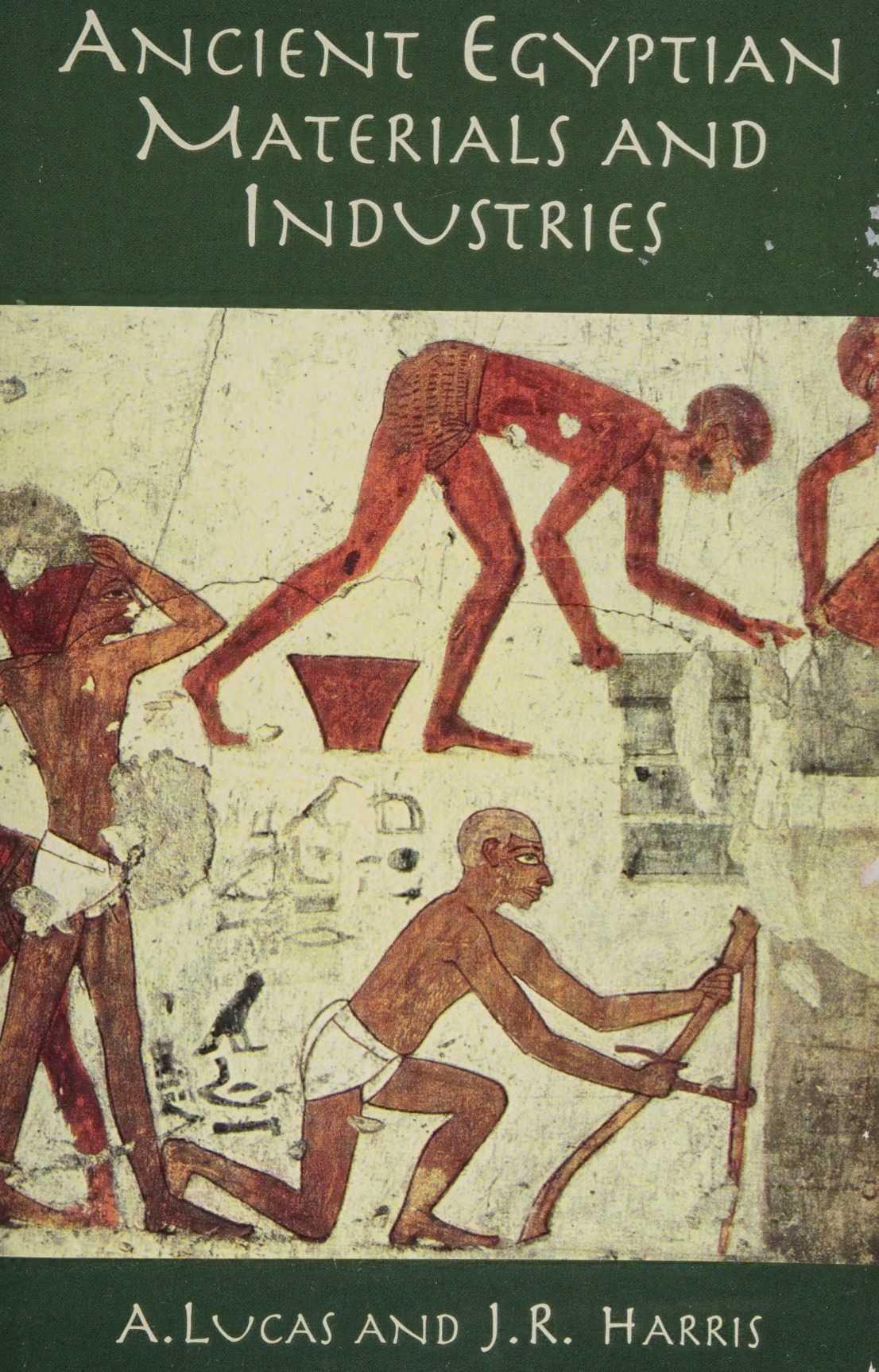
Ancient Egyptian Materials and Industries

Ancient Egyptian Materials and Industries

Lucas, A. and Harris, J.R. (1962)

Book · Publisher: Dover · Pages: 570 pp.

Abstract
The majesty and splendor of ancient Egypt were largely due to the remarkably advanced technological skills developed by its artisans and craftsmen. This comprehensive and detailed study of ancient Egyptian technology meticulously documents how these workers, along with other Egyptians, exploited the land’s abundant resources. First published in 1926 and later revised and enlarged, this monumental work became a standard reference, unmatched in any other field of archaeology. The present volume reprints the fourth edition, thoroughly revised in light of more recent research and archaeological discoveries. Topics covered include a wide range of materials and techniques central to Egyptian life: the use of animal products, building materials, cosmetics, perfumes, incense, fibers, glazed ware, glass and its production, metals and alloys, painting materials, pottery, woodworking, precious and semi-precious stones, distillation of alcoholic beverages, and substances used in mummification. Profoundly erudite and rich in detail, Ancient Egyptian Materials and Industries is an indispensable reference for students of Egyptology and classical civilizations, and a vital resource for anyone interested in the long and remarkable history of technological innovation. Sinkankas: Drastically revised, rearranged: the substances now include beverages, animal products, building materials, cosmetics, perfumes & incense, ceramics & glass, fibers, metals & alloys, mummification materials, oils, fats, waxes, painting materials, pottery & its manufacture, gemstones, other stones, woods & woodworking, and a historical analysis. Ch 12, [335–54], on gemstones, among which now additionally appear coral, amber, malachite, and jade, while horn, ivory, nacre and tortoiseshell are described in Ch 2. Ornamental stones are treated in Ch 13, [355–75]. The author notes that “diamond, opal, ruby and sapphire were not known to the ancient Egyptians.” In his preface, Harris notes the inclusion of information taken from recent studies, with references added to the list in the previous edition. Much technological information is also added, with an appendix of reliable chemical analyses. “The most consistent modification has, however, been in matters of lexicography, in order to eliminate invalid evidence derived from inaccurate or disputed translations of Egyptian texts.” In this connection, see also Harris’ Lexicographical Studies in Ancient Egyptian Materials, 1961. In this edition, the following places are of gemological interest: beads, Ch 4, [41–7] (includes gemstone materials); inlaid gemstone eyes, Ch 7, [98–127] (many types & examples); gemstones in general, Ch 16, [386–405]; other stones, Ch 17, [406–28]. Lucas should always be consulted whenever one writes or lectures about Egyptian jewelry.
Keywords
gems, ancient gemology, ancient jewelry, Egypt, Egyptian jewelry
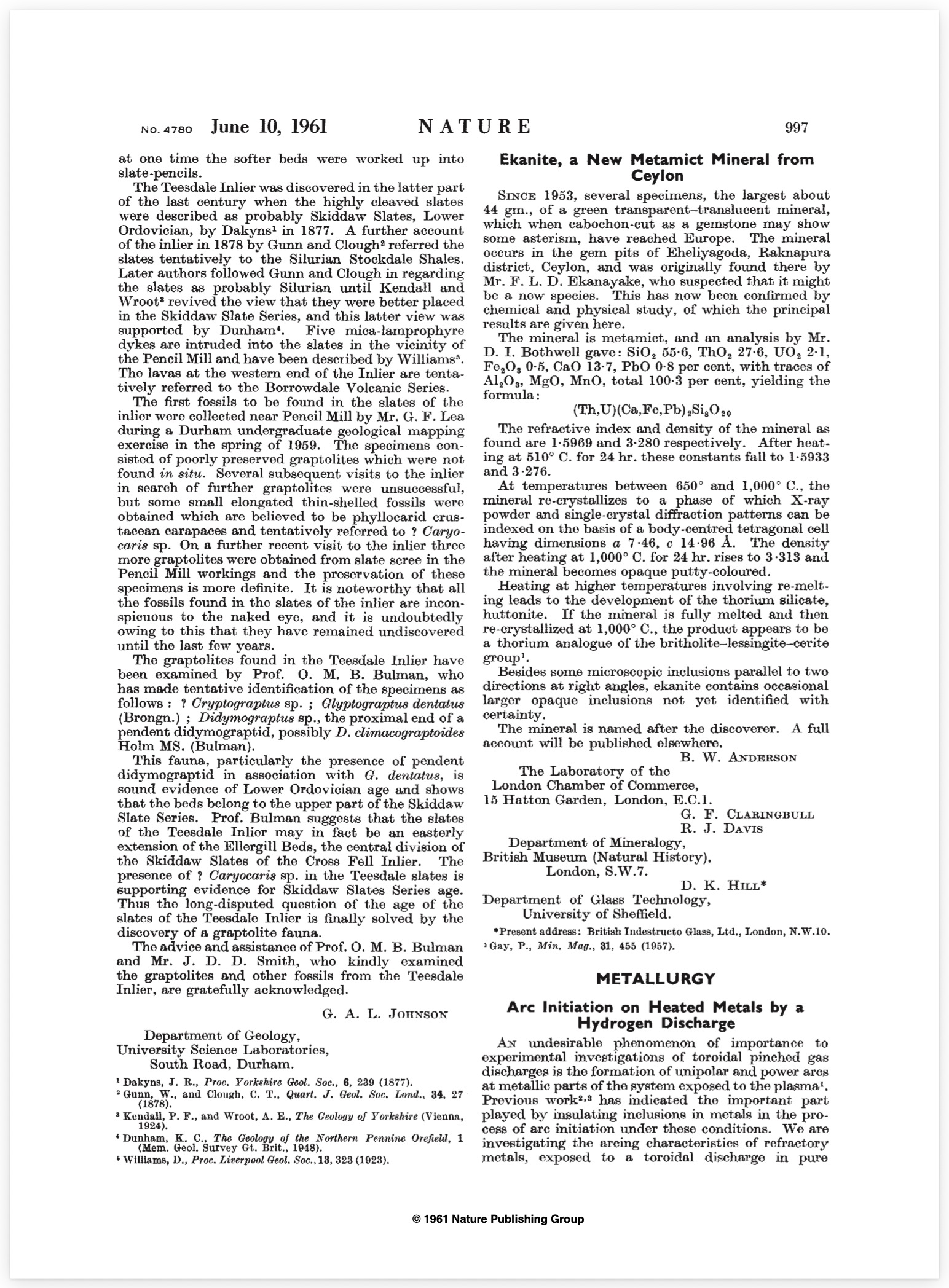
Ekanite, a new metamict mineral from Ceylon

Ekanite, a new metamict mineral from Ceylon

Anderson, B.W., Claringbull, G.F., Davis, R.J. and Hill, D.K. (1961)

Journal Article · Source: Nature · Volume: Vol. 190 · Issue: No. 4780 · Pages: p. 997

Abstract
Anderson, Claringbull, Davis and Hill describe ekanite, a newly recognized metamict mineral from the gem pits of Eheliyagoda in the Ratnapura district of Ceylon. Known since 1953 as green transparent-to-translucent pebbles, some fashioned as cabochons showing a gemstone-quality smoky asterism, the material was recognized as unusual by F.L.D. Ekanayake, after whom the mineral was named. Chemical analysis indicates a thorium-rich calcium silicate containing uranium, lead and minor rare-earth elements, with the approximate formula (Th,U)(Ca,Fe,Pb)₂Si₈O₂₀. The mineral is metamict, with refractive index about 1.5969 and density 3.276. Heating between 650 and 1,000 °C causes recrystallization to an X-ray powder pattern resembling thorite or zircon; at higher temperatures it melts and, if subsequently recrystallized, produces an X-ray pattern analogous to huttonite. Microscopic examination shows occasional larger opaque inclusions but no identifiable inclusions responsible for the asterism.
Keywords
gems, Ceylon, Sri Lanka, ekanite, metamict mineral
Corundum from Tanganyika

Corundum from Tanganyika

Webster, R. (1961)

Journal Article · Source: Gems & Gemology · Volume: Vol. 10 · Issue: No. 7, Fall · Pages: pp. 202–205

Keywords
corundum, ruby, sapphire, Tanzania.12, East Africa.12, inclusions.5, gems
The Powder Method in X-ray Crystallography

The Powder Method in X-ray Crystallography

Azaroff, L.V. and Bueger, M.J. (1958)

Book · Publisher: MacGraw-Hill · Pages: 342 pp.

Abstract
Instruction in the various laboratory methods for investigating crystals has long been part of the mineralogy and geology curriculum at the Massachusetts Institute of Technology, encompassing both optical and x-ray techniques. While suitable texts exist for optical methods, there has been no adequate textbook on the x-ray powder method. To support lectures and prepare students for laboratory work, the authors initially wrote a set of notes on the theory and practice of this method, which eventually evolved into this book. The expanded format allowed for more detailed discussion and the inclusion of advanced material beyond what could be covered in a short course. The powder method is inherently simple yet widely valuable across science and industry, often used by individuals with no formal training in crystallography. This book is written with such users in mind, maintaining a fundamental approach while assuming only limited prior knowledge. It omits detailed coverage of general crystallography, x-ray generation, and equipment beyond powder cameras, as these are addressed in other sources. Detection methods using photographic film are emphasized, given their simplicity and permanence, despite the growing use of ionization-type detectors. The principles outlined apply regardless of detection technique, but film is expected to remain relevant in routine applications for the foreseeable future.
Keywords
gems, gemology, advanced gemology, gem testing, x-ray powder diffraction, analytical
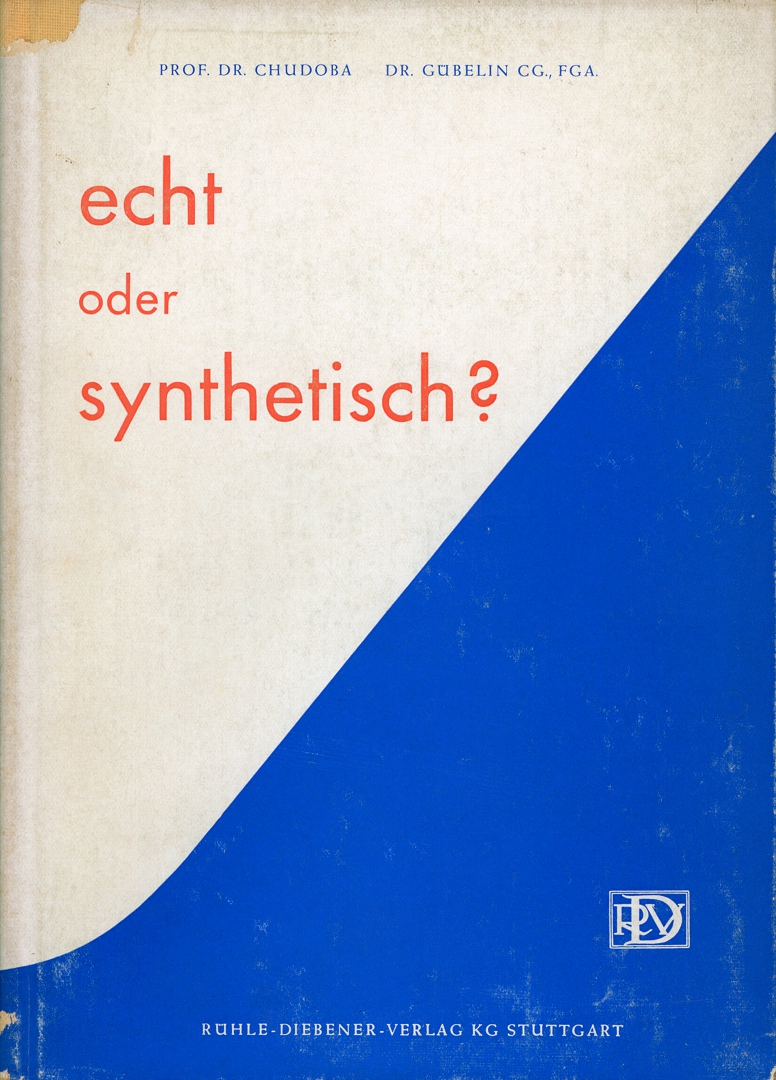
Echt oder synthetisch?

Echt oder synthetisch?

Genuine or Synthetic?

Chudoba, K. and Gübelin, E. (1956)

Book · Publisher: Rühle-Diebener-Verlag · Pages: 156 pp. · Language: in German

Abstract
Chudoba and Gübelin provide a practical guide to distinguishing natural gemstones from synthetic counterparts, combining a short history of artificial gem production with detailed discussion of the principal manufacturing methods and their diagnostic consequences. The Verneuil flame-fusion process, flux growth, and hydrothermal synthesis are described, together with the characteristic structures and inclusions they produce. Particular attention is given to synthetic ruby and sapphire, spinel, emerald, and other important gem materials, with comparisons between natural and laboratory-grown stones based on growth zoning, curved striae, gas bubbles, mineral inclusions, refractive properties, fluorescence, and other microscopic and physical features. The authors emphasize examination with the gemological microscope as one of the most powerful means of separation, supported by numerous photomicrographs illustrating inclusions and growth phenomena in both natural and synthetic gems. Conceived as a concise working manual for gemologists and jewelers, the book brought together the principal identification criteria then available at a time when synthetic gemstones were becoming increasingly sophisticated and commercially important.
Keywords
corundum, ruby, sapphire, synthetic corundum.7, synthetic ruby, synthetic sapphire, gems
Inclusions in synthetic spinels

Inclusions in synthetic spinels

Gübelin, E.J. (1956)

Journal Article · Source: The Gemmologist · Volume: Vol. 25 · Issue: No. 302, September, pp. 153–157; No. 303, October, pp. 173–176

Keywords
inclusions, synthetic spinel, gems
Asterism in corundum

Asterism in corundum

Tait, A.S. (1955)

Journal Article · Source: Journal of Gemmology · Volume: Vol. 5 · Issue: No. 2, April · Pages: pp. 65–72

Keywords
corundum, ruby, sapphire, inclusions.5, phenomena, star, gems
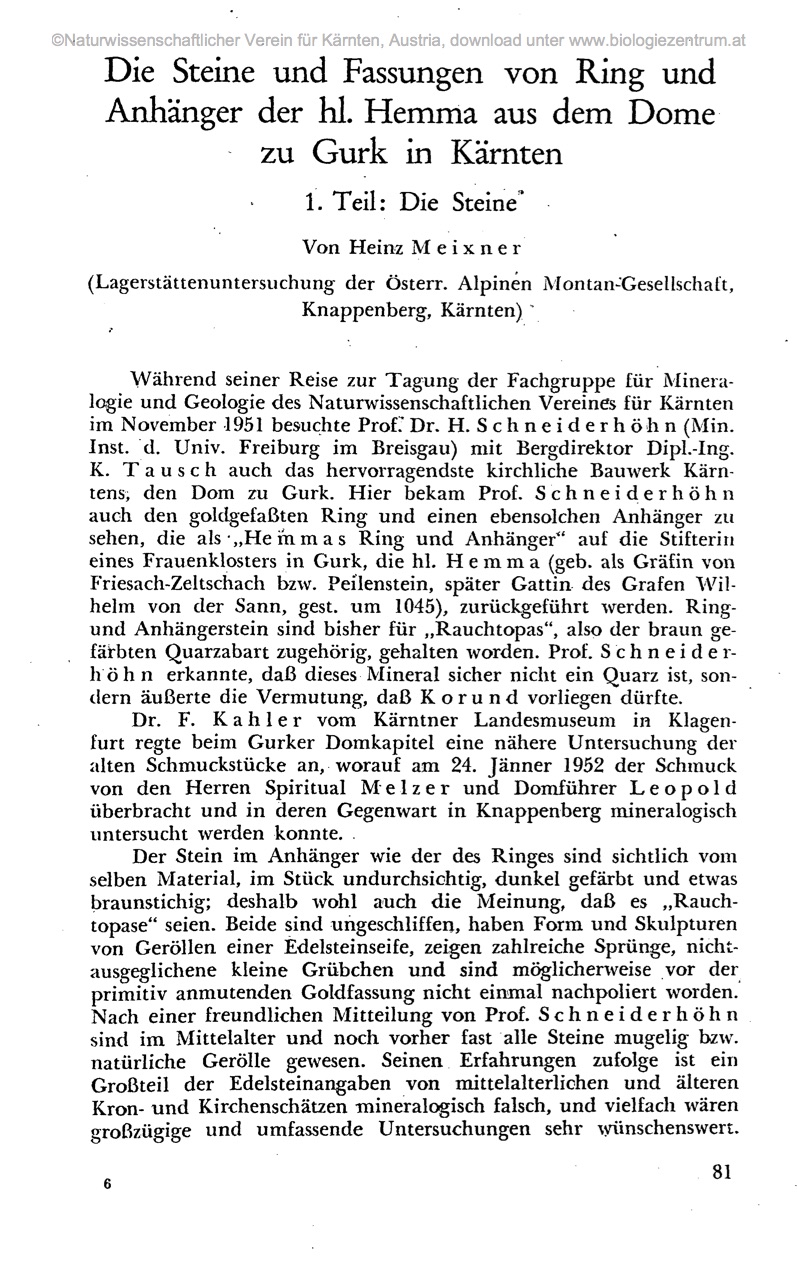
Die Steine und Fassungen von Ring und Anhaenger der hl. Hemma aus dem Dome zu Gurk in Kaernten; 1. Teil, Die Steine

Die Steine und Fassungen von Ring und Anhaenger der hl. Hemma aus dem Dome zu Gurk in Kaernten; 1. Teil, Die Steine

The Stones and Settings of the Ring and Pendant of Saint Hemma from the Cathedral of Gurk in Carinthia; Part 1, The Stones

Meixner and Heinz (1952)

Journal Article · Source: Carinthia II · Volume: Jg. 142 (Car. II, Jg. 62, H. 1) · Pages: pp. 81–84 · Language: in German

Abstract
A laboratory examination of an unpolished gemstone from one of the St. Hemma jewels (11th century) of the Gurk cathedral, Carinthia, Austria, showed it to be corundum with rutile inclusions, not yellow quartz (false topaz) as labeled. The source of the stone was probably a Far Eastern locality.
Keywords
corundum, quality.10, history.1, gems
Unusual two and three phase inclusions in Ceylon sapphire

Unusual two and three phase inclusions in Ceylon sapphire

Hoagland, L.P. (1952)

Journal Article · Source: Journal of Gemmology · Volume: Vol. 3 · Issue: No. 8, Oct. · Pages: pp. 330–336

Abstract
At a meeting of the Mineralogical Society held on 24ᵗʰ January, 1952, for the second time within a year a new gem mineral was described. On the former occasion only two small cut specimens of the mineral (taaffeite) were on view, these representing the whole of the world’s known supply; whereas in describing sinhalite Dr. G. F. Claringbull was able to produce a score of cut examples, some of them of considerable size. There was also one small pebble of rough, recovered by Dr. E. H. Rutland from samples of illam held by the lapidaries, Charles Mathews & Son.
Keywords
corundum, Sri Lanka.12, inclusions.5, gems
Inclusions in diamond

Inclusions in diamond

Gübelin, E.J. (1951)

Journal Article · Source: The Gemmologist · Volume: Vol. 20 · Issue: No. 245, December · Pages: pp. 241–243

Keywords
diamond, inclusions, gems
Die diagnotische Bedeutung der Einschlüsse in Edelsteinen

Die diagnotische Bedeutung der Einschlüsse in Edelsteinen

The diagnostic significance of the inclusions in gemstones

Gübelin, E.J. (1948)

Journal Article · Source: Schweizerische Mineralogische und Petrographische Mitteilungen · Volume: Vol. 28 · Issue: No. 1 · Pages: pp. 146–156 · Language: in German

Keywords
corundum, ruby, sapphire, inclusions.5, Kashmir.11, India.12, gems

Exploring the Literature of Gemstone Inclusions

The literature of gemstone inclusions covers identification, origin determination, treatments, synthesis, mineral inclusions, fluid inclusions and other internal features of natural and synthetic gems.

For a curated selection of important sources, read Inclusions in Gemstones — Hyperion Literature Sources.

About Four Treasures

Four Treasures is Lotus Gemology's freely accessible gemological reference database. Use the full database to search by author, title or keyword and explore literature on gemology, mineralogy, jewelry and related fields. Where available, hyperlinks on titles may lead directly to the full publication.

Search the Complete Four Treasures Database