Gemstone Inclusions Bibliography

Gemstone Inclusions Bibliography

Explore books, articles and historical sources on inclusions in gemstones in Four Treasures, the Lotus Gemology reference database. This bibliography brings together matching records from the collection, with publication details, abstracts and cover images where available.

Gemstone Inclusion References

The list below matches the terms inclusion or inclusions in the database's searchable fields. Some references discuss inclusions as part of a broader subject.

1,001–1,020 of 1,111 matching references
Further notes on “inclusions” in gems, etc.

Further notes on “inclusions” in gems, etc.

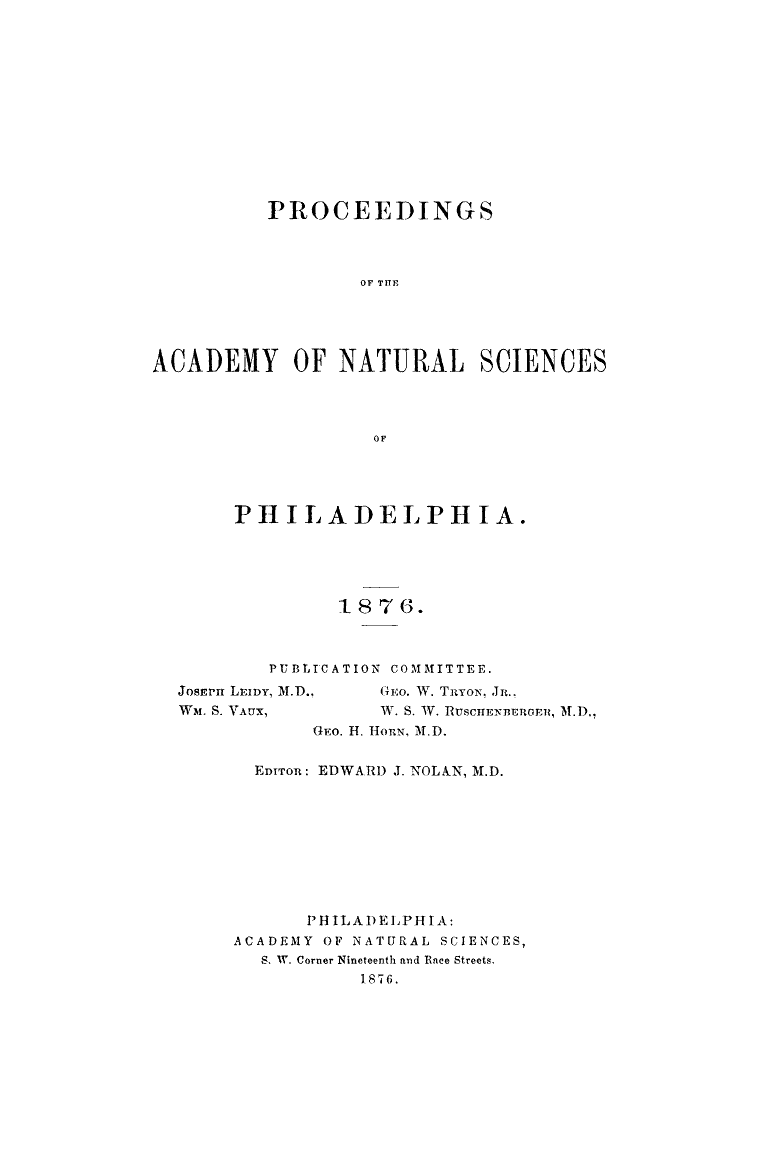
Lea, I. (1876)

Journal Article · Source: Proceedings of the Academy of Natural Sciences of Philadelphia · Issue: May · Pages: pp. 98–107 (reprinted in Gems & Gemology, Winter, 1955, pp. 230–236, 254)

Abstract
A detailed continuation of Isaac Lea’s earlier studies of microscopic inclusions in gemstones and minerals. Drawing on an enlarged personal collection, Lea examines cavities, fluid inclusions and minute enclosed crystals in sapphire, ruby, spinel, emerald, beryl, zircon, moonstone and other gem materials. Of particular importance is his observation that fine sapphires commonly contain abundant acicular crystals and cavities; he relates the oriented needles directly to the intersecting bands that produce the star in asteriated corundum. He also describes inclusions in North Carolina corundum, Ceylon sapphires and spinels, emeralds containing fluid-filled cavities with enclosed cubic crystals, and other distinctive internal features, illustrating many of them on two plates. The paper is an important early contribution to gemstone microscopy and to the recognition of inclusions as diagnostic evidence of a gem’s internal structure and growth history.
Keywords
corundum, inclusions.5, gems
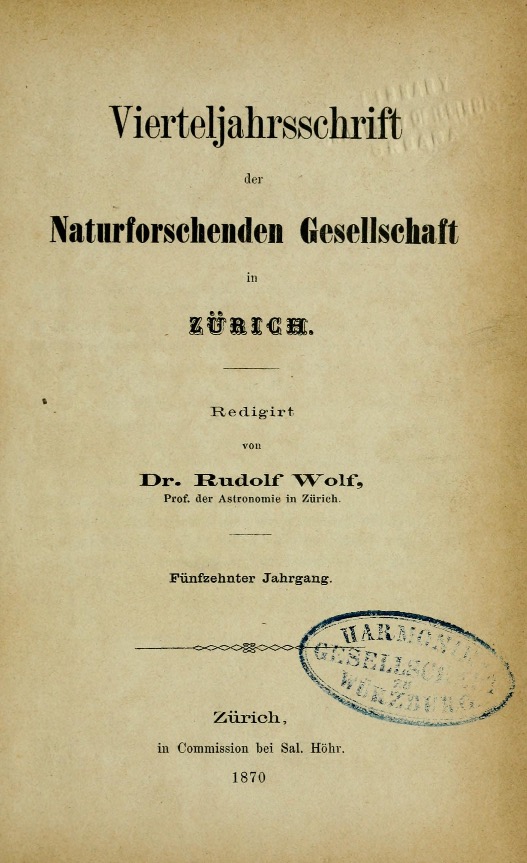
Nephrit (Punamu) aus Neuseeland

Nephrit (Punamu) aus Neuseeland

Nephrite (Punamu) from New Zealand

Kenngott, A. (1870)

Journal Article · Source: Vierteljahrsschrift der Naturforschenden Gesellschaft in Zürich · Volume: Vol. 15 · Pages: pp. 372–377 · Language: in German

Abstract
Fischer: Kenngott, Ad. reports in the Züricher Vierteljahrschrift der naturforsch. Gesellsch. Zürich Quarterly Journal of the Natural History Society], XV. Year 1870, pg. 372–377 [Leonh. Gein. Yearbook 1871, 293] on two handpieces of punamu nephrite acquired for the Zürich collection of Edm. v. Fellenberg. These pieces were detached from a large erratic block* weighing 180 pounds that was brought to Europe. This is the same block mentioned and analyzed by L.R. v. Fellenberg (the father of the former) in his article from 1869–70 [see above, pg. 278]. Kenngott’s microscopic examination revealed that the mineral is homogeneous and polarization. There are hardly any significant foreign black inclusions, but there might be some traces of chrome iron or magnetite. According to Kenngott’s analysis, punamu nephrite can be classified as a variety of greenstone (like Damour), and he compiles 25 known nephrite analyses (note that the numbers given in analyses 10 and 11 by Damour do not match those in the original Damour article due to some error).
Keywords
gems, jade, amphibole jade, nephrite, Fischer-Book
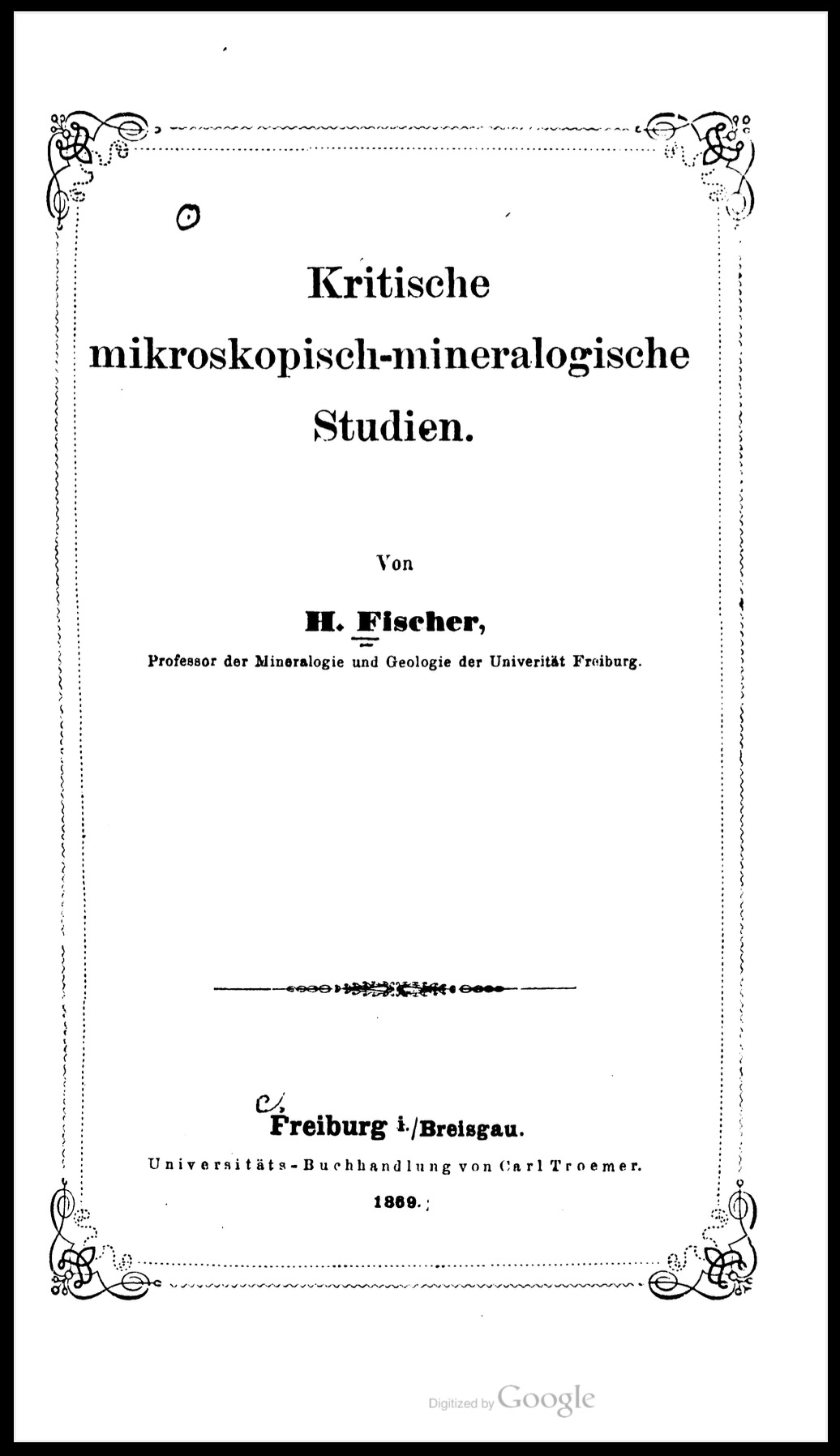
Kristische, mikroskopisch-mineralogische Studien

Kristische, mikroskopisch-mineralogische Studien

Critical, microscopic-mineralogical studies

Fischer, H. (1869)

Book · Volume: 1st Fortsetzung · Pages: 96 pp., 2 plates · Language: in German

Abstract
Fischer presents the first continuation of his critical microscopic-mineralogical studies, applying microscopic examination to the identification and differentiation of minerals and rocks whose true nature could be difficult to establish from external appearance alone. He compares microscopic structure, texture, inclusions, and other diagnostic characteristics with chemical and physical evidence and critically reassesses earlier mineral identifications. Of particular relevance to jade research are the discussions on pp. 9, 24–25, and 48, where nephrite and related or superficially similar materials are considered as part of Fischer’s continuing effort to distinguish true nephrite from “pseudonephrite” and other jade-like substances. The work illustrates the increasing importance Fischer attached to microscopy in resolving the nineteenth-century “jade question” and in establishing more reliable mineralogical identifications of archaeological stone artifacts.
Keywords
gems, jade, Fischer-Book
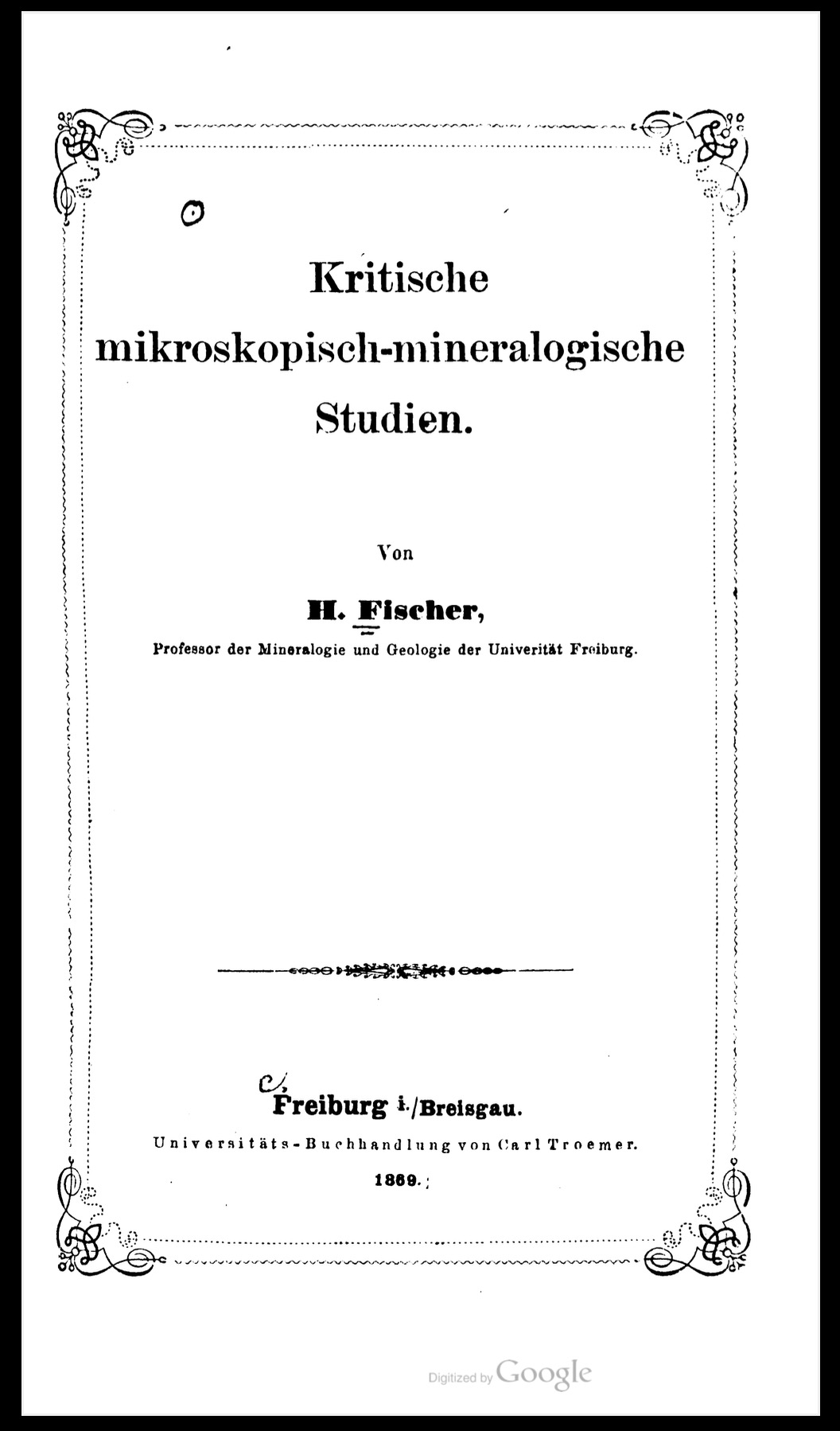
Kristische, mikroskopisch-mineralogische Studien

Kristische, mikroskopisch-mineralogische Studien

Critical, microscopic-mineralogical studies

Fischer, H. (1869, 1871, 1873)

Book · Pages: 64, 64, 96 pp., 2 plates; · Language: in German

Abstract
Fischer presents a series of critical microscopic-mineralogical studies applying microscopy to the identification and differentiation of minerals and rocks whose nature could not always be determined reliably from their external appearance. He examines microscopic structure, texture, inclusions, and other diagnostic features, comparing these observations with chemical and physical evidence and reassessing earlier mineral identifications. Of particular relevance to jade research are his discussions of nephrite and nephrite-like materials, in which microscopy is used to distinguish true nephrite from superficially similar substances. The studies form an important part of Fischer’s contribution to the nineteenth-century “jade question” and illustrate the growing use of microscopic methods for identifying compact mineral aggregates and archaeological stone materials.
Keywords
gems, jade, Fischer-Book
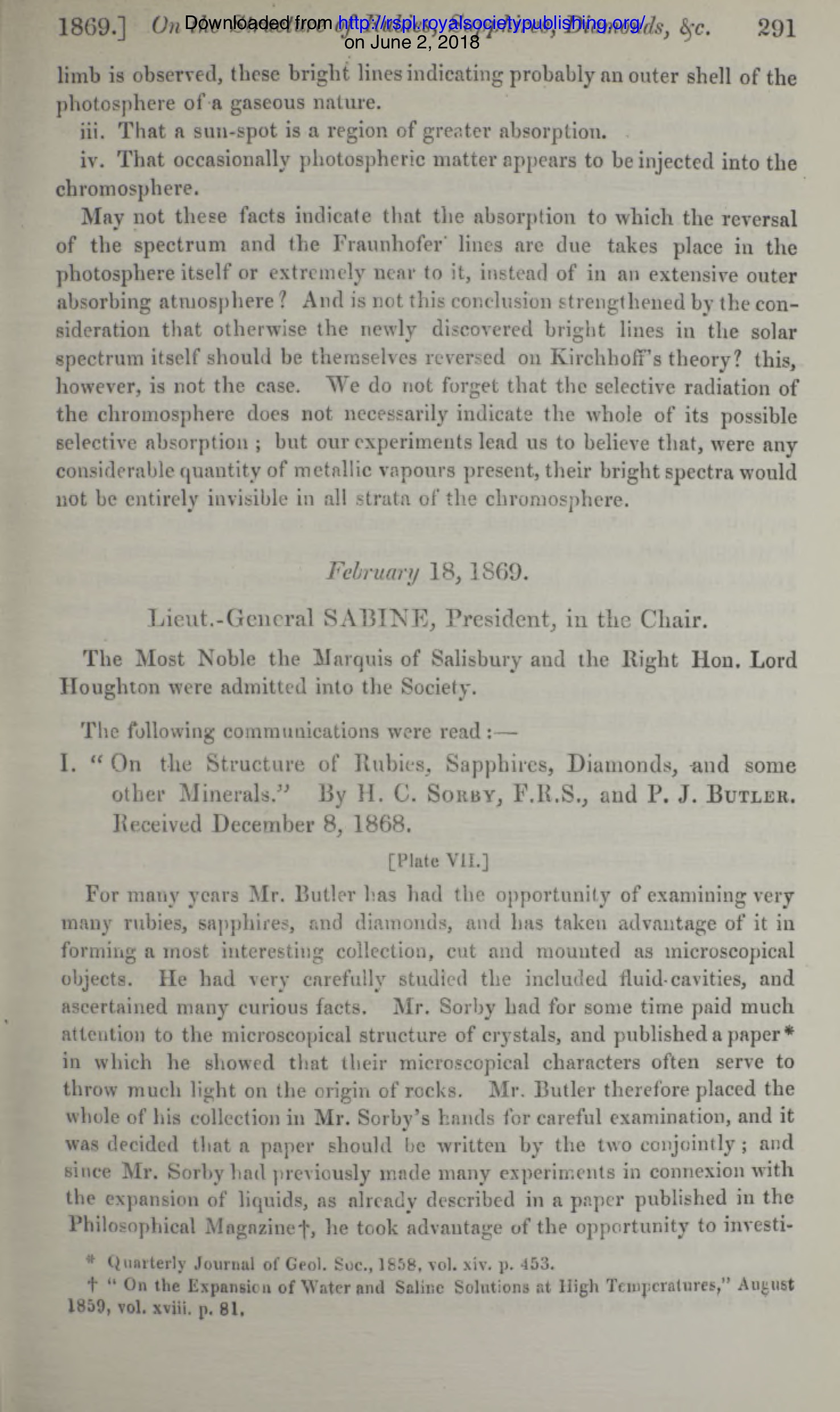
On the structure of rubies, sapphires, diamonds, and some other minerals

On the structure of rubies, sapphires, diamonds, and some other minerals

Sorby, H.C. and Butler, P.J. (1869)

Journal Article · Source: Proceedings of the Royal Society of London · Volume: Vol. 17 · Issue: No. 109 · Pages: pp. 291–302, 1 plate

Abstract
Sorby and Butler investigate the internal structure of rubies, sapphires, diamonds, and other minerals by microscopic examination, using inclusions and growth features to interpret the conditions under which the crystals formed. They describe minute cavities, enclosed crystals, and structural irregularities visible within transparent specimens and compare their character and distribution in different minerals. Particular attention is given to rubies and sapphires, whose internal features provide evidence of successive stages of crystal growth, and to diamonds, in which inclusions and structural characteristics are likewise examined. The authors argue that microscopic features preserved within crystals can provide important evidence concerning their origin and formation. The paper is an important early contribution to the systematic microscopy of gemstones and helped establish the study of inclusions and internal growth structures as a means of investigating mineral genesis.
Keywords
corundum, inclusions.5, ruby, sapphire, spinel, aquamarine, beryl, emerald, gems
Further notes on microscopic crystals

Further notes on microscopic crystals

Lea, I. (1869)

Journal Article · Source: Proceedings of the Academy of Natural Sciences of Philadelphia · Issue: 11-May · Pages: pp. 119–121; reprinted in Gems & Gemology, Fall, 1955, pp. 205–207, 218–219

Abstract
Lea continues his microscopic investigation of minute crystals enclosed within minerals, adding observations to those reported in his earlier 1869 paper. He describes the forms and occurrence of microscopic crystalline inclusions and considers their identification and relationship to their host minerals. Particular attention is given to the value of careful microscopic examination for recognizing well-developed crystal forms that are invisible or indistinct to the unaided eye. The study is of historical gemological interest as an early investigation of mineral inclusions by microscopy, anticipating the later importance of internal features for gemstone identification and for interpreting mineral growth and formation.
Keywords
corundum, inclusions.5, gems
Notes on microscopic crystals included in some minerals

Notes on microscopic crystals included in some minerals

Lea, I. (1869)

Journal Article · Source: Proceedings of the Academy of Natural Sciences of Philadelphia · Issue: Feb. 16 · Pages: reprinted in Gems & Gemology, Fall, 1955, pp. 203–205

Abstract
Lea reports microscopic observations of minute crystals enclosed within larger mineral specimens, emphasizing that such inclusions may themselves possess recognizable crystalline forms and provide evidence concerning the formation of their host minerals. He describes microscopic crystals observed in several minerals and considers their shapes, arrangement, and possible mineralogical identity. Of particular gemological importance is the early application of microscopy to the study of inclusions in transparent minerals, demonstrating that internal features could reveal information not obtainable from external examination alone. The paper anticipates the later systematic use of inclusions in gemology for mineral identification and for interpreting the conditions and sequence of crystal growth.
Keywords
corundum, inclusions.5, gems, inclusions, history of microscopy
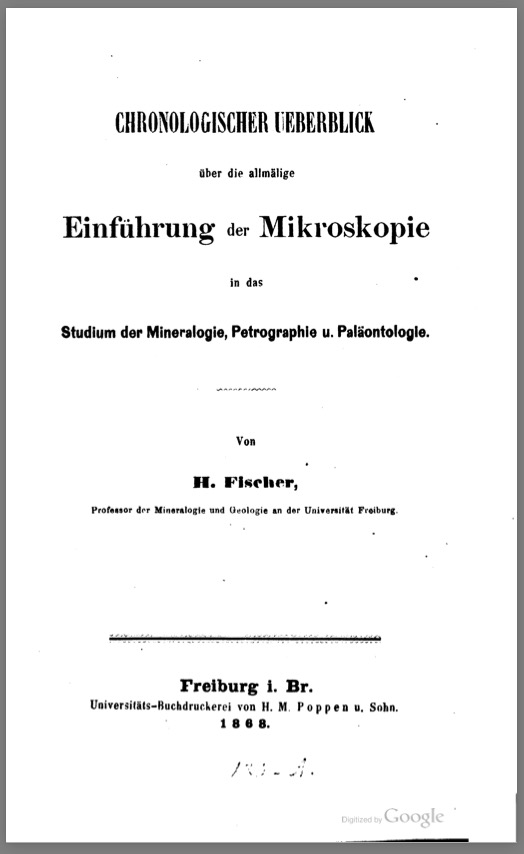
Chronologischer Ueberblick über die allmälige Einführung der Mikroskopie in das Studium der Mineralogie, Petrographie und Paläontologie

Chronologischer Ueberblick über die allmälige Einführung der Mikroskopie in das Studium der Mineralogie, Petrographie und Paläontologie

Chronological overview of the gradual introduction of microscopy into the study of mineralogy, petrography, and paleontology

Fischer, H. (1868)

Book · Publisher: Universitäts - Buchdruckerei · Pages: 80 pp. · Language: in German

Abstract
Fischer presents a chronological history of the introduction and development of microscopic methods in mineralogy, petrography, and paleontology. He traces early observations with magnifying instruments and microscopes and the gradual application of these techniques to minerals, rocks, fossils, and thin sections, discussing the contributions of numerous investigators and improvements in instruments and observational methods. Particular attention is given to the increasing recognition that microscopic examination could reveal structures, inclusions, textures, and mineral constituents that could not be distinguished macroscopically. The work documents an important methodological transition in nineteenth-century mineralogy and petrography, when microscopy was becoming an established analytical technique for identifying minerals and investigating the composition and structure of rocks.
Keywords
gems, jade, Fischer
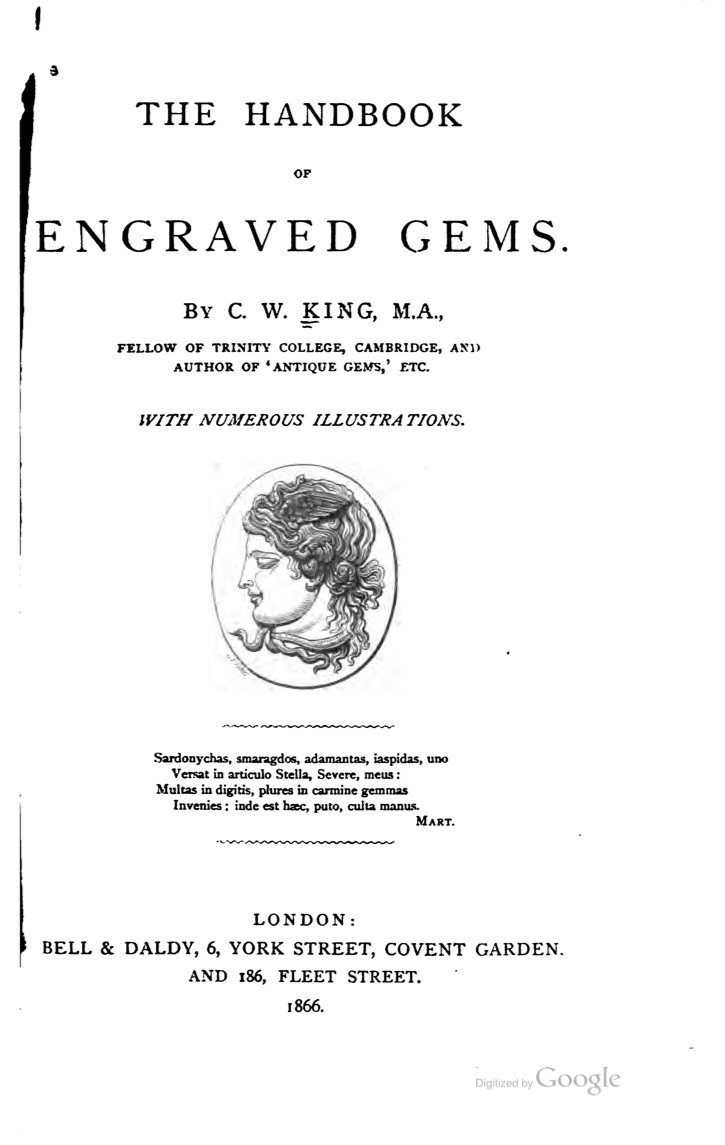
The Handbook of Engraved Gems

The Handbook of Engraved Gems

King, C.W. (1866)

Journal Article · Publisher: Bell & Dadly · Pages: 396 pp.

Abstract
Sinkankas: This volume is primarily a comprehensive history of the art of gem engraving, enriched with additional material that amplifies or embellishes the central theme. The opening chapter—an extensive 183 pages—is historical in nature, followed by chapters on famous rings and signets, European cabinets of engraved gems, artists' signatures, a catalog of ancient gem engravers, and a curious inclusion: a lengthy ode to the bronze statues in the Gymnasium of Zeuxippus by a certain Christodorus, inserted without a clearly discernible purpose. Subsequent chapters describe the gems illustrated in the plates and elsewhere, concluding with a chapter of detailed notes. Written in King’s meticulous and richly detailed style, the work, like his earlier publications, is a treasure trove of information, particularly valuable today for its descriptions of contemporary gem collections, which now hold significant historical importance. Many surviving copies suffer from weak, embrittled cloth—especially along the spine—and intact, sound copies are rare.
Keywords
corundum, ruby, sapphire, history.1, quality, gems, glyptic
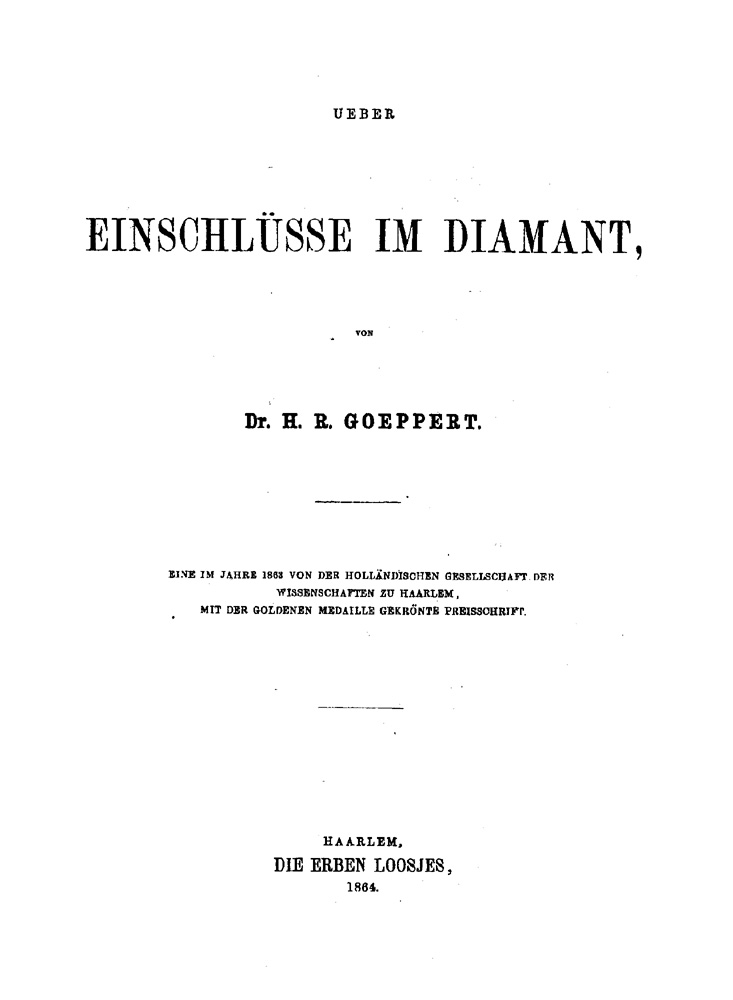
Ueber Einschlüsse im Diamant

Ueber Einschlüsse im Diamant

On inclusions in diamond

Göppert, H.R. (1864)

Book · Publisher: Die Erben Loosjes · Pages: 84 pp., 7 plates (lithographic; showing diamond crystals and inclusions) · Language: in German

Abstract
This well researched paper describing various inclusions found in the mineral diamond won a gold medal from the Dutch Society of Science in Haarlem. Goeppert describes and analysis's various diamond inclusions, which to him resemble organic remains, and also gives an account of occurrences of diamond, which at the time were mostly alluvial. In this time prior to the discoveries of the great diamond fields of South Africa, the author puts forth a very convincing case that the carbon inclusions in diamond are organic in nature and that diamonds were created through some type of sedimentary process. However, shortly after this volume appeared the kimberlite pipe of the Dark Continent were found and the true igneous origin of diamond established once and for all time. Scarce. Goeppert was professor of medicine and botany at the University of Breslau (now Wroclaw, Poland). From 1852 he was director of the Botanical Gardens at the University.
Keywords
gems, inclusions, diamond
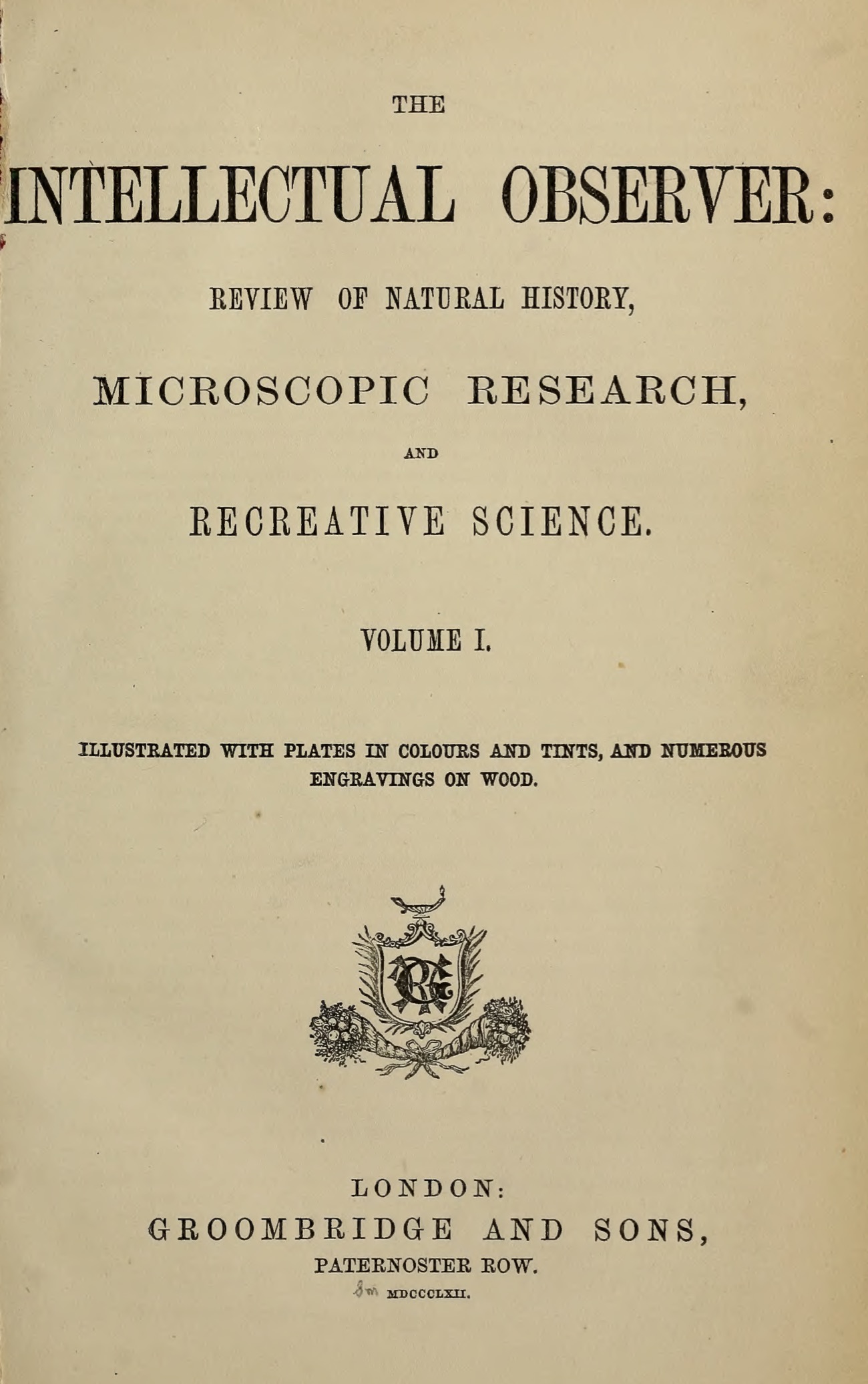
On the application of the microscope to the art of design

On the application of the microscope to the art of design

Slack, H.J. (1862)

Journal Article · Source: The Intellectual Observer · Volume: Vol. 1 · Pages: pp. 111–114, 1 plate

Abstract
Manufacturing experience affords many instances of surprising success achieved by ornamental goods, whose patterns were judiciously selected from natural objects; but although examples of various combinations of form and colour occur in great profusion in those portions of the natural world which are accessible to unassisted sight, the microscope constantly presents us with a rich store of ideas which the decorative artist would do well to study and employ. If colour be the especial subject of his pursuit, the wings of butterflies or the wing-cases of beetles, the petals of flowers—such as London-pride—minute sea-weeds, and other common objects, are highly instructive; and if we were requested to point out an illustration of the union of extraordinary splendour with grateful repose, we could not do better than refer to the armour in which the diamond beetle is arrayed. When Mr. Owen Jones completed his Alhambra Court, at the Crystal Palace, every one was struck by the mingled softness and gorgeousness of the aspect. The eye could look steadily without being wearied, while a visit to the House of Lords, when its colours were new and fresh, afflicted observers with an unpleasant sense of tension, rapidly followed by weariness, from which there was no escape. Even in the cases of persons afflicted with colour blindness, we sometimes find that what may be called colour discords are productive of disagreeable impressions, while colour harmonies, although only partially perceived, call forth pleasurable emotions. Still more striking are the effects of colour harmonies and discords upon individuals whose physical and mental organs are in a sound and cultivated state. They are not satisfied with the mere avoidance of mistakes, or with the presentation of the most elementary concords which pigments can produce. Their tastes lead them to desire to untwist all the chains of colour harmony; they love the complicated effects of tertiary combinations, and are discontented with brilliance if it be destitute of repose.
Keywords
gems, inclusions, microscopy, aesthetics, photomicrography, art
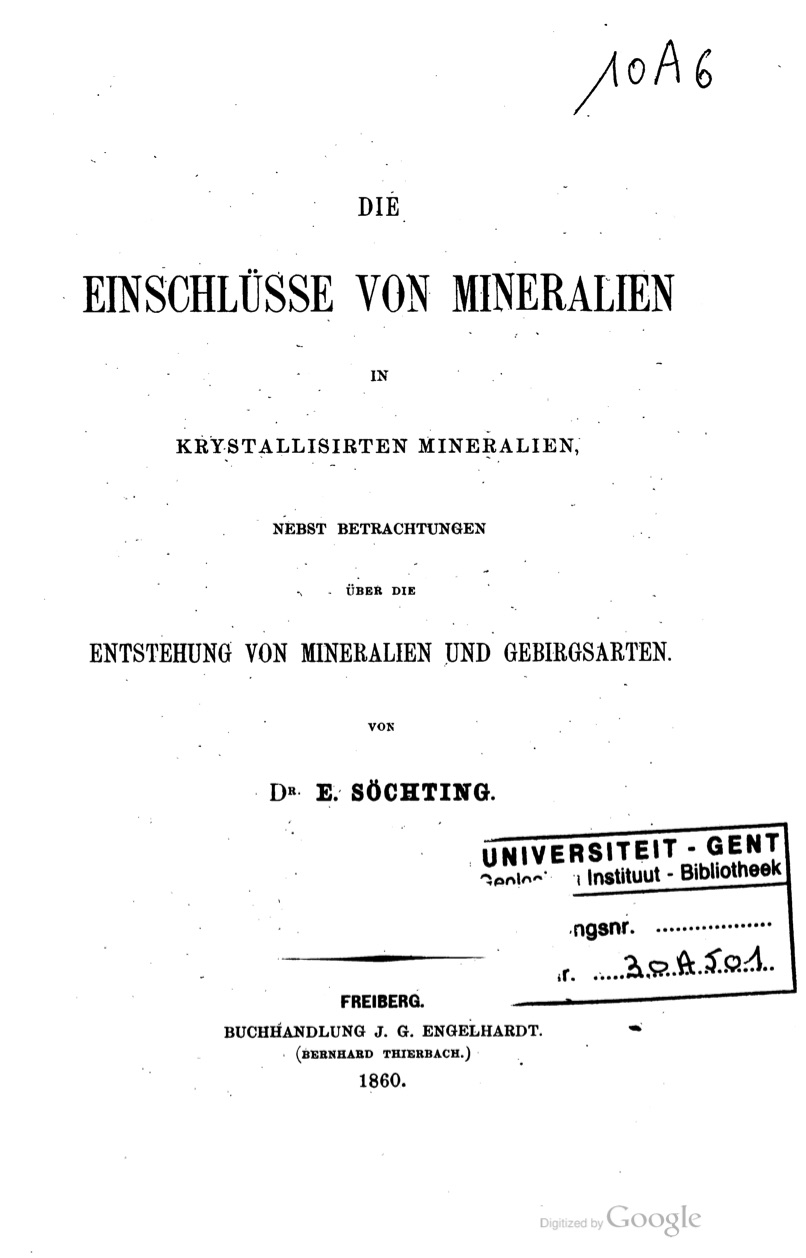
Die Einschlüsse von Mineralien in Krystallisirten Mineralien

Die Einschlüsse von Mineralien in Krystallisirten Mineralien

Inclusions of Minerals in Crystallized Minerals

Söchting, J.W.E. (1860)

Book · Publisher: Buchhandlung J.G. Engelhardt · Pages: 357 pp. · Language: in German

Abstract
Sinkankas: A worthy continuation of the pioneering work on inclusions by R. Blum, G. Leonhard, et al., 1854, which should be consulted, is the present large and important work that reflects the careful search of its author throughout the mineralogical literature. As a result, it reports on many new types of inclusions, both mineralic and organic in nature, many of which are based on his own observations. However, there are errors, such as the occurrence of gold in diamond, and numerous speculations, some of which were later confirmed, while others were disproved. Although references are noted, there is no bibliography, and one is forced to work back through the text to find full citations of works.
Keywords
corundum, inclusions.5, gems
On the microscopical structure of crystals, indicating the origin of minerals and rocks

On the microscopical structure of crystals, indicating the origin of minerals and rocks

Sorby, H.C. (1858)

Journal Article · Source: Quarterly Journal of the Geological Society of London · Volume: Vol. 14 · Pages: pp. 453–500

Abstract
Sorby’s landmark paper demonstrates how microscopic examination of minerals and rocks can be used to reconstruct the conditions under which they formed. Using thin sections and transmitted-light microscopy, he studies crystal textures and, especially, microscopic cavities and fluid inclusions containing liquids, gases, and sometimes daughter crystals. Sorby shows that such inclusions may preserve samples of the fluids present during crystal growth and that changes in their liquid and vapor proportions upon heating can provide information on formation temperatures. From these observations he distinguishes minerals formed from aqueous solutions, molten material, and other geological environments and applies the method to interpreting the origin of rocks. The paper is foundational to microscopic petrography and fluid-inclusion research and is particularly important to gemology because the study of inclusions subsequently became one of the principal means of determining gemstone genesis, geological environment, and, ultimately, distinguishing natural from synthetic and treated gems.
Keywords
corundum, inclusions.5, gems
Narrative of the proceedings and scientific observations of the late Mission to Ava

Narrative of the proceedings and scientific observations of the late Mission to Ava

Calcutta Government Gazette (1828)

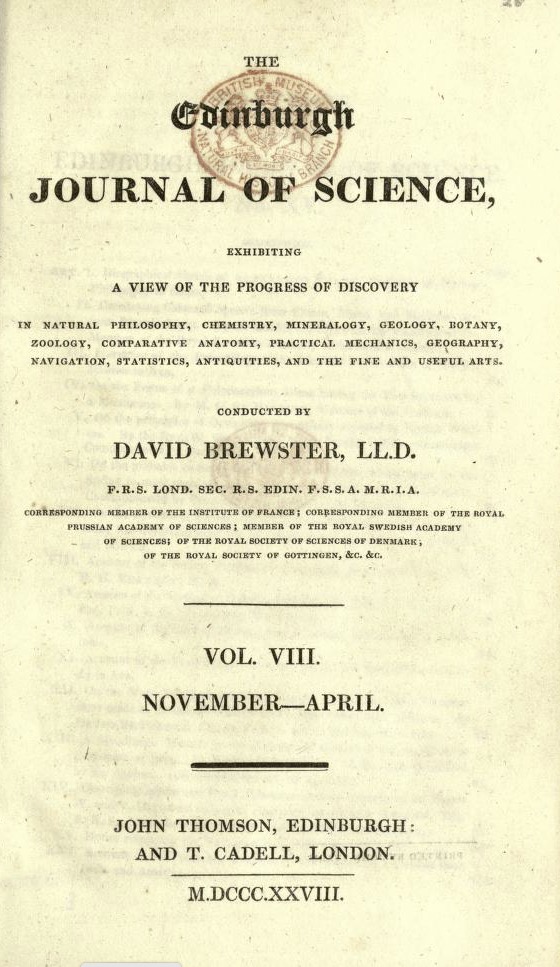
Journal Article · Source: Edinburgh Journal of Science · Volume: Vol. 8 · Issue: No. 15 · Pages: pp. 10–25

Abstract
This report of a diplomatic mission to the Kingdom of Ava contains a brief description of the ruby and sapphire mines. It is a reprint of the earlier 1827 report from the Calcutta Government Gazette.
Keywords
gems, corundum, Afghanistan.12, inclusions.5, blue sapphire
Notice respecting the existence of the new fluid in a large cavity in a specimen of sapphire

Notice respecting the existence of the new fluid in a large cavity in a specimen of sapphire

Brewster, D. (1827)

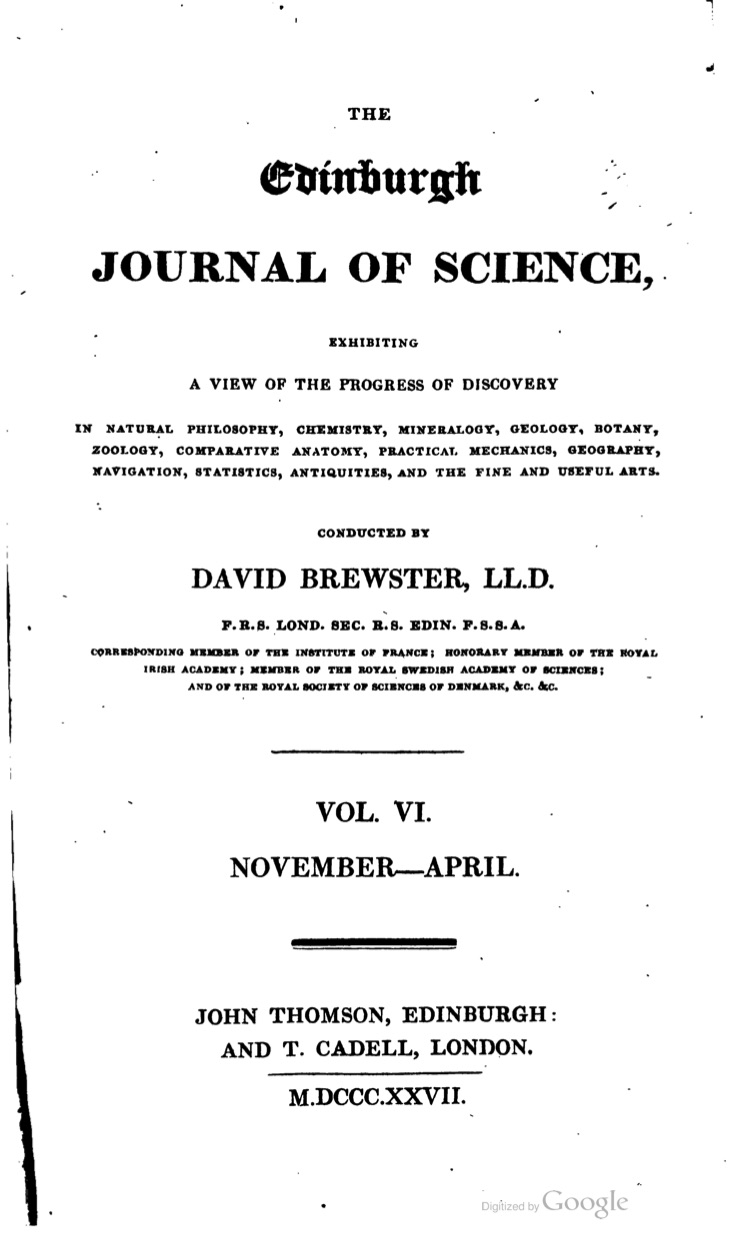
Journal Article · Source: Edinburgh Journal of Science · Volume: Vol. 6 · Pages: pp. 155–156

Abstract
A brief note by David Brewster reporting a large fluid-filled cavity observed in a specimen of sapphire. The paper extends his earlier investigations of fluids enclosed within minerals and records the presence and behavior of the trapped liquid in corundum. Of particular gemological importance, it is an early specific description of a fluid inclusion in sapphire, demonstrating that such inclusions occur in precious stones as well as in other minerals. The notice forms part of Brewster’s pioneering work on mineral inclusions and the physical conditions under which crystals form.
Keywords
corundum, sapphire, inclusions.5, gems
On the existence of two new fluids in the cavities of minerals, which are immiscible, and possess remarkable physical properties

On the existence of two new fluids in the cavities of minerals, which are immiscible, and possess remarkable physical properties

Brewster, D. (1826)

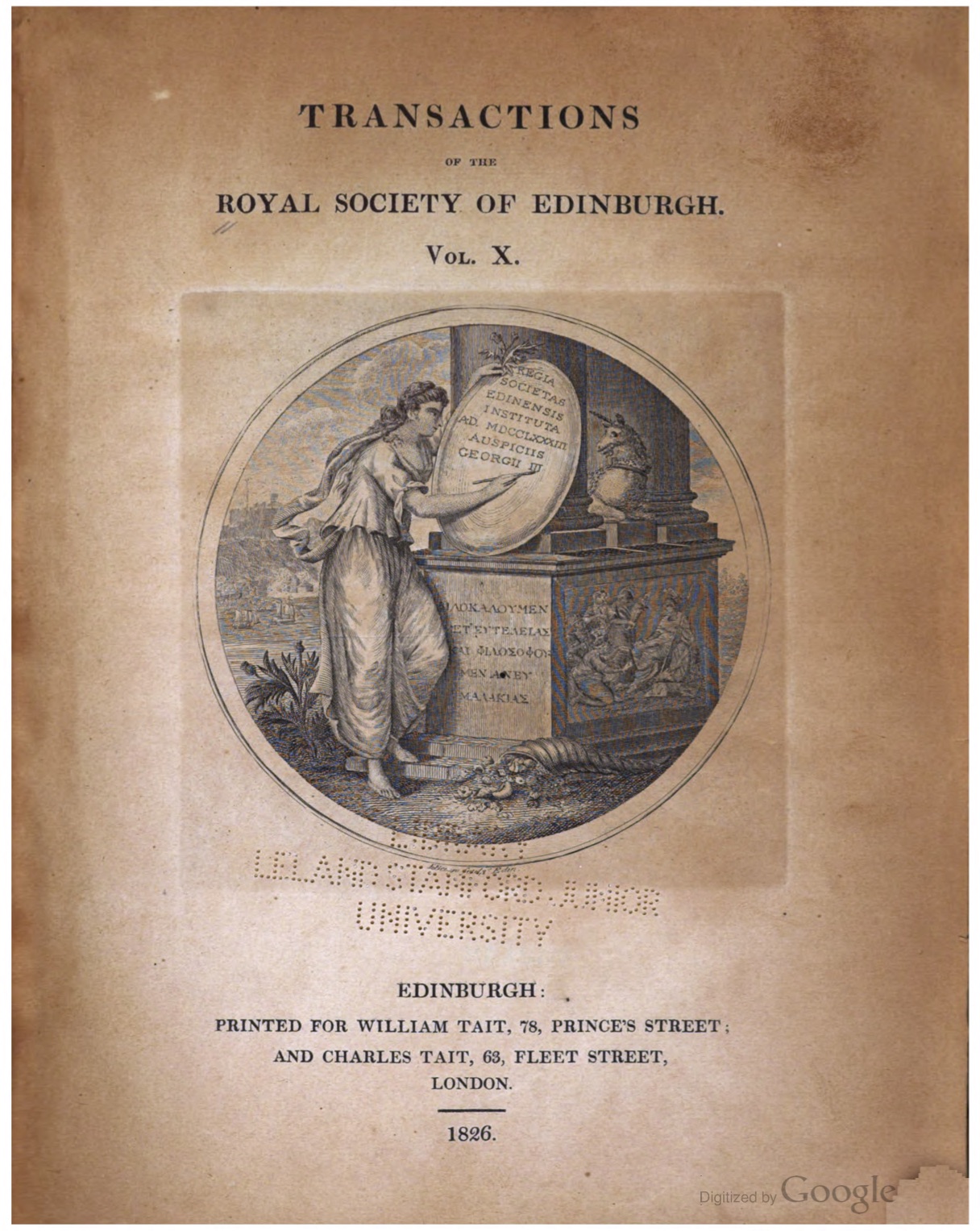
Journal Article · Source: Transactions of the Royal Society of Edinburgh · Volume: Vol. 10 · Issue: Part 1 · Pages: pp. 1–41, 2 plates

Abstract
An important early study by David Brewster of liquid inclusions enclosed within minerals. Brewster describes cavities containing two immiscible fluids with markedly different physical properties and examines their behavior under changes of temperature and pressure. Using microscopic observation and optical methods, he investigated the relative volumes, expansion and contraction of the enclosed fluids and the formation and movement of bubbles within the cavities. The paper is a major early contribution to the study of fluid inclusions and is especially important to gemology and mineralogy because such inclusions later became valuable evidence for mineral growth conditions, geological environment and, in some cases, geographic origin.
Keywords
corundum, inclusions.5, gems
On the state of water and aeriform matter in cavities found in certain crystals

On the state of water and aeriform matter in cavities found in certain crystals

Davy, H. (1822)

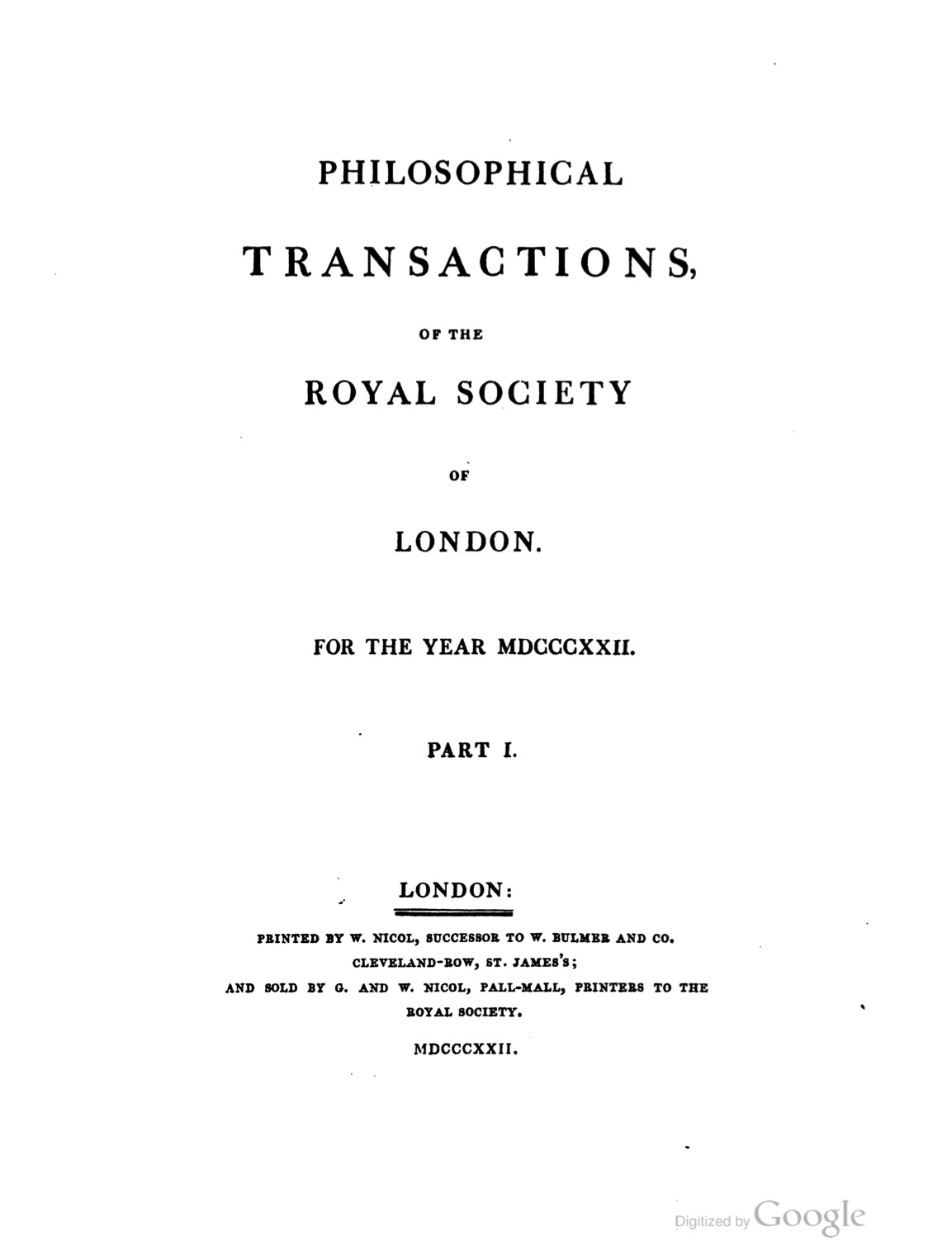
Journal Article · Source: Philosophical Transactions of the Royal Society of London · Volume: Vol. 112 · Pages: pp. 367–376

Abstract
An important early study by Humphry Davy of fluid and gaseous inclusions enclosed within crystals. Davy examines cavities containing liquid and aeriform matter in several minerals and considers the physical state, composition and behavior of the enclosed substances when the crystals are heated or broken. The paper is significant in the history of mineralogy because it helped establish that crystals can trap fluids and gases during their formation, providing evidence about the conditions under which minerals crystallize. For gemology, it is an early contribution to the study of fluid inclusions, which later became important for understanding gemstone genesis, geological environment and, in some cases, geographic origin.
Keywords
corundum, inclusions.5, gems
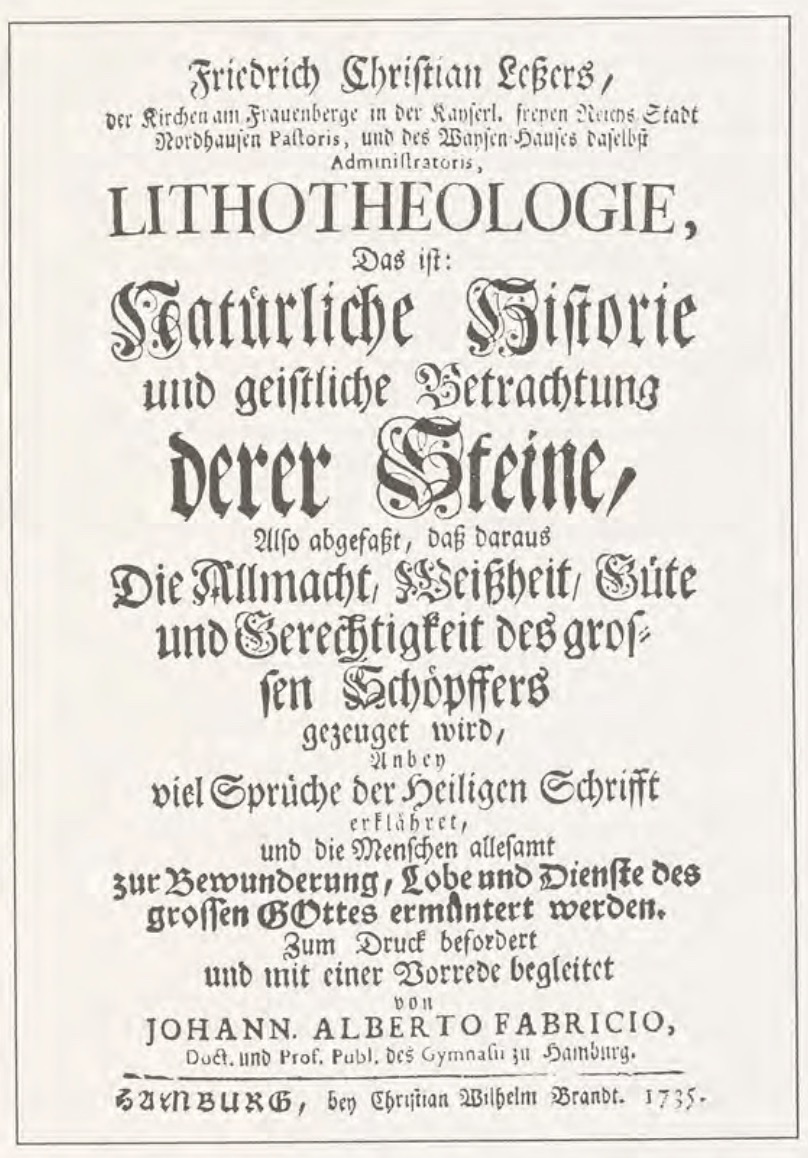
Lithotheologie, Das ist: Natürliche Historie und geistliche Betrachtung derer Steine, also abgefasst, dass daraus die Allmacht, Weisheit, Güte und Gerechtigkeit des grossen Schöpffers gezeuget wird, anbey viel Sprüche der Heiligen Schrifft erklähret und die Menschen allesamt zur Bewunderung, Lobe und Dienste des grossen Gottes ermuntert werden.

Lithotheologie, Das ist: Natürliche Historie und geistliche Betrachtung derer Steine, also abgefasst, dass daraus die Allmacht, Weisheit, Güte und Gerechtigkeit des grossen Schöpffers gezeuget wird, anbey viel Sprüche der Heiligen Schrifft erklähret und die Menschen allesamt zur Bewunderung, Lobe und Dienste des grossen Gottes ermuntert werden.

Lithotheologic, that is: Natural history and spiritual contemplation of stones, composed in such a way that from them the omnipotence, wisdom, goodness, and justice of the great Creator are demonstrated; together with explanations of many passages of Holy Scripture, and an exhortation to all mankind to admiration, praise, and service of the great God

Lesser, F.C. (1735)

Book · Publisher: Christian Wilhelm · Pages: 1300 pp. · Language: in German

Abstract
Sinkankas: Utterly fascinating work in great detail and complexity, attempting to demonstrate the hand of God in every manifestation of the mineral kingdom. Lesser assembled an astounding fund of information culled from hundreds of ancient and modern sources and covering nearly every aspect of geology, mineralogy, paleontology, and gemology. So successful was he, and apparently so careful in his choices and interpretations, that the present work was very commonly quoted by later writers in earth sciences and mineralogy. It is divided into nine books, each with several parts and chapters. Book one explains fundamental interrelationships existing among the lithosphere, atmosphere, hydrosphere, and biosphere. Book two concerns the origin and formation of rocks and minerals. Book three treats occurrences or deposits of mineral materials, including gemstones. Book four discusses the properties of minerals and stones. Book five addresses “precious” and “non-precious” stones, with pp. 343–66 treating precious stones, though restricted to a limited number of the better-known species and varieties, the stones themselves being apportioned among transparent, translucent, and opaque kinds, i.e., diamond, ruby, garnet, hyacinth, sapphire, amethyst, emerald, topaz, opal, and chrysolite as transparent stones, and translucent stones such as carnelian, sard, and other varieties of chalcedony; opaque stones include turquoise, malachite, jasper, lapis lazuli, and jade. This book also contains descriptions of some famous diamonds and other large and valuable gems, as well as data on the precious stones mentioned in the Bible. Also among the stones in this book are those that display remarkable inclusions, fanciful portraits or scenes, fossils, and crystals, and other curious, if not marvelous, mineral materials. Book six treats architectural and monumental stones, and also includes brief discussions of engraved gems, seals, and ringstones, with pp. 832–46 describing and speculating on the true identities of the gemstones in the vestments and breastplate of the High Priest, suitably illustrated with diagrams showing their positions and identities. Book seven concerns the misuse of stones, ostentatious display of gemstones, superstitious belief in their powers, the use of birthstones and planetary stones, and other topics of this nature. Book eight treats artificial stones of all kinds, including gemstones. Book nine concerns “works of wonder” in stone, e.g., Lot’s wife turned into a pillar of salt!
Keywords
gems, history of gemology, diamond, garnet, ruby, sapphire, emerald, pearl, high priest's breastplate, jade, lapis lazuli, jasper, malachite
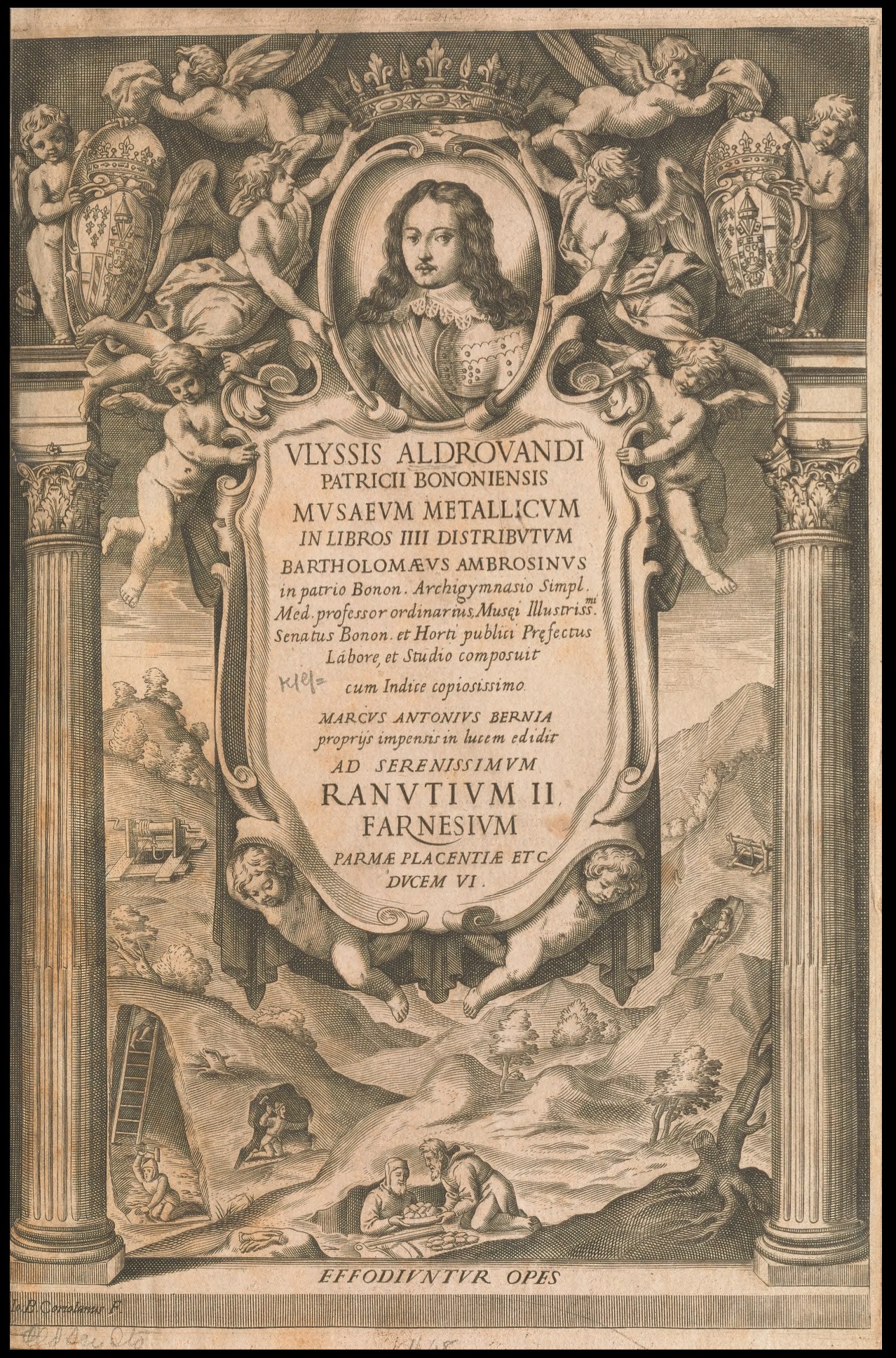
Musaeum metallicum

Musaeum metallicum

Metallic Museum

Aldrovandi, U. (1648)

Book · Pages: 979 pp. (see p. 706) · Language: in Latin

Abstract
Very scarce. Edited by Bartolomeo Ambrosini [see note below]. Some forty years after he died, Aldrovandi's Musaeum Metallicum was published as a thick folio volume. Since his death, the work had existed as a manuscript, Geologica ovvero Fossilibus" in the library collections of the University of Bologna, which had been bequeathed all of Aldrovandi's manuscripts. Even unpublished, many scholars studied it as a resource for their own researches. The value others placed upon Aldrovandi's material did not go unnoticed, which is why a former student of the author, Bartolomeo Ambrosini was entrusted by the Bologna senate to edit the material Aldrovandi had accumulated and oversee its publication. The final product is a superb book. The work consists of a single volume divided into four books: on metals, earths, succi concreti (concrete juices), and stones (minerals, rocks, and fossils). Within each of these books, whole chapters are devoted to the consideration of a single "fossil." In a style typical of its time, each chapter then describes the fossil's medical properties, synonyms, localities, origins, varieties, and uses. Aldrovandi includes references to classical and medival authors through out the volume in a fashion that anticipated modern scholars by compiling long lists of authorities but omitting those commonly cited (Partington, 1961-70). The antiquarian nature of the book commonly gives the names and descriptions of the items listed a strange, unrecognizable character. However, Foresti (1887) attempted to ease the struggle by matching relatively modern names to Aldrovandi's. The comprehensive index included at the end of Musaeum Metallicum also makes this a reader friendly book. Perhaps the most outstanding feature for the connoiseur of mineralogic literature are the several hundered woodcuts scattered throughout the volume. Some of these are full page but most are smaller, with many possessing a quaint, interesting character. These figures are designed to illustrate features described in the text, but since minerals do not easily lend themselves to illustration, the pictures "rather require the text to explain them" (Adams, 1938). That Aldrovandi was a man of accumulation is clearly shown by his inclusion of all facts that came to his attention without apparently any critical faculty to distinguish between the true and imaginary, the important and nonessential. A great amount of scientific value is contained in Musaeum Metallicum but an overburden must be removed to discover those nuggets. In truth, the author was a product of his time. The influence of the church and other authorities did not bind his writings and ideas as they had past authors, "and so," as Adams (1938) writes, "one gathers the impression that he was writing at the opening of a new age ...""
Keywords
gems, jade, Fischer-Book, mineralogy, early mineralogy

Exploring the Literature of Gemstone Inclusions

The literature of gemstone inclusions covers identification, origin determination, treatments, synthesis, mineral inclusions, fluid inclusions and other internal features of natural and synthetic gems.

For a curated selection of important sources, read Inclusions in Gemstones — Hyperion Literature Sources.

About Four Treasures

Four Treasures is Lotus Gemology's freely accessible gemological reference database. Use the full database to search by author, title or keyword and explore literature on gemology, mineralogy, jewelry and related fields. Where available, hyperlinks on titles may lead directly to the full publication.

Search the Complete Four Treasures Database