Emerald Bibliography

Emerald Bibliography

Explore books, articles and historical sources on emerald in Four Treasures, the Lotus Gemology reference database. This bibliography brings together matching records from the collection, with publication details, abstracts and cover images where available.

Emerald References

The list below matches the terms emerald or emeralds in the database's searchable fields. Some references discuss emeralds as part of a broader subject.

721–740 of 848 matching references
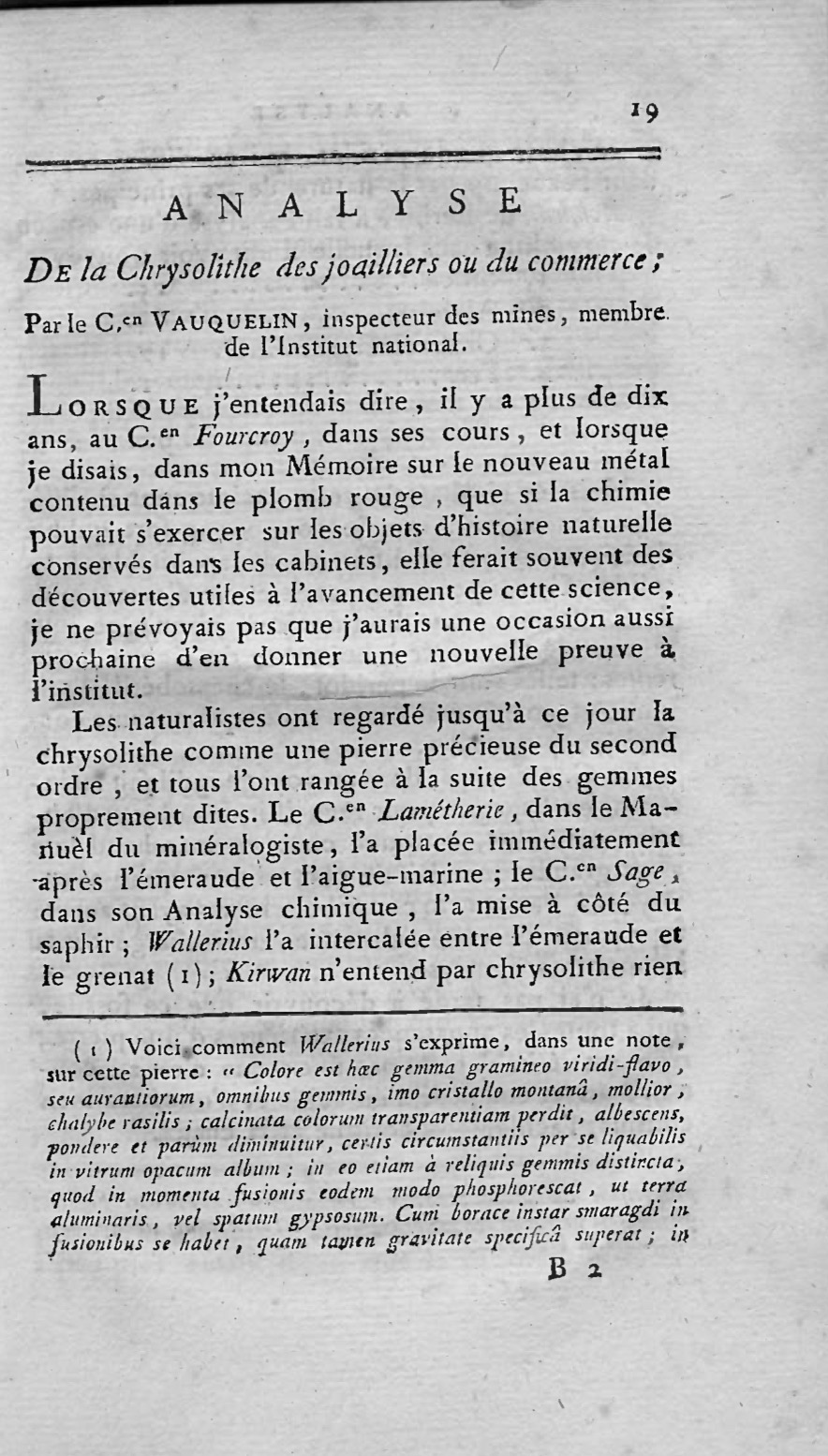
Du Béril de Saxe, dans lequel M. Tromsdorf a annoncé l'existence d'une terre nouvelle qu'il a nommée Agustine

Du Béril de Saxe, dans lequel M. Tromsdorf a annoncé l'existence d'une terre nouvelle qu'il a nommée Agustine

Analysis of the Saxon Beryl, in which Mr. Johann Bartholomäus Trommsdorff announced the existence of a new earth which he named Agustine

Vauquelin, N.-L. (1799)

Journal Article · Source: Journal des Mines · Volume: Vol. 12 · Issue: No. 86 · Pages: pp. 81–87 · Language: in French

Abstract
An investigation by Nicolas-Louis Vauquelin of beryl from Saxony following Johann Bartholomäus Trommsdorff’s announcement that it contained a supposed new earth, which he named Agustine (Agusterde). Vauquelin chemically examined the material to determine whether this represented a genuinely new substance and found no justification for recognizing Trommsdorff’s proposed earth as a new constituent. The paper belongs to the intense late eighteenth-century effort to determine the chemical composition of minerals and identify new elements and earths. Of gemological interest, it contributed to clarification of the chemistry of beryl shortly after Vauquelin’s own discovery of glucina (beryllia) in beryl and emerald.
Keywords
gems, peridot, olivine, Egypt, Zabargad, St. John’s Island
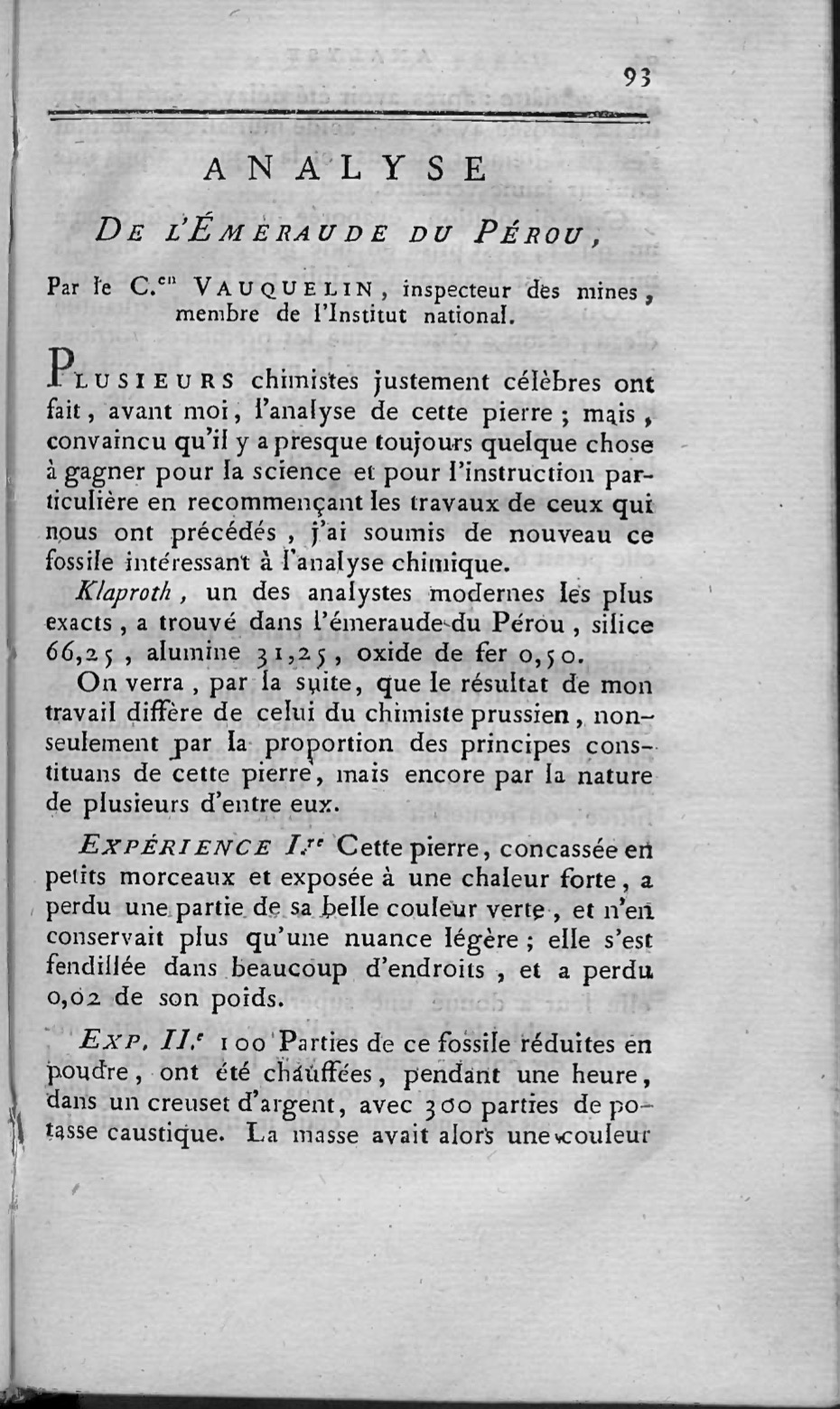
Analyse de l'émeraude du Pérou

Analyse de l'émeraude du Pérou

Analysis of the emerald of Peru

Vauquelin, N.-L. (1798)

Journal Article · Source: Journal des mines · Volume: Vol. 2 · Issue: No. 24 · Pages: pp. 93–97 · Language: in French

Abstract
An important chemical analysis of a Peruvian emerald by Nicolas-Louis Vauquelin. By comparing its composition with that of beryl, Vauquelin demonstrated that emerald and beryl are essentially the same mineral species, despite their different colors and traditional classification as separate stones. His analysis also identified the newly discovered earth glucina (beryllia, BeO) as a constituent of emerald. Vauquelin further investigated the cause of the green color and detected chromium, which he had recently discovered, attributing the emerald’s coloration to this element. The paper was therefore a major contribution to gemstone chemistry, establishing the mineralogical relationship between emerald and beryl and identifying chromium as the coloring agent of emerald.
Keywords
gems, beryl, emerald
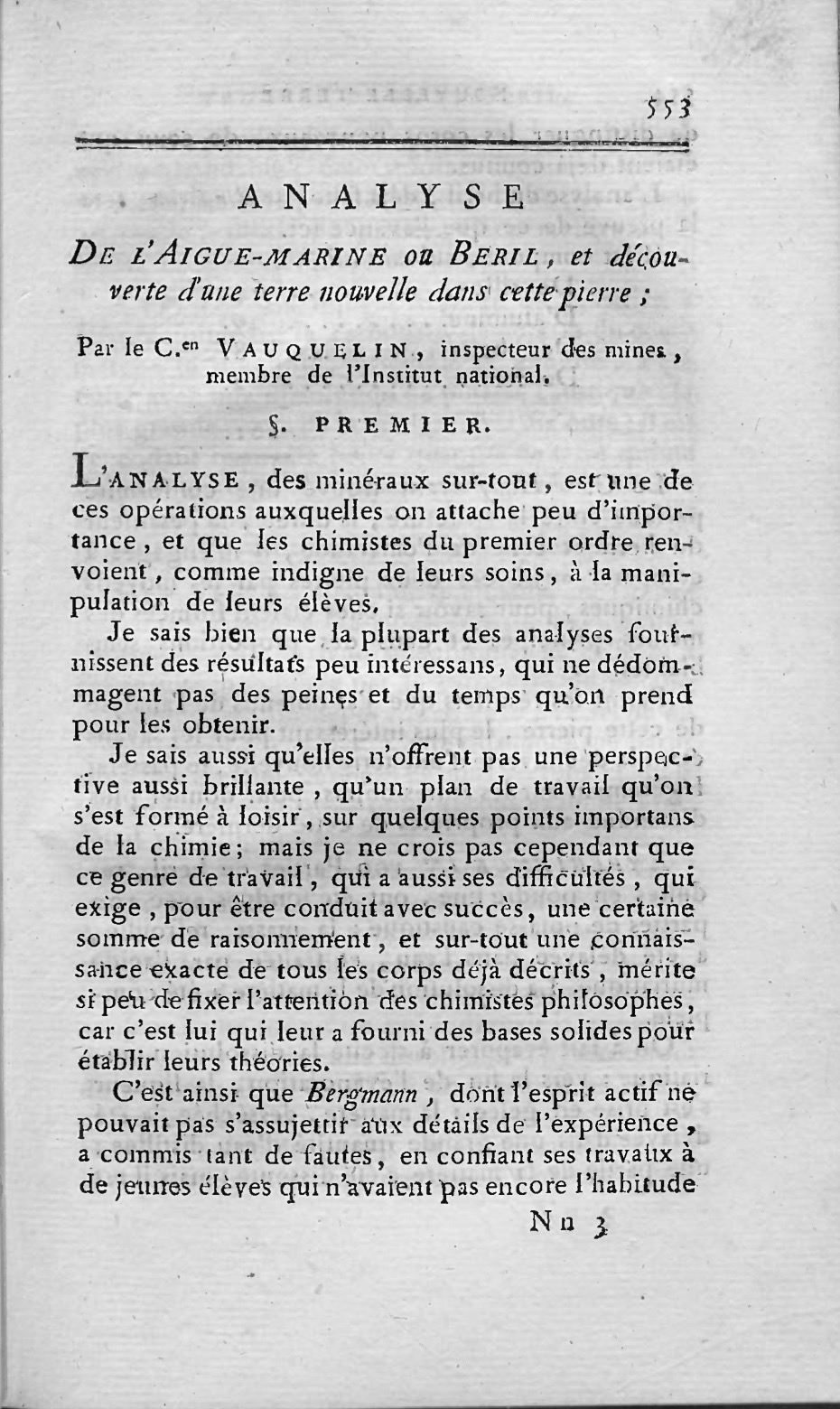
Analyse de l'aigue-marine ou beril, et découverte d'une terre nouvelle dans cette pierre

Analyse de l'aigue-marine ou beril, et découverte d'une terre nouvelle dans cette pierre

Analysis of aquamarine, or beryl, and discovery of a new earth in this stone

Vauquelin, N.-L. (1798)

Journal Article · Source: Journal des mines · Volume: Vol. 2 · Issue: No. 43 · Pages: pp. 553–564 · Language: in French

Abstract
An important chemical investigation of aquamarine (beryl) by Nicolas-Louis Vauquelin, in which he announced the discovery of a previously unknown earth in the mineral. Through chemical analysis, Vauquelin distinguished this substance from alumina and identified what became known as glucina (beryllia), beryllium oxide, thereby establishing beryl as chemically distinct from minerals with which it had previously been associated. The discovery ultimately led to recognition of the element beryllium. The paper is particularly important to gemology because it demonstrated that emerald and aquamarine are varieties of the same mineral species, beryl, despite their markedly different colors, and illustrates the growing importance of chemical composition in the scientific classification of gemstones.
Keywords
gems, beryl, aquamarine
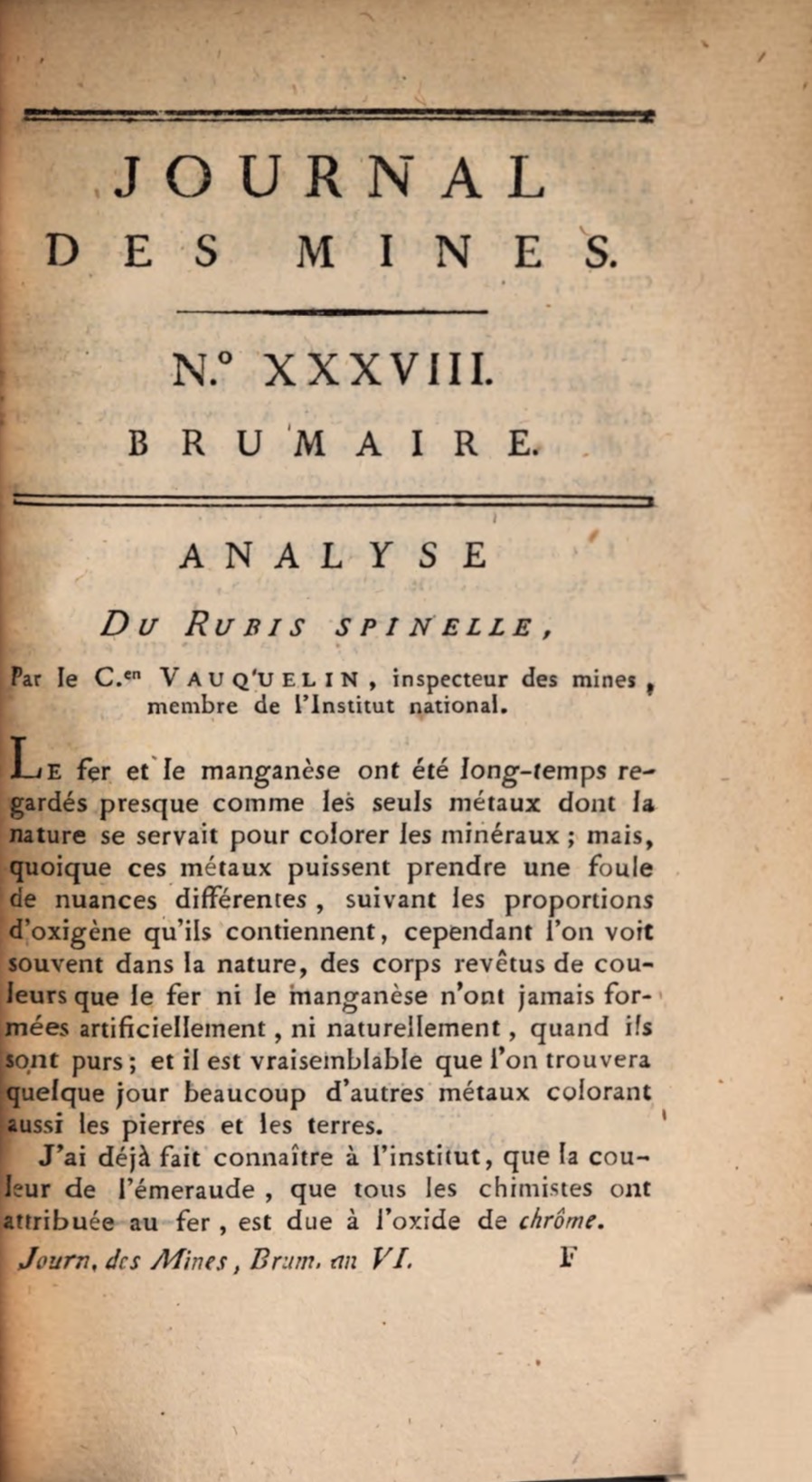
Analyse du rubis spinelle; Analyse de lemeraude du Pérou"

Analyse du rubis spinelle; Analyse de lemeraude du Pérou"

Analysis of ruby spinel; Analysis of the emerald from Peru

Vauquelin, N.-L. (1797)

Journal Article · Source: Journal des Mines · Volume: Vol. 8 · Issue: No. 38 · Pages: pp. 81–98 · Language: in French

Abstract
Vauquelin reports chemical analyses of spinel ruby and emerald from Peru. His investigation of spinel distinguishes its composition from that of true ruby, while the emerald analysis is historically important for the identification of a previously unknown constituent, later named beryllium (beryllia as the oxide). The paper represents an important early application of quantitative chemical analysis to gemstones and contributed to the mineralogical distinction of visually similar gem materials.
Keywords
gems, corundum, history.1, spinel, beryl, emerald
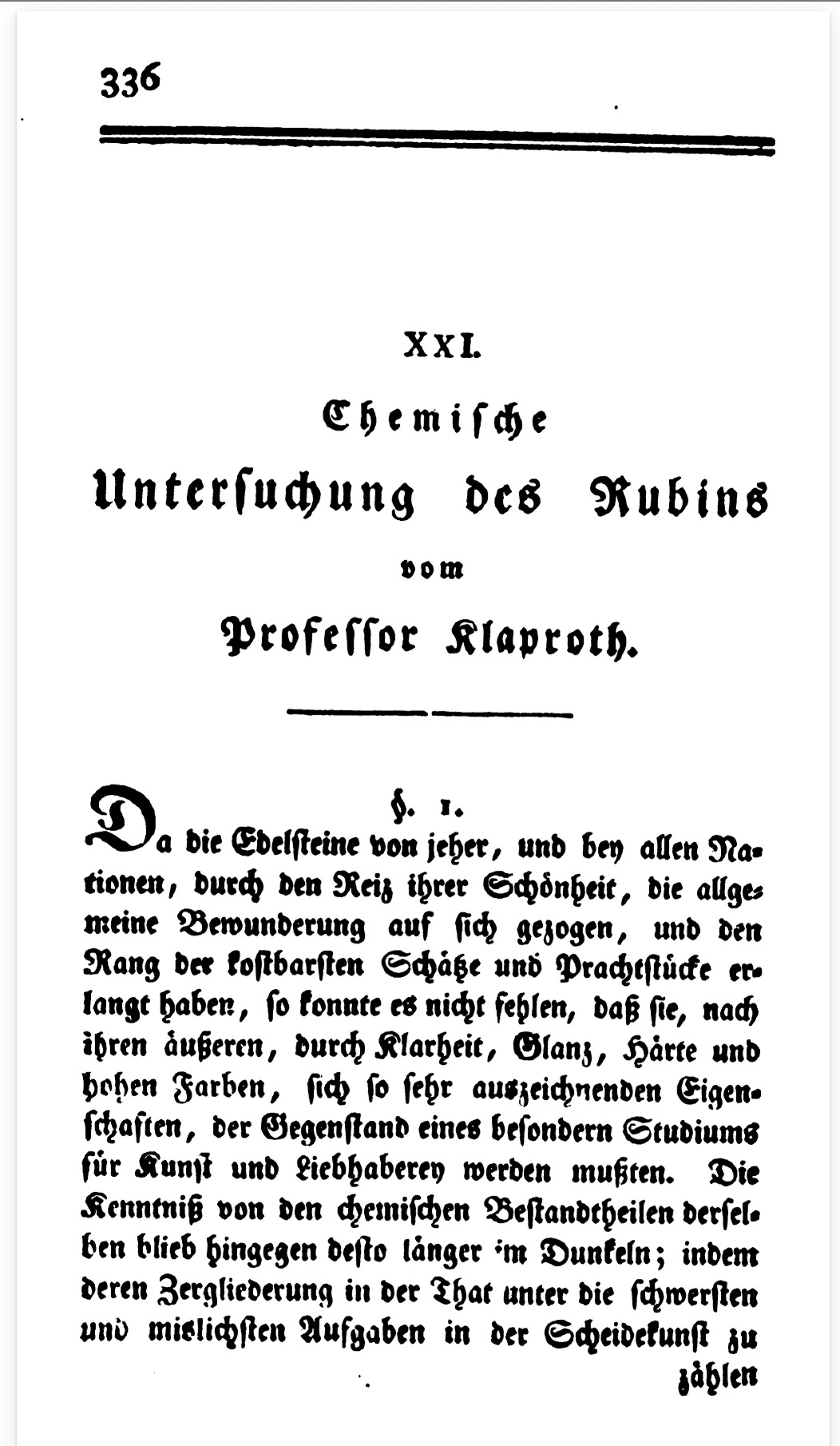
Chemische Untersuchung des Rubins

Chemische Untersuchung des Rubins

Chemical investigation of ruby

Klaproth, M.H. (1789)

Journal Article · Source: Schriften der Gesellschaft Naturforschender Freunde zu Berlin · Volume: Vol. 9 · Pages: pp. 336–350 · Language: in German

Abstract
Since precious stones have, from time immemorial and among all nations, attracted universal admiration through the charm of their beauty, and have attained the rank of the most costly treasures and objects of splendour, it was inevitable that their outward properties—so remarkably distinguished by clarity, lustre, hardness, and rich colours—should become the subject of special study both for science and for connoisseurship. Knowledge of their chemical constituents, however, remained obscure for much longer, since their analysis was in fact one of the most difficult and uncertain tasks in analytical chemistry, until Marggraf, the father of more rigorous analytical chemistry, opened the way; after him Bergmann, Scheele, and other celebrated men attempted to pursue it further. On the occasion of his analysis of topaz, he found that precious stones were not, as had previously been believed, simple natural products consisting solely of the most homogeneous and pure siliceous or quartz substance, but that their composition was more complex, and particularly that pure alumina constituted a considerable proportion of them. Bergmann confirmed this finding in his treatise on the earth of precious stones, published in 1777,* in which he gave an account particularly of the constituents found in ruby, sapphire, topaz, hyacinth, and emerald. Soon afterwards another celebrated chemist, Director Achard, published a treatise on the same subject,** whose account of the constituents of precious stones agreed entirely with Bergmann’s, differing only slightly in their proportions.
Keywords
gems, corundum, chemistry.2, ruby, spinel
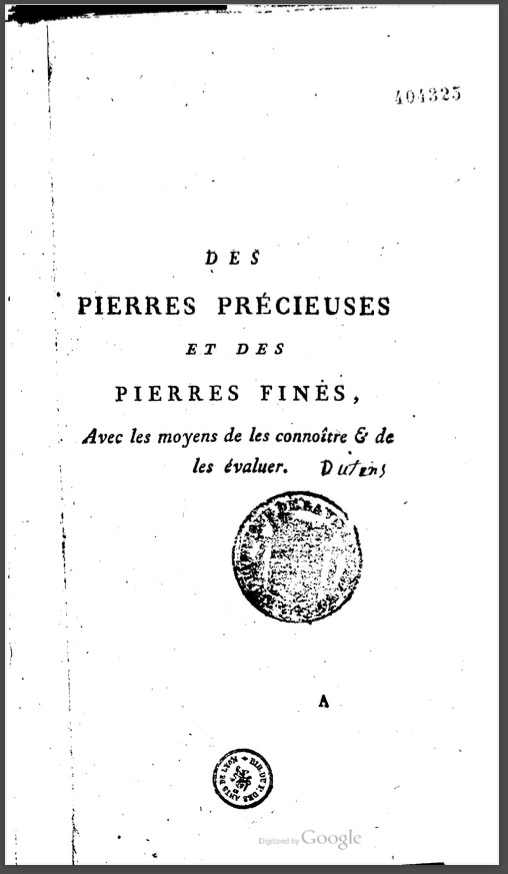
Des Pierres précieuses et des Pierres fines, avec les moyens de les connoitre & de les évaluer

Des Pierres précieuses et des Pierres fines, avec les moyens de les connoitre & de les évaluer

On Precious Stones and Fine Stones, with the Means to Recognize and Evaluate Them

Dutens, L. (1776)

Book · Publisher: F.A. Didot & De Bure · Pages: 224 pp. · Language: in French

Abstract
Jonathan Hill: First edition of this introduction to precious stones written for collectors and jewelers; according to the author this is the first complete treatise on precious stones. Dutens describes the chief varieties including diamonds, rubies, sapphires, emeralds, etc. He has also provided an interesting table at the end of current prices of diamonds of increasing carats. In the Preface, Dutens reviews the writings on precious stones of earlier authors including Pliny, Theophrastus, Boyle, and Romé de l’Isle. This work is a notable work in typography as well: it is the first book printed by François Ambroise Didot, l’aîné (1730-1804), who promoted technical innovation in printing and papermaking and introduced the new form of typographical measurement, the “point Didot.” We quote from the 1783 catalogue of Mérard de Saint-Just: “Ce petit Traité est le premier Ouvrage sorti des presses de M. Didot l'aîné, où l’on ait aperçu cette supériorité de talents qui l’a mis tout de suite au-dessus de tous ses confrères de France, d’Italie, d’Allemagne et de Hollande, et qui l’associe dès lors à la gloire de Baskerville, et surtout à celle d’Ibarra.”–from André Jammes’ wonderful Les Didots catalogue, no. 73. Dutens (1730-1812), diplomat and man of letters, edited the works of Leibniz (1768), was a fellow of the Royal Society, and was historiographer to the King of England. Sinkankas: In his preface, Dutens discusses the merits of previous works on gemstones and explains why he decided to write this one. A connoisseur of arts and of gems, he traveled widely throughout Europe and spent much time visiting collections and discussing their contents with their owners. One would therefore expect that the book was based on his experiences, but it seems that it is no more than a reworking of information available in earlier books treating gemstones, as remarked by King above, who believes Dutens derived most of his information from De Boodt and De Laet. In the first part, Dutens explains his system of classification whereby the finest and most durable of gemstones are dubbed “oriental,” while those of lesser quality and hardness receive the title of “occidental,” thus perpetuating in a highly popular and widely distributed work these unfortunate and misleading terms that persisted in use well into the last century. Some generalities on gemstones also appear here, such as curious lore, origin of gemstones, and other topics, followed by separate chapters on the major gemstones beginning with diamond. The latter chapter records recent experiments in France and elsewhere on the combustibility of diamond, one such experiment he personally observed. The second part describes lesser gemstones, mainly massive types used mostly in cabochons or in the manufacture of small to large ornamental articles or decorations. Despite King’s criticisms, Dutens’ work did provide useful, accurate information and received acclaim and wide distribution.
Keywords
gems, jade, Fischer-Book
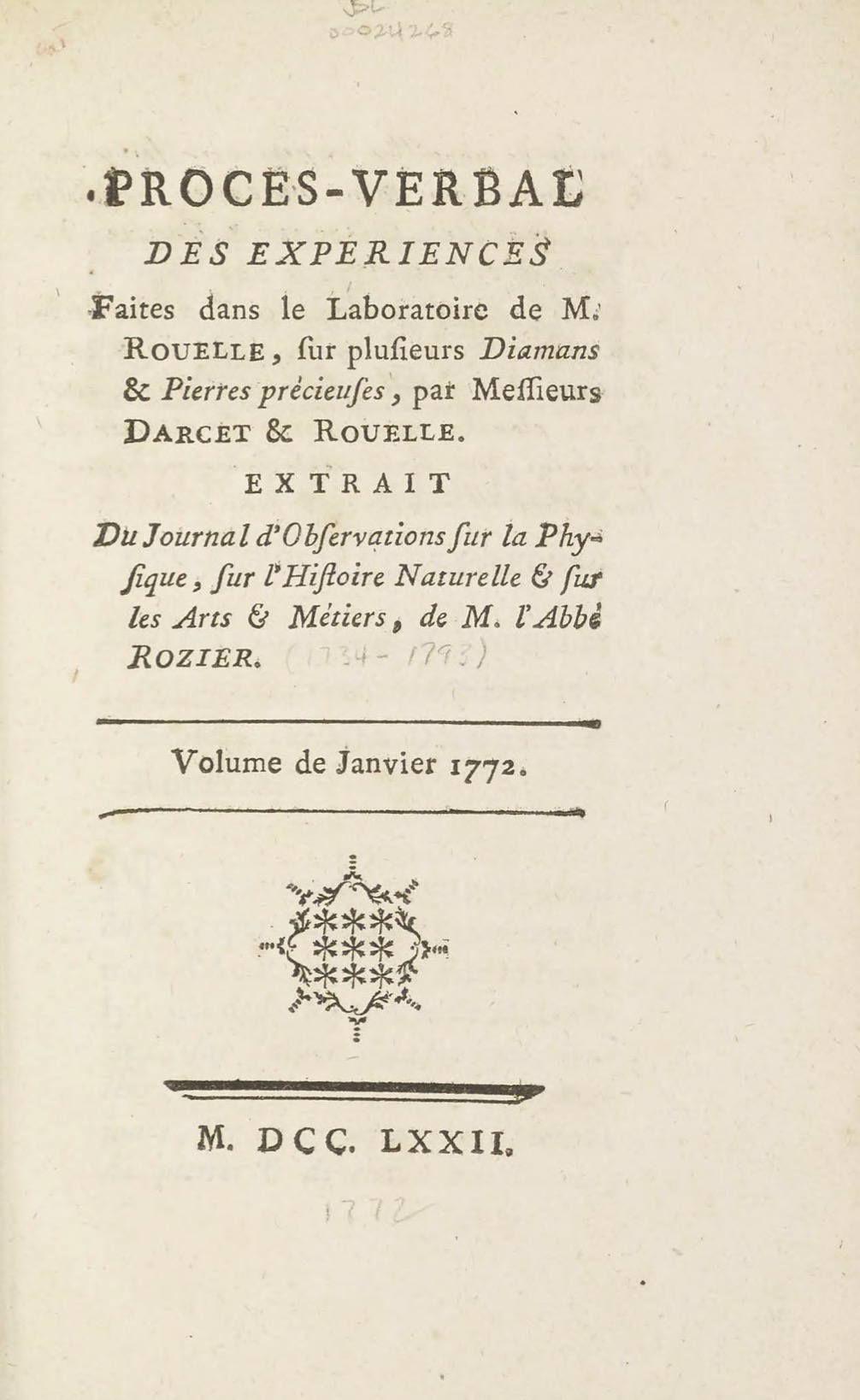
Proces-Verbal des Expériences Faites dans le Labratoire de M. Rouelle, sur plusiers Diamans & Pierres précieuses, par Messieurs Darcet & Rouelle

Proces-Verbal des Expériences Faites dans le Labratoire de M. Rouelle, sur plusiers Diamans & Pierres précieuses, par Messieurs Darcet & Rouelle

Verbal process of the Experiments Made in the Laboratory of Mr. Rouelle, on several Diamonds & Precious Stones, by Messrs. Darcet & Rouelle

Darcet, J., d’ and Rouelle, G.F. (1772)

Journal Article · Source: Du Journal d’Observations sur la Physique l’Histoire Naturelle & sur les Arts & Métiers · Issue: January · Language: in French

Abstract
An account of experiments conducted by Jean d’Arcet and Guillaume-François Rouelle in Rouelle’s laboratory on diamonds and other precious stones subjected to intense heat. The investigations formed part of the eighteenth-century debate over the nature of diamond and its behavior in fire. By comparing diamonds with other gemstones under strongly heated conditions, the experiments showed the exceptional disappearance or destruction of diamond while other stones behaved differently. These observations contributed to the experimental work that eventually established diamond as a combustible substance and, subsequently, as a form of carbon. Published in the Journal de Physique in January 1772, the paper is an important early contribution to the experimental chemistry of gemstones.
Keywords
corundum, treatments.6, gems, heat treatment
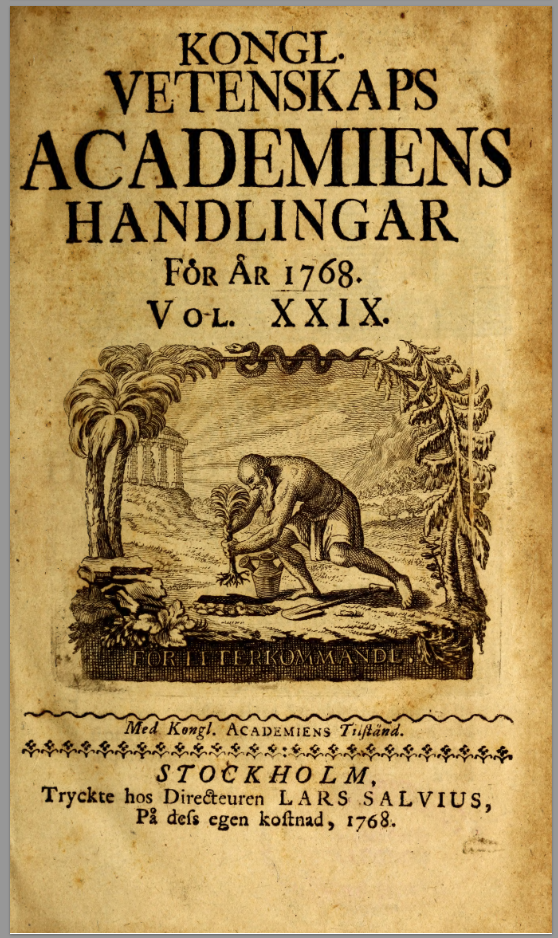
Försök På En del Kiesel-Arter, och i synnerhet de hårdare så kallade Äkta Stenar

Försök På En del Kiesel-Arter, och i synnerhet de hårdare så kallade Äkta Stenar

Experiments on Some Siliceous Species, and in Particular the Harder so-called Genuine Stones

Qvist, B.A. (1768)

Journal Article · Source: Kongl. Vetenskaps Academiens Handlingar [Proceedings of the Royal Swedish Academy of Sciences] · Volume: Series 1, Vol. 29 · Issue: January–March · Language: in Swedish

Abstract
Swedish article describing the fusibility and other physical properties of gems. Also includes a table listing the different gems by density and hardness from diamond (1) to zeolite (13). According to Schuh, this hardness scale was modified by Richard Kirwan in his 1784 English edition (First edition) “Elements of Mineralogy”, pp. 171–173 and is considered the first hardness scale ever published in an English book: https://mineralogicalrecord.com/new_biobibliography/kirwan-richard/
Keywords
gems, properties, fusibility, density, specific gravity, hardness, ruby, sapphire, emerald, spinel, topaz, beryl, garnet
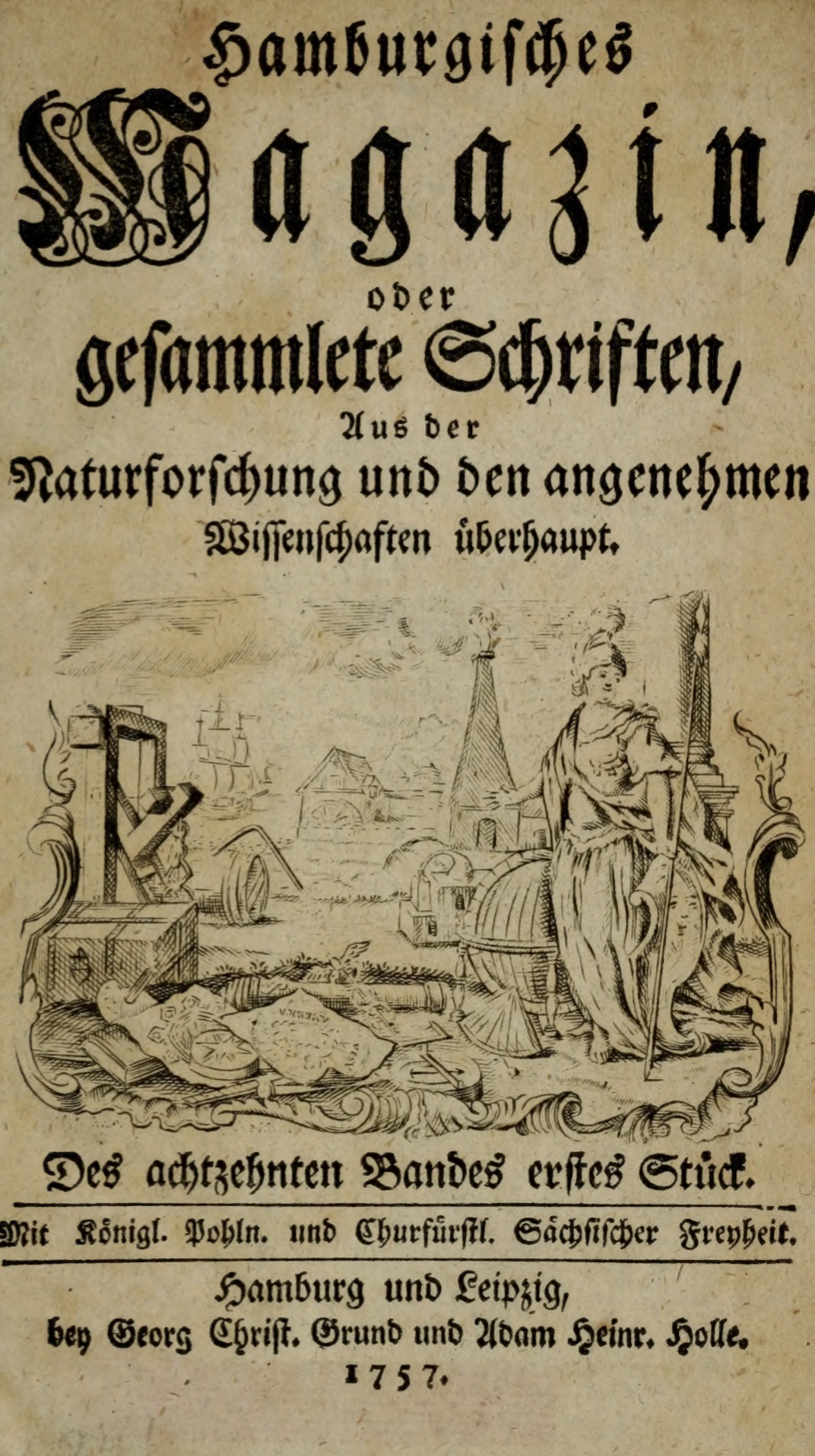
Geschichte von Edelgesteinen und den Vornehmsten Reichthümern in Ost- und Westindien

Geschichte von Edelgesteinen und den Vornehmsten Reichthümern in Ost- und Westindien

History of Precious Stones and the Principal Riches of the East and West Indies

Anonymous (1757)

Journal Article · Source: Hamburgisches Magazin · Volume: Vol. 18 · Pages: pp. 500–543 · Language: in German

Abstract
German account of the principal precious stones, pearls, and other valuable products of the East and West Indies, compiled from earlier travel accounts and observations by travelers who had visited the mining regions. A substantial section is devoted to diamonds, describing their occurrence and mining in India and Borneo, including the celebrated mines of Golconda and surrounding districts, methods of working the deposits, labor, trading practices, currencies, and the valuation of stones. Colored gemstones are treated separately, with particular attention to the ruby and sapphire deposits of Pegu (Burma) and Ceylon. The Burmese stones are said to come from a mine called “Capelan,” twelve days’ journey northeast of Ava, producing rubies, yellow topazes, blue and white sapphires, and other colored stones. Fine rubies are described as scarce, with the best stones reserved for the king, and a schedule of ruby prices according to weight is given. Ceylon is described as another important source, where colored stones were recovered from river sands after the rainy season, including sapphires, topazes, garnets, and rock crystal. The work also discusses emeralds and their trade between the Americas, Europe, and Asia. An extensive section on pearls describes fisheries in the Persian Gulf, Ceylon, Japan, and the West Indies, together with diving, the opening of pearl oysters, pearl formation, grading, color, shape, size, and value, while rejecting older beliefs that pearls originated from heavenly dew. Coral and amber are also discussed, including the East Asian trade and consumption of amber. The article provides a valuable mid-eighteenth-century European synthesis of contemporary knowledge concerning gemstone sources, mining, commerce, valuation, and consumption in Asia and the Americas.
Keywords
gems, corundum, Sri Lanka.12, garnet, zircon, spinel, tourmaline, sapphire, Ceylon
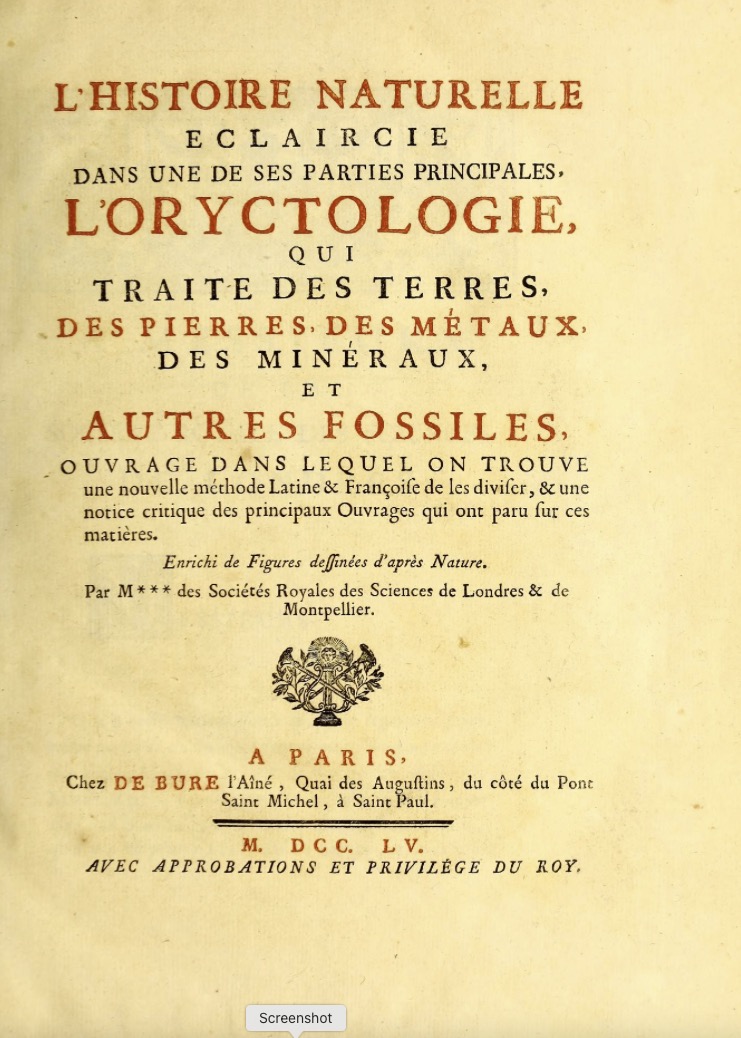
L’histoire naturelle éclaircie dans une de ses parties principales, l’oryctologie : qui traite des terres, des pierres, des métaux, des minéraux, et autres fossiles : ouvrage dans lequel on trouve un nouvelle méthode latine & françoise de les diviser, & une notice critique des principaux ouvrages qui ont paru sur ces matières

L’histoire naturelle éclaircie dans une de ses parties principales, l’oryctologie : qui traite des terres, des pierres, des métaux, des minéraux, et autres fossiles : ouvrage dans lequel on trouve un nouvelle méthode latine & françoise de les diviser, & une notice critique des principaux ouvrages qui ont paru sur ces matières

The Natural History Elucidated in One of Its Principal Parts, Oryctology: Which Deals with Earths, Stones, Metals, Minerals, and Other Fossils: A Work in Which a New Latin and French Method of Classifying Them Is Presented, Along with a Critical Review of the Principal Works Published on These Subjects

Dezallier d’Argenville, A.J., Chedel, P.Q. and Collin de Vermont, H. (1755)

Book · Publisher: Chez De Bure l’aîné · Language: in French

Abstract
Dezallier d’Argenville’s L’histoire naturelle éclaircie… l’oryctologie (1755) is an important mid-eighteenth-century treatise on what would later develop into mineralogy and geology. The work systematically describes and classifies earths, stones, metals, minerals, and other substances then grouped under the broad category of “fossils,” presenting parallel Latin and French terminology and discussing the principal earlier literature on the subject. Of particular gemological interest are its descriptions and classification of precious and ornamental stones, including diamonds, rubies, sapphires, emeralds, topazes, garnets, opals, agates, jaspers, rock crystal, and other lapidary materials, with attention to their physical appearance, varieties, localities, and contemporary nomenclature. The volume is also notable for its engraved plates, drawn by Hyacinthe Collin de Vermont and engraved by Pierre Quentin Chedel, illustrating minerals, crystals, fossils, and related natural-history specimens. It provides a valuable picture of European mineralogical and gemological knowledge immediately before the major advances in chemical mineralogy and crystallography of the later eighteenth century.
Keywords
gems, jade, Fischer-Book
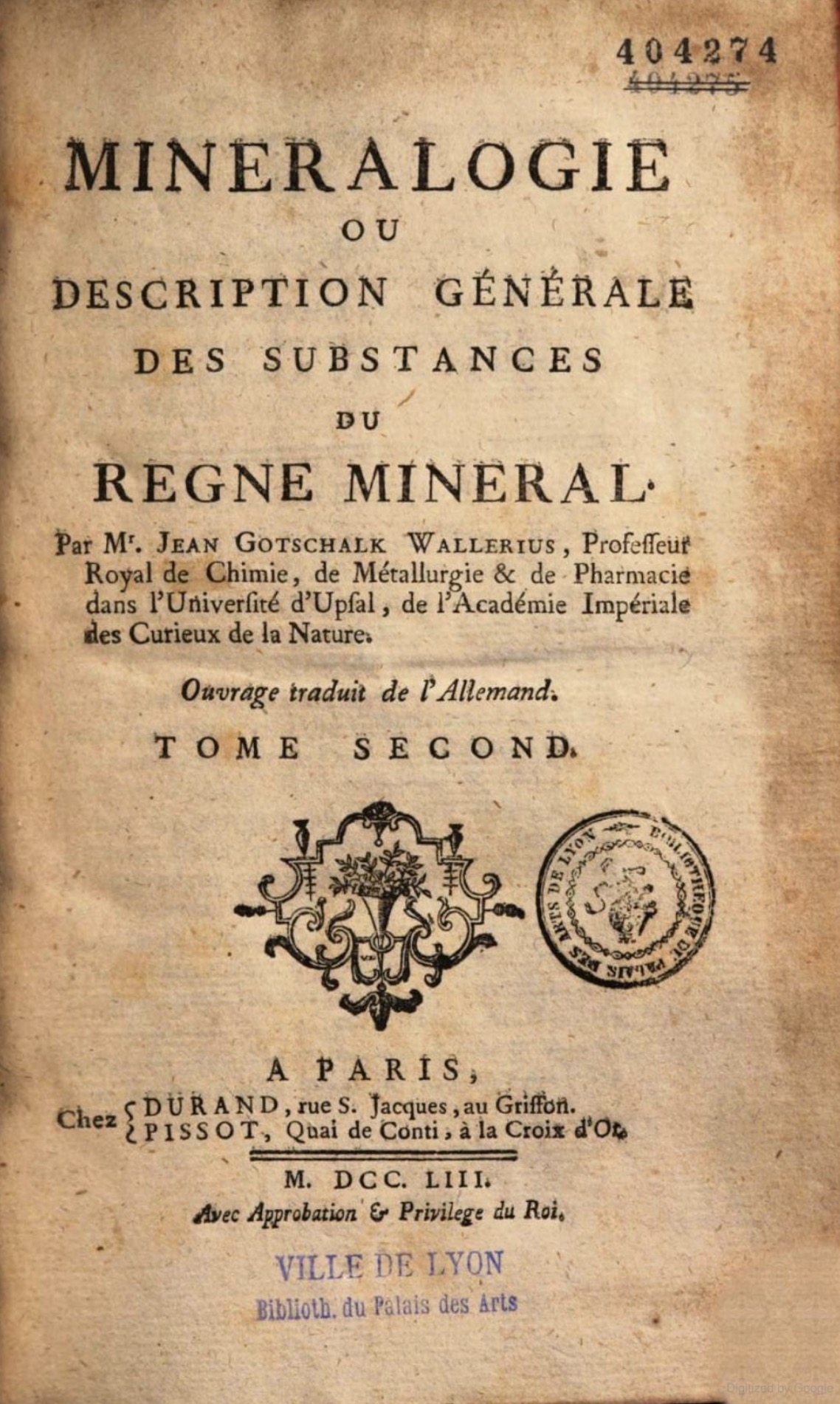
Minéralogie, ou description générale des substances du règne

Minéralogie, ou description générale des substances du règne

Mineralogy, or General Description of the Substances of the Mineral Kingdom

Wallerius, J.G. (1753)

Book · Publisher: Durand / Pissot · Pages: 591, 256 pp. · Language: in French

Abstract
This French translation of Wallerius’s influential Mineralogia presents an early systematic classification of the mineral kingdom, dividing it into earths, stones, minerals, and concretions, followed by preparations made from mineral substances. Minerals are distinguished through their composition, form, colour, transparency, hardness, specific gravity, geological occurrence, and behaviour under heat or chemical treatment. The extensive treatment of stones includes nephrite, rock crystal, agate, chalcedony, onyx, opal, jasper, lapis lazuli, and numerous ornamental materials. Precious stones are discussed separately, including diamond, ruby, sapphire, topaz, emerald, chrysolite, amethyst, garnet, hyacinth, and aquamarine. Wallerius describes their varieties, crystal forms, relative hardness, colours, host rocks, geographical sources, and response to fire, while also addressing false or coloured crystals, methods of artificial staining, and means of distinguishing genuine stones. Although many identifications and mineral relationships are now obsolete, the work represents an important transition from traditional lapidary nomenclature toward the systematic classification of minerals by observable physical and chemical properties.
Keywords
gems, jade, Fischer, Naldi
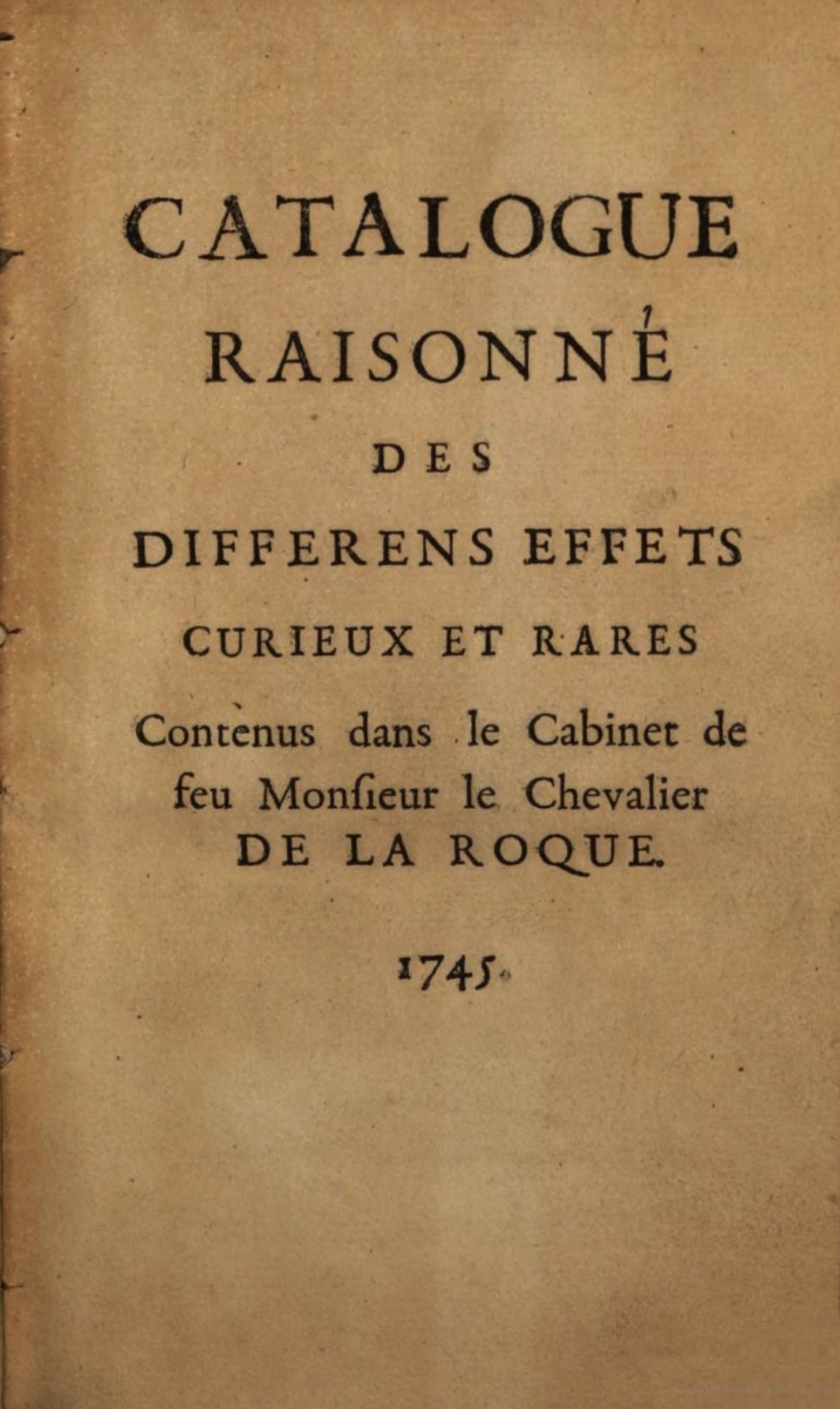
Catalogue raisonné des differens effets curieux & rares, contenus dans le Cabinet de seu Monsieur le Chevalier de la Roque

Catalogue raisonné des differens effets curieux & rares, contenus dans le Cabinet de seu Monsieur le Chevalier de la Roque

Annotated Catalog of the Various Curious and Rare Objects Contained in the Cabinet of the Late Monsieur Chevalier de La Roque

Gersaint, E.-F. (1745)

Book · Publisher: Jaques Barois · Pages: 258 pp. · Language: in French

Abstract
Sinkankas: The collection of Jean, chevalier De La Roque (1661–1745). Pp. 109–147: “Pierreries, Agates, Pierres gravées … [etc.].” Includes diamonds, rubies, emeralds, oriental topaz, sapphire, oriental amethyst, turquoise, balas ruby, hyacinth, and others, not to mention the engraved gems (cameos, intaglios, mounted in rings, and loose). Mentioned by Mariette, Traité des pierres gravées, I, 458.
Keywords
gems, gemology, history of gemology, early lapidaries, glyptic, engraved gems, ruby, diamond, emerald, agate, topaz, sapphire, spinel, cameos, intaglios, rings
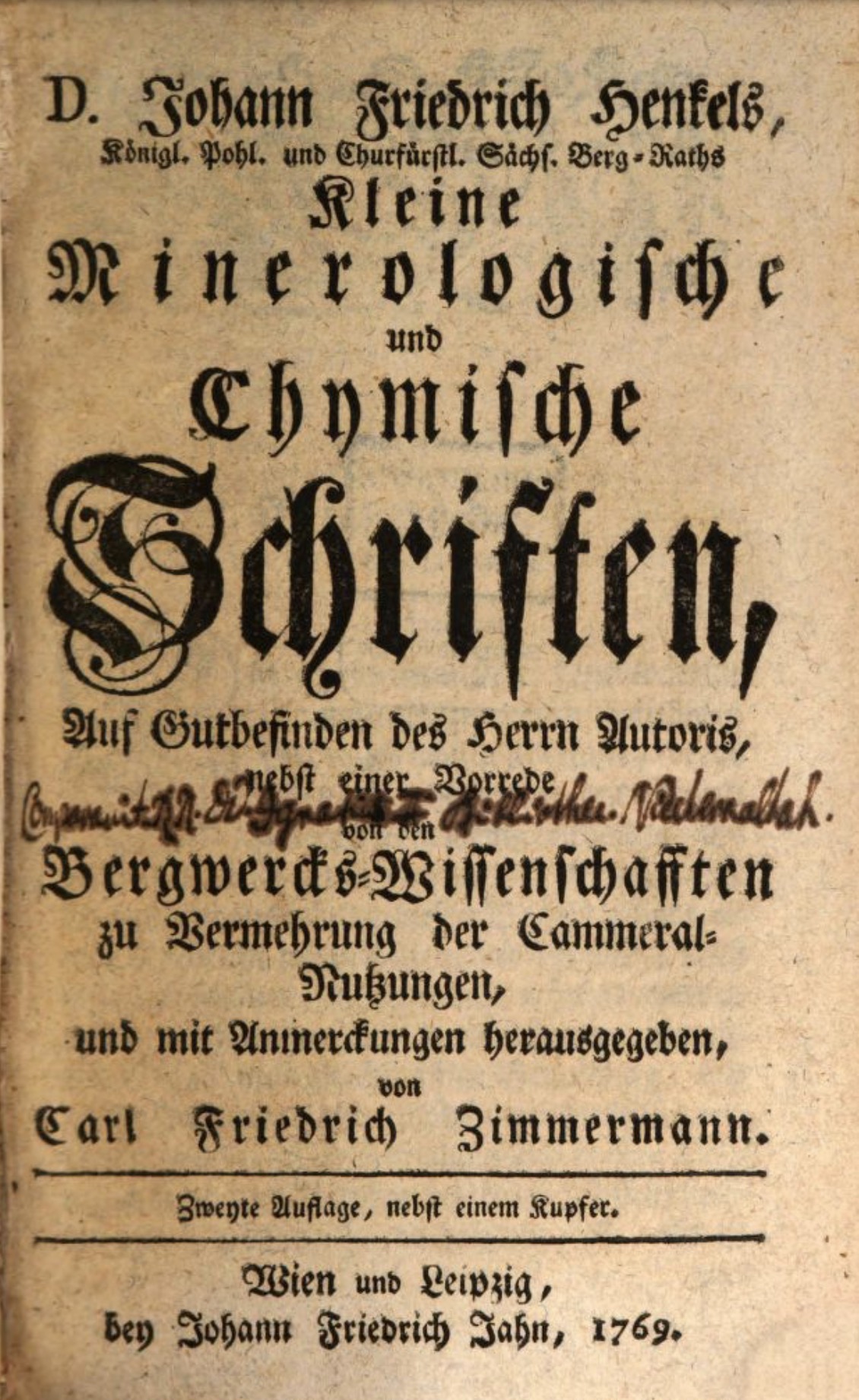
Kleine Mineralogische und Chymische Schrifften. Auf Gutbefinden des Herrn Autoris. Nebst einer Vorrede von den Bergwercks-Wissenschafften zu Vermehrung der Cammeral-Nutzungen, und mit Anmerckungen herausgegeben von Carl Friedrich Zimmermann

Kleine Mineralogische und Chymische Schrifften. Auf Gutbefinden des Herrn Autoris. Nebst einer Vorrede von den Bergwercks-Wissenschafften zu Vermehrung der Cammeral-Nutzungen, und mit Anmerckungen herausgegeben von Carl Friedrich Zimmermann

D. Johann Friedrich Henkel’s, Royal Polish and Electoral Saxon Mining Councillor, Small Mineralogical and Chemical Writings. Published with the approval of the author, together with a preface on the mining sciences for the increase of cameral (state fiscal) revenues, and with annotations by Carl Friedrich Zimmermann

Henkel, J.F. (1744)

Book · Publisher: Friedrich Henkel · Pages: 619 pp. · Language: in German

Abstract
Sinkankas: Henkel presents his views on the formation of minerals, including coral and gemstones, with extensive annotations by Zimmermann. He recognized five modes of formation: (1) congelation, (2) concretion, (3) vegetation (as in coral), (4) crystallization, and (5) petrifaction. Henkel believed that durable minerals—especially gemstones—were composed of minute particles that grew together into structurally continuous masses or crystals, producing transparency while excluding water. He discusses at length, as does Zimmermann, experiments by Robert Boyle, Francis I, and others on the effects of intense heat on gemstones, describing the behavior of diamond, emerald, ruby, and other gems. Additional topics include Saxon fossil resin (pp. 539–553), the celebrated Saxon topaz (pp. 554–565), and a green jasper bearing “hieroglyphic figures” (pp. 607–619), possibly referring to graphic granite. The work is described by John Ferguson in Bibliotheca Chemica (Vol. I, p. 386), which also notes later editions published in 1747 and in Vienna in 1769, together with biographical and bibliographical information on Henkel and his writings.
Keywords
gems, gemology, history of gemology, gem testing, mineralogy, early mineralogy, jasper, topaz, amber, gem formation
Edelgesteine

Edelgesteine

Gemstones

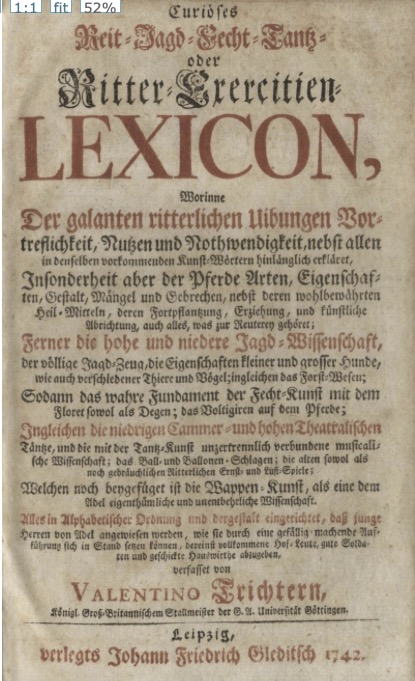
Trichter, V. (1742)

Book Section · Source: Curiöses Reit- Jagd- Fecht- Tantz- oder Ritter-Rxercitien-Lexicon · Pages: pp. 575–576 · Language: in German

Abstract
Precious stones: These are those which are made valuable not only due to their rarity and beauty but also because nature has adorned them with a special light and radiance, making them, in a sense, noble—so that they sparkle like the finest stars and have always maintained a higher status than gold or silver. There are two types of precious stones: transparent and opaque. The transparent ones include amethyst, beryl, carbuncle, chrysolite, diamond, hyacinth, ruby, sapphire, and emerald. Among the opaque ones, though some are semi-transparent, are agate, carnelian, chalcedony, jasper, the so-called cat’s eye, lapis lazuli, nephrite, and gallstone, malachite and schreckstein, onyx, opal, turquoise, etc. These precious stones, especially the transparent ones, originate from water or moisture impregnated with mountain salt, which allows them to grow and develop into crystals. It is impossible for something to be transparent that has not first been in liquid form. Dense substances such as silver and lead, when dissolved in separating water or other acidic liquids, can easily grow into transparent crystals. Similarly, one often finds completely clear water droplets inside the most beautifully grown crystals, and in the hardest stones in India, the finest gemstones. Moreover, that there is some mountain salt mixed in is evident from the geometric shape of the precious stones, which are clearly recognizable as having the same structure as salt and saltpeter, as the mined crystals and diamonds, which differ only in hardness, grow entirely angular, often even with veins and such deposits, so that one can clearly see how the salty components have been layered on top of each other. Their charming colors come from a delicate metallic sulfur, similar to metals found in mines: for example, carbuncle, ruby, garnet, and amethyst from a gold-sulfur; sapphire from the tincture of silver; emerald and chrysolite from the greenish-sulfuric nature of copper; topaz and hyacinth from the sulfurous substance of iron, etc. However, this sulfur in precious stones is very volatile, so much so that the colors resulting from it can easily disappear and evaporate in the fire. But since these gemstones, when broken, are often irregular, or unclean and blotchy, even the most beautiful and purest stones do not shine as brightly as when they are cut, whereby the multiple facets reflect and play the light that falls on the foil or diamond ink all the more toward the eye. Therefore, those skilled in this art are called gem cutters, and they practice a free craft; however, they have been regulated by a noble order in Nuremberg for more than 100 years.
Keywords
gems, history of gemology, turquoise, lapis lazuli, carnelian, jasper, jade
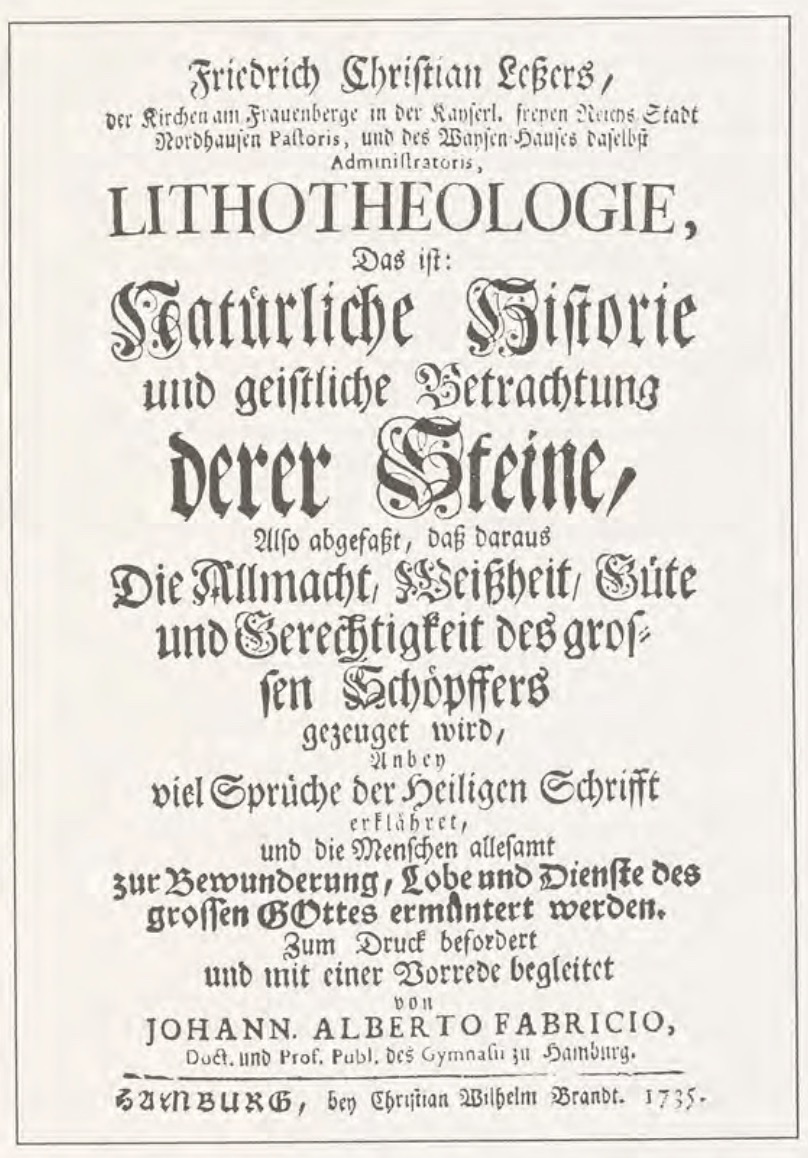
Lithotheologie, Das ist: Natürliche Historie und geistliche Betrachtung derer Steine, also abgefasst, dass daraus die Allmacht, Weisheit, Güte und Gerechtigkeit des grossen Schöpffers gezeuget wird, anbey viel Sprüche der Heiligen Schrifft erklähret und die Menschen allesamt zur Bewunderung, Lobe und Dienste des grossen Gottes ermuntert werden.

Lithotheologie, Das ist: Natürliche Historie und geistliche Betrachtung derer Steine, also abgefasst, dass daraus die Allmacht, Weisheit, Güte und Gerechtigkeit des grossen Schöpffers gezeuget wird, anbey viel Sprüche der Heiligen Schrifft erklähret und die Menschen allesamt zur Bewunderung, Lobe und Dienste des grossen Gottes ermuntert werden.

Lithotheologic, that is: Natural history and spiritual contemplation of stones, composed in such a way that from them the omnipotence, wisdom, goodness, and justice of the great Creator are demonstrated; together with explanations of many passages of Holy Scripture, and an exhortation to all mankind to admiration, praise, and service of the great God

Lesser, F.C. (1735)

Book · Publisher: Christian Wilhelm · Pages: 1300 pp. · Language: in German

Abstract
Sinkankas: Utterly fascinating work in great detail and complexity, attempting to demonstrate the hand of God in every manifestation of the mineral kingdom. Lesser assembled an astounding fund of information culled from hundreds of ancient and modern sources and covering nearly every aspect of geology, mineralogy, paleontology, and gemology. So successful was he, and apparently so careful in his choices and interpretations, that the present work was very commonly quoted by later writers in earth sciences and mineralogy. It is divided into nine books, each with several parts and chapters. Book one explains fundamental interrelationships existing among the lithosphere, atmosphere, hydrosphere, and biosphere. Book two concerns the origin and formation of rocks and minerals. Book three treats occurrences or deposits of mineral materials, including gemstones. Book four discusses the properties of minerals and stones. Book five addresses “precious” and “non-precious” stones, with pp. 343–66 treating precious stones, though restricted to a limited number of the better-known species and varieties, the stones themselves being apportioned among transparent, translucent, and opaque kinds, i.e., diamond, ruby, garnet, hyacinth, sapphire, amethyst, emerald, topaz, opal, and chrysolite as transparent stones, and translucent stones such as carnelian, sard, and other varieties of chalcedony; opaque stones include turquoise, malachite, jasper, lapis lazuli, and jade. This book also contains descriptions of some famous diamonds and other large and valuable gems, as well as data on the precious stones mentioned in the Bible. Also among the stones in this book are those that display remarkable inclusions, fanciful portraits or scenes, fossils, and crystals, and other curious, if not marvelous, mineral materials. Book six treats architectural and monumental stones, and also includes brief discussions of engraved gems, seals, and ringstones, with pp. 832–46 describing and speculating on the true identities of the gemstones in the vestments and breastplate of the High Priest, suitably illustrated with diagrams showing their positions and identities. Book seven concerns the misuse of stones, ostentatious display of gemstones, superstitious belief in their powers, the use of birthstones and planetary stones, and other topics of this nature. Book eight treats artificial stones of all kinds, including gemstones. Book nine concerns “works of wonder” in stone, e.g., Lot’s wife turned into a pillar of salt!
Keywords
gems, history of gemology, diamond, garnet, ruby, sapphire, emerald, pearl, high priest's breastplate, jade, lapis lazuli, jasper, malachite
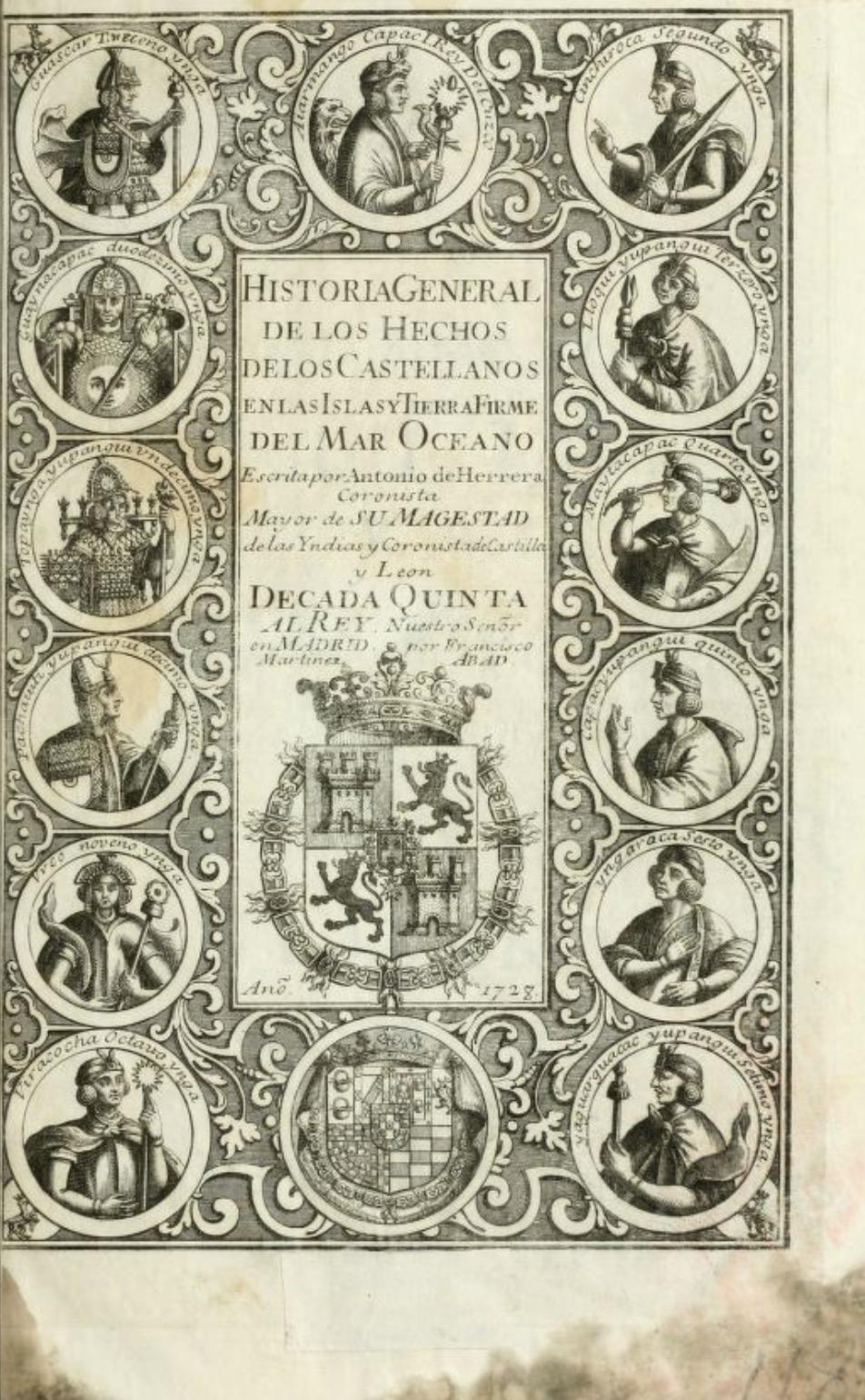
Historia general de los hechos de los castellanos en las islas i tierra firme del mar oceano / escrita por Antonio de Herrera ...; En quatro decadas desde el año de 1492 hasta el de 1531

Historia general de los hechos de los castellanos en las islas i tierra firme del mar oceano / escrita por Antonio de Herrera ...; En quatro decadas desde el año de 1492 hasta el de 1531

General history of the events of the Castilians on the islands and the mainland of the ocean sea / written by Antonio de Herrera ... ; In four decades from the year 1492 to the year of 1531

Herrera y Tordesillas, A., de (1726)

Book · Publisher: Castellano · Pages: 486 pp. · Language: in Spanish

Abstract
Antonio de Herrera y Tordesillas’s Historia general de los hechos de los castellanos en las islas i tierra firme del mar océano is an extensive official history of Spanish exploration and conquest in the Americas, covering events from 1492 to 1531. Drawing upon royal archives, reports, letters, and earlier chronicles, Herrera recounts the voyages of discovery, conquests of Mexico and other regions, encounters with Indigenous peoples, establishment of Spanish settlements, and the geography, customs, resources, and commerce of the New World. Of particular interest to gemologists are numerous references to gold, silver, pearls, emeralds, turquoise, greenstones, and other precious and ornamental materials encountered, traded, presented as tribute, or seized during the conquests. The work provides important evidence for European perceptions of Indigenous valuables and for the sources, uses, and circulation of precious materials in the Americas during the early colonial period, although Herrera wrote several decades after many of the events he describes.
Keywords
gems, jade, Fischer-Book
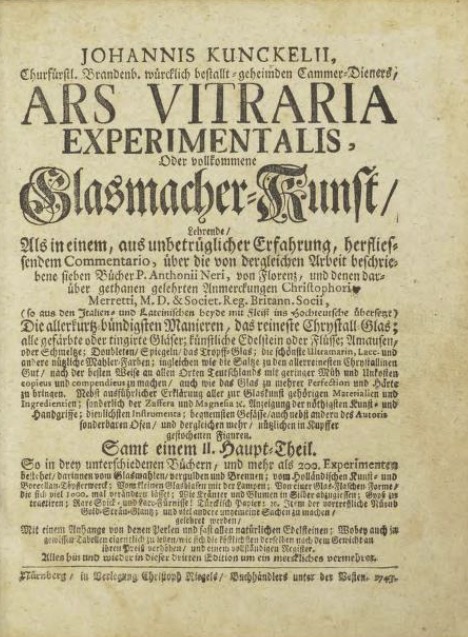
Ars vitraria experimentalis, oder vollkommene Glasmacher-Kunst : lehrende als in einem, aus unbetrüglicher Erfahrung, herfliessendem Commentario, über die von dergleichen Arbeit beschriebene sieben Bücher P. Anthonii Neri

Ars vitraria experimentalis, oder vollkommene Glasmacher-Kunst : lehrende als in einem, aus unbetrüglicher Erfahrung, herfliessendem Commentario, über die von dergleichen Arbeit beschriebene sieben Bücher P. Anthonii Neri

Ars vitraria experimentalis, or perfect glassmaking art: teaching as in a commentario flowing from unmistakable experience, about the seven books described by such work P. Anthonii Neri

Kunckel, J. (1689)

Book · Source: Documenta technica. Reihe II, Quellenschriften zur Technikgeschichte · Publisher: Hildesheim · Pages: viii, 472  pp. · Language: in German

Abstract
Johann Kunckel’s Ars vitraria experimentalis, oder vollkommene Glasmacher-Kunst is an expanded German edition and experimental commentary on Antonio Neri’s L’Arte vetraria, incorporating Kunckel’s own extensive practical experience in glassmaking and chemistry. The work describes the preparation of glass, furnaces, raw materials, coloring agents, purification, crystal glass, enamels, artificial gems, and numerous specialized glass compositions, while critically testing and supplementing Neri’s recipes. Of particular interest to gemologists are its methods for producing colored glasses and imitations of precious stones, including materials intended to resemble ruby, sapphire, emerald, and other gems. Kunckel’s emphasis on experiment and reproducible workshop practice makes the work an important source for the history of glass technology, synthetic gem imitations, and the transition from alchemical craft traditions toward experimental chemistry in the late 17th century.
Keywords
corundum, synthetic corundum.7, gems
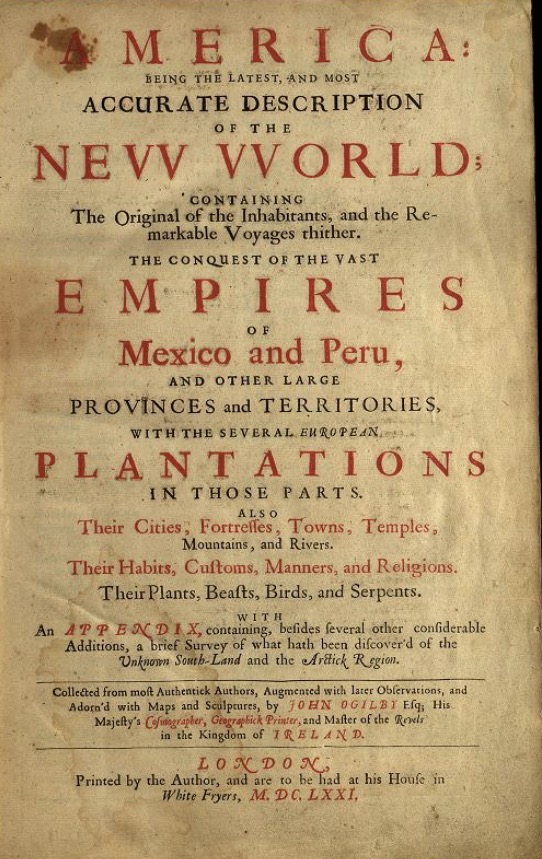
America: Being the Latest, and Most Accurate Description of the New World

America: Being the Latest, and Most Accurate Description of the New World

Ogilby, J. (1671)

Book · Publisher: self published · Pages: 674 pp.

Abstract
John Ogilby’s America: Being the Latest, and Most Accurate Description of the New World is an extensively illustrated 17th-century survey of the Americas, largely adapted from Arnoldus Montanus’s De Nieuwe en Onbekende Weereld. It describes the geography, natural history, Indigenous peoples, settlements, governments, religions, customs, commerce, and European colonization of North, Central, and South America and the Caribbean. The work is notable for its numerous maps, views, and engravings depicting cities, landscapes, peoples, plants, animals, and natural resources. Of particular interest to gemologists are accounts of gold, silver, emeralds, pearls, precious stones, and other mineral resources, including descriptions of their localities, mining, Indigenous use, and trade. Although much of the information was compiled from earlier sources rather than Ogilby’s firsthand observations, the book provides an important synthesis of contemporary European knowledge of the mineral wealth and precious materials of the New World.
Keywords
gems, jade, Fischer-Other
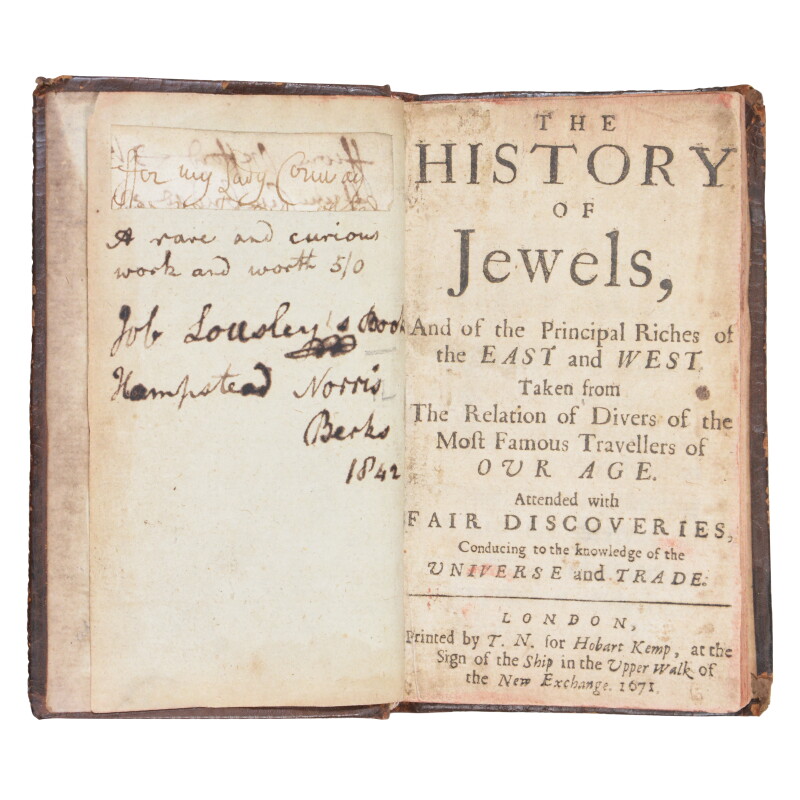
The History of Jewels and of the Principal Riches of the East and West

The History of Jewels and of the Principal Riches of the East and West

Chappuzeau, S. (1671)

Book · Publisher: Hobart Kemp · Pages: 128 pp.

Abstract
Samuel Chappuzeau’s The History of Jewels, and of the Principal Riches of the East and West is an early English-language work devoted to precious stones, pearls, and other valuable natural products. It discusses diamonds, rubies, sapphires, emeralds, pearls, and other gems, including their geographical sources, qualities, sizes, values, trade, and notable specimens, while also treating other commodities regarded as riches of the East and West. Drawing upon contemporary travel and commercial literature, the book reflects European knowledge of the principal gem-producing regions and international gem trade during the 17th century. It is particularly valuable to historians of gemology for its descriptions of the characteristics and valuation of precious stones and for its evidence concerning the routes by which Asian and American luxury materials reached European markets.
Keywords
Tavernier, India.12, Sri Lanka.12, Burma.12, Persia, history.1, corundum, quality.10, gems, jade, Fischer-Book, Indian lapidary
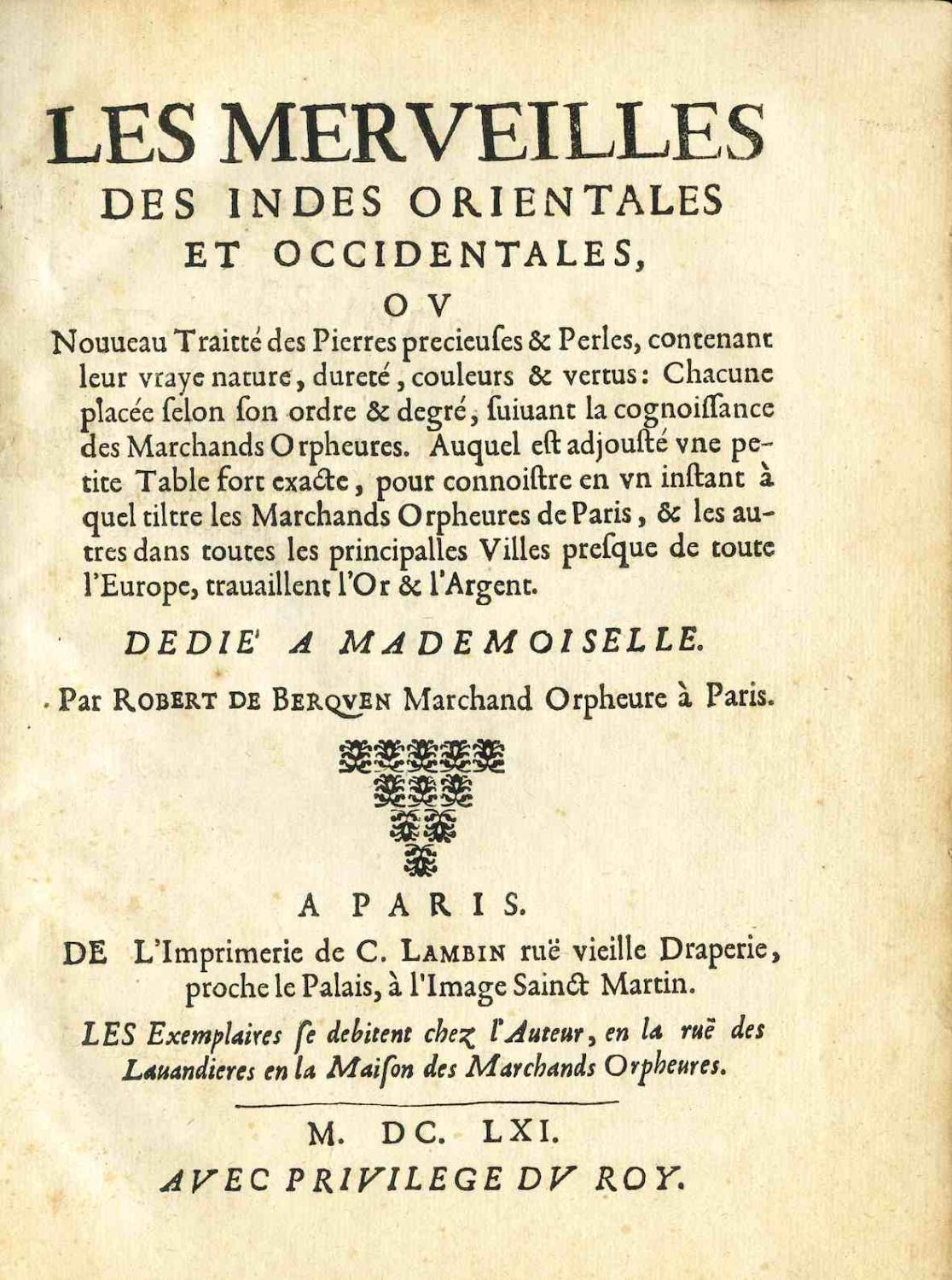
Les Merveilles des Indes Orientales et Occidentales…

Les Merveilles des Indes Orientales et Occidentales…

The Marvels of the East and West Indies

Berquen, R., de (1661)

Book · Publisher: C. Lambin · Pages: 112 pp. · Language: in French

Abstract
Sinkankas: Very early, and important treatise on gemstones, gold & silver, but with by far most space devoted to gemstones. The first chapter attempts to reconcile differing views of various writers, as cited by Berquen, on the origin of gemstones and precious metals, with following chapters taking up the principal gemstones, and some minor ones, as diamond, sapphire, topaz, ruby, spinel, emerald, amethyst, aquamarine, hyacinth, opal, chrysolite, iris, vermeille, garnets, carnelian, turquoise, quartz varieties, pearl, coral and amber, and lastly, a chapter on gold and silver. Little rhyme or reason is apparent in the way the material is presented, and occasionally some strange pairs appear as amethyst and aquamarine being discussed together in the same chapter. Despite claims to expertise, Berquen appears to have taken most of his information from the sources cited in the text and little can be identified that was not already general knowledge at the time. Berquen appeared to be most familiar with diamonds and pearls, but increasingly unfamiliar with the uncommon or rare gemstones, whose descriptions, one suspects, were mere paraphrases of other text excerpts. A footnote to the table of contents mentions only the table of precious metal finenesses as being appended to the text and nothing about the poem which comes immediately after, nor the advice to apprentices. Sabin 4957 cites the work for its material on the West Indies but actually there is very little information on same in this first edition. Another issue of this edition is described in JCB 2, 51–52; see also Brunet, 6, 262.
Keywords
corundum, history.1, gems, jade, Fischer-Book

Exploring the Literature of Emerald

Emerald literature spans gemology, mineralogy, deposits, identification, treatments, synthesis, history and the gem trade, with important sources covering deposits around the world.

For a curated guide to this subject, read Green Fire — Lotus Gemology's Guide to the Literature of Emerald.

About Four Treasures

Four Treasures is Lotus Gemology's freely accessible gemological reference database. Use the full database to search by author, title or keyword and explore literature on gemology, mineralogy, jewelry and related fields. Where available, hyperlinks on titles may lead directly to the full publication.

Search the Complete Four Treasures Database